
Join Our Webinar
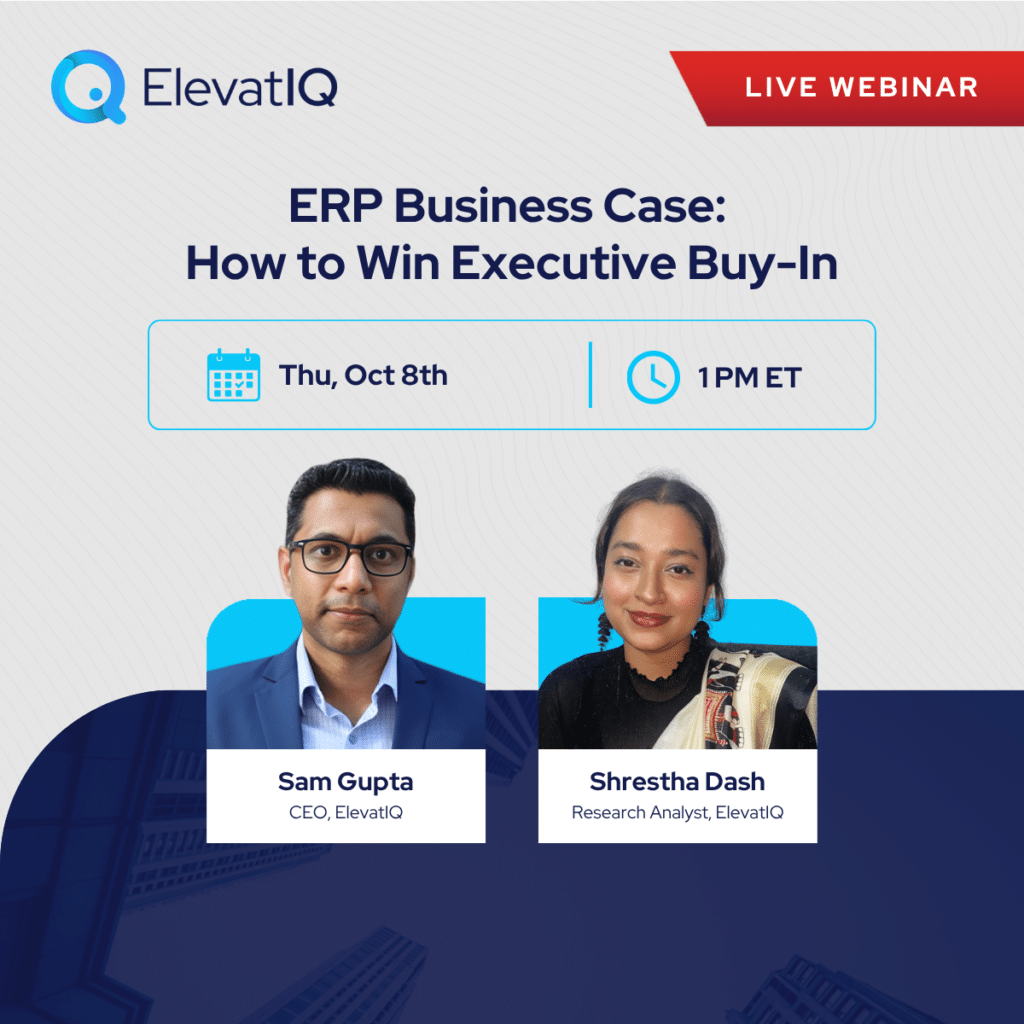
ERP Business Case: How to Win Executive Buy-In
Oct 8th, 2026 | 1 PM ET
Building an ERP business case is rarely as simple as comparing implementation costs with projected savings. Yet many organizations still start there. They estimate ERP software costs. Then they search for enough productivity gains to justify the investment. However, this approach often creates inflated ROI assumptions. A stronger ERP business case starts with the current state. What are inefficient processes costing today? Where is working capital trapped? How much revenue leaks through operational gaps? And how much does legacy technology really cost? In this webinar, we explore how to quantify the cost of doing nothing before deciding whether an ERP transformation makes economic sense.
Next, we break the current-state economics into measurable categories. These include process inefficiency, working capital, revenue leakage, technology debt, and risk exposure. We examine manual work, rework, inventory, premium freight, downtime, collections, customizations, integrations, shadow IT, and unsupported systems. Then, we show how to translate operational problems into dollars.
Finally, we build a defensible 3-to-5-year ERP business case. We compare the cost of doing nothing with optimizing the existing environment and pursuing ERP transformation. We account for growth, wage inflation, rising support costs, additional headcount, technology debt, and increasing operational complexity. Where appropriate, we connect the model to NPV, IRR, payback period, and cash-flow impact. The goal is not to manufacture financial justification for ERP. Instead, it is to give executives a credible decision framework for determining which path creates the strongest economic outcome.
Register to save a spot today!
Join Now
Learning Objectives:
Build a measurable current-state baseline for an ERP business case.
Quantify process inefficiency, working capital, revenue leakage, technology debt, and risk exposure.
Distinguish hard savings from cost avoidance, capacity creation, working-capital release, and risk reduction.
Calculate the true cost of maintaining legacy ERP systems and manual processes.
Model the cost of doing nothing over a 3-to-5-year planning horizon.
Apply realistic addressability and benefit-capture assumptions to ERP ROI.
Compare ERP transformation with optimization and status-quo scenarios.
Build a defensible ERP business case using NPV, IRR, payback, and cash-flow analysis.

Speakers
Sam Gupta
CEO | ElevatIQ
Sam Gupta has been a thought leader in the digital transformation space for nearly two decades, with the primary focus on business software. Sam is rated as #1 thought leader in the ERP and CRM categories and #5 in the digital transformation category on Thinkers 360. He is also among the top 100 thought leaders across all categories. He has been part of large transformation initiatives for Fortune 500 corporations, but now spends his time consulting with SMEs as a CEO at ElevatIQ. Sam regularly speaks at industry conferences and contributes his experiences through many popular blogs and publications. He also hosts a podcast called WBSRocks, focused on business growth through digital transformation, where he interviews top influencers and executives focused on digital transformation.
Shrestha Dash
Industry Research Analyst | ElevatIQ
Shrestha Dash is passionate about uncovering actionable insights and exploring the ever-evolving landscape of technology and digital transformation. With a strong analytical foundation, she delves into topics such as ERP, enterprise software, and digital ecosystems, offering in-depth research and thoughtful analysis. Currently working as an Industry Research Analyst at ElevatIQ, she combines her expertise in research with a flair for storytelling, helping businesses navigate complex industry trends and make informed decisions.