

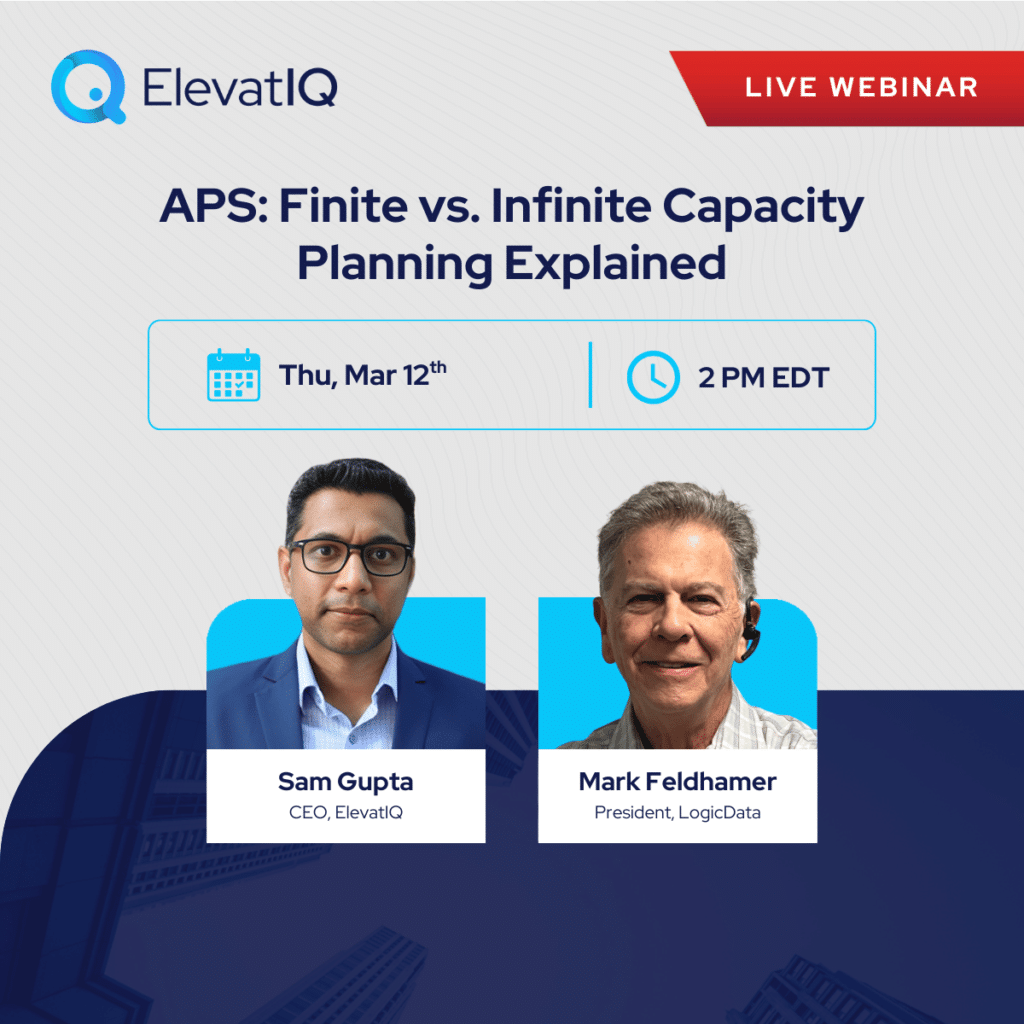
Join Our Webinar

Advanced Planning and Scheduling (APS): Finite vs. Infinite Capacity Planning Explained

Group

Mar 12th, 2026 | 2 PM ET

Advanced Planning and Scheduling (APS) delivers value only when implemented with discipline and clarity. In this session, we break down what APS truly is and why it matters in complex manufacturing environments. First, we define APS in operational terms. Then, we demonstrate how it strengthens production scheduling, capacity planning, and shop-floor control. If you face missed due dates, recurring bottlenecks, or constant firefighting, this discussion will resonate.

Next, we examine the foundations. We briefly trace APS from early MRP and MRP II frameworks to today’s constraint-based, algorithm-driven scheduling engines. More importantly, we clarify the difference between finite capacity planning and infinite capacity planning. You will learn when each approach is appropriate, and where each introduces operational risk. This distinction is essential if you want your scheduling logic to reflect real-world constraints rather than theoretical capacity.

Finally, we connect APS to measurable business outcomes. Effective APS reduces lead times and improves on-time delivery. It stabilizes production and restores predictability. When properly aligned with your operating model, APS lowers costs, builds customer trust, and strengthens your competitive position. By the end of this webinar, you will know which scheduling methodology fits your business and how to tailor it to your operational realities.

Register to save a spot today!

Join Now

Join us for a powerful session on advanced planning and scheduling and the difference between finite vs infinite capacity planning.

Learning Objectives:

Define Advanced Planning and Scheduling (APS) and understand its role in modern operations.

Understand the foundational history and evolution of APS systems.

Differentiate between finite capacity planning and infinite capacity planning, including practical use cases for each.

Identify how APS improves efficiency, reduces operational frustration, and strengthens customer confidence.

Evaluate which scheduling process aligns with your manufacturing or distribution environment.

Learn how to customize APS strategies to fit your specific operational constraints and growth objectives.


Speakers

Sam Gupta Headshot

Sam Gupta
CEO | ElevatIQ

Sam Gupta has been a thought leader in the digital transformation space for nearly two decades, with the primary focus on business software. Sam is rated as #1 thought leader in the ERP and CRM categories and #5 in the digital transformation category on Thinkers 360. He is also among the top 100 thought leaders across all categories. He has been part of large transformation initiatives for Fortune 500 corporations, but now spends his time consulting with SMEs as a CEO at ElevatIQ. Sam regularly speaks at industry conferences and contributes his experiences through many popular blogs and publications. He also hosts a podcast called WBSRocks, focused on business growth through digital transformation, where he interviews top influencers and executives focused on digital transformation.

Mark Feldhamer

Mark Feldhamer
Founder and President | LogicData

Mark Feldhamer, LogicData’s Founder and President, has more than 40 years of experience with manufacturing technology and 25 years of experience in project management. His expertise in Infor’s Syteline and CloudSuite Industrial (CSI) has led to over 250+ successful implementations of ERP software. One of Mark’s favorite things is Advanced Planning and Scheduling (APS). He has been referred to as an “APS genius” due to his ability to understand and translate the complexity of APS into easily digestible nuggets of knowledge.

Join Now

Join us for a powerful session on advanced planning and scheduling and the difference between finite vs infinite capacity planning.

FREE RESOURCE

2026 Digital Transformation Report

This digital transformation report summarizes our annual research on ERP and digital transformation trends and forecasts for the year 2026.