
Last Updated on April 2, 2026 by Shrestha Dash
Usually, standard ERP contracts price user licenses in volume tiers. For example, 1-100 users at $150 per user, 101-500 at $125, 501-1,000 at $100. What vendors may not always emphasize during initial sales cycles is that these tier breakpoints can reset at renewal. Tier pricing often applies only to current purchases unless otherwise negotiated. And, may pay higher per-user rates for incremental licenses unless future tier pricing was locked in before operational dependency.
For growth companies – startups scaling from Series A to Series C, private equity portfolio companies rolling up acquisitions, mid-market organizations expanding internationally this pricing structure creates a trap. The ERP you select at 150 users becomes mission-critical infrastructure by the time you reach 600 users. At which point the vendor knows you cannot switch platforms. Also, tier pricing negotiations happen from a position of increased dependency rather than strong competitive leverage.
ERP volume discount contract negotiation determines whether growth translates into escalating per-user costs that strain budgets. Or whether, expansion happens at pre-negotiated rates that were secured when vendors competed for your business. Organizations that negotiate volume discount provisions during initial procurement can realize significant cost savings over contract lifecycles. Organizations that defer these negotiations until they need additional users discover that vendors often have limited incentive to offer additional discounts when switching ERP is operationally and financially prohibitive.
This blog examines how ERP volume discount structures actually work. Why standard tier pricing penalizes growth. Which contract provisions lock in future expansion pricing, and how growth companies can secure favorable rates before dependency eliminates leverage.

How ERP Volume Discount Tiers Actually Work
Understanding ERP volume discount contract negotiation requires distinguishing between how vendors present tier pricing during sales versus how tier structures actually function in contracts and at renewal.
The Sales Pitch: “You’ll Save Money as You Grow”
Vendors present volume tier pricing as growth-friendly: start small at higher per-user rates, then automatically move to lower tiers as headcount increases. The implication is that tier pricing benefits customers by making expansion affordable.
Typical tier structure presentation:
- Tier 1 (1-100 users): $150 per user per month
- Tier 2 (101-500 users): $125 per user per month
- Tier 3 (501-1,000 users): $100 per user per month
- Tier 4 (1,001+ users): $85 per user per month
A company starting with 150 users pays: (100 × $150) + (50 × $125) = $21,250 monthly. If they grow to 600 users, the assumption is they’ll pay (100 × $150) + (400 × $125) + (100 × $100) = $75,000 monthly, a blended rate of $125 per user.
The Contract Reality: Tier Pricing Resets and Requires Renegotiation
What vendor sales presentations omit: tier pricing often applies only to the current purchase transaction unless cumulative provisions are included. More critically, tier structures may reset at contract renewal depending on negotiated terms, and incremental user additions mid-contract may be priced at current tier rates rather than volume tier rates.
How contracts actually price growth:
- Mid-contract additions: If you start with 150 users (Tier 1/2 pricing) and add 100 users six months later, those incremental users may be priced at your current tier rate – not at the volume discount tier they would qualify for if purchased initially. The 100 new users might be $150 each, not $125, because the contract treats additions separately from initial purchases.
- Renewal resets: When your 3-year contract expires, tier pricing does not automatically continue at the rates negotiated initially. Vendors re-price based on “current pricing” which may reflect updated list rates that can increase over time since initial signature. Even if your user count qualifies for Tier 3 volume discounts, the vendor may argue that renewal pricing starts from updated list rates, not the rates you negotiated three years prior.
- No cumulative volume credit: Unless explicitly negotiated, tier discounts generally do not accumulate unless explicitly negotiated, based on total users licensed over the contract term. A company that grows from 200 to 800 users over three years has licensed 800 users cumulatively but may not receive Tier 3 pricing unless the contract explicitly provides volume credit for cumulative licensing.
As a result, growth companies that assume tier pricing automatically rewards expansion discover that vendors structure contracts to reset pricing at every opportunity, increasing vendor revenue when customers have the least leverage to negotiate.
Why Growth Companies Have Leverage During Initial Procurement
The fundamental dynamic in ERP volume discount contract negotiation is that leverage shifts dramatically from pre-signature (when vendors compete for business) to post-implementation (when operational dependency makes switching prohibitive).
Pre-Signature: Competitive Leverage Creates Negotiating Power
During vendor selection, organizations evaluate multiple ERP platforms. Vendors know that aggressive pricing and favorable contract terms influence selection decisions. This competitive environment creates the strongest negotiating leverage customers will ever have.
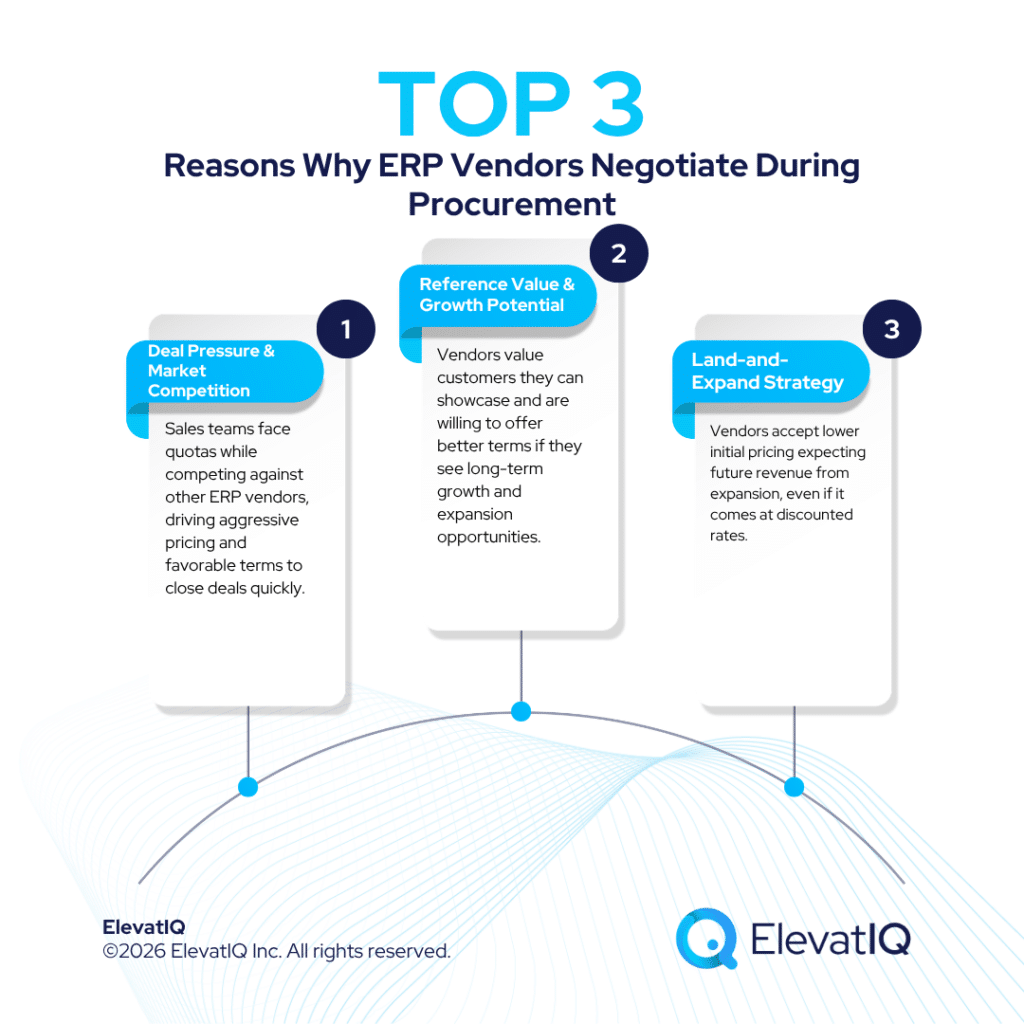
Why vendors negotiate during procurement:
- Deal closure pressure: Sales teams face quarterly quotas and annual targets. Closing deals before fiscal periods end drives concessions on pricing, contract terms, and future growth provisions.
- Reference customer value: Vendors want successful ERP implementations they can reference to win future business. For growth companies with expansion plans, becoming a reference customer across multiple geographies or business units carries additional value.
- Market share competition: In competitive deals where customers evaluate SAP, Oracle, Microsoft, and NetSuite simultaneously, vendors discount aggressively to win market share and prevent competitors from gaining a foothold.
- Land-and-expand strategy: Vendors accept lower initial pricing if they believe the customer will grow substantially, reasoning that future expansion revenue, even at discounted rates, exceeds the cost of initial concessions.
This leverage window closes the moment contracts are signed and implementation begins. Once data migrates to the new ERP, business processes are redesigned around system workflows, and users are trained, switching costs become prohibitive.
Post-Implementation: Operational Dependency Eliminates Leverage
Twelve months post-go-live, when a company needs to add 200 users to support a new business unit, the negotiation dynamic has reversed completely. Vendors generally recognize that:
- Switching costs can reach millions of dollars: Re-implementation, data migration, business disruption, and user retraining make platform changes financially unfeasible for growth-stage companies.
- Timeline constraints prevent alternatives: Launching a new business unit or completing an acquisition often requires ERP access within relatively short timeframes, not the 12-18 months required to implement an alternative platform.
- Operational disruption is unacceptable: Businesses dependent on ERP for order processing, financial close, inventory management, and compliance reporting cannot tolerate transition periods during platform switches.
Vendor pricing for incremental users may reflect this dynamic. Why offer volume discounts when the customer cannot credibly threaten to switch platforms? The only negotiating leverage remaining is delayed purchase timing and even that is limited when business growth creates immediate ERP capacity needs.


ERP System Scorecard Matrix
This resource provides a framework for quantifying the ERP selection process and how to make heterogeneous solutions comparable.
The Contract Provisions That Lock In Future Volume Pricing
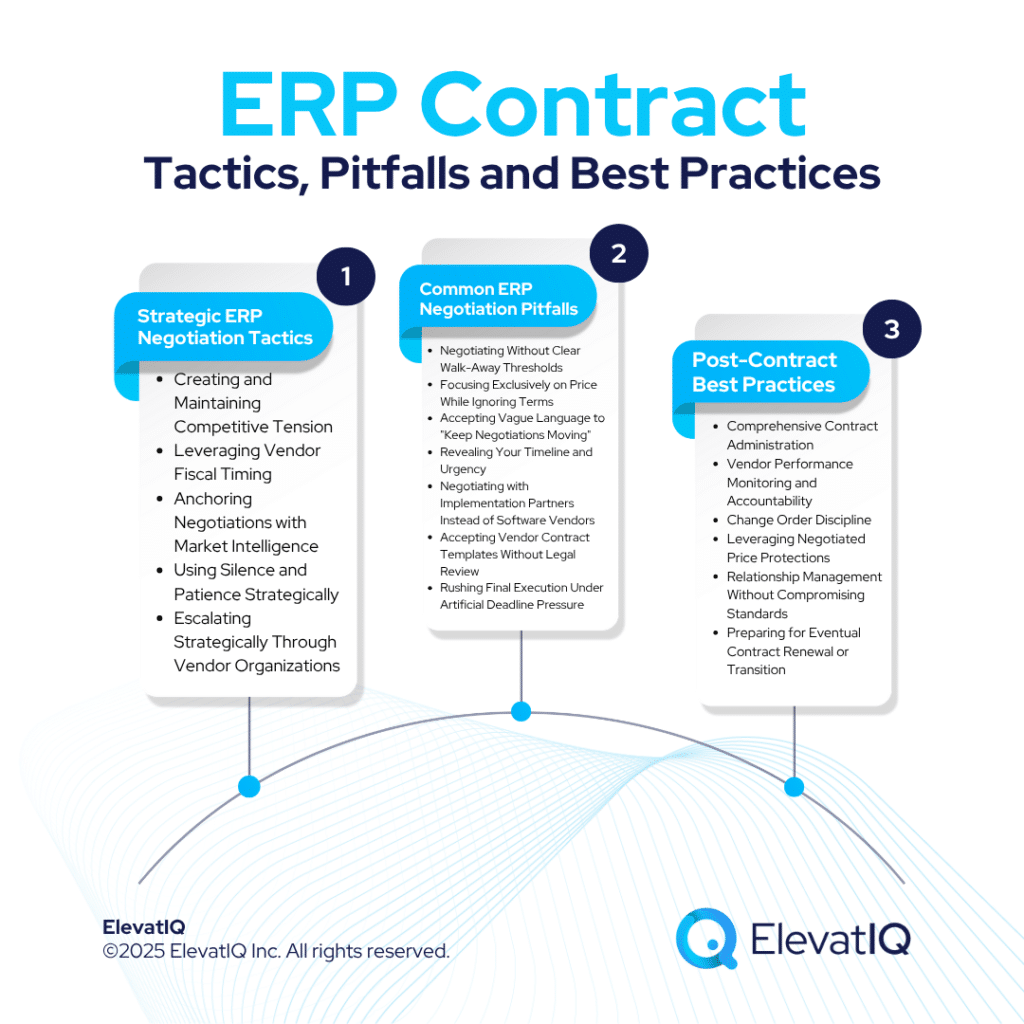
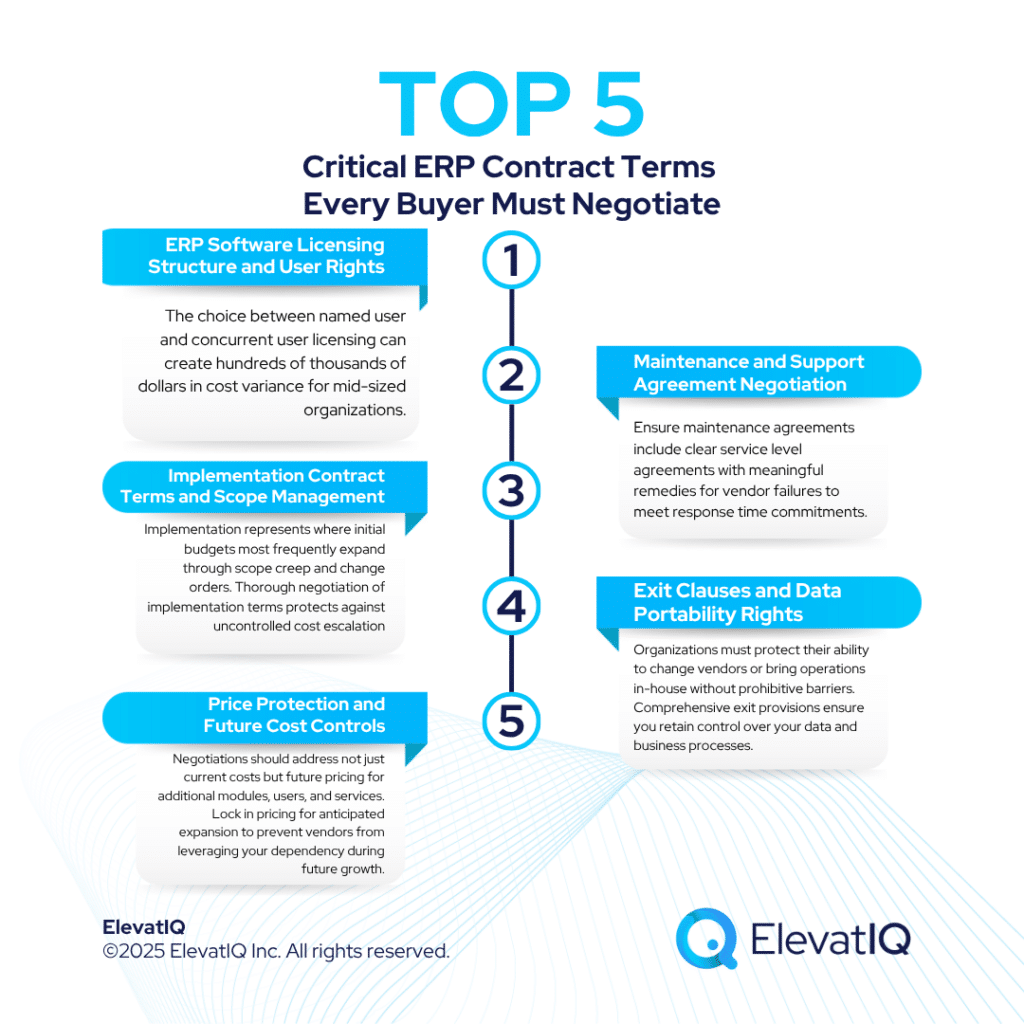
Effective ERP volume discount contract negotiation requires explicit contract language that pre-commits vendors to specific pricing for future user additions, tier structures that apply cumulatively rather than transactionally, and renewal pricing protections that prevent arbitrary escalation.
Provision 1: Pre-Negotiated Expansion Pricing
Rather than accepting contracts that leave future pricing to “then-current rates” or “market pricing,” growth companies should negotiate specific per-user rates for anticipated expansion tiers.
Recommended contract language:
“Customer may add users at any time during the Term at the following pre-negotiated rates, regardless of then-current list pricing:
- Users 1-500: $125 per user per month
- Users 501-1,000: $100 per user per month
- Users 1,001-2,500: $85 per user per month
- Users 2,501+: $75 per user per month
These rates apply to all user additions through [Contract Expiration Date + 2 years] and are not subject to increase except as provided in Section [Annual Escalation]. Customer may add users in any quantity without minimum purchase requirements.”
This creates absolute pricing certainty. A company that starts with 200 users and grows to 1,200 users knows exactly what every incremental license costs – there is no renegotiation, no “market rate” ambiguity, no vendor leverage to extract premium pricing during growth phases.
Provision 2: Cumulative Volume Credit for Tier Qualification
Standard tier structures evaluate each purchase transaction independently. Organizations should negotiate cumulative tier qualification that recognizes total users licensed over the contract term.
Recommended contract language:
“Volume tier pricing shall be calculated based on cumulative users licensed during the Term, not per-transaction user counts. If Customer licenses total users exceeding any tier threshold during the Term, all future user additions shall be priced at the tier corresponding to cumulative user count.
Example: If Customer begins Term with 150 users (Tier 1) and subsequently adds 400 users (cumulative 550 users, qualifying for Tier 3), all future user additions during Term shall be priced at Tier 3 rates. Customer shall receive retroactive credits for any users previously licensed at higher tiers once cumulative count qualifies for lower tier.”
This approach prevents companies from paying Tier 1 rates on incremental additions after licensing 800 cumulative users over three years, since vendors would otherwise evaluate each transaction independently.
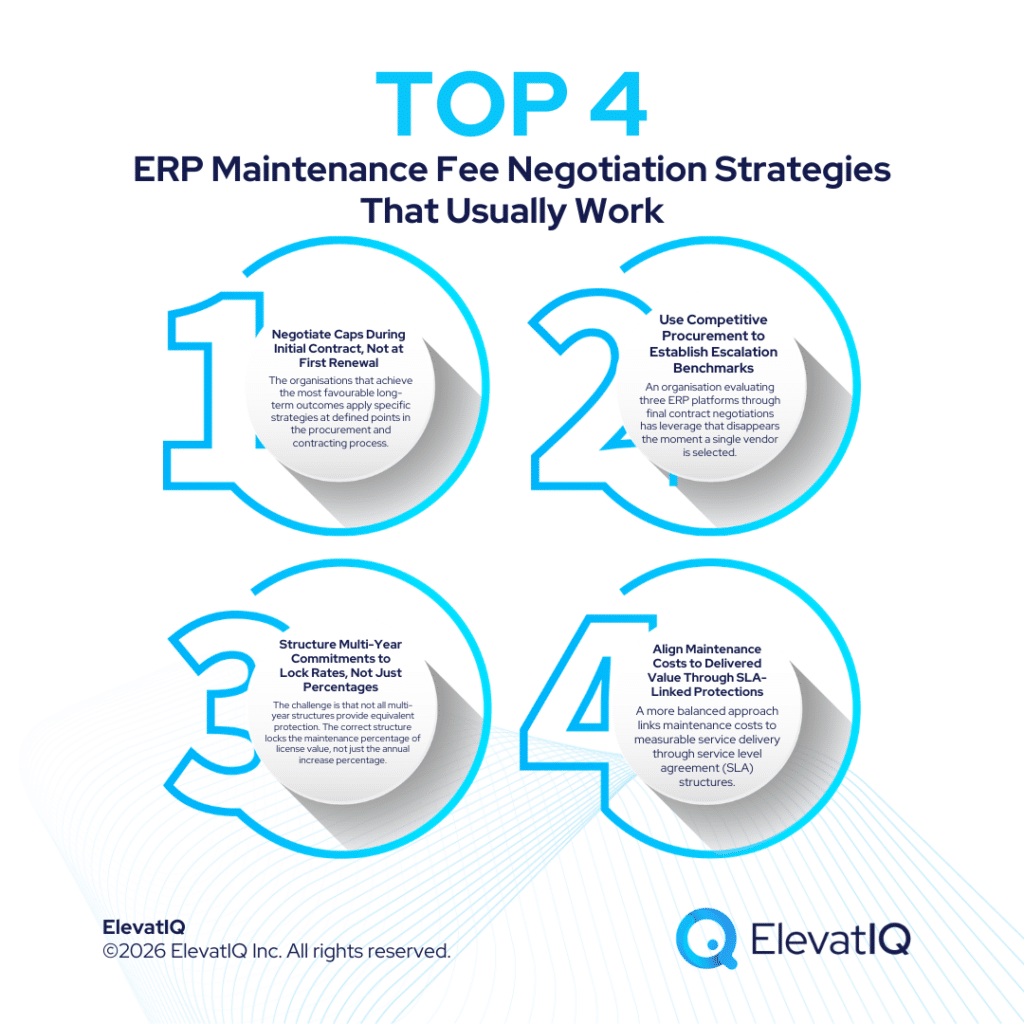
Provision 3: Renewal Pricing Locks with Defined Escalation Caps
Renewal periods are when vendors attempt to reset pricing to current market rates, often 20-30% above initial contract rates. Growth companies should negotiate renewal pricing that continues pre-negotiated tier rates with defined annual escalation caps.
Recommended contract language:
“Upon expiration of the Initial Term, this Agreement shall automatically renew for successive [1-year] Renewal Terms unless either party provides [90] days written notice of non-renewal. Pricing during Renewal Terms shall continue at the rates specified in Exhibit [Pricing Schedule] as adjusted by the Annual Escalation Rate, defined as the lesser of (a) [3%] or (b) CPI-U. Vendor shall not increase pricing during Renewal Terms except as provided by Annual Escalation Rate. Volume tier thresholds and rates negotiated in Initial Term shall continue through all Renewal Terms subject only to Annual Escalation Rate adjustments.”
This prevents vendors from arguing that renewals trigger re-pricing to “then-current” rates that have increased substantially since initial negotiations.
Provision 4: No Minimum Purchase Requirements for Volume Tier Access
Some vendors structure tier pricing with minimum purchase requirements arguing that Tier 3 discounts require committing to 500+ users upfront, not qualifying for Tier 3 rates after cumulative additions reach 500.
Recommended contract language:
“Customer qualifies for volume tier pricing based on actual user count, not minimum purchase commitments. Customers are not required to license minimum quantities to access any pricing tier. Tier qualification is determined by cumulative users licensed as of the date of each user addition. Vendor shall not require Customer to pre-purchase or commit to minimum user quantities to qualify for volume tier rates.”
This ensures that tier discounts apply based on actual usage growth, not artificial commitment thresholds that force organizations to over-license to access favorable pricing.
How Pre-Negotiated Volume Pricing Saves Hundreds of Thousands
The financial impact of ERP volume discount contract negotiation becomes clear when comparing costs under vendor-standard contracts versus negotiated expansion pricing provisions.
Illustrative Scenario
Series B Startup Scaling From 200 to 1,200 Users Over 4 Years
Vendor-Standard Pricing (No Pre-Negotiated Expansion Rates):
- Year 1: 200 users at $150/user = $360,000 annually
- Year 2: Add 300 users at $150/user (vendor argues current tier) = $810,000 annually
- Year 3: Add 400 users at $140/user (vendor grants modest discount) = $1,450,000 annually
- Year 4: Add 300 users at $130/user = $1,840,000 annually
Total 4-year cost: $4,460,000
Pre-Negotiated Volume Tier Pricing:
- Year 1: 200 users at $125/user (negotiated starting rate) = $300,000 annually
- Year 2: Add 300 users at $125/user (pre-negotiated Tier 2) = $750,000 annually
- Year 3: Add 400 users at $100/user (cumulative 900 users qualifies Tier 3) = $1,080,000 annually
- Year 4: Add 300 users at $85/user (cumulative 1,200 users qualifies Tier 4) = $1,224,000 annually
Total 4-year cost: $3,354,000
Illustrative savings: (approximately $1.1 million over 4 years) achieved entirely through contract provisions negotiated before the first user was licensed. This does not account for renewal pricing resets under vendor-standard contracts, which could add another 15-25% cost escalation in Years 5-7 without pre-negotiated renewal rate protections.
What Independent ERP Advisors Leverage Here
The structural challenge in ERP volume discount contract negotiation is that growth companies lack visibility into what pricing terms are negotiable, what tier structures other organizations have secured, and which contract provisions create enforceable protections versus vendor promises that evaporate at renewal.
Independent ERP advisors provide:
- Benchmark data on volume tier pricing negotiated by comparable organizations (commonly observed ranges: approximately 15–25% off list rates for Tier 1, 30-40% for Tier 3+)
- Contract language templates that explicitly pre-negotiate expansion pricing, cumulative tier qualification, and renewal rate protections
- Vendor negotiation leverage vendors recognize that experienced advisors understand which provisions are negotiable and will walk away from contracts that lack adequate growth protections
The financial return on advisory engagement is measurable. An advisor fee of $40,000 that secures pre-negotiated expansion pricing saving $1.1 million over four years could generate a significant return (e.g., 27x in an illustrative scenario) before considering any implementation cost reductions, better SLA terms, or liability protections achieved through the same engagement.
The Conclusion
ERP volume discount contract negotiation determines whether organizational growth translates into escalating software costs that strain budgets or pre-negotiated rates that remain stable regardless of vendor leverage. Organizations that treat volume tier pricing as vendor-controlled ‘market rates’ rather than negotiable contract terms consistently pay premium prices for expansion instead of securing discounts during initial procurement.
The leverage window for negotiating favorable expansion pricing is narrow and significantly diminishes once contracts are signed and ERP implementations begin. Vendors typically have limited incentive to provide volume discounts when operational dependency makes switching prohibitive. The time to negotiate future pricing is before you need it – when competitive pressure, deal closure timelines, and vendor growth expectations create the leverage necessary to secure terms that protect against cost escalation throughout the contract lifecycle.
For organizations currently evaluating ERP platforms, negotiating initial contracts, or approaching renewals with substantial user growth since last negotiation, the team at ElevatIQ provides independent ERP advisory support across volume pricing negotiation, tier structure analysis, and growth provision development at exactly the stage where these decisions determine whether expansion happens at pre-negotiated rates or at pricing levels determined by the vendor’s prevailing commercial terms from operationally dependent customers.
All commentary represents an independent ERP advisory perspective based on contract benchmarks, pricing analysis, and cited primary sources.

ERP Selection: The Ultimate Guide
This is an in-depth guide with over 80 pages and covers every topic as it pertains to ERP selection in sufficient detail to help you make an informed decision.
FAQs
Related Posts: