
Last Updated on April 8, 2026 by Shrestha Dash
In November 2022, Funko – the maker of Pop, vinyl collectible figures, reported third-quarter results that triggered a 59% single-day stock price collapse. The steepest decline in company history. The primary contributing factor was not a market crash or competitive threat. It was an operational disruption largely driven by implementing two massive infrastructure changes simultaneously. One, consolidating five Washington distribution facilities into a new 860,000-square-foot Arizona warehouse. At the same time, the ERP system was not fully operational at the required scale.
The result: $85 million in annual fulfillment expense increases despite similar throughput. $5 million in excess warehouse labor in Q3 2022 alone, inventory that ballooned 170% year-over-year to $234 million. And ultimately, a shareholder lawsuit alleging executives may have concealed ‘significantly larger delays’ in ERP implementation while proceeding with the warehouse move anyway. By May 2024, the federal court dismissed the securities fraud claims. But not before Funko settled derivative lawsuits for $2 million and documented one of the clearest examples of ERP warehouse implementation timing failure. Thus, creating catastrophic operational and financial consequences.
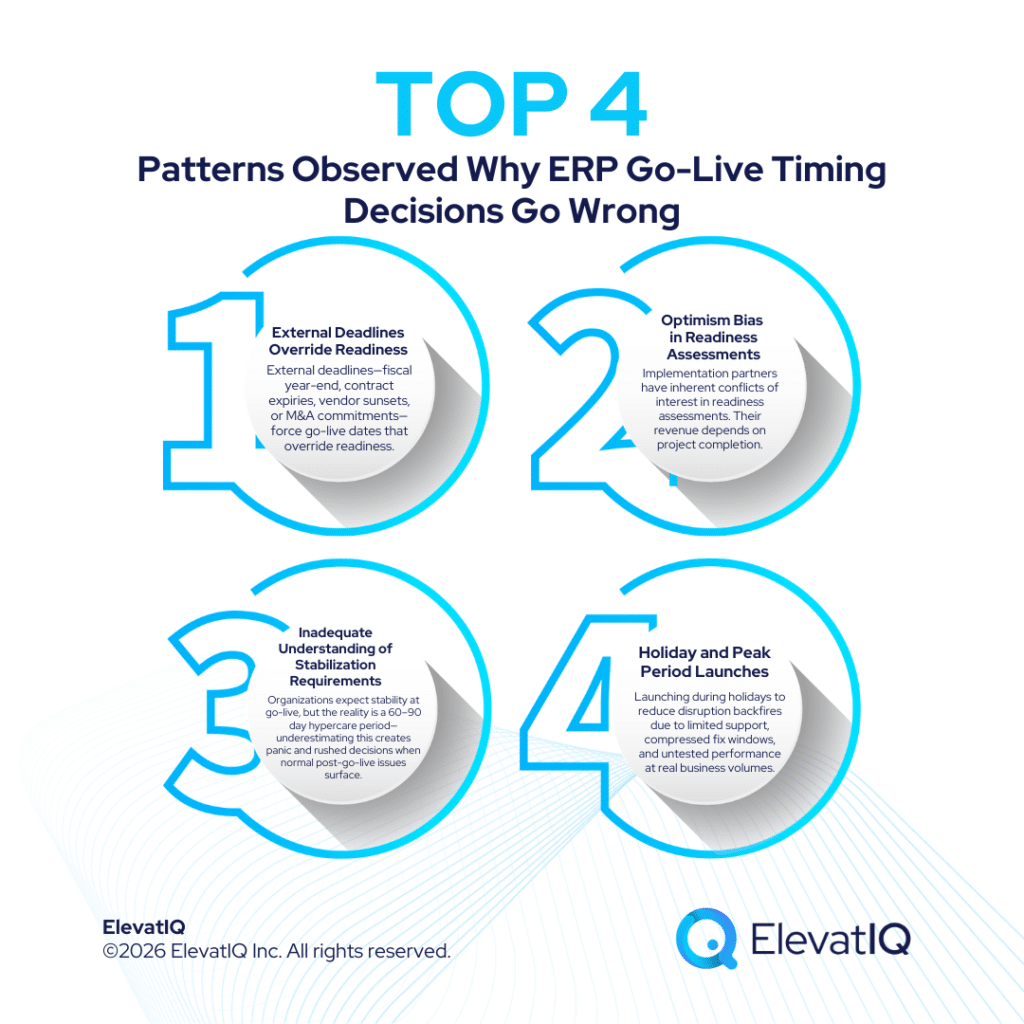
This case demonstrates what happens when organizations treat ERP go-live dates more as schedule commitments than as readiness gates. They move forward with dependent infrastructure changes even when foundational systems are not ready. Thus, creating compounding failures that destroy operational efficiency and credibility with investors.
The Timeline: From Dual Infrastructure Projects to Operational Collapse
Funko’s ERP warehouse implementation timing failure unfolded across 18 months, during which executives publicly promoted both initiatives while privately managing escalating delays and cost overruns.
- 2021–Early 2022: Funko announces plans to consolidate five Washington distribution facilities into a single 860,000-square-foot warehouse in Buckeye, Arizona. Simultaneously, the company begins implementing a new ERP system designed to improve inventory management, order fulfillment, and operational efficiency.
- May 2022: Inventory totals $161.5 million, up 160.8% year-over-year. Funko attributes the increase to “supply chain disruptions and delayed inventory arrivals,” downplaying operational challenges related to the warehouse consolidation and ERP rollout.
- Q2 2022: Inventory climbs to $234 million, up 170.9% year-over-year. The new Arizona warehouse is operational, but the ERP system that was supposed to manage inventory, order routing, and fulfillment workflows is not fully functional.
- Q3 2022 (November 2022 earnings call): CEO Brian Mariotti discloses that Funko added approximately $85 million in annual fulfillment expenses despite similar overall throughput. The company paid $5 million in excess warehouse labor during Q3 alone to operate the consolidated fulfillment center without the intended software. Stock price collapses 59% on November 4, 2022.
CFO Jennifer Fall Jung states on the earnings call: “We had to put more bodies to get the goods out the door versus having the systems in place.” She adds that Funko will “continue to take on higher costs until the ERP transition is complete.”
To manage the operational chaos
Funko added third-party logistics providers and co-packer warehouses to assist with throughput — essentially outsourcing fulfillment because the new warehouse could not function efficiently without working ERP software.
- March 2023: Funko announces plans to destroy at least $30 million worth of excess inventory accumulated during the warehouse and ERP transition period. The inventory write-down reflects the operational inability to manage stock levels without functioning inventory management software.
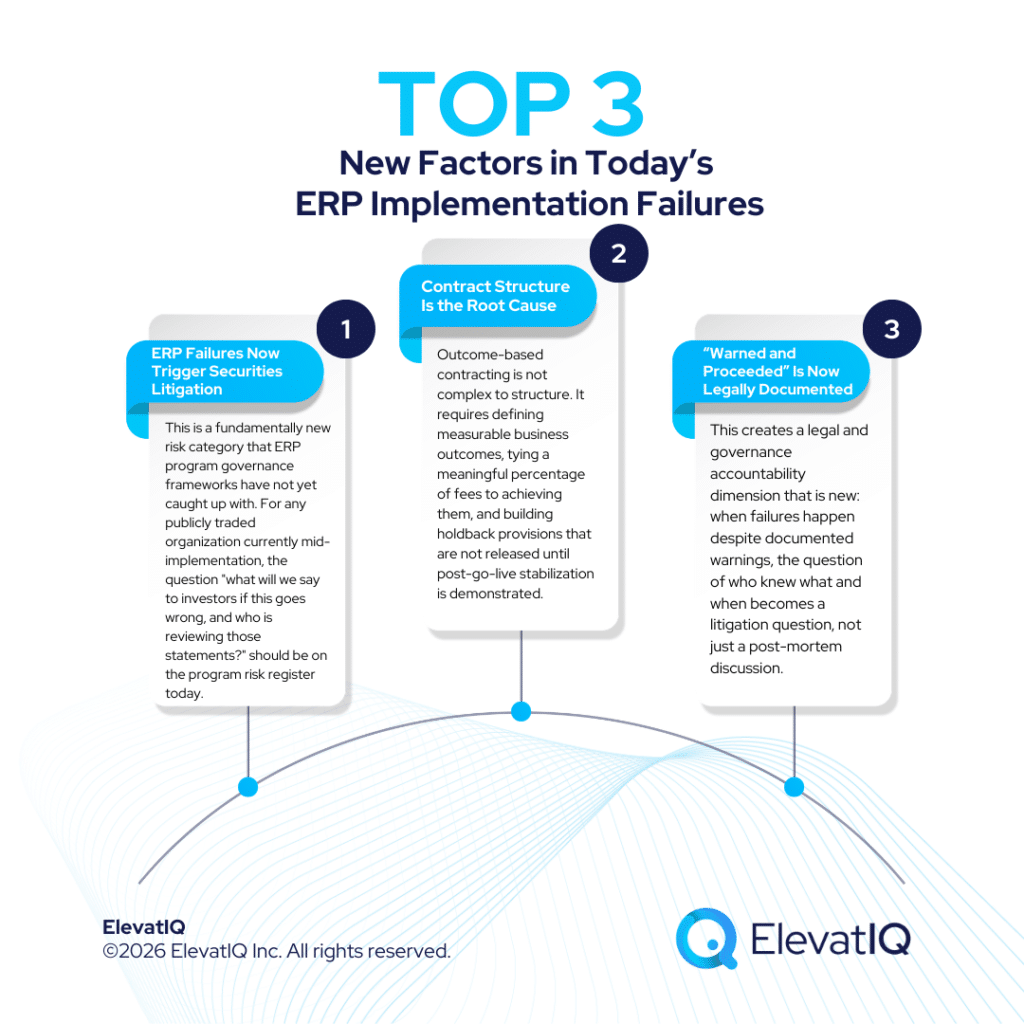
- June 2023: Shareholders file securities class action lawsuit (Studen v. Funko) alleging executives concealed ERP delays and misled investors about the impact on operations and EBITDA margins.
- May 2024: Federal court dismisses securities fraud claims, finding shareholders did not adequately prove materiality or scienter (intent to defraud). However, the court’s decision does not dispute that ERP delays occurred or that the warehouse move proceeded without functional software.
- August 2024: Funko settles derivative shareholder lawsuits for $2 million, resolving claims that executives breached fiduciary duties through mismanagement of the ERP and warehouse projects.
The Root Cause: Moving Infrastructure Before Systems Work
The core ERP warehouse implementation timing failure at Funko was the decision to consolidate distribution operations into a new Arizona facility before the ERP system could support warehouse management, inventory allocation, order routing, and fulfillment workflows at the scale and complexity the consolidated facility required.
Why Timing Matters in ERP + Infrastructure Changes
ERP systems and physical distribution facilities are interdependent infrastructure. The ERP manages:
- Inventory allocation: Which SKUs are stored in which warehouse locations
- Order routing: Which orders are fulfilled from which facilities based on inventory availability, shipping costs, and customer proximity
- Receiving and put-away: How incoming inventory is logged, quality-checked, and assigned to storage locations
- Pick-pack-ship workflows: How orders are picked from shelves, packed, and shipped to customers
- Cycle counting and physical inventory: How warehouse teams reconcile system inventory to actual stock on hand
The Problems Leading to the Compounding Failure
When an ERP system is not fully functional, meaning it cannot reliably perform these operations without manual intervention, system workarounds, or excessive error rates, moving to a new warehouse creates a compounding failure:
- Manual processes don’t scale. Five smaller warehouses operating with manual workarounds can limp along because each facility handles a manageable subset of SKUs and orders. Consolidating into one 860,000-square-foot facility concentrates all that volume into a single operation where manual processes collapse under the scale.
- Physical workflows are designed around software capabilities. The new Arizona warehouse layout, where products are stored, how pick paths are optimized, which loading docks serve which carriers, was presumably designed assuming the ERP would direct warehouse workers efficiently. Without working software, the physical design becomes a liability rather than an efficiency gain.
- You cannot train users on systems that don’t work. Warehouse workers cannot be trained on ERP pick-pack-ship workflows if the software is still being debugged. The result is undertrained staff using manual workarounds in a facility designed for automated ERP-driven processes.
Funko’s decision to proceed with the warehouse consolidation while the ERP remained non-functional contributed to this failure cascade.


ERP Selection Requirements Template
This resource provides the template that you need to capture the requirements of different functional areas, processes, and teams.
The Financial Impact: $85M in Annual Costs, $30M Inventory Write-Off
The financial consequences of Funko’s ERP warehouse implementation timing failure were immediate, substantial, and ongoing.
$85 Million Annual Fulfillment Cost Increase
CEO Mariotti’s November 2022 disclosure – “$85 million in annual fulfillment expenses despite similar overall throughput” quantifies the operational inefficiency created when warehouse operations run without proper ERP support.
What this means: Funko was processing approximately the same number of orders and shipping similar volumes as before the warehouse move, but operational costs increased by $85 million annually. This is not a one-time implementation expense or capital investment; it is ongoing annual operating cost inflation caused by operational inefficiency.
Where the costs came from:
- Excess labor: $5 million in Q3 2022 alone for “more bodies to get the goods out the door” because ERP-driven automation and workflow optimization were unavailable
- Third-party logistics and co-packers: Additional warehousing and fulfillment partners were brought in to handle overflow that the new Arizona facility could not process efficiently
- Inventory management costs: Higher carrying costs for $234 million in inventory (170% above the prior year) accumulated due to the inability to accurately track stock levels and manage SKU assortments without working ERP
$30 Million Inventory Write-Off
By March 2023, Funko announced plans to destroy at least $30 million worth of excess inventory. This was not a defective product or regulatory compliance disposal; it was inventory accumulated during the ERP and warehouse transition that the company could no longer efficiently store or sell.
A key contributing factor: Without fully functional ERP inventory management, Funko may not have been able to:
- Accurately track which SKUs were slow-moving and should not be reordered
- Optimize inventory levels across the consolidated warehouse
- Execute aged inventory reduction strategies before the stock becomes unsellable
The result was inventory bloat that eventually required write-offs when warehouse capacity constraints and carrying costs made holding the inventory more expensive than destroying it.

ERP System Scorecard Matrix
This resource provides a framework for quantifying the ERP selection process and how to make heterogeneous solutions comparable.
The Investor Disclosure Failure: What Funko Knew vs. What Funko Said
The shareholder lawsuits centered on a fundamental question: did Funko’s executives disclose the full extent of ERP delays and their operational impact to investors, or did they downplay the severity while proceeding with the warehouse move?
The Allegations
Shareholders alleged that Funko’s leadership “failed to disclose that: (i) Funko was experiencing significantly larger delays in implementing its ERP software than it was disclosing to investors; (ii) having moved into a new warehouse without functioning ERP software in place would lead to dramatically higher costs and poorer inventory management practices; and (iii) Funko’s inability to efficiently operate the new distribution center would have a substantial, undisclosed impact on the Company’s EBITDA margin.”
What this means in plain language: Executives knew the ERP was not ready, knew the warehouse move would fail without working ERP, and knew this would crater profitability — while public disclosures indicated the projects were progressing until the Q3 2022 earnings call when the operational issues became more visible.
The Court’s Ruling (And What It Doesn’t Resolve)
In May 2024, the federal court dismissed the securities fraud claims, finding that shareholders did not adequately prove:
- Materiality: The undisclosed ERP delays were significant enough to affect investor decisions
- Scienter: That executives specifically intended to defraud investors rather than simply mismanaging projects
However, the court’s ruling does not mean the ERP warehouse implementation timing failure didn’t occur. It means shareholders could not meet the legal standard to prove securities fraud. The court did not dispute that:
- The ERP system experienced delays
- The warehouse move proceeded without functional software
- Operational costs increased by $85 million annually as a result
- Inventory ballooned to unsustainable levels
The $2 million derivative lawsuit settlement in August 2024 further confirms that Funko’s board and management acknowledged some level of mismanagement, even if criminal fraud could not be proven.
The Lessons: What Organizations Must Learn From Funko’s Failure
Funko’s ERP warehouse implementation timing failure provides specific, actionable lessons for any organization planning simultaneous ERP implementations and infrastructure changes.
Dependent Infrastructure Changes Must Sequence, Not Overlap
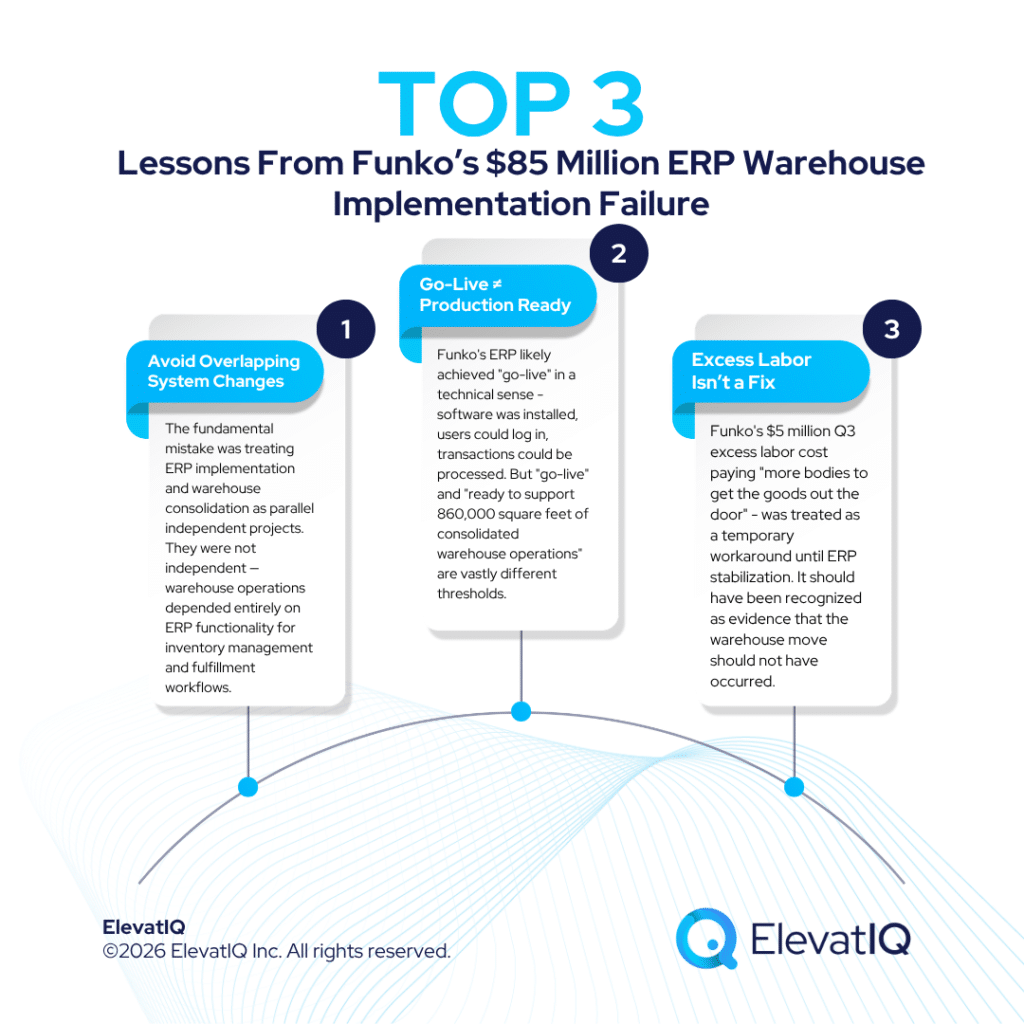
The fundamental mistake was treating ERP implementation and warehouse consolidation as parallel, independent projects. They were not independent — warehouse operations depended entirely on ERP functionality for inventory management and fulfillment workflows.
The correct sequencing:
- Implement and stabilize ERP in existing warehouse facilities
- Operate for 3–6 months to validate ERP inventory management, order routing, and fulfillment workflows under production conditions
- Only after ERP stability is confirmed, begin warehouse consolidation using the proven ERP system
This sequencing adds a timeline potentially 6–12 months longer total but prevents the compounding failure where neither project can succeed because both are unstable simultaneously.
“Go-Live” Does Not Mean “Ready for Production Scale”
Funko’s ERP likely achieved “go-live” in a technical sense – software was installed, users could log in, and transactions could be processed. But “go-live” and “ready to support 860,000 square feet of consolidated warehouse operations” are vastly different thresholds.
Organizations should define production readiness separately:
- Go-live: System is functional for basic transactions in a controlled environment
- Production scale readiness: System can handle peak transaction volumes, user counts, and operational complexity without performance degradation or excessive error rates requiring manual intervention
Moving the warehouse before achieving production scale readiness significantly increased the risk of operational failure.
Excess Labor Costs Are a Red Flag, Not a Temporary Fix
Funko’s $5 million Q3 excess labor cost paying “more bodies to get the goods out the door” – was treated as a temporary workaround until ERP stabilization. It should have been recognized as evidence that the warehouse move should not have occurred.
When labor costs spike post-implementation, it signals:
- ERP workflows are not automating processes as designed
- Manual interventions are replacing system-driven efficiency
- The system is not ready to support operations at the current scale
Organizations that accept excess labor as ‘temporary’ may discover it persists for extended periods because the root cause of inadequate ERP functionality is never fully remediated.
The Conclusion
Funko’s $85 million annual cost increase, $30 million inventory write-off, 59% stock price collapse, and shareholder lawsuits largely stem from a critical timing decision: consolidating warehouse operations before ERP systems were ready to support them. This is not solely a software or vendor implementation issue; it primarily reflects a management decision to proceed with dependent infrastructure changes despite indications that foundational systems were not fully operational.
The ERP warehouse implementation timing failure lessons from Funko are unambiguous: infrastructure changes that depend on ERP functionality must sequence after ERP stability is confirmed under production conditions. Treating ERP go-live dates as schedule commitments rather than readiness gates can create significant operational challenges where manual processes cannot scale, costs explode, and investor confidence collapses.
For organizations planning ERP implementations alongside facility consolidations, system integrations, or other dependent infrastructure projects, the question is not “can we run these in parallel to save time?” The question is “what happens if the ERP isn’t ready when we need it to support the infrastructure change?” Funko answered that question with $85 million in annual costs, shareholder lawsuits, and operational chaos that took years to resolve.
For organizations seeking independent advisory support for ERP implementation sequencing, infrastructure dependency analysis, and operational readiness assessment, the team at ElevatIQ provides consulting services across implementation planning, risk mitigation, and project governance at exactly the stage where timing decisions determine whether ERP implementations enable operational excellence or create multi-year crisis management exercises.
All commentary represents an independent editorial perspective based on publicly reported court filings, earnings calls, and cited primary sources.

ERP Selection: The Ultimate Guide
This is an in-depth guide with over 80 pages and covers every topic as it pertains to ERP selection in sufficient detail to help you make an informed decision.
FAQs
Related Posts: