
Last Updated on April 17, 2026 by Shrestha Dash
Software license audits are often perceived as extending beyond pure compliance checks. For most large ERP vendors, they can also serve as a revenue-generating mechanism. That is, a structured process for identifying gaps between what customers technically owe under a complex licensing agreement and what they actually paid for. Understanding ERP audit rights before you sign a contract is one of the most financially consequential steps an organization can take. Yet it rarely receives the attention it deserves during procurement.
This blog breaks down how vendor audit clauses work. What makes them dangerous, and what ERP audit rights protections buyers should negotiate. Especially, before they find themselves on the receiving end of a multi-million dollar true-up demand.
Why ERP Vendors Are Auditing More Aggressively Than Ever
Software license audits are not new. But the frequency and financial stakes have shifted considerably in recent years. Industry data published in 2025 indicates that 62% of companies faced software vendor audits in 2024. Thus, up by 40% the previous year. For organizations with more than 5,000 employees, that figure climbed to 66%. The same research found that nearly one in three organizations incurred financial liabilities exceeding one million dollars from audits in 2024. This is more than three times the share from just two years prior.
The drivers behind this surge are not difficult to identify. Enterprise software vendors face consistent pressure to grow revenue year over year. And audits have become a reliable mechanism for achieving that. Especially in mature markets where new customer acquisition has slowed. When a vendor’s quarterly earnings fall short of analyst expectations, audit activity may increase. The relationship is not coincidental.
Oracle, SAP, and VMware (under Broadcom) have consistently ranked among the most active audit initiators in the enterprise software market. Each brings a distinct approach. Oracle has long been known for aggressive enforcement around database and Java licensing. SAP is particularly active around indirect access and integration usage. And, Broadcom’s acquisition of VMware triggered a significant escalation in audit activity alongside sweeping licensing model changes. Vendor audit teams are often embedded within the sales organization and incentivized to convert findings into revenue-generating amendments. A structural fact that should inform how buyers approach every audit interaction.
What ERP Audit Rights Clauses Actually Say
Most enterprise ERP contracts contain an audit rights clause. This grants the vendor the ability to examine a customer’s systems and usage data to verify licensing compliance. These clauses are typically presented as standard, non-negotiable provisions. In practice, many are neither.
- Standard audit rights language tends to be broad and buyer-unfavorable. It may grant the vendor the right to conduct audits with little advance notice, at any time, and any frequency. Also, using audit methodologies and tools of the vendor’s own choosing. The clause may also specify that any identified shortfall must be remediated at current list prices rather than the discounted rates the customer originally negotiated.
- Providers have inserted audit right language within clients’ contracts, providing legal authority to conduct audits of a client’s environment using both human and technical tools. Also, including scripts that listen to a customer’s environment and generate reports identifying potential non-compliance. This automatically places the client in a defensive position.
- There is also a deliberate ambiguity problem. ERP contract language can sometimes be ambiguous regarding permissible use. Customers often find architecture-based compliance the most difficult area to monitor and govern. A common example involves connecting an ERP system to development and test environments, or linking it to a CRM platform via API. Scenarios that many buyers assume are standard practice, but that some vendors can characterize as unlicensed usage.
The Indirect Access Problem
No audit trigger has generated more unexpected costs for ERP customers than indirect access. This refers to any scenario where an external system – a third-party application, a web portal, a robotic process automation tool, or a custom integration- accesses ERP functionality without going through a direct, licensed user login.
SAP indirect access remains one of the top triggers for license compliance audits. Organizations have faced surprise bills in the tens of millions of dollars when such indirect usage was deemed out of compliance. In 2025, SAP indirect access audits became stricter than ever. SAP expects customers to have addressed indirect usage either by assigning proper named-user licenses or adopting its Digital Access licensing model. The grace period for organizations that delayed addressing this has effectively ended.
The practical implication is significant. Every time an organization adds a new integration between its ERP and another platform, it may be creating a new compliance exposure without realizing it. Every connection between an ERP and an outside platform made through APIs may be identified by the ERP provider as a missed charge. Along with retroactive billing initiated from the date the connection was established.


ERP Selection Requirements Template
This resource provides the template that you need to capture the requirements of different functional areas, processes, and teams.
The True-Up Trap: How Compliance Demands Escalate
A true-up is the process by which a customer reconciles actual software usage against purchased licenses and pays for any excess. In principle, true-ups are a reasonable mechanism. In practice, they frequently become financial traps.
The issue is timing and pricing. When a vendor-initiated audit identifies a compliance gap whether from user count overages, indirect access, or architectural configuration, the demand for remediation often comes at current list prices rather than the discounted rates the customer negotiated at the time of purchase. For organizations that secured significant discounts during the initial deal, this creates a substantial and asymmetric cost exposure.
Non-compliance identified during an SAP audit can result in a requirement to purchase licenses for the excess at list price, along with back maintenance fees going back up to two years on those licenses. Beyond the pricing mechanics, audit findings are frequently overstated. The audit report generated by vendors to justify the imposition of additional fees may be subject to interpretation and should be carefully reviewed, and should never be taken at face value.
Organizations that accept initial audit findings without challenge routinely overpay relative to what a legitimate, carefully negotiated resolution would require. Industry experience suggests that customers who engage proactively and push back on initial findings can often reduce the exposure substantially.

ERP System Scorecard Matrix
This resource provides a framework for quantifying the ERP selection process and how to make heterogeneous solutions comparable.
Audit Triggers to Understand
Not all audits are triggered by usage anomalies. Common audit triggers include:
- Contract renewals, merger activity, inconsistent usage reports, or significant shifts in IT infrastructure.
- Organizations approaching a renewal, undergoing an acquisition, or migrating between deployment models should treat these as elevated-risk periods and review their licensing position before the vendor does.
- Software audits are not random. If an organization is selected for audit, the vendor believes there is a revenue opportunity with the customer’s use of the software.
Negotiating ERP Audit Rights: What Protections to Demand
Understanding which ERP audit rights protections are achievable, and making them a negotiation priority, is something procurement teams should plan for before a contract is signed. Once the licensing agreement is in place, buyers have significantly less leverage to modify its terms. The following protections are achievable in most enterprise negotiations when raised during the procurement phase.
Frequency Limits
Unconstrained audit frequency creates continuous compliance anxiety and operational disruption. Buyers should negotiate an explicit limit on how often audits can occur.
- A fair audit clause from the customer’s perspective would allow audits no more than once per year. Requires at least 30 days’ advance notice and also restricts audits to normal business hours. It also specifies that if non-compliance is found, the vendor cannot initiate another audit for six to twelve months.
- An annual frequency cap is a reasonable and achievable negotiation position for most enterprise customers.
- Some organizations are able to negotiate an 18-month or two-year interval. Particularly during large multi-year deals when the buyer has significant leverage.
Notice and Scope Requirements
Advance notice provisions serve two purposes:
- They give buyers time to prepare
- They prevent the ambush dynamic that vendors sometimes use to generate maximally unfavorable findings.
A 30-day written notice requirement is the baseline; 45 to 60 days is preferable for organizations with complex, multi-system environments. Equally important is scope limitation.
- Vendors running proprietary measurement scripts on customer environments have a built-in incentive to generate findings neutral or pre-agreed tools to reduce that conflict.
- Audit rights clauses should specify what the vendor can and cannot examine, which systems and data the audit covers, and what measurement tools and methodologies are considered acceptable.
True-Up Pricing at Contract Rates
Perhaps the most financially consequential audit protection is a clause requiring that any compliance shortfall identified during an audit be remediated at the discount rates the customer originally negotiated, not at current list prices.
Procurement teams should negotiate an annual true-up clause that allows self-reporting of any overuse and purchase of needed licenses at normal discounted rates once per year, rather than facing retroactive penalties at list price. Locking true-up pricing to contracted rates eliminates one of the most common and damaging financial outcomes of vendor-initiated audits.
Cure Periods Before Penalties Apply
Standard audit clauses treat identified compliance gaps as immediate violations subject to retroactive fees. A cure period provision changes that dynamic by giving the organization time to respond to findings before financial penalties attach.
Modifying the audit clause so that indirect usage findings are not automatically deemed non-compliant and requiring that SAP or any vendor review findings with the customer first and allow a cure period of 60 to 90 days to resolve or license any shortfall before penalties apply. This ensures a fair chance to address audit questions before they escalate into formal compliance claims. Cure periods are particularly important for indirect access findings, where technical architecture decisions rather than intentional misuse are often the root cause.
Dispute Resolution Procedures
Standard audit clauses frequently leave dispute resolution undefined. Which means buyers have no contractual mechanism to formally contest findings they believe are inaccurate. Negotiating an explicit dispute resolution process. It includes independent review rights, defined escalation timelines, and binding arbitration options. All of which gives organizations meaningful protection against inflated claims.
The right to conduct an independent self-audit, using the customer’s own interpretation of the contract, is a related and valuable provision. Conducting a self-audit based on your own reasonable interpretation of the contract before or during a vendor-initiated audit can provide invaluable baseline data for pushing back on vendor allegations and demands for additional fees.
Reciprocal Audit Rights
Audit provisions are typically one-directional: vendors can audit customers, but not vice versa. Buyers should negotiate reciprocal rights to verify vendor compliance with service level commitments, ERP implementation deliverables, and other contractual obligations. While vendors rarely agree to full reciprocity, the request creates negotiating leverage and signals to the vendor that the buyer is approaching the contract as a genuinely bilateral agreement.
Building Internal Defenses Against Audit Risk
Contractual protections reduce exposure but do not eliminate it. Organizations also need internal processes that maintain continuous awareness of their licensing position.
Software Asset Management
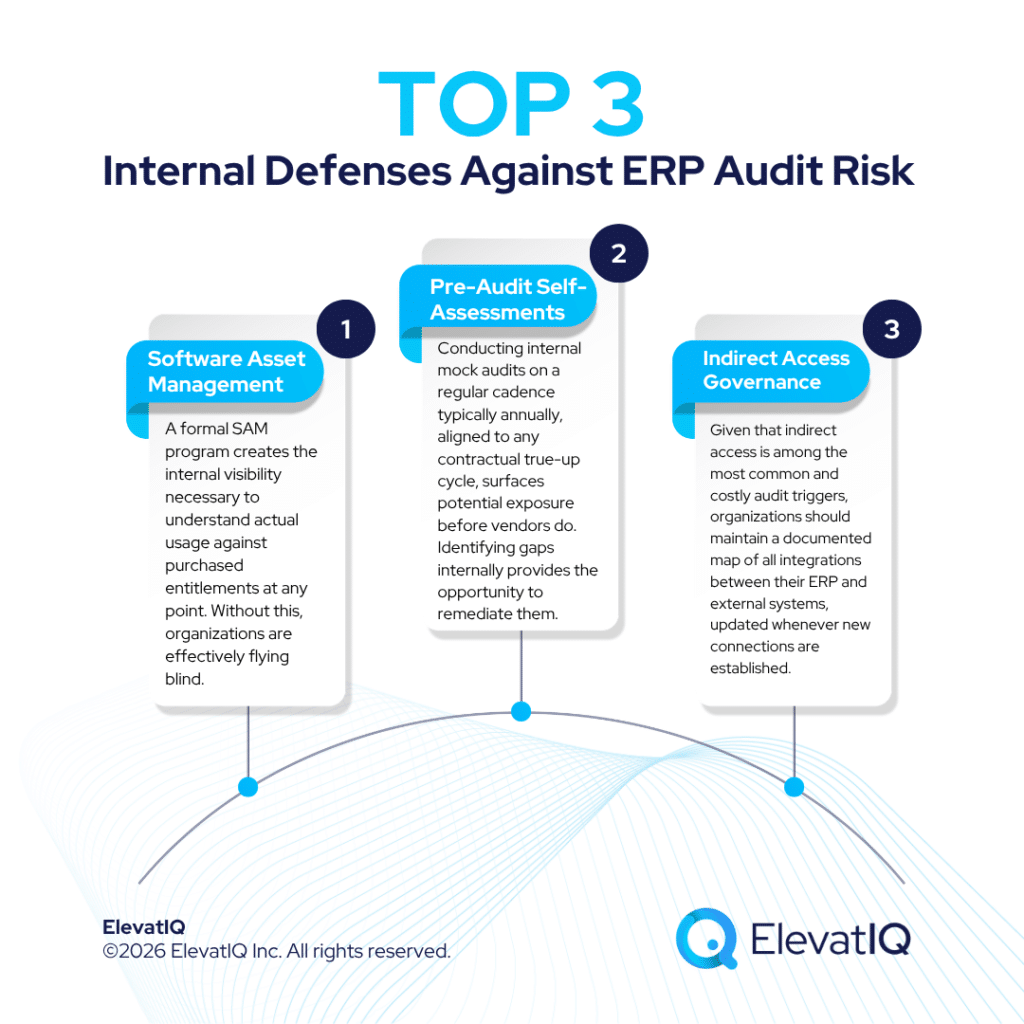
A formal software asset management (SAM) program creates the internal visibility necessary to understand actual usage against purchased entitlements at any point. Without this, organizations are effectively flying blind. They may not have full visibility into their compliance position until a vendor audit tells them otherwise, by which point they have lost control of the process.
Effective SAM programs track user counts, integration connections, and environmental usage across production, development, and test systems. They also monitor changes in licensing agreements, because vendor model updates such as SAP’s introduction of Digital Access licensing for indirect use, can create new compliance obligations from existing deployments without any corresponding change in the customer’s actual usage.
Pre-Audit Self-Assessments
Conducting internal mock audits on a regular cadence typically annually, aligned to any contractual true-up cycle, surfaces potential exposure before vendors do. Identifying gaps internally provides the opportunity to remediate them at contracted rates, document the resolution, and close the exposure before it becomes an audit finding. Always perform a mock audit before submitting official measurement data to a vendor. Once data has been submitted, it cannot be retracted, and an invoice for non-compliance can be generated quickly.
Indirect Access Governance
Given that indirect access is among the most common and costly audit triggers, organizations should maintain a documented map of all integrations between their ERP and external systems, updated whenever new connections are established. Every API connection, middleware deployment, or third-party portal that touches ERP data should be reviewed against licensing terms before deployment — not after. CIOs should right-size their environments with audit compliance in mind and not assume that gray areas that may have been overlooked in the past will continue to go unenforced.
Responding to an Audit Notice
Receiving an audit notice from a vendor is not an emergency, but it does require a measured and coordinated response. The instinct to cooperate fully and immediately is often counterproductive.
The first step is to review the contract carefully. To understand exactly what the vendor is entitled to examine. What notice they were required to provide, and what methodology they are permitted to use. If the audit notice does not comply with ERP contractual requirements, this is immediately relevant. Organizations should not panic or self-incriminate when receiving an audit notice. They should acknowledge receipt, consult legal or advisory resources, and clarify audit timelines, tools, and data sources before proceeding.
Engaging experienced independent ERP advisors at this stage, before submitting any data or responding to scope requests, tends to substantially improve outcomes. The percentage of organizations utilizing third-party assistance for software audits rose to 52 percent in 2025, up from 34 percent in 2023, reflecting growing recognition that traditional internal approaches are often inadequate when facing a well-resourced vendor audit team.
The Conclusion
All of the protections described in this blog are far easier to obtain before a contract is signed than after. Once an organization is locked into a multi-year ERP agreement, the leverage to modify these terms largely disappears until the next renewal cycle.
ERP vendors are commercially sophisticated organizations with experienced contract teams. Their default terms are written to protect their interests, not their customers’. Buyers who approach contract negotiations without equivalent expertise or independent advisory support frequently accept provisions they later regret, sometimes to the tune of seven or eight figures in unexpected true-up demands.
ElevatIQ works with organizations preparing to select, negotiate, or renew ERP contracts to ensure that licensing terms, audit provisions, and true-up mechanics reflect the buyer’s actual risk profile and long-term interests. Our vendor-agnostic perspective, with no commercial relationships with any ERP vendor, means our analysis is focused solely on protecting your organization’s position.

ERP Selection: The Ultimate Guide
This is an in-depth guide with over 80 pages and covers every topic as it pertains to ERP selection in sufficient detail to help you make an informed decision.
FAQs
Related Posts: