
Last Updated on April 19, 2026 by Shrestha Dash
Signing an ERP implementation contract is one of the highest-stakes procurement decisions an organization will make. Yet many buyers focus almost entirely on software licensing costs and give far less scrutiny to the one document that determines who absorbs the financial pain when things go wrong: the implementation services agreement itself.
The choice between a fixed price and a time and materials (T&M) ERP implementation contract is rarely about which model is inherently superior. It is about which one is appropriate for your specific project conditions and whether you have negotiated enough protections within that model to keep risk where it belongs.
This blog examines both ERP implementation contract models in depth, covering how each allocates risk, what change order provisions should look like, and what buyers should demand regardless of which model they choose.

What the Two Contract Models Actually Mean
Before evaluating risk, it helps to be precise about what each model commits both parties to.
Fixed Price Contracts
Under a fixed price model, the vendor agrees to deliver a defined scope of work for a predetermined total fee. Payments are typically structured around project milestones, for example, a portion at kickoff, another at user acceptance testing, and the final amount at go-live.
Key characteristics:
- Scope, deliverables, and timeline are defined and locked before work begins
- The vendor absorbs the financial risk if their estimates are wrong or work takes longer than planned
- Any requirement not explicitly covered in the contract scope is subject to a formal change order and additional fees
- Vendors typically build a risk contingency buffer into their pricing to protect against uncertainty
The last point matters more than most buyers realize. Because vendors are accepting delivery risk, they price that risk into the contract. Fixed price contracts tend to include contingency buffers for unknowns, which can inflate the project cost by 15% to 30% or more, and the client pays this premium regardless of whether the risks ever materialize.
Time and Materials Contracts
Under a T&M model, the buyer pays for actual hours worked at pre-agreed rates, plus any direct project expenses. There is no guaranteed final price; the total depends entirely on how long the work takes.
Key characteristics:
- The scope can evolve throughout the project without formal ERP renegotiation
- The buyer absorbs the financial risk if implementation takes longer than expected
- Vendor invoices are based on actual time spent, requiring the buyer to monitor hours closely
- There may be limited direct incentive for vendors to optimize efficiency, since they are paid for the time and materials utilized, without the same direct time-based incentive to complete the project quickly.
The flexibility of T&M suits projects where requirements are not fully defined or where significant customization is anticipated. However, without spending controls built into the contract, T&M can expose buyers to runaway costs when scope expands or technical complexity proves greater than expected.
How Risk Is Allocated Under Each Model
Risk allocation is the core issue in any ERP implementation contract negotiation. The two models distribute it very differently.
Under a Fixed Price Contract
The vendor carries execution risk – if they underestimate effort, they absorb the cost overrun. This sounds like a buyer-friendly arrangement, and in theory it is. In practice, vendors manage this risk through two mechanisms that shift it back to buyers:
- Scope inflation at the change order stage. Because any work not explicitly described in the contract can be classified as out-of-scope, vendors may have an incentive to define scope narrowly and then bill for changes. Vague or incomplete ERP requirements documentation creates fertile ground for change order disputes.
- Risk premium pricing. Vendors build uncertainty buffers into fixed price bids. If the project runs smoothly, the buyer may have paid more than the actual delivery cost. If disputes arise over scope, the buyer may face both the premium already paid and additional change order fees.
Under a Time and Materials Contract
The buyer carries cost risk, if the project expands or takes longer, their costs rise proportionally. Industry studies suggest that approximately 47% of ERP implementation projects experience cost overruns. Separately, among organizations that did exceed their budgets, nearly 35% said the initial project scope was expanded NetSuite – the exact dynamic that T&M contracts leave financially unprotected by default.
Vendors operating under T&M also face reduced accountability for delivery quality. Since they are compensated regardless of outcomes, contractual performance standards and acceptance criteria become even more important under this model than under fixed price.


ERP System Scorecard Matrix
This resource provides a framework for quantifying the ERP selection process and how to make heterogeneous solutions comparable.
Change Order Procedures: Where Contracts Succeed or Fail
Regardless of which model a buyer selects, change order procedures are where the practical protection lives. Both ERP implementation contract models are vulnerable to disputes when change order language is weak. Under a fixed price contract, every request the vendor classifies as outside the original scope becomes a potential change order. Without clear definitions of what constitutes a legitimate change versus a clarification of vague scope, vendors can impose additional fees on items a reasonable buyer would consider implied by the original requirements.
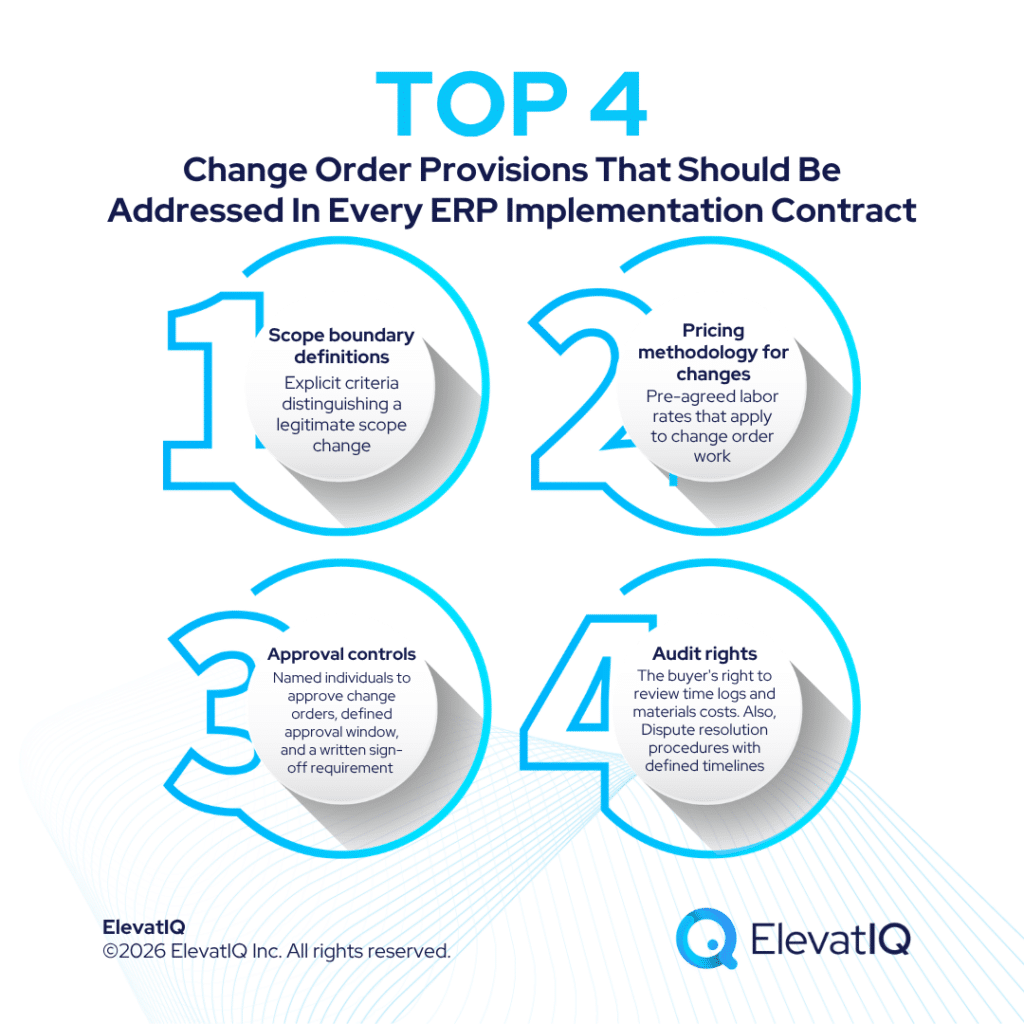
Under a T&M contract, scope changes have no formal gate – work simply continues. Without a structured change request process, it becomes difficult to track what was originally agreed upon, what was added, and at whose request. Strong change order provisions should address the following regardless of which ERP implementation contract model is in use:
Scope boundary definitions
- Explicit criteria distinguishing a legitimate scope change from a clarification or correction of ambiguous vendor documentation
- A process for the buyer to dispute vendor claims that work falls outside original scope
Pricing methodology for changes
- Pre-agreed labor rates that apply to change order work, preventing vendors from charging premium rates for out-of-scope items
- A cap on change order markup or overhead percentages
- Written itemized estimates for each change request before work begins
Approval and authorization controls
- Named individuals on the buyer side with authority to approve change orders
- A defined approval window (e.g., five business days) to prevent delays from authorization bottlenecks
- A written sign-off requirement before any out-of-scope work commences
Audit rights
- The buyer’s right to review time logs and materials costs supporting any change order invoice
- Dispute resolution procedures with defined timelines if a buyer contests a change order
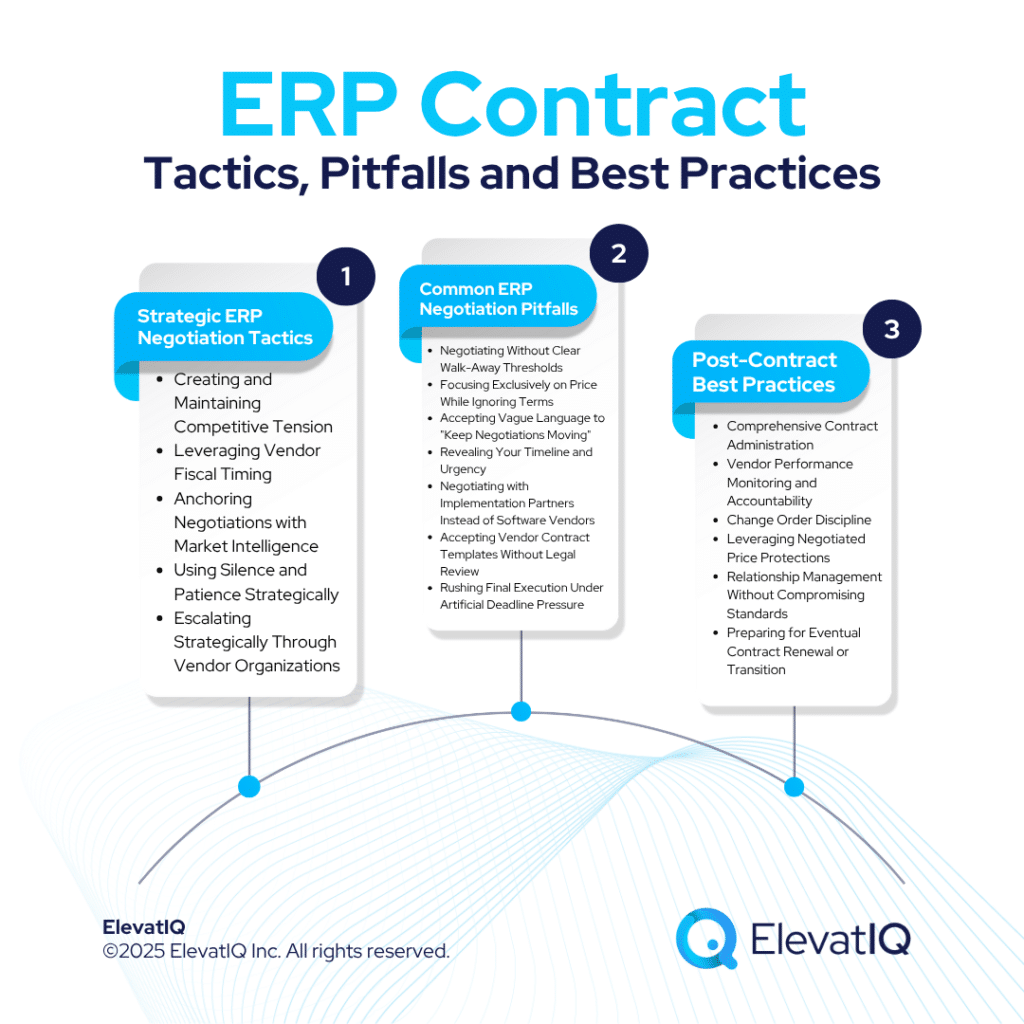
One practical note: change order disputes are commonly cited as a major source of conflict in ERP projects. High-profile cases like the MillerCoors vs. HCL dispute which resulted in a $100 million lawsuit before eventual settlement, were attributed by outside observers to contracts that were loosely defined and left substantial room for disagreement about what each party had committed to deliver.
Cost Controls Buyers Should Negotiate Into Either Model
Beyond change order language, buyers can negotiate additional protections into any ERP implementation contract – fixed price or T&M alike.
For Fixed Price Contracts
- Scope completeness warranty: Require the vendor to warrant that their fixed price proposal reflects a complete and accurate assessment of the work required to meet documented requirements. This limits the vendor’s ability to reclassify work as out of scope based on their own estimating errors.
- Acceptance criteria with teeth: Define functional acceptance criteria that must be met before milestone payments are released. “Substantially conforms to documentation” is not an acceptable standard. Require documented test cases with pass/fail criteria.
- Change order volume caps: Negotiate a threshold beyond which aggregate change order costs trigger a contract renegotiation or an ERP independent assessment. This prevents a nominally fixed price contract from becoming variable in practice through uncontrolled scope additions.
For Time and Materials Contracts
- Not-to-Exceed (NTE) clauses: A Not-to-Exceed cap establishes a ceiling on total billable hours or total project cost, beyond which the vendor cannot charge without a formal, buyer-approved change order. This hybrid approach offers the best of both worlds – the project operates on a flexible T&M basis, but is bound by a firm budget ceiling, providing the adaptability of T&M with the budget protection of a fixed price model.
- Spending authorization thresholds: Require vendor notification when cumulative costs reach defined percentages of the project budget, for example, at 50%, 75%, and 90% of the NTE cap. This builds early warning into the contract rather than surfacing overruns only at invoice time.
- Role-based rate schedules: Pre-agree specific hourly rates for each resource category (project manager, functional consultant, technical consultant, integration specialist). This prevents vendors from staffing projects with senior resources at premium rates for work that does not require that level of seniority.
- Time-log transparency: When internal resources run low, organizations frequently use a software vendor’s services team or third-party consultants more than planned, with experienced ERP consultants typically running $150–175 per hour plus travel expenses. NetSuite requires weekly time-log submissions broken down by task, resource, and project phase, which gives buyers the visibility to govern these costs proactively.
Which Model Is Right for Your ERP Project?
There is no universally correct answer. It depends on the state of your requirements and your organization’s capacity to govern the implementation actively.
Fixed price contracts are generally more appropriate when:
- Requirements are fully documented, stable, and unlikely to change significantly during implementation
- The vendor has a well-established, repeatable implementation methodology for the specific ERP product
- The organization needs budget certainty for internal planning or board-level approvals
- The buyer has limited bandwidth to monitor vendor activity on a day-to-day basis
Time and materials contracts are generally more appropriate when:
- Requirements are still evolving or involve significant business process redesign
- The project involves heavy customization or complex integrations where effort is genuinely hard to estimate upfront
- The organization has strong internal project management capability and can monitor vendor hours closely
- Speed of iteration is a priority and formal change order cycles would slow progress unacceptably
A hybrid approach – T&M for early discovery and design phases, transitioning to fixed price for defined build phases – is also worth considering for complex ERP implementations. This structure is well-suited to large ERP rollouts: fixed price for well-scoped modules where the vendor has repeatable implementation patterns, and T&M for integration, customization, and cutover support. It allows requirements to stabilize through T&M engagement before locking a price, reducing the vendor’s justification for large contingency buffers.
The Question Buyers Often Miss
Most discussions about ERP implementation contract models focus on which model is less risky. The more useful question is: which model are you actually equipped to manage?
A fixed price contract with weak scope definitions and no change order controls does not protect a buyer. Neither does a T&M contract with no spending caps and no time-log visibility requirements. The contract model is a framework. The protection comes from the specific language within it.
The MillerCoors case underscores a broader lesson: when ERP contracts are poorly defined and loosely based, neither party has a clear definition of success or responsibility – setting the stage for disputes where the cost of legal escalation can quickly eclipse the original project investment. Organizations that lack internal expertise in technology contract negotiation frequently discover this distinction only after costs have escalated.
Conclusion
Both fixed price and T&M ERP implementation contract models offer legitimate paths to a well-governed ERP project – under the right conditions and with the right provisions in place. Fixed price shifts execution risk to the vendor but requires precise scope documentation and disciplined change order controls to prevent that protection from eroding. T&M preserves flexibility but demands NTE caps, rate transparency, and active buyer oversight to remain cost-controlled.
For most mid-market and enterprise buyers, the single most important step is engaging qualified support before the contract is signed, not after disputes arise. Independent ERP advisors – those without financial relationships with the software vendors or system integrators on the other side of the table – are best positioned to evaluate which model fits a specific project and negotiate the provisions that make it enforceable.
ElevatIQ’s enterprise technology selection and IT procurement advisory services support buyers through both the vendor selection process and the contract negotiation stage. Working as independent ERP advisors, the team reviews proposed contract structures, flags risk allocation gaps, and helps organizations secure language that improves vendor accountability regardless of which pricing model is on the table.

ERP Selection: The Ultimate Guide
This is an in-depth guide with over 80 pages and covers every topic as it pertains to ERP selection in sufficient detail to help you make an informed decision.
FAQs
Related Posts: