
Last Updated on April 20, 2026 by Shrestha Dash
Will AI replace ERP? It is the question rattling Wall Street, IT leaders, and enterprise software buyers in 2026. It deserves a more precise answer than the market has been giving it. Enterprise software stocks recorded one of their worst-performing quarters relative to the S&P 500 in recent history. The iShares Expanded Tech-Software Sector ETF (IGV) reportedly declined significantly in Q1 2026. It’s the steepest quarterly drop since the financial crisis of 2008. Salesforce, Adobe, and Workday also saw significant share price declines over the same period.
A key contributing factor was investor concern that AI agents could perform the same workflows. Which was previously handled by dedicated enterprise software platforms – making traditional SaaS subscriptions redundant.
In March 2026, Goldman Sachs published a formal research report titled “Will AI Eat Software? It is one of the most closely watched pieces of enterprise technology analysis in years. For CIOs, CFOs, and procurement teams asking will AI replace ERP, the conclusions in that report carry direct practical implications. This blog breaks down what the research actually found. Why ERP sits in a structurally different position from other software categories. Also, what it means for organizations currently evaluating or implementing ERP systems.
The Scope: What Triggered the 2026 Enterprise Software Selloff
The immediate catalyst was the launch of Anthropic’s enterprise AI agent plugins in early February 2026. Which extended AI automation into functions previously controlled by point software solutions — legal research, CRM workflows, data analytics, and customer support. Investors read this as a signal that AI could systematically hollow out the core revenue streams of traditional SaaS vendors.
The selloff that followed was swift and largely indiscriminate. Shortly after, major enterprise software stocks dropped sharply regardless of whether their business models were genuinely exposed to AI substitution. Short-selling activity across software stocks increased compared to recent years.
The core fear is straightforward: if an AI agent can handle the same workflow that previously required a dedicated software subscription, why would an enterprise continue paying per-seat SaaS fees? It is a legitimate question. But as Goldman Sachs’ research makes clear, it requires a much more precise answer than “yes” or “all software is at risk.”
What Goldman Sachs Actually Found
Goldman Sachs analyst Gabriela Borges assessed seven common bearish arguments investors were making about enterprise software, assigning each a risk score from 1 (low risk) to 5 (high risk). The framework is directly relevant to the question of will AI replace ERP because ERP appears at the center of the most important finding.
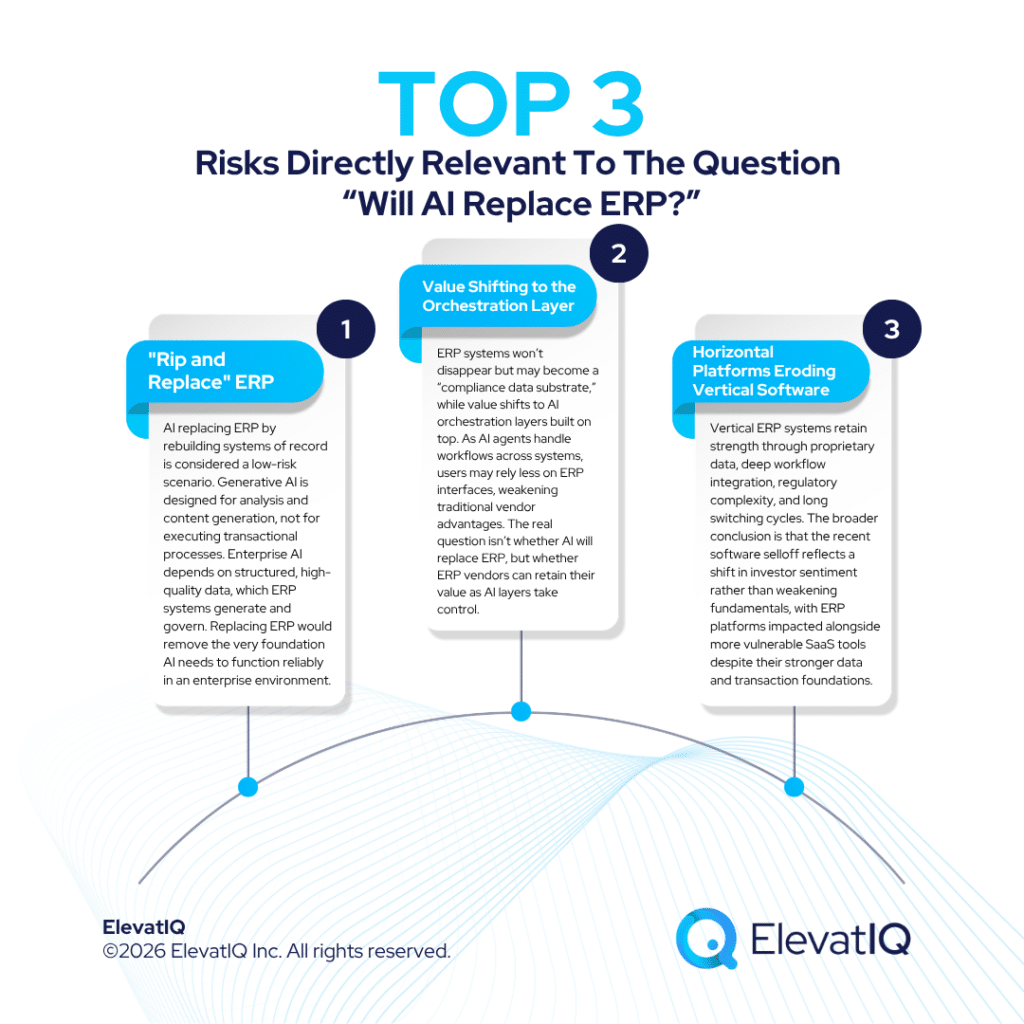
“Rip and Replace” ERP: Goldman Rates It Risk Score 1 (Lowest)
The most alarming version of the AI disruption thesis holds that new AI entrants will rebuild the systems-of-record layer from scratch, making foundational platforms like ERP, CRM, and HR software obsolete. Will AI replace ERP by making it structurally irrelevant? Goldman Sachs analysis rated this scenario as low risk of all seven arguments examined.
The reasoning is straightforward: generative AI is an analysis and generation engine, not a transaction engine. Enterprise-grade AI depends on large volumes of high-quality, structured, and traceable data and ERP systems serve as the primary containers and governance infrastructure that produce and maintain that data. Replacing the ERP to build AI on top of it would mean dismantling the very foundation AI agents need to function reliably in an enterprise context.
Value Shifting to the Orchestration Layer: Risk Score 4 (Elevated)
This is where Goldman sees the more realistic near-term risk. The report suggests ERP systems will not disappear but could become what Goldman calls a “compliance data substrate,” with commercial value increasingly captured by the orchestration layer sitting on top of them. AI agents can read, write, and reconcile across multiple systems of record, and over time, users may no longer need to directly access the original ERP interface. This weakens the moat ERP vendors have historically held through interface control, process dependency, and user habit.
This is the scenario enterprise buyers should be watching. The question is not will AI replace ERP, it is whether ERP vendors will maintain their value position as AI orchestration layers grow on top of them.
Horizontal Platforms Eroding Vertical Software: Risk Score 2 (Low to Moderate)
Goldman assessed the risk that horizontal AI tools allow buyers to build their own industry workflows, cutting into specialized vertical software pricing power. This was rated low to moderate risk. Vertical ERP platforms benefit from proprietary industry data, deep workflow integration, compliance barriers in regulated industries, and customer switching timelines measured in years, not months.
The overarching Goldman conclusion, as analyst Matthew Martino articulated: the recent repricing of software stocks reflects a rapid shift in investor sentiment rather than a sudden deterioration in fundamentals. The selloff appears to have been applied broadly rather than selectively, punishing ERP platforms alongside far more vulnerable narrow SaaS tools that lack their data depth and transaction criticality.


ERP Selection Requirements Template
This resource provides the template that you need to capture the requirements of different functional areas, processes, and teams.
Why Will AI Replace ERP Is the Wrong Question
Will AI replace ERP? The Goldman Sachs research says no but unpacking why reveals what enterprise buyers actually need to prepare for.
The key technical distinction is between deterministic and probabilistic systems.
- Deterministic systems execute precise, repeatable transactions with zero tolerance for error. Financial ledgers, inventory movements, procurement approvals, payroll processing, and compliance reporting all fall into this category. An ERP system processing a multi-entity consolidation or a three-way purchase order match cannot afford to be correct most of the time. It must be correct every time, with a full audit trail.
- Probabilistic systems including AI language models, produce outputs based on learned patterns. They excel at tasks where speed and approximation are acceptable: content generation, research summarization, customer support triage, and data analysis. A 95% accuracy rate is a strong result for AI-generated content. It is a catastrophic result for a financial ledger.
The architecture emerging across enterprise technology in 2026 reflects this reality. AI agents are increasingly functioning as the reasoning and interface layer. Thus, interpreting user intent, surfacing recommendations, and orchestrating cross-system workflows. ERP systems remain the execution layer where transactions are committed, financial controls are enforced, and regulatory compliance is maintained.
So rather than framing it as will AI replace ERP, the more accurate question is: how will AI sit on top of ERP and what does that mean for buyers evaluating systems today?

ERP System Scorecard Matrix
This resource provides a framework for quantifying the ERP selection process and how to make heterogeneous solutions comparable.
What This Means for Organizations Evaluating ERP Right Now
The debate playing out in financial markets has direct practical implications for enterprise buyers. There are three dimensions worth addressing.
ERP Vendors Are Embedding AI Fast
The notion that AI will replace ERP assumes that ERP vendors will stand still while new entrants build AI capabilities around them. That is not what is happening. SAP has launched Joule, its generative AI assistant, which draws on process and business data across S/4HANA to surface recommendations and automate workflows. Oracle has embedded AI throughout its Fusion ERP suite running on Oracle Cloud Infrastructure. Microsoft Dynamics 365 has integrated Copilot across its ERP and CRM modules. Workday acquired AI platform Sana specifically to extend its reach as an intelligent front door to enterprise workflows.
Legacy ERP vendors may actually have a structural advantage here. Their deeper backend architectures and richer longitudinal datasets make AI agent integration more straightforward than rebuilding AI-native applications from scratch. The AI-native ERP category is still young, and long-term reliability, governance, and compliance capabilities remain open questions for most new entrants.
The Real Risk Is Vendor Lock-In, Not ERP Replacement
While the research makes clear that “will AI replace ERP” answers to “no,” the more immediate risk for buyers is a different one: selecting ERP vendors or signing contracts that limit your ability to leverage AI as it matures.
Goldman Sachs’ own evaluation framework emphasizes system-of-record ownership and data integration moat, both of which favor established ERP platforms. But the report also stresses execution: vendors that actively integrate new AI capabilities are better positioned than those that bolt AI onto legacy interfaces cosmetically. For buyers, this translates into a concrete evaluation criterion: what is this vendor’s AI roadmap, how is it priced, and does it build on open standards or create new layers of proprietary lock-in?
ElevatIQ’s 2026 Digital Transformation Report flagged this tension directly: AI disruption is forcing traditional enterprise software vendors to redirect R&D investment, with on-premise products receiving minimal attention and some offerings approaching end-of-life. Organizations evaluating ERP need to assess whether their shortlisted systems position them to leverage AI capabilities over the next five years or whether they will find themselves locked into architectures with limited optionality.
AI Changes What You Should Evaluate, Not Whether You Need ERP
One of the most practical takeaways from the Goldman Sachs report is that AI does not eliminate the need for rigorous ERP selection, it raises the stakes. The nature of what to evaluate shifts, with new criteria sitting alongside traditional functional and integration assessments:
- Does the vendor provide AI capabilities embedded in core workflows, or only as add-on modules at extra cost?
- How does the vendor’s AI interact with your organization’s proprietary data and who governs that interaction?
- How is the licensing model structured as agentic AI adds value independent of user headcount and will the vendor try to reprice based on agent consumption?
- How does the ERP’s AI roadmap position your organization relative to the orchestration layers likely to sit above the ERP in future architecture?
These are not planning questions for three years from now. They belong in vendor RFPs and contract negotiations being written today.
The Buyer’s Takeaway
The organizations most exposed to the AI disruption narrative are not those running ERP. They are those that deferred ERP investment in favor of fragmented point solutions that now face genuine substitution risk from AI agents and those that signed rigid multi-year ERP contracts without provisions for AI flexibility.
Will AI replace ERP? The analysis suggests the answer is no. ERP’s role as the deterministic backbone of enterprise financial and operational data makes it structurally necessary for any AI-augmented enterprise architecture. But ERP buying decisions made today without factoring in vendor AI maturity, licensing flexibility, and architectural optionality carry real risk of aging poorly in a fast-moving environment.
Conclusion
The Goldman Sachs “Will AI Eat Software?” report is not a verdict on ERP obsolescence. It is a carefully structured analysis of where AI disruption risk is concentrated and where it is not. Will AI replace ERP? Based on the research and underlying technology considerations, the answer appears to be no. The ERP systems are the data foundation AI depends on, not a workflow layer AI can replicate. The risk for enterprise buyers lies not in ERP being replaced, but in selecting vendors or contract structures that limit their ability to benefit from the AI-augmented architecture now taking shape.
Working with independent ERP advisors, who have no commercial relationships with the vendors and system integrators they evaluate, gives organizations the objectivity to distinguish genuine AI capability from marketing claims.
ElevatIQ’s enterprise technology selection services are built on exactly that vendor-agnostic model. As independent ERP advisors, ElevatIQ helps organizations cut through the AI disruption noise, evaluate vendor roadmaps honestly, and make ERP decisions that hold up well beyond the current market cycle.
All commentary represents an independent editorial perspective based on publicly reported information.

ERP Selection: The Ultimate Guide
This is an in-depth guide with over 80 pages and covers every topic as it pertains to ERP selection in sufficient detail to help you make an informed decision.
FAQs
Related Posts: