
Last Updated on February 10, 2026 by Shrestha Dash
In February 2023, Quebec’s Société de l’assurance automobile du Québec (SAAQ) launched SAAQclic, a digital platform intended to modernize driver licensing and vehicle registration services for millions of Quebecers. Within days, the system became synonymous with failure. Which means overloaded servers, multi-hour service queues, and a customer service crisis that exposed fundamental flaws in the ERP implementation approach.
Two years later, Quebec’s auditor general delivered a damning verdict: the $1.1 billion digital transformation represents “a total failure” with a system that “still doesn’t work properly.” A critical contributor to the disaster was an ERP data migration failure that provides critical lessons for organizations undertaking similar transformations. This was not simply a technology problem, it was a comprehensive breakdown in data migration strategy, readiness validation, and risk management.
Understanding what went wrong with SAAQ’s data migration, why decision-makers proceeded despite clear warning signs, and how organizations can avoid similar outcomes is essential for anyone planning digital transformations involving legacy system replacement and large-scale data conversion.

The SAAQ Digital Transformation: Ambitious Vision, Catastrophic Execution
The SAAQ’s CASA modernization program aimed to drag a decades-old licensing and registration system into the digital age. At its core was SAAQclic, an online platform where Quebec residents could renew licenses, schedule driver tests, update vehicle registrations, and conduct transactions previously requiring in-person visits to crowded service centers.
The Scope and Scale
The digital transformation involved replacing legacy systems that had served the SAAQ for over 30 years with modern SAP technology implemented by LGS, an IBM subsidiary. The scope included driver licensing systems managing millions of active licenses, vehicle registration databases tracking vehicle ownership and transactions, insurance records linking vehicles to coverage, payment processing systems, appointment scheduling, and integration with multiple government agencies.
The initial $638 million budget over 10 years appeared reasonable for a transformation of this magnitude. However, the auditor general’s investigation revealed the true cost would exceed $1.1 billion—a cost overrun of $500 million, or 78% above original estimates. More significantly, despite this massive investment, the system fundamentally failed to deliver on its core promise.
The Launch Disaster
When SAAQclic went live in February 2023, immediate problems became apparent. The platform experienced severe performance issues with overloaded servers unable to handle user loads. Multi-hour queues formed at physical service centers as citizens unable to use the broken online system sought in-person assistance. System outages occurred frequently, with services unreliable for weeks during the initial rollout period. Data integrity issues emerged where information in the new system did not match legacy records.
Quebec auditor general Guylaine Leclerc concluded that “there was no indication that this system functioned correctly” at launch. The failure was so severe that more people visited physical SAAQ outlets after SAAQclic launched than before, exactly the opposite of the intended outcome.
The Data Migration Failure at the Core
One of the foundational contributors to SAAQclic’s failure was the ERP data migration failure, which cascaded through every aspect of the implementation. The auditor general’s report identified critical data migration deficiencies that doomed the project from the start.
Reliability and Integrity Not Assured
According to Leclerc’s findings, “the SAAQ migrated SAAQclic online without assuring the reliability and integrity of the system or the data.” This represents a fundamental violation of data migration best practices. Organizations cannot successfully launch systems when data quality and system reliability remain unvalidated.
What this means in practice:
- Unvalidated data conversion: The migration from legacy systems to SAP occurred without comprehensive validation that converted data matched source records accurately
- Missing data quality gates: No formal approval process required, demonstrating that migrated data met quality standards before go-live
- Incomplete testing: Data-dependent business processes were not adequately tested with production data volumes and real-world scenarios
- No reconciliation processes: Systems lacked robust mechanisms to identify and correct data discrepancies between legacy and new platforms
The Extended Service Outage
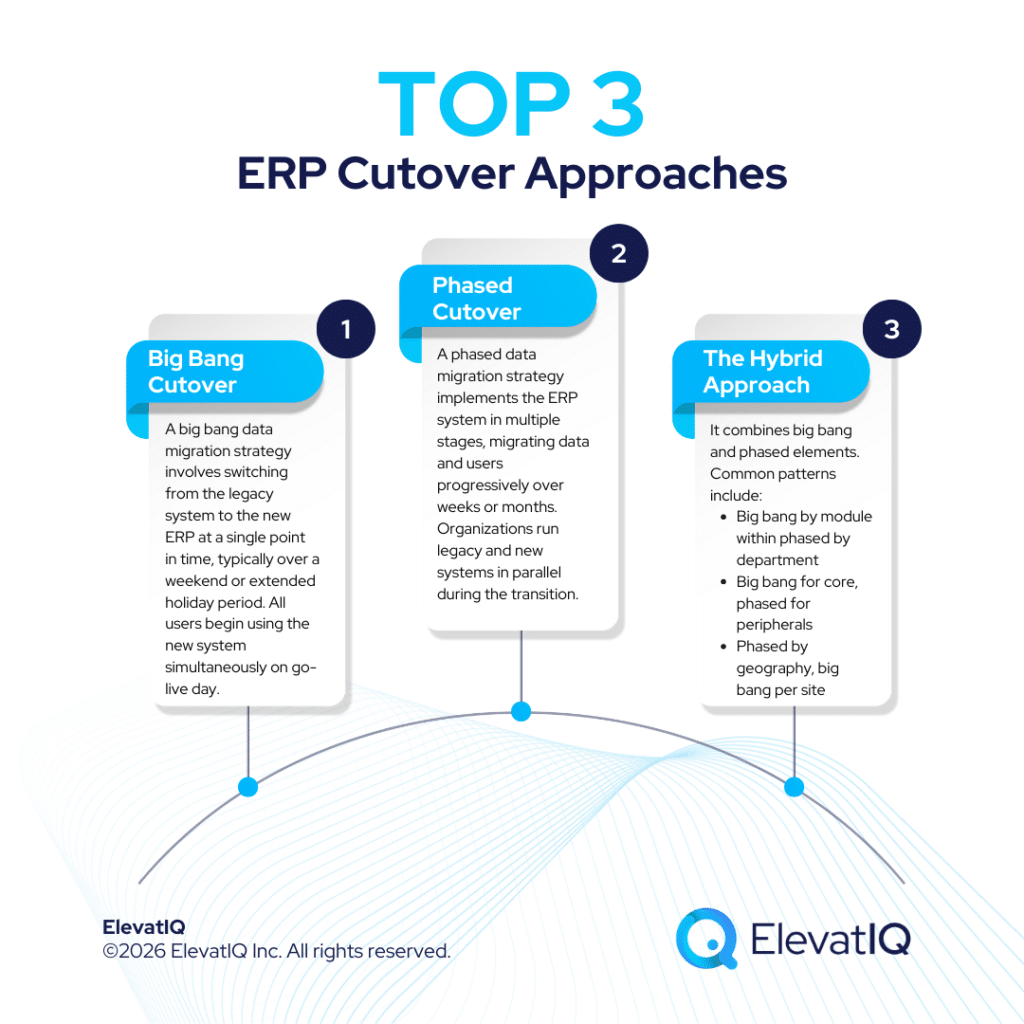
The launch of SAAQclic involved replacing the old computer system with the new digital platform in what implementation teams call a “big bang” cutover. During this transition, the system was down or unreliable for weeks, an extended service outage that created massive operational disruption.
This extended outage affected not just SAAQ customers but entire industries dependent on SAAQ services. Collision repair facilities across Quebec rely on SAAQ services to verify vehicle ownership, process salvage claims, and coordinate repairs on vehicles involved in insurance claims. The outage meant repairers could not access necessary data, creating cascading delays throughout the automotive service sector.
Ongoing Data Problems
Two years after launch, SAAQclic continues to experience data-related failures. In May 2025, a major IT outage affecting SAAQ servers disrupted services across Quebec, with service centers and partner locations forced to close. While officials attributed this incident to Microsoft Azure hosting issues rather than SAAQclic itself, the pattern of recurring outages suggests deeper systemic problems with data architecture and system reliability.
The auditor general reported that the SAAQ expects to reduce system errors to “an acceptable level” by December 2025, nearly three years after launch. This timeline indicates fundamental data quality and system stability issues that should have been resolved before production deployment.


ERP Selection Requirements Template
This resource provides the template that you need to capture the requirements of different functional areas, processes, and teams.
Why the Data Migration Failed: Root Causes
Understanding why SAAQ’s ERP data migration failure occurred requires examining multiple contributing factors that combined to create a perfect storm of dysfunction.
Inadequate Pre-Migration Data Assessment
Organizations cannot successfully migrate data they do not understand. Effective data migration requires comprehensive assessment of source data quality, completeness, consistency, and structure before designing conversion processes. The evidence suggests SAAQ underinvested in this foundational activity.
Critical assessment activities that appear to have been insufficient:
- Data profiling: Systematic analysis of legacy data to identify duplicates, missing values, format inconsistencies, and referential integrity violations
- Data volume and complexity analysis: Understanding the sheer scale of records, relationships, and dependencies being migrated
- Historical data decisions: Determining how much transaction history to migrate versus archive
- Master data governance: Establishing authoritative sources and resolution processes for conflicting data
Without thorough data assessment, migration teams cannot design effective conversion processes, identify cleansing requirements, or estimate realistic timelines.
Compressed Timeline and Scope Pressure
The auditor general’s report revealed that labor hours were underestimated by over one million hours, according to audit findings and sworn testimony. Thus, triggering disputes with the IT supplier LGS. This massive underestimation suggests that project planners fundamentally misunderstood the complexity of data migration requirements.
When timelines prove inadequate, organizations face difficult choices: delay go-live to complete necessary work properly, or proceed on schedule despite clear indicators of unreadiness. SAAQ chose the latter, with disastrous consequences.
The decision-making breakdown:
- Deadline prioritization: Transport Minister François Bonnardel was described as focused on delivery timelines rather than financial details or quality indicators
- Warning signs ignored: Companies flagged problems with the portal before launch, but decision-makers proceeded anyway
- Ministerial pressure: Government ministers received presentations indicating the project was on track when reality told a different story
- Transparency failures: Karl Malenfant, former vice-president of digital experience, admitted he assured senior ministers in 2021 and 2022 that the project was within budget when scope was actually expanding significantly
Lack of “Load Early, Load Often” Approach
Industry best practice for complex data migrations follows the “load early, load often” methodology, conducting multiple test migrations throughout the project to identify and resolve issues progressively. Each iteration reveals data quality problems, mapping errors, and transformation logic flaws when they can still be corrected efficiently.
The SAAQ ERP implementation appears to have skipped or inadequately executed this critical practice. The severe data problems discovered immediately after go-live suggest that comprehensive data migration testing did not occur with production data volumes and real-world scenarios.
Insufficient Change Management and User Preparation
Data migration is not purely technical, it requires users to understand how data structures, naming conventions, and access patterns change in new systems. The dramatic increase in physical service center visits after SAAQclic launch indicates that users found the new system so confusing and unreliable that they abandoned it in favor of in-person service.
This pattern suggests:
- Inadequate training: Users were not prepared for how the new system organized and presented data differently than legacy systems
- Poor data accessibility: Information users needed was difficult to locate or unavailable due to incomplete migration
- Trust erosion: Early data quality problems destroyed confidence in system reliability

ERP System Scorecard Matrix
This resource provides a framework for quantifying the ERP selection process and how to make heterogeneous solutions comparable.
The Cascading Impact of Data Migration Failure
The consequences of SAAQ’s ERP data migration failure extended far beyond technical problems, creating operational, financial, political, and reputational damage that continues years later.
Operational Catastrophe
The immediate operational impact was severe:
- Service delivery collapse: The platform intended to reduce physical service center visits instead increased them, overwhelming staff
- Multi-hour queues: Citizens faced extended wait times as online services failed and in-person alternatives became overloaded
- Industry disruption: Collision repair facilities, car dealers, and other businesses dependent on SAAQ services faced weeks of system unavailability
- Reduced functionality: Two years post-launch, users still report that the system has fewer features and is more difficult to use than the pre-SAAQclic website
Financial Disaster
The cost implications are staggering:
- $500 million cost overrun: Original $638 million budget ballooned to $1.1 billion, representing 78% overrun
- No value delivered: Despite the massive investment, the system fails to function as intended
- Ongoing remediation costs: Additional spending continues as SAAQ attempts to fix fundamental problems
- Hidden costs: Government resources diverted to crisis management, public inquiries, and damage control
Political Fallout
The failure triggered significant political consequences:
- Ministerial resignation: Éric Caire, Quebec’s minister responsible for cybersecurity and digital technology, resigned after intense criticism
- Executive termination: The SAAQ’s president and CEO Denis Marsolais was fired in April 2023
- Public inquiry: Premier François Legault ordered a public inquiry led by retired judge Denis Gallant
- Anti-corruption investigation: Quebec’s anti-corruption squad (UPAC) launched an investigation
- Government credibility damage: The failure became emblematic of the Legault government’s inability to manage large-scale technology projects
Reputational Destruction
The damage to organizational credibility will take years to repair:
- Vendor relationship damage: Disputes with LGS over underestimated labor hours and contract modifications
- Public trust erosion: Citizens lost confidence in SAAQ’s ability to deliver reliable services
- Auditor general condemnation: Official finding that the implementation was “a total failure” with “no indication that this system functioned correctly”
- National embarrassment: Coverage of the failure spread beyond Quebec, becoming a cautionary tale of government IT incompetence
Lessons Learned: Preventing Data Migration Disasters
The SAAQ case provides invaluable lessons for organizations planning data migrations as part of ERP implementations or digital transformations.
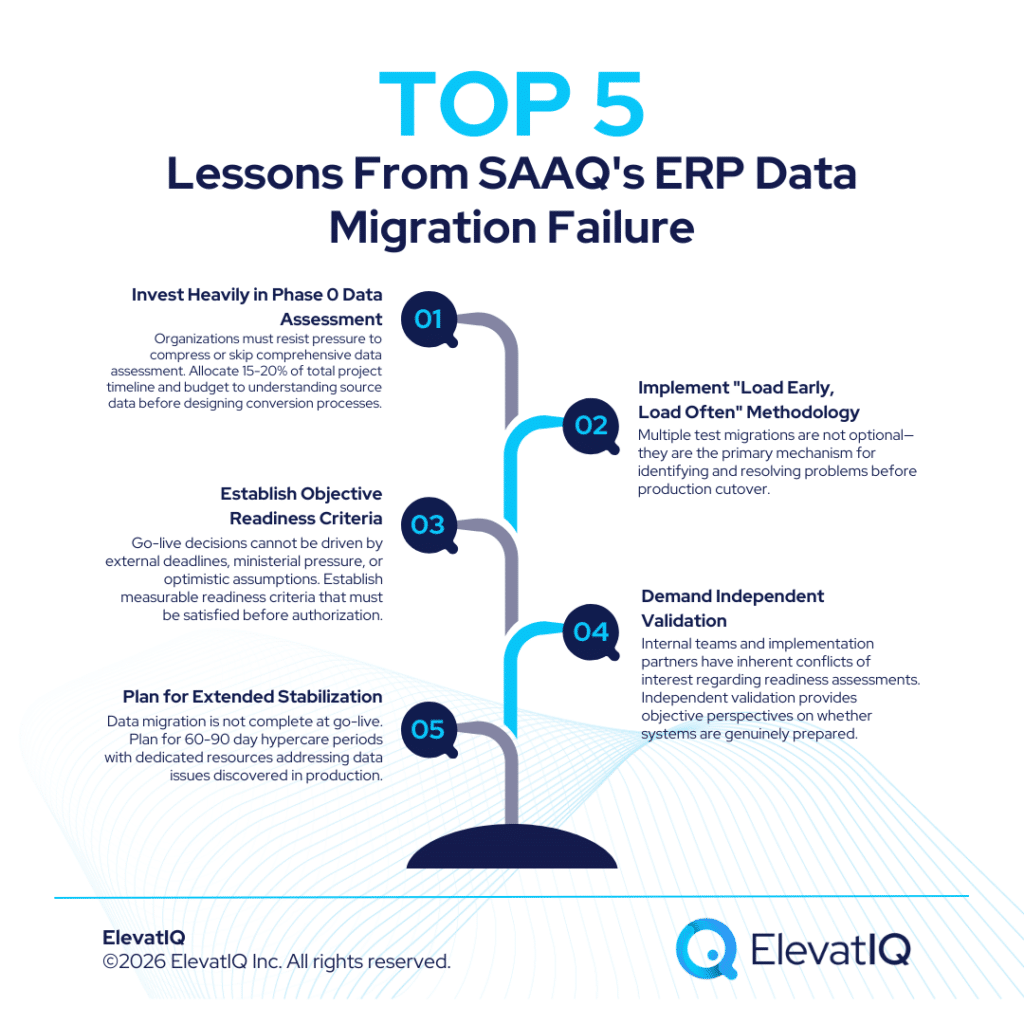
Lesson 1: Invest Heavily in Phase 0 Data Assessment
Organizations must resist pressure to compress or skip a comprehensive data assessment. Allocate 15-20% of the total project timeline and budget to understanding the source data before designing conversion processes.
Essential Phase 0 activities:
- Conduct comprehensive data profiling to identify quality issues, duplicates, and inconsistencies
- Document data lineage, understanding where data originates and how it flows through systems
- Establish data governance frameworks defining ownership, standards, and resolution processes
- Create detailed data maps showing relationships between legacy and target data structures
- Develop data quality metrics and acceptance criteria that must be met before migration
Lesson 2: Implement “Load Early, Load Often” Methodology
Multiple test migrations are not optional—they are the primary mechanism for identifying and resolving problems before production cutover.
Proven approach:
- First migration (6-9 months before go-live): Identify major data quality issues, mapping errors, and transformation logic problems
- Second migration (4-6 months before go-live): Validate that corrections from the first migration worked and identify remaining issues
- Third migration (2-3 months before go-live): Confirm data quality meets acceptance criteria with production volumes
- Final migration (go-live): Execute with confidence, knowing data conversion processes have been thoroughly validated
Organizations that conduct only one migration attempt during final cutover invariably discover problems when options for correction are severely limited.
Lesson 3: Establish Objective Readiness Criteria
Go-live decisions cannot be driven by external deadlines, ministerial pressure, or optimistic assumptions. Establish measurable readiness criteria that must be satisfied before authorization.
Data migration readiness criteria should include:
| Criterion | Measurement | Acceptance Threshold |
| Data completeness | Percentage of required fields populated | 100% for critical fields, >95% overall |
| Data accuracy | Sample validation matching source records | >99% accuracy on validated samples |
| Referential integrity | Orphaned records without valid parent references | <0.1% of total records |
| Performance | Query response times, transaction processing speed | Meet or exceed legacy system performance |
| User acceptance | Business user validation of migrated data | Formal sign-off from all departments |
Lesson 4: Demand Independent Validation
Internal teams and implementation partners have inherent conflicts of interest regarding readiness assessments. Independent ERP validation provides objective perspectives on whether systems are genuinely prepared.
Independent validation should assess:
- Data quality against established criteria
- Completeness of migration documentation
- Adequacy of testing coverage with production scenarios
- Accuracy of vendor/partner assertions about progress and readiness
- Risk assessment of proceeding versus delaying go-live
Lesson 5: Plan for Extended Stabilization
Data migration is not complete at go-live. Plan for 60-90 day hypercare periods with dedicated resources addressing data issues discovered in production.
Stabilization planning includes:
- War rooms with 24/7 support for first 2-4 weeks
- Data reconciliation processes comparing legacy and new system outputs
- Issue triage categorizing problems by business impact
- Rapid correction processes for critical data errors
- Communication protocols keeping stakeholders informed
Working with Independent ERP Advisors
Organizations planning data migrations often lack internal expertise to assess vendor claims, validate data quality, or make informed readiness decisions. Implementation partners have utilization targets and margin pressures that can influence recommendations. Internal teams face career implications if projects fail.
This is where independent ERP advisors provide essential oversight that protects organizational interests.
At ElevatIQ, we help organizations avoid ERP data migration failure through:
- Data Migration Strategy Development: We assess source data landscapes, recommend data cleansing approaches, design conversion methodologies, and establish realistic timelines based on actual data complexity.
- Readiness Validation: We conduct independent assessments at critical gates to validate whether data quality meets criteria for go-live or requires additional preparation time.
- Quality Assurance: We review data profiling results, validate test migration outcomes, assess completeness of data reconciliation, and identify gaps in conversion processes before production cutover.
- Risk Assessment: We evaluate data migration risks objectively, without commercial pressures to minimize timelines or understate complexity, providing realistic effort estimates and risk mitigation strategies.
Our independent position means recommendations focus on sustainable success rather than meeting arbitrary deadlines or protecting vendor/partner revenue.
Conclusion
The SAAQ SAAQclic disaster represents a textbook ERP data migration failure where fundamental best practices were violated, warning signs were ignored, and deadline pressure overrode quality concerns. The $500 million cost overrun and system that continues to experience significant functional and reliability issues two years after launch demonstrate the catastrophic consequences of underestimating data migration complexity.
Organizations can learn from SAAQ’s mistakes by investing heavily in Phase 0 data assessment, implementing “load early, load often” methodologies with multiple test migrations, establishing objective readiness criteria validated independently, resisting pressure to proceed when data quality is inadequate, and planning for extended post-go-live stabilization periods.
Data migration is the foundation upon which successful ERP implementations are built. Poor data quality creates problems that permeate every aspect of operations—inaccurate reporting, flawed analytics, broken integrations, and user distrust that undermines adoption. The cost of proper data migration planning and execution is minimal compared to the exposure from failures like SAAQ’s.
(This content is based on publicly available vendor statements, industry research, analyst insights, and practitioner experience and is provided for informational purposes only.)

ERP Selection: The Ultimate Guide
This is an in-depth guide with over 80 pages and covers every topic as it pertains to ERP selection in sufficient detail to help you make an informed decision.
FAQs
Related Posts: