
Last Updated on April 2, 2026 by Shrestha Dash
When Zimmer Biomet filed a $172 million lawsuit against Deloitte in September 2024, alleging that a failed SAP S/4HANA implementation “seriously disrupted our business” and “put patient care at risk,” the case highlighted a question that most ERP contracts systematically avoid answering until litigation forces the issue: who bears the financial risk when enterprise software implementations collapse?
In many cases, for organizations that sign vendor-provided agreements without extensive negotiation, the majority of financial risk remains with the customer. Standard ERP vendor contracts limit supplier liability to 6–12 months of fees paid, meaning a $2 million license with a $5 million implementation partner contract caps vendor exposure at $2–4 million, while the customer may absorb substantial losses, including publicly reported figures such as over $100 million in remediation costs (MillerCoors), significant revenue disruption (Lamb Weston), and tens of millions in operational impact (Zimmer Biomet).
ERP contract liability and indemnification provisions determine financial responsibility when software fails, integrators breach obligations, or implementations miss critical deadlines. Yet these clauses receive less procurement attention than pricing schedules, despite representing one of the most significant contractual risk factors in a multi-million-dollar technology investment. Organizations negotiate 5% off license fees while accepting standard limitation of liability language that caps their recovery at fractions of actual damages.
This blog examines how ERP contract liability and indemnification provisions actually work, why vendor-provided templates systematically favor suppliers over customers, what happens when ERP implementations fail and contracts prohibit adequate recovery, and which specific contractual mechanisms organizations should negotiate before signing, when leverage exists to shift risk allocation closer to balanced.

Why ERP Liability Matters More Than Organizations Realize
The structural challenge with ERP contract liability and indemnification provisions is that most organizations negotiate them during procurement, when everyone expects success. But enforce them post-failure, when operational disruption, financial losses, and board-level accountability have transformed theoretical contract language into consequential legal constraints.
The Hidden Imbalance in Standard Vendor Contracts
Standard ERP vendor and integrator agreements include multi-layered liability limitations designed to minimize supplier exposure while maximizing customer risk absorption. The structure typically includes:
- Exclusion of consequential damages: Vendors disclaim liability for lost profits, lost revenue, business interruption, data loss, reputational damage, or any indirect or consequential damages, categories that often represent the most significant financial impact of ERP failures. Lamb Weston’s $135 million Q3 revenue loss would be classified as “consequential damages” and excluded from recovery under standard contract language.
- Cap on direct damages: Even for breach of contract claims that survive the consequential damages exclusion, vendors limit total liability to fees paid over a defined period, typically 6–12 months. For a $2 million annual subscription, that caps direct damages at $1–2 million regardless of actual losses. For implementation partner contracts, the cap is often tied to fees paid for specific work orders or project phases, not total contract value.
- Time limitations for claims: Vendors impose contractual statutes of limitations requiring customers to bring claims within 12–24 months of the breach or failure. Organizations that spend 18 months attempting internal remediation before recognizing the ERP implementation cannot be salvaged may find themselves time-barred from recovery.
- Broadly worded disclaimer of warranties: Beyond express warranties (which vendors draft narrowly), standard contracts disclaim all implied warranties including merchantability, fitness for particular purpose, and non-infringement. This forces customers to prove breach of specific written commitments rather than relying on reasonable expectations about software functionality or implementation quality.
The combined effect is a liability structure where the vendor’s maximum exposure is capped at low single-digit millions while the customer’s operational, financial, and reputational exposure is uncapped and potentially catastrophic.
What Happens When Implementations Fail
The mechanics of ERP implementation failures reveal why ERP contract liability and indemnification provisions matter more than procurement teams typically appreciate during vendor selection.
MillerCoors vs. HCL Technologies (2016): MillerCoors (now Molson Coors) filed a $100 million lawsuit alleging HCL failed to deliver a functional ERP system, staffed the project inadequately, and failed to follow its own methodology. The complaint stated: “HCL’s failure to staff the project with a sufficient number of people and failure to follow its own methodology and quality assurance processes was done knowingly, or with reckless disregard for the impact such actions would have on MillerCoors.”
The case eventually settled, but the litigation costs, management distraction, and years of operational disruption exceeded any amount recoverable under standard ERP contract terms. The limitation of liability clause in the original agreement would have capped HCL’s exposure to a fraction of MillerCoors’ actual damages, which is precisely why the case required litigation rather than contractual remedy.
Waste Management vs. SAP (2008): Waste Management abandoned a $100 million SAP implementation and sued for breach of contract and fraud, alleging SAP misrepresented system capabilities and implementation readiness. SAP’s defense included invoking contractual disclaimers and liability limitations. The case settled after years of litigation.
The pattern across ERP implementation lawsuits is consistent: customers allege material breaches, misrepresentations, or failures to deliver promised functionality, while vendors invoke contractual liability limitations and warranties disclaimers that make recovery mathematically impossible within the agreement’s remedies framework. Litigation often becomes necessary not because the contract lacks dispute resolution mechanisms, but because the contract’s remedy provisions may be insufficient to address the scale of failure.


ERP Selection Requirements Template
This resource provides the template that you need to capture the requirements of different functional areas, processes, and teams.
The Anatomy of Limitation of Liability Clauses
Understanding how ERP contract liability and indemnification provisions actually operate requires examining the specific components that determine when liability is triggered, what damages are recoverable, and which carve-outs create exceptions to standard limitations.
The Two-Tiered Liability Structure
Vendor-provided ERP contracts typically use a two-tiered limitation structure:
Tier 1 — Exclusion of Damages by Type:
Standard language: “In no event shall Vendor be liable for any indirect, incidental, consequential, special, exemplary, or punitive damages, including but not limited to lost profits, lost revenue, loss of data, loss of use, business interruption, or cost of substitute goods or services, arising out of or relating to this Agreement, regardless of the form of action or theory of liability, whether in contract, tort, negligence, strict liability, or otherwise, even if Vendor has been advised of the possibility of such damages.”
This clause significantly limits vendor responsibility for precisely the damages ERP failures cause most frequently: revenue disruption, operational losses, and business continuation costs. Such clauses are generally enforceable in many jurisdictions, subject to applicable law and specific contractual carve-outs.
Tier 2 — Cap on Remaining Liability:
Standard language: “Vendor’s total cumulative liability arising out of or relating to this Agreement, whether in contract, tort, negligence, or otherwise, shall not exceed the amounts paid or payable by Customer to Vendor during the twelve (12) month period immediately preceding the event giving rise to liability.”
This caps direct damages, typically limited to breach of contract or warranty claims – at a rolling 12-month fee window. For subscription-based SaaS ERP, this means liability is capped at annual subscription fees ($500K–$5M depending on organization size). For implementation partner agreements billed on time-and-materials basis, the cap often references fees paid for the specific work order or project phase where the breach occurred, not total contract value.

ERP System Scorecard Matrix
This resource provides a framework for quantifying the ERP selection process and how to make heterogeneous solutions comparable.
The Carve-Outs That Actually Matter
Effective negotiation of ERP contract liability and indemnification requires identifying which risks justify exclusions from standard liability limitations and which carve-outs vendors will accept.
Data Loss and Security Breaches
Standard limitation language typically disclaims liability for data loss. This is unacceptable for ERP implementations where vendor or integrator actions could corrupt financial data, customer records, or operational history.
Recommended contract language:
“Notwithstanding any other provision in this Agreement, the limitation of liability shall not apply to: (a) Customer data loss or corruption caused by Vendor’s acts or omissions; (b) security breaches resulting from Vendor’s failure to maintain industry-standard security controls; (c) unauthorized access to Customer systems due to Vendor’s negligence or breach of security obligations. For claims arising under this Section, Vendor’s liability shall not exceed [3x annual fees OR a specified dollar amount based on risk assessment].”
This creates a separate, higher liability cap for data-related failures while avoiding unlimited liability that vendors will not accept.
Intellectual Property Indemnification
IP indemnification is the provision requiring the vendor to defend the customer against third-party claims that the software infringes patents, copyrights, or trade secrets. This is typically uncapped — meaning it is excluded from the general limitation of liability because vendors control the software’s development and are best positioned to assess IP risk.
Recommended contract language:
“Vendor shall indemnify, defend, and hold harmless Customer from and against any and all third-party claims alleging that the Software or Services infringe or misappropriate any patent, copyright, trademark, or trade secret. This indemnification obligation is not subject to the limitation of liability in Section [X] and shall include all costs of defense, settlement amounts, and damages awarded.”
Without explicit uncapped indemnification language, some vendor contracts attempt to subject even IP indemnification to the general liability cap. Thus, leaving customers exposed to third-party infringement claims while the vendor’s indemnity obligation is capped at inadequate amounts.
Gross Negligence and Willful Misconduct
Courts in many jurisdictions may decline to enforce limitation of liability clauses that protect parties from liability for gross negligence or intentional wrongdoing. However, relying on courts to invalidate unconscionable contract terms requires litigation.
Recommended contract language:
“The limitation of liability shall not apply to claims arising from: (a) fraud, willful misconduct, or criminal acts by either party; (b) gross negligence; (c) breach of confidentiality obligations; (d) violation of applicable law or regulation.”
This makes explicit what courts would likely enforce anyway, and creates contractual clarity that these behaviors carry full financial liability regardless of damage type or amount.
Implementation Failure Leading to Go-Live Postponement
Many ERP implementations fail not because the software never works, but because it works inadequately at planned go-live, forcing postponement, remediation, and extended parallel operations. Standard limitation language treats these as “delay damages” subject to exclusion.
Recommended contract language:
“If Software or Services fail to meet Acceptance Criteria at scheduled Go-Live Date due to Vendor or Implementation Partner’s breach of obligations under this Agreement or the Project Plan, and such failure results in postponement of Go-Live by [30] days or more, Vendor shall reimburse Customer for: (a) costs of extended parallel operations; (b) additional third-party consultant fees incurred for remediation; (c) incremental internal labor costs for rework. These reimbursements are not subject to the general limitation of liability and shall be calculated based on actual documented costs.”
This creates contractual recovery for a common type of ERP failure, a system that cannot launch on schedule due to vendor performance issues.
Indemnification: Who Defends When Third Parties Sue?
While limitation of liability addresses financial responsibility between contracting parties, indemnification addresses responsibility for third-party claims. In ERP contexts, indemnification becomes critical when implementation failures create downstream liability to customers, regulators, or business partners.
The Mechanics of Indemnification Obligations
An indemnification clause requires one party (the indemnitor) to defend, reimburse, or hold harmless the other party (the indemnitee) against specified third-party claims or losses.
Standard vendor indemnification language: “Vendor shall indemnify Customer against third-party claims alleging that the Software infringes intellectual property rights.”
This is narrow — covering only IP claims, not operational failures, data breaches affecting customer data, or regulatory violations.
What Indemnification Should Cover in ERP Contracts
Effective ERP contract liability and indemnification provisions require expanding indemnification scope beyond the narrow IP-only protection vendors offer by default.
Indemnification for Data Breaches Affecting Customer’s Customers:
When an ERP system stores customer data (common in e-commerce, distribution, and services businesses) and a vendor-caused security breach exposes that data, the customer faces regulatory fines, customer notification costs, credit monitoring obligations, and potential class-action litigation.
Recommended contract language:
“Vendor shall indemnify, defend, and hold harmless Customer from and against any and all third-party claims, including regulatory actions, arising from: (a) unauthorized access to or disclosure of data stored in the Software due to Vendor’s failure to maintain security controls documented in Exhibit [Security Standards]; (b) breach of data protection laws (including GDPR, CCPA, or successor legislation) caused by Vendor’s acts or omissions. Vendor’s indemnification obligations under this Section include all costs of regulatory response, customer notification, credit monitoring, legal defense, settlements, and judgments.”
This shifts responsibility for vendor-caused data breaches to the party that controls the security infrastructure.
Indemnification for Regulatory Non-Compliance:
ERP systems in regulated industries (pharmaceuticals, medical devices, financial services, food and beverage) must support compliance with industry-specific regulations. When vendor-delivered functionality fails to meet regulatory requirements and results in regulatory action, the customer should not bear sole responsibility.
Recommended contract language:
“If Software fails to provide functionality documented in Exhibit [Regulatory Requirements] and such failure results in Customer’s non-compliance with applicable regulations, Vendor shall: (a) indemnify Customer for fines, penalties, and remediation costs imposed by regulatory authorities; (b) promptly modify Software at no additional charge to achieve compliance; (c) reimburse Customer’s costs of implementing temporary workarounds pending Software modification.”
This creates contractual accountability for regulatory functionality commitments that vendors make during sales cycles but disclaim in standard ERP contract terms.
Mutual vs. Unilateral Indemnification
Vendor-provided contracts typically include unilateral indemnification — the customer indemnifies the vendor, but the vendor’s indemnification of the customer is limited to narrow IP claims.
What customers indemnify vendors for (standard language):
“Customer shall indemnify Vendor against any claims arising from: (a) Customer’s use of the Software in violation of applicable law; (b) Customer’s breach of confidentiality obligations; (c) claims by Customer’s employees, contractors, or customers arising from Customer’s use of the Software; (d) combination of the Software with Customer’s systems or third-party products.”
What vendors indemnify customers for (standard language):
“Vendor shall indemnify Customer against third-party claims that the Software infringes intellectual property rights.”
This imbalance means customers agree to broad protection of vendors while receiving narrow IP-only protection in return.
Recommended approach:
Negotiate for mutual indemnification where each party indemnifies the other for claims arising from that party’s breach, negligence, or failure to perform contractual obligations. This creates balanced risk allocation rather than the standard one-sided structure.
The Insurance Backstop That Often Doesn’t Exist
Even when organizations negotiate improved limitation of liability and indemnification provisions, contractual remedies are only as valuable as the vendor’s or integrator’s ability to pay. Insurance requirements provide the financial backstop.
What Insurance Vendors Should Carry
Standard ERP contracts require vendors to maintain commercial general liability and workers’ compensation insurance but omit coverage types that are particularly relevant for ERP implementation failures.
- Professional liability (errors and omissions) insurance: Covers claims arising from professional services failures, including implementation partner negligence, inadequate staffing, failure to follow methodology, or delivery of defective work product. This is the coverage that would respond to claims like MillerCoors alleged against HCL.
- Cyber liability insurance: Covers data breaches, security failures, ransomware incidents, and regulatory fines. This is the coverage that would respond when vendor security failures compromise customer data.
- Technology errors and omissions insurance: Covers software failures, functionality defects, and system performance issues. This is the coverage that would respond when delivered software fails to meet specifications.
Recommended contract language:
“Vendor shall maintain, at Vendor’s expense, the following insurance coverage throughout the Term and for [24] months following termination: (a) Professional Liability Insurance with limits of not less than $[X] per claim and $[Y] aggregate; (b) Cyber Liability Insurance with limits of not less than $[X] per claim; (c) Technology Errors and Omissions Insurance with limits of not less than $[X] per claim. Vendor shall name Customer as an additional insured on all applicable policies and shall provide certificates of insurance evidencing such coverage upon request.”
The coverage limits should be scaled to contract value and risk exposure — typically 1x–2x total contract value for implementation partners, and higher for software vendors supporting mission-critical operations.
The Certificate of Insurance Isn’t Enough
Requiring insurance certificates at contract signing creates compliance documentation but doesn’t ensure coverage remains in force throughout multi-year implementations. Vendors can cancel policies, change carriers, or reduce coverage limits mid-contract.
Recommended contract language:
“Vendor shall provide Customer with [30] days’ advance written notice of any cancellation, non-renewal, material change in coverage, or reduction in policy limits for any insurance required under this Agreement. Failure to maintain required insurance constitutes a material breach permitting Customer to terminate for cause and recover damages.”
This creates contractual consequences for lapses in coverage and provides advance warning before protection disappears.
The Question Every Board Should Ask Before Signing
Organizations that treat ERP contract liability and indemnification as boilerplate legal terms rather than strategic risk allocation decisions systematically underestimate their exposure when implementations fail. The board-level question is not “did we negotiate a discount on license fees?” but rather “if this implementation collapses at go-live, what percentage of our actual losses are contractually recoverable?”
For most organizations operating under vendor-provided contract templates, the answer is often a small fraction of total losses, in some cases less than 10%. A $135 million revenue loss subject to a $2 million liability cap which could represent recovery in the low single-digit percentage range.
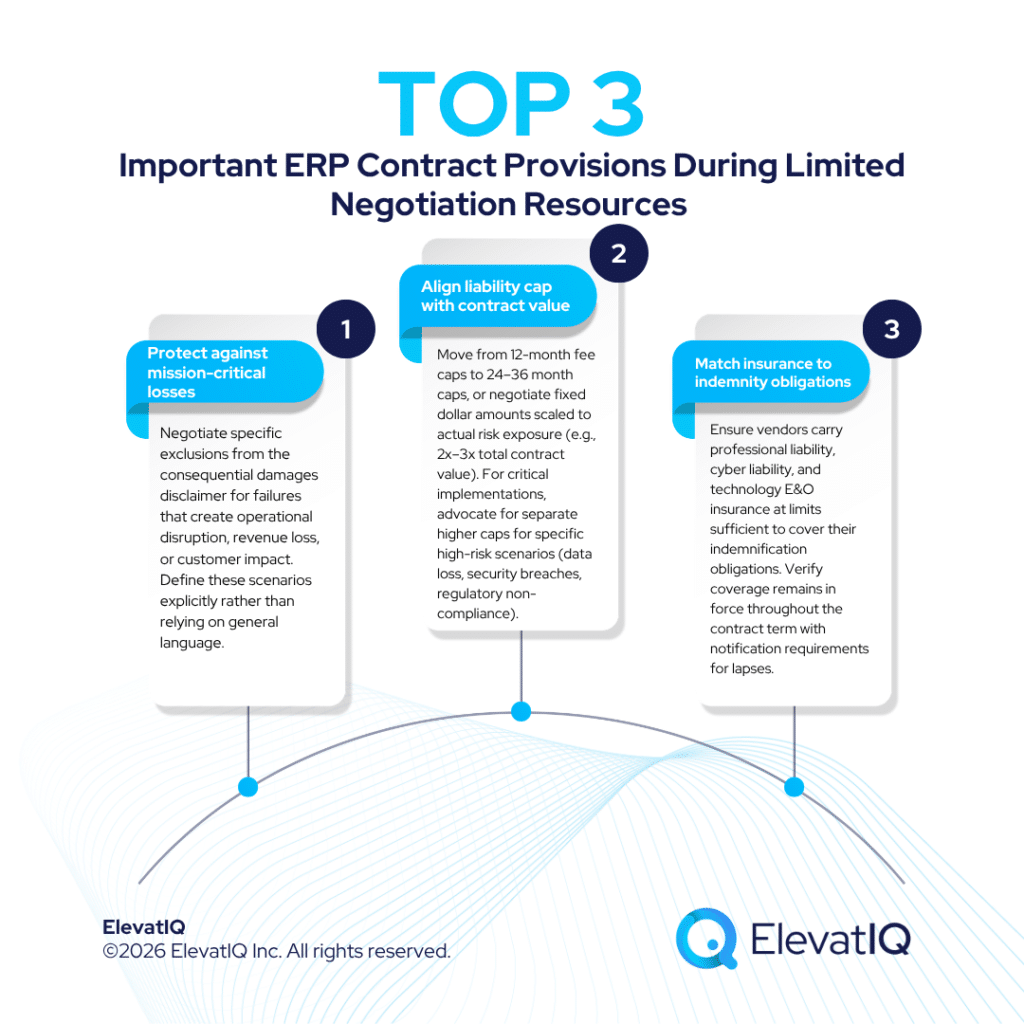
The Three Contract Provisions That Matter Most
If contract negotiation resources are limited, prioritize these three provisions over all others:
1. Expand consequential damages carve-outs for mission-critical failures
Negotiate specific exclusions from the consequential damages disclaimer for failures that create operational disruption, revenue loss, or customer impact. Define these scenarios explicitly rather than relying on general language.
2. Increase the liability cap to meaningful multiples of contract value
Move from 12-month fee caps to 24–36 month caps, or negotiate fixed dollar amounts scaled to actual risk exposure (e.g., 2x–3x total contract value). For critical implementations, advocate for separate higher caps for specific high-risk scenarios (data loss, security breaches, regulatory non-compliance).
3. Require insurance coverage that matches contractual indemnification obligations
Ensure vendors carry professional liability, cyber liability, and technology E&O insurance at limits sufficient to cover their indemnification obligations. Verify coverage remains in force throughout the contract term with notification requirements for lapses.
What Independent ERP Advisors Identify That Internal Teams Miss
The structural challenge in negotiating ERP contract liability and indemnification is that procurement teams lack visibility into how other organizations have structured these provisions, what terms are genuinely negotiable, and where vendors draw non-negotiable lines.
Independent ERP advisors provide:
- Benchmark data on liability caps negotiated by comparable organizations (median: 18–24 months of fees; aggressive: 36 months or fixed amounts of 2x–3x contract value)
- Contract language templates that explicitly address data loss, security breaches, regulatory non-compliance, and go-live postponement, the scenarios that standard vendor terms often exclude
- Vendor negotiation leverage — vendors recognize that experienced advisors understand which provisions are enforceable, which create litigation risk for vendors, and where compromise is achievable
The financial return on advisory engagement is measurable. An advisor fee of $50,000 that secures contractual recovery rights for 25% of actual damages rather than the vendor-template 5% creates $20 million in potential downside protection on a $100 million implementation failure, a 400x return if the worst-case scenario materializes.
The Conclusion
ERP contract liability and indemnification provisions determine financial consequences when implementations fail. Organizations that treat these as standard legal boilerplate rather than strategic risk allocation decisions consistently underestimate their exposure and overestimate their contractual remedies.
The uncomfortable reality is that standard vendor contracts often allocate a significant portion of implementation risk to customers while capping vendor exposure at levels that may be insufficient to address the full scale of potential failure consequences. A $2 million liability cap provides no meaningful protection against a $135 million operational collapse. An IP-only indemnification clause provides no protection against the data breaches, regulatory violations, or business continuity failures that represent the majority of ERP implementation risks.
Effective negotiation requires identifying which risks justify exclusions from standard limitation language, which indemnification obligations vendors will accept, and which insurance requirements create financial backstops when contractual remedies prove inadequate. These negotiations occur during procurement when leverage exists, not after go-live when operational dependency has eliminated negotiating power.
For organizations currently evaluating ERP platforms, mid-negotiation, or reviewing draft contracts before signature, the team at ElevatIQ provides independent ERP advisory support across contract negotiation, liability provision benchmarking, and vendor engagement strategy at exactly the stage where these decisions determine whether implementation risk remains manageable or becomes catastrophic.
All commentary and analysis represent an independent ERP advisory perspective based on industry standards, legal precedent, and cited primary sources.

ERP Selection: The Ultimate Guide
This is an in-depth guide with over 80 pages and covers every topic as it pertains to ERP selection in sufficient detail to help you make an informed decision.
FAQs
Related Posts: