
Last Updated on March 16, 2026 by Shrestha Dash
In December 2025, Rhode Island deployed the payroll module of its $91.2 million Workday-based ERP system to 15,000+ state employees. By January 2026, employees reported missing wages, incorrect pay calculations, overtime errors, and benefits deduction failures. In February 2026, hundreds of state workers received W-2 tax forms listing their employer as the “State of Rhode Island Umbrella Company”. A system configuration label that was never intended for external distribution.
By March 2026, Governor Dan McKee had fired the Director of Administration. The state’s ERP remained in “hyper care” stabilization mode with implementation partner Accenture. And also unions were demanding accountability for what they characterized as “the latest and most embarrassing failure”. These payroll errors were affecting critical workers, including correctional officers, cancer patients on medical leave, and employees with decades of state service.
This state government ERP payroll failure represents the ERP implementation pattern that turns technically successful system deployments into operational disasters. The software may be technically operational and the integrations functioning. But the system appears to struggle with accurately processing the complex payroll rules, union agreements, and benefit structures that govern public sector compensation. The result is a system that is “live” in production but fundamentally unreliable. Especially for the core business process, it was implemented to support.
The Scope: A System Six Years in Planning That Failed in Four Pay Cycles
Rhode Island’s ERP modernization began planning in 2019. Nearly all Department of Administration internal processing remained manual. Timesheets submitted as hard copies or PDFs, payroll calculations performed on a decades-old COBOL-based mainframe system, and financial operations supported by spreadsheets. The state’s Director of Administration at the time characterized operations as “relying on typewriters and carbon paper.”
The modernization project proceeded in two phases:
- Phase 1 (July 2025): Financial operations modules go live – accounts payable, general ledger, procurement, budgeting. This deployment occurred relatively smoothly with minimal reported disruptions.
- Phase 2 (November 2025): Human Capital Management (HCM) and payroll modules deploy, replacing legacy COBOL payroll system. This is where the state government ERP payroll failure began.
Within four pay cycles (December 2025 through January 2026), the following payroll failures were documented by state employee unions:
- Missing wages: Employees not receiving full pay for hours worked, with some paychecks thousands of dollars short
- Incorrect overtime calculations: Shift differentials, hazard pay, and overtime formulas failing to calculate correctly across different union contracts
- Benefits deduction errors: Health insurance, retirement contributions, and other deductions either not processed or processed incorrectly
- Leave accrual failures: Vacation, sick leave, and other time-off balances not updating correctly, creating situations where employees with accrued leave showed as “leave without pay” in system records
- Payment timing issues: Some employees receiving paychecks late or not at all during specific pay periods
The impact was immediate and personal for state employees who rely on predictable paychecks to manage mortgages, medical expenses, and family budgets. One correctional officer reported being shorted $6,300 in a single paycheck. An employee undergoing cancer treatment faced “leave without pay” status because required medical leave documentation was not processed during the ERP transition, potentially affecting health insurance coverage during active treatment.
The Root Cause Of the State Government ERP Payroll Failure
Rhode Island’s state government ERP payroll failure follows a pattern documented across government Workday implementations nationwide: the software is sophisticated and cloud-native, but government payroll requirements are more complex than the vendor’s standard functionality handles without extensive customization.
What makes government payroll different from private sector
According to Director of Administration testimony before the state legislature in March 2025, Rhode Island’s implementation required “going through 50-plus collective bargaining agreements and rules and regulations around payroll.” Each union contract contains unique compensation formulas:
- Shift differentials that vary by time of day, day of week, and employee classification
- Overtime calculation rules that differ across unions and may compound (overtime on holiday pay, overtime on shift differential, etc.)
- Hazard pay provisions triggered by specific working conditions or assignments
- Leave accrual formulas that vary based on years of service, classification, and contract provisions
- Pension and retirement contribution calculations tied to specific pay categories and benefit tier structures
Workday’s standard payroll functionality is designed for conventional salaried and hourly employment structures. Government union contracts often introduce layered payroll rules where a single employee’s pay calculation may involve multiple simultaneous provisions that require extensive configuration and testing. The result: the system calculates payroll, but the calculations are frequently wrong. From a vendor perspective, the platform may be functioning as configured. For employees, however, the only metric that matters is whether the paycheck is correct, and in many cases, it was not.


ERP Selection Requirements Template
This resource provides the template that you need to capture the requirements of different functional areas, processes, and teams.
The “Hyper Care” That Never Ends
ERP vendors typically include “hyper care” periods in implementation contracts, intensive post-go-live support lasting 30–90 days while the system stabilizes and remediation occurs for issues discovered in production. Rhode Island’s ERP has been in hyper care with implementation partner Accenture since the November 2025 payroll deployment, with support scheduled to continue through at least March 2026.
This extended hyper care period signals a fundamental problem: the system is not stabilizing, it is being actively managed to prevent operational collapse. Four months of continuous crisis support suggests the implementation did not achieve production readiness before go-live occurred.
What hyper care typically involves:
- Dedicated vendor resources monitoring system performance in real time
- Rapid response teams addressing critical errors as they emerge
- Daily or weekly calls between vendor, implementation partner, and client to review open issues
- Emergency configuration changes and patches deployed outside normal release cycles
What hyper care should not involve is fundamental reconfiguration of payroll calculation logic – yet Rhode Island’s ongoing support strongly suggests the system requires more than bug fixes and performance tuning. When hundreds of employees receive incorrect W-2 forms four months after go-live, the problems are not isolated edge cases but systemic configuration or data quality failures.
The financial implications are significant. Extended hyper care periods can add significant unplanned costs depending on vendor resource levels and support intensity. For Rhode Island, an extended hyper care period could represent additional unplanned costs beyond the $91.2 million contract value if stabilization support continues for several months.

ERP System Scorecard Matrix
This resource provides a framework for quantifying the ERP selection process and how to make heterogeneous solutions comparable.
The Political Accountability Of The ERP Failures Cost
In March 2026, Governor McKee fired the Director of Administration following the W-2 “umbrella company” debacle. This executive-level accountability for state government ERP payroll failure is unusual – most ERP implementation problems result in vendor blame, consultant turnover, or mid-level staff reassignments, but rarely in cabinet-level terminations.
The Director of Administration termination signals political recognition that the ERP failure is not a technical IT problem but a governance and management crisis affecting 15,000+ employees and undermining public confidence in basic government operations.
Why this matters for future state ERP implementations
When executives face termination for ERP failures, it changes the risk calculation for successor leaders. The next Director of Administration inherits a partially functional system, ongoing vendor support costs, union grievances, and political pressure to “fix” problems without additional budget or timeline delays. This creates defensive decision-making: prioritize avoiding further visible failures over addressing root causes that might require system redesign or re-implementation.
Rhode Island has experienced this dynamic before. In 2016, a failed unified healthcare benefits portal (RIBridges) led to the resignation of the Health and Human Services Secretary and the Chief Technology Officer. That failure prompted a statewide IT project freeze and eventually a system rebuild. The pattern suggests Rhode Island struggles with large-scale ERP implementations across multiple administrations and vendors, pointing to organizational capacity or governance gaps that transcend individual technology choices.
The Lessons: What Others Must Learn From Rhode Island’s ERP Payroll Failure
Rhode Island’s state government ERP payroll failure provides specific, actionable lessons for any state or municipality planning government ERP implementations.
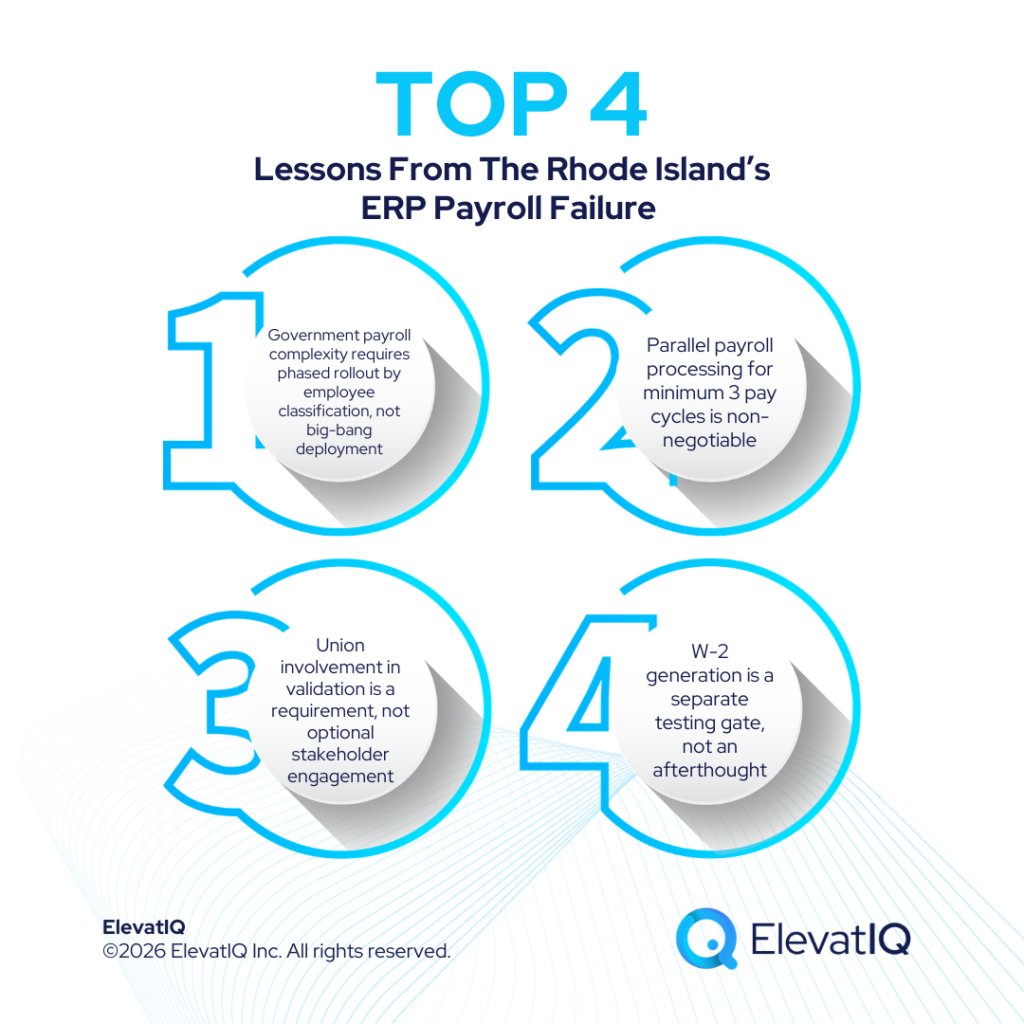
Government payroll complexity requires phased rollout by employee classification, not big-bang deployment
Rather than deploying payroll to all 15,000+ employees simultaneously across 50+ union contracts, Rhode Island should have implemented sequentially: start with salaried exempt employees with simple pay structures (no overtime, no shift differentials, standard benefits), validate calculations are correct, then add hourly non-exempt employees, then add complex union classifications incrementally.
This sequential approach allows configuration errors to be identified and fixed in controlled populations before cascading to the entire workforce. The timeline delay, potentially 6–12 months longer than big-bang deployment, is far preferable to four months (and counting) of payroll errors affecting everyone.
Parallel payroll processing for minimum 3 pay cycles is non-negotiable
The state should have run parallel payroll, processing every paycheck in both the old COBOL system and the new Workday system simultaneously. And, reconciled every employee’s pay calculation before trusting Workday as the sole system of record. Only after 3+ cycles of perfect reconciliation should cutover have occurred. Rhode Island appears to have skipped parallel processing or conducted it inadequately, gambling that Workday configuration was correct based on testing with sample data rather than full employee population with real union contracts.
Union involvement in validation is a requirement, not optional stakeholder engagement
Government payroll is governed by collective bargaining agreements, which means union representatives are the subject matter experts on compensation rules. They should have been deeply involved in:
- Validating that Workday configuration matched contract language
- Reviewing test payroll calculations for sample employees from each classification
- Signing off on payroll accuracy before go-live as a formal gate
Treating unions as stakeholders to be “managed” rather than validation partners creates the adversarial dynamic Rhode Island now faces, where unions publicly demand accountability while the state defends the vendor’s performance.
W-2 generation is a separate testing gate, not an afterthought
The “umbrella company” W-2 error reveals a specific failure: no one tested W-2 form generation before deployment. W-2s pull data from payroll records but format that data according to IRS requirements and employer configuration. Testing should have generated sample W-2s, verified all fields populated correctly, and validated employer information before distributing forms to employees and transmitting to IRS. This is an example of a downstream process (W-2 generation in February) failing due to inadequate configuration of an upstream system (Workday employer setup during ERP implementation). Comprehensive testing identifies these dependencies before they become public embarrassments.
The Conclusion
Four months after deployment, the system still required stabilization support, employees continued reporting payroll errors, unions were filing grievances, and the administration had replaced the Director of Administration. Taken together, these developments suggest the system may have gone live before full production readiness was achieved. The state government ERP payroll failure was predictable and preventable through longer testing, parallel processing, phased rollout, and union validation, all standard practices in government payroll ERP implementations.
The decision to proceed with big-bang deployment across 15,000+ employees and 50+ union contracts despite the known complexity was a risk management failure. That decision may have been driven by timeline pressure, budget constraints, or vendor commitments but regardless of cause, the result is the same: a $91.2 million system that cannot reliably perform the core function it was implemented to support. States and municipalities currently planning payroll modernization, Rhode Island’s experience provides a clear roadmap of what not to do. For those mid- ERP implementation, it demonstrates why independent validation, phased rollout, and union engagement are not bureaucratic delays but essential safeguards against operational disaster.
For organizations seeking independent advisory support for government ERP planning, vendor evaluation, or implementation oversight, the team at ElevatIQ provides specialized consulting for public sector technology implementations at exactly the stage where these decisions determine whether systems succeed or become multi-year crisis management exercises.
All commentary represents an independent editorial perspective based on publicly reported information and government ERP implementation standards.

ERP Selection: The Ultimate Guide
This is an in-depth guide with over 80 pages and covers every topic as it pertains to ERP selection in sufficient detail to help you make an informed decision.
FAQs
Related Posts: