
Last Updated on July 21, 2026 by Shrestha Dash
Key Highlights
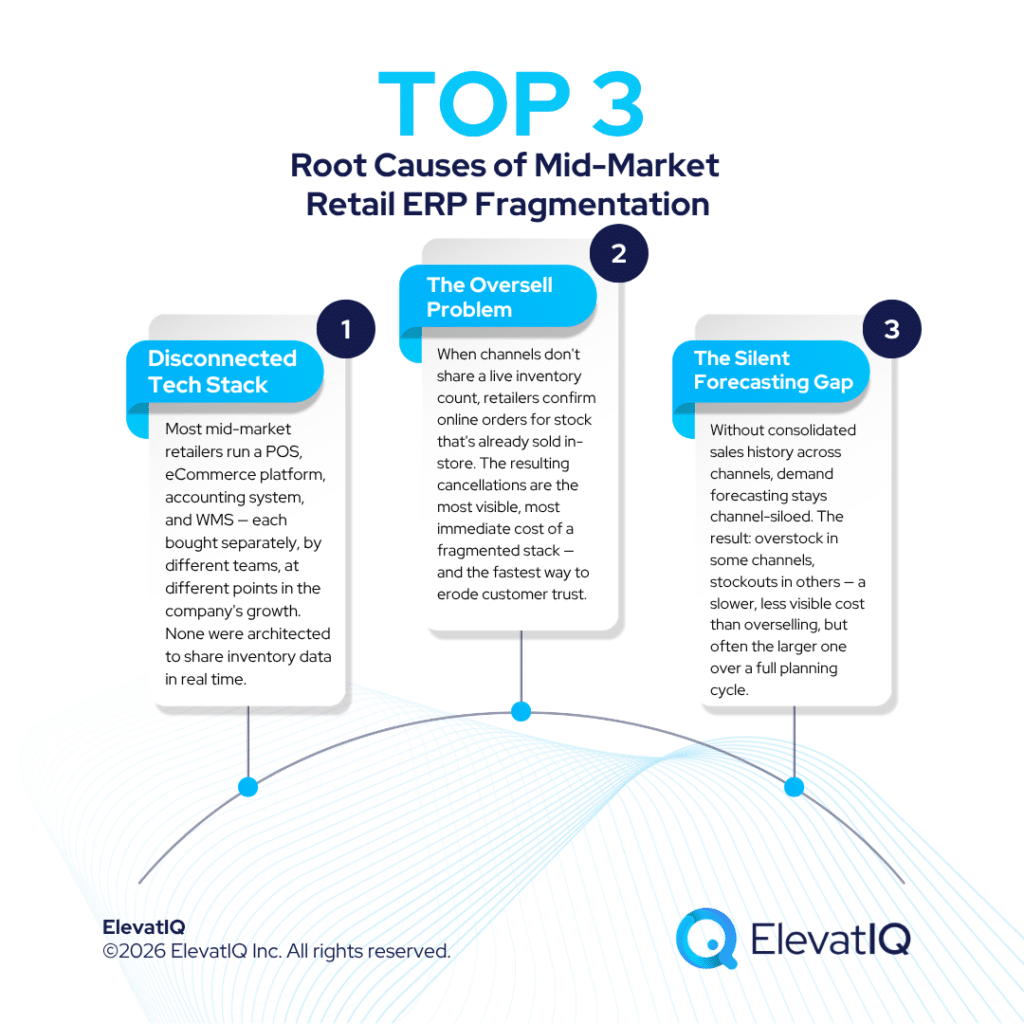
- Most mid-market retail ERP challenges begin with a tech stack built one system at a time: a POS, an eCommerce platform, a basic accounting system, and a WMS. None of which were architected to share inventory data in real time.
- The most immediate and visible consequence of this fragmentation is overselling: when channels don’t share a live inventory count, retailers confirm orders for stock that no longer exist, and the resulting cancellations quietly erode customer loyalty.
- Unified commerce platforms promise to solve the mid-market retail ERP challenges omnichannel fragmentation caused by collapsing the stack into one system but best-in-class POS, eCommerce, and warehouse management rarely come from a single vendor, and the trade-offs are often underestimated at the point of selection.
- Without consolidated sales history across channels, demand forecasting stays channel-siloed, which shows up later as a recurring pattern of overstock in some channels and stockouts in others. A slower, less visible cost than overselling but often a larger one.

Introduction
For many mid-sized retailers, the technology conversation often circles back to the same question: why doesn’t the software talk to itself?
The POS system knows what is sold in the store today. The eCommerce platform knows what is sold online. The accounting system knows what should reconcile at month-end. The warehouse management system knows what’s physically on the shelf. Each system is confident in its own version of the truth and none of them are looking at the same truth at the same time.
This is the core of the mid-market retail ERP challenges created today in omnichannel operations. It isn’t that any individual system is poorly built. It’s that these systems were rarely designed, purchased, or implemented as parts of a single connected architecture. They were bought one at a time, by different teams, at different points in the company’s growth, to solve different immediate problems. The connective tissue between them was never part of the original plan and retailers are left reconciling the gap manually, one report at a time.
This blog looks at where that gap shows up most visibly, why the “one system for everything” pitch rarely delivers what it promises in practice, and what a more deliberate approach to architecture looks like for mid-market retailers weighing their options.
The Mid-Market Retail Tech Stack Reality
Understanding mid-market retail ERP challenges omnichannel operations create starts with an honest look at what’s actually running underneath most retail businesses in this revenue range.
What a Typical Mid-Market Retail Stack Looks Like
| System | Typical Role | Common Limitation |
| POS | In-store checkout and transaction processing | Chosen for checkout speed and hardware reliability, not integration depth |
| eCommerce Platform | Online storefront and order capture | Operates on its own inventory feed, often synced on a delay |
| Accounting System | Financial recordkeeping and reporting | Frequently a lower-tier system, reconciled manually against sales data |
| WMS | Inventory movement and fulfillment in the distribution center | Tracks physical stock accurately, but not always visible to other systems in real time |
Each of these systems performs its individual function reasonably well. The problem sits in the white space between them. Inventory counts often sync on a scheduled basis rather than continuously, although some modern retail architectures support near-real-time synchronization. Order data lives in separate silos. Customer records don’t merge cleanly across channels. Finance teams may spend significant effort reconciling numbers at month-end when systems are not fully integrated.
This is not a failure of any single vendor. It’s the predictable outcome of best-of-breed tools, each optimized for one job, that were never designed to operate as a connected whole.


ERP Selection Requirements Template
This resource provides the template that you need to capture the requirements of different functional areas, processes, and teams.
The Oversell Problem: Retail’s Most Visible Symptom of Fragmentation
Of all the mid-market retail ERP challenges omnichannel fragmentation produces, overselling is the one customers experience directly and the one most likely to damage brand trust in a single interaction.
The mechanics are straightforward. A customer buys the last unit of a product in-store. The eCommerce platform doesn’t know that yet, because inventory sync between POS and eCommerce runs on a delay rather than in real time. An online customer places an order for the same item minutes later. The order gets confirmed, for stock that no longer exists.
What follows is a predictable and costly sequence: a cancellation notice, a refund, a customer service interaction. Repeated fulfillment issues can negatively affect customer satisfaction and loyalty. Recent industry coverage of omnichannel fulfillment points to overselling, stockouts, delayed orders, and inconsistent service across channels as the typical symptoms of weak inventory visibility. These problems tend to compound as retailers add more channels without adding more margin for error.
Why Overselling Persists Even as Retailers Scale
| Root Cause | Operational Effect |
| Inventory sync runs on a schedule, not continuously | A sale in one channel isn’t reflected elsewhere until the next sync cycle |
| No single system of record for available-to-sell inventory | Each channel makes commitments based on its own, sometimes stale, view of stock |
| Safety stock and channel allocation rules are inconsistent or undefined | Systems default to showing full available inventory as sellable everywhere |
The fix is conceptually simple i.e. real-time, unified inventory visibility across every channel but it requires either a platform that natively unifies inventory across POS, eCommerce, and the warehouse, or an integration layer disciplined enough to sync changes across systems in near real time, with clear rules for how allocation and safety stock are handled. Many mid-market retailers continue to struggle with implementing either approach consistently, which is why this particular pain point tends to persist for years even as the rest of the business scales.

ERP System Scorecard Matrix
This resource provides a framework for quantifying the ERP selection process and how to make heterogeneous solutions comparable.
Why “ERP for Retail” Often Overpromises
This is where the “one system for everything” pitch runs into the reality of how retail software actually gets built.
Unified commerce platforms, whether positioned as retail-specific ERP or all-in-one commerce suites, genuinely can reduce the number of systems a retailer has to manage, and for some businesses that trade-off makes sense. But the caveat that doesn’t always make it into the vendor conversation is this: organizations often find that leading capabilities in POS, eCommerce, and warehouse management may come from different vendors. A platform strong enough to run high-volume distribution center operations is frequently not the same platform offering the most flexible, conversion-optimized storefront experience.
Unified Platform vs. Best-of-Breed: The Real Trade-offs
| Consideration | Unified Platform | Best-of-Breed (Integrated) |
| Number of systems to manage | Fewer, often one core platform | More, requiring active integration management |
| Depth of functionality per module | Generally adequate across the board | Can be best-in-class in each specific area |
| Implementation complexity | Lower upfront, but harder to reverse | Higher upfront, concentrated in integration design |
| Long-term flexibility | Constrained by a single vendor’s roadmap | More flexible, dependent on integration discipline |
| Best fit | Simpler catalogs, fewer fulfillment variations | Complex fulfillment, differentiated channel experiences |
When a unified platform vendor says it “does everything,” organizations should carefully evaluate whether a unified platform delivers the depth of functionality required for their most critical business processes. For a retailer whose competitive advantage depends on a best-in-class online experience or a highly tuned warehouse operation, that gap between adequate and best-in-class can be a real cost, even if it doesn’t show up until well after the ERP implementation is complete.
The alternative i.e. keeping specialized, best-of-breed systems and integrating them, comes with its own underestimated cost. Integration work is rarely as simple as “connect the APIs.” It requires deciding which system owns which data, how conflicts are resolved when two systems disagree, how real-time the sync genuinely needs to be for each data type, and who maintains that integration as each platform gets upgraded independently. This is architecture work, not configuration work, and it’s frequently underscoped at the point of vendor selection.
The Demand Forecasting Gap Nobody Talks About
Fragmented systems don’t only create tactical problems like overselling, they quietly undermine strategic buying decisions too, and this gap tends to go unnoticed for far longer.
Reliable demand forecasting depends on consolidated sales history across every channel a product sells through. Forecasting may become channel-siloed when data from multiple channels is not consolidated effectively. Buyers make purchasing decisions based on eCommerce trends without full visibility into in-store demand, or the reverse. The result is a familiar and expensive pattern: overstocked in some channels, chronically out-of-stock in others, with working capital tied up in the wrong inventory in the wrong place.
How the Forecasting Gap Compounds Over Time
| Stage | What Happens | Downstream Cost |
| Sales data | Captured separately by channel, not consolidated | Forecasts reflect only part of true demand |
| Buying decisions | Based on incomplete, channel-specific trends | Purchase quantities misaligned with actual demand |
| Inventory allocation | Set without a unified view of where demand is strongest | Overstock in slower channels, stockouts in faster ones |
| Financial impact | Discovered at markdown time or during a stock audit | Margin erosion that’s hard to trace back to its root cause |
This is a harder problem to notice than overselling because it doesn’t generate a customer complaint, it shows up instead in markdowns, carrying costs, and buying decisions made on incomplete information without anyone realizing it at the time. Over a full planning cycle, it can become a significant operational and financial challenge over time. Precisely because it stays invisible until someone finally consolidates the data and sees the pattern laid out.
How an Independent ERP Advisory Consultant Can Help Here
The honest answer to “should we go with a unified platform or a best-of-breed integrated stack” is that it depends on the business: its channel mix, its fulfillment complexity, its growth trajectory, and how much of its competitive differentiation actually lives inside the systems being evaluated. There is no universally correct answer, which is exactly why this decision deserves to be made deliberately rather than reverse-engineered after a contract is already signed.
Vendor-Led vs. Independent Architecture Evaluation
| Phase | Vendor-Led Evaluation (Common) | Independent Advisory Approach |
| Starting point | Platform demo, feature checklist | Business requirements mapped first: channel mix, fulfillment models, growth plans |
| Recommendation basis | Shaped by the vendor’s own product scope | Shaped by what the business actually needs, regardless of vendor |
| Unified vs. best-of-breed | Framed as a foregone conclusion by the vendor pitching | Evaluated on its merits for the specific retailer |
| Integration planning | Often addressed after platform selection | Designed as part of the architecture decision, before commitment |
| Ongoing incentive | Vendor benefits from a sale either way | No stake in which architecture is chosen |
At ElevatIQ, we work with mid-market retailers on exactly this question: whether a unified commerce platform or an integrated best-of-breed architecture is the right fit for their specific business, before they commit to either path. As an independent ERP consulting firm, we don’t sell software and don’t take referral fees from vendors, which means our enterprise architecture recommendations aren’t shaped by which platform we’re incentivized to place. Our role is to map a retailer’s actual operational requirements against what each architectural approach can realistically deliver, so the decision is grounded in the business rather than in a vendor’s roadmap.
For retailers already living with the symptoms described above, addressing underlying architectural decisions may help resolve many of these recurring operational challenges. Not another point solution layered on top of an already fragmented stack.
Conclusion
Mid-market retail ERP challenges omnichannel operations tend to follow recognizable patterns, which also means they’re identifiable before they become expensive. The retailers who navigate this most successfully share a common trait: they treat the unified-versus-best-of-breed decision as an architecture question to be answered deliberately, not a feature comparison to be settled in a demo.
A few signals tend to indicate a retailer is heading toward one of these challenges rather than away from it:
- Inventory sync between channels is described as “good enough” because the retailer hasn’t yet measured how often it oversells
- A unified platform is being selected primarily because it promises to “do everything,” without a clear comparison of how it performs in the areas that matter most to the business
- Demand forecasting is still built on channel-specific sales reports rather than a consolidated view across the business
- Integration between systems is being planned as a “phase two” problem, to be solved after go-live
These signals may indicate that architectural considerations have not yet been fully evaluated. The architecture decision was made reactively, around whatever system was easiest to buy, rather than deliberately, around what the business actually needs. Getting that decision right before committing to a platform either unified or best-of-breed, tends to be far less costly than correcting it after the fact.

ERP Selection: The Ultimate Guide
This is an in-depth guide with over 80 pages and covers every topic as it pertains to ERP selection in sufficient detail to help you make an informed decision.
Related Posts: