
Last Updated on July 21, 2026 by Shrestha Dash
Key Highlights
- Nonprofits face every ERP implementation challenge that commercial organizations face, plus restricted fund tracking, grant reporting, government receivables, and FASB ASC 958 compliance, along with smaller budgets, leaner IT capacity, and also higher finance staff turnover.
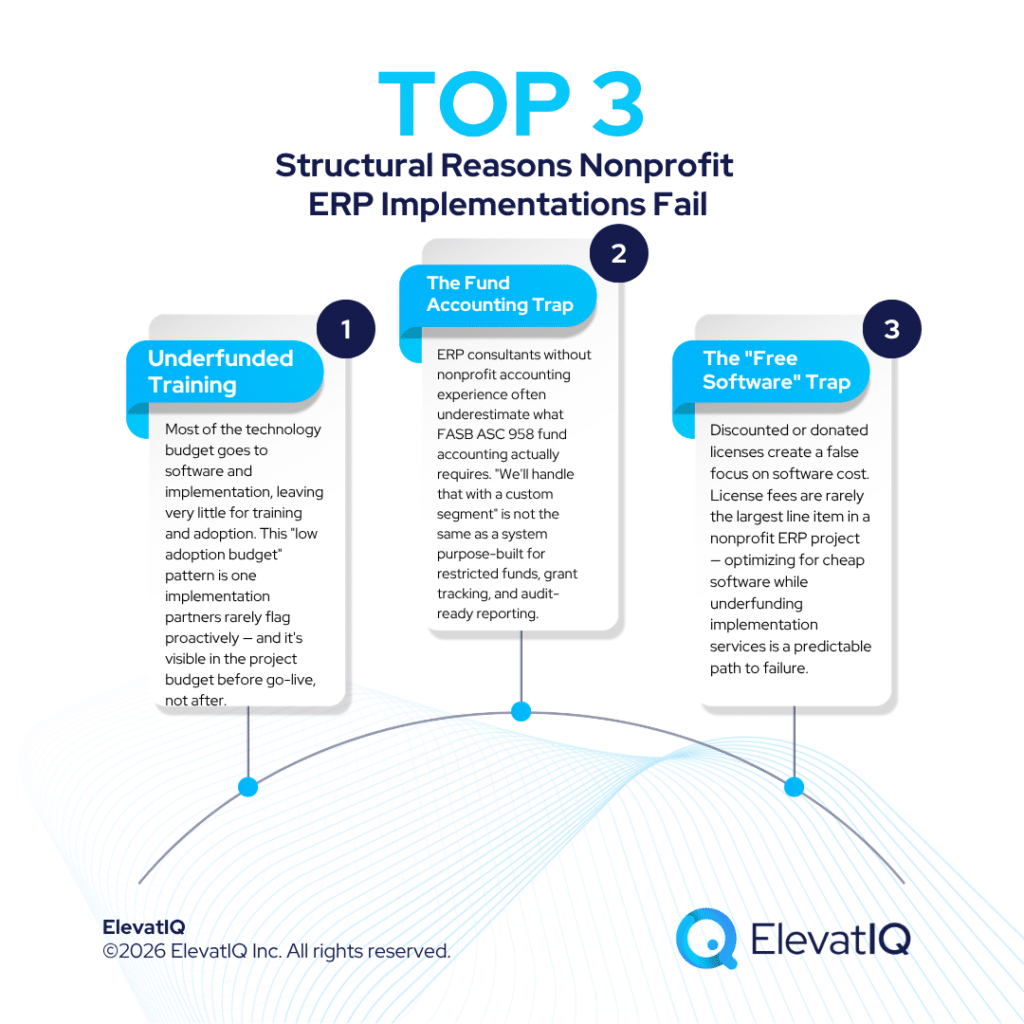
- Training and change management are consistently underfunded in nonprofit technology projects. In a typical low-adoption budget scenario, most of the technology budget goes to tools, leaving very little for user training and adoption, a pattern that implementation partners do not always highlight proactively.
- The fund accounting trap is one of the most common nonprofit ERP implementation failure reasons: ERP consultants without nonprofit accounting experience often underestimate what fund accounting requires, and “we’ll handle that with a custom segment” is not the same as a system purpose-built for nonprofit financial management.
- Discounted or donated software can create an unintended focus on license costs rather than total implementation costs. Several vendors offer nonprofit discounts or donated software licenses, but the software cost is rarely the largest line item in an ERP implementation, and optimizing for software cost while underfunding implementation services is a predictable path to failure.

Introduction
ERP implementations are hard for every organization. They require process re-engineering, data migration, change management, user training, and also sustained leadership attention over a project timeline measured in months. Commercial organizations with mature IT departments, stable finance teams, and dedicated project budgets still fail at ERP implementations regularly.
Nonprofits attempt the same undertaking with structural disadvantages that most commercial organizations do not face. They manage a more complex financial environment such as restricted funds, grant reporting, government receivables, and FASB compliance with teams that are often leaner. And also less experienced with enterprise systems, and experiencing higher turnover than their commercial counterparts.
The nonprofit ERP implementation failure reasons that surface repeatedly across organizations of different sizes, types, and missions are not random. They follow a predictable pattern and they are often visible before implementation begins, to anyone who knows where to look.
This blog examines those nonprofit ERP implementation failure reasons: what they are, why they persist, and what a different approach to nonprofit ERP implementation looks like.
The Structural Disadvantage Nonprofits Start With
Before examining specific nonprofit ERP implementation failure reasons, it is worth being precise about the conditions nonprofits are working within because the structural context explains why the same patterns repeat.
How the Nonprofit Operating Environment Differs from Commercial
| Dimension | Commercial Organization | Nonprofit |
| Financial model | Revenue-driven, profit-focused | Mission-driven, fund-stewardship-focused |
| Accounting framework | GAAP (for-profit) | FASB ASC 958 (nonprofit-specific) |
| Fund complexity | Single pool of operating funds | Net assets classified as with donor restrictions and without donor restrictions under FASB ASC 958 (each with distinct reporting and usage rules) |
| Grant compliance | Not applicable for most | Federal grants governed by 2 CFR Part 200 (Uniform Guidance); funder-specific reporting requirements |
| Technology investment | Treated as operational priority | Chronically underfunded (According to industry reports, approximately 60% of nonprofits identified cost as their primary technology infrastructure challenge) |
| Finance staff profile | Typically stable, commercial accounting background | Higher turnover; nonprofit accounting is a specialized skill set |
| IT capacity | Dedicated IT staff in most organizations | Limited or outsourced IT in most nonprofits |
This is the environment in which an ERP implementation must succeed and understanding it is the starting point for understanding nonprofit ERP implementation failure reasons. The system, the implementation partner, and the project plan all need to account for it. Many implementation approaches do not fully account for these conditions.


ERP Selection Requirements Template
This resource provides the template that you need to capture the requirements of different functional areas, processes, and teams.
The Training Budget Reality
One of the most consistent nonprofit ERP implementation failure reasons is the pattern of how technology budgets allocation happens and how little reaches training and adoption.
In a typical nonprofit technology project, a significant portion of nonprofit technology budget allocation is often for software, infrastructure, and implementation services. What remains for training, documentation, and also change management is often a small fraction of the total investment. This is the “low adoption budget” scenario that technology advisors in the nonprofit sector have documented repeatedly: organizations invest heavily in acquiring a system, then discover after go-live that user adoption falls below expectations.
The consequences are often predictable. A system that users cannot navigate confidently does not get used. Manual workarounds often re-emerge. Spreadsheets return. The ERP becomes a system of record that finance uses and other departments may continue relying on spreadsheets or manual processes. And the operational integration that justified the investment never materializes.
This is not a failure of the system. It is a failure of the project structure and it is often visible in the project budget before implementation begins.
The training budget problem is one of the nonprofit ERP implementation failure reasons that compounds in organizations also facing high staff turnover. Training delivered in month three of an implementation has to be re-delivered to the new hire who joined in month seven or it simply is not, and the new hire learns the system by asking colleagues who also learned it imperfectly.

ERP System Scorecard Matrix
This resource provides a framework for quantifying the ERP selection process and how to make heterogeneous solutions comparable.
The Fund Accounting Trap
Fund accounting is one of the areas where many nonprofit ERP implementations encounter significant challenges.
What Fund Accounting Requires That Commercial Accounting Does Not
Under FASB ASC 958, nonprofits classify net assets as either with donor restrictions or without donor restrictions. This is not cosmetic. It determines the fund usage, the report, and how they appear on the Statement of Financial Position. A restricted fund cannot be used for general operations without audit exposure. A grant with conditions cannot be recognized as revenue until those conditions are substantially met.
| Requirement | Commercial ERP Standard? | Nonprofit ERP Requirement |
| Net asset classification (restricted vs. unrestricted) | No | Native at transaction level |
| Grant tracking from application through closeout | No | Budget-vs-actual per grant; reimbursable billing |
| Functional expense allocation (program, management, fundraising) | No | Required for Form 990 and audit |
| Release of restrictions when conditions are met | No | Automated release logic at restriction condition |
| Fund-level reporting across multiple simultaneous grants | No | Real-time, dimensional reporting by fund |
When an ERP consultant whose background is in commercial manufacturing or services encounters nonprofit fund accounting for the first time, they may propose a chart of accounts workaround using custom segments, or underscope the configuration work required.
Reliance on custom segments instead of native fund accounting capabilities has contributed to implementation challenges in some nonprofit ERP projects. A custom segment can replicate some reporting outputs of true fund accounting. It cannot replicate the enforcement logic, restriction tracking, or audit trail a purpose-built fund accounting architecture provides.
“Our Grassi experts recommend a ‘people-first’ approach by evaluating your current workflows, securing stakeholder buy-in, and creating alignment early… Be realistic about how your current operations will look within each platform, and avoid over-customizing, which can lead to unnecessary complexity.” — David M. Rottkamp, CPA, Partner and Nonprofit Practice Leader, Grassi, May 2025
High Finance Turnover: The Implementation Risk Nobody Plans For
Finance turnover is one of the nonprofit ERP implementation failure reasons most consistently absent from project risk registers and one of the most disruptive when it materializes mid-project.
What Finance Turnover Does to an ERP Implementation
| Scenario | Impact on Implementation |
| Controller departs mid-requirements phase | Chart of accounts, fund structure, and grant reporting logic decisions stall or are made by the wrong person |
| CFO changes during configuration | Prior decisions get revisited; implementation partner scope expands; timeline extends |
| Finance staff turns over between training and go-live | Users trained on the system are no longer there; new staff learn on a live system without documentation |
| New CFO arrives post-go-live | New leadership may distrust or not understand a system configured by their predecessor |
A resilient implementation design accounts for turnover from the start:
- Requirements documentation is written to survive personnel changes, not maintained in the outgoing controller’s head
- Configuration decisions are logged with rationale, so new leadership can understand why the system was built as it was
- Training materials are built for ongoing use, not a single pre-go-live session
- Key decisions are made at the governance level, not delegated to one person who may not be there at go-live
This is a project structure problem, not a technology problem. And it requires governance oversight not the implementation partner to solve.
The “Free” Software Trap
The “free software” trap is among the most avoidable nonprofit ERP implementation failure reasons and one of the most common in organizations where the technology investment decision is made by leadership without implementation experience. Microsoft for Nonprofits provides discounted and donated Microsoft products to eligible 501(c)(3) organizations. TechSoup facilitates donated and deeply discounted software from multiple vendors. Some ERP providers offer specific nonprofit tiers at reduced licensing rates.
These programs are genuinely valuable. The problem arises when nonprofit leaders, understandably sensitive to cost, focus primarily on software acquisition costs, and underfund everything else.
The Real Cost Structure of a Nonprofit ERP Implementation
| Cost Component | Typical Proportion of Total Project Cost |
| Software licensing (annual subscription) | Often the most visible but not always the largest cost |
| Implementation services | Frequently 2–4x the first-year software cost |
| Data migration | Often underestimated; can rival implementation services cost |
| Internal resource time | Rarely budgeted explicitly; significant in practice |
| Training and change management | Typically underfunded relative to project need |
| Post-go-live support and optimization | Often not budgeted until needed |
Depending on scope and complexity, Sage Intacct implementation costs for nonprofits may begin around $5,000 for smaller deployments and can exceed $50,000 for more complex implementations, independent of the annual subscription fee. A nonprofit that negotiates free or deeply discounted software and then allocates the remaining budget to implementation services may discover that software discounts do not materially reduce total project costs.
The organizations most at risk from this particular nonprofit ERP implementation failure reason are those that receive donated or discounted software, treat the cost savings as budget relief rather than reinvesting in implementation quality, and arrive at go-live with a system that is not fully adopted by users.
How an Independent ERP Advisory Consultant Can Help Here
The nonprofit ERP implementation failure reasons described in this blog are predictable. This means mitigation of many is possible through stronger planning and governance. Many share a common root cause: the project structure does not account for the specific conditions of a nonprofit operating environment.
What Independent Advisory Changes in a Nonprofit Implementation
| Risk | Without Independent Advisory | With Independent ERP Advisory Oversight |
| Training underfunding | Flagged at go-live when it is too late | Identified in project budget review before implementation begins |
| Fund accounting complexity | Discovered mid-configuration as scope expands | Scoped accurately in requirements; system selected on native fund accounting capability |
| Finance turnover | Project progress may stall when a key person departs | Documentation and governance design protects continuity regardless of personnel changes |
| Free software trap | Budget allocated to license savings; implementation underfunded | Total cost of ownership modeled before vendor selection |
| Implementation partner scope creep | Discovered as change orders mid-project | Scope defined independently; implementation partner performance evaluated against independently defined scope |
An independent ERP advisory consultant is not the implementation partner. Their role is to protect the organization’s investment through objective governance: ensuring the system selected fits nonprofit financial requirements, the project budget reflects actual cost structure, and the implementation partner delivers against the defined scope.
ElevatIQ works with nonprofit organizations as an independent ERP advisory consultant. We hold no implementation certifications with any ERP vendor and receive no referral fees from software providers. Our nonprofit ERP engagements begin with a requirements and readiness assessment, examining fund accounting complexity, finance team stability, training capacity, and total cost of ownership before any vendor conversation begins.
Conclusion
The nonprofit ERP implementation failure reasons that recur across organizations of different sizes and missions are not solely caused by software selection. They are caused by a project structure that does not account for the nonprofit operating environment: the complexity of fund accounting, the reality of finance team turnover, the chronic underfunding of training, and the misallocation of resources that follows from optimizing for software cost rather than implementation quality.
The signals that a nonprofit ERP implementation is heading toward these outcomes are often visible before the project begins:
- Training and adoption are not line items in the project budget
- The implementation partner selected has limited demonstrated nonprofit accounting experience
- The system selected was chosen primarily because of its nonprofit pricing program
- Fund accounting requirements were presented to the implementation partner as “similar to departmental accounting” rather than as a distinct financial model
- There is no documentation plan for implementation decisions, making the project heavily dependent on the current team remaining in place
Addressing these signals requires someone outside the vendor-implementation partner relationship who can provide an objective assessment of the project structure before significant project investments are made and timelines are set. That assessment is where nonprofit ERP implementations can often be strengthened. Not at go-live, and not during project recovery, but before the project plan is signed.

ERP Selection: The Ultimate Guide
This is an in-depth guide with over 80 pages and covers every topic as it pertains to ERP selection in sufficient detail to help you make an informed decision.
Related Posts: