
Last Updated on May 5, 2026 by Shrestha Dash
When enterprise organizations evaluate ERP systems, most of the attention lands on functionality, deployment options, and licensing fees. Support models rarely get the same scrutiny, and vendors often structure offerings accordingly. Over the past several years, ERP vendor support models have undergone a quiet but consequential transformation. One that is reshaping what buyers actually receive once the contract is signed and the implementation is complete.
Understanding these shifts is not optional. For organizations committing to multi-year ERP relationships, often in the seven-figure range. The support model embedded in your agreement directly determines what kind of help you get. Also, how fast, and at what additional cost, when things go wrong or when business needs evolve.
How ERP Vendor Support Models Are Shifting Beyond Pricing
The industry-wide migration from perpetual licensing to subscription-based arrangements is well documented. What is less discussed is how this shift has quietly restructured the nature of support itself.
Under the traditional perpetual license model, annual maintenance fees, typically range from 15 to 22 percent of the original license cost. It usually covers a fairly clear set of entitlements. It often includes product updates, bug fixes, access to support portals, and some level of direct vendor assistance. Buyers understood what they were paying for, even if the fees were substantial.
The subscription model collapses these elements into a single recurring fee and presents it as a simplification. In practice, it is often anything but simple.
Bundled Does Not Mean Comprehensive
Cloud-based ERP subscriptions typically include what vendors describe as a “base level” of support. What falls outside that base level is where buyers frequently encounter surprises. Premium support tiers which offer faster response times, dedicated account management, or access to senior engineers, are increasingly sold as separate add-ons, often at meaningful additional annual cost.
A buyer who compares subscription pricing across vendors may not be comparing equivalent support entitlements at all. One vendor’s standard tier may include 24-hour critical incident response, while another’s requires an upgraded ERP contract to access the same.
Consumption-Based Complexity
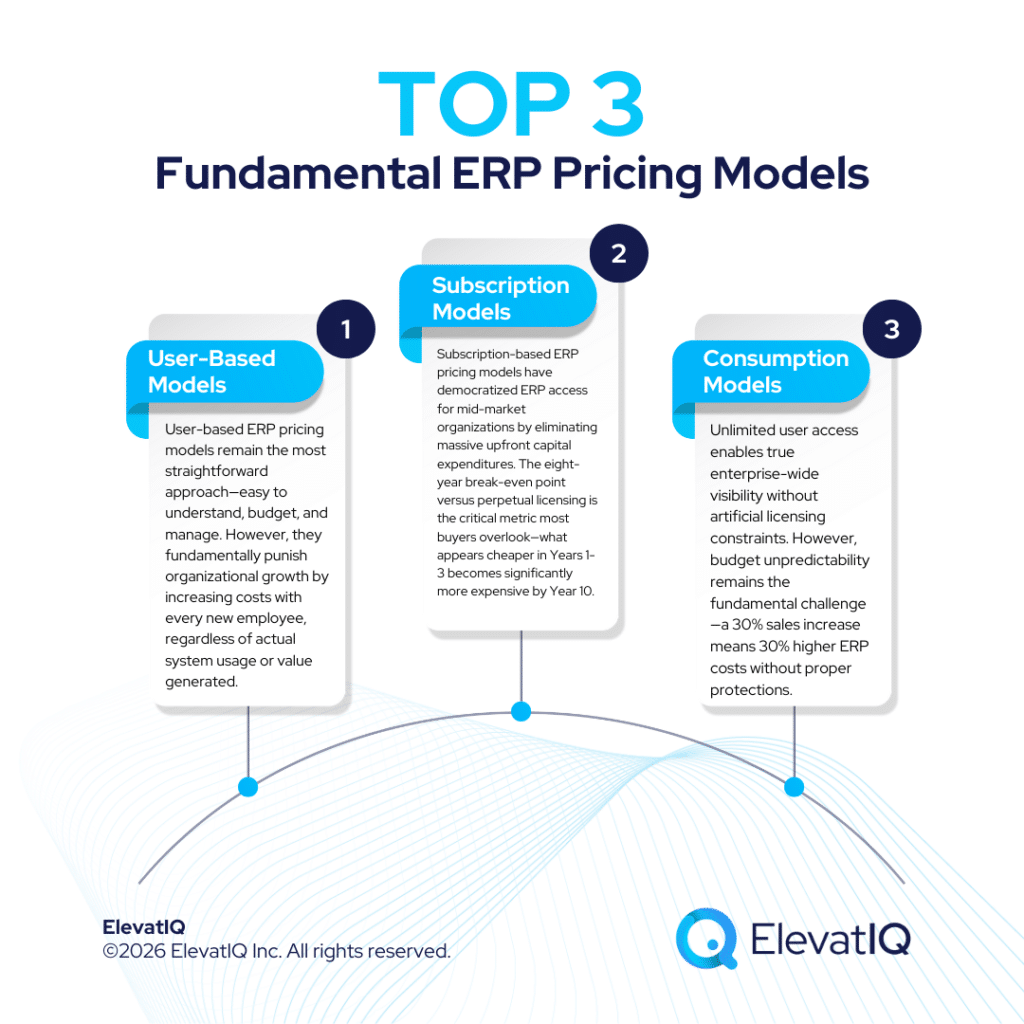
Several major ERP vendors have also introduced consumption-based licensing layers within their subscription frameworks. Charges tied to document volumes, API call thresholds, data storage consumption, and indirect user access have become standard features of cloud ERP commercial structures. These mechanics can generate cost exposure that was not anticipated at contract signing. Particularly, as transaction volumes grow or as more third-party systems interact with the ERP.
From a support perspective, this matters because consumption overages often create service disruptions or throttling situations. Resolving them may require navigating vendor escalation paths that are only available to customers on higher-tier support arrangements.


ERP Selection Requirements Template
This resource provides the template that you need to capture the requirements of different functional areas, processes, and teams.
SLA Dilution in ERP Vendor Support Models: The Detail Hiding in Plain Sight
Service level agreements are the contractual backbone of vendor support obligations. Yet in modern ERP agreements, SLA language has evolved in ways that may reduce practical accountability in certain scenarios while maintaining the appearance of strong commitments.
Response Time vs. Resolution Time
One of the most important distinctions buyers overlook is the difference between response time and resolution time. Most ERP vendor SLAs guarantee response times which is the interval between logging a ticket and receiving an acknowledgment. Very few offer enforceable resolution time commitments, meaning the vendor is contractually obligated only to acknowledge the problem, not to fix it within any defined period.
For mission-critical ERP environments, this gap is significant. A system availability issue affecting order processing, financial close, or supply chain operations can remain unresolved for extended periods while remaining technically within SLA compliance.
Tiered Priority Definitions
SLA structures in cloud ERP contracts increasingly rely on vendor-defined priority classifications commonly labeled P1 through P4 or equivalent. The challenge is that what qualifies as a critical incident under the vendor’s internal definitions may not align with what the customer experiences as business-critical. Vendors often retain the right to reclassify incident severity. This can, in some cases, affect response commitments without any breach of contract.
Shared Infrastructure Caveats
In multi-tenant cloud environments, SLA uptime guarantees are often measured at the infrastructure level rather than the application level. A vendor may maintain 99.9 percent platform uptime while specific application modules experience availability issues that fall outside the reported metric. Buyers negotiating ERP agreements should ensure that SLA measurements reflect application-level availability relevant to their operational workflows, not just platform-level metrics.nal complexity increase significantly in subsequent deployments.

ERP System Scorecard Matrix
This resource provides a framework for quantifying the ERP selection process and how to make heterogeneous solutions comparable.
What Buyers Consistently Miss
The commercial dynamics behind ERP vendor support models are not difficult to understand once they are surfaced. The problem is that procurement teams and IT leaders often engage with support terms late in the evaluation process. Usually, after commercial positions have already been established.
The Long-Term Cost Curve
A frequently cited advantage of subscription models is predictable costs. Over a long horizon, however, subscription costs are not fixed, they are subject to annual escalation clauses, often embedded in ERP contract terms that receive limited attention during negotiation. On-premises annual maintenance fees historically drew scrutiny because they were line items on a perpetual license agreement. Cloud subscription escalations are structurally equivalent but are sometimes framed differently.
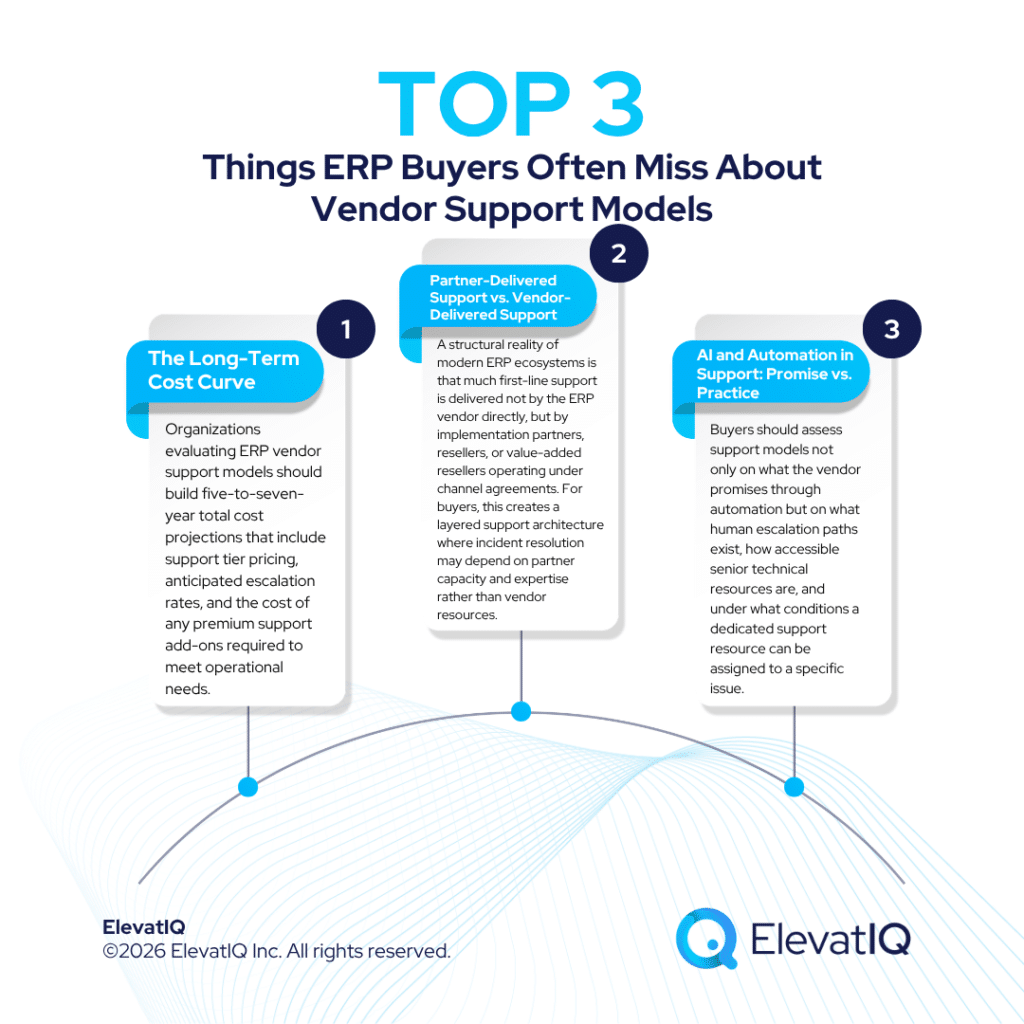
Organizations evaluating ERP vendor support models should build five-to-seven-year total cost projections that include support tier pricing, anticipated escalation rates, and the cost of any premium support add-ons required to meet operational needs.
Partner-Delivered Support vs. Vendor-Delivered Support
A structural reality of modern ERP ecosystems is that much first-line support is delivered not by the ERP vendor directly, but by implementation partners, resellers, or value-added resellers operating under channel agreements. For buyers, this creates a layered support architecture where incident resolution may depend on partner capacity and expertise rather than vendor resources.
This arrangement is not inherently problematic, but it requires clarity in the contract about who owns which support obligation, what escalation paths exist to the vendor when the partner cannot resolve an issue, and how response time commitments are measured across the partner-vendor boundary. Evaluating ERP vendor support models means mapping this layered accountability before it becomes an operational problem.
AI and Automation in Support: Promise vs. Practice
ERP vendors are increasingly promoting AI-assisted support capabilities – automated ticket triage, self-service knowledge bases, virtual assistants for common queries. These tools have genuine utility for routine support scenarios. They are less suited to the kind of complex, environment-specific issues that enterprise ERP customers typically face when something goes wrong.
Buyers should assess support models not only on what the vendor promises through automation but on what human escalation paths exist, how accessible senior technical resources are, and under what conditions a dedicated support resource can be assigned to a specific issue.
Key Questions to Ask Before Agreeing to ERP Vendor Support Models
Organizations evaluating ERP vendor support models should bring a specific set of questions into contract negotiations rather than accepting standard terms at face value:
- What is explicitly covered under the base support tier, and what requires an upgraded contract?
- How does the vendor define incident severity levels, and does the buyer have any input into priority classification?
- Are resolution time commitments included anywhere in the SLA, or only response time acknowledgments?
- How are SLA metrics measured — at the platform level or at the application and process level?
- What escalation path exists if the implementation partner cannot resolve a critical issue?
- Are there annual escalation clauses in support pricing, and at what rate?
- What data portability and exit support provisions exist if the relationship ends?
These questions do not require adversarial negotiating postures. They represent a reasonable baseline for understanding what an organization is actually purchasing when it commits to an ERP vendor relationship.
Evaluating ERP Vendor Support Models as Part of Vendor Selection
Support model assessment should not occur as a final contract review step. It belongs in the vendor evaluation phase, alongside functional fit and commercial benchmarking.
When comparing ERP vendors, buyers benefit from mapping support tier structures side by side rather than comparing headline subscription prices. The effective cost of a support model that requires a premium add-on to meet operational requirements may be meaningfully higher than a competitor’s all-inclusive arrangement, even if the base subscription appears lower.
Reference checks with existing customers should include specific questions about support experience, not just product satisfaction. Customers who have been through major incidents, upgrade cycles, or environment-specific issues offer the most relevant perspective on what vendor support actually looks like in practice.
The Conclusion
ERP vendor support models are a legitimate and complex area of commercial risk. The shift toward subscription-based delivery has introduced genuine benefits, including reduced infrastructure burden, faster update cycles, and cleaner commercial structures, alongside structural changes in how support obligations are defined and enforced.
Independent ERP advisors can provide meaningful value at this stage of the process, not by negotiating on a buyer’s behalf but by helping organizations understand what standard terms look like across the vendor landscape, where the material risks in specific contract structures are concentrated, and what provisions are genuinely negotiable versus standard boilerplate.
Organizations navigating ERP selection and contract review can benefit from the kind of vendor-neutral perspective that ElevatIQ’s independent advisory practice brings to enterprise technology selection. Understanding what you are actually buying, not just what the sales deck describes, is the foundation of a successful long-term ERP relationship.

ERP Selection: The Ultimate Guide
This is an in-depth guide with over 80 pages and covers every topic as it pertains to ERP selection in sufficient detail to help you make an informed decision.
FAQs
Related Posts: