
Last Updated on September 9, 2026 by Shrestha Dash
Key Highlights
- Oracle does not publish official NetSuite pricing. Every quote is negotiated. This means NetSuite pricing changes at renewal are often the first time a growing company sees how its actual cost structure has shifted since initial signing.
- One independent NetSuite implementation partner has reported examples of standard full-user license pricing increasing from roughly $99 to $129 per user per month. A change reported to have caught a number of existing customers off guard at renewal.
- NetSuite’s cost structure is built from three separate components. A base platform fee, per-user licensing, and add-on modules. Growing companies typically see all three increase simultaneously as they scale, not just user count in isolation.
- Modules can generally be added during the contract term and, depending on the agreement, are often only removable at renewal. This means a company’s module footprint, and its cost, tends to grow between renewal cycles.

Introduction
For a growing company on NetSuite, the platform’s pricing structure is often well understood at the point of initial purchase. And also considerably less clear by the time the first or second renewal comes around. New users get added as headcount grows. Additional modules get activated to support new operational needs. None of this happens as a single negotiated event. It happens incrementally, and the cumulative effect on the renewal quote isn’t always modeled until the number is already on the table.
This is the practical reality behind NetSuite pricing changes for companies in growth mode. The total cost isn’t static. And unlike the initial deal, subsequent cost increases don’t always come with the same negotiating leverage a company had before switching costs were sunk into ERP implementation and customization.
This piece lays out NetSuite’s actual cost structure. A reported example of the kind of pricing change that has caught growing companies by surprise. It also provides a framework for modeling when cumulative cost growth is significant enough to warrant evaluating alternatives. Rather than assuming renewal terms are simply the cost of doing business. The pricing figures and reported rate change described below reflect market data as of current standard of 2026. Since Oracle does not publish official pricing and negotiated terms shift over time, these figures should be treated as directional, not as a current price list, and verified against your own contract at the time of renewal.
NetSuite’s Pricing Structure (Briefly)
Since NetSuite’s general pricing architecture is covered in more detail elsewhere, this section stays brief on the base structure and focuses on what matters most for anticipating NetSuite pricing changes: three components make up the total cost, and each one is a separate lever that can move independently at renewal.
The Three Cost Components
| Component | What It Covers | Reported Range (as of 2026) |
| Base platform fee | Access to the core NetSuite tenant and foundational financials | Roughly $999–$5,000 per month, depending on edition and service tier |
| Per-user licenses | Named-user access; full users vs. limited/Employee Self-Service users are priced very differently | Full users commonly reported in the $99–$199 per user per month range; limited-access users considerably less |
| Add-on modules | Advanced Financials, Advanced Inventory, Manufacturing, WMS, SuiteCommerce, SuitePeople HR, and similar | Individually priced, commonly ranging from roughly $500 to several thousand dollars per month depending on the module |
It’s worth being direct about the source of these figures: Oracle does not publish an official NetSuite price list. The ranges above come from independent NetSuite implementation partners and procurement-data firms working from negotiated deals, not from Oracle’s own published rates. Any specific quote a company receives should be evaluated against its own negotiated terms, not treated as validated against a public benchmark that doesn’t exist.


ERP Selection Requirements Template
This resource provides the template that you need to capture the requirements of different functional areas, processes, and teams.
A Reported Pattern: What NetSuite Pricing Changes Have Looked Like in Practice
Beyond the general structure, it’s useful to look at a specific, reported example of NetSuite pricing changes affecting existing customers at renewal, rather than reasoning about the risk in the abstract.
A Reported Rate Increase
| Detail | What Was Reported |
| License type affected | Full-user licenses |
| Previous rate | Approximately $99 per user per month |
| Reported new rate | Approximately $129 per user per month |
| Approximate increase | Roughly 30% |
| Source | Reported independently by a NetSuite implementation partner, based on client contract data, not an Oracle public announcement |
This kind of change illustrates why NetSuite pricing changes are best modeled proactively rather than discovered at the renewal table. A 30% increase on the per-user rate alone, applied across a growing user base, compounds with any concurrent increase in module costs or added seats, and the combined effect on a renewal quote can be considerably larger than any single line item suggests.
The Module Ratchet
Separately from rate changes, NetSuite contracts are commonly structured so that modules can be added to an existing agreement at any point during the contract term, but are typically only removable at renewal. For a growing company, this means the module footprint, and the cost associated with it, tends to move in one direction between renewal cycles: up. A module added mid-contract may remain part of the cost base until the next renewal, depending on the agreement.

ERP System Scorecard Matrix
This resource provides a framework for quantifying the ERP selection process and how to make heterogeneous solutions comparable.
Modeling When Cost Growth Becomes a Switching Trigger
Rising costs at renewal are a legitimate reason to reassess a platform, but NetSuite pricing changes aren’t automatically a reason to switch. The useful question is what specific modeling should happen before concluding either way.
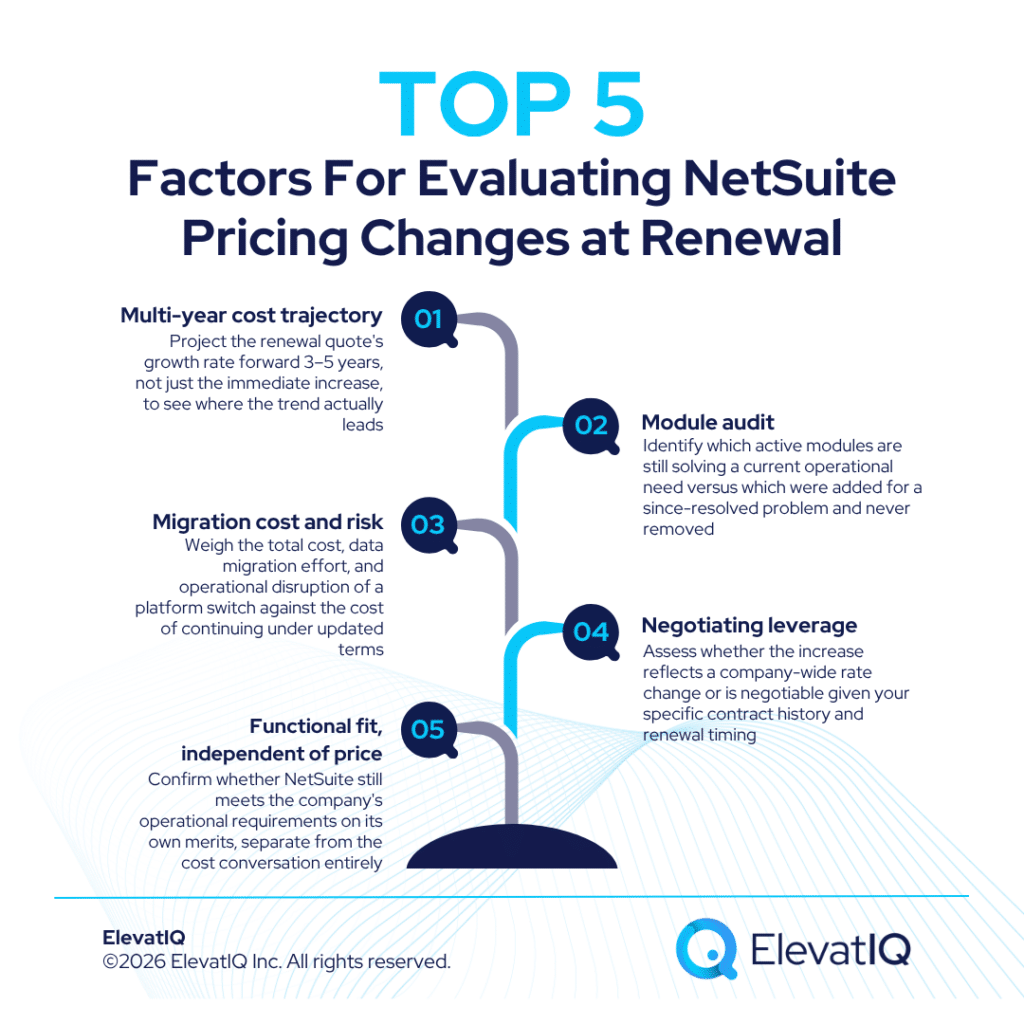
A Framework for Evaluating NetSuite Pricing Changes at Renewal
| Factor | What to Actually Model |
| Multi-year cost trajectory | Project the renewal quote’s growth rate forward 3–5 years, not just the immediate increase, to see where the trend actually leads |
| Module audit | Identify which active modules are still solving a current operational need versus which were added for a since-resolved problem and never removed |
| Migration cost and risk | Weigh the total cost, data migration effort, and operational disruption of a platform switch against the cost of continuing under updated terms |
| Negotiating leverage | Assess whether the increase reflects a company-wide rate change or is negotiable given your specific contract history and renewal timing |
| Functional fit, independent of price | Confirm whether NetSuite still meets the company’s operational requirements on its own merits, separate from the cost conversation entirely |
A rising renewal quote is a legitimate trigger to run this analysis. It is not, by itself, proof that switching is the right answer, in many cases, a clear-eyed module audit and a renegotiation grounded in accurate market data resolves the bulk of the cost growth without the disruption of a full platform change.
How ElevatIQ Can Help
Modeling NetSuite pricing changes accurately, and deciding what they actually warrant, is exactly the kind of analysis that benefits from an evaluation with no stake in the outcome. As an independent ERP consulting firm, ElevatIQ doesn’t sell NetSuite, any competing platform, or any add-on modules, and we don’t receive referral fees tied to a company’s renewal decision either way.
For a growing company facing a renewal with unexpected cost growth, that independence means we can help audit the current module footprint against actual operational need, model the multi-year cost trajectory against the realistic cost of a platform switch, and support renewal negotiations with accurate market context, so the eventual decision, whether that’s renegotiating, trimming the module footprint, or evaluating alternatives, is grounded in the company’s own numbers rather than the renewal quote in isolation.
Conclusion
NetSuite pricing changes at renewal are a normal part of running on any subscription-based ERP, but the compounding effect of rate increases, user growth, and an accumulating module footprint can catch growing companies off guard if it isn’t modeled until the quote arrives. Understanding NetSuite’s actual cost structure, and treating a rising renewal number as a prompt for analysis rather than either automatic acceptance or automatic panic, is what separates a well-managed renewal from a reactive one.
A few things are worth confirming before a renewal conversation.
- The company has modeled its cost trajectory over a multi-year horizon, not just reacted to the current quote
- Every active module has been audited against current operational need, not just historical justification
- Any switching conversation is grounded in an honest migration-cost comparison, not just frustration with the renewal number
- The negotiation itself is informed by accurate market data, not assumptions about what NetSuite “should” cost
Getting this sequence right, model first, then decide, tends to produce a better outcome than either accepting whatever the renewal quote says or assuming a platform switch is the answer without running the numbers.
Note on pricing figures: Oracle does not publish official NetSuite pricing. All dollar figures in this article are industry-reported estimates drawn from independent implementation partners and procurement-data firms, current as of 2026, and should be verified against your own negotiated contract terms rather than treated as Oracle-confirmed rates.s what turns a confirmed end-of-life date into a manageable transition rather than a rushed one.

ERP Selection: The Ultimate Guide
This is an in-depth guide with over 80 pages and covers every topic as it pertains to ERP selection in sufficient detail to help you make an informed decision.
Related Posts: