
Last Updated on June 15, 2026 by Shrestha Dash
If your organization is still running Oracle E-Business Suite, you are not alone. The situation is more nuanced than most of the headlines suggest. Oracle has extended Premier Support for EBS 12.2 through at least 2037, rolling the date forward one year at a time under its Continuous Innovation model. On paper, that sounds like a comfortable runway.
In practice, it is not. Understanding why requires a clearer view of how Oracle’s support lifecycle works, what “at least 2037” actually means contractually, and what the realistic ERP planning timeline looks like for organizations that still need to migrate. This is not an argument for panic. It is an argument for honesty about where EBS customers stand in 2026 and what the right planning posture looks like right now.
Understanding Oracle EBS Support Tiers: What You Are Actually Getting
To navigate Oracle EBS end-of-support decisions effectively, it helps to understand what each support tier actually delivers because the differences between them are material.
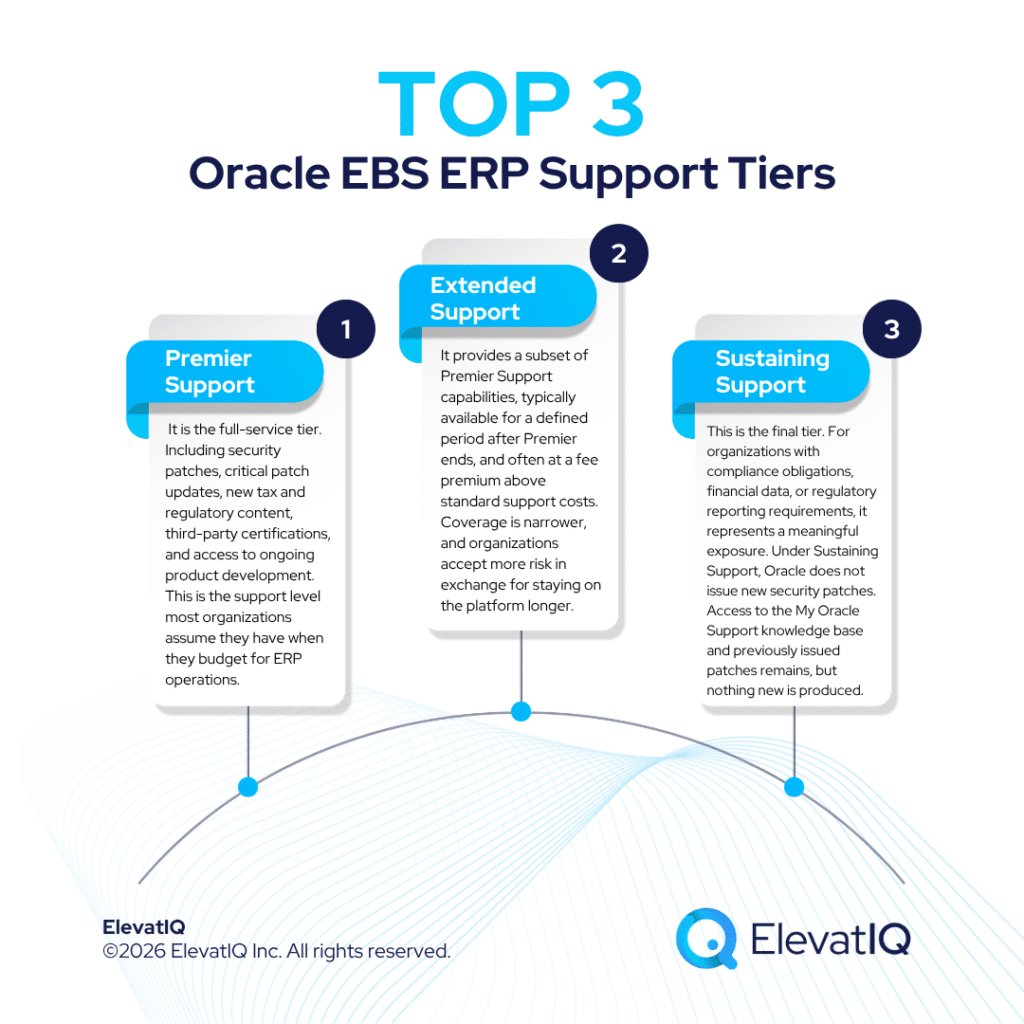
- Premier Support. It is the full-service tier. Including security patches, critical patch updates, new tax and regulatory content, third-party certifications, and access to ongoing product development. This is the support level most organizations assume they have when they budget for ERP operations.
- Extended Support. It provides a subset of Premier Support capabilities, typically available for a defined period after Premier ends, and often at a fee premium above standard support costs. Coverage is narrower, and organizations accept more risk in exchange for staying on the platform longer.
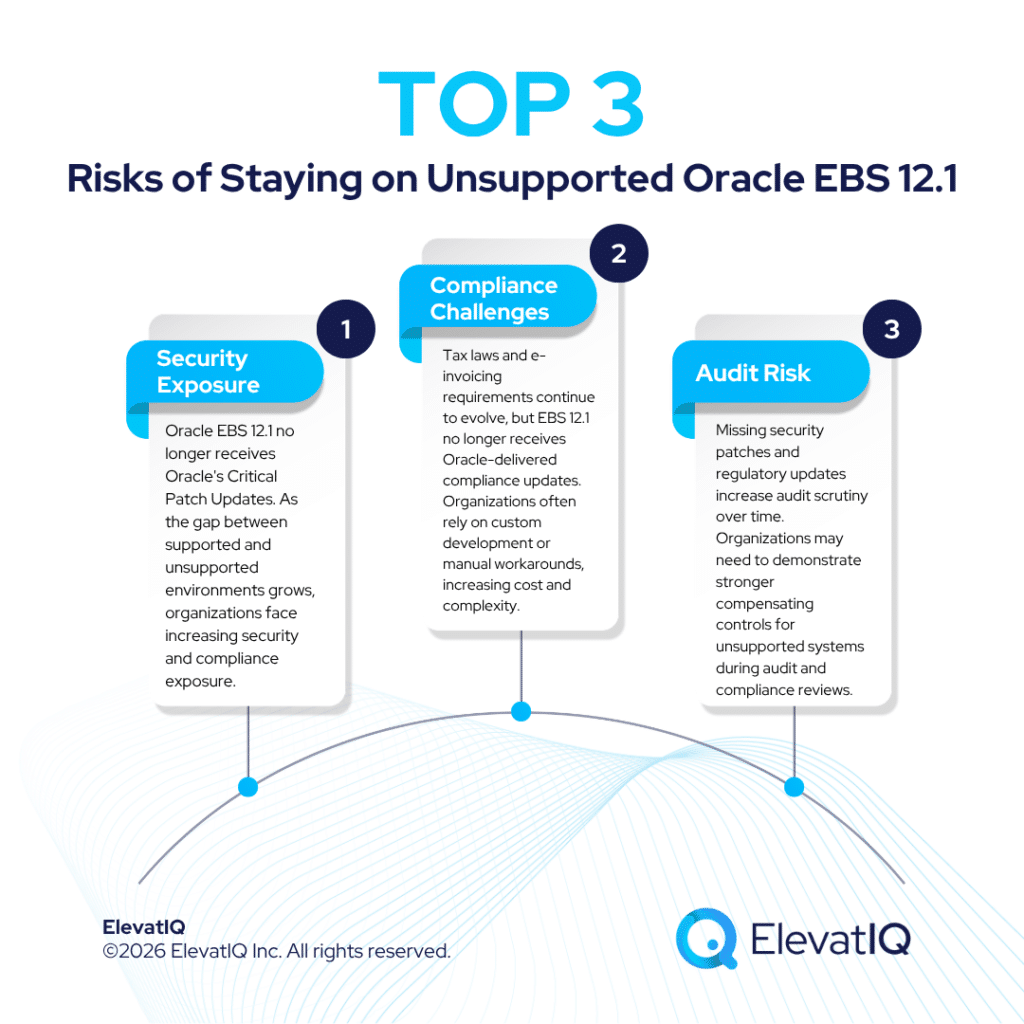
- Sustaining Support. This is the final tier. For organizations with compliance obligations, financial data, or regulatory reporting requirements, it represents a meaningful exposure. Under Sustaining Support, Oracle does not issue new security patches. No new Critical Patch Updates. No new tax or regulatory content. No new certified interoperability with third-party software. Access to the My Oracle Support knowledge base and previously issued patches remains, but nothing new is produced.
For organizations operating under frameworks such as SOC 2, ISO 27001, or PCI DSS, operating unsupported ERP software may create compliance, security, and audit concerns that require additional risk management controls, not just a technology one.
Where EBS Customers Stand in 2026
The Oracle EBS end-of-support picture in 2026 splits cleanly into two populations.
- If you are on EBS 12.1: Premier Support for Oracle E-Business Suite 12.1 ended several years ago, and organizations remaining on 12.1 are now operating under Sustaining Support. The migration argument here is not theoretical; it is immediate.
- If you are on EBS 12.2: Oracle’s most recently announced Premier Support date extends through at least 2037. Oracle has maintained a practice of extending this date by one year annually, as part of its Continuous Innovation commitment. The current announcement is genuine as Oracle has consistently honored these extensions since first making the commitment in 2018.
What the 2037 date does not provide is a permanent contractual guarantee. Historically, Oracle has extended Premier Support on a recurring basis, typically adding an additional year to the support horizon. The word “at least” is doing meaningful work in that commitment. Organizations that build their ERP strategy around a specific date that Oracle has not permanently locked in are taking a planning risk that may not be apparent until the window narrows.
That structural ambiguity is one reason migration planning for EBS 12.2 organizations should begin now, regardless of what the current announced support horizon reads.


ERP Selection Requirements Template
This resource provides the template that you need to capture the requirements of different functional areas, processes, and teams.
The Planning Lead Time Argument: Why 2026 Is the Right Year to Start
The most common framing around Oracle EBS end of support is deadline-driven: organizations wait for a hard date, then begin planning. That framing works poorly for ERP migrations, for a straightforward reason.
Complex Oracle EBS environments. Particularly, those with significant customizations, deep integrations, multiple business units, and years of accumulated configuration do not migrate in six months. Realistic planning timelines for organizations of that type run 18 to 36 months for the migration itself, and frequently longer when pre-migration assessment, data cleansing, process redesign, and organizational change management are included.
An organization that begins migration planning in 2026 and executes through 2028 or 2029 is in a defensible position. An organization that waits until 2034 to begin planning for a 2037 deadline has almost no margin for the delays, scope changes, and re-scoping that are normal features of large ERP migrations, not exceptions.
There is also a resource availability dimension. As the EBS support horizon firms up and the migration wave accelerates, experienced implementation resources, both Oracle-side and independent, become constrained. Organizations that begin planning early have more access to the consultants who know EBS deeply and can navigate the translation to Oracle Fusion Cloud with realistic expectations. Organizations that delay planning may face increased competition for experienced ERP implementation resources as migration activity grows.

ERP System Scorecard Matrix
This resource provides a framework for quantifying the ERP selection process and how to make heterogeneous solutions comparable.
Customization Debt: The Underestimated Migration Complication
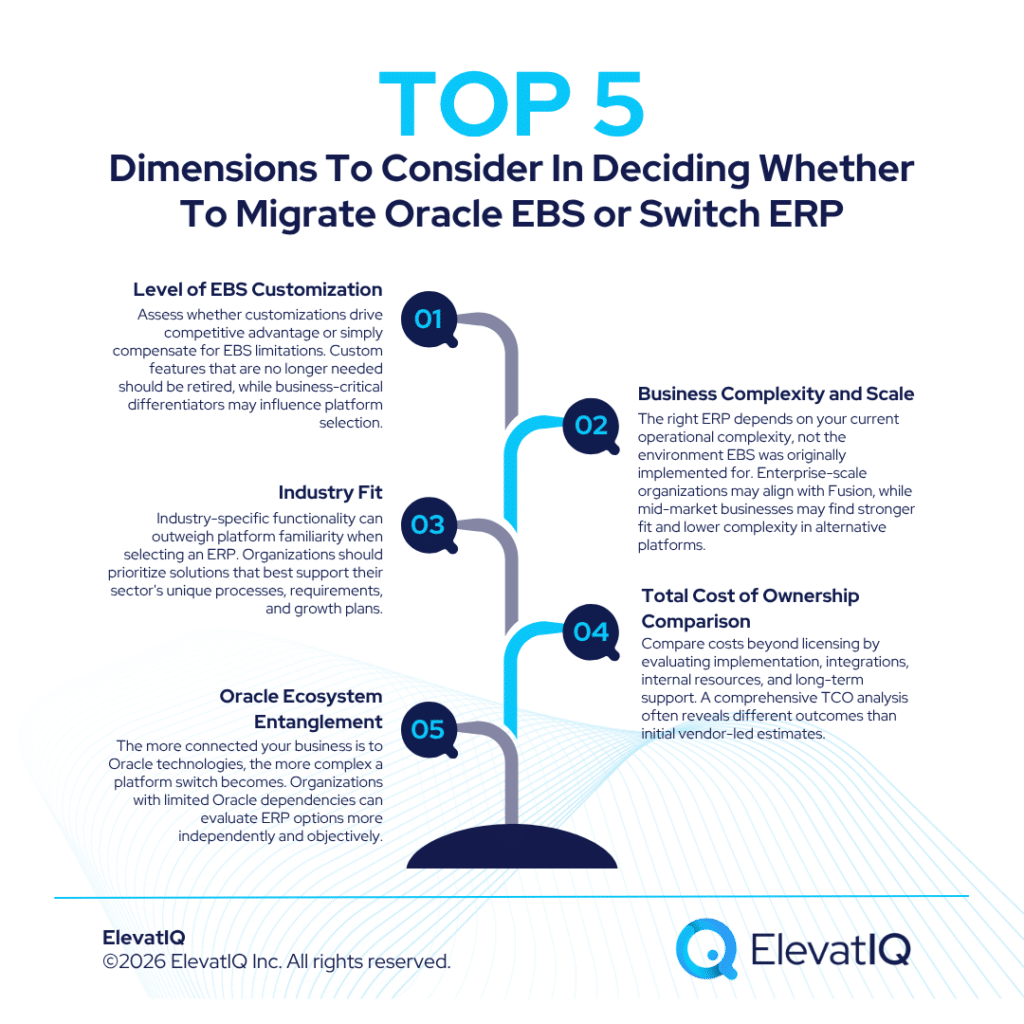
One of the structural realities of Oracle EBS is that it was designed to be heavily customizable. Most long-running EBS deployments took full advantage of that. For organizations evaluating their Oracle EBS end-of-support position, customization debt is frequently the factor that most directly determines migration complexity and cost. Over ten, fifteen, or twenty years of operation, organizations accumulated customizations that solved real business problems at the time they were built. Many of those customizations are now undocumented, maintained by people who have left the organization, or built on Oracle APIs and data structures that do not translate directly to Oracle Fusion Cloud.
Customization debt is often the single largest variable in EBS migration complexity and cost. It is also the variable most likely to be underestimated during initial migration scoping, because the full picture of what has been customized and how deeply it is embedded in current operations rarely surfaces until the assessment work begins.
This is a reason to start the assessment process earlier rather than later. Understanding the true scope of customization debt before entering vendor negotiations or ERP implementation partner conversations gives organizations much more realistic data for budgeting and timeline planning, and it surfaces tradeoffs (rebuild vs. retire vs. reconfigure in standard) that are better made with time to deliberate than under schedule pressure.
The Oracle Fusion Cloud Migration Decision: What Independent Guidance Looks Like
When Oracle and its implementation partners discuss EBS migration paths, the natural direction of that conversation is toward Oracle Fusion Cloud. Oracle Fusion Cloud offers continuous updates and an expanding set of AI-enabled capabilities across many business processes. For many organizations working through Oracle EBS end-of-support planning, it will be the right destination.
But “right for Oracle” and “right for your organization” are not always the same determination. Some EBS organizations have business requirements, integration architectures, or regulatory environments that make a different destination. That determination requires an evaluation that is not shaped by vendor incentives.
Independent ERP advisory in the EBS migration context means starting with the business requirements and working outward to the technology decision, rather than starting with the destination and working backward. It also means having candid conversations about the realistic total cost of an Oracle Fusion Cloud migration, not just the licensing costs. But also, the implementation services, data migration, integration rework, change management, and the post-go-live stabilization period that often extends longer than the original implementation timeline. For organizations with significant EBS customization debt, the process of rationalizing that customization against Fusion Cloud’s standard capabilities is itself a substantial body of work, one that shapes the entire cost and timeline of the migration project.
Conclusion
Oracle EBS end of support is not a single date; it is a layered timeline with different urgency levels depending on which version you are running and what your compliance obligations require. For EBS 12.1 organizations, the migration argument is immediate. For EBS 12.2 organizations, the Premier Support runway is real, but the year-by-year rollover structure, the planning lead time requirements, and the complexity of customization rationalization all make 2026 the right year to begin serious ERP migration planning, not the year to defer the conversation until the horizon firms up further. The organizations that navigate EBS migrations most successfully are the ones that begin the process with an honest assessment of where they are, not a vendor’s roadmap for where they should go.

ERP Selection: The Ultimate Guide
This is an in-depth guide with over 80 pages and covers every topic as it pertains to ERP selection in sufficient detail to help you make an informed decision.
Related Posts: