

Last Updated on May 11, 2026 by Shrestha Dash
The decision to replace an ERP system is never made lightly. It carries significant capital commitment, organizational disruption, and implementation risk. Yet a pattern that surfaces consistently across enterprise replacement projects is that the original diagnosis (the reason the organization believed it needed a new system) turns out to be incomplete. Or in some cases, wrong entirely.
Understanding why companies change ERP is important. Understanding why those reasons are often misread is more important. Organizations that go into a replacement cycle without interrogating their own assumptions tend to carry the same underlying problems into the new system, a costly way to learn that the software was not really the issue.
The Gap Between the Stated Reason and the Real Reason Behind Why Companies Change ERP
When project sponsors document the business case for ERP replacement, the language tends to be system-centric: the current platform cannot support growth, lacks reporting capability, does not integrate well with other tools, or is too difficult to maintain. These are legitimate technical observations. They are also frequently symptoms of something else.
The gap between what an organization says is wrong with its ERP and what is actually driving operational difficulty is one of the more consistent findings in enterprise software advisory work. Systems absorb blame efficiently. They are visible, they are expensive, and they are easy to point to when business performance falls short. What is harder to surface and harder to build a business case around, is that the problem may be rooted in how the organization uses the system, how its processes are designed, or how its data is governed.
When the System Is the Symptom, Not the Cause
Consider a distribution company that identifies poor inventory visibility as its primary driver for ERP replacement. Reporting is inconsistent, on-hand quantities are unreliable, and planning decisions are regularly made outside the system using spreadsheets. The conclusion drawn is that the ERP lacks sufficient inventory management capability.
What a structured pre-replacement assessment might reveal instead: item master records have not been maintained consistently across locations, replenishment parameters have not been updated to reflect current lead times, and warehouse staff have developed workarounds that bypass system transactions. The ERP’s inventory module is largely functional, it simply has not been configured or used in a way that could produce reliable output. Replacing the system in this scenario does not resolve the problem. It defers it, at significant cost, until the same patterns reassert themselves in the new environment.


ERP Selection Requirements Template
This resource provides the template that you need to capture the requirements of different functional areas, processes, and teams.
The Most Common Misdiagnoses When Companies Change ERP
Certain patterns of misdiagnosis appear with enough regularity to be worth examining directly. These are the scenarios where why companies change ERP and what is actually driving the problem diverge most sharply.
Reporting Gaps Attributed to the System
Reporting deficiencies are among the most cited reasons why companies change ERP. The current system, the complaint goes, cannot produce the reports leadership needs. Decisions require manual data extraction, consolidation in spreadsheets, and significant analyst time.
In many cases, this is a data quality and architecture problem, not a reporting capability problem. ERP systems produce output that reflects the quality and completeness of the transactional data entered into them. When master data is inconsistent, when transactions are recorded inconsistently across departments, or when chart of accounts structures have accumulated years of unmanaged additions, no reporting tool, regardless of the platform will produce clean output. Migrating to a new ERP with the same underlying data practices reproduces the same reporting environment within months of go-live.
Integration Complexity Blamed on the Platform
Organizations running multiple systems alongside their ERP commonly attribute integration friction to the ERP’s technical limitations. The platform, they argue, does not connect well with the CRM, the warehouse management system, or the eCommerce layer.
Integration complexity is real, but it is often as much a function of how integrations were originally designed and documented as it is a platform limitation. Point-to-point integrations built without a defined architecture, lacking documentation, and maintained by consultants who are no longer engaged become progressively harder to manage regardless of the ERP involved. Replacing the ERP without addressing the integration architecture transfers the complexity to the new environment.
User Adoption Issues Framed as Usability Problems
When end users avoid the system, rely on workarounds, or actively circumvent its processes, the common interpretation is that the system is difficult to use. Usability is a legitimate dimension of ERP evaluation, and it varies meaningfully across products and user populations.
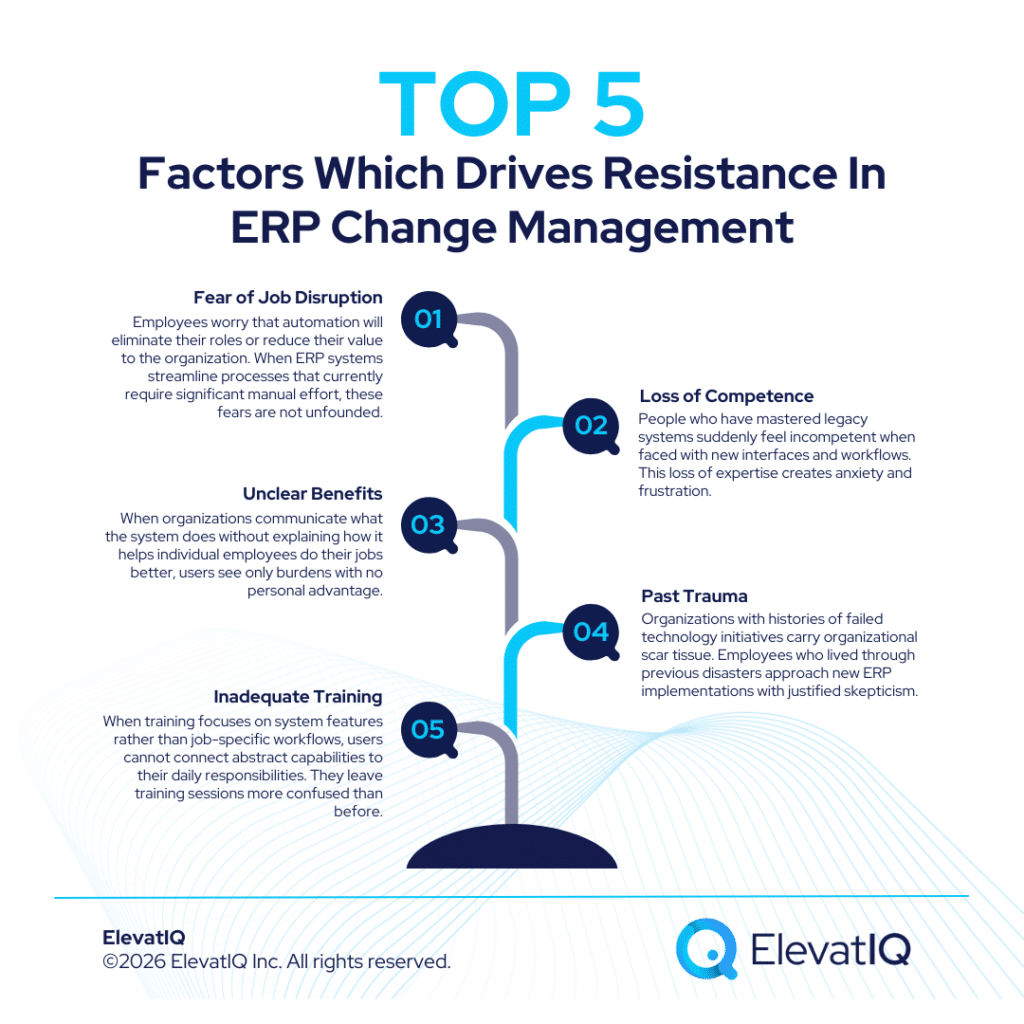
However, low adoption is more often a consequence of inadequate training, insufficient change management investment, or process design that makes the system harder to use than the manual alternative. When the system requires more steps to complete a transaction than the spreadsheet it replaced, users will use the spreadsheet. That is a process design and implementation decision, not a platform limitation.
Scalability Concerns That Mask Organizational Complexity
Growth-stage organizations frequently identify their ERP as a constraint on scaling. The system, they report, cannot handle increased transaction volumes, additional entities, or more complex reporting requirements.
Scalability is one of the more compelling reasons why companies change ERP, and sometimes it is legitimate. Some of these concerns are legitimate. Not every ERP scales equally, and product selection at an earlier stage of growth may have involved trade-offs that become binding constraints later. But scalability concerns can also mask a different problem: organizational complexity that has outpaced process discipline. When companies grow through acquisition, expand into new geographies, or diversify their business model without updating their operating processes, the ERP reflects that complexity. No replacement system will simplify an organization that has not first simplified itself.

ERP System Scorecard Matrix
This resource provides a framework for quantifying the ERP selection process and how to make heterogeneous solutions comparable.
Why Internal Inefficiency Is Harder to Diagnose Than Why Companies Change ERP
There is an organizational dynamic that makes internal inefficiency genuinely difficult to surface and address in the context of an ERP evaluation. ERP replacement projects generate momentum. Once a leadership team has decided that a new system is the answer, the organizational energy moves toward vendor selection, project planning, and stakeholder alignment. The question of whether the diagnosis is correct rarely receives the same investment. Going back to leadership with a recommendation to fix internal processes rather than replace the system requires a different kind of confidence, and it can be perceived as defending the status quo.
Additionally, the problems that internal inefficiency creates includes poor data quality, inconsistent process execution, departmental workarounds. They all accumulate gradually and rarely have a single visible cause. A system failure is an event. A culture of incomplete data entry is a pattern, and patterns are harder to surface in a standard vendor evaluation process.
Independent assessments conducted before a replacement decision is finalized tend to catch these dynamics. An objective review of current system utilization, configuration gaps, and process execution quality can distinguish between a platform that genuinely no longer fits the organization’s needs and one that has not been given the conditions to succeed.
When Replacement Is the Right Answer
None of this is an argument against replacement. There are genuine circumstances that explain why companies change ERP and arrive at the right conclusion. Where the current system is a legitimate constraint and replacement is the appropriate course of action.
A platform that has reached vendor end-of-support, that lacks the architectural capability to support a material change in business model, or that was selected for a significantly different organizational context may represent a real constraint rather than a misused tool. Similarly, organizations that have outgrown the functional depth of a mid-market system and require enterprise-grade capability in areas like multi-entity financial consolidation, global trade compliance, or complex manufacturing planning may have a genuine case for replacement.
The distinction worth preserving is between a system that cannot meet the organization’s needs and a system that has not been configured, maintained, or used in a way that could meet them. Both produce similar symptoms. They require very different interventions.
A More Useful Framework Before Committing to Replacement
Examining why companies change ERP, honestly and rigorously, before a replacement decision is finalized is one of the highest-value steps an organization can take. The following questions go beyond what the vendor evaluation process typically asks:
- Has a current-state utilization review been conducted? What percentage of the existing system’s relevant functionality is actively in use, and what has been licensed but not deployed?
- What is the quality of master data in the current environment? Would the same master data practices, carried into a new system, produce different outcomes?
- Where do workarounds exist, and why were they created? Are workarounds symptoms of system limitation, or symptoms of implementation and change management gaps?
- What would a process redesign, independent of the system? If the processes were redesigned without changing the platform, how much of the reported problem would remain?
- Has the organization’s operating model changed materially since implementation? If so, has the system configuration been updated to reflect that change, or has it remained static while the business evolved around it?
These questions do not predetermine the outcome. They ensure that the decision to replace, if that is where the analysis leads is grounded in a genuine understanding of the problem rather than a diagnosis shaped by the most visible symptom.
The Cost of Getting the Diagnosis Wrong
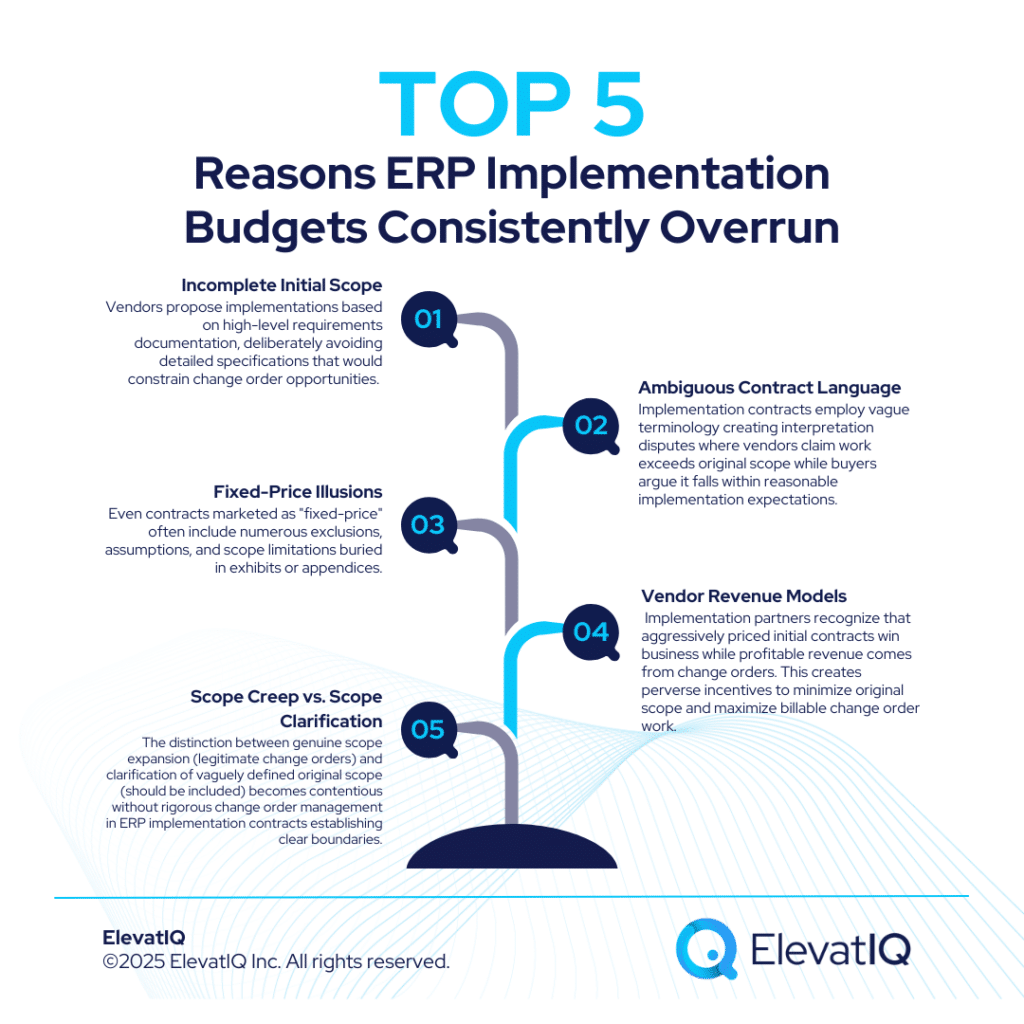
ERP replacement projects are among the most resource-intensive initiatives an organization undertakes. Budget overruns, extended timelines, and productivity disruption during go-live are well-documented risks. When why companies change ERP is built on a misdiagnosis, those costs are incurred without resolving the underlying issue.
The more durable cost is the organizational one. Teams that have been through a difficult replacement cycle, only to find the same reporting problems, the same integration friction, and the same adoption challenges in the new system. Thus, also develop a well-founded skepticism about the next initiative. That skepticism makes every subsequent improvement effort harder to execute. Getting the diagnosis right at the outset is not a theoretical exercise. It is the foundation on which a successful replacement, or a successful optimization of the current environment, is built.
How Independent Advisory Changes the Equation
Organizations navigating this decision benefit from advisory support that is not structured around a specific outcome. Implementation partners and ERP vendors have legitimate interests in a replacement project proceeding, that is how their engagements are structured. Independent ERP advisors operate differently: the value they provide is in the quality of the diagnosis, not in any particular conclusion.
ElevatIQ’s independent advisory practice works with enterprise organizations to assess whether replacement is genuinely the right answer. And when it is, to ensure the selection and implementation process is built on a clear-eyed understanding of the problem being solved. That kind of vendor-neutral perspective is available through ElevatIQ’s enterprise technology selection services. The organizations that get the most value from ERP investment are the ones that ask hard questions before they commit to a direction, not after the contract is signed.describes, is the foundation of a successful long-term ERP relationship.

ERP Selection: The Ultimate Guide
This is an in-depth guide with over 80 pages and covers every topic as it pertains to ERP selection in sufficient detail to help you make an informed decision.
Related Posts: