
Last Updated on June 19, 2026 by Shrestha Dash
Key Highlights
- Organizations may face increased competition for experienced EBS resources and potentially higher consulting costs as migration activity grows.
- Oracle EBS 12.1 moved to Sustaining Support on January 1, 2022. This means no new security patches, no regulatory updates, and no new bug fixes, while many organizations continue paying Oracle support and maintenance fees.
- Four years without new Critical Patch Updates can create a growing security and compliance challenge that may require additional compensating controls during SOC 2, ISO 27001, PCI DSS, and similar audit reviews.
- Every year spent on an unsupported EBS 12.1 system adds undocumented customization debt. Thus, directly increasing the scope and cost of any future migration.
Introduction
In late 2021, Oracle EBS 12.1 hit a milestone that most organizations had seen coming for years. Premier Support ended on December 31, moving EBS 12.1 customers into Sustaining Support effective January 1, 2022. Oracle’s announcement was clear, the deadline was widely covered in the ERP community, and the implications were well documented.
And yet, many organizations chose to defer major action. Some were mid-implementation on other priorities. Some were waiting to see what Oracle would do next. Many simply decided that the system still worked, the business was running fine, and the consequences of Oracle EBS end of support could be dealt with later.
It is now 2026. “Later” has arrived and the Oracle EBS end of support consequences that seemed manageable in 2021 have had four years to compound. Security exposure may have increased. Regulatory compliance may require additional effort and workarounds. Customization debt has accumulated. And organizations may find it increasingly difficult to secure experienced EBS resources for migration and support activities. This blog looks at what the Oracle EBS end of support consequences actually look like in practice, not as theoretical risk but as operational reality for organizations still running EBS 12.1 in 2026.
What Actually Changed in January 2022: Sustaining Support vs. Premier
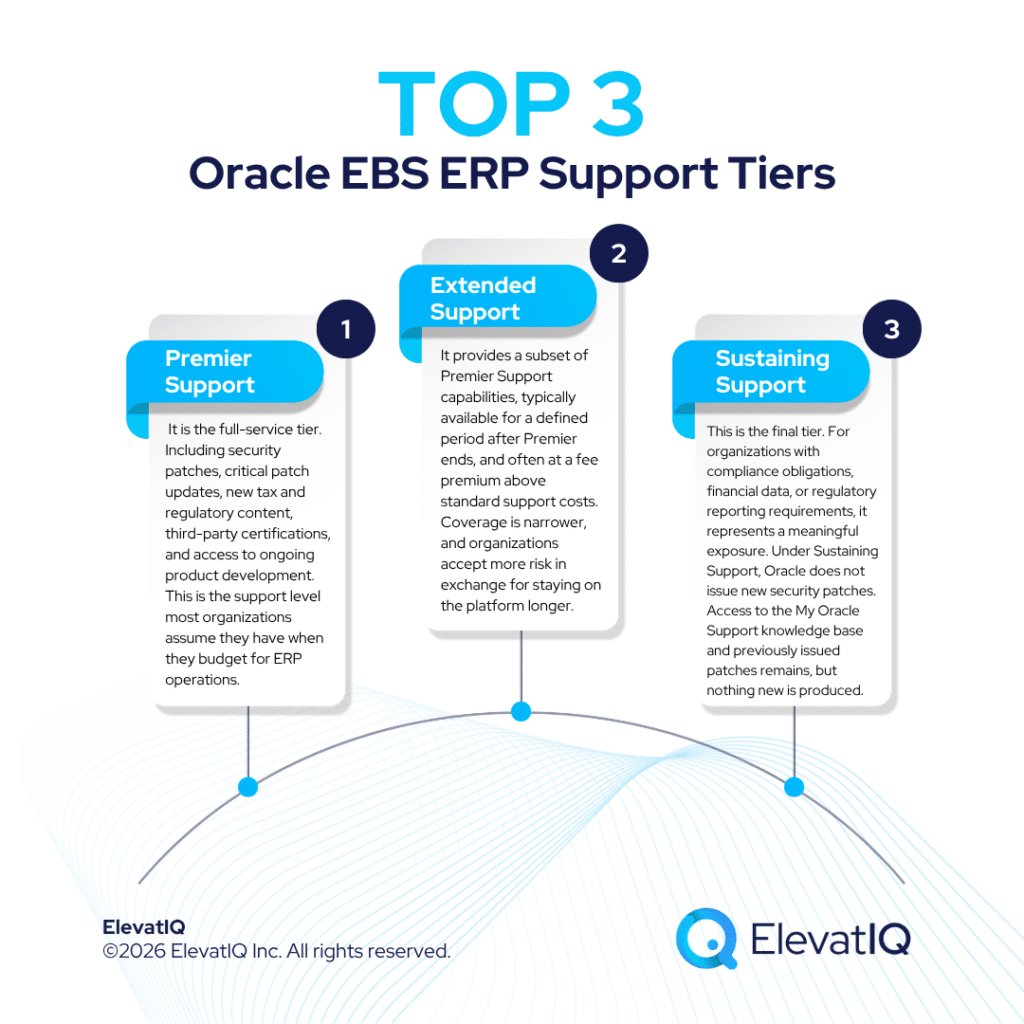
The Oracle EBS end of support consequences begin with a clear understanding of what Sustaining Support is and is not because many organizations running EBS 12.1 today continue paying Oracle support and maintenance fees while receiving a fundamentally reduced level of service.
What Premier Support Included
| Support Element | Covered Under Premier Support |
| Security patches & Critical Patch Updates | Yes – quarterly delivery |
| Tax, payroll & regulatory updates | Yes – per legislative cycle |
| Third-party certifications (OS, browser, DB) | Yes – as infrastructure updates |
| Bug fixes | Yes – new defects addressed |
| Technical support access | Yes – full capability |
What Sustaining Support Actually Provides
Under Sustaining Support, organizations retain access to previously issued patches, existing documentation, and diagnostic assistance. What they do not receive is anything new:
- No new security patches or Critical Patch Updates. Vulnerabilities identified after the Premier Support cutoff are not addressed by Oracle for EBS 12.1 environments.
- No new tax or regulatory updates. Changes to payroll tax tables, VAT legislation, country-specific compliance requirements, and other regulatory content are not delivered.
- No new third-party certifications. When underlying infrastructure such as operating systems, browsers, databases is updated, Oracle does not certify EBS 12.1 compatibility with those new versions.
- No new bug fixes. Product defects identified after the cutoff are not resolved.
The critical detail: organizations continue paying Oracle support and maintenance fees despite receiving a more limited level of support than was available under Premier Support. They continue paying for support services while receiving a more limited level of support than was available under Premier Support.


ERP Selection Requirements Template
This resource provides the template that you need to capture the requirements of different functional areas, processes, and teams.
The Compounding Cost of Staying: Security, Audit, and Compliance Exposure
The Oracle EBS end of support consequences in the security and compliance domain are not hypothetical. They are structural, and they worsen with every quarterly CPU cycle that EBS 12.1 environments miss.
Security Exposure
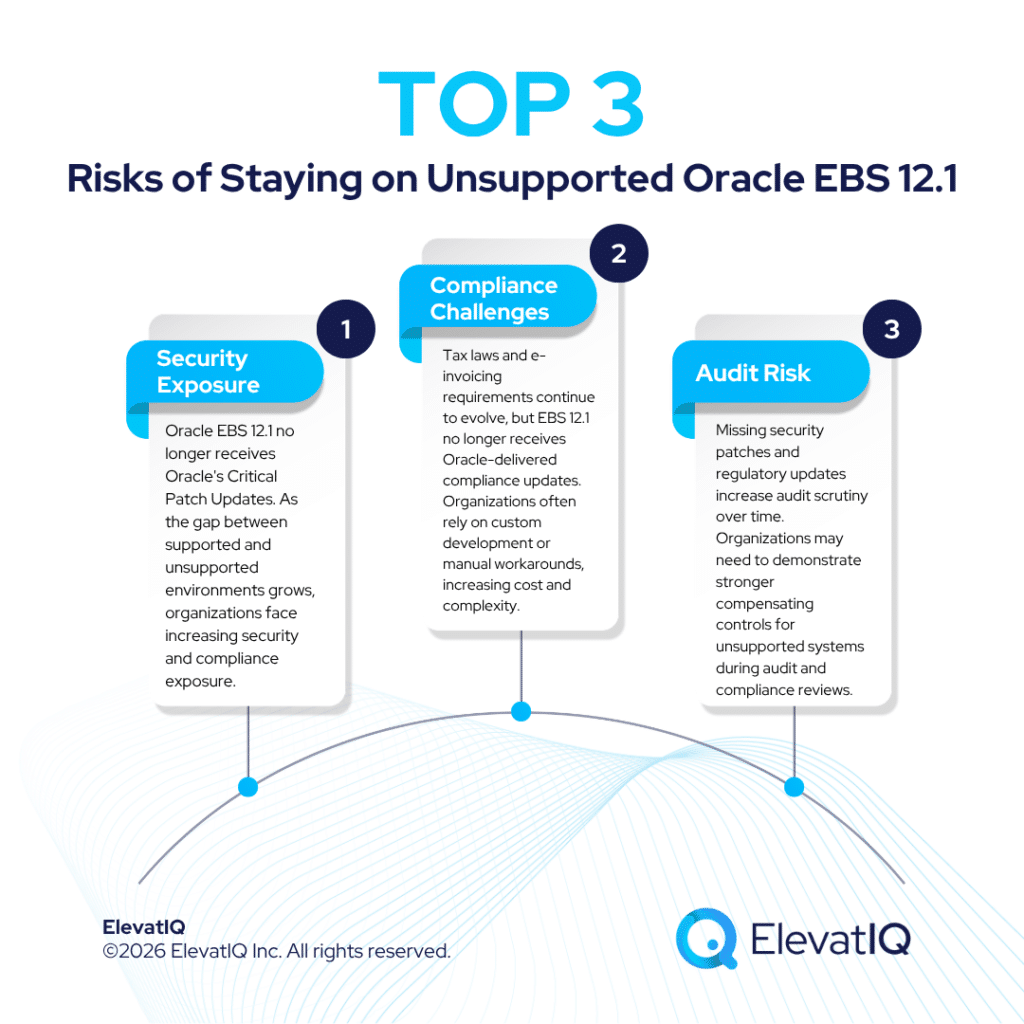
Oracle’s quarterly Critical Patch Updates address vulnerabilities across Oracle Database, Java, WebLogic, and application-layer components. EBS 12.1 environments under Sustaining Support receive none of these updates. Every quarter that passes may increase the gap between supported and unsupported environments from a security maintenance perspective.
/expertise/ERPFor organizations operating under information security frameworks such as SOC 2, ISO 27001, PCI DSS, or sector-specific equivalents, this creates a documented compliance exposure. These frameworks generally expect organizations to maintain effective vulnerability management and risk mitigation processes. When the ERP system processing financial data, procurement transactions, and payroll cannot receive security patches, the audit conversation shifts from:
“When will you patch this?”
to:
“What compensating controls are in place for a system that cannot be patched?”
That often becomes a more complex audit and risk-management discussion and one that grows harder with each passing quarter.
Regulatory and Legislative Non-Compliance
Tax law does not pause because the ERP system’s support has ended. Since January 2022, tax authorities across multiple jurisdictions have issued changes that Oracle has not delivered as updates to EBS 12.1. The e-invoicing wave is the most visible current example of Oracle EBS end of support consequences in the compliance domain.
Several jurisdictions, including Germany, Belgium, Poland, and France, are implementing or expanding e-invoicing requirements during this period. Organizations running EBS 12.1 cannot receive these compliance changes through Oracle’s standard delivery mechanism. Addressing them requires custom development, bolt-on solutions, or manual workarounds. Each of which adds cost and operational complexity, and none of which eliminates the underlying audit exposure.
Audit Risk
The combination of missing security patches and undelivered regulatory updates creates an audit risk profile that is increasingly difficult to manage as time passes. Internal audit functions and external auditors are aware of Oracle’s support tier definitions. An organization that has been operating on Sustaining Support for four years with a documented gap in security patching and regulatory updates, may face increased scrutiny during audit and compliance reviews compared with earlier years. The gap is no longer a theoretical future risk. It is a measurable, documented exposure with a specific start date.

ERP System Scorecard Matrix
This resource provides a framework for quantifying the ERP selection process and how to make heterogeneous solutions comparable.
The Hidden Cost That Compounds Silently: Customization Debt
The security and compliance dimension of Oracle EBS end of support consequences is visible and measurable. The customization debt dimension is less visible and in many ways more consequential for organizations that eventually migrate.
How Customization Debt Accumulates on an Unsupported System
Every year on EBS 12.1 Sustaining Support, the team keeping the system operational makes accommodations that add to the customization layer:
| Trigger | Resulting Customization |
| Oracle not delivering regulatory updates | Custom-built tax and compliance workarounds |
| Third-party systems update; no new EBS certifications | Custom integration patches and middleware fixes |
| New reporting requirements emerge | Bespoke report development outside standard EBS |
| Business process changes post-go-live | Configuration extensions built on an aging codebase |
Each accommodation is rational in isolation. Collectively, they constitute an accumulating layer of undocumented, organizationally specific customization that makes a future migration more complex and more expensive with every year that passes.
The Direct Impact on Migration Cost
The relationship between customization debt and migration cost is direct:
- Migration scoping begins with a customization inventory cataloguing what exists, what maps to the destination platform, and what requires rebuilding.
- Organizations accumulating workarounds for four years on an unsupported system arrive at that inventory with significantly more undocumented customization than they had in 2021.
- The full scope of that accumulation frequently surfaces for the first time during the assessment process after an implementation partner has been engaged and a project timeline has been set.
This is a commonly observed pattern in ERP migration assessments: the organizations that deferred the decision longest tend to have the largest gap between their initial assumption of migration complexity and the reality that surfaces during discovery.
The Talent Problem: A Shrinking Pool at a Rising Price
The Oracle EBS end of support consequences extend beyond the technology to the people required to manage and eventually migrate it. EBS 12.1 is a mature platform, and its talent pool reflects that maturity.
The Supply Side Is Contracting
- EBS functional and technical consultants such as PL/SQL developers, Forms and Reports specialists, DBA resources have been in the field for ten to twenty years.
- The pipeline of new EBS expertise has been narrow for years; consulting firms and Oracle’s ecosystem have oriented toward Fusion Cloud, not EBS 12.1.
- Many experienced EBS specialists entered the workforce during the platform’s peak adoption years, creating long-term succession and talent availability concerns.
The Demand Side Has Not Disappeared
- Thousands of organizations globally are still running EBS in production in 2026.
- Many organizations are evaluating migration strategies, increasing demand for experienced EBS resources.
- Organizations that delayed may face increased competition for experienced specialists and potentially higher consulting costs.
The Practical Impact
For organizations that need EBS 12.1 support or are beginning migration planning in 2026, the talent constraint shows up in two ways: higher day rates for experienced EBS resources, and longer lead times to secure the specialists needed for customization assessment, data extraction, and migration scoping, the foundational work that every migration requires before ERP implementation begins.
Why “We’ll Deal With It Later” Now Means a Harder Migration in 2026
The deferral decision made by many EBS 12.1 organizations in 2021 was not unreasonable on its face. The system was running. Operations were stable. The immediate Oracle EBS end of support consequences were not visible the way a system outage would be. What that decision did not account for was the compounding nature of the exposure. Each year may introduce additional complexity in areas such as security, compliance, customization, and staffing.
For many organizations, the migration effort may now be larger, more expensive, and more complex than it would have been several years earlier. The assessment reveals more customization than anticipated. Data quality issues are deeper. Compliance gaps require remediation. EBS resources are harder to secure. And the organization has fewer years of stable infrastructure under it during the migration period. None of this makes migration impossible. It makes it costlier and more constrained than it needed to be.
How Independent ERP Consultants Can Help
Organizations confronting Oracle EBS end of support consequences in 2026 often face a structural problem: most of the advisory available to them has directional interests. Oracle and its partners have migration revenue incentives. Implementation firms have preferred delivery methodologies. Even well-intentioned guidance from peers is shaped by individual experience with specific platforms and projects.
Independent ERP advisory addresses this by removing vendor incentives from the analysis. Here is what that looks like in practice for EBS 12.1 organizations:
1. Independent EBS Environment Assessment
Before any migration commitment is made, an honest inventory of the organization’s actual EBS environment is conducted, including ERP customization scope, compliance gaps, data quality, integration dependencies, and talent requirements. This assessment is not shaped by a preferred migration destination, and its findings do not change based on which implementation partner has already been engaged.
2. Migration Path Evaluation Without Vendor Bias
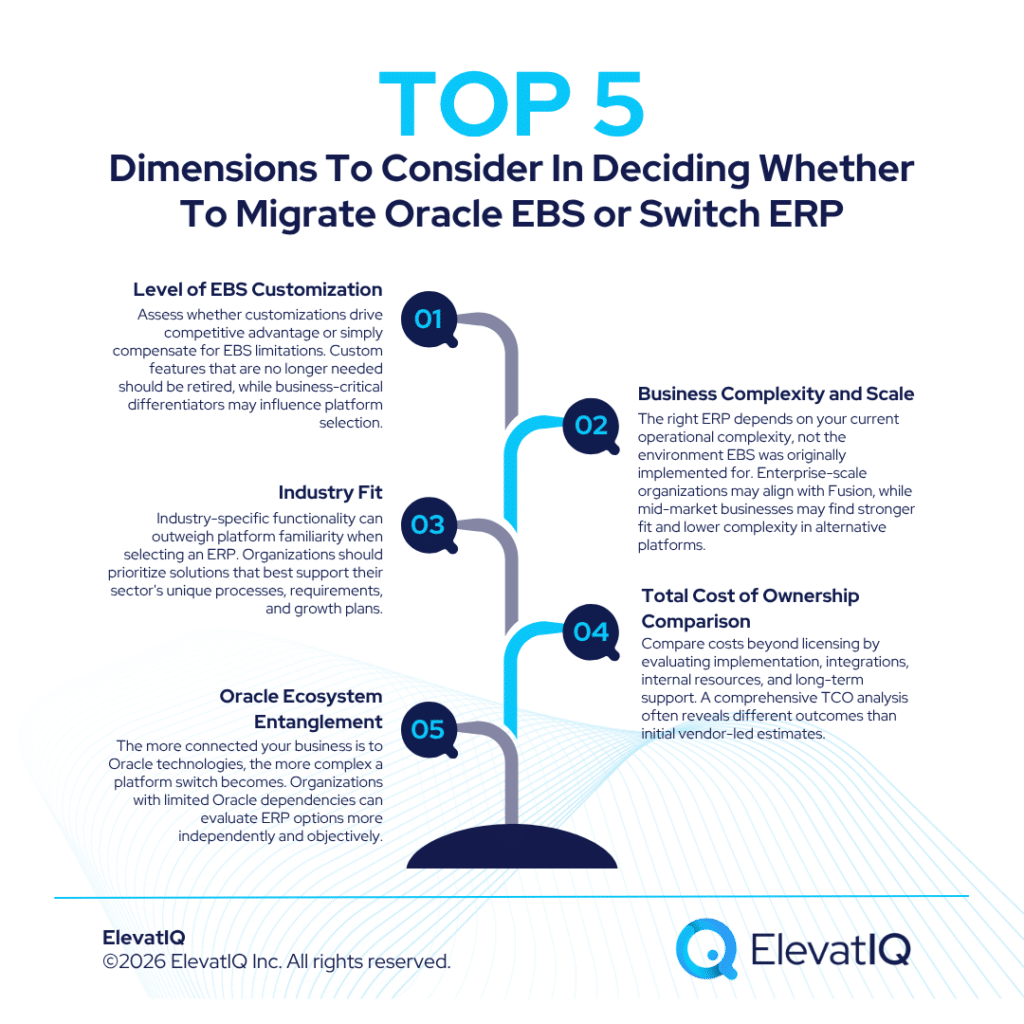
Oracle Fusion Cloud is not the only path out of EBS 12.1, and it is not automatically the right one. An independent evaluation considers the full range of options such as Fusion Cloud, SAP S/4HANA, Microsoft Dynamics 365, NetSuite, Infor CloudSuite against the organization’s specific requirements, industry fit, and total cost of ownership profile. The right platform should win the evaluation on merit, not by default.
3. Realistic Total Cost of Ownership Modeling
Independent advisory models the full migration cost: ERP implementation services, data migration, integration rework, dual-run licensing during the transition period, internal resource burden, and post-go-live stabilization. Organizations that receive this modeling before contracting are in a fundamentally stronger position than those who receive it as a change order mid-implementation.
4. Implementation Oversight
For organizations that have already selected a migration path and an implementation partner, independent oversight ensures that the project is executed against the organization’s requirements, not against the implementation partner’s preferred delivery scope. Scope creep, change-order growth, and timeline extensions are among the most frequently cited challenges in ERP migration projects.
The consistent pattern in independent ERP advisory is that organizations discover the full scope of their Oracle EBS end of support consequences not when they decide to act, but when honest assessment work begins. That discovery is most useful before a migration commitment is made, not after.
Conclusion
The Oracle EBS end of support consequences that seemed manageable as a future consideration in 2021 are a present operational reality in 2026. Security vulnerability gaps may have accumulated through four years of missed Critical Patch Updates. Regulatory compliance has become harder to maintain as e-invoicing mandates and tax law changes arrive without Oracle’s standard update mechanism. Customization debt has grown with every workaround added to a system the organization can no longer lean on Oracle to maintain. And organizations may face a more limited pool of experienced EBS resources than was available several years earlier.
The organizations navigating this in 2026 are not facing a problem that cannot be solved. They are facing a problem that is more expensive and more complex to solve than it would have been if addressed in 2022 and one that will be more expensive still if addressed in 2028.
The starting point, in every case, is an honest ERP assessment of where the organization actually stands: what has been customized, what compliance gaps exist, what the data quality looks like, and what a realistic migration path requires. That assessment is most useful before a migration commitment is made, not after.

ERP Selection: The Ultimate Guide
This is an in-depth guide with over 80 pages and covers every topic as it pertains to ERP selection in sufficient detail to help you make an informed decision.
Related Posts: