
Last Updated on December 12, 2025 by Shrestha Dash
The most expensive ERP contract decisions often occur not during initial procurement but years later, when organizations discover that automation and AI add-ons, which ERP vendors position as “optional enhancements” have become operational necessities. Often priced at premium rates far exceeding what could have been negotiated during initial implementation. For example, a company that implemented SAP in 2023 paying standard subscription fees now faces $30 per user monthly for Microsoft Copilot functionality, AI consumption charges for automated processing, and premium pricing for predictive analytics capabilities that competitors negotiated as included features during their original contracts.
This pattern—vendors unbundling automation and AI capabilities from base ERP platforms and monetizing them as separately licensed add-ons, represents one of the fastest-growing cost escalation vectors in enterprise software. What begins as a manageable base subscription transforms into a complex fee structure where every advanced capability, intelligent automation, or AI-powered feature requires incremental payment. Organizations that fail to anticipate and negotiate pricing for automation and AI add-ons in ERP implementations will eventually need discover they must either pay whatever vendors demand or operate without capabilities competitors leverage for competitive advantage.
Successfully protecting against future ERP cost escalation from automation and AI add-ons requires understanding why vendors unbundle these capabilities, identifying which features you’ll inevitably need, locking in pricing for automation and AI add-ons ERP contracts include today even when you won’t activate them immediately, and establishing contractual protections preventing vendors from charging premium rates once your operational dependency eliminates negotiating leverage.
The AI Unbundling Trend: Why Vendors Separate Automation from Base ERP
Enterprise software vendors historically included new functionality within existing maintenance and subscription fees. Enhanced reporting, improved workflows, and capability upgrades were expected components of ongoing vendor relationships. However, automation and AI represent a fundamental shift where vendors increasingly position these capabilities as premium add-ons requiring separate licensing and generating new revenue streams independent of base subscriptions.
Understanding the Vendor Monetization Strategy
Revenue Growth Imperative: Public ERP vendors face intense pressure to demonstrate revenue growth to investors. With user-based subscription models reaching saturation—most organizations have licensed all the users they need—vendors require new monetization avenues. Automation and AI add-ons ERP platforms now feature create these opportunities, allowing vendors to charge existing customers incrementally without adding users.
Competitive Differentiation: Rather than competing solely on base platform capabilities, vendors differentiate through AI features—intelligent process automation, predictive analytics, natural language interfaces, automated decision-making. By pricing automation and AI add-ons separately, vendors can market “starting at” prices for base platforms while generating premium revenue from organizations requiring advanced capabilities.
Usage-Based Economics: Unlike traditional user licensing where costs remain relatively fixed, consumption-based pricing for automation and AI add-ons creates variable revenue streams scaling with customer usage. The more organizations leverage AI features, process transactions through automation, or consume AI-powered analytics, the more vendors earn—aligning vendor incentives with customer adoption while creating unlimited revenue potential.
Lock-In Leverage: Vendors recognize that automation and AI add-ons ERP systems offer become more valuable after implementation when organizations have committed to platforms, integrated systems, trained users, and configured processes. This dependency enables premium pricing since customers lack practical alternatives once locked into ERP ecosystems.
Examples of Vendor AI Unbundling
- Microsoft Dynamics 365: Microsoft positions Copilot for Finance as a $30 per user per month add-on separate from base Dynamics 365 subscriptions. Organizations wanting AI-powered financial analysis, automated journal entries, or intelligent reconciliation must budget this incremental cost beyond their core ERP investment.
- SAP S/4HANA: SAP increasingly employs consumption-based pricing for AI capabilities through AI credits systems. Rather than including AI features in base subscriptions, SAP charges based on AI utilization—per prediction, per analysis, or per automated decision. Creating variable costs tied to how extensively organizations leverage these capabilities.
- Oracle Cloud ERP: Oracle’s Digital Assistant and other AI-powered features operate on Universal Credits through per-request or subscription models, introducing consumption-based charges for AI functionality that adds cost uncertainty depending on usage patterns.
- Workday: While Workday includes certain AI capabilities in base subscriptions, advanced machine learning features, extended analytics, and specialized automation often require premium tier licensing or separate module purchases at substantial incremental costs.
This unbundling creates a two-tier ERP landscape: base platforms providing fundamental functionality and premium tiers offering automation and AI add-ons critical for competitive operations but priced to maximize vendor revenue from customers with limited alternatives.
The Cost Escalation Trap: Premium Pricing After Platform Lock-In
The fundamental problem with separately priced automation and AI add-ons ERP vendors offer manifests most painfully when organizations discover capabilities they need years after implementation, when negotiating leverage has evaporated and vendors can charge premium rates with minimal resistance.
How Lock-In Eliminates Negotiating Power
Operational Dependency: After 2-3 years operating on an ERP platform, organizations have configured complex workflows, integrated dozens of systems, trained hundreds of users, customized reports and dashboards, and embedded the ERP deeply into business operations. Switching vendors to access better AI pricing would require massive reinvestment—often $2-5 million for mid-sized organizations—making it economically irrational regardless of ongoing AI add-on costs.
Sunk Cost Reality: Having invested millions in ERP implementation, integration, customization, and training, organizations face enormous psychological and financial barriers to abandoning platforms even when vendor pricing becomes unreasonable. This sunk cost dynamic—the more you’ve invested, the harder switching becomes—gives vendors pricing power they lacked during initial procurement.
Integration Complexity: Modern ERP systems integrate with CRM platforms, supply chain tools, e-commerce systems, analytics applications, and numerous other technologies. These integration architectures represent substantial investment and operational criticality. Migrating to alternative ERP vendors purely for better AI pricing would require rebuilding integration ecosystems at prohibitive cost and risk.
Organizational Inertia: Beyond technical and financial considerations, organizational change resistance creates powerful momentum maintaining existing vendor relationships. Users familiar with current systems resist learning new platforms. IT teams invested in current architectures resist wholesale technology transitions. Executives wary of implementation risk avoid vendor changes absent compelling business cases.
Premium Pricing Scenarios
Organizations frequently encounter these cost escalation patterns when requesting automation and AI add-ons ERP implementations didn’t originally include:
Scenario 1: Predictive Analytics Requirements
A manufacturing company implemented their ERP in 2022, negotiating favorable base subscription pricing. In 2024, competitive pressure required advanced demand forecasting using machine learning. The vendor quoted $50,000 annually for predictive analytics add-ons—far exceeding what companies negotiating this capability during original implementation secured. Lacking practical alternatives after two years of operational dependency, the manufacturer paid the premium pricing.
Scenario 2: Intelligent Process Automation
A services organization discovered that competitors automated invoice processing, expense management, and vendor reconciliation using AI capabilities. Their ERP vendor offered these automation and AI add-ons at $25 per user monthly—$150,000 annually for their 500-user base. Companies that negotiated automation inclusion during original procurement avoided these incremental costs, while this organization paid premium pricing from a position of dependency.
Scenario 3: Natural Language Interfaces
An enterprise recognized that natural language query capabilities dramatically improved user adoption and system value. However, their vendor priced conversational AI interfaces as premium add-ons at $15 per user monthly. With 1,000 users, this represented $180,000 annually for functionality competitors secured as included features by negotiating proactively during initial implementations.
Scenario 4: AI-Powered Financial Close
A finance team implementing automated month-end close processes discovered their ERP vendor’s AI-powered automation required separate licensing beyond base subscriptions. The vendor quoted $75,000 annually for intelligent journal entry suggestions, automated variance analysis, and predictive close timeline management. Competitors who anticipated and negotiated these automation and AI add-ons during original ERP contracts secured substantially better pricing or inclusion in base subscriptions.
These scenarios share common patterns: organizations didn’t anticipate needing capabilities during original implementations, vendors unbundled features from base platforms, and operational dependency eliminated negotiating leverage by the time organizations recognized requirements—enabling vendors to charge premium prices without meaningful customer pushback.sses.
Leveraging Implementation Experience: Identifying Renewal PrioritiesIdentifying Future Automation and AI Needs Today
The critical strategy for protecting against cost escalation from automation and AI add-ons ERP vendors price separately requires anticipating which capabilities your organization will eventually need and negotiating favorable pricing today, even when you won’t activate features immediately.
Assessing Your AI Trajectory
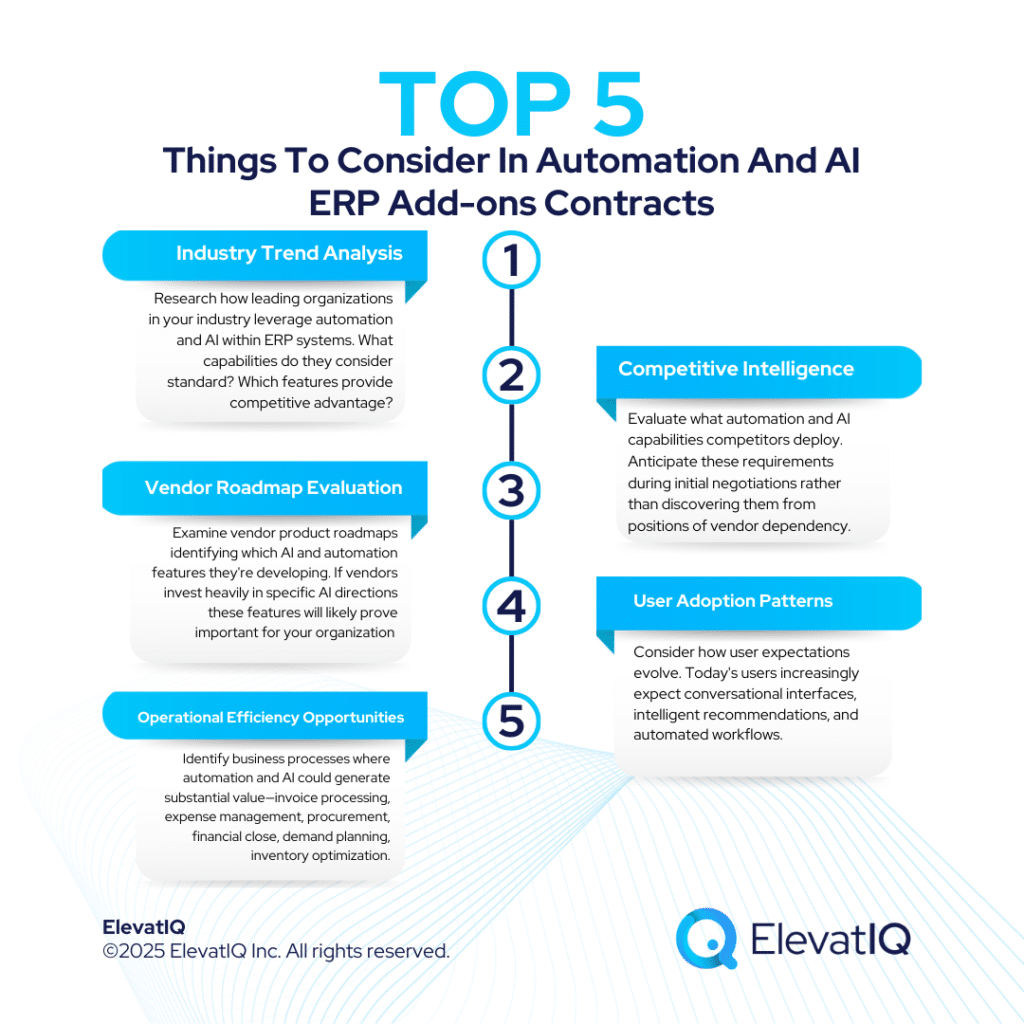
- Industry Trend Analysis: Research how leading organizations in your industry leverage automation and AI within ERP systems. What capabilities do they consider standard? Which features provide competitive advantage? If industry leaders employ predictive analytics, intelligent automation, or AI-powered decision support, your organization will likely require these capabilities within 2-3 years regardless of current plans.
- Competitive Intelligence: Evaluate what automation and AI capabilities competitors deploy. If rivals use AI for demand forecasting, automated procurement negotiations, intelligent inventory optimization, or predictive maintenance, competitive pressure will eventually force similar adoption. Anticipate these requirements during initial negotiations rather than discovering them from positions of vendor dependency.
- Vendor Roadmap Evaluation: Examine vendor product roadmaps identifying which AI and automation features they’re developing. Capabilities currently in beta or planned for release will likely become standard expectations within 12-24 months. If vendors invest heavily in specific AI directions—conversational interfaces, predictive analytics, process mining, intelligent automation—these features will likely prove important for your organization even if they seem unnecessary today.
- User Adoption Patterns: Consider how user expectations evolve. Today’s users increasingly expect conversational interfaces, intelligent recommendations, and automated workflows. What seems like “nice to have” AI enhancement today often becomes “expected functionality” within 18-24 months as user experiences in consumer applications raise expectations for enterprise systems.
- Operational Efficiency Opportunities: Identify business processes where automation and AI could generate substantial value—invoice processing, expense management, procurement, financial close, demand planning, inventory optimization. Even if you won’t implement these improvements immediately, you’ll likely pursue them within your contract term. Negotiate pricing for automation and AI add-ons supporting these opportunities now rather than later.
Creating Your AI Feature Inventory
Develop comprehensive inventories of automation and AI add-ons you may need:
Intelligent Process Automation:
- Automated invoice processing and matching
- Intelligent expense report review and approval
- Vendor payment automation with anomaly detection
- Purchase order generation from predictive demand
- Automated financial reconciliations
- Intelligent workflow routing and approvals
Predictive Analytics and Forecasting:
- Demand forecasting with machine learning
- Revenue predictions and pipeline analysis
- Cash flow forecasting and optimization
- Inventory optimization and reorder point predictions
- Customer churn prediction and retention modeling
- Supplier risk assessment and monitoring
Natural Language Capabilities:
- Conversational query interfaces for ERP data
- Natural language report generation
- Voice-activated data entry and retrieval
- Intelligent search across ERP modules
- Automated narrative generation for financial reports
AI-Powered Decision Support:
- Pricing optimization recommendations
- Supplier selection and negotiation assistance
- Production scheduling optimization
- Resource allocation recommendations
- Risk identification and mitigation suggestions
Advanced Analytics:
- Real-time business intelligence
- Predictive maintenance for equipment
- Supply chain optimization modeling
- Scenario planning and simulation
- Anomaly detection for fraud prevention
This inventory provides foundation for negotiating comprehensive protection against future cost escalation from automation and AI add-ons, even when you won’t activate all features immediately.
Locking In AI Pricing During Initial Negotiations
The most powerful protection against premium pricing for automation and AI add-ons ERP vendors offer comes from negotiating favorable rates during initial contract discussions when you possess maximum leverage—before operational dependency develops and competitive alternatives provide meaningful negotiating power.
Pre-Negotiated Add-On Pricing
- Specific Feature Pricing: Even for automation and AI add-ons you won’t activate immediately, secure specific per-user or consumption-based pricing you can trigger at pre-agreed rates:
- “Customer may activate [specific AI feature] at any time during the contract term at the rate of $[amount] per user per month, regardless of then-current list pricing. This rate shall remain fixed throughout the initial term and any renewal periods.” This provision prevents vendors from charging premium prices once they recognize your platform dependency. You’re locking today’s pricing for future activation.
- Modular Pricing Schedules: Negotiate comprehensive pricing schedules covering all automation and AI add-ons the vendor offers, even those you definitely won’t use initially:
- “Pricing Schedule B attached hereto establishes Customer’s rates for all AI and automation features, modules, and add-ons. These rates apply regardless of activation timing and supersede any future list pricing for these capabilities.”
- Volume Discount Application: Ensure any volume discounts negotiated for base licenses also apply to automation and AI add-ons rather than allowing vendors to charge higher rates for AI capabilities:
- “All volume discounts, pricing tiers, and preferential rates negotiated for base ERP licenses shall apply equally to AI and automation add-ons, modules, and consumption-based features.”
- Most-Favored Pricing for AI: Negotiate clauses ensuring you receive automation and AI pricing no less favorable than vendors offer similarly-situated customers:
- “Customer shall receive pricing for all AI, automation, and advanced analytics features no less favorable than Vendor offers customers of similar size, industry, and deployment configuration. If Vendor offers more favorable AI pricing to comparable customers, Customer’s rates shall automatically adjust to match.”
Inclusion Strategies
Beyond locking in pricing for separately licensed features, negotiate inclusion of automation and AI add-ons within base subscriptions:
- Bundled AI Capabilities: Rather than accepting vendor unbundling, negotiate that specific AI features are included in base licensing:
- “Base ERP subscription includes the following AI and automation capabilities at no additional charge: [list specific features]. Vendor shall not separately license these capabilities or convert them to add-on pricing during the contract term.”
- AI Credit Allocations: For vendors employing consumption-based AI pricing, negotiate substantial included credits within base subscriptions:
- “Base subscription includes [X] monthly AI credits for automation, predictive analytics, and intelligent processing features. Unused credits roll over quarterly.”
- Tiered Inclusion: Negotiate that moving to higher user count tiers automatically includes additional automation and AI add-ons:
- “Upon Customer reaching [threshold] users, base subscription automatically includes [specific AI features] without additional per-user charges.”


The 2026 Digital Transformation Report
Thinking of embarking on a ERP journey and looking for a digital transformation report? Want to learn the best practices of digital transformation? Then, you have come to the right place.
Contractual Protections Against AI Cost Escalation
Beyond pre-negotiating specific automation and AI add-ons pricing, comprehensive ERP contracts include structural protections preventing cost escalation even when adding capabilities not explicitly priced during initial negotiations.
Price Protection Frameworks
- Maximum AI Cost Increases: Establish caps on how much automation and AI add-ons can increase annually:
- “Pricing for AI, automation, and analytics add-ons shall not increase more than [3-5%] annually, regardless of changes to Vendor’s standard list pricing.”
- Pricing Methodology Locks: When specific automation and AI add-ons weren’t explicitly priced, establish methodologies ensuring reasonable pricing:
- “Pricing for AI features not explicitly listed in Schedule B shall be calculated as [X%] discount from then-current list pricing, but in no event shall exceed [amount] per user monthly or [amount] per-transaction.”
- Escalation Dispute Resolution: Include procedures for resolving pricing disputes when adding automation and AI add-ons:
- “If parties disagree on pricing for AI features Customer wishes to activate, either party may request third-party pricing benchmarking. Pricing shall be set at median rate comparable customers of similar size receive from Vendor for equivalent capabilities.”
- Feature Migration Protections: Prevent vendors from converting included features to separately priced add-ons:
- “Vendor shall not remove features from base subscription and convert them to separately licensed add-ons during the contract term. Any features included in base subscription at contract execution shall remain included throughout initial term and renewals.”
Consumption Cap Protections
For automation and AI add-ons employing consumption-based pricing, establish comprehensive caps:
Monthly/Annual Consumption Limits: Negotiate maximum charges regardless of utilization:
“Total monthly charges for all consumption-based AI and automation features shall not exceed $[amount] regardless of actual usage volumes, API calls, transactions processed, or predictions generated.”
Alert Mechanisms: Require proactive notifications when approaching consumption limits:
“Vendor shall alert Customer when AI consumption reaches 75% and 90% of monthly allocations, providing 15-day notice before any overage charges accrue.”
Grace Period Provisions: Include periods for evaluating consumption before overages apply:
“Upon reaching consumption limits, Customer shall have 30-day grace period to evaluate usage patterns and negotiate capacity adjustments before overage charges begin.”
Activation Rights and Flexibility
Negotiating favorable pricing for automation and AI add-ons proves worthless if contracts impose restrictions on when, how, or which features you can activate. Comprehensive agreements establish activation flexibility ensuring you control timing and utilization.
On-Demand Activation
Immediate Activation Rights: Secure ability to activate pre-negotiated automation and AI add-ons without vendor delays or approval processes:
“Customer may activate any AI or automation features listed in Pricing Schedule B immediately upon written notice to Vendor. Activation shall occur within [24-48 hours] without requiring vendor approval, additional agreements, or contract amendments.”
No Minimum Commitments: Prevent vendors from requiring minimum user counts, usage commitments, or term lengths for AI features:
“Customer may activate AI features for any number of users from 1 to total licensed users without minimum thresholds. Customer may discontinue AI features at any time without penalty, with charges prorated to activation period.”
Pilot and Testing Rights: Negotiate ability to pilot automation and AI add-ons before full deployment:
“Customer may pilot any AI feature with up to [50] users for [90] days at no charge to evaluate functionality before full activation. Pilot periods do not constitute activation triggering payment obligations.”
Flexible Deactivation
Discontinuation Without Penalty: Ensure ability to turn off automation and AI add-ons that disappoint without losing access to other features or facing penalties:
“Customer may discontinue any AI or automation add-on at any time with [30] days notice. Discontinuation shall not affect Customer’s access to base ERP functionality, other add-ons, or negotiated pricing. Charges for discontinued features cease immediately upon effective date.”
No Lock-In Periods: Avoid mandatory commitment periods for AI features:
“AI and automation add-ons carry no minimum term requirements. Customer may activate and deactivate features monthly based on business needs.”
Trial Reactivation: Maintain ability to reactivate features you’ve discontinued:
“Customer may reactivate previously discontinued AI features at original negotiated pricing without penalty or waiting periods.” exports in standard formats with validation assistance; and (4) temporary access to system during data migration period.”
Strategic Negotiation for Automation and AI Add-Ons
Protecting against future ERP cost escalation from automation and AI add-ons requires proactive negotiation during initial contracts when leverage exists, before operational dependency eliminates alternatives. Organizations that anticipate AI requirements, create comprehensive feature inventories, lock in favorable pricing even for capabilities they won’t immediately activate, and establish contractual protections against premium pricing position themselves for cost-effective AI adoption throughout ERP lifecycles.
Conversely, buyers who treat automation and AI add-ons as distant concerns or accept vendor unbundling without pricing protections discover that capabilities essential for competitive operations come with premium price tags vendors demand from positions of customer dependency. The difference between organizations protecting against AI cost escalation and those facing unlimited expenses often traces to whether they negotiated comprehensive automation and AI add-ons provisions before implementations began.
The investment in thorough AI pricing negotiation—even for features that seem unnecessary today—delivers returns throughout the ERP relationship, preventing the cost surprises and operational constraints that plague organizations who discover too late that competitive necessities require premium payments to vendors who recognize customers lack practical alternatives.
For organizations navigating ERP procurement in the AI era, independent advisory expertise provides essential guidance through rapidly evolving automation and AI add-ons pricing dynamics, helping secure contract protections that transform potentially unlimited cost escalation into predictable, manageable investments serving your organization throughout your ERP lifecycle.
FAQs
Related Posts: