
Last Updated on February 19, 2026 by Shrestha Dash
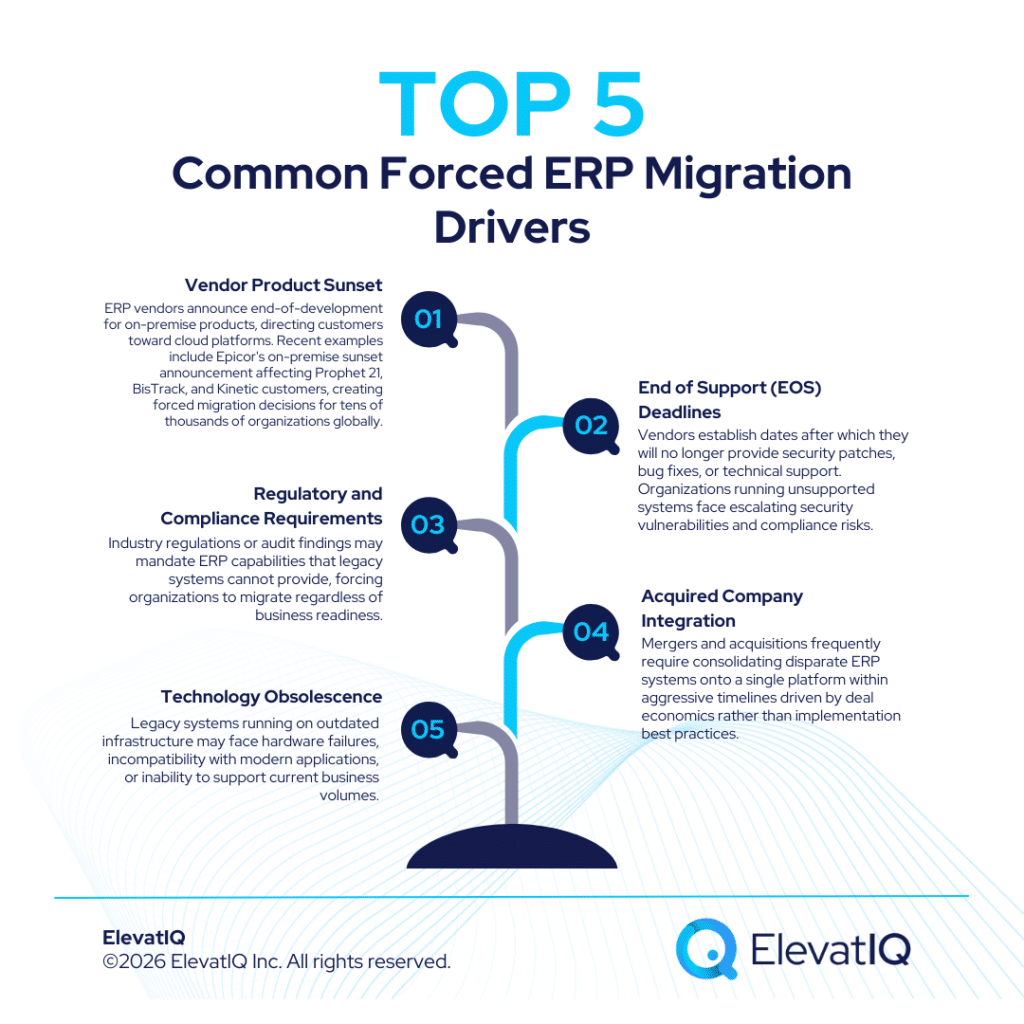
Epicor’s announcement to sunset on-premise development for Kinetic, Prophet 21, and BisTrack has created a decision point for roughly 20,000 organizations globally. While Active Support continues through December 31, 2029, this timeline requires thoughtful evaluation of migration options that will shape your ERP strategy for the next decade. The Epicor cloud migration decision is not simply about technology deployment, it is about total cost of ownership, operational requirements, organizational readiness, and long-term strategic alignment. Should you migrate to Epicor Cloud and leverage the Ascend program? Does staying on-premise in Sustaining Support make financial sense? Or should you evaluate alternative ERP vendors that might better serve your evolving needs?
This decision framework provides structured approaches to evaluate Epicor cloud migration options objectively, calculate true costs across different paths, and make informed choices aligned with business requirements rather than vendor preferences or deadline pressure.
Understanding Your Decision Context
Before evaluating specific migration options, organizations must establish decision criteria that reflect their unique circumstances. The optimal path for a heavily customized Epicor ERP deployment differs significantly from a straightforward Prophet 21 implementation running standard processes.
Key Decision Factors
- Customization Complexity: Organizations with extensive customizations face substantially higher migration efforts regardless of which path they choose. Custom code, modified workflows, specialized reports, and unique integrations all require conversion, rebuilding, or replacement. Document your current customization inventory, this will be the single largest cost driver in any migration scenario.
- Financial Considerations: Your organization’s financial position, budget flexibility, and accounting preferences significantly influence optimal paths. Companies prioritizing capital expenditure control favor cloud subscriptions. Organizations with depreciated on-premise infrastructure and limited OpEx budget flexibility may prefer extended on-premise operations.
- Operational Requirements: Regulatory compliance, data sovereignty needs, integration dependencies, and business continuity requirements create constraints that some deployment models cannot satisfy. Highly regulated industries or data-sensitive operations may find cloud migration challenging despite vendor pressure.
- Organizational Change Capacity: Your ability to absorb disruption matters. Organizations undergoing major business transitions, leadership changes, or market challenges may lack capacity to execute complex ERP migrations alongside other strategic initiatives.
The Three-Path Decision Framework
Every Epicor on-premise customer faces three fundamental options:
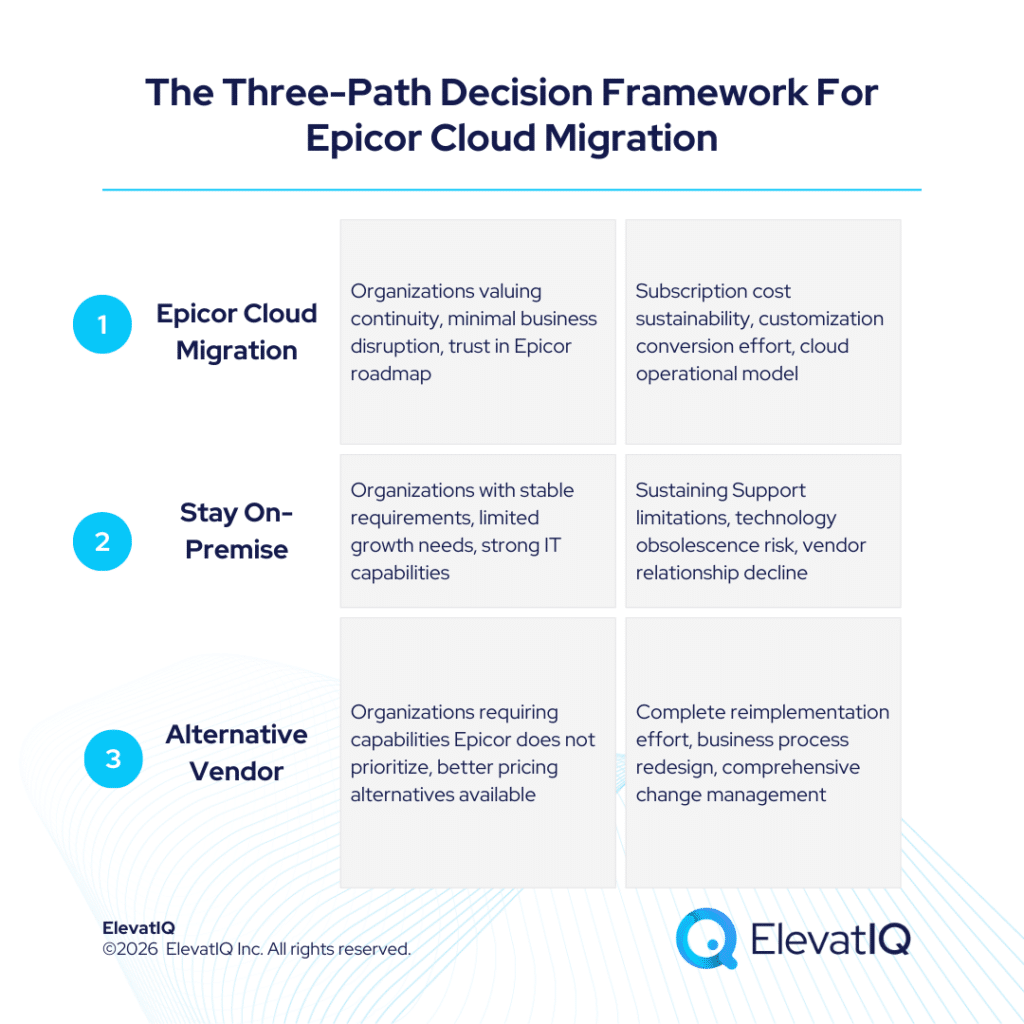
| Decision Path | Best For | Key Considerations |
| Epicor Cloud Migration | Organizations valuing continuity, minimal business disruption, trust in Epicor roadmap | Subscription cost sustainability, customization conversion effort, cloud operational model |
| Stay On-Premise | Organizations with stable requirements, limited growth needs, strong IT capabilities | Sustaining Support limitations, technology obsolescence risk, vendor relationship decline |
| Alternative Vendor | Organizations requiring capabilities Epicor does not prioritize, better pricing alternatives available | Complete reimplementation effort, business process redesign, comprehensive change management |
Path 1: Epicor Cloud Migration Analysis
Migrating to Epicor Cloud represents continuity with change, maintaining your vendor relationship while transitioning to cloud deployment. This path minimizes business process disruption but introduces subscription cost models and cloud operational changes.
Epicor Cloud Migration Advantages
- Operational Continuity: Users retain familiarity with Epicor interfaces, terminology, and workflows. Training requirements focus on cloud-specific changes rather than learning entirely new systems. Business processes require modification only where cloud architecture necessitates it, not wholesale redesign.
- Vendor Relationship Maintenance: Your existing Epicor account team, implementation partner relationships, and support channels continue. Institutional knowledge about your specific Epicor configuration transfers more readily than starting fresh with new vendors.
- Ascend Program Support: Epicor provides structured migration support through the Ascend with Epicor program, including AI-powered readiness assessments, proven migration methodology, advanced tooling for data conversion, and fixed-fee pricing options that provide cost certainty.
- Access to Innovation: Cloud platforms receive continuous updates with AI capabilities, modern user interfaces, enhanced analytics, and new features without disruptive upgrade projects. Organizations gain access to Epicor’s innovation roadmap as capabilities release.
Epicor Cloud Migration Challenges
- Customization Conversion: This represents the most significant challenge for many organizations. Custom code written for on-premise architecture often cannot transfer directly to cloud environments. Organizations must either rebuild customizations using cloud-compatible frameworks, replace custom functionality with standard cloud features, or accept functional gaps where customizations cannot be recreated.
- Subscription Cost Sustainability: The shift from capital expenditure to operating expense fundamentally changes budget dynamics. While Year 1 appears affordable, annual subscription escalations commonly in the 3–5% range compound significantly. A $100,000 annual subscription with 4% yearly increases becomes $148,000 by Year 10—and never ends, unlike depreciated on-premise licenses.
- Cloud Operational Model: Organizations accustomed to controlling update timing, infrastructure configuration, and system access must adapt to vendor-managed environments. Scheduled maintenance windows, update cadences, and infrastructure decisions shift to Epicor’s control, reducing organizational flexibility.
- Integration Complexity: Third-party integrations designed for on-premise Epicor may require modification or replacement for cloud environments. API architectures differ, authentication methods change, and connectivity models shift from direct database access to web services.
Estimated Total Cost of Ownership: Epicor Cloud Migration
Calculate comprehensive approximate TCO across realistic time horizons. Most organizations underestimate long-term subscription costs by focusing only on initial years. For example:
Year 1-3 Costs:
- Migration project fees: $50,000-$500,000 depending on customization complexity and data volume
- Cloud subscription (100 users × $150/month average): $180,000 annually
- Data migration and cleansing: $25,000-$100,000
- Customization conversion: $50,000-$300,000 for heavily customized systems
- Training and change management: $20,000-$75,000
- Estimated Total 3-Year TCO: $700,000-$1,700,000
Year 4-10 Costs:
- Ongoing subscription with 4% annual increase: Starting $180,000, reaching $240,000 by Year 10
- Module additions and user expansion: Budget 10-15% growth
- Support and optimization: $15,000-$30,000 annually
- Estimated Total 10-Year TCO: $2,200,000-$3,500,000
Organizations must evaluate whether this investment delivers sufficient value compared to alternative paths.


ERP Selection Requirements Template
This resource provides the template that you need to capture the requirements of different functional areas, processes, and teams.
Path 2: Stay On-Premise Analysis
Remaining on-premise through sustaining support represents the path of minimal disruption but requires accepting vendor support limitations and potential technology obsolescence.
Staying On-Premise Advantages
- Cost Predictability: Maintenance fees remain relatively stable without migration project expenses or subscription escalation. Infrastructure costs are known quantities. No surprise cost increases from cloud consumption or user expansion.
- Operational Stability: Business processes continue without modification. Users require no retraining. Integrations function without changes. Customizations remain intact. This stability matters particularly when organizations face other business priorities.
- Infrastructure Control: Organizations maintain complete control over update timing (choosing when to apply patches), infrastructure configuration decisions, backup and disaster recovery strategies, and system access and security policies.
- Delayed Decision Making: Staying on-premise through 2029 preserves optionality. Technology landscapes evolve, vendor positions shift, and organizational needs clarify. Deferring migration decisions allows market conditions to develop before committing resources.
Staying On-Premise Challenges
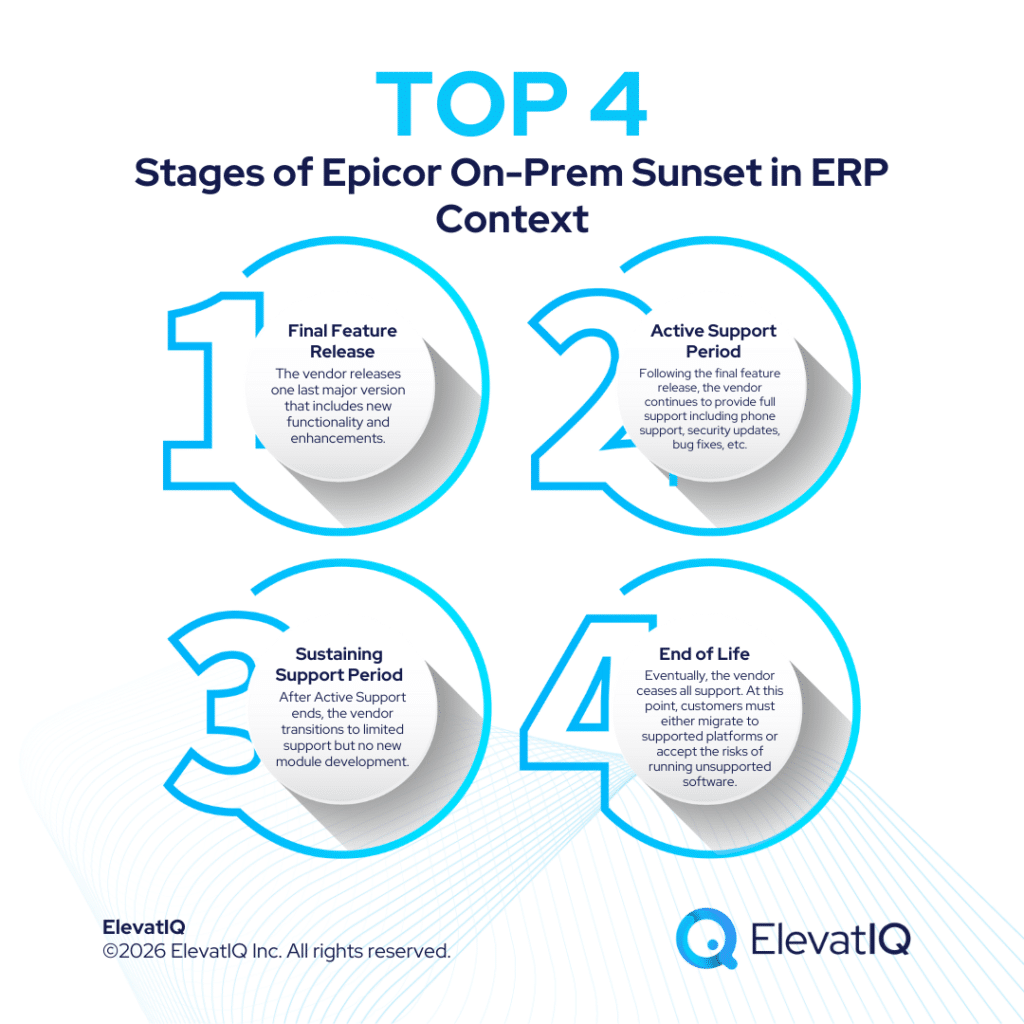
- Limited Support After 2029: Beginning January 1, 2030, Epicor transitions on-premise customers to Sustaining Support. This will typically include no new modules or features, limited support for critical issues only, reduced priority from vendor account teams, and no development resources addressing newly discovered bugs.
- Technology Obsolescence: Cloud platforms receive AI capabilities, modern interfaces, enhanced analytics, and integration innovations that on-premise versions will not receive. Organizations risk competitive disadvantage if competitors leverage capabilities unavailable on aging platforms.
- Security Vulnerability Risk: While Epicor generally provides security patches for critical vulnerabilities during Sustaining Support, reduced attention to emerging threats increases risk over time. Organizations must strengthen internal security monitoring and response capabilities.
- Vendor Relationship Deterioration: Epicor’s focus and resources concentrate on cloud platform development. On-premise customers receive lower priority from account teams, implementation partners prioritize cloud expertise over on-premise knowledge, and ecosystem innovation focuses on cloud capabilities.
Estimated Total Cost of Ownership: Stay On-Premise
Year 1-5 Costs:
- Annual maintenance (18-22% of license value): $40,000-$100,000 depending on license size
- Infrastructure refresh requirements: $50,000-$150,000 for hardware/storage upgrades
- Internal IT support and administration: $60,000-$120,000 annually
- Estimated Total 5-Year TCO: $500,000-$950,000
Year 6-10 Costs (Sustaining Support):
- Sustaining Support fees: Typically 10-15% higher than Active Support
- Infrastructure maintenance: Aging hardware increases failure risk and replacement costs
- Security and monitoring enhancements: Additional investment required as vendor support diminishes
- Estimated Total 10-Year TCO: $1,200,000-$2,100,000
Organizations staying on-premise achieve lower costs if planning horizons end before forced migration becomes necessary (business sale, retirement, major restructuring).

ERP System Scorecard Matrix
This resource provides a framework for quantifying the ERP selection process and how to make heterogeneous solutions comparable.
Path 3: Alternative Vendor Analysis
Switching to alternative ERP vendors represents the highest-disruption path but may deliver superior long-term value when Epicor limitations are significant or competitive platforms better align with strategic requirements.
When Alternative Vendors Make Sense
- Functional Gaps: Epicor may lack capabilities competitors provide. If your organization requires functionality Epicor does not prioritize in its roadmap—advanced analytics, specific industry features, or integration capabilities—alternatives warrant evaluation.
- Pricing Advantages: Competitive analysis may reveal that alternative vendors offer comparable functionality at substantially lower total cost of ownership. Some organizations discover 30-50% TCO reductions by switching vendors when subscription models and customization requirements are factored comprehensively.
- Strategic Misalignment: Epicor’s strategic direction may not align with your business trajectory. Organizations expanding into industries or geographies where Epicor has limited presence may benefit from vendors with stronger positions in target markets.
- Private Equity Concerns: Epicor’s private equity ownership introduces considerations about long-term strategy stability, product investment priorities, and customer-focused decision making. Organizations concerned about PE-driven decisions may prefer vendors with different ownership structures.
Alternative Vendor Migration Considerations
Switching vendors introduces greater complexity than staying within the Epicor family:
- Complete Reimplementation: Unlike Epicor cloud migrations that preserve some configuration, alternative vendor migrations require reimplementing all business processes, master data, integrations, and workflows from scratch.
- Extended Timeline: Organizations should typically expect 12–24 months for full implementation, significantly longer than Epicor cloud migrations that might complete in 6-9 months.
- Higher Change Management Requirements: Users must learn completely new interfaces, terminology, and workflows. Training requirements multiply, and productivity dips during adoption periods extend longer.
- Data Migration Complexity: Converting data between different vendors’ data models requires extensive mapping, transformation, and validation. Historical data conversion often proves more challenging than Epicor-to-Epicor migrations.
Decision Framework: Structured Evaluation Approach
Organizations require systematic approaches to evaluate these paths objectively rather than relying on vendor recommendations or anecdotal experiences.
Step 1: Assess Current State Comprehensively
Before comparing future options, document your current Epicor environment thoroughly:
- Customization Inventory: Catalog all custom code, modified workflows, specialized reports, custom integrations, and unique configurations. Estimate lines of custom code and complexity levels.
- Integration Map: Document all system integrations including EDI connections, third-party applications, data exchange processes, and API dependencies.
- Data Quality Assessment: Evaluate master data completeness, duplicate records, orphaned transactions, and data governance maturity. Poor data quality multiplies migration complexity.
- User Requirements: Engage business users to understand which capabilities are essential versus which could be replaced with alternative approaches.
Step 2: Calculate True Total Cost of Ownership
Compare all three paths using estimated 10-year TCO analysis. For example:
| Cost Category | Epicor Cloud | Stay On-Premise | Alternative Vendor |
| Implementation | $200,000-$800,000 | $0 (no migration) | $525,000-$1,800,000 |
| Year 1-5 Recurring | $900,000-$1,200,000 | $500,000-$950,000 | $900,000-$1,800,000 |
| Year 6-10 Recurring | $1,100,000-$1,500,000 | $700,000-$1,150,000 | $1,200,000-$2,400,000 |
| 10-Year Total | $2,200,000-$3,500,000 | $1,200,000-$2,100,000 | $2,625,000-$6,000,000 |
These ranges reflect variations in organizational size, customization complexity, user counts, and vendor selection.
Step 3: Evaluate Strategic Fit
Beyond costs, assess strategic alignment across multiple dimensions:
Functional Fit:
- Does the platform provide capabilities required for current operations?
- Can it support anticipated business model evolution over next 5-10 years?
- Does it offer industry-specific functionality critical to competitive positioning?
Vendor Relationship:
- Do you trust the vendor’s long-term roadmap and strategic direction?
- Has the vendor delivered on previous commitments and timelines?
- Does vendor ownership structure (public, private, PE) align with your preferences?
Implementation Risk:
- Does your organization have capacity to absorb implementation disruption?
- Can you dedicate required resources without compromising business operations?
- Do you have implementation partner relationships that reduce execution risk?
Technology Architecture:
- Does cloud, on-premise, or hybrid deployment align with IT strategy?
- Can the platform integrate with current and planned technology ecosystem?
- Does it support data sovereignty, compliance, and security requirements?
Step 4: Validate Assumptions Through Due Diligence
Before finalizing decisions, validate assumptions through structured due diligence:
Epicor Cloud Migration:
- Obtain detailed Ascend program proposals with fixed-fee pricing
- Conduct Epicor cloud readiness assessment identifying customization compatibility
- Interview Epicor cloud customers with similar implementations about their experiences
- Review Epicor cloud SLAs, performance commitments, and support structures
Staying On-Premise:
- Confirm infrastructure sustainability through planned horizon
- Assess internal IT capability to support aging platform with declining vendor support
- Evaluate third-party support providers if vendor support becomes insufficient
- Calculate risk-adjusted costs accounting for potential security incidents or system failures
Alternative Vendors:
- Issue structured RFPs to 2-3 qualified alternative vendors
- Conduct detailed product demonstrations focused on your specific requirements
- Contact reference customers in your industry with similar complexity
- Obtain comprehensive implementation proposals with clear scope, timeline, and budget
Working with Independent ERP Advisors
Organizations evaluating Epicor cloud migration decisions often lack internal expertise to objectively assess vendor claims, validate total cost of ownership calculations, or compare alternative platforms without bias. Epicor account teams have commercial incentives to guide customers toward Epicor Cloud. Alternative vendors have incentives to win switching customers. Implementation partners may have preferences based on their practice areas.
This is where independent ERP advisors provide essential value through objective analysis free from vendor commercial interests.
At ElevatIQ, we help organizations navigate Epicor migration decisions through:
- Objective Path Evaluation: We assess whether Epicor Cloud, extended on-premise operation, or alternative vendors align best with your business requirements, financial constraints, and strategic priorities—without commercial bias toward any vendor or path.
- Total Cost of Ownership Modeling: We calculate comprehensive TCO across all paths, including migration costs, subscription fees with escalation, customization conversion, integration requirements, and long-term operational expenses. Our modeling provides transparency into true financial implications across 5-10 year horizons.
- Alternative Vendor Assessment: If alternative vendors warrant consideration, we accelerate evaluation by eliminating non-viable options, conducting structured requirements analysis, facilitating detailed demonstrations, and negotiating favorable contract terms across multiple competing vendors.
- Migration Risk Assessment: We evaluate your customization complexity, data quality, integration requirements, and organizational readiness to provide realistic migration effort estimates, timeline projections, and risk mitigation strategies regardless of which path you choose.
- Contract Negotiation Support: Whether staying with Epicor or exploring alternatives, we help negotiate favorable terms including migration subsidies or fixed-fee pricing, subscription pricing locks extending 3-5 years, customization conversion support, post-migration hypercare commitments, and exit provisions if systems do not perform as specified.
Our independent position means recommendations focus solely on your long-term success rather than vendor revenue targets or implementation partner utilization optimization.
Conclusion
The Epicor cloud migration decision represents more than a technology deployment choice—it shapes your ERP strategy, financial commitments, and operational capabilities for the next decade. While Epicor’s on-premise sunset announcement may create initial concern, organizations have substantial time to evaluate options systematically and execute transitions aligned with business requirements.
Understanding the three fundamental paths—Epicor Cloud migration, extended on-premise operation, or alternative vendor selection, requires comprehensive analysis of total cost of ownership, strategic fit, ERP implementation risk, and long-term value. Each path has appropriate scenarios where it represents the optimal choice based on customization complexity, financial considerations, operational requirements, and organizational change capacity.
Organizations approaching this decision strategically, calculating comprehensive costs objectively, and maintaining negotiating leverage through early evaluation will successfully navigate this transition. Those deferring decisions until deadlines approach will face compressed timelines, limited options, and potentially suboptimal outcomes driven by urgency rather than strategic alignment.
Working with independent ERP advisors who understand Epicor migration dynamics, know alternative vendor capabilities, and can provide objective total cost of ownership modeling substantially improves decision quality. The investment in expert guidance represents a fraction of the exposure from suboptimal vendor selection or poorly structured contracts, and provides the independent perspective that vendor sales teams and implementation partners cannot offer.
(This content is based on publicly available vendor statements, industry research, analyst insights, and practitioner experience and is provided for informational purposes only.)

ERP Selection: The Ultimate Guide
This is an in-depth guide with over 80 pages and covers every topic as it pertains to ERP selection in sufficient detail to help you make an informed decision.
FAQs
Related Posts: