
Last Updated on March 16, 2026 by Shrestha Dash
In February 2023, Quebec’s SAAQ launched a digital platform despite unresolved testing issues and unmet readiness criteria, leading to widespread service failures immediately after go-live. Thus, leaving citizens unable to access critical services and creating a public accountability crisis. The ERP implementation partner’s contract apparently lacked clear, enforceable acceptance criteria that would have prevented production deployment of a system that demonstrably failed to meet basic functionality requirements.
This pattern repeats across ERP implementations: organizations invest millions in systems that fail at go-live, vendors claim deliverables meet contractual obligations, customers dispute performance adequacy, and litigation becomes necessary because contracts never defined what “working” actually means. The absence of clear ERP contract acceptance criteria transforms disputes over technical performance into expensive legal battles over contractual interpretation.
Standard vendor contracts include vague acceptance language like “system shall perform substantially in accordance with documentation” or “acceptance upon delivery”, terms that create more ambiguity than clarity. When the ERP system fails during critical processes such as month-end close, sends invoices to the wrong customers, or cannot generate required regulatory and compliance reports, disputes escalate: the vendor argues the system meets specifications, the customer claims it is unusable, and the contract provides no objective framework to resolve the disagreement.
This blog examines what ERP contract acceptance criteria actually accomplish, why vendor-provided contracts systematically avoid specificity, how to structure acceptance testing provisions that define “done” objectively, which payment triggers should be linked to acceptance milestones, and how clarity at contract signing prevents conflicts that destroy ERP implementation budgets and timelines.

Why Acceptance Criteria Matter More Than Organizations Realize
The fundamental challenge with ERP contract acceptance criteria is that most organizations negotiate them during vendor selection, when commercial relationships are optimistic and everyone expects success but invoke them post-implementation, when operational reality has exposed performance gaps and financial consequences have made abstract contract language critically important.
The Payment Trigger That Vendors Control
Standard ERP contracts structure payment obligations around delivery dates, not acceptance outcomes. Vendors invoice when software is delivered, when ERP implementation milestones are completed, or when training sessions are conducted, regardless of whether deliverables actually work.
How vendor-standard payment terms operate:
- License fees: Due upon contract signature or software delivery, before any testing occurs
- Implementation milestones: Paid when vendor certifies milestone completion (design approval, configuration complete, data migration executed), not when customer validates functionality
- Training: Paid upon delivery of training sessions, not upon demonstration that users can actually perform required tasks
- Go-live support: Paid when go-live occurs, not when system stability is achieved
This structure means vendors may receive the majority of contract value before the customer has fully validated system performance. By the time acceptance issues surface, typically 30–90 days post go-live, when month-end close failures, integration breakdowns, or data quality problems become operationally visible, vendors have been fully paid and leverage to compel remediation has evaporated.
Effective ERP contract acceptance criteria shift payment triggers from vendor-certified delivery to customer-verified acceptance, creating financial incentive for vendors to deliver functional systems rather than minimally compliant deliverables.
What Happens When “Acceptance” Isn’t Defined
Organizations that sign contracts without explicit acceptance criteria discover too late that vendor and customer definitions of “working system” diverge dramatically when ERP implementation quality is challenged.
MillerCoors vs. HCL Technologies (2017): MillerCoors alleged HCL delivered a non-functional SAP implementation despite HCL’s claims that deliverables met contractual specifications. The dispute centered on whether the system “substantially conformed” to requirements, language broad enough that both parties claimed contractual compliance while holding completely opposite interpretations of system functionality.
The litigation created substantial legal costs, management distraction, and operational disruption precisely because the contract lacked objective acceptance criteria that could have prevented deployment of an inadequate system.
The pattern across ERP disputes:
- Vendor claims system meets “documented specifications” (referring to functional specs written by the vendor)
- Customer claims system fails to support business processes (referring to business requirements discussed during sales)
- Contract references both documents without defining which governs acceptance
- Litigation focuses on contract interpretation rather than system functionality
Clear ERP contract acceptance criteria eliminate this ambiguity by defining measurable pass/fail standards before ERP implementation begins.
The Anatomy of Effective Acceptance Criteria
Understanding how ERP contract acceptance criteria actually function requires examining the specific components that determine when testing occurs, what standards apply, and which remedies exist when deliverables fail acceptance.
The Three-Tier Acceptance Framework
Organizations that structure acceptance provisions effectively use a three-tier framework that tests deliverables at increasing levels of integration and operational complexity.
Tier 1: Deliverable Acceptance (Configuration, Customizations, Integrations)
Individual deliverables – configured modules, custom reports, integration interfaces – undergo isolated acceptance testing before broader system integration.
Recommended contract language:
“Each Deliverable shall be subject to Deliverable Acceptance Testing within [10] business days of Vendor’s delivery notification. Acceptance Criteria for each Deliverable are defined in Exhibit [Acceptance Criteria Matrix]. Customer may reject any Deliverable that fails to meet documented Acceptance Criteria. Upon rejection, Vendor shall remediate deficiencies and resubmit for testing within [15] business days. If Deliverable fails Acceptance Testing twice, Customer may: (a) require Vendor to continue remediation at no additional cost; (b) engage third-party resources to remediate with costs borne by Vendor; or (c) terminate the applicable Statement of Work and receive refund of fees paid for that Deliverable.”
This creates defined testing windows, explicit pass/fail criteria, and remedies that don’t require litigation.
Tier 2: System Integration Testing (SIT) Acceptance
After individual deliverables pass isolated testing, integrated system testing validates that modules, customizations, and integrations function together.
Recommended contract language:
“Following Deliverable Acceptance of all components within a Release, the integrated system shall undergo System Integration Testing (SIT). SIT Acceptance Criteria include: (a) end-to-end process testing across integrated modules; (b) data flow validation between ERP and third-party systems; (c) integration error rate not exceeding [X] errors per [Y] transactions; (d) system performance meeting benchmarks defined in Exhibit [Performance Standards]. SIT Acceptance Period shall be [30] business days. Customer may reject integrated system if SIT Acceptance Criteria are not met. Vendor shall remediate integration failures at no additional cost.”
This prevents the common scenario where individual modules work in isolation but fail when integrated with real data flows and user workflows.
Tier 3: User Acceptance Testing (UAT) and Production Readiness
User acceptance testing validates that the integrated system supports actual business processes with real users performing real transactions.
Recommended contract language:
“Following SIT Acceptance, the system shall undergo User Acceptance Testing (UAT) conducted by Customer’s business users. UAT Acceptance Criteria include: (a) successful execution of business process scenarios defined in Exhibit [UAT Test Cases]; (b) data accuracy validation comparing system outputs to expected results; (c) regulatory reporting validation for compliance-critical reports; (d) user satisfaction survey indicating [X]% of users confirm system supports their workflows. UAT Period shall be [45] business days. Go-Live shall not occur until UAT Acceptance is achieved. Payment of [X]% of total contract value is contingent upon UAT Acceptance.”
This ties the largest payment holdback to the most comprehensive validation, ensuring vendors cannot walk away from performance issues after collecting fees.
The Acceptance Criteria Matrix: Translating Requirements into Testable Standards
The challenge with ERP contract acceptance criteria is translating business requirements (“system shall support month-end close”) into objective, measurable pass/fail tests (“month-end close process completes within 5 business days with all reconciliations balanced and regulatory reports generated without manual intervention”).
How to structure an Acceptance Criteria Matrix:
| Requirement ID | Business Requirement | Acceptance Criterion | Test Method | Pass/Fail Threshold |
| REQ-001 | Month-end financial close | Close process completes within defined timeline | Execute month-end close with test data | Pass: Close completes in ≤5 business days with zero manual adjustments. Fail: Close exceeds 5 days OR requires manual intervention |
| REQ-002 | Inventory accuracy | Real-time inventory visibility across warehouses | Query inventory levels, compare to physical counts | Pass: System inventory matches physical counts within ±2%. Fail: Variance exceeds ±2% |
| REQ-003 | Customer order processing | Orders processed from entry to shipment confirmation | Process 100 test orders end-to-end | Pass: ≥95 orders process without errors. Fail: >5 orders require manual intervention |
| REQ-004 | Regulatory compliance reporting | SOX compliance reports generate automatically | Generate SOX-required reports | Pass: All required reports generate with complete data. Fail: Any report fails to generate OR contains incomplete data |
This matrix becomes Exhibit A to the contract, eliminating disputes over what “working” means.
The Testing Period Trap (And How to Avoid It)
Standard vendor contracts impose unrealistic testing periods that make thorough acceptance testing operationally impossible.
Some vendor-standard contracts propose testing periods such as:
- 5–10 business days for deliverable acceptance
- 15–20 business days for system integration testing
- 20–30 business days for user acceptance testing
These windows are insufficient for organizations to recruit business users, develop test cases, execute comprehensive testing, document defects, and validate remediation.
Realistic testing periods based on system complexity:
- Simple configurations (single module, <50 users): 15–20 days deliverable testing, 30 days UAT
- Mid-complexity implementations (3–5 modules, 100–500 users): 20–30 days deliverable testing, 45–60 days UAT
- Complex enterprise implementations (full-suite, 1,000+ users, multiple entities): 30–45 days deliverable testing, 60–90 days UAT
Recommended contract language:
“Testing periods specified in this Agreement represent minimum durations. Customer may extend any testing period by providing written notice to Vendor prior to period expiration, provided such extension is based on: (a) volume of defects requiring remediation; (b) complexity of test scenarios; (c) availability of business users. Extended testing periods do not alter Acceptance Criteria or relieve Vendor of obligation to deliver conforming deliverables.”
This prevents vendors from arguing that extended testing constitutes acceptance by silence.


ERP Selection Requirements Template
This resource provides the template that you need to capture the requirements of different functional areas, processes, and teams.
Linking Payment to Acceptance: The Financial Mechanism That Ensures Quality
The most effective mechanism for ensuring ERP vendors deliver functional systems is structuring payment obligations around acceptance milestones rather than delivery dates.
The Payment Holdback Structure
Organizations with negotiating leverage should structure contracts to withhold 20–30% of total fees (sometimes higher in complex implementations) until final acceptance is achieved.
Recommended payment structure:
- 20–30% upon contract signature (demonstrates commitment, funds initial work)
- 30–40% upon Deliverable Acceptance (tied to isolated component testing)
- 20–30% upon SIT Acceptance (tied to integrated system validation)
- 20–30% upon UAT Acceptance and Go-Live Stability (tied to production readiness and 30–60 day stabilization period)
This creates continuous financial incentive for vendor performance throughout the implementation lifecycle.
Recommended contract language:
“Vendor invoices shall be paid according to the Payment Schedule in Exhibit [Payment Terms], contingent upon achievement of corresponding Acceptance Milestones. No payment shall be due for any deliverable, phase, or milestone that has not achieved Acceptance as defined in this Agreement. If Customer rejects any deliverable or milestone, Vendor shall remediate deficiencies before corresponding payment becomes due. Customer’s payment of any invoice does not constitute acceptance of underlying deliverables unless Customer has provided written Acceptance in accordance with Section [Acceptance Procedures].”
This prevents vendors from arguing that payment constitutes implied acceptance.
The Go-Live Stability Criterion
Many ERP implementations appear successful at go-live but collapse within 30–60 days when transaction volumes increase, month-end processes execute, or seasonal business cycles stress the system.
Recommended contract language:
“Final Acceptance and release of final payment holdback is contingent upon Go-Live Stability, defined as: (a) successful completion of [first month-end close, first quarter-end close, first annual close — depending on go-live timing]; (b) system availability exceeding [99.5%] during [60] days following Go-Live; (c) integration error rate not exceeding [X] errors per [Y] transactions; (d) no Priority 1 or Priority 2 defects remaining unresolved. Final payment of [X]% of total contract value shall be due [30] days following achievement of Go-Live Stability.”
This ensures vendors remain financially engaged through the highest-risk post-implementation period.

ERP System Scorecard Matrix
This resource provides a framework for quantifying the ERP selection process and how to make heterogeneous solutions comparable.
The Rejection and Remediation Process: What Happens When Deliverables Fail
Even with clear ERP contract acceptance criteria, deliverables will fail testing. The contract must define what happens next; otherwise, disputes over remediation timelines and costs create the same conflicts that acceptance criteria were designed to prevent.
Rejection Rights and Remediation Obligations
Standard vendor contracts often require customers to accept deliverables “unless materially nonconforming”, language that favors vendors by making rejection difficult to justify.
Recommended contract language:
“Customer may reject any deliverable that fails to meet Acceptance Criteria defined in Exhibit [Acceptance Criteria Matrix]. Rejection need not be based on ‘material’ nonconformance. Any failure to meet documented Acceptance Criteria constitutes grounds for rejection. Customer shall provide written rejection notice within [X] business days of testing completion, identifying specific Acceptance Criteria that were not met and evidence supporting rejection.”
This eliminates vendor arguments that minor deficiencies don’t justify rejection.
The Two-Attempt Rule
Organizations should negotiate contracts that limit vendor remediation attempts to prevent endless cycles of test-fail-remediate that delay go-live indefinitely.
Recommended contract language:
“Upon rejection of any deliverable, Vendor shall remediate identified deficiencies and resubmit for Acceptance Testing within [15] business days. If deliverable fails Acceptance Testing a second time, Customer may, in its sole discretion: (a) grant Vendor additional remediation opportunity with extended timeline; (b) engage third-party resources to complete remediation, with costs deducted from amounts due to Vendor; (c) terminate the applicable Statement of Work and receive refund of fees paid for rejected deliverable plus costs incurred in reliance on Vendor’s performance.”
This creates consequences for repeated failure that don’t require litigation.
The Production Use Exception
Vendors often include contract language stating that any production use of the system constitutes acceptance, even if that use occurs during UAT when business users are testing with live data.
Recommended contract language:
“Customer’s use of any deliverable, system component, or the integrated system for training, testing, or limited production purposes during Acceptance Testing periods does not constitute Acceptance and does not waive Customer’s right to reject deliverables that fail Acceptance Criteria. Acceptance occurs only upon Customer’s written acceptance confirmation or expiration of testing periods without written rejection.”
This prevents vendors from claiming that UAT with real data constitutes implied acceptance.
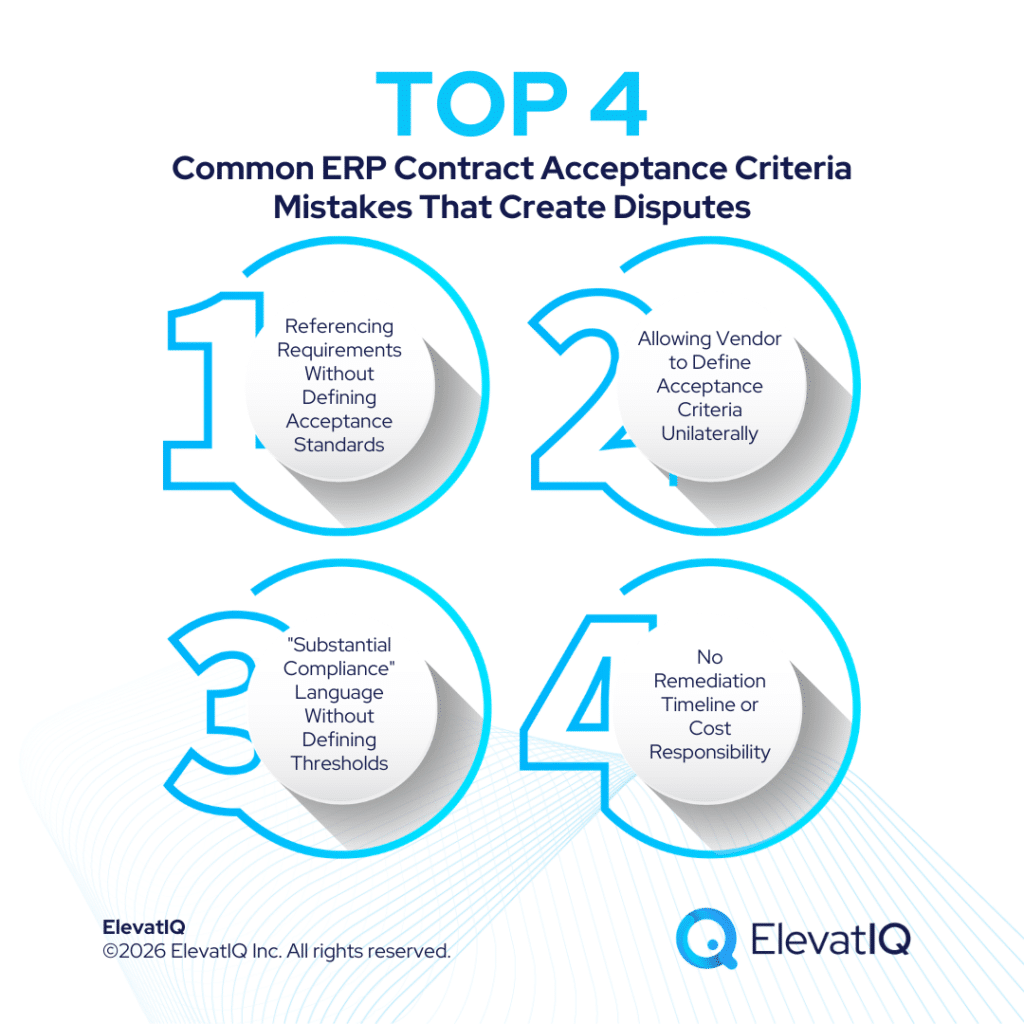
Common Acceptance Criteria Mistakes That Create Disputes
Organizations that experience acceptance-related disputes typically made one or more structural mistakes during ERP contract negotiation that created ambiguity where clarity was needed.
Referencing Requirements Without Defining Acceptance Standards
Contracts that state “system shall meet requirements in Exhibit A” without translating requirements into testable acceptance criteria create disputes over ERP requirement interpretation.
Why this fails: A requirement like “support multi-currency transactions” can mean basic currency conversion OR full multi-currency accounting with realized/unrealized gain/loss tracking. Without acceptance criteria that define what “support” means, vendor and customer will dispute whether minimal functionality satisfies the requirement.
Allowing Vendor to Define Acceptance Criteria Unilaterally
Some contracts state “acceptance criteria shall be defined in vendor-provided test plans” — giving vendors control over the standards they must meet.
Why this fails: Vendors define acceptance criteria narrowly to ensure deliverables pass. A vendor-written test plan might validate that a report “generates output” without testing whether that output is accurate, complete, or usable.
“Substantial Compliance” Language Without Defining Thresholds
Contracts that require deliverables to “substantially comply” with specifications create litigation over what “substantial” means.
Recommended fix: Define substantial compliance numerically: “System passes Acceptance Testing if ≥95% of defined test cases pass and no Priority 1 defects remain unresolved. Systems passing 90–94% of test cases require Vendor remediation but may proceed to next testing phase at Customer’s discretion. Systems passing <90% of test cases fail Acceptance Testing.”
This creates objective thresholds that eliminate “substantial compliance” disputes.
No Remediation Timeline or Cost Responsibility
Contracts that require vendors to “remediate defects” without defining timelines or cost allocation create delays when vendors prioritize other clients over remediation work.
Recommended fix: “Vendor shall remediate all Priority 1 defects within [5] business days, Priority 2 defects within [10] business days, and Priority 3 defects within [20] business days, at no additional cost to Customer. Vendor’s failure to meet remediation timelines permits Customer to engage third-party resources with costs deducted from Vendor payments.”
What Independent ERP Advisors Identify That Internal Teams Miss
The structural challenge in negotiating ERP contract acceptance criteria is that procurement teams lack visibility into how other organizations have structured acceptance provisions, what testing periods are realistic, and which payment structures create vendor accountability.
Independent ERP advisors provide:
- Acceptance criteria templates tailored to specific ERP platforms, industries, and implementation complexity levels, not generic boilerplate
- Benchmark data on realistic testing periods (organizations with similar complexity, user counts, and integration requirements)
- Payment structure guidance showing what percentage holdbacks are achievable at different vendor negotiation positions
- Testing resource planning that identifies how many business users, for how many hours, across which testing phases, enabling realistic timeline commitments
The financial return on advisory engagement is measurable. For example, an advisor fee of $40,000 that structures acceptance criteria preventing deployment of a non-functional system might avoid the $5M–$50M remediation costs, operational losses, and litigation expenses that organizations like MillerCoors, Waste Management, and SAAQ incurred when inadequate acceptance provisions allowed failed implementations to proceed to production.
The Conclusion
ERP contract acceptance criteria serve a simple purpose: they define “done” before disputes arise over whether deliverables are functional. Organizations that treat acceptance provisions as boilerplate legal language rather than operational governance mechanisms consistently underestimate their importance, until ERP implementation failures create conflicts that contracts provide no framework to resolve.
The uncomfortable reality is that vendor-standard acceptance language favors suppliers by making rejection difficult, payment automatic, and remediation optional. “Acceptance upon delivery” provides no protection when delivered software crashes under production load. “Substantial compliance” creates litigation over thresholds that should have been defined numerically at contract signing. “Vendor-defined test plans” allow vendors to write acceptance criteria they know their deliverables will pass.
Effective ERP contract acceptance criteria require defining measurable pass/fail standards, structuring realistic testing periods, linking payment to acceptance milestones, and creating remediation obligations with timelines and cost consequences. These provisions are negotiated during procurement , when leverage exists. Not after go-live when operational dependency has eliminated the customer’s ability to demand vendor accountability.
For organizations currently evaluating ERP platforms, negotiating contracts, or approaching implementation phases, the team at ElevatIQ provides independent ERP advisory support across contract negotiation, acceptance criteria development, and testing strategy design, at exactly the stage where these decisions determine whether implementations succeed on quality standards or fail on vendor-favorable contract terms.

ERP Selection: The Ultimate Guide
This is an in-depth guide with over 80 pages and covers every topic as it pertains to ERP selection in sufficient detail to help you make an informed decision.
FAQs
Related Posts: