
Last Updated on December 12, 2025 by Shrestha Dash
The most overlooked moment in ERP lifecycle management occurs not at initial procurement but years later, when contracts approach expiration and organizations must decide: renegotiate with the incumbent vendor or transition to an alternative? Yet most companies sleepwalk into this critical decision, discovering too late that automatic renewal clauses have locked them into additional contract terms, often with embedded price increases, before they’ve adequately evaluated alternatives or positioned themselves for meaningful renegotiations.
This pattern repeats across industries with depressing regularity. Finance teams miss renewal notification windows buried in vendor correspondence. Procurement contacts change, and successor teams lack historical knowledge of negotiation leverage points or contract terms. Implementation partners who benefit from continuation bias subtly discourage vendor switching. By the time executives recognize a renewal opportunity exists, the 60-90 day notification window has closed, auto-renewal has triggered, and the organization faces another 3-5 years locked into potentially suboptimal relationships.
Successfully navigating ERP contract renewals requires understanding how auto-renewal clauses work and why they favor vendors, establishing processes that prevent missed notification deadlines, leveraging implementation experience to identify renegotiation priorities, accurately assessing whether to remain with incumbents or transition to alternatives, and positioning your organization for more favorable renewal terms than the original implementation deal secured.
The Hidden Cost of Auto-Renewal: How Vendors Lock You In
Most ERP contract renewals include automatic renewal clauses—standard provisions that seemed inconsequential during initial negotiations but become critical at contract expiration. These provisions transform passive inaction into active contract continuation, creating significant vendor advantages and buyer disadvantages in ERP contract renewals.
Understanding Auto-Renewal Mechanics
Automatic Renewal Fundamentals: Contracts typically include language stating that agreements automatically renew for additional terms (commonly 1-3 years) unless either party provides written notice of non-renewal within specified windows—usually 60-90 days before expiration.
This seemingly administrative provision has profound consequences:
- Renewal Default: In the absence of affirmative action to prevent renewal, contracts automatically continue. This places burden on buyers to actively opt out rather than requiring vendors to actively secure renewals. From a behavioral economics perspective, this “default to continuation” dramatically favors incumbents.
- Notification Window Obscurity: Renewal notification requirements often appear in contract boilerplate rather than executive summaries or key dates tracking. Organizations maintaining casual contract administration easily miss these critical windows buried in dense legal language.
- Notification Address Changes: Vendors specify notification addresses—often to legal departments, account teams, or addresses that change over time. Organizations with leadership turnover, restructured procurement teams, or changed vendor contacts frequently send renewal notices to incorrect addresses, creating disputes about whether proper notice occurred.
- Ambiguous Effective Dates: Contracts sometimes contain ambiguous language about when renewal notification windows open, creating confusion about whether the clock has started. Has the 90-day window begun, or does it start from a different date than contract expiration?
The Financial Consequences of Missed Renewals
Missing renewal notification windows creates cascading costs and constraints:
- Automatic Price Increases: Renewal terms often include embedded price increases—often 3-5% annually—that automatically apply upon renewal. Organizations that fail to renegotiate discover subscription costs increase on renewal dates regardless of their satisfaction or market alternatives.
- Loss of Negotiating Leverage: Once auto-renewal triggers, vendors recognize customers lack practical alternatives and have lost bargaining power. Renegotiating after auto-renewal has begun from a position of operational dependency proves far less successful than negotiating before renewal triggers.
- Operational Lock-In: With another contract term commencing, switching vendors becomes substantially more difficult. Implementation resources are committed, user adoption is advanced, integrations are embedded, and business processes depend on the system. Undoing this momentum requires extraordinary justification.
- Strategic Inflexibility: Locked into another 3-5 year commitment, organizations lose flexibility to respond to market changes, pursue better alternatives, or adjust technology strategies. This constraint becomes particularly painful if the vendor’s product roadmap diverges from organizational needs or if superior alternatives emerge.

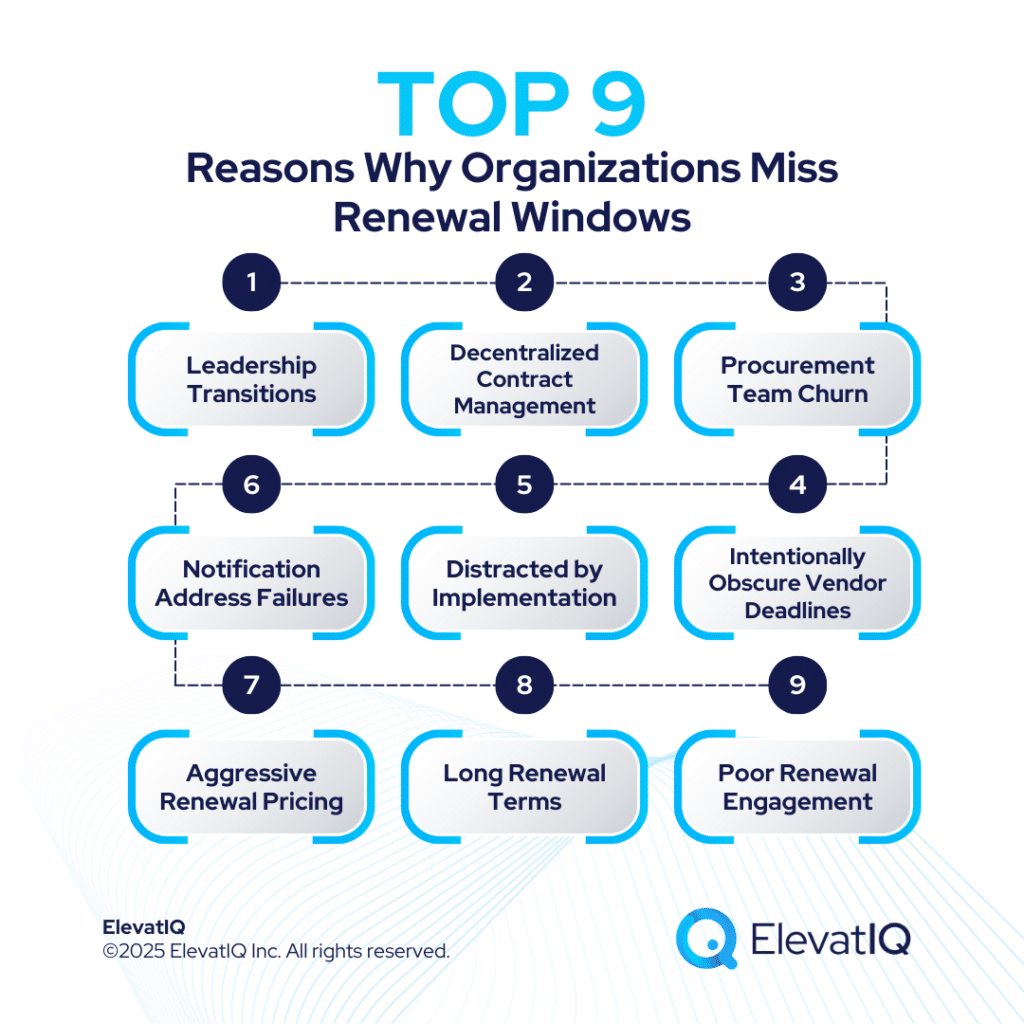
Why Organizations Miss Renewal Windows: Common Pitfalls
Understanding patterns that lead to missed renewal deadlines helps organizations implement preventive processes and protect against this costly mistake.
Organizational Reasons for Missing Deadlines
- Leadership Transitions: CIOs, procurement directors, or project sponsors who negotiated original contracts change roles or leave organizations. Successor leaders lack historical context about renewal dates, notification requirements, or strategic considerations that should inform renegotiation approaches.
- Decentralized Contract Management: Procurement, IT, finance, and operations teams each maintain portions of vendor relationships. ERP contracts may not receive centralized stewardship, resulting in critical renewal notifications falling between organizational silos where no single team assumes responsibility.
- Procurement Team Churn: Vendor management responsibilities rotate between procurement professionals or get absorbed by already-overextended teams. As responsibilities shift, critical contract dates often don’t transfer, creating lapses in attention when renewal windows open.
- Notification Address Failures: Vendors specify notification addresses, which may direct correspondence to legal departments, finance teams, account managers, or other addresses. When these addresses change—due to reorganizations, office closures, or email system changes—renewal notices fail to reach intended recipients.
- Distracted by Implementation: During the first 2-3 years post-go-live, organizations focus heavily on implementation optimization, stabilization, and value realization. As the contract midpoint passes, attention diminishes while renewal windows approach unnoticed.
Vendor Factors Creating Renewal Challenges
- Intentionally Obscure Deadlines: Some vendors benefit from missed renewal notifications and employ tactics making deadlines difficult to identify—burying renewal dates in annual true-up invoices, sending notices to outdated addresses, or using ambiguous contract language about notification requirements.
- Aggressive Renewal Pricing: Vendors often employ dramatically higher renewal pricing than original implementations offered, knowing customers locked in by operational dependency have limited practical alternatives. This “price after the lock-in” strategy exploits the vendor’s knowledge that customers can’t easily switch.
- Long Renewal Terms: Standard renewals often extend for full original contract terms (typically 3-5 years). This lengthy lock-in limits how frequently organizations can renegotiate, constraining their ability to secure improved terms as market conditions or negotiating positions evolve.
- Poor Renewal Engagement: Rather than proactively engaging customers about renewal needs, timelines, and opportunities months before expiration, vendors often wait until near renewal deadlines before initiating serious renewal discussions. This compressed timeline disadvantages buyers seeking to evaluate alternatives.
Preventing Renewal Disasters: Establishing Governance and Tracking
The most critical step in effective ERP contract renewal management occurs years before actual renewal—establishing processes that ensure renewal dates, notification requirements, and decision deadlines receive ongoing attention and accountability.
Building Renewal Governance Infrastructure
Centralized Contract Registry: Maintain a master contract database tracking all critical dates for every technology vendor agreement:
- Original contract effective and expiration dates
- Renewal notification windows (start and end dates)
- Renewal term length and potential pricing
- Notification address and required procedures
- Historical pricing and key terms
- Assigned contract steward with backup contacts
Make this registry accessible to procurement, IT, finance, and operations teams with defined role-based permissions ensuring visibility across stakeholder groups.
Renewal Calendar and Alerts: Create explicit calendar entries triggering alerts at critical milestones:
- 12 Months Before Expiration: Strategic review begins. Does the ERP still meet organizational needs? Are emerging alternatives worth evaluating? Should vendor transition planning begin?
- 9 Months Before Expiration: Competitive market assessment concludes. Preliminary vendor selection (stay or switch?) occurs.
- 6 Months Before Expiration: Renegotiation strategy finalizes if staying with incumbent. RFP process commences if planning to switch vendors.
- 120 Days Before Expiration: Formal renewal discussions begin with incumbent vendor or alternative vendors reach final negotiations.
- 90 Days Before Expiration: Renewal notification window opens. If planning to exit, formal non-renewal notice goes to vendor.
- 60 Days Before Expiration: Final contract negotiations and executive approvals finalize.
- 45 Days Before Expiration: Executed renewal agreement in place or transition planning to new vendor progresses.
Executive Accountability: Designate an executive—typically VP of IT, CIO, or VP of Procurement—as the renewal decision authority. Establish board-level or steering committee oversight ensuring renewal decisions receive appropriate strategic consideration rather than operating as routine administrative tasks.
Vendor Relationship Reviews: Schedule annual business reviews with key vendors (including ERP vendors) to discuss:
- System performance against SLAs and commitments
- Organizational satisfaction and any concerns
- Emerging needs or capability gaps
- Anticipated changes to volume, scale, or requirements
- Preliminary renewal discussions for large contracts
Establishing Clear Processes for Notification and Response
Written Renewal Procedures: Document specific procedures for handling renewal notifications:
- Which vendor correspondence triggers renewal considerations
- Who receives and acknowledges renewal notices
- Required verification that proper notice occurred
- Decision processes for evaluating stay vs. switch decisions
- Timeline for communicating renewal or non-renewal decisions to vendors
- Escalation procedures if renewal decisions face obstacles
Calendar-Based Reminders: Don’t rely on vendors sending renewal notices on schedule. Set internal calendar reminders weeks before expected notification windows open, eliminating dependency on vendor communication timing.
Notification Verification: Upon receiving vendor renewal proposals or communications, immediately verify:
- Contract expiration date (confirm from original executed agreement, not vendor communication which may contain errors)
- Renewal notification window and deadline
- Required notification procedures and addresses
- Proposed renewal terms and pricing
- Any changes from original contract terms
Document this verification creating an audit trail demonstrating proper attention to renewal processes.
Leveraging Implementation Experience: Identifying Renewal Priorities
By the time renewal windows approach, organizations possess knowledge about ERP performance, satisfaction, and suitability that should inform renegotiation or alternative vendor decisions. The critical step is extracting this operational knowledge and converting it into strategic renewal guidance.
Conducting Renewal Readiness Assessments
- Satisfaction and Performance Evaluation: Assess whether the ERP vendor has delivered satisfactory performance against contracted terms:
- Service Level Performance: Did the vendor meet SLA commitments regarding support responsiveness, system availability, and incident resolution? Did actual performance match contractual guarantees, or have there been material gaps? If support performance disappointed, renewal negotiations must prioritize improved commitments or consider vendors offering superior support.
- Feature and Functionality Delivery: Has the vendor delivered promised capabilities, new features, and enhancements according to roadmaps? If planned features critical to your strategy remain perpetually “on the roadmap” without delivery, does renewal make sense?
- Implementation Success: Did the original implementation achieve defined success metrics, deliver promised business value, and complete on schedule and budget? If implementation struggled, does that forecast poor long-term vendor performance?
- Ongoing Support Quality: Since go-live, has vendor support proved responsive, knowledgeable, and genuinely committed to your success? Or has vendor attention diminished after initial implementation, with support becoming reactive, slow, and dismissive of concerns?
- Operational Stability: Has the system operated reliably, or have there been security incidents, data issues, unexpected outages, or performance problems? System reliability significantly impacts long-term satisfaction.
- Customization and Integration Support: If ERP customizations or integrations proved difficult, has the vendor maintained these enhancements effectively? Or have vendor updates routinely broken customizations, forcing expensive rework?
Identifying Gaps and Unmet Needs
Beyond evaluation of actual vendor performance, assess whether the ERP continues meeting evolving organizational needs:
- Business Evolution: How has your business strategy, markets, or operating model changed since ERP implementation? Does the ERP vendor’s product roadmap support these new directions, or are emerging needs misaligned with vendor capabilities?
- Technology Landscape Shifts: Has the technology landscape evolved? Artificial intelligence, advanced analytics, IoT capabilities, real-time processing, or other innovations may now be standard in competitive ERP offerings but unavailable in your current system.
- Industry-Specific Requirements: Have regulatory, compliance, or industry-specific requirements evolved requiring ERP capabilities your current vendor hasn’t added?
- User Adoption and Engagement: How well have users adopted the ERP? If adoption remains challenging, does that reflect poor system fit, inadequate training/support, or genuine system limitations? Would a different vendor experience better?
- Competitive Positioning: How do critical capabilities of your ERP compare to leading alternative vendors? Are competitors deploying superior systems providing competitive advantages? Is your organization falling behind due to ERP limitations?
- Cost Structure Alignment: Does current vendor pricing remain competitive? Have you evaluated pricing from alternative vendors to assess market rates?
This comprehensive assessment creates factual foundation for stay vs. switch decisions, preventing renewal choices driven by inertia rather than strategic analysis.
Deciding: Stay and Renegotiate vs. Switch Vendors
The renewal window presents a critical strategic decision: remain with the incumbent vendor and attempt renegotiation, or transition to an alternative? This decision requires evaluating multiple factors systematically.
The Stay and Renegotiate Case
Advantages of Renegotiating with Incumbents:
- Operational Continuity: Relationships with support teams are established, integration architectures are stable, users understand the system, and business processes are configured. Renegotiating preserves these operational foundations.
- Customization Preservation: Custom code, configurations, and extensions developed during implementation transfer to renewed agreements without rebuilding. Alternative vendors might require extensive customization redevelopment.
- Lower Transition Risk: Implementations carry risk. Renegotiating with an incumbent vendor you know moderates execution risk compared to large-scale transitions with new vendors.
- Shorter Decision Timeline: Renewal negotiations with established vendors proceed faster than full implementation evaluation and selection processes, fitting compressed renewal windows.
The Switch Vendors Case
Advantages of Transitioning to Alternatives:
- Renegotiation Leverage Absence: If vendor pricing increased dramatically, support degraded, or capabilities disappointed, attempts to negotiate improvement often prove futile. Vendors recognize your operational dependency and have little incentive to provide significant concessions during renewals. Switching vendors represents the only way to materially change your economics or experience.
- Superior Alternatives Availability: If your assessment identified demonstrably superior alternatives offering better pricing, superior capabilities, or better vendor engagement, the switching cost and transition risk may prove justified.
- Strategic Misalignment: If vendor product roadmap diverges from your strategic technology direction, staying with the vendor perpetuates ongoing limitation. Switching enables alignment with your evolving needs.
- Performance Disappointment: If vendor support, stability, or responsiveness disappointed significantly, renegotiation often proves unsuccessful. Vendors recognize they’ve underperformed and calculate that customers lack practical alternatives. Switching may be the only path to better service.
Framework for Evaluation
Quantitative Comparison:
- Renewal Cost vs. Alternatives: Compare total cost of ownership of renewal agreement vs. proposed alternative vendors. Include not just subscription costs but ERP implementation, integration, customization, training, and migration costs.
- Lifecycle Cost Analysis: Model costs over 5-10 years under each scenario (renewal vs. switching), accounting for anticipated growth, feature additions, and potential future transitions.
- Switching Payback Period: Calculate how long cost savings from alternative vendors take to offset transition costs and implementation investments.
Qualitative Assessment:
- Relationship Quality: How satisfied are you with the vendor relationship? Does your account team genuinely understand your business? Are they responsive to your needs?
- Product Direction: Does the vendor’s product roadmap align with your strategic direction? Are they investing in capabilities you need?
- Industry Trends: Are leading organizations in your industry selecting this vendor or moving away? What does market momentum suggest?
- Implementation Success: How successful was the original implementation? Does that forecast positive or concerning long-term vendor engagement?
Risk Assessment:
- Implementation Risk: How likely is successful ERP implementation with an alternative vendor? What have other implementations revealed about their execution quality?
- Continuity Risk: How much operational disruption would a vendor transition create? Can you tolerate this disruption given current business circumstances?
- Integration Risk: How complex would integrations be with alternative vendors? Do existing integrations transfer, or require rebuilding?


The 2026 Digital Transformation Report
Thinking of embarking on a ERP journey and looking for a digital transformation report? Want to learn the best practices of digital transformation? Then, you have come to the right place.
Negotiating Favorable Renewal Terms
If deciding to stay with incumbent vendors, the renewal negotiation represents a critical opportunity to improve terms, address performance concerns, and position for the next contract period.
Leveraging Implementation Experience in Negotiations
Documented Performance Gaps: Use your satisfaction assessment to identify areas where vendor performance disappointed. Present specific evidence—missed SLAs, support quality complaints, feature delays—as foundation for demanding concessions:
“Our analysis of your SLA compliance over the past 3 years shows you failed to meet response time commitments in 18 of 36 months. For the renewal period, we require enhanced penalties for SLA breaches or will evaluate alternatives.”
Market Benchmarking: Armed with alternative ERP vendor research, present market data showing competitors offer superior pricing, capabilities, or terms:
“We’ve evaluated three alternative vendors offering substantially similar functionality at 15-20% lower cost. For renewal, we need pricing within 5% of competitive rates or will seriously evaluate transitions.”
Lessons Learned Requirements: Use implementation experience to demand contractual improvements addressing issues encountered:
“During implementation, we encountered issues with resource availability that delayed project timelines. For renewal, we require contracted minimum resource commitments including specific expertise levels and availability guarantees.”
Negotiating Renewal-Specific Protections:
Declining Auto-Renewal Provisions: Most importantly, negotiate explicit renewals requiring affirmative action from both parties rather than automatic continuation. This eliminates the default bias favoring vendors:
“Contracts shall not automatically renew. Renewal shall require written agreement from both Customer and Vendor at least 60 days prior to expiration, specifying renewal terms, pricing, and duration.”
Extended Notification Windows: Negotiate longer notification periods—120 days rather than standard 60-90 days—providing adequate time for thoughtful renewal decisions:
“Either party may provide written notice of non-renewal any time from 120 to 90 days prior to expiration. Notice provided outside this window shall have no effect on renewal.”
Renewal Pricing Predictability: Secure maximum price increase caps for renewal periods, typically lower than negotiated for initial terms:
“Renewal pricing shall not increase more than 3% annually, with any increases tied to documented CPI increases.”
Most-Favored-Customer Pricing on Renewals: Ensure renewal pricing doesn’t disadvantage existing customers vs. new buyers:
“Customer shall receive pricing no less favorable than Vendor offers similarly-situated customers for equivalent services during the renewal period.”
Negotiating Additional Concessions
Beyond pricing, use renewal leverage to address contract gaps and limitations discovered during implementation:
Enhanced Service Levels: Upgrade SLA commitments based on what you’ve learned about support quality and operational needs:
“Renewal period shall include guaranteed 2-hour response times for severity 1 incidents, 8-hour response for severity 2, with automatic service credits (2% of monthly fees) if response times are not met.”
Capability Commitments: Secure commitments for specific features or enhancements your evaluation identified as important:
“Vendor commits to delivering [specific functionality] during Year 1 of renewal period. If functionality is not delivered by [date], Customer may terminate renewal without penalty.”
Implementation Support: Even in renewals without major reimplementation, negotiate that minor enhancements, integrations, or configuration changes receive vendor support:
“Renewal includes 50 hours of professional services annually for system enhancements, configuration adjustments, and optimization activities.”
Data and Exit Protections: Strengthen data export rights and exit provisions based on lessons learned:
“Upon contract termination for any reason, Vendor shall provide at no charge complete data exports in standard formats, system documentation, and 30 days of technical support for data transition and validation.”
Avoiding Auto-Renewal Traps: Proactive Non-Renewal
If renewal assessment concludes that alternatives are superior or vendor performance disappointing, proactively communicate non-renewal decisions within established notification windows.
Executing Non-Renewal Decisions
Formal Non-Renewal Notice: Once renewal decision concludes that you won’t renew, immediately provide formal written notice to vendors following contractual notification procedures:
- Send to all addresses specified in contracts
- Include specific reference to contract and expiration date
- State clearly that you will not renew
- Request written confirmation of non-renewal receipt
- Document delivery method and confirmation receipt
Don’t rely on verbal communication or informal notification. Execute formal written procedures documented contractually, creating audit trail demonstrating proper notice.
Transition Planning Initiation: Simultaneously with non-renewal notice, begin formal transition planning to alternative vendor or retirement of the system:
- Establish transition timeline and milestones
- Identify integration changes required with new vendor
- Plan data migration and validation processes
- Communicate transition to stakeholders and affected users
- Budget for transition costs including implementation, integration, training
Vendor Cooperation Requirements: Leverage non-renewal to secure cooperation obligations supporting smooth transition:
“Upon receipt of non-renewal notice, Vendor shall provide: (1) complete system documentation including customizations and configurations; (2) 40 hours professional services for transition support; (3) data exports in standard formats with validation assistance; and (4) temporary access to system during data migration period.”
Strategic ERP Contract Renewal Management
ERP contract renewals represent pivotal moments where organizations can redirect relationships, renegotiate favorable terms, or transition to superior alternatives. Yet most companies allow these opportunities to pass unexploited, sleepwalking into auto-renewals that lock them into suboptimal vendor relationships for additional years. Successfully managing ERP contract renewals requires establishing governance preventing missed notification deadlines, conducting satisfaction and needs assessment leveraging years of implementation experience, systematically evaluating whether to stay and renegotiate or transition to alternatives, and negotiating renewal terms that address performance gaps and position for success in subsequent contract periods.
Organizations that establish renewal governance early, conduct thoughtful assessments before renewal windows open, and execute strategic decisions about staying or switching position themselves for significantly better outcomes than those treating renewals as administrative formalities. The investment in proactive renewal management delivers returns through favorable contract terms, improved vendor performance, or successful transitions to superior alternatives.
For organizations approaching ERP contract renewals, independent advisory expertise provides essential guidance evaluating stay vs. switch decisions, benchmarking renewal pricing against market alternatives, and negotiating favorable renewal terms. The specialized perspective advisors bring to renewal decisions typically delivers value far exceeding advisory costs through avoided auto-renewal traps, improved pricing, and strategic transitions enabling long-term success.

FAQs
Related Posts: