
Last Updated on September 22, 2026 by Shrestha Dash
Key Highlights
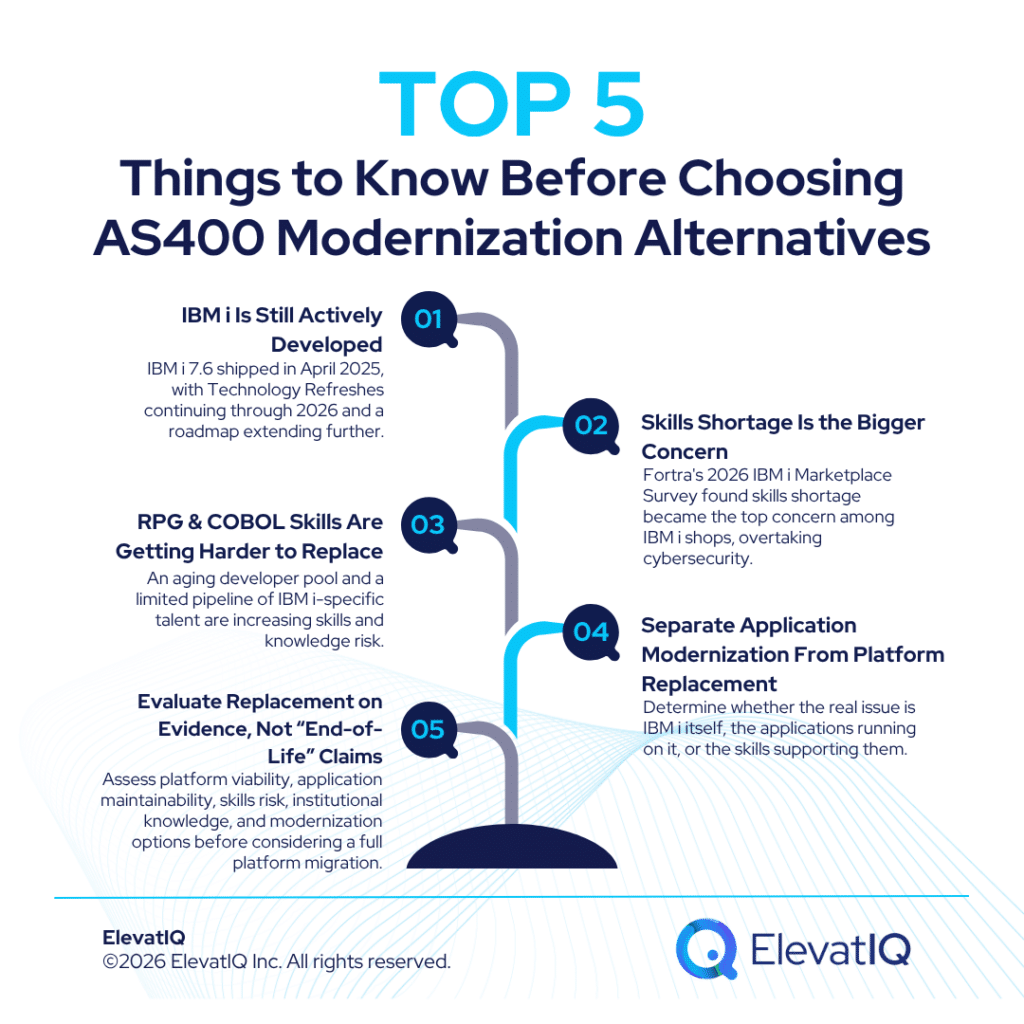
- Unlike platforms with a published sunset date, IBM i (the operating system that runs on what was originally called the AS/400) remains under active development. IBM i 7.6 shipped in April 2025, Technology Refreshes continue to ship through 2026, and the next major release is currently expected around 2028 based on publicly discussed roadmap information. AS400 modernization alternatives conversations should start from that reality, not from an assumption of vendor abandonment.
- The real driver behind most AS400 modernization alternatives evaluations isn’t a vendor sunset date, it’s a skills problem. Fortra’s 2026 IBM i Marketplace Survey found that skills shortage is now the top concern among IBM i shops. Thus, displacing cybersecurity from the top spot for the first time in nine years.
- The RPG and COBOL talent pool is aging, with experienced developers increasingly approaching retirement. And also fewer new professionals entering the field with IBM i-specific skills.
- A genuine AS400 modernization alternatives ERP evaluation needs to separate two distinct questions that often get conflated. Whether the platform itself needs replacing. And also whether the applications and skills built on top of it need modernizing. The second one is frequently the real problem, even when the first gets blamed.
Introduction
“AS400 end of life” is a phrase that shows up constantly in vendor and reseller outreach aimed at businesses running IBM i. And it’s worth being direct about why that framing is inaccurate. IBM i is not on a published sunset timeline the way some other legacy enterprise platforms are. It has a current, active release, ongoing Technology Refreshes, and a publicly discussed roadmap extending years into the future.
That doesn’t mean there’s nothing to worry about. AS400 modernization alternatives conversations are happening across the IBM i installed base for real reasons. But the reasons are different from what “end of life” framing implies. The platform itself is being maintained. The people who know how to work on it are retiring, and the pipeline replacing them is thin. That’s a fundamentally different problem, one that changes what the right response actually looks like.
This piece separates the actual, confirmed facts about IBM i’s ongoing development from the skills-driven pressure that’s real, and lays out what a genuine AS400 modernization alternatives evaluation should account for as a result.
The Platform Is Actively Developed (The Dates Confirm It)
Before evaluating anything else, it’s worth establishing what’s actually true about IBM i’s development status, since this is where “end of life” messaging most directly conflicts with the facts.
IBM i’s Confirmed Release and Support Status
| Milestone | Status |
| Current major release | IBM i 7.6, shipped April 2025 |
| Ongoing Technology Refreshes | Actively shipping through 2026 (including IBM i 7.5 TR8 and 7.6 TR2, announced mid-2026) |
| Next major release | Currently expected around 2028 based on publicly discussed roadmap information; timing remains subject to change. |
| Support horizon | IBM i 7.6 has a multi-year support horizon extending into the mid-2030s; exact support dates depend on the release and applicable IBM support terms. |
This is a materially different situation from a platform with an announced end-of-support date. IBM continues to release new OS versions, ship regular Technology Refreshes with new capabilities, and invest in the underlying Power hardware the platform runs on. Any AS400 modernization alternatives conversation that starts from “IBM is discontinuing this platform” is starting from an inaccurate premise, and that matters because it changes the urgency and the type of decision being made.


ERP Selection Requirements Template
This resource provides the template that you need to capture the requirements of different functional areas, processes, and teams.
The Real Driver: A Skills Problem, Not a Vendor Problem
If the platform isn’t disappearing, the reasonable question is why AS400 modernization alternatives keep coming up as a serious business concern. The answer, consistently, is people rather than technology.
What’s Actually Driving the Pressure
| Factor | What the Data Shows |
| Skills shortage is now the top concern | Fortra’s 2026 IBM i Marketplace Survey found skills shortage displaced cybersecurity as the top concern among IBM i shops for the first time in nine consecutive years |
| RPG and COBOL skills are becoming harder to replace | Industry reporting points to an aging pool of experienced IBM i developers, while fewer new professionals enter the field with IBM i-specific skills. |
| Limited education pipeline | Long-tenured IBM i environments can carry significant knowledge risk when business logic, system dependencies, and maintenance expertise are concentrated among a small number of experienced developers. |
| Institutional knowledge risk | Long-tenured IBM i applications are often undocumented, with business logic existing primarily in the knowledge of the developers who built and maintained them |
This is a genuinely different problem from platform obsolescence, and it calls for a different response. A skills shortage can be addressed through several paths that don’t require abandoning the platform: application modernization that reduces reliance on deep RPG expertise, managed services partnerships, structured knowledge capture from retiring staff, or in some cases, a deliberate move to a different platform where the skills market is deeper. Treating all of these as equivalent to “the vendor is sunsetting this system” leads to the wrong evaluation.

ERP System Scorecard Matrix
This resource provides a framework for quantifying the ERP selection process and how to make heterogeneous solutions comparable.
What a Genuine AS400 Modernization Alternatives Evaluation Should Separate
The mistake many organizations make is treating “modernize” and “replace the platform” as the same decision. They frequently aren’t, and conflating them leads to either premature platform switches or, just as often, inaction because the wrong problem is being evaluated.
Two Distinct Questions Worth Separating
| Question | What It’s Actually About |
| Does the platform itself need replacing? | A question about IBM i’s ongoing viability, support, and fit for current and future operational needs and the confirmed roadmap above suggests this is less urgent than commonly assumed |
| Do the applications and the skills behind them need modernizing? | A question about code maintainability, institutional knowledge risk, and the sustainability of relying on a shrinking pool of RPG and COBOL expertise, this is frequently the more urgent and more solvable problem |
An organization that concludes “we need AS400 modernization alternatives” without separating these two questions often ends up evaluating a full ERP or platform replacement when the actual, more pressing risk is losing the ability to maintain existing applications as key staff retire. AI-assisted development and code-modernization tools now emerging for IBM i environments can directly address the skills risk without requiring a platform migration at all. A genuine evaluation should assess both paths on their own merits before assuming the platform itself is the problem.
How ElevatIQ Can Help
Sorting out whether an organization’s real problem is the platform, the applications running on it, or the people who maintain them is exactly the kind of assessment that benefits from independent evaluation. As an independent ERP consulting firm, ElevatIQ doesn’t sell IBM i modernization tooling, competing ERP platforms, or managed services contracts tied to either outcome.
For organizations facing AS400 modernization alternatives pressure, that independence means we can help assess the actual condition of the current environment, document institutional knowledge and skills risk honestly, and evaluate application modernization approaches alongside genuine platform-replacement options, so the resulting decision addresses the actual risk the organization is facing rather than a generic “legacy system” narrative that may not reflect the platform’s real status.
Conclusion
AS400 modernization alternatives are a legitimate topic for any organization running IBM i, but the “end of life” framing that often accompanies this conversation doesn’t match the platform’s actual, confirmed development status. IBM i has a current release, active ongoing updates, and a roadmap extending years forward. The real pressure driving modernization conversations is a skills and knowledge risk, not a vendor sunset.
A few things are worth confirming before treating this as a platform-replacement decision:
- Whether the actual concern is the platform’s viability or the sustainability of the RPG/COBOL skills supporting it, these call for different responses
- Whether application modernization or knowledge-capture approaches could address the skills risk without a full platform migration
- Whether claims that IBM i is approaching “end of life” accurately reflect IBM’s current product and support roadmap, rather than assuming platform replacement is necessary
- Whether the organization has a realistic plan for institutional knowledge currently concentrated in a small, aging group of specialists
Getting this distinction right: platform risk versus skills risk, helps organizations determine whether they need application modernization, skills and knowledge-risk mitigation, or a broader platform evaluation, rather than assuming that platform replacement is the only response.
Note on figures: Skills-shortage statistics and workforce age estimates cited above are drawn from industry surveys and reporting current as of 2026, not from a single authoritative census of the RPG/COBOL labor market, and should be understood as directional industry signals rather than precise figures.

ERP Selection: The Ultimate Guide
This is an in-depth guide with over 80 pages and covers every topic as it pertains to ERP selection in sufficient detail to help you make an informed decision.
Related Posts: