
Last Updated on June 19, 2026 by Shrestha Dash
Key Highlights
- Food and beverage manufacturers face a simultaneous convergence of margin pressure, regulatory mandates, and supply chain volatility in 2026 and many ERP systems in use today were not originally designed to handle all three simultaneously.
- The “patchwork problem” which means running a legacy ERP, a standalone WMS, a QMS spreadsheet, and a disconnected planning tool, is among the most common and costly operational patterns in mid-market F&B manufacturing.
- FSMA 204’s Food Traceability Rule, with a revised compliance deadline of July 20, 2028, requires bi-directional lot traceability at a level of detail that many ERPs require significant customization or complementary applications to support effectively.
- BRCGS certification standards expect mock recall completion within 4 hours. Most F&B manufacturers relying on disconnected systems struggle to meet that expectation in practice.
Introduction
Every industry has ERP growing pains. Food and beverage manufacturers often encounter ERP limitations earlier than many industries because of their unique operational and regulatory requirements. A machinery manufacturer might run a basic ERP for years before the gaps become critical. A food manufacturer hits the ceiling the moment operations scale such as a second production line, a new co-packer relationship, a retail channel added alongside DTC and the system that felt adequate yesterday stops working today.
The food and beverage ERP challenges organizations face in 2026 are not new in kind, but they are new in intensity. Margin pressure, regulatory complexity, supply chain volatility, and consumer transparency expectations are converging simultaneously. The organizations navigating this well tend to share one characteristic: an ERP data model built for how food manufacturing actually works, not adapted from a generic platform with workarounds layered on top.
This blog examines why F&B manufacturers often outgrow generic ERP systems earlier than expected, and what those limits look like operationally before they become a crisis.
The Convergence of Pressures Hitting F&B Manufacturers in 2026
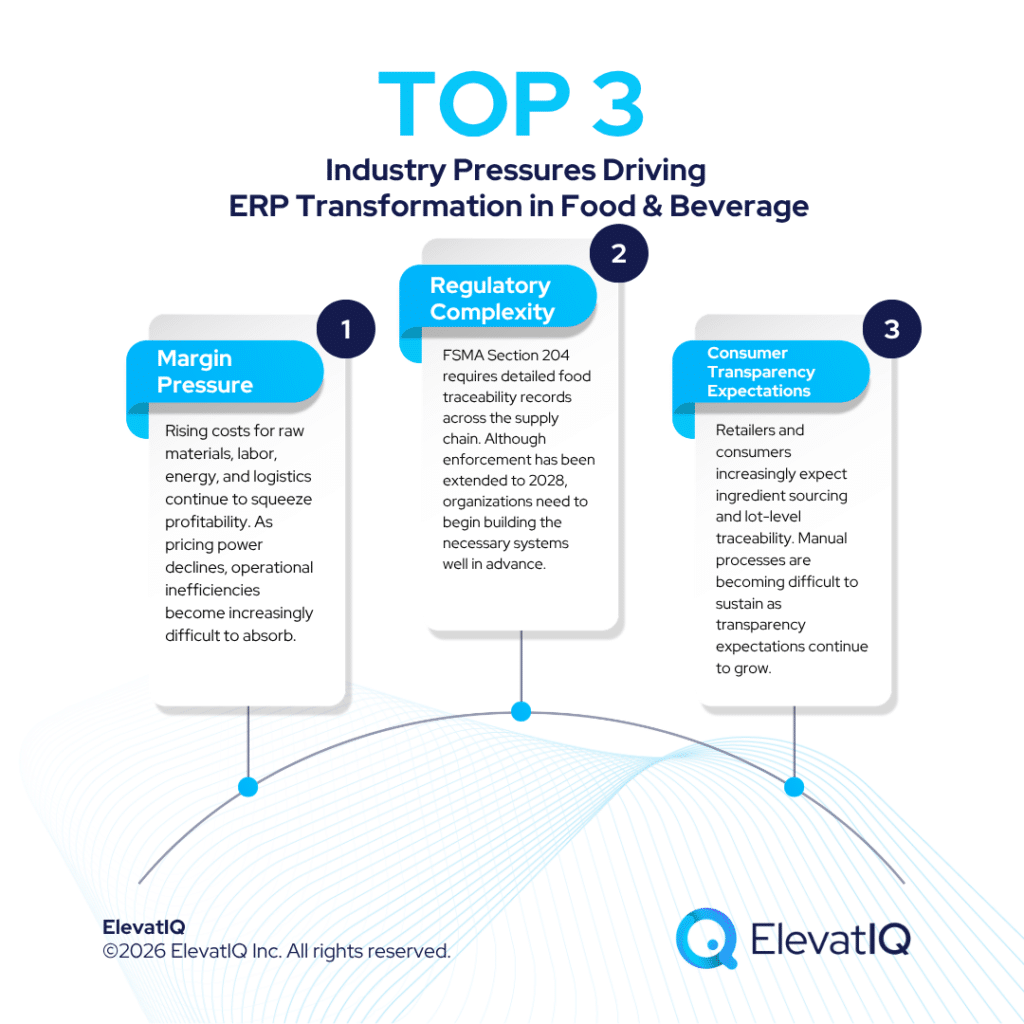
Food and beverage ERP challenges do not exist in isolation. They compound because the external pressures on the industry are compounding at the same time. Three distinct forces are colliding in 2026:
1. Margin Pressure
Input costs of raw materials, energy, labor, logistics, have remained elevated well above pre-pandemic baselines, while the ability to pass those increases on through pricing has narrowed. Volumes in several categories have softened in response to successive price increases, removing pricing as a reliable margin lever. Every operational inefficiency that was previously absorbed by margin now has nowhere to go.
2. Regulatory Complexity
The FDA’s Food Traceability Rule under FSMA Section 204, with a revised compliance deadline of July 20, 2028, extended from the original January 2026 date. It requires any manufacturer handling foods on the Food Traceability List to maintain detailed records at every Critical Tracking Event in the supply chain. The requirements themselves have not changed with the extension; only the enforcement timeline has. For organizations starting from a patchwork baseline, 2028 is closer than it appears when the underlying system architecture work has not yet begun.
3. Consumer Transparency Expectations
Clean-label and ingredient-transparency expectations have moved from a premium positioning tool to a baseline retail requirement across most categories. Retail buyers increasingly expect lot-level ingredient sourcing documentation as a standard part of supplier qualification. Meeting that expectation through a manual process assembled before every audit is not sustainable at scale.
None of these pressures is manageable in isolation. Together, they expose exactly where food and beverage ERP challenges are most acute.


ERP Selection Requirements Template
This resource provides the template that you need to capture the requirements of different functional areas, processes, and teams.
Why F&B Manufacturers Hit the Generic ERP Ceiling Faster Than Other Industries
The food and beverage ERP challenges that surface at scale are not about features. They are about data model compatibility. Many traditional ERP platforms were originally designed around discrete manufacturing assumptions. Food manufacturing introduces operational requirements that often challenge those assumptions.
Where Generic ERPs Assume vs. What F&B Actually Needs
| Generic ERP Assumption | F&B Operational Reality |
| One BOM produces one output | A formula produces a primary product, potential co-products, yield loss within tolerance, and allergen-impacted rework |
| Inventory is quantity-based | Catch-weight operations require actual weight at receiving to drive cost, the unit quantity is a target, not a fact |
| Standard cost model, set periodically | Actual batch cost fluctuates with commodity markets, a frozen standard cost quickly becomes meaningless |
| Production yield is predictable | Yield is a variable governed by tolerance bands, not a fixed number |
| One unit of measure per item | F&B items routinely carry multiple simultaneous UoMs – kg, litre, unit, and case, across different transaction types |
As F&B manufacturers add production lines, facilities, or distribution channels, what starts as a manageable inconvenience in a generic ERP becomes operationally unworkable. Manual data entry multiplies across every shift. Decisions get made on information that is already hours or days old. Compliance risk accumulates in the gaps between systems that were never designed to work together.
The ceiling is not hit gradually. It tends to arrive suddenly triggered by a specific growth event that exposes limitations the system was never designed to handle.

ERP System Scorecard Matrix
This resource provides a framework for quantifying the ERP selection process and how to make heterogeneous solutions comparable.
The Patchwork Problem: How Mid-Market F&B Systems Actually Look
The most common response to food and beverage ERP challenges at mid-market scale is not to fix the ERP, it is to build around it. The result is a fragmented architecture that holds together until a compliance event, a recall, or a new customer’s audit requirements expose how fragile the connections are.
The Typical Mid-Market F&B System Stack
| Function | How It Is Typically Managed |
| Financials and purchasing | Legacy ERP |
| Warehouse operations | Standalone WMS – disconnected from ERP |
| Quality management | Spreadsheet or SharePoint folder |
| Production scheduling | Separate planning tool or Excel |
| Regulatory compliance documentation | Third-party tool or manual binder |
A legacy ERP handles financials. Custom scheduling tools or spreadsheets run the production floor. Quality records live in a tool never built for that purpose. Compliance documentation sits in a binder or shared drive no system has touched. Integrations stitch these into something resembling a connected environment , until a change pulls on the wrong thread.
What the Patchwork Architecture Actually Costs
The fragmentation is not just inconvenient, it can have measurable impacts across multiple operational dimensions:
- Labor: Manual reconciliation between disconnected systems consumes hours across every production shift, a recurring overhead that compounds daily
- Inventory accuracy: When WMS and ERP records disagree, neither is trusted in real time; physical counts become a recurring requirement rather than an exception
- Quality traceability: Events recorded outside the ERP cannot be traced to a specific lot without a manual investigation, one that depends on whoever built the original spreadsheet still being available
- Audit preparation: What takes a few hours in a system-managed environment routinely takes days when data lives across disconnected tools
- Decision latency: Sourcing, production, and commercial decisions are made on data at least one manual reconciliation behind the current state of the operation
Food and beverage ERP challenges rooted in patchwork architectures are not just an IT problem. They are an operational cost problem, a compliance risk problem, and a decision-quality problem simultaneously.
The Operational Capabilities Generic ERPs Cannot Deliver Without Heavy Customization
Four capabilities commonly emerge as critical requirements in food and beverage ERP environments. Many generic ERP platforms either lack these capabilities natively or require significant customization.
The Four Non-Negotiable F&B ERP Capabilities
- Bi-Directional Lot Traceability – The ability to trace any finished good backward to every raw ingredient lot it contains, and any ingredient lot forward through every product it became. This is a data model requirement, not a reporting feature. If the ERP does not capture lot-level transactions at every production step as the work happens, that traceability cannot be reconstructed accurately after the fact.
- Batch Genealogy – The complete system record of every ingredient, formula version, production parameter, actual versus theoretical yield, and quality deviation for a specific batch. In a generic ERP, this typically lives in paper binders or free-text fields. In a food-specific ERP, it is a structured, queryable record tied to the batch from the moment production begins.
- Allergen Control Across Formula Changes – Allergen flags must propagate automatically from ingredient level through every formula using that ingredient. When a formula change introduces or removes an allergen, the system should surface the labeling impact before the change reaches the floor. Most generic ERPs either lack this entirely or implement it through custom fields with no enforcement logic.
- FEFO Inventory Management – First Expired, First Out must be enforced at the system level, not a spreadsheet updated periodically. Shipping the wrong lot because the warehouse layer ignores expiry is a compliance event. FEFO needs to be embedded in fulfillment logic, not managed manually.
These are not edge-case requirements. They are baseline operational necessities for any food manufacturer operating at meaningful scale and the food and beverage ERP challenges that arise when they are absent are not theoretical.
The Recall Readiness Gap: What “4 Hours” Actually Requires
Recall readiness is where food and beverage ERP challenges become directly measurable. The expectations are specific and industry-wide:
| Standard | Expectation |
| BRCGS Global Standard | Full mock recall demonstrable within 4 hours, conducted at least annually |
| FSMA Section 204 | Traceability records provided to FDA within 24 hours of a formal request |
| Operational best practice | Traceability information should be rapidly retrievable from a centralized and integrated system |
In practice, many mid-market F&B manufacturers running patchwork systems find meeting the 4-hour BRCGS expectation challenging. The data required to answer a recall question which finished goods used this ingredient lot, which customers received them, what the production parameters were, lives across multiple systems, some in paper records, some reconstructable only by the one QA manager who built the original tracking spreadsheet.
Why Recall Cost Is Not Just a Compliance Issue
A food recall that cannot be executed efficiently has consequences that go well beyond the regulatory response. The commercial exposure includes:
- Product over-withdrawal: Without precise lot traceability, manufacturers often pull more product than was at risk, destroying margin unnecessarily
- Retailer relationship damage: Slow or inaccurate recall execution affects buyer confidence independent of the underlying safety event
- Brand damage amplification: The longer a recall takes to scope and execute, the longer it stays in public visibility
- Repeat audit scrutiny: A recall exposing traceability gaps invites more intensive ongoing regulatory attention
Addressing food and beverage ERP challenges around recall readiness means the ERP data model is either ready for this moment before it happens, or it is not. A mock recall drill is the operational test and the time to discover the gaps is before a real event triggers the clock.
How an Independent ERP Advisory Consultant Can Help Here
The standard approach to addressing food and beverage ERP challenges is to start with software: research vendors, attend demos, shortlist, select. The problem is that this sequence puts the vendor’s demonstration in front of the organization’s requirements and ERP vendors naturally focus demonstrations on the capabilities they believe best showcase their platforms, not what matters for a specific operation’s actual gaps.
The Difference a Requirements-First Approach Makes
| Step | Vendor-Led Approach | Independent Advisory, Requirements-First Approach |
| Starting point | Vendor demo | Operational workflow documentation |
| Shortlisting basis | Vendor’s category claims | Requirements specification mapped to actual operational gaps |
| Demo script | Vendor’s standard presentation flow | Scenarios built directly from the organization’s processes |
| Scoring methodology | Subjective impression | Weighted scorecard against documented, prioritized requirements |
| Outcome driver | Best demo performance wins | Best operational fit wins |
Before any vendor conversation begins, actual workflows are documented: how batches are created and costed, how lot genealogy is currently captured or not, how allergen controls work across formula changes, how the recall process functions and where the gaps are, and where demand planning disconnects from production. That documentation produces a requirements specification specific enough to test, not a generic food industry feature list.
Systems that look similar in a scripted demo often look very different when tested against real operational scenarios particularly around the four capabilities above.
An independent ERP advisory consultant brings no vendor certification relationships and no software commission arrangements. The recommendation reflects operational fit, not vendor relationship. ElevatIQ works as an independent ERP advisory consultant for food and beverage manufacturers navigating these decisions, beginning with requirements documentation before any vendor enters the conversation.
Conclusion
The broader food and beverage ERP challenges at mid-market scale are almost always visible in the operational environment well before they become a formal project. The signals tend to be recognizable to anyone running the operation:
- The QA manager who has become the primary source of traceability and compliance knowledge because critical information resides outside the system of record
- The production planner maintaining the real schedule in Excel because the ERP’s scheduling module does not reflect actual floor constraints
- The warehouse team running weekly manual inventory counts because the system record and the physical count never agree
- The finance team spending days before every customer audit pulling data from three systems that were never designed to communicate with each other
Organizations that recognize those patterns are already past the question of whether they need a better system. The real question is how to select the right one and how to ensure the ERP implementation actually resolves the gaps rather than recreating them in a more expensive platform. That is a process question before it is a technology question. The answer starts with an honest assessment of the current operational state, not with a vendor demo.

ERP Selection: The Ultimate Guide
This is an in-depth guide with over 80 pages and covers every topic as it pertains to ERP selection in sufficient detail to help you make an informed decision.
Related Posts: