
Last Updated on June 24, 2026 by Shrestha Dash
Key Highlights
- The pet food category has undergone a fundamental product complexity shift. Raw, freeze-dried, prescription, breed-specific, and functional nutrition formats now coexist in the same facility. Each has distinct formulas, labeling, and compliance requirements that many general-purpose ERP systems were not originally designed to manage.
- FDA facility registration, AAFCO nutritional adequacy requirements, and CVM regulatory oversight translate into specific data and documentation obligations that organizations typically need their ERP and related business systems to support. Rather than relying primarily on disconnected spreadsheets or paper-based QA records.
- Ingredient sourcing transparency has become a commercial requirement, not just a regulatory one. A 2026 BSM Partners survey found that around 87% of US pet owners are concerned about where their pet’s food ingredients are sourced and approximately 74% said they would pay more for verified transparency.
- Mock recall readiness is the operational test that reveals whether a pet food manufacturing ERP is actually fit for purpose. A widely recognized industry benchmark is demonstrating full traceability within four hours. A benchmark that many manufacturers relying on disconnected systems may struggle to meet consistently.
Introduction
The pet food industry has spent the past decade humanizing itself and the operational consequences of that shift are now arriving at the ERP level. What was once a relatively straightforward manufacturing category has become one of the most complex in the food sector: multiple protein formats, condition-specific therapeutic diets, breed-specific formulations, functional nutrition claims, DTC subscription fulfillment, and retail channel compliance requirements – all running simultaneously, often through the same facility.
A pet food manufacturing ERP that was sufficient at $15 million in revenue with a handful of SKUs across two channels may no longer be sufficient at $50 million with 200 SKUs across three channels, a co-manufacturer relationship, and FDA traceability obligations.
This blog examines where that complexity is coming from, what it demands from a pet food manufacturing ERP, and why the gap between what mid-market manufacturers need and what their current system delivers tends to surface at the worst possible moment during a recall, an audit, or a major retail customer’s compliance review.
The Category Complexity Explosion
Pet food is no longer a single-format business for most mid-market manufacturers. Industry analysts project continued growth in the global pet food market over the next several years, driven by premiumization, functional nutrition, and segment-specific nutrition. That growth is arriving at the manufacturing floor as formula proliferation, processing complexity, and SKU management challenges that many legacy or general-purpose ERP systems were not originally designed to handle.
How the Product Portfolio Has Changed
| Format | Operational ERP Requirement |
| Raw and freeze-dried | Cold chain tracking, short shelf-life FEFO enforcement, Salmonella testing documentation per lot |
| Prescription / therapeutic diets | Veterinary claim substantiation, CVM regulatory documentation, controlled distribution channel management |
| Breed-specific and life-stage | Formula version control across high SKU count, label variant management |
| Functional nutrition (digestive, joint, immune) | Ingredient claim documentation, nutrient analysis linkage to finished product specification |
| DTC subscription | Demand-driven production scheduling, fulfillment integration, personalized nutrition configuration |


ERP Selection Requirements Template
This resource provides the template that you need to capture the requirements of different functional areas, processes, and teams.
Each format introduces distinct compliance documentation, production parameters, and labeling requirements. A pet food manufacturing ERP should be capable of managing these simultaneously, not through a separate spreadsheet per product line.
As pet food manufacturers layer new automation onto existing operations, the integration between plant floor systems and the ERP becomes a recurring friction point.
“Legacy systems often clash with modern automation technologies, creating compatibility issues that disrupt operations. For example, manufacturers report difficulties connecting IoT-enabled equipment to aging infrastructure.” — Scott Hungerford, Burns & McDonnell, Pet Food Processing, May/June 2025
“We can combine bin level data from the floor with inventory levels from the ERP system in a single report. This eliminates the need for manual data collection and reconciliation, allowing users to spend less time gathering information and more time acting on insights to improve processes, maintain quality, and stay ahead of daily production demands.” — Nathan Kramer, NorthWind Technical Services, Pet Food Processing, May/June 2025
Kramer’s observation reflects a recurring pattern across pet food operations: the value of an ERP is often realized only when it is genuinely connected to production data, not running in parallel with it.
Industry coverage of pet food ingredient sourcing in 2025 and 2026 has increasingly become a competitive differentiator rather than a compliance afterthought. Brands that cannot substantiate their sourcing claims with verifiable data are increasingly at a disadvantage with both retail buyers and direct consumers. that exposes limitations the system was never designed to handle.

ERP System Scorecard Matrix
This resource provides a framework for quantifying the ERP selection process and how to make heterogeneous solutions comparable.
The Regulatory Layer Most Pet Food Manufacturers Underestimate
Pet food regulatory requirements sit at the intersection of multiple overlapping frameworks. Understanding what each demands and how those demands translate into ERP data requirements, is where most mid-market manufacturers discover their system gaps.
The Three-Framework Regulatory Environment
FDA Facility Registration and FSMA Preventive Controls
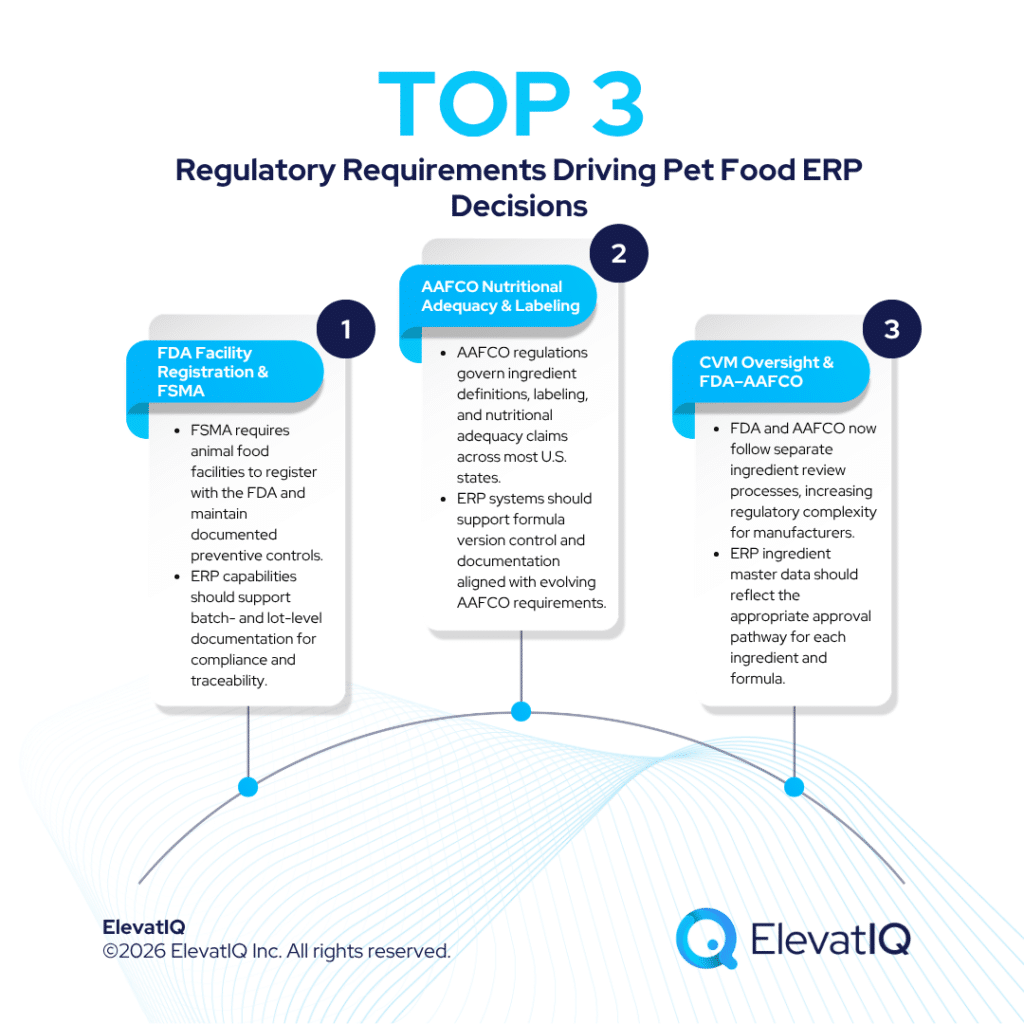
Under FSMA, any facility that manufactures, processes, packs, or stores animal food in the United States is required to register with FDA’s Center for Veterinary Medicine and implement a written Preventive Controls for Animal Food (PCAF) plan. This plan must include hazard analysis, preventive controls, monitoring procedures, corrective actions, and verification activities. Organizations typically require ERP capabilities that support documentation of these activities at the batch and lot level, not just at the product specification level.
AAFCO Nutritional Adequacy and Labeling
AAFCO’s model regulations adopted by most US states, govern how pet food products make nutritional adequacy statements, how ingredients are listed, and how certain health claims are substantiated. Because AAFCO’s Official Publication is updated annually, ingredient definitions and labeling requirements change on a rolling basis. A pet food manufacturing ERP should support formula management that links ingredient definitions to AAFCO-recognized names, tracks changes across formula versions, and maintains documentation of nutritional substantiation.
CVM Oversight and the FDA-AAFCO Separation
In 2023, FDA changed its ingredient review collaboration with AAFCO for ingredient review support, resulting in separate FDA and AAFCO processes for ingredient review and regulatory guidance. This means pet food manufacturers now navigate CVM’s ingredient approval process independently from AAFCO’s model regulations and those frameworks can produce different outcomes for the same ingredient. Organizations should ensure the ERP’s ingredient master and formula management reflect which approval pathway applies to each ingredient used in each formula. connected environment , until a change pulls on the wrong thread.
Ingredient Sourcing Transparency: From Marketing Claim to ERP Data Requirement
Ingredient sourcing transparency has become an increasingly important commercial expectation across retail and DTC channels and the data required to support it must exist in the pet food manufacturing ERP at the purchase order and lot level, not just at the product specification level.
What the Consumer Demand Signal Looks Like
A March/April 2026 BSM Partners survey of 1,000 US dog and cat owners, published in Pet Food Processing, found:
- 87% said they are concerned about where their pet’s food ingredients are sourced
- Only 41% reported knowing where those ingredients actually come from
- 74% said they would pay more for verified sourcing transparency
- 86% said it is important that vitamins and minerals originate from the United States
- 93% said they would be more likely to purchase products featuring US-sourced micronutrients
“Ingredient sourcing, once handled quietly in procurement meetings and supplier contracts, has moved into plain view. What used to be a back-of-house operational choice is now, unmistakably, a front-of-pack trust signal.” — Pet Food Processing, March/April 2026
What Transparency Requires from the ERP
| Transparency Claim | ERP Data Required |
| Country of origin per ingredient | Supplier-linked country of origin at purchase order and lot level |
| Protein source verification | Lot-level certificate of analysis linked to ingredient receipt |
| Allergen-free facility verification | Allergen zone mapping and cleaning validation per production run |
| No ingredients from specific geographies | Supplier country-of-origin flags enforced at ingredient intake |
A product specification document alone is typically insufficient to support these requirements. Effective traceability generally requires transaction-level data such as purchase order, goods receipt, lot assignment, production order as a continuous chain the ERP maintains through normal operations.
Recall Readiness: Why the 4-Hour Benchmark Matters
The pet food industry’s recall history provides context that no theoretical discussion of pet food manufacturing ERP requirements can replace. FDA’s outbreaks and advisories page documents a consistent pattern: Salmonella, Listeria, E. coli, aflatoxin, and foreign material events, across brands of every size and category. Between mid-2020 and mid-2025, approximately 45 total pet food recalls were recorded. The Midwestern Pet Foods aflatoxin and Salmonella incident alone accounted for an estimated approximately 93% of all pet food pounds recalled during that period, a reminder of how rapidly one ingredient contamination event cascades through shared lot environments.
| Standard | Expectation |
| Many certification schemes and industry best practices | Mock recalls conducted at minimum every six months |
| Widely recognized industry benchmark | Full forward and backward lot trace within 4 hours |
| Best-in-class | May achieve complete traceability in under 30 minutes in a fully integrated ERP |
The question a mock recall drill answers is simple: if the FDA requests which customers received a product from a specific lot right now, how long does it take to answer and how confident are you in that answer?
What One-Up/One-Down Traceability Actually Requires from ERP
“Maintaining food traceability may seem like ticking a regulatory box, but it’s your frontline defense against disaster. You can’t afford to guess where an ingredient came from or scramble to locate contaminated batches after your products hit the shelves.” — Aptean, Food Recall and Traceability: Key Risks and Solutions, September 2025
One-up/one-down traceability is the regulatory minimum. But in a multi-SKU pet food environment with co-manufacturers, shared ingredient lots across product lines, and multiple distribution channels, the operational need is full genealogy. Every ingredient lot through every production transformation to every customer shipment, in both directions, without manual reconstruction.
That typically requires the pet food manufacturing ERP to capture lot-level transactions at every step: receiving, production, quality release, packing, and shipment as a continuous, connected chain. Any step recorded on paper, in a separate quality system, or in a spreadsheet creates a break. A chain with breaks may make it difficult to answer a recall question in 4 hours.
How an Independent ERP Advisory Consultant Can Help Here
The typical approach to addressing pet food manufacturing ERP challenges begins with software evaluation: research vendors, attend demos, shortlist, select. The problem is that this sequence places vendor capabilities in front of the organization’s requirements and vendors serving the food and pet food space naturally emphasize the capabilities their platforms showcase most effectively during demonstrations, that look impressive in a demo, not the capabilities that matter for a specific operation’s compliance and traceability gaps.
Requirements-First vs. Vendor-Led Evaluation
| Stage | Vendor-Led Approach | Independent Advisory Approach |
| Starting point | Vendor demo scripted to strengths | Operational workflow and compliance gap documentation |
| Requirements basis | Vendor’s food industry feature list | Organization’s actual FSMA, AAFCO, and CVM obligations mapped to data requirements |
| Demo design | Vendor-controlled presentation | Scenarios built from the organization’s specific product formats and traceability workflows |
| Evaluation scoring | Subjective impression | Weighted scorecard against documented requirements |
| Outcome driver | Best demo wins | Best operational and compliance fit wins |
Before any vendor conversation begins, the actual operational environment needs to be documented: how formula versions are managed, how ingredient lot numbers are captured and linked to production orders, how the mock recall process works and where it breaks down, and what AAFCO and CVM documentation currently lives outside the system.
That documentation produces a requirements specification precise enough to test. A vendor demonstrating how their system handles a formula change affecting allergen status across 15 SKUs will respond very differently than one running a standard food industry demo.
An independent ERP advisory consultant brings no vendor certification relationships and no software commissions. ElevatIQ works with pet food manufacturers as an independent ERP advisory consultant, beginning with requirements documentation before any vendor enters the conversation.
Conclusion
Pet food manufacturing ERP requirements in 2026 reflect a category that has changed structurally. Manufacturers who built systems around a simpler portfolio, fewer channels, and lighter compliance are finding the gaps surface at the worst moments during a mock recall that takes two days instead of four hours, a retail buyer audit requesting lot-level sourcing documentation that does not exist, or an FDA inspection revealing a break in preventive controls documentation.
The signals that a pet food manufacturing ERP may be approaching its limits are recognizable before a crisis forces the issue:
- QA managers who are the single point of failure for any traceability question because the data lives in their spreadsheet
- Production planners managing formula versions in Excel because the ERP cannot handle the SKU complexity
- Compliance teams spending weeks before an audit manually reconstructing lot genealogy a properly configured system surfaces in minutes
- Procurement teams unable to provide retail buyers with lot-level ingredient sourcing documentation without a manual research process per order
Organizations experiencing these patterns may find that the discussion shifts from whether to improve their ERP capabilities to how best to address those gaps. The question is how to select one that is better aligned with those requirements rather than recreating them in a more expensive platform.
That is a requirements and process question before it is a technology question. The answer starts with an honest assessment of the current operational state, not a vendor demo.

ERP Selection: The Ultimate Guide
This is an in-depth guide with over 80 pages and covers every topic as it pertains to ERP selection in sufficient detail to help you make an informed decision.
Related Posts: