
Last Updated on August 17, 2026 by Shrestha Dash
Key Highlights
- For medical device manufacturers, the medical device ERP compliance cost of a fragmented system isn’t just operational inefficiency. It can trigger an FDA warning letter, a consent decree, or a recall, all of which can carry costs that exceed the investment required for a compliance-focused ERP implementation.
- Production and traceability records that have traditionally been maintained through mechanisms such as Device History Records (DHRs) are now governed under the FDA’s Quality Management System Regulation (QMSR), effective February 2, 2026 and manufacturers still managing this partly in ERP and partly on paper or shared drives are carrying real audit exposure.
- Companies selling into Europe are navigating live EU MDR transition deadlines and evolving EUDAMED registration requirements and an ERP that wasn’t built to support that documentation load adds real market-access risk on top of regulatory risk.
- CAPA and UDI are operational processes as much as they are compliance processes. When they live outside ERP or disconnected from it, the resulting gaps between documentation and operational execution are among the types of issues investigators commonly assess during inspections.

Introduction
In most manufacturing industries, an ERP selection that turns out to be a poor fit is a productivity problem. Teams work around it, efficiency suffers, and eventually the business replaces or re-implements the system. In medical device manufacturing, a poor-fit ERP may create ongoing regulatory and compliance risks that can increase over time if not addressed.
This is what makes the medical device ERP compliance cost conversation different from the equivalent conversation in most other industries. A generic ERP implementation that falls short on inventory accuracy or reporting speed is inconvenient. FDA investigators and EU notified bodies commonly evaluate areas such as production records, corrective actions, traceability, and device identification during inspections and audits.
The regulatory landscape itself has also been shifting. The FDA amended 21 CFR Part 820 through the Quality Management System Regulation (QMSR), aligning many requirements more closely with ISO 13485:2016, and the EU MDR transition is now hitting real deadlines rather than distant ones. Both changes have direct implications for how ERP systems need to be configured and both are explored below.
The Regulatory Stakes Are Different
Understanding the true medical device ERP compliance cost starts with recognizing that the downside risk in this industry isn’t measured the same way it is elsewhere.
What a Compliance Gap Actually Costs vs. What Prevention Costs
| Consequence of a Compliance Gap | Typical Business Impact |
| FDA Form 483 observation | Remediation effort, management time, follow-up inspection risk |
| FDA warning letter | Public record, customer and investor scrutiny, mandated corrective action plan |
| Consent decree | Court-enforced oversight, ongoing compliance costs, operational restrictions |
| Product recall | Direct recall costs, market withdrawal, reputational damage, potential litigation |
| Proper ERP implementation designed around compliance | Upfront investment, offset by reduced audit and enforcement exposure |
A warning letter alone typically triggers months of remediation work, a formal response to the FDA, and heightened scrutiny on every subsequent inspection. A consent decree can subject an organization to extended court-supervised oversight and operational restrictions until compliance obligations are satisfied. A recall carries direct costs plus the harder-to-quantify cost of lost trust with clinicians and patients. For many organizations, the cost of a compliance-focused ERP implementation may be substantially lower than the potential costs associated with enforcement actions, recalls, or prolonged remediation efforts. Which is exactly the framing that tends to get lost when ERP selection is treated as a generic IT project rather than a compliance decision.


ERP Selection Requirements Template
This resource provides the template that you need to capture the requirements of different functional areas, processes, and teams.
The Production Record Gap: What Changed Under QMSR
Medical device manufacturers have long organized their compliance documentation around three familiar concepts: the Design History File, the Device Master Record, and the Device History Record. The DHR being the record demonstrating that a specific device or lot was manufactured according to its approved specifications.
Effective February 2, 2026, the FDA’s Quality Management System Regulation amended the device current good manufacturing practice requirements of 21 CFR Part 820, incorporating the international standard ISO 13485:2016 by reference. While QMSR aligns terminology more closely with ISO 13485, manufacturers still need to maintain equivalent design, manufacturing, and traceability records to demonstrate compliance.
Legacy Terminology vs. Current Regulatory Framing
| Legacy Term (Pre-QMSR) | Current Regulatory Basis | Underlying Requirement |
| Device History Record (DHR) | ISO 13485 production and traceability clauses, incorporated via QMSR | Proof each device or lot was made to specification |
| Device Master Record (DMR) | ISO 13485 documentation and Medical Device File requirements | Specifications and procedures for manufacturing the device |
| Design History File (DHF) | ISO 13485 design and development file requirements | Documented evidence of the design and development process |
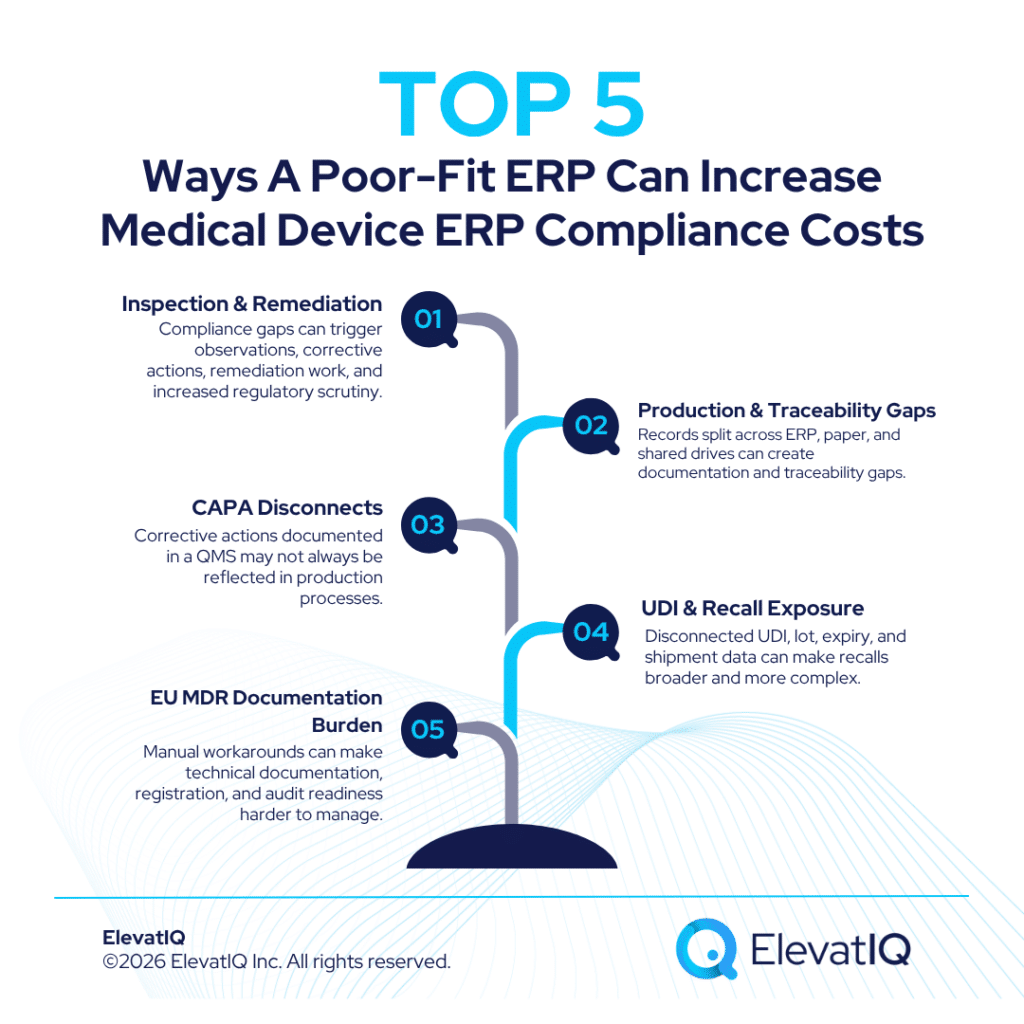
What hasn’t changed is where the compliance exposure actually lives day to day: manufacturers using general-purpose ERPs are still commonly managing part of this documentation in the system and part of it on paper or shared drives. That split can create documentation and traceability gaps that may attract attention during an inspection.

ERP System Scorecard Matrix
This resource provides a framework for quantifying the ERP selection process and how to make heterogeneous solutions comparable.
The EU MDR Transition Is No Longer a Future Problem
For manufacturers selling into Europe, the EU MDR is no longer a distant compliance milestone. It’s a set of deadlines that are actively being enforced, and it adds a second, distinct layer to the overall medical device ERP compliance cost equation alongside FDA obligations.
EU MDR Compliance Load on ERP
| Requirement | What It Demands of ERP |
| Technical documentation (Annex II/III) | Traceable links between design, manufacturing, and risk management records |
| EUDAMED actor and device registration | Accurate, exportable UDI and device master data |
| Notified body review readiness | Production and quality records available on demand, not reconstructed under time pressure |
| Post-market surveillance obligations | Consolidated complaint, CAPA, and field data tied back to specific devices and lots |
Review timelines may vary significantly depending on device complexity, documentation readiness, and notified body capacity. An ERP that was configured with only FDA requirements in mind, or with no regulatory requirements in mind at all, is not positioned to support this documentation load without significant manual patchwork.
CAPA Process Management: Where Disconnected Systems Show Their Weakness
Corrective and Preventive Action, or CAPA, is one of the most heavily scrutinized elements of any medical device quality system and it’s also one of the processes most likely to live outside the ERP entirely, in a standalone quality management system with no operational connection back to production. A disconnected CAPA process can create significant compliance and operational challenges.
What an Uncontrolled CAPA Process Looks Like
| Step | What Happens | Resulting Disconnect |
| CAPA is opened | Logged in a standalone QMS after a complaint or nonconformance | ERP has no record that a CAPA exists |
| Root cause identified | Documented in the QMS | Operational changes it implies aren’t reflected in production routing or specs |
| Corrective action implemented | Recorded as “complete” in the QMS | ERP-driven production may not reflect the change for weeks |
| Effectiveness check | Performed against QMS records | No system-level evidence the change was operationally sustained |
Investigators frequently assess whether corrective actions are properly implemented and reflected in operational processes, because it exposes a gap between what an organization says it did and what its production systems show it actually did. A CAPA that is documented as complete but is not reflected in relevant operational processes may indicate that the corrective action was not fully implemented.
UDI Compliance: An Operational Requirement, Not Just a Labeling Rule
Unique Device Identification is often treated as a labeling exercise, handled by regulatory affairs and applied at the packaging stage. In practice, UDI reaches much further into daily operations than that framing suggests.
Where UDI Touches Operations Beyond the Label
| Operational Area | UDI-Driven Requirement |
| Lot and batch tracking | UDI must tie back to specific production lots throughout their lifecycle |
| Expiry management | Expiration data must be accurately linked to the UDI at the unit or lot level |
| GUDID submissions | Device identifier data must stay synchronized with what’s actually being produced and shipped |
| Recall and field action execution | UDI is the mechanism for identifying exactly which units are affected |
When UDI data lives only in a labeling system, disconnected from the ERP that manages lot genesis, expiry, and shipping, the risk isn’t just a labeling error. It’s an inability to execute a precise, narrowly scoped recall if one is ever needed. Insufficient traceability may increase the scope, cost, and complexity of recall activities. And one of the clearest illustrations of how medical device ERP compliance cost compounds when a single system is left out of the operational picture.
Managing Medical Device ERP Compliance Cost Through Independent Advisory
Choosing an ERP for a medical device manufacturer is a fundamentally different exercise than choosing one for most other industries, because regulatory fit is often one of the most important evaluation criteria, not generic feature comparison. Managing medical device ERP compliance cost effectively starts well before implementation, it starts with how the system is selected in the first place.
Generic ERP Evaluation vs. Compliance-First Evaluation
| Phase | Generic ERP Evaluation | Compliance-First Approach |
| Requirements gathering | Built around operational features: inventory, scheduling, reporting | Built around regulatory obligations first: QMSR, EU MDR, UDI, CAPA traceability |
| Vendor demos | Evaluated on general manufacturing functionality | Evaluated on how specific compliance workflows are actually supported |
| Gap identification | Found during implementation or after go-live | Identified and addressed before a vendor is selected |
| Ongoing risk | Manual workarounds absorb the compliance gap indefinitely | System is configured to close the gap at the source |
At ElevatIQ, we work with medical device manufacturers to define ERP system requirements that map directly to their regulatory obligations rather than to generic quality management features. As an independent ERP consulting firm, we don’t sell software and don’t receive commissions from vendors, which means our recommendations are shaped by what a manufacturer’s compliance and operational reality actually requires, not by which platform we have an incentive to place. For a manufacturer weighing a first ERP implementation, a replacement, or an integration between ERP and an existing quality system, that compliance-first requirements definition is a factor that can significantly influence whether the eventual system closes the gaps.
Conclusion
The medical device ERP compliance cost of getting this wrong isn’t hypothetical, and it isn’t limited to the price of the software itself. It shows up in inspection findings, in warning letters, and in the operational disruption of a recall. All of which are more expensive, and more disruptive, than doing the requirements work properly before a system is selected.
A few signals tend to indicate a manufacturer is carrying more compliance exposure than it realizes:
- Production or traceability records are split between the ERP and paper-based or shared-drive systems, with no single source of truth
- CAPA is managed in a standalone quality system with no defined link back to operational changes in ERP
- UDI data is treated as a labeling function rather than something tied to lot tracking, expiry, and recall readiness
- EU MDR documentation requirements haven’t been mapped against what the current ERP can actually produce on demand
These signals may indicate that regulatory requirements were not fully incorporated into ERP selection or system design decisions. The ERP was selected, or is being operated, without regulatory obligations as the primary filter. Closing that gap before an inspection or audit forces the issue is consistently less costly than closing it afterward.

ERP Selection: The Ultimate Guide
This is an in-depth guide with over 80 pages and covers every topic as it pertains to ERP selection in sufficient detail to help you make an informed decision.
Related Posts: