
Last Updated on October 15, 2026 by Shrestha Dash
Key Highlights
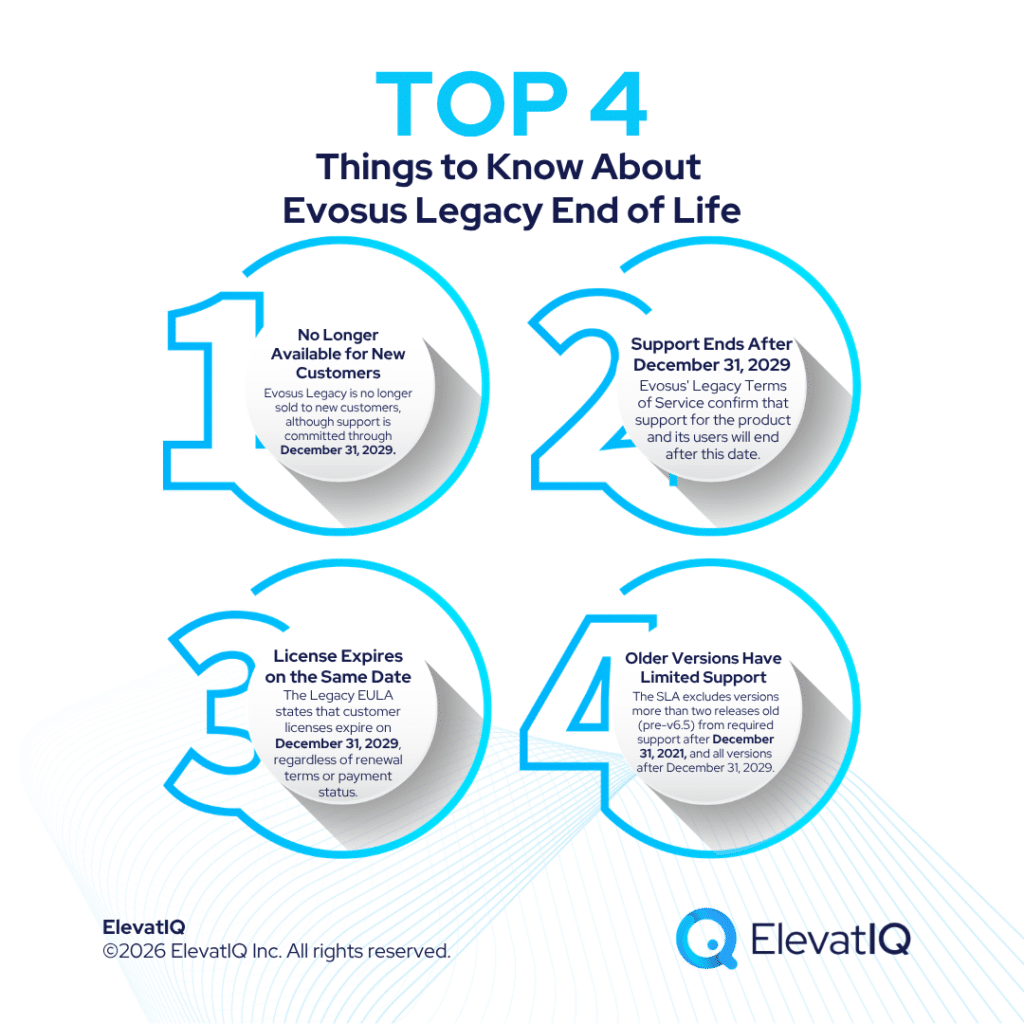
- Evosus has confirmed the Evosus Legacy end of life. The business management software is no longer sold to new customers. And also support for the product will end after December 31, 2029. The date is specified in Evosus’ Legacy Terms, EULA, and Service Level Agreement.
- Evosus has also specified version-based support limitations for Legacy. Versions more than two releases old, defined by Evosus as versions earlier than v6.5, are not required to receive support after December 31, 2021. As a result, some dealers and retailers may already have limited or no vendor support. This also depends on the Legacy version they are running.
- Evosus’s own migration path is its cloud platform LOU. The multi-year transition window gives dealers and retailers time to plan ahead of the final cutoff. Pool, spa, and hearth dealers and retailers still need to independently evaluate whether LOU, or an alternative platform, is the better long-term fit for their specific business.
- Waiting until close to the Evosus Legacy end of life can concentrate cost. This also concentrates staff training and data migration risk into a shorter window. It also may leave dealers and retailers with less time to compare platforms and negotiate commercial terms.
Introduction
Software end-of-life announcements are common across the ERP and business management software industry. But the details of each one matter more than the headline. Evosus is a business management platform built specifically for pool, spa, and hearth (fireplace and stove) dealers and retailers. It has confirmed that its Legacy product is no longer available for purchase by new customers. And also confirmed that support for existing Legacy customers will end on December 31, 2029.
For a niche, vertical-specific platform like Evosus Legacy, this kind of announcement often gets less attention than a similar move from a major horizontal ERP vendor. But the operational stakes for the dealers and retailers who depend on it are just as real. Pool, spa, and hearth dealers and retailers use platforms like Evosus Legacy to run service scheduling, retail point of sale, inventory, and accounting in a single system. This also means a required transition away from Legacy because the Evosus Legacy end of life can touch nearly every part of daily operations.
This piece looks at what’s actually been confirmed about the Evosus Legacy end of life timeline. What a phased support and end-of-life policy like this means in practice. And also how a dealer and retailer should approach the transition decision independently of the vendor’s own recommended path.
What Evosus Has Actually Confirmed
Understanding the real urgency behind the Evosus Legacy end of life starts with separating the marketing message from the contractual language. Since the two are usually more specific than they first appear.
Evosus Legacy Timeline: Marketing Language vs. Contractual Terms
| Source | What It States |
| Evosus Legacy product page | Legacy software is no longer for sale; support is committed through December 31, 2029 |
| Legacy Terms of Service | Evosus will discontinue support for the Legacy product and its users after December 31, 2029 (the “Expiration Date”) |
| Legacy EULA | A customer’s Legacy Product License itself expires on December 31, 2029, regardless of renewal terms or payment status |
| Service Level Agreement | Evosus is not required to support any Legacy version more than two releases old (pre-v6.5) after December 31, 2021, and won’t support any version after December 31, 2029 |
The SLA detail is worth sitting with. A dealer and retailer running an older, unpatched version of Legacy may already be outside the vendor’s support obligations well ahead of the because of the Evosus Legacy end of life in 2029, independent of the final cutoff date. That’s a distinction that’s easy to miss if a business only pays attention to the year printed on the marketing page.


ERP Selection Requirements Template
This resource provides the template that you need to capture the requirements of different functional areas, processes, and teams.
Why a Multi-Year Runway Is Both a Relief and a Trap
A multi-year support window ahead of the Evosus Legacy end of life gives dealers and retailers meaningful time to plan a transition before the final cutoff. Evosus has also been transparent about the technical reasoning: the top layer of Legacy’s programming sits on VB6, an aging technology stack, and the company evaluated how long it could realistically continue supporting the full stack underneath it before settling on the 2029 date.
The trap isn’t the timeline itself, it’s what a long runway tends to do to decision-making inside a dealer and retailer business.
Common Patterns in Long-Runway Software Transitions
| Pattern | What Typically Happens |
| “We have years, no rush” | Evaluation gets deprioritized against day-to-day operational demands |
| Migration planning starts in the final 12–18 months | Data migration, staff retraining, and integration work all get compressed into a shorter window than the vendor intended |
| Single-vendor default | The business moves to the vendor’s own successor platform without comparing it against alternatives, simply because it’s the path of least resistance |
| Version drift | Dealers and retailers running older Legacy versions discover they’ve already lost pieces of vendor support well before the final deadline |
None of this is unique to Evosus. These are common risks in software transitions with distant deadlines, and it’s precisely why treating a 2029 date as “not yet a priority” is a different decision than treating it as “not yet urgent, but already worth planning.”

ERP System Scorecard Matrix
This resource provides a framework for quantifying the ERP selection process and how to make heterogeneous solutions comparable.
Evaluating LOU, and What Else Belongs in the Conversation
Planning around the Evosus Legacy end of life means engaging with Evosus’s own recommended path for Legacy customers, which is its cloud-based successor platform LOU. The company positions LOU as unifying service, retail, inventory, and accounting in one system, with continuous updates handled in the cloud rather than through periodic on-premises releases. In a September 2024 discussion with Legacy customers, Evosus said it expected most dealers and retailers to move to LOU around 2027 into 2028, ahead of the final 2029 cutoff tied to the Evosus Legacy end of life.
For a Legacy customer, LOU is a reasonable starting point for evaluation, since it’s built by the same team with direct knowledge of what Legacy customers actually use day to day. But a starting point for evaluation is not the same as an automatic decision, and this is where the distinction between a vendor’s recommended migration path and an independently evaluated one matters most.
Questions Worth Answering Before Committing to Any Platform, Including LOU
| Evaluation Area | Why It Matters for Pool, Spa, and Hearth Dealers and Retailers |
| Feature parity timeline | Whether functionality a dealer and retailer currently relies on in Legacy is available in the new platform now, or on a future roadmap |
| Data migration scope | How cleanly service history, inventory records, and customer data actually transfer, and what gets left behind or requires manual re-entry |
| Total cost over the transition period | Licensing, training, potential parallel-running costs, and any hardware or integration changes required |
| Integration footprint | Whether existing point-of-sale, payment processing, or accounting integrations are supported on day one |
| Alternative platforms | Whether a broader look at other retail, service, and inventory management platforms serving specialty dealers and retailers surfaces a better long-term fit than staying within the Evosus product family |
A vendor’s own successor product can be a reasonable option, but it is also the option most directly presented and supported by the incumbent vendor. That makes independent comparison against the same requirements important. An independent ERP evaluation treats it as one candidate among several, evaluated against the same criteria as anything else.
Managing the Transition Through Independent Advisory
Navigating the Evosus Legacy end of life well ahead of the deadline is where independent, vendor-agnostic evaluation matters most. Vertical, dealer- and retailer-specific software like Evosus Legacy often gets less structured evaluation support than mainstream ERP transitions. It is largely because the market is smaller and less served by general enterprise software consultants. That gap tends to leave dealers and retailers choosing between doing the evaluation entirely in-house or defaulting to whatever path the incumbent vendor lays out.
In-House Transition Planning vs. Independent Evaluation
| Phase | In-House Default | Independent, Requirements-First Approach |
| Requirements gathering | Built around what the current system already does | Built around what the business actually needs going forward, including gaps in the current system |
| Platform comparison | Limited to the vendor’s own recommended path | Evaluated against other platforms serving specialty retail and service dealers and retailers |
| Migration timeline | Reactive, often starting close to the support deadline | Planned with enough lead time to avoid compressed, high-risk migration windows |
| Negotiating position | Limited, since the deadline is approaching and options feel narrow | Stronger, since evaluation starts early enough to walk away from a poor-fit deal |
At ElevatIQ, we work with dealers, retailers, and specialty service businesses to define system requirements based on actual operational needs. Rather than defaulting to whichever platform a vendor’s own transition messaging points toward. As an independent ERP and business software consulting firm, we don’t sell software and don’t receive commissions from vendors, which means our recommendations are shaped by what a dealer and retailer’s operations actually require, not by which platform we have an incentive to place. For a pool, spa, or hearth dealer and retailer weighing when and how to move off Evosus Legacy, that independent, requirements-first evaluation is what determines whether the eventual system genuinely fits the business or simply replicates the current one in a newer interface.
Conclusion
The Evosus Legacy end of life does not require every dealer and retailer to migrate immediately, but it does warrant proactive planning. December 31, 2029, the date set for the Evosus Legacy end of life, is still several years away, and Evosus has been more transparent than many vendors about its reasoning and its intended transition path. But a distant deadline is exactly the kind of signal that’s easy to deprioritize until it isn’t, and the businesses that end up doing rushed, high-risk migrations are rarely the ones that started planning too early.
A few signals tend to indicate a dealer and retailer should start evaluating options sooner rather than later:
- The business is running a Legacy version more than two releases old, meaning some support may already be limited ahead of the final 2029 date
- No one inside the business has mapped out what a realistic migration timeline and cost actually look like
- LOU, or any other platform, hasn’t been evaluated against a clear list of the business’s actual operational requirements
- The plan is currently “we’ll deal with it closer to 2029”
Starting the evaluation well ahead of the deadline gives dealers and retailers more time to compare platforms, validate requirements, plan the migration, and negotiate commercial terms before the support cutoff approaches.

ERP Selection: The Ultimate Guide
This is an in-depth guide with over 80 pages and covers every topic as it pertains to ERP selection in sufficient detail to help you make an informed decision.
Related Posts: