
Last Updated on October 6, 2026 by Shrestha Dash
Key Highlights
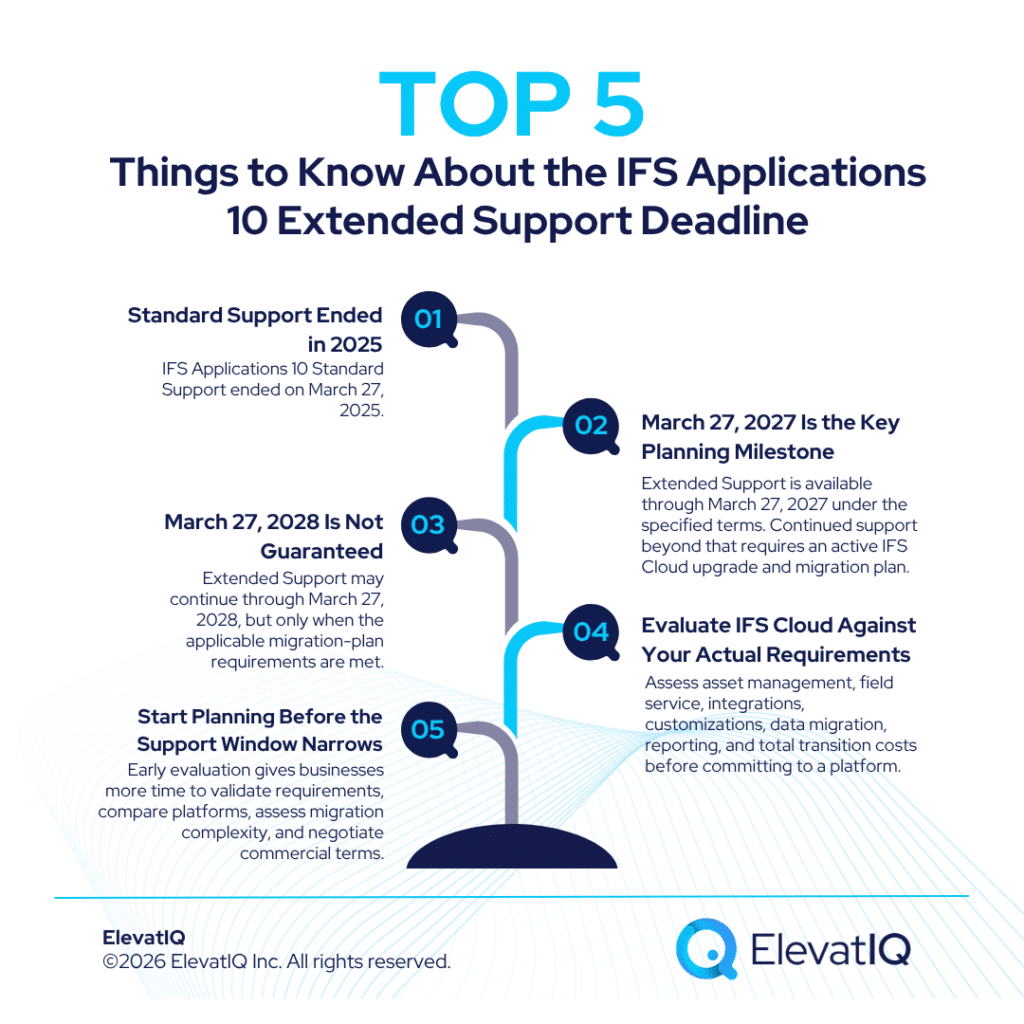
- IFS has confirmed that standard support for IFS Applications 10 ended March 27, 2025. Under its Extended Support Terms, customers that have purchased IFS Cloud and are in the process of upgrading can receive Extended Support for up to two years by default, through March 27, 2027.
- March 27, 2028 is the scheduled end of Extended Support under the current terms, rather than a guaranteed migration deadline. If a customer has not completed the upgrade by March 27, 2027 but can demonstrate an active IFS Cloud upgrade and migration plan, Extended Support can continue through March 27, 2028, subject to the applicable terms. If the customer cannot demonstrate an active plan and still requires Extended Support after March 27, 2027, an Order Form is required.
- This timeline differs from the support pattern often described as IFS’s ‘5+3’ model. In this releases could receive five years of Standard Support followed by up to three years of Extended Support.
- For asset-intensive businesses, where IFS Applications 10 often underpins enterprise asset management and field service operations, the IFS Applications 10 Extended Support deadline is less about a single date and more about a narrowing window to plan a transition. While also maintaining access to the applicable support options.
Introduction
Support lifecycle announcements from ERP vendors tend to get read as a single date on a calendar. But the details usually matter more than the headline. IFS Applications 10 is used by organizations across asset-intensive industries for capabilities including asset management, maintenance, and field service. In this case, the fine print carries real planning consequences.
IFS has been reasonably transparent about its own support terms. Publishing the exact dates and conditions directly in its Extended Support Terms documentation. What those terms show is a structure with two distinct phases rather than a single deadline. And the second phase is conditional on the customer’s own migration planning, not something IFS grants automatically.
This piece looks at what IFS has actually confirmed about the IFS Applications 10 support timeline. And also what the conditional structure of the IFS Applications 10 Extended Support deadline means in practice. Also, how asset-intensive businesses should approach the ERP evaluation independently of IFS’s own recommended path to IFS Cloud.
What IFS Has Actually Confirmed
Understanding the real shape of the IFS Applications 10 Extended Support deadline starts with separating the general “extended support until 2028” summary from the conditional terms that actually govern it.
IFS Applications 10 Support Timeline: General Summary vs. Contractual Terms
| Source | What It States |
| IFS Extended Support Terms | Standard support for IFS Applications 10 ended March 27, 2025 |
| Section 2.2 | Customers that have purchased IFS Cloud and are in the process of upgrading from IFS Applications 10 can receive Extended Support under the specified terms. |
| Section 2.2.1 | Extended Support is available for a maximum of two years from March 28, 2025, or until IFS Cloud go-live or the end of the applicable maintenance/subscription term, whichever occurs first. |
| Section 2.2.2 | If the upgrade is not completed by March 27, 2027 but the customer can demonstrate an active IFS Cloud upgrade and migration plan, Extended Support can continue through March 27, 2028, subject to the applicable terms. |
| If the customer cannot demonstrate an active migration plan after March 27, 2027 and still requires Extended Support, an Order Form is required. |
The conditional structure is worth sitting with. A business that treats March 2028 as a fixed, guaranteed date may be working from an inaccurate picture. For customers relying on Extended Support, March 27, 2027 is the key planning milestone. This is because continued Extended Support beyond that date is conditional. Particularly, on demonstrating an active IFS Cloud upgrade and migration plan.


ERP Selection Requirements Template
This resource provides the template that you need to capture the requirements of different functional areas, processes, and teams.
Why This Timeline Is Shorter Than IFS’s Historical Pattern
The IFS Applications 10 Extended Support deadline looks different from IFS’s historical support pattern, which is worth understanding before assuming the same structure applies here. IFS has historically offered support structures that could provide up to three years of Extended Support after Standard Support for certain releases. This is sometimes described as a ‘5+3’ support model, referring to five years of Standard Support followed by up to three years of Extended Support.
IFS Applications 10 has a more conditional structure, with Extended Support available for up to two years by default and potentially continuing into a third year when the applicable migration-plan requirements are met.
Common Assumptions vs. What the IFS Applications 10 Extended Support Deadline Actually Requires
| Assumption | What the Terms Actually Say |
| “IFS gives a flat multi-year extended support window like it always has” | The default Extended Support window for Apps 10 is two years, not three, and is not automatic beyond that |
| “The 2028 date applies to everyone on Apps 10” | The 2028 extension is conditional on the customer being able to demonstrate an active IFS Cloud upgrade and migration plan after March 27, 2027 |
| “We can decide on a path closer to the deadline” | Waiting until close to March 2027 to start planning leaves little time to actually build and document a credible migration plan before support options narrow |
| “Extended support just continues automatically” | Continuing support after March 2027 without a migration plan in place requires a new commercial order with IFS, not a simple renewal |
This does not mean every customer needs to migrate immediately. But it does create a defined planning window tied directly to the IFS Applications 10 Extended Support deadline. Particularly for organizations that intend to remain supported while evaluating their next ERP platform. vendor is sunsetting this system” leads to the wrong evaluation.

ERP System Scorecard Matrix
This resource provides a framework for quantifying the ERP selection process and how to make heterogeneous solutions comparable.
Evaluating IFS Cloud, and What Else Belongs in the Conversation
IFS Cloud is IFS’s recommended successor path for customers approaching the IFS Applications 10 Extended Support deadline. But organizations should validate functional coverage, configuration requirements, integrations, customizations, data migration, and reporting as part of their evaluation. For some customers, staying within the IFS product family may simplify aspects of the transition. Compared with moving to an unrelated platform, although the actual migration effort should be validated based on the organization’s configurations, integrations, customizations, data, and reporting requirements.
That said, IFS Cloud being the vendor’s own recommended path is not the same as it being the only path worth evaluating. For asset-intensive businesses in particular, where enterprise asset management and field service capabilities are the core requirement, the evaluation should weigh IFS Cloud against the same criteria applied to any other candidate.
Questions Worth Answering Before Committing to Any Platform, Including IFS Cloud
| Evaluation Area | Why It Matters for Asset-Intensive Businesses |
| Asset management and field service parity | Whether the specific EAM, maintenance, and field service functionality currently used in Applications 10 is fully available in IFS Cloud today, not on a future roadmap |
| Data and configuration migration scope | How cleanly asset registers, maintenance history, and configured business logic transfer, and what requires manual rework |
| Total cost over the transition period | Subscription licensing, migration services, potential parallel-running costs, and integration rework |
| Documented migration plan requirement | What it actually takes to satisfy IFS’s own March 2027 requirement for a demonstrated, active migration plan, and how early that documentation needs to start |
| Alternative platforms | Whether other ERP or EAM-capable platforms serving asset-intensive industries offer a better long-term fit than continuing within the IFS product family |
A vendor’s own successor platform is often a reasonable starting point, particularly when organizations expect continuity in the capabilities and industry processes they already rely on.wn merits before assuming the platform itself is the problem.
Managing the Transition Through Independent Advisory
Preparing for the IFS Applications 10 Extended Support deadline well in advance of March 2027 gives businesses more time. Particularly to validate requirements, assess migration options, and negotiate commercial terms. Businesses that wait until the deadline is close tend to have less room to negotiate, less time to validate requirements properly, and fewer realistic alternatives left to consider.
Reactive Planning vs. Independent, Requirements-First Evaluation
| Phase | Reactive Default | Independent, Requirements-First Approach |
| Requirements gathering | Built around replicating what Applications 10 already does | Built around what the business’s asset management and field service operations actually need going forward |
| Platform comparison | Limited to IFS Cloud as the assumed path | Evaluated against IFS Cloud and other platforms serving asset-intensive industries on the same criteria |
| Migration plan documentation | Assembled reactively as the March 2027 requirement approaches | Developed early enough to be genuinely credible, not just sufficient to satisfy the requirement |
| Negotiating position | Limited, since the support requirement is close and options feel narrow | Stronger, since evaluation starts early enough to consider alternatives if the preferred path does not meet business requirements |
At ElevatIQ, we work with asset-intensive businesses to define ERP and EAM requirements based on actual operational needs, rather than defaulting to whichever platform a vendor’s own support terms point toward. As an independent ERP and business software consulting firm, we don’t sell software and don’t receive commissions from vendors, which means our recommendations are shaped by what a business’s asset management and field service operations actually require, not by which platform we have an incentive to place.
For a business running IFS Applications 10, that independent, requirements-first evaluation is what determines whether IFS Cloud, or an alternative, is the platform that genuinely fits the business rather than simply the path of least resistance ahead of the IFS Applications 10 Extended Support deadline.
Conclusion
The IFS Applications 10 Extended Support deadline is not a single, flat date. It is effectively a two-stage support timeline: the default Extended Support period runs through March 27, 2027, while continued Extended Support through March 27, 2028 is conditional on the customer meeting the applicable requirements, including demonstrating an active IFS Cloud upgrade and migration plan.
Treating March 2028 as a guaranteed runway, without accounting for the 2027 documentation requirement, is a planning gap that could leave a business with fewer options than it expects. A few signals tend to indicate an asset-intensive business should start evaluating ERP options sooner rather than later:
- No one inside the business has mapped out what a credible, documented IFS Cloud migration plan actually requires ahead of the March 2027 deadline
- IFS Cloud hasn’t been evaluated against a clear list of the business’s actual asset management and field service requirements
- Alternative platforms serving asset-intensive industries haven’t been considered at all
- The plan is currently “we’ll deal with it closer to 2027 or 2028”
Early evaluation gives organizations more time to compare platforms, validate requirements, assess migration complexity, and negotiate commercial terms.

ERP Selection: The Ultimate Guide
This is an in-depth guide with over 80 pages and covers every topic as it pertains to ERP selection in sufficient detail to help you make an informed decision.
Related Posts: