
Last Updated on March 19, 2026 by Shrestha Dash
In September 2025, SAP India suspended software services to Nayara Energy, India’s second-largest single-site refinery. Also, citing European Union sanctions against the company for refining Russian oil. The suspension affected SAP’s Enterprise Resource Planning (ERP) Central Component, which Nayara described in Delhi High Court filings as its “central nervous system,” supporting finance, accounting, supply chain, plant maintenance, quality management, and tax compliance across its 20-million-ton-per-year refinery and 7,000-petrol-pump retail network.
By March 2026, Nayara remained locked in litigation, reporting difficulties generating GST 2.0-compliant invoices, tax reports, and accessing software updates required for regulatory compliance. Switching vendors would be technically complex and financially prohibitive due to 18 years of SAP customization and integration across Nayara’s operations.
SAP cannot restore services. Its German parent company faces EU legal liability if it supports a sanctioned entity, even through its Indian subsidiary. This case transforms ERP vendor lock-in from a commercial negotiation problem into a geopolitical risk. This also raises concerns for national infrastructure dependencies. When a foreign vendor can unilaterally suspend mission-critical ERP services to a company representing a significant share of India’s refining capacity, the dependency is not just operational. It is a sovereignty vulnerability.

The Suspension: When Software Services Become Sanctions Enforcement
SAP’s September 2025 suspension notice informed Nayara that services were being terminated due to EU sanctions imposed in July 2025 against Nayara for its ties to Russia and refining of Russian crude oil. The EU sanctions targeted Nayara specifically because Russian oil giant Rosneft owns 49.13% of the company.
What “suspension of services” means in ERP context:
SAP did not shut down Nayara’s ERP system remotely. The software continues running. What stopped was:
- Software updates and patches: Including critical tax compliance updates required for India’s GST 2.0 regime implementation
- Technical support: No assistance for system errors, performance issues, or configuration problems
- Access to new modules or functionality: Preventing Nayara from implementing operational improvements or regulatory changes
- License renewals and maintenance contracts: Creating legal uncertainty about Nayara’s right to continue using the software
The immediate operational impact focused on GST 2.0 compliance. India implemented new Goods and Services Tax invoicing requirements that required software changes to generate compliant invoices. Without SAP support to deploy the India-specific tax module, Nayara could not issue legally valid invoices, meaning it could sell fuel but could not bill customers in compliance with Indian tax law.
This creates a cascading operational risk: difficulties generating compliant invoices can disrupt revenue recognition, customer billing processes, and expose the company to potential tax authority penalties.
The Legal Argument: Indian Contract vs. Extraterritorial Sanctions
Nayara’s lawsuit in Delhi High Court centers on a straightforward legal question: can a contract between two Indian companies (Nayara Energy and SAP India Private Limited) be suspended based on foreign sanctions that have no legal force in India?
Nayara’s position:
The contract is governed by Indian law, executed between Indian entities, and provides services to critical Indian infrastructure. EU sanctions against Nayara do not create legal obligations for SAP India, an Indian company operating under Indian jurisdiction. Suspending services based on foreign sanctions constitutes “extraterritorial application of law” that undermines Indian sovereignty.
SAP’s defense:
SAP India cannot provide services without support from its German parent company. The corporate structure makes SAP India dependent on SAP SE (Germany) for software development, patches, updates, and technical expertise. If SAP SE provides support that indirectly benefits a sanctioned entity, German executives face criminal liability under EU law, potentially including imprisonment.
Senior Advocate Amit Sibal, representing SAP, stated explicitly: officials “would end up in a German jail for violating the EU sanctions if it were to restore the services to Nayara.”
The Delhi High Court initially denied urgent relief in September 2025, stating “It is not a straightforward issue” and requiring SAP to file a written response before ruling. The case is scheduled for hearing on March 16, 2026 – six months after the suspension, during which Nayara has operated with degraded ERP functionality and mounting compliance risks.


ERP Selection Requirements Template
This resource provides the template that you need to capture the requirements of different functional areas, processes, and teams.
The 18-Year Lock-In: Why Migration Is Not an Option
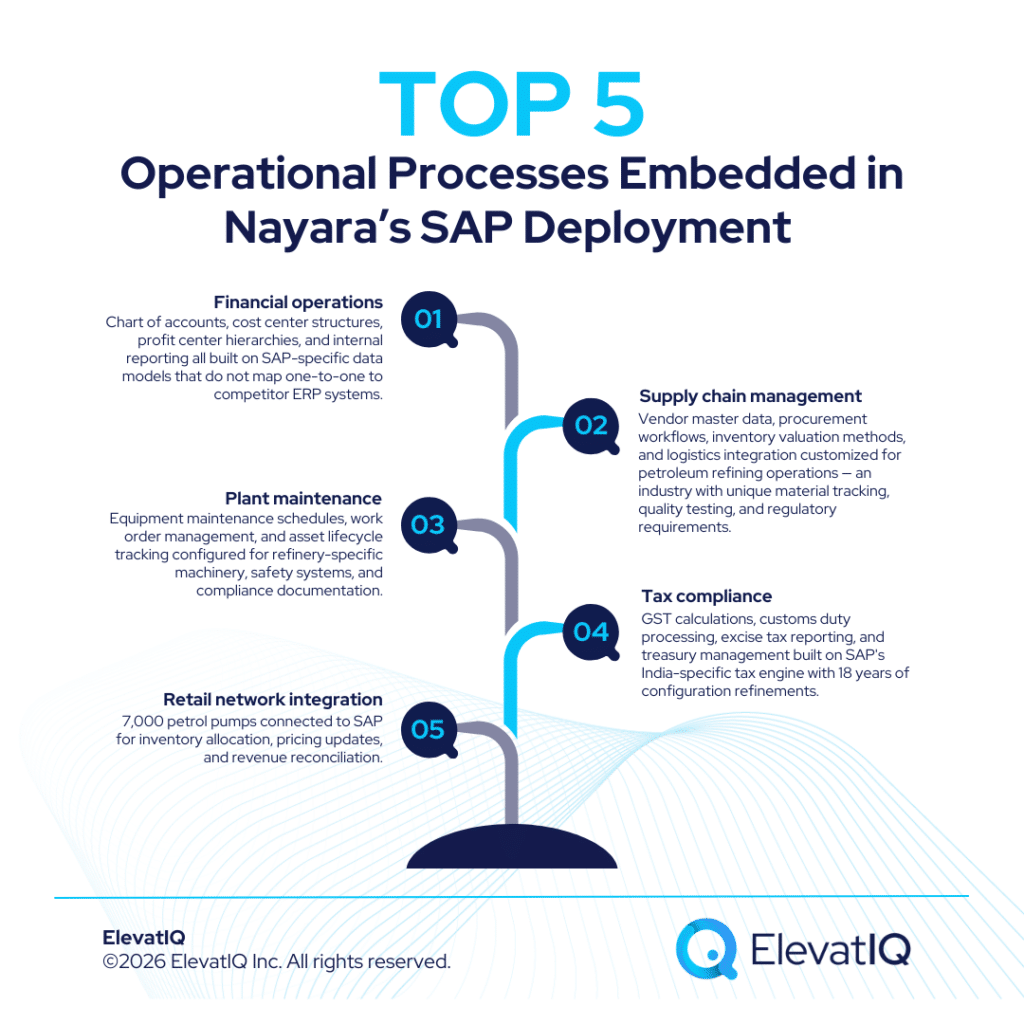
Nayara’s court petition explicitly states that SAP software “is fully integrated and customized to every operation of (Nayara) over a period of 18 years and (Nayara) cannot change to any alternative.” This is ERP vendor lock-in at its most severe. Unlike commercial software where switching vendors involves data export, ERP system selection, and re-implementation, Nayara’s SAP deployment is embedded in every operational process:
- Financial operations: Chart of accounts, cost center structures, profit center hierarchies, and internal reporting all built on SAP-specific data models that do not map one-to-one to competitor ERP systems.
- Supply chain management: Vendor master data, procurement workflows, inventory valuation methods, and logistics integration customized for petroleum refining operations — an industry with unique material tracking, quality testing, and regulatory requirements.
- Plant maintenance: Equipment maintenance schedules, work order management, and asset lifecycle tracking configured for refinery-specific machinery, safety systems, and compliance documentation.
- Tax compliance: GST calculations, customs duty processing, excise tax reporting, and treasury management built on SAP’s India-specific tax engine with 18 years of configuration refinements.
- Retail network integration: 7,000 petrol pumps connected to SAP for inventory allocation, pricing updates, and revenue reconciliation.
The software license fees usually do not measure the cost to migrate this level of integration. It is measured in:
- Implementation timeline: 3–5 years for full migration of operations this complex
- Business disruption: Running parallel systems during transition, with high error risk during cutover
- Re-customization costs: potentially tens of millions of dollars to rebuild years of SAP-specific business process automation in an alternative platform
- Operational risk: Refinery operations cannot be interrupted. Migration failures could halt production
For context, Nayara’s refinery processes 400,000 barrels per day. A single day of refinery disruption could represent tens of millions of dollars in lost revenue. Migration risks that could cause even temporary operational failures make switching commercially prohibitive.

ERP System Scorecard Matrix
This resource provides a framework for quantifying the ERP selection process and how to make heterogeneous solutions comparable.
The Geopolitical Dimension: ERP as National Infrastructure Vulnerability
Nayara’s case exposes a vulnerability that extends beyond one company: when critical national infrastructure depends on foreign-owned ERP systems, geopolitical conflicts can create operational leverage points.
India’s petroleum supply chain exposure:
Nayara produces approximately 8% of India’s petroleum products and operates 7% of the country’s retail fuel network. The company’s operations directly affect:
- Fuel availability for transportation, agriculture, and industrial operations
- Government petroleum revenue (Nayara’s tax contributions are substantial)
- Energy security in a nation of 1.4 billion people dependent on petroleum imports
When a foreign software vendor suspends services due to sanctions compliance, it highlights how geopolitical decisions outside India can affect domestic energy operations.
The precedent risk:
If Delhi High Court rules in favor of SAP, allowing foreign parent company compliance with EU sanctions to override Indian contractual obligations. It establishes precedent that any Indian company using foreign-headquartered ERP could face service suspension if the parent company’s home jurisdiction imposes sanctions.
This creates incentive for Indian companies in strategic sectors (defense, energy, telecommunications, financial services) to either:
- Accept ongoing exposure to foreign policy weaponization of enterprise software dependencies
- Migrate to Indian-developed ERP systems (expensive, technically risky, limited vendor options currently)
- Demand contractual protections against geopolitical service suspension (vendors unlikely to accept)
The Microsoft Precedent: Why Nayara Thought It Had Leverage
Nayara’s legal strategy was informed by a July 2025 incident where Microsoft suspended services (Outlook, Teams, data access) after EU sanctions, then reversed the suspension after Nayara filed suit in Delhi High Court. Microsoft restored access before the case proceeded to judgment. The Microsoft reversal likely created expectations that SAP would follow the same pattern: suspend services for compliance show, face legal pressure, restore services quietly. SAP has not followed that script.
The difference appears to be the depth of ERP integration versus productivity software. Microsoft email and collaboration tools are operationally important but not structurally embedded in every business transaction. Nayara could theoretically switch to Google Workspace, Zoho, or other collaboration platforms with moderate disruption.
SAP ERP is the transaction engine for the entire business. There is no quick alternative. This gives SAP less commercial incentive to restore services – the lock-in is so complete that Nayara cannot credibly threaten vendor switch, even in litigation.
What the Delhi High Court Decision Means for Global ERP
The March 16, 2026 hearing will address questions that affect every multinational ERP deployment:
Question 1: Can foreign parent company legal obligations override Indian subsidiary contractual commitments?
Yes: Indian companies using SAP, Oracle, Microsoft, Workday, or any foreign-headquartered ERP face potential service suspension based on home country foreign policy. This affects sovereignty and infrastructure resilience.
No: Global ERP vendors operating in India face legal exposure when home country compliance requirements conflict with Indian contractual obligations. This could push vendors to restructure corporate entities or limit India operations.
Question 2: Can software vendors unilaterally suspend services based on sanctions against customers rather than against the vendor?
Yes: Vendors gain extraordinary power to terminate relationships without contractual breach by customer, based solely on third-party political decisions.
No: Vendors must maintain services even when doing so creates legal risk in home jurisdictions, potentially requiring vendors to choose between markets (serve India or comply with EU, not both).
Question 3: Does critical infrastructure status create heightened contractual obligations for ERP vendors?
Yes: Vendors serving energy, defense, finance, or telecommunications sectors may face legal requirements to ensure service continuity regardless of geopolitical disruptions.
No: National infrastructure can be held hostage to foreign vendor decisions with no Indian legal remedy.
The Conclusion
For decades, ERP vendor lock-in has been framed as a commercial problem: organizations pay premium prices for upgrades, accept unfavorable ERP contract terms, and struggle with expensive migrations because switching costs are prohibitive. Nayara’s case suggests that ERP vendor lock-in can create geopolitical vulnerabilities where foreign sanctions or regulatory actions indirectly disrupt domestic operations.
The lesson for organizations in strategic sectors is unambiguous: ERP vendor selection is no longer just a technology decision or financial decision, it is a sovereignty and risk management decision. Dependence on foreign-headquartered ERP vendors creates exposure to sanctions, policy changes, and geopolitical conflicts that can suspend critical business operations without warning and without contractual remedies.
For organizations currently evaluating ERP vendors, negotiating contracts, or managing long-term ERP dependencies, the questions Nayara faces should inform planning:
- What happens if our ERP vendor faces legal prohibition on supporting our operations due to foreign sanctions or policy changes?
- Can our contract include service continuation guarantees that override vendor home-country legal obligations?
- What is our realistic migration timeline and cost if we must switch vendors under crisis conditions?
- Do we have fallback capabilities (manual processes, alternative systems) if ERP services are suspended?
For organizations seeking independent ERP advisory support for ERP vendor evaluation, contract negotiation, or geopolitical risk assessment in enterprise technology dependencies, the team at ElevatIQ provides consulting services across vendor strategy, contract risk mitigation, and operational resilience planning.
All commentary represents an independent editorial perspective based on publicly reported court filings, legal analysis, and ERP vendor dependency standards.

ERP Selection: The Ultimate Guide
This is an in-depth guide with over 80 pages and covers every topic as it pertains to ERP selection in sufficient detail to help you make an informed decision.
FAQs
Related Posts: