
Last Updated on April 20, 2026 by Shrestha Dash
When ERP systems go down, the financial consequences accumulate fast. Order processing halts. Financial close cycles stall. Production schedules break. Customer commitments are missed. For organizations running mission-critical operations on a single ERP platform, unplanned downtime is not an inconvenience. It is a direct operational and financial crisis.
Yet when most buyers negotiate ERP contracts, disaster recovery provisions receive far less scrutiny than pricing, licensing terms, or implementation scope. The result is that disaster recovery in ERP contracts is silent or vague. Especially, on exactly the commitments that matter most when something goes wrong.
Disaster recovery in ERP contracts deserves dedicated negotiation effort. This blog covers what buyers need to address – RTO and RPO commitments, backup requirements, cloud provider responsibilities, and the testing rights that determine whether any of it actually works in practice.
Why Disaster Recovery in ERP Contracts Gets Overlooked
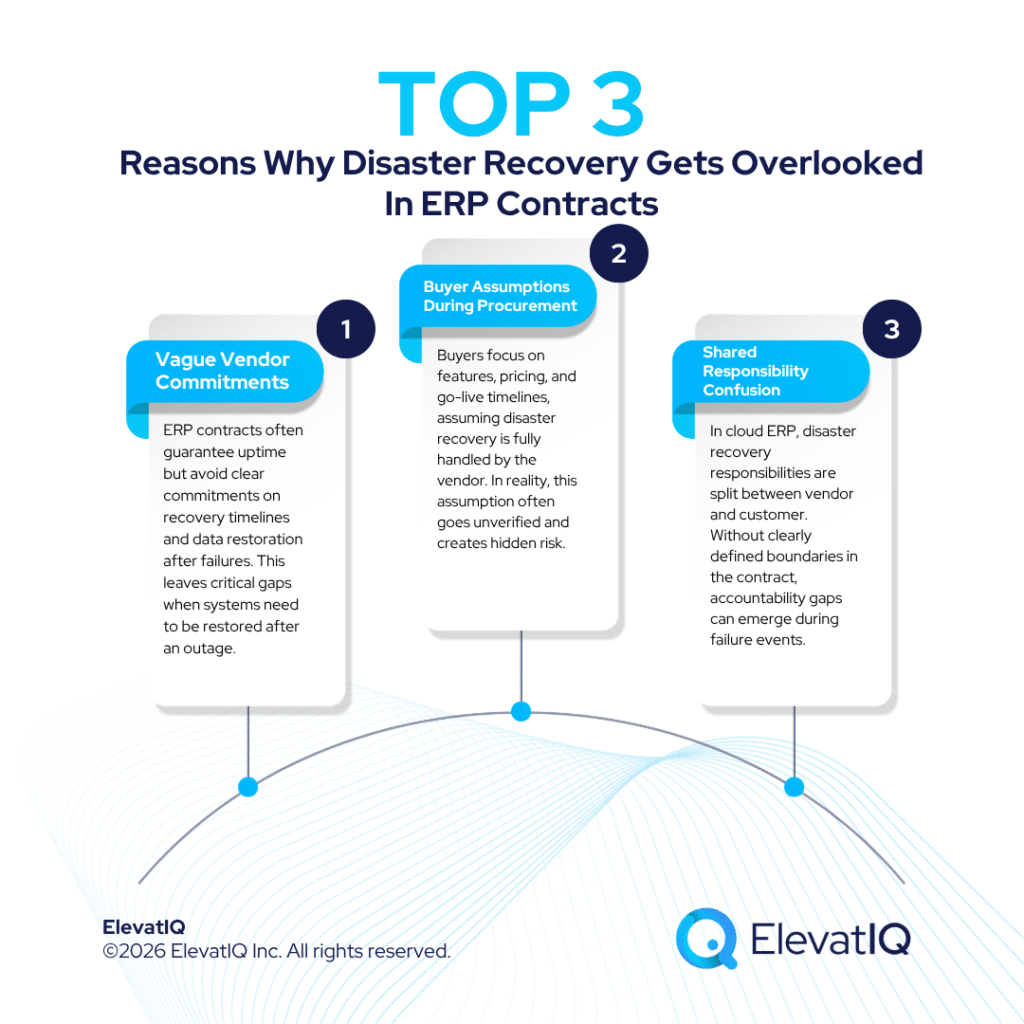
The gap in many ERP contracts is not always accidental. Vendors may benefit from vague language. Standard SaaS agreements typically guarantee infrastructure uptime, the availability of the platform but stop well short of committing to specific data recovery timelines or functional restoration standards after a failure event.
Buyers, focused on features, price, and go-live timelines during contract negotiations, often accept this framing. The assumption, especially for cloud ERP deployments, is that the vendor is handling disaster recovery as part of the service. That assumption is often incorrect, and addressing disaster recovery in ERP contracts before signing is far less costly than discovering the gap after an outage.
The distinction matters most in the cloud context, where the shared responsibility model explicitly divides accountability between vendor and customer. Understanding exactly where that line falls and negotiating contract language that locks it down is a foundational step in any ERP procurement.
RTO and RPO: The Two Numbers That Define Your Risk Exposure
Recovery Time Objective (RTO) and Recovery Point Objective (RPO) are the two core metrics that any discussion of disaster recovery in ERP contracts must address. They are not technical details for the IT team to handle separately, they are business risk decisions that belong in the contract itself.
- Recovery Time Objective (RTO) defines the maximum amount of time the ERP system can be offline before the outage becomes operationally unacceptable. It answers the question: how quickly must the system be restored? An RTO of four hours means the vendor is committing to have the system operational within four hours of a declared disaster event.
- Recovery Point Objective (RPO) defines the maximum amount of data loss, measured in time, that the organization can tolerate. It answers the question: how current must the data be when we recover? An RPO of one hour means the system will be restored with no more than one hour of transactional data lost.
Both metrics look in different directions from the point of failure. RPO looks backward – how recent was the last recoverable backup? RTO looks forward – how long until systems are back online?
Setting Appropriate Targets for Mission-Critical ERP
Not all ERP modules carry the same criticality, and RTO/RPO targets should reflect that. A financial close system processing period-end entries carries different risk than a secondary reporting module. Buyers should conduct a Business Impact Analysis (BIA) before contract negotiations to understand the operational and financial cost of downtime per hour across core ERP functions. This analysis anchors RTO/RPO discussions in business reality rather than arbitrary benchmarks.
As a general orientation, enterprise-class ERP providers running managed hosting environments may support RPO targets as tight as 30 minutes and RTO windows in the two- to four-hour range for high-priority workloads. However, achieving tighter targets requires both the right infrastructure architecture and explicit contractual commitments, not assumptions. Buyers should press vendors on what specific RTO and RPO figures they can commit to contractually, not just what they claim is technically possible.
What Contract Language Should Capture
Vague language like “best efforts to restore within a reasonable timeframe” is not enforceable and provides no recourse. Disaster recovery in ERP contracts must specify:
- Named RTO and RPO figures, expressed in hours or minutes, not qualitative terms
- The definition of a “disaster event” that triggers these commitments including whether ransomware, accidental deletion, and partial system failures are covered alongside infrastructure outages
- Whether the committed RTO and RPO apply to the full ERP system or only to specific components
- Financial remedies – service credits or penalties, that apply if the vendor misses committed recovery targets
- Escalation procedures and communication timelines during a declared disaster event


ERP Selection Requirements Template
This resource provides the template that you need to capture the requirements of different functional areas, processes, and teams.
Understanding Cloud Provider Responsibilities: The Shared Responsibility Gap
One of the most consequential misunderstandings in disaster recovery in ERP contracts is the assumption that moving to cloud ERP transfers disaster recovery responsibility to the vendor. It does not, at least not entirely.
Every major cloud provider including those underpinning ERP platforms like SAP S/4HANA Cloud, Oracle Fusion ERP, and Microsoft Dynamics 365 operates under a shared responsibility model. The specifics vary by deployment type, but the general principle is consistent:
- The cloud provider is responsible for the availability and resilience of the infrastructure – the physical data centers, the network, the compute and storage layers, and the platform uptime.
- The customer retains responsibility for how data is configured, replicated, governed, and recovered at the application and data level.
Oracle has stated this plainly in its cloud documentation: while OCI is responsible for resilience of the cloud, the customer is responsible for resilience in the cloud. Microsoft’s Azure shared responsibility documentation makes the same distinction. Customers who design and implement DR strategies including cross-region replication, failover configurations, and recovery runbooks – are better protected than those who rely on platform-level availability SLAs alone.
For buyers, this means disaster recovery in ERP contracts must address two distinct layers:
Infrastructure-level commitments (vendor responsibility)
- Data center redundancy and geographic failover capability
- Platform uptime SLA (typically 99.9% or higher, but note this governs availability, not recovery from failure)
- Incident notification timelines and communication protocols during outages
Application and data-level commitments (negotiated boundary)
- Backup frequency and retention period for the customer’s ERP data
- Geographic location of backup copies (same-region vs. geo-redundant)
- Who is responsible for executing recovery steps – the vendor’s managed services team, or the customer’s IT organization
- Whether the vendor provides a managed DR service as part of the standard subscription or as a separately priced add-on
Many SaaS ERP contracts may not explicitly address the second set of items, leaving buyers to assume coverage they do not have. Explicit contract language assigning responsibility for each layer is essential.
Backup Requirements: Frequency, Retention, and Access
Backup provisions are the operational foundation of any DR commitment. Disaster recovery in ERP contracts should define:
- Backup frequency: How often is a full backup of the ERP environment taken? For most enterprise ERP deployments, daily full backups with continuous log archiving between snapshots is commonly considered a baseline approach. Buyers with tighter RPO requirements should ask whether intraday or near-continuous replication is available and contractually committed.
- Retention period: How long are backup copies retained? Standard commercial terms often default to 30 days. Organizations with compliance, audit, or regulatory obligations – financial services, healthcare, government contractors, frequently need longer retention periods, sometimes 90 days or more. This needs to be in the contract, not handled as a configuration default that can change.
- Geographic redundancy: Are backup copies stored in a separate geographic region from the primary system? Single-region backups are vulnerable to the same regional event that caused the primary outage. Geo-redundant storage ensures that a natural disaster, data center failure, or regional infrastructure incident does not take out both the primary system and its backups simultaneously.
- Buyer access to backups: Can the buyer independently access backup data, or must all recovery operations go through the vendor? This matters both for operational control and for scenarios where the vendor relationship has terminated or the vendor has gone out of business. Contracts should guarantee buyer access to backup data regardless of contract status.

ERP System Scorecard Matrix
This resource provides a framework for quantifying the ERP selection process and how to make heterogeneous solutions comparable.
DR Testing Rights: The Provision Most Contracts Omit
Of all the elements of disaster recovery in ERP contracts, DR testing rights are the most commonly absent and their absence can turn a written commitment into an unverified assumption.
A vendor can document robust RTO and RPO targets in a contract. Without regular, verified testing, neither the buyer nor the vendor actually knows whether those targets are achievable. Hardware configurations change. Data volumes grow. Integration dependencies evolve. A DR plan that worked eighteen months ago may not perform the same way today.
DR testing rights that buyers should negotiate into any ERP contract
- Annual failover testing: The right to require the vendor to execute a full DR failover test at least once per year, demonstrating that systems can be restored to the contracted RTO and RPO targets under realistic conditions.
- Tabletop exercise participation: The right to participate in or independently conduct tabletop exercises that walk through disaster scenarios, validate escalation procedures, and confirm that both vendor and customer teams understand their respective roles.
- Access to test results: The right to receive written documentation of DR test outcomes, including whether RTO and RPO targets were met, what issues were identified, and what remediation steps were taken.
- Unannounced testing rights: For the most risk-sensitive organizations, the right to request a DR test on reasonable notice – say, 30 days, without having to wait for an annually scheduled exercise.
- Remediation obligations: If a DR test reveals that the vendor cannot meet committed RTO or RPO targets, the contract should specify a remediation timeline and an escalation path if issues are not resolved.
The absence of testing rights means the buyer has a paper commitment that has never been verified. For mission-critical ERP systems where downtime costs thousands of dollars per hour, that may not be an acceptable position for many organizations.
On-Premises vs. Cloud ERP: How DR Responsibilities Differ
Disaster recovery in ERP contracts looks different depending on the deployment model, and buyers should approach negotiation accordingly.
- Cloud SaaS ERP: The vendor manages infrastructure, platform, and often application-layer backups as part of the service. The risk for buyers is assuming that this coverage is complete without verifying what is and is not included. The shared responsibility gap described above is most pronounced here. Key negotiation focus: defining the exact scope of vendor-managed DR, locked-down RTO/RPO commitments, and testing rights.
- Cloud IaaS/PaaS (customer-managed ERP on cloud infrastructure): The buyer is responsible for a broader range of DR decisions such as replication configuration, failover architecture, and recovery runbook design, while the cloud provider manages the underlying infrastructure. Key negotiation focus: infrastructure availability SLAs, support for DR architecture implementation, and contractual clarity on where provider responsibility ends.
- On-premises ERP: The buyer owns the full DR stack, but the ERP vendor’s contract still plays a role, specifically around support during recovery events, access to disaster recovery licenses for standby systems, and the vendor’s own obligations if software bugs contributed to a data loss event. Key negotiation focus: DR-specific license terms, support response commitments during outages, and vendor liability for data loss attributable to defective software.
Connecting DR Commitments to Broader Business Continuity Planning
Disaster recovery in ERP contracts does not exist in isolation. ERP is typically one of several interconnected systems such as EDI integrations, financial reporting tools, third-party logistics platforms, CRM, that together enable business operations. A contractual DR commitment that covers the ERP platform but not its integration dependencies leaves the organization partially protected at best.
Buyers should ensure that DR contract provisions account for:
- Integration recovery sequencing: In what order must interconnected systems be restored for the ERP to function usefully after a failover?
- Dependency mapping: Which third-party systems or APIs does the ERP rely on, and what are those providers’ DR commitments?
- Data reconciliation procedures: After recovery, how are data discrepancies between the ERP and connected systems identified and resolved?
These cross-system considerations are frequently outside the scope of standard vendor contract templates, which is exactly why they need to be raised explicitly during negotiation.
Conclusion
Disaster recovery in ERP contracts is not a technical afterthought – it is a direct expression of how much operational risk an organization is willing to accept without contractual protection. ERP systems are among the most mission-critical platforms in any enterprise. The cost of unplanned downtime measured in lost transactions, missed reporting deadlines, and broken customer commitments, is too high to leave DR provisions to standard vendor language.
Buyers who invest the effort to negotiate specific RTO and RPO targets, clear backup requirements, defined cloud provider responsibilities, and enforceable testing rights are far better positioned than those who accept default contract terms and discover the gaps only when something goes wrong. Getting disaster recovery in ERP contracts right is not inherently complex but it does require knowing what to ask for.
Working with independent ERP advisors who have evaluated DR provisions across dozens of vendor agreements gives organizations the benchmarking intelligence to know what is achievable, what is negotiable, and what red flags to watch for in standard vendor templates. ElevatIQ’s enterprise technology selection and IT procurement advisory services include contract review support specifically designed to surface gaps in disaster recovery, SLA, and business continuity provisions helping organizations secure the protections they need from independent ERP advisors who negotiate vendor agreements every day.

ERP Selection: The Ultimate Guide
This is an in-depth guide with over 80 pages and covers every topic as it pertains to ERP selection in sufficient detail to help you make an informed decision.
FAQs
Related Posts: