
Last Updated on August 18, 2026 by Shrestha Dash
Key Highlights
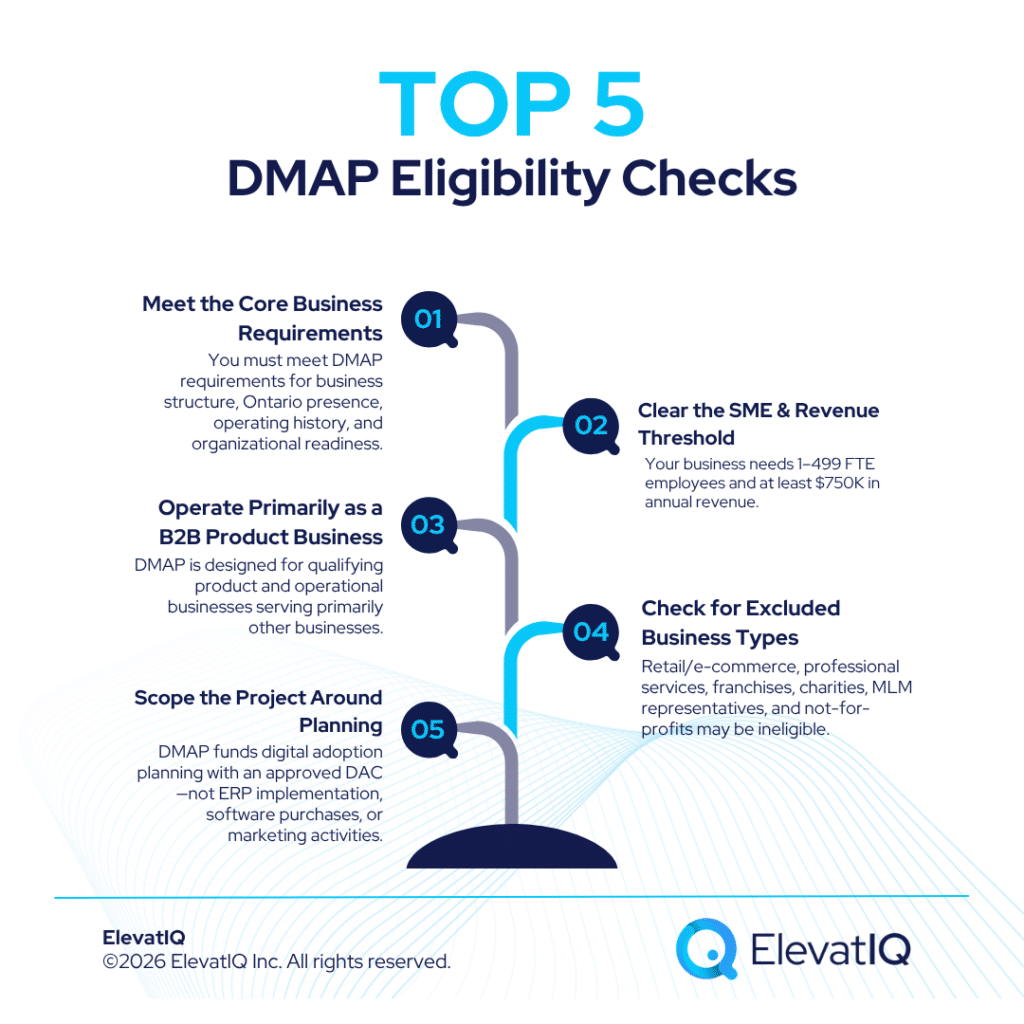
- DMAP eligibility Ontario 2026 rules are more specific than most SMEs assume. A minimum $750,000 in annual revenue, a B2B sales model, and “in operation for multi years” are baseline requirements, not just the well-known 1–499 employee range.
- Several categories of business are explicitly excluded, including consumer-facing retail and e-commerce operations, professional business services (legal, accounting, consulting, marketing, real estate, and similar), corporate chains and franchises, registered charities, MLM representatives, and not-for-profits.
- DMAP funds the planning phase, engaging an approved Digital Adoption Consultant (DAC) to build a Digital Modernization and Adoption Plan. Not the purchase or implementation of ERP software itself, which is a distinction many ERP buyers miss when they first look into the program.
- The program also excludes marketing- and promotion-related activities entirely, including website development, SEO, advertising campaigns, and market research, so an ERP-focused digital adoption plan needs to be framed and scoped correctly from the outset.

Introduction
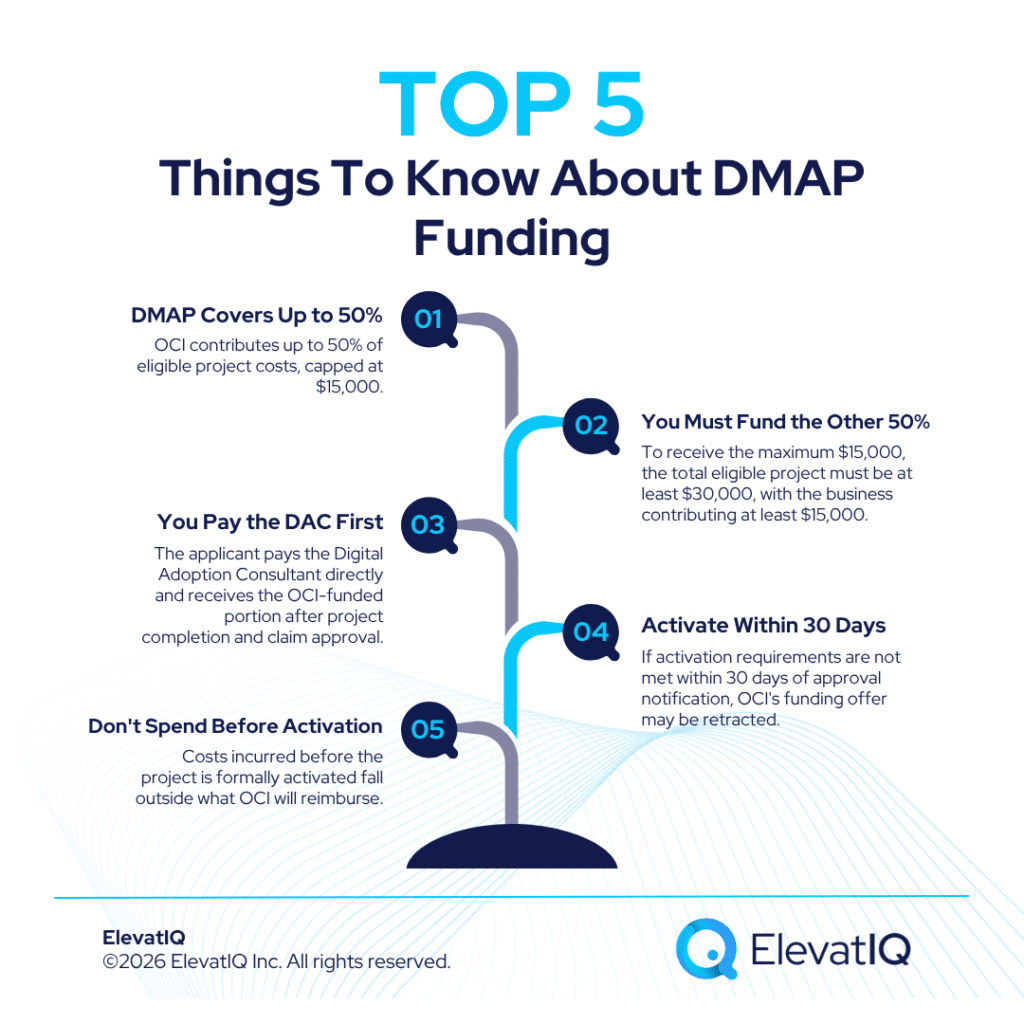
For an Ontario SME evaluating an ERP project, the Digital Modernization and Adoption Plan (DMAP) grant for 2026 looks like an obvious way to offset the cost of getting the planning right before committing to a system. Up to $15,000 in reimbursement, delivered through a 50% cost-share, to work with a qualified consultant on a digital strategy. On paper, it’s a straightforward fit for exactly the kind of upfront requirements and readiness work that ERP buyers are often told to do and often skip.
In practice, DMAP eligibility Ontario rules are narrower and more specific than most first-time applicants expect. The program has clear revenue thresholds, a defined business model requirement, and a list of excluded industries that catches more companies than the widely known “no retail” rule. It also funds a specific kind of work, plan development through an approved consultant rather than technology purchases directly, which matters a great deal if an ERP buyer is expecting the grant to offset software or implementation costs.
This blog walks through DMAP’s actual eligibility criteria in detail, the exclusions that most often surprise applicants, and a self-assessment checklist to help determine fit before starting the application process.
What DMAP Actually Funds (And What It Doesn’t)
Before assessing DMAP eligibility Ontario criteria in detail, it’s worth being precise about what DMAP pays for, since this is where many ERP buyers form the wrong expectations.
DMAP Funding Scope
| Funded Under DMAP | Not Funded Under DMAP |
| Fees paid to an approved Digital Adoption Consultant (DAC) to develop a Digital Modernization and Adoption Plan | Purchase of ERP software, licenses, or hardware |
| Assessment of current digital maturity and technology gaps | Implementation, configuration, or deployment of the chosen system |
| Development of a strategy and roadmap for technology adoption | Website development, SEO, advertising, or market research |
DMAP is a planning grant, not an implementation grant. The output is a documented Digital Modernization and Adoption Plan, developed with a DAC, that can include an ERP-focused readiness assessment and selection roadmap. Businesses that complete a DMAP project may be eligible to explore other funding opportunities that support implementation of digital technology initiatives. Applicants should review current OCI and DCC programs separately, as implementation funding is not provided through DMAP itself.


ERP Selection Requirements Template
This resource provides the template that you need to capture the requirements of different functional areas, processes, and teams.
Core Applicant Eligibility Requirements
Beyond the widely cited 1–499 employee range, DMAP eligibility Ontario requirements include several conditions that are easy to overlook.
Applicant-Level Eligibility Criteria
| Requirement | Detail |
| Legal structure | Incorporated federally or provincially, with a valid Business Number |
| Operating history | In operation for multiple years |
| Ownership | For-profit, privately owned business |
| Employee count | Between 1 and 499 full-time equivalent employees, and revenue-generating |
| Minimum revenue | At least $750,000 in annual revenue |
| Business model | A product company: an item designed, manufactured, or manufactured for, including software product development, operating primarily under a B2B model |
| Location | Permanent establishment in Ontario |
| Organizational readiness | A demonstrated change management culture, willingness to invest resources, and the capability to implement and sustain new technologies |
The B2B and product-company requirement is worth pausing on: the program defines this as a business model where the company sells products or services directly or indirectly primarily to other businesses, or sells products, goods, or services that assist other businesses in their operations. A company that sells primarily to individual consumers, even if it also serves some business clients, does not clearly fit this definition, which is a separate consideration from the consumer-facing retail exclusion covered next.

ERP System Scorecard Matrix
This resource provides a framework for quantifying the ERP selection process and how to make heterogeneous solutions comparable.
The Exclusions That Trip Up ERP Buyers
This is where DMAP eligibility Ontario rules narrow considerably, and where several categories of otherwise qualified-looking businesses get ruled out.
Business Types Ineligible for DMAP
| Excluded Category | What It Covers |
| Consumer-facing retail or e-commerce | Businesses whose primary operations involve direct-to-consumer retail or online sales |
| Professional business services | Businesses whose primary activity is advisory, consulting, or knowledge-based services delivered directly by individuals or firms, explicitly including legal, accounting, management and business advisory, marketing, public relations, financial or insurance advisory, recruitment, real estate, and brokerage firms |
| Corporate chains, franchises, or registered charities | Regardless of size or revenue |
| Multi-level marketing representatives | Any business operating as an MLM representative |
| Not-for-profits | Any not-for-profit organization structure |
The professional business services exclusion is the one most likely to catch an ERP buyer off guard when researching DMAP eligibility Ontario rules. The eligibility criteria are explicit that value derived primarily from professional expertise, rather than from scalable products, operational processes, or technology-enabled production, places a business in this excluded category, meaning an accounting firm, a marketing agency, a management consultancy, or a similar knowledge-services business is not eligible for DMAP funding, even if it otherwise meets the revenue and employee thresholds and is actively evaluating an ERP system.
What DMAP Won’t Pay For, Even If Your Business Qualifies
Separate from who can apply, DMAP eligibility Ontario rules also restrict what kind of project work is eligible and this list matters for how an ERP-focused digital adoption plan should be scoped.
Activities Excluded From DMAP Funding
- Advertising and promotional campaigns
- Search Engine Optimization
- Website development
- Market research
- Product development (for software companies)
- Development of marketing materials, including digital advertisements, landing pages, and content creation
The program is explicit that it does not support activities primarily related to marketing or promotional efforts. For an ERP buyer, this means the DMAP-funded plan needs to be framed around operational technology adoption. Thus, assessing systems, processes, and data architecture, rather than any marketing- or web-adjacent deliverables that might otherwise seem to fall under “digital transformation.”
Self-Assessment Checklist: Is Your Business a DMAP Fit?
Before starting a DMAP application, it’s worth working through the DMAP eligibility Ontario criteria that most commonly determine fit for ERP-focused applicants.
Quick Eligibility Self-Check
| Question | If “No,” DMAP Eligibility Is at Risk |
| Is your business incorporated (federally or provincially) with a valid Business Number and a permanent Ontario establishment? | Required baseline criteria |
| Have you been in operation for multiple years, with at least $750,000 in annual revenue? | Common disqualifier for newer or smaller businesses |
| Do you have between 1 and 499 full-time equivalent employees? | Outside the defined SME range |
| Do you sell products or services primarily to other businesses (B2B), rather than primarily to consumers? | Consumer-facing model conflicts with program intent |
| Is your core business a product, manufacturing, or operationally-driven company, not professional advisory, consulting, marketing, legal, accounting, real estate, or similar services? | Professional business services are explicitly excluded |
| Are you structured as a for-profit, privately owned business, not a franchise, corporate chain, charity, MLM, or not-for-profit? | Each of these structures is explicitly excluded |
| Is your planned project focused on technology adoption planning, not website development, SEO, advertising, or marketing materials? | These activities fall outside DMAP’s funded scope |
A “no” on one or more items may indicate that the business does not meet DMAP eligibility requirements. Applicants should review the program guidelines carefully and discuss any eligibility questions with OCI or an approved DAC before applying.
How ElevatIQ Can Help
Working through DMAP eligibility Ontario requirements is often the easy part. The harder question for ERP buyers specifically, is how to structure the digital adoption plan itself so it produces something genuinely useful for an ERP selection decision, rather than a generic strategy document built to satisfy a grant application.
ElevatIQ serves as an approved Digital Adoption Consultant, and we work with Ontario SMEs specifically on ERP-focused digital modernization plans. As an independent ERP consulting firm, our role in a DMAP engagement is the same as in any other engagement: we assess current systems and operational gaps, build a technology roadmap grounded in the business’s actual requirements, and help executive teams build the case for what comes next, without a vendor relationship shaping the recommendation. For a business that’s eligible and ready to apply, that combination of DAC-approved status and vendor-neutral ERP expertise means the DMAP plan can double as the first real step of an ERP selection process, not just a compliance exercise to unlock the grant.
Conclusion
DMAP eligibility Ontario requirements go well beyond the commonly cited employee range, and for ERP buyers specifically, understanding both who qualifies and what the grant actually funds is the difference between a productive application and a wasted one.
A few signals are worth checking before applying to confirm DMAP eligibility Ontario status:
- Your business meets the revenue, employee count, and B2B/product-company criteria, not just the general “SME” description
- Your business isn’t classified as a professional business service, even if it uses “consulting” or “advisory” language internally
- Your planned project is scoped as technology adoption planning, not implementation, marketing, or website work
- You’re prepared to work with a DAC, since this is a non-negotiable program requirement
Getting these right before submitting an application saves time on both sides, yours and OCI’s and positions the resulting plan to actually inform a real ERP decision, rather than sitting unused once the grant is reimbursed.
Note: Meeting the eligibility requirements does not guarantee approval, as all applications undergo review and funding decisions remain discretionary.

ERP Selection: The Ultimate Guide
This is an in-depth guide with over 80 pages and covers every topic as it pertains to ERP selection in sufficient detail to help you make an informed decision.
Related Posts: