
Last Updated on January 21, 2026 by Shrestha Dash
Epicor recently announced a significant shift in its product strategy that affects thousands of manufacturing, distribution, and building supply organizations worldwide. The company has scheduled final on-premise feature releases for Epicor Kinetic, Prophet 21, and BisTrack, with development resources transitioning exclusively to cloud-based platforms. This Epicor on-premise sunset represents more than a simple product update, it is a strategic inflection point that requires careful evaluation and planning.
For tens of thousands of organizations globally currently running Epicor solutions in on-premise environments, this announcement triggers important questions: What does the timeline actually mean for my business? What are the real cost implications of cloud migration? Should I stay with Epicor Cloud or explore alternatives? How much time do I actually have to make these decisions?
Understanding the Epicor on-premise sunset timeline, evaluating your options objectively, and also developing a migration strategy aligned with your business requirements is essential. This is not an overnight transition; Epicor is providing extended timelines through 2029 and beyond. However, proactive planning now will position your organization to make informed decisions rather than reactive choices driven by deadline pressure.

What the Epicor On-Premise Sunset Actually Means
The Epicor on-premise sunset announcement includes specific timelines that vary by product. Therefore, understanding what “sunset” means in practical terms helps organizations plan appropriately without unnecessary alarm.
Defining “Sunset” in ERP Context
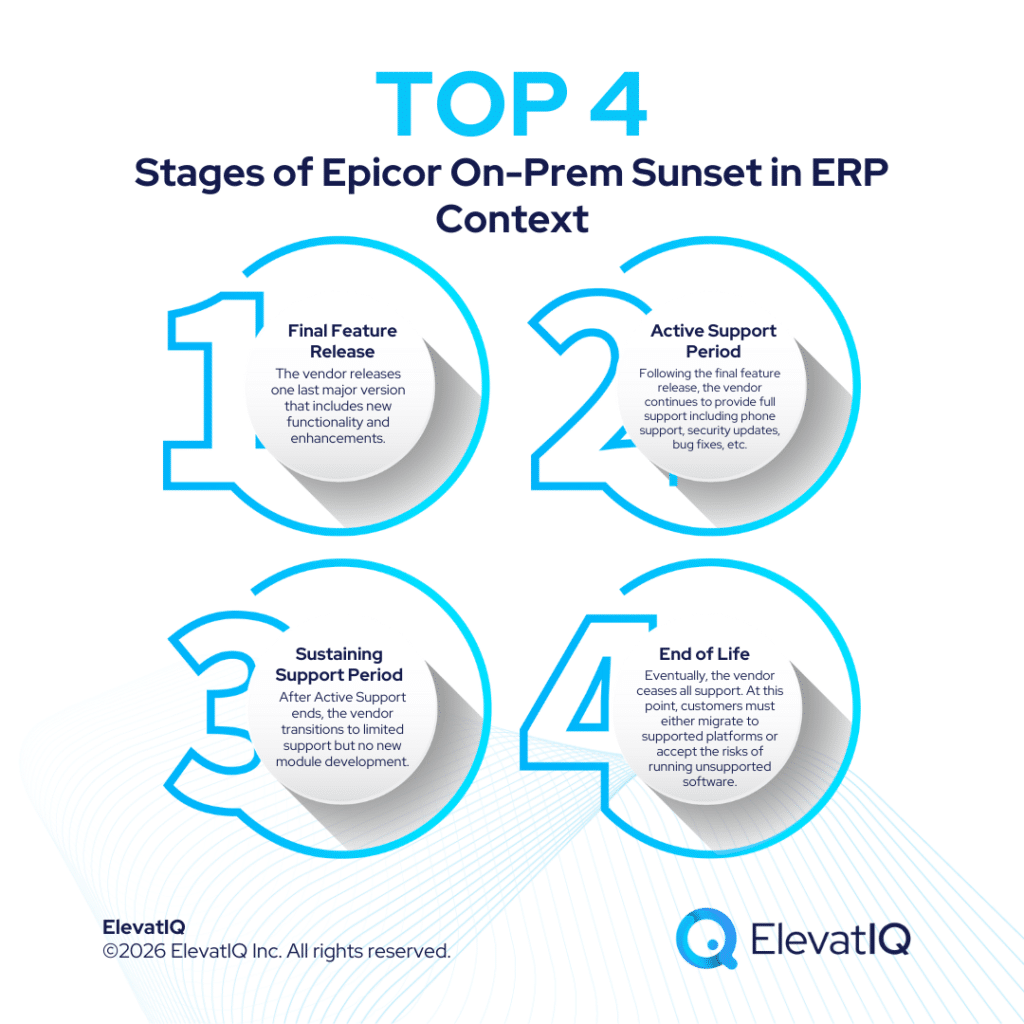
When ERP vendors announce product sunsets, they typically follow a phased approach that includes several distinct stages:
- Final Feature Release: The vendor releases one last major version that includes new functionality and enhancements. Also, after this release, no additional features will be developed for on-premise versions.
- Active Support Period: Following the final feature release, the vendor continues to provide full support including phone support, security updates, bug fixes, and investigation of new issues. This period typically extends several years.
- Sustaining Support Period: After Active Support ends, the vendor transitions to limited support that includes security patches, access to existing knowledge bases, and online resources, but no new module development or major bug fixes.
- End of Life: Eventually, the vendor ceases all support. At this point, customers must either migrate to supported platforms or accept the risks of running unsupported software.
The Epicor on-premise sunset follows this standard pattern, thus providing organizations with extended timeframes for planning and execution.
Epicor-Specific Timelines by Product
Epicor has also announced different timelines for each of its major on-premise products:
| Product | Final Feature Release | Active Support Through | Sustaining Support Begins |
| Epicor Kinetic | 2028 | December 31, 2029 | January 1, 2030 |
| Prophet 21 | To be announced | December 31, 2029 | January 1, 2030 |
| BisTrack | To be announced | December 31, 2029 | January 1, 2030 |
| BisTrack UK 3.9 | 2017 (already released) | December 31, 2026 | January 1, 2027 |
What Active Support Includes
During the Active Support period through December 31, 2029, Epicor on-premise customers will continue to receive:
- Full access to Epicor phone support for technical issues
- Security updates and patches addressing vulnerabilities
- Investigation of newly discovered issues and bugs
- Access to the Epicor online knowledge base and resources
- Support for existing modules and functionality
This means organizations running Epicor Kinetic, Prophet 21, or BisTrack have until the end of 2029 before entering the limited Sustaining Support phase—approximately five years from the announcement.
What Sustaining Support Means
Beginning January 1, 2030, on-premise customers enter Sustaining Support, which also provides:
- Limited phone support for critical issues
- Access to the latest release that was available (but not new modules)
- Online knowledge base and self-service resources
- Security patches for critical vulnerabilities
Sustaining Support represents a significant reduction in support scope, but it does not mean systems become inoperable. Many organizations successfully run ERP systems in Sustaining Support for years when the business case for migration does not justify the investment.
Why Epicor Is Transitioning to Cloud-Only Development
Understanding the vendor’s strategic rationale helps contextualize the Epicor on-premise sunset announcement and evaluate whether the cloud platform aligns with your organization’s needs.
The Vendor Economics of Cloud Platforms
Vaibhav Vohra, President and Chief Product & Technology Officer at Epicor, explained the company’s position: “Our cloud investments enable us to deliver secure, scalable, and current Cognitive ERP capabilities that help businesses make better supply chain decisions in an increasingly complex world.”
From the vendor perspective, cloud-first strategies provide several advantages:
- Unified Development Focus: Maintaining parallel on-premise and cloud platforms also requires development resources to support both architectures. Concentrating engineering effort on a single deployment model accelerates innovation and reduces costs.
- Continuous Update Delivery: Cloud platforms enable vendors to push updates frequently without requiring customers to manage disruptive upgrade projects. Organizations receive new features, security enhancements, and also AI capabilities automatically.
- Recurring Revenue Model: Subscription-based cloud licenses provide predictable recurring revenue that improves vendor financial stability and company valuation. This model has become the standard across the enterprise software industry.
- AI and Analytics Integration: Modern AI capabilities and embedded analytics function more effectively in cloud environments where vendors can leverage centralized data lakes and computational resources that on-premise deployments cannot easily replicate.
The Industry-Wide Pattern
The Epicor on-premise sunset is not unique. ERP vendors across the market are pursuing similar strategies:
- SAP has strongly encouraged S/4HANA Cloud adoption while continuing S/4HANA on-premise support with extended timelines
- Oracle has focused innovation on Oracle Fusion Cloud while maintaining Database and E-Business Suite for existing customers
- Infor consolidated resources on CloudSuite platforms
- Microsoft pushes Dynamics 365 Cloud while maintaining Business Central on-premise for specific scenarios
This industry-wide shift reflects vendor recognition that cloud platforms provide the foundation for next-generation ERP capabilities including AI-powered automation, real-time analytics, and continuous innovation.


ERP Selection Requirements Template
This resource provides the template that you need to capture the requirements of different functional areas, processes, and teams.
The Real Cost Implications of Cloud Migration
One of the most consequential aspects of the Epicor on-premise sunset involves understanding the financial impact of migrating to Epicor Cloud versus staying on-premise with limited support or exploring alternative vendors.
Capital Expenditure to Operating Expense Shift
The fundamental financial change in cloud migration involves transforming ERP from a capital expenditure (CapEx) to an operating expense (OpEx):
On-Premise Model:
- Large upfront license purchase (CapEx)
- Annual maintenance fees (typically 18-22% of license cost)
- Internal infrastructure costs (servers, storage, network)
- Internal IT staff for system administration and upgrades
Cloud Subscription Model:
- Monthly or annual subscription fees (OpEx)
- No infrastructure investment required
- Vendor manages servers, storage, updates
- Reduced IT staffing requirements for system maintenance
For CFOs and finance teams, this shift has significant implications for budget planning, cash flow management, and balance sheet treatment.
Total Cost of Ownership Analysis
Research from IBM Consulting indicates that some organizations eliminating on-premise infrastructure have reported up to 34% cost savings and significant improvements in operational efficiency, depending on implementation quality and readiness. However, these benefits depend on implementation quality and organizational readiness.
Migration Cost Components Include:
| Cost Category | Typical Range | Key Considerations |
| Cloud Subscription | $100-$500 per user/month | Varies by module complexity, user type, and contract negotiation |
| Migration Services | $50,000-$500,000+ | Depends on data volume, customization complexity, implementation partner rates |
| Data Migration | $25,000-$150,000 | Varies by data quality, volume, and cleansing requirements |
| Customization Conversion | $50,000-$300,000+ | Heavily customized on-premise systems require significant rework for cloud |
| Training and Change Management | $15,000-$100,000 | Essential for user adoption, often underestimated |
| Parallel Operations | Varies | Maintaining both systems during transition adds temporary costs |
The Parallel System Cost Challenge
One cost component organizations frequently underestimate is parallel system operation during migration. Companies must maintain full support for legacy on-premise systems while building and testing cloud environments. This dual-platform cost burden can last 6-18 months depending on migration complexity.
Hidden Subscription Costs
Beyond base subscription fees, organizations should account for:
- Annual Price Increases: Cloud subscriptions typically include 3-5% annual escalation clauses. Over a 10-year period, this compounds significantly.
- User Expansion: Cloud pricing scales with user count. Business growth automatically increases recurring costs.
- Module and Feature Additions: Cloud platforms often tier features, requiring upgrades to higher-priced plans for capabilities that were included in comprehensive on-premise licenses.
- Integration and Add-On Costs: Third-party integrations and application marketplace add-ons introduce additional subscription fees that compound over time.

ERP System Scorecard Matrix
This resource provides a framework for quantifying the ERP selection process and how to make heterogeneous solutions comparable.
Your Migration Decision Framework
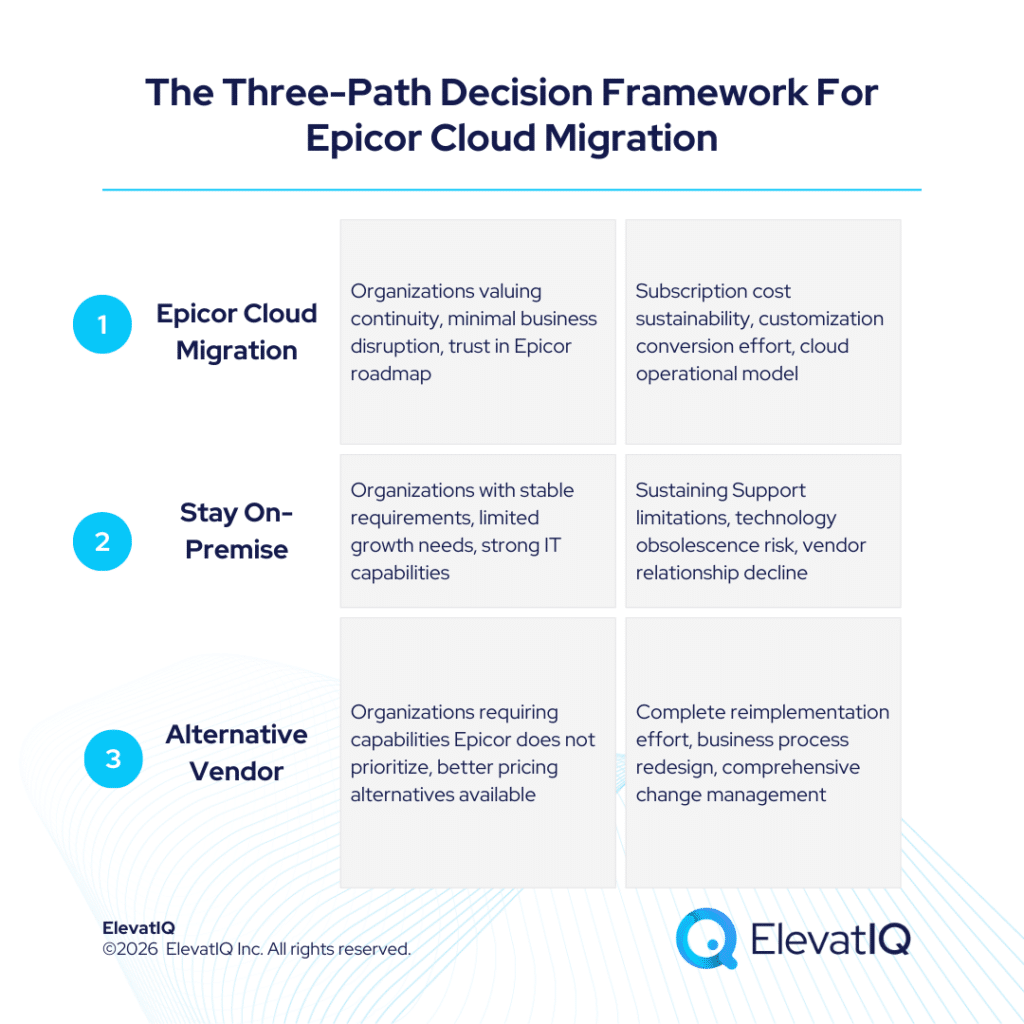
Organizations facing the Epicor on-premise sunset have three fundamental paths forward, each with distinct implications and appropriate scenarios.
Option 1: Migrate to Epicor Cloud (Kinetic, Prophet 21, or BisTrack Cloud)
Staying with Epicor but transitioning to cloud deployment offers several advantages:
Advantages of Epicor Cloud Migration:
- Familiarity: Users know the Epicor interface, workflows, and terminology, reducing training requirements
- Vendor Support: Epicor’s Ascend with Epicor program provides migration assistance, tools, and fixed-fee pricing
- AI-Powered Tools: Access to migration readiness assessments and automated data conversion tools
- Continuity: Maintain existing vendor relationship, implementation partner ecosystem, and industry-specific capabilities
Challenges with Epicor Cloud:
- Customization Conversion: Heavily customized on-premise deployments require significant rework to function in cloud environments
- Subscription Cost Uncertainty: Long-term total cost of ownership may exceed on-premise maintenance costs depending on user count and modules
- Control Reduction: Cloud platforms reduce organizational control over update timing, infrastructure management, and system access
When Epicor Cloud Makes Sense:
This path is optimal when your organization has relatively standard Epicor configurations, values continuity and minimizing business disruption, trusts Epicor’s long-term cloud platform roadmap, and can absorb subscription cost structures within budget constraints.
Option 2: Stay On-Premise in Sustaining Support
Organizations can choose to remain on current on-premise systems through the Sustaining Support period and potentially beyond. While this carries risks, it may be appropriate in specific circumstances.
Advantages of Staying On-Premise:
- Predictable Costs: No migration expenses, no subscription fee increases, only standard maintenance continuation
- Operational Continuity: No business disruption from migration, no process changes, no user retraining required
- Infrastructure Control: Maintain existing control over system access, customizations, and integration timing
Risks of Staying On-Premise:
- Limited Support: After December 31, 2029, support becomes limited with no new features or major bug fixes
- Security Vulnerabilities: While critical security patches continue in Sustaining Support, reduced attention to emerging threats increases risk
- Technology Obsolescence: Missing AI capabilities, modern interfaces, and innovations that cloud platforms deliver
- Vendor Relationship Deterioration: Organizations in Sustaining Support receive lower priority from vendor account teams and ecosystem partners
When Staying On-Premise Makes Sense:
This path may be appropriate when your current system meets business needs without requiring new capabilities, migration ROI cannot be justified within your planning horizon, you have strong internal IT capabilities to manage aging infrastructure, or you are planning business transitions (acquisition, divestiture, retirement) that make long-term ERP investment unnecessary.
Option 3: Migrate to Alternative ERP Vendor
The Epicor on-premise sunset creates a natural evaluation window for considering whether alternative ERP platforms better serve your long-term needs.
When to Consider Alternatives:
Organizations should evaluate alternative vendors when:
- Epicor Cloud pricing significantly exceeds alternative vendors for comparable functionality
- Epicor’s industry-specific capabilities have gaps that competitors address more comprehensively
- Your organization requires capabilities that Epicor does not prioritize in its roadmap
- Concerns exist about Epicor’s long-term market position or private equity ownership implications
Alternative Vendor Considerations:
- For manufacturing organizations (current Epicor Kinetic users), alternatives include Acumatica, IFS Cloud, Infor CloudSuite Industrial, and Microsoft Dynamics 365 F&O.
- For distribution organizations (current Prophet 21 users), alternatives include NetSuite, Acumatica, Infor CloudSuite Distribution, SAP Business One, and Microsoft Dynamics 365 Business Central.
- For building materials and lumber (current BisTrack users), alternatives include industry-specific solutions like DTNA, Epicor Inspire, or broader platforms like NetSuite and Acumatica adapted for the sector.
Alternative Migration Challenges:
Switching vendors involves greater complexity than staying within the Epicor family. Expect complete process redesign, extensive data migration and cleansing, comprehensive user retraining, integration rebuilding, and implementation timelines of 12-24 months.
The Ascend with Epicor Migration Program
A program specifically to support on-premise customers through cloud migration, Epicor has developed Ascend. Understanding what this program provides helps evaluate the migration path.
What Does It Include
The Ascend with Epicor program offers:
- AI-Powered Readiness Assessment: Tools that analyze your current digital landscape and generate customized readiness assessments identifying potential migration blockers such as unsupported customizations or outdated reports.
- Proven Migration Methodology: Structured approach developed through thousands of successful migrations, including business planning support and fixed-fee pricing options.
- Advanced Migration Tooling: Automation for data migration scope analysis and conversion, designed to streamline the process and reduce timeline.
- Expert Consulting Guidance: Access to Epicor Professional Services consultants and the global partner ecosystem for implementation support.
Customer Migration Experiences
Bryan DeRuvo, Vice President of ERP and IT at VMC Group, described their experience: “The process moving to the Cloud was very simple for us using the Ascend with Epicor cloud tools; it could not have been easier. It took a few hours to get the database uplifted, moving our customizations over, and testing. That was a very easy process for us. Epicor provides a lot of guidance and handholding on that, and their project management team was not invasive, but very supportive.”
While this testimonial highlights successful migration, it is important to note that experiences vary significantly based on customization complexity, data quality, and organizational readiness. Organizations with minimal customizations and clean data typically experience smoother migrations than those with heavily modified systems and complex integration requirements.
Strategic Planning for Epicor Customers
Regardless of which path your organization ultimately chooses, certain planning imperatives apply universally.
Start Assessment Now, Not in 2028
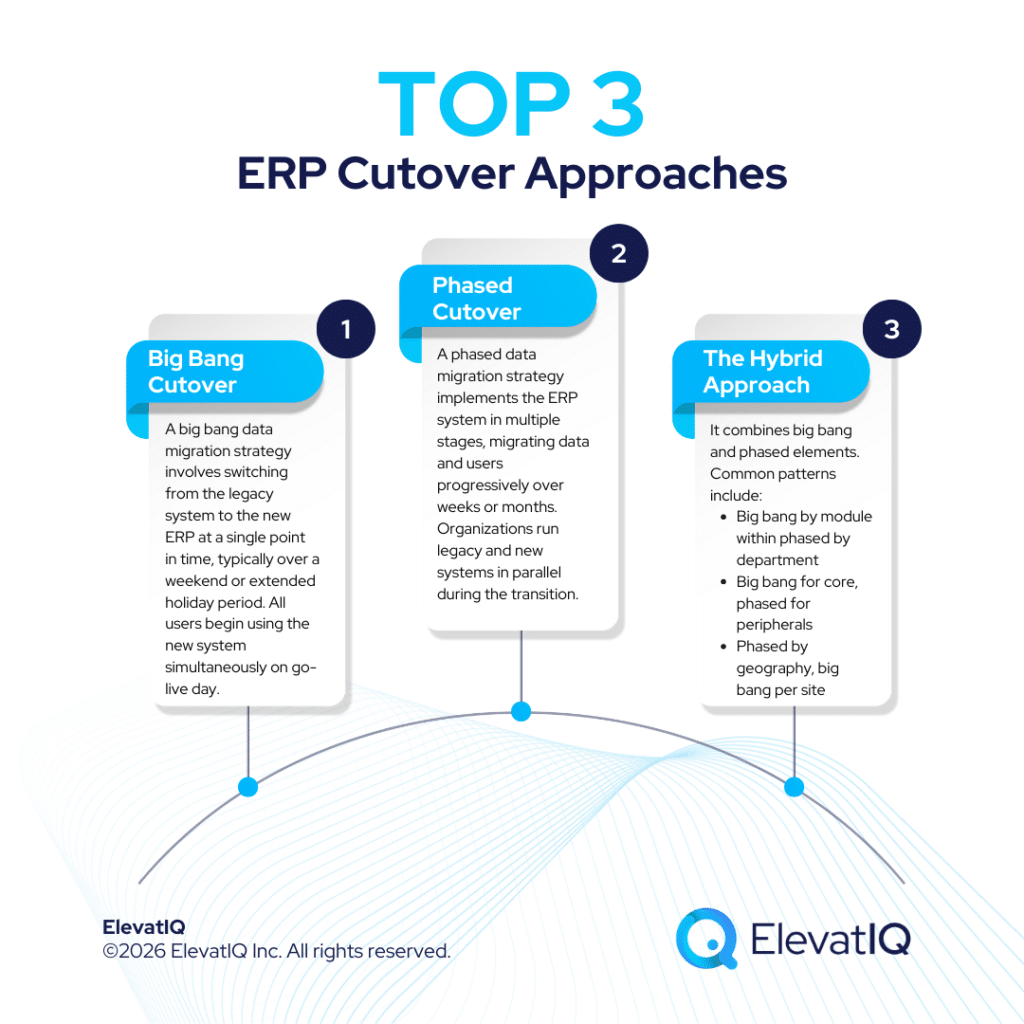
While Active Support extends through December 31, 2029, organizations should begin strategic planning immediately rather than deferring decisions. The timeline appears generous, but comprehensive migration projects require 12-24 months to execute properly. Waiting until 2028 compresses decision-making and limits options.
Conduct Comprehensive Current State Assessment
Before evaluating migration paths, document your current environment thoroughly:
- Customization Inventory: Catalog all custom code, modifications, workflows, and integrations
- Data Quality Assessment: Evaluate data cleanliness, duplication, and governance maturity
- Integration Mapping: Document all system integrations including third-party applications, EDI connections, and data exchange processes
- User Requirements: Engage business users to understand which capabilities are essential versus those that could be replaced with alternative approaches
Calculate True Total Cost of Ownership
Compare migration options based on comprehensive 5-10 year TCO analysis, not just Year 1 costs:
Epicor Cloud TCO:
- Subscription fees × user count × years
- Annual escalation (typically 3-5% compounding)
- Migration project costs
- Ongoing support and optimization
Alternative Vendor TCO:
- Implementation costs (typically higher than in-family migration)
- Subscription fees × user count × years
- Change management and training investments
- Opportunity cost of business disruption
Stay On-Premise TCO:
- Continued maintenance fees
- Infrastructure refresh requirements
- Internal IT costs
- Risk cost of reduced support and aging technology
Evaluate Migration Timing Strategically
Not all organizations should migrate immediately. Consider timing based on:
- Business Cycle Alignment: Schedule migrations during slow operational periods, not peak seasons or critical business events.
- Fiscal Year Considerations: Align CapEx to OpEx transitions with budget planning cycles and tax planning strategies.
- Technology Refresh Cycles: If infrastructure refresh is required soon anyway, cloud migration may provide better ROI than on-premise infrastructure investment.
- Organizational Change Capacity: Assess whether your organization can absorb ERP migration alongside other strategic initiatives without overloading resources.
Working with Independent ERP Advisors
Organizations evaluating the Epicor on-premise sunset implications often lack internal expertise to objectively assess their options. Epicor has commercial incentives to guide customers toward Epicor Cloud. Alternative vendors have incentives to win switching customers. Implementation partners may have preferences based on their practices.
This is where independent ERP advisors provide critical value by offering objective analysis free from vendor or partner commercial interests.
At ElevatIQ, we help organizations navigate Epicor migration decisions through:
- Objective Alternative Evaluation: We assess whether Epicor Cloud, alternative vendors, or extended on-premise operation aligns best with your business requirements and financial constraints, without commercial bias toward any vendor.
- Total Cost of Ownership Modeling: We calculate comprehensive TCO across all options, including migration costs, subscription fees, and long-term operational expenses, providing transparency into true financial implications.
- Migration Risk Assessment: We evaluate your customization complexity, data quality, integration requirements, and organizational readiness to provide realistic migration effort and timeline estimates.
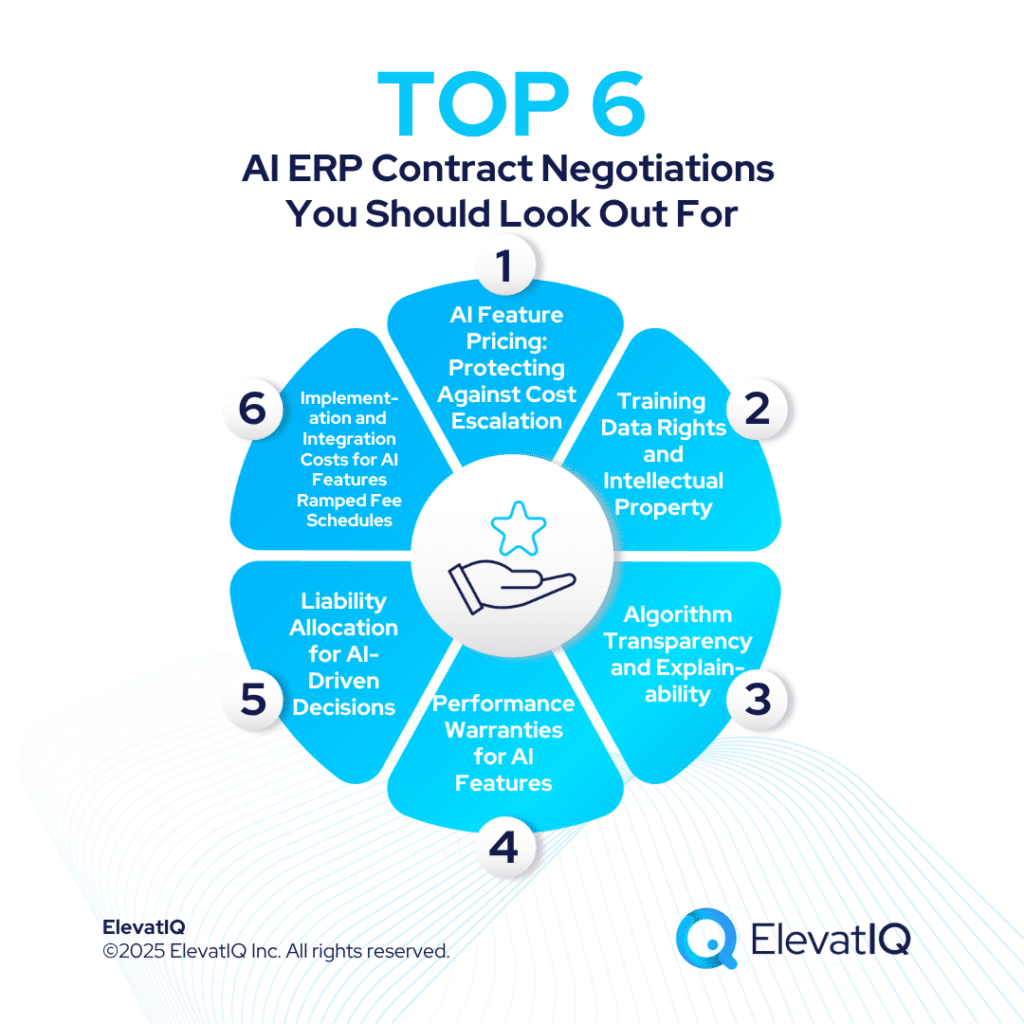
- Contract Negotiation Support: Whether staying with Epicor or exploring alternatives, we help negotiate favorable terms including migration subsidies, subscription pricing locks, and protective contract clauses.
- Implementation Oversight: For organizations proceeding with migration, we provide independent validation of implementation partner work quality and readiness assessments to ensure your interests are protected throughout the project.
Our independent position means recommendations focus solely on your long-term success rather than vendor revenue targets or implementation partner utilization optimization.
Conclusion
The Epicor on-premise sunset represents a significant strategic inflection point for manufacturing, distribution, and building supply organizations. While the announcement may create initial concern, it is not an immediate crisis. With Active Support extending through December 31, 2029, organizations have meaningful time to evaluate options thoughtfully and plan transitions without reactive pressure.
Understanding the sunset timeline is critical. This is a planned transition, not an emergency. Organizations have approximately five years to assess their current environment, evaluate alternatives, and execute migrations in a controlled and deliberate manner. There are three viable paths forward: migrating to Epicor Cloud, remaining on-premise through Sustaining Support, or moving to an alternative ERP platform. Each option can be appropriate depending on customization complexity, business requirements, financial modeling, and risk tolerance. No single path is universally correct, and decisions should be based on objective analysis rather than assumptions or vendor pressure.
For organizations choosing Epicor Cloud, the Ascend with Epicor program provides tools and methodology designed to streamline migration. However, success depends heavily on organizational readiness, data quality, and realistic expectations. Heavily customized on-premise environments should anticipate meaningful effort to refactor customizations for cloud compatibility. The financial implications extend beyond initial migration costs. Cloud adoption fundamentally shifts ERP from capital expenditure to operating expense, making long-term total cost of ownership analysis across 5–10 years essential. Subscription escalation, user growth, and parallel system costs must all be considered. Ultimately, the Epicor on-premise sunset presents both risk and opportunity. Organizations that begin assessment early, evaluate options objectively, and plan migrations aligned with business priorities can turn this transition into a catalyst for ERP optimization rather than a forced, suboptimal decision.
(This content is based on publicly available vendor statements, industry research, analyst insights, and practitioner experience and is provided for informational purposes only.)

ERP Selection: The Ultimate Guide
This is an in-depth guide with over 80 pages and covers every topic as it pertains to ERP selection in sufficient detail to help you make an informed decision.
FAQs
Related Posts: