
Last Updated on October 27, 2026 by Shrestha Dash
Key Highlights
- An ERP expert witness is an independent professional who gives an objective, evidence-based opinion on ERP projects in legal and dispute-resolution settings.
- Expert input is typically sought in failed implementations, scope and contract disagreements, cost and timeline overruns, data migration issues, and licensing disputes.
- The role involves reviewing project records, applying industry practice, forming an independent opinion, and communicating it clearly through reports and testimony.
- Experts can serve as consulting experts (behind the scenes) or testifying experts (formal evidence), depending on the matter and the applicable rules.
- Engaging an expert early helps legal teams understand the technical issues before committing to a position.
- Independence, hands-on ERP experience, and a sound methodology are the key qualities to look for.
Introduction
An ERP project touches finance, supply chain, manufacturing, HR, and customer operations all at once. When it goes well, the business barely notices the system. When it does not, the consequences can reach well beyond the IT department, and sometimes into a courtroom or an arbitration hearing.
In those situations, attorneys and decision-makers often need someone who can explain what happened, in plain language, from a technical and project-delivery standpoint. That is where an ERP expert witness comes in. This blog explains what an ERP expert witness is, the situations where one is typically needed, what the role involves, and what to look for when choosing one.
What Is an ERP Expert Witness?
An ERP expert witness is a professional with deep, hands-on experience in ERP selection, implementation, customization, and support for enterprise resource planning systems, who provides an objective opinion in a legal or dispute-resolution setting.
The role is not to take a side. A credible ERP expert witness examines the facts, compares them to accepted industry practices, and gives an independent opinion on questions such as whether the project was scoped realistically, whether the delivery followed a sound methodology, or whether the issues described are consistent with the system’s capabilities.
An expert witness may be asked to provide a written report, give a deposition, or testify at a hearing or trial. The exact process depends on the jurisdiction and the forum, whether that is a court, an arbitration panel, or a mediation.


ERP Selection Requirements Template
This resource provides the template that you need to capture the requirements of different functional areas, processes, and teams.
Why ERP Disputes Need Specialized Expertise
ERP implementations are complex by nature. They involve contracts and statements of work, requirement documents, configuration decisions, data migration, integrations, testing cycles, training, and organizational change, often spread across many months and multiple parties.
Judges, juries, and arbitrators are rarely familiar with how these projects work in practice. Terms like fit-gap analysis, user acceptance testing, cutover, or change request carry specific meanings in the ERP world. An ERP expert witness helps translate this context so that the decision-makers can evaluate the evidence with a clear understanding of how ERP projects are normally run.
Common Situations Where an ERP Expert Witness Is Needed
Not every difficult ERP project ends in a dispute, and most disagreements are resolved without legal action. When a dispute does escalate, an ERP expert witness may be asked to contribute in situations such as:
| Situation | What it typically involves | Where an expert’s analysis helps |
| Failed or abandoned implementations | The system did not go live, or went live without the agreed functionality | Examining project records to understand the factors behind the outcome |
| Scope and deliverable disagreements | The parties interpret the contract or statement of work differently | Explaining how scope is normally defined and managed in ERP projects |
| Budget and timeline overruns | Costs or schedules grew significantly | Reviewing whether causes relate to requirements changes, resourcing, or project management |
| Data migration and integration problems | Data quality issues or failed integrations disrupted operations | Assessing migration approach, testing, and cutover practices |
| Customization and performance concerns | The delivered solution does not perform as expected | Distinguishing design, configuration, and business process factors |
| Licensing and contract disputes | Disagreements on license scope, usage, or renewal terms | Clarifying how the software is deployed and used |
| Insurance and damages claims | The impact of an ERP failure needs to be assessed | Providing a technical view of the issues involved |
It is worth noting that each dispute has its own facts. The presence of a problem on a project does not by itself establish that any party was at fault, which is exactly why an objective review matters.

ERP System Scorecard Matrix
This resource provides a framework for quantifying the ERP selection process and how to make heterogeneous solutions comparable.
What Does an ERP Expert Witness Actually Do?
The work varies by matter, but it generally follows a structured path:
- Reviewing the record. This usually includes contracts, statements of work, requirement documents, project plans, status reports, change requests, test results, and correspondence between the parties.
- Applying industry knowledge. The expert compares what happened on the project with generally accepted ERP implementation practices and the capabilities of the software involved.
- Forming an independent opinion. The expert identifies the technical and project-related factors that appear to have contributed to the outcome, based on the evidence.
- Communicating findings. This may involve a written expert report, support in preparing for depositions, and testimony that explains technical matters clearly to a non-technical audience.
The quality of the work depends on a transparent, well-documented methodology. Opinions should be grounded in the evidence rather than assumptions.
Consulting Expert vs. Testifying Expert
In some legal systems, an expert can serve in two different capacities, and the distinction matters for how the work is used.
| Aspect | Consulting expert | Testifying expert |
| Role | Helps the legal team understand the technical issues | Provides an opinion presented formally as evidence |
| Typical work | Assessing strengths and weaknesses, shaping strategy | Preparing a report, supporting depositions, giving testimony |
| Visibility | Usually works behind the scenes, subject to local rules | Opinion is shared with the other parties and the forum |
| Best suited for | Early case assessment | Matters where formal expert evidence is required |
Which arrangement fits a given matter, and how each is treated procedurally, is a question for the attorneys involved and depends on the applicable rules.
When Should You Engage an ERP Expert Witness?
In general, earlier is better. Engaging an ERP expert witness or consulting expert while a dispute is still taking shape can help legal teams:
- Understand the technical issues before committing to a position
- Identify which documents and records matter most
- Preserve relevant project artifacts and communications
- Evaluate whether a claim or defense is supported by the project evidence
Bringing in an expert late in the process is still possible, but it can leave less time to review a large volume of project records thoroughly.
What to Look for in an ERP Expert Witness
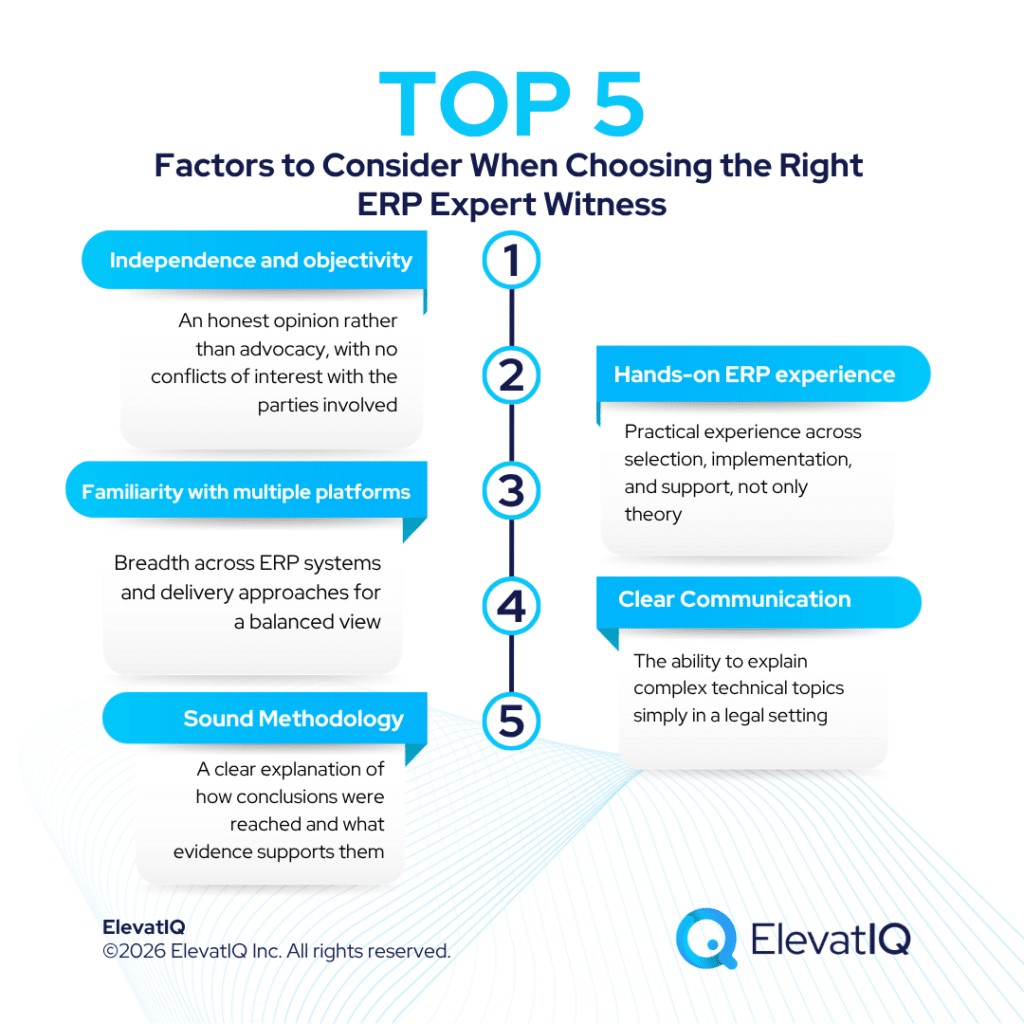
Choosing the right expert is a significant decision. Some factors worth considering:
| Factor | What to look for |
| Independence and objectivity | An honest opinion rather than advocacy, with no conflicts of interest with the parties involved |
| Hands-on ERP experience | Practical experience across selection, implementation, and support, not only theory |
| Familiarity with multiple platforms | Breadth across ERP systems and delivery approaches for a balanced view |
| Clear communication | The ability to explain complex technical topics simply in a legal setting |
| Sound methodology | A clear explanation of how conclusions were reached and what evidence supports them |
| Relevant qualifications for the forum | A background that meets the admissibility standard of the relevant jurisdiction, confirmed by counsel |
The Value of an Independent Perspective
Because ERP disputes often involve software vendors, implementation partners, and customers, independence is a critical quality. As an independent ERP consultancy, ElevatIQ is not tied to any single software vendor or implementation partner, which supports a neutral, evidence-based approach. Our consultants bring practical experience from ERP selection and implementation advisory work, and we now extend that experience to ERP expert witness engagements, supporting legal teams with technical analysis and clear, objective opinions.
Please note that ElevatIQ provides technical and industry expertise. We do not provide legal advice, and decisions about legal strategy should always be made with qualified legal counsel.
Final Thoughts
ERP projects are high-stakes investments, and when expectations and outcomes diverge, an objective, technically grounded view can help everyone involved understand what actually happened. An ERP expert witness provides that clarity, whether in a courtroom, an arbitration, or the early stages of case assessment.
If you are an attorney, in-house counsel, or a business leader dealing with an ERP-related matter and would like to understand how an independent expert can support the process, the ElevatIQ team would be glad to start a conversation. Contact ElevatIQ to discuss your requirements in confidence.

ERP Selection: The Ultimate Guide
This is an in-depth guide with over 80 pages and covers every topic as it pertains to ERP selection in sufficient detail to help you make an informed decision.
Related Posts: