
Last Updated on June 15, 2026 by Shrestha Dash
Every organization running Oracle E-Business Suite eventually arrives at the same decision point: what comes next? For most of the last decade, the assumed answer was Oracle Fusion Cloud. Oracle’s own cloud ERP platform, positioned as the natural destination for EBS customers and marketed accordingly. Oracle’s messaging on this has been consistent. Its migration tooling has improved, and its partner ecosystem is oriented around making that path visible.
What receives considerably less attention is the question that should come before it. Is Oracle Fusion Cloud the right destination for your organization specifically, or is it the right destination for Oracle?
The decision to migrate Oracle EBS or switch ERP platforms entirely is one of the most consequential technology choices an EBS organization will make. It deserves a process that begins with business requirements, not with a vendor’s preferred roadmap. This blog works through the criteria that should drive that decision. The scenarios where each path makes more sense. And also, why “switching ERPs” is not inherently riskier than migrating to Fusion when the analysis is done honestly.

The Fork in the Road: Two Paths Out of EBS
When an EBS organization decides to move off the platform, the core question of whether to migrate Oracle EBS or switch ERP entirely presents two broad paths.
- Path 1: Migrate to Oracle Fusion Cloud. This is an in-family transition, moving from Oracle’s on-premise ERP to Oracle’s cloud ERP. It preserves the Oracle relationship. It allows for module-level data mapping from EBS to Fusion counterparts. It also keeps the organization within Oracle’s support and licensing ecosystem. For organizations deeply embedded in Oracle’s broader technology stack, this path has real continuity advantages.
- Path 2: Replace EBS with a different cloud ERP. This means evaluating ERP alternatives such as SAP S/4HANA, Microsoft Dynamics 365 Finance, NetSuite, Infor CloudSuite, or other platforms depending on industry and scale and selecting the one that best fits the organization’s requirements, independent of the existing Oracle relationship.
The framing that Path 2 is inherently riskier or more disruptive than Path 1 does not hold up under scrutiny. Both paths require data migration, process re-engineering, integration rebuilds, and organizational change management. The key variables such as complexity, cost, timeline, and fit often depend on the organization’s specific EBS environment and requirements. Not usually on whether the destination is Oracle or someone else.
The assumption that staying with Oracle is the lower-risk path is one of the most consistent pieces of received wisdom in the EBS migration conversation. The independent ERP analysis frequently does not support this.
The Criteria Checklist: What Should Actually Drive the Decision
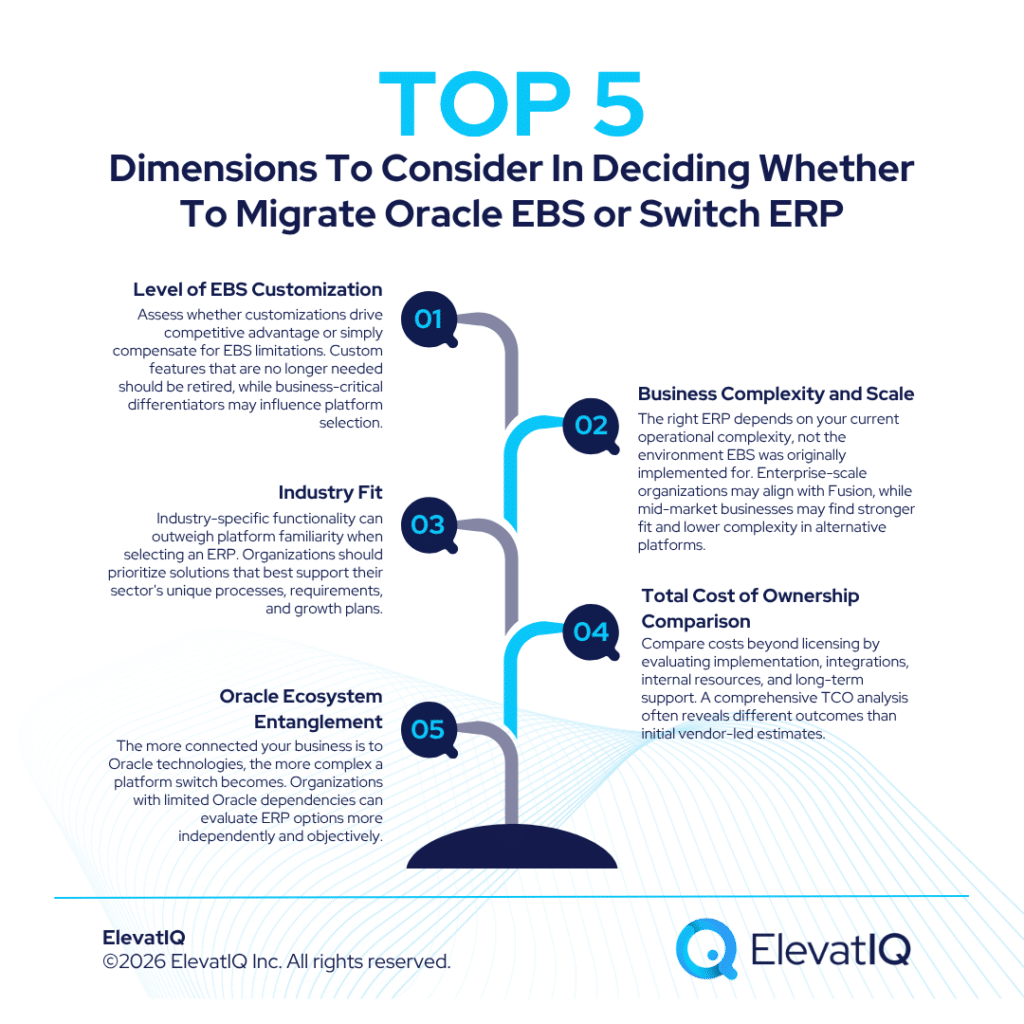
Deciding whether to migrate Oracle EBS or switch ERP requires honest evaluation across five dimensions. The answers are organization-specific which is exactly why a vendor-influenced process produces worse outcomes than an independent one.
1. Level of EBS Customization
For any organization working through whether to migrate Oracle EBS or switch ERP, this is the most operationally significant variable. Organizations that have accumulated deep EBS customizations such as extensive PL/SQL development, custom Forms, bespoke workflow logic, industry-specific extensions. They often face a rationalization decision regardless of destination. Both Fusion Cloud and alternative platforms require that EBS-era customizations be evaluated against the destination platform’s standard capabilities.
The question is not simply “how much customization exists?”. But “how much of that customization reflects genuine business differentiation versus working around EBS limitations?”. Customizations that compensate for EBS constraints that the destination platform solves natively are candidates for retirement, not rebuilding. Organizations with very high EBS customization debt that traces to business-specific logic may find that a platform purpose-built for their industry is now, regardless of what the current announced support horizon reads.


ERP Selection Requirements Template
This resource provides the template that you need to capture the requirements of different functional areas, processes, and teams.
2. Business Complexity and Scale
Oracle Fusion Cloud is an ERP built for large enterprise complexity including multi-entity structures, multi-currency operations, global supply chains, complex procurement workflows, and deep financial management requirements. For organizations at that scale and complexity, Fusion is a credible destination with genuine fit.
For mid-market organizations that have outgrown the scale at which EBS was originally appropriate or that were running EBS as a legacy choice rather than because it was the best fit, the calculus looks different. NetSuite, for instance, is widely recognized as the leading mid-market cloud ERP for organizations with multi-entity global financial requirements at a scale that does not require the full complexity of Fusion. Microsoft Dynamics 365 Finance serves organizations with strong Microsoft ecosystem alignment and a preference for lower total cost of ownership at enterprise scale. The right destination depends on where the organization actually sits on the complexity spectrum, not where it sat when it originally implemented EBS.
3. Industry Fit
Industry fit is a legitimate differentiator in any decision to migrate Oracle EBS or switch ERP. It often can outweigh platform familiarity considerations.
SAP S/4HANA has the deepest industry-specific functionality for discrete and process manufacturing, retail, and utilities at global scale. Infor CloudSuite was purpose-built for specific verticals. They include industrial manufacturing, healthcare, and distribution. Along with pre-configured industry processes that reduce implementation complexity for those sectors. Oracle Fusion Cloud has strong cross-industry capability but narrower industry-specific depth than SAP in some manufacturing verticals. Microsoft Dynamics 365 Finance has strong integration with Microsoft’s broader ecosystem and established presence in professional services and distribution.
An EBS organization in discrete manufacturing with complex production planning requirements has a different industry fit conversation than a financial services organization primarily running Oracle Financials. Treating them as the same decision type produces poorly calibrated recommendations.

ERP System Scorecard Matrix
This resource provides a framework for quantifying the ERP selection process and how to make heterogeneous solutions comparable.
4. Total Cost of Ownership Comparison
TCO comparisons between Oracle Fusion Cloud and alternative platforms are frequently undermodeled in EBS migration conversations. In part because Oracle’s migration tooling and Oracle-affiliated advisory makes Fusion the path of least resistance to scope, and in part because the dual-run licensing costs during a Fusion migration are often not fully reflected in initial estimates.
A realistic TCO comparison should include: licensing costs over a three-to-five year horizon, implementation services for each platform given the organization’s specific complexity profile, integration rebuild costs (which depend on the destination’s integration architecture), internal resource burden during ERP implementation, and post-go-live support and enhancement costs. Organizations that conduct this comparison rigorously, across multiple platforms, consistently find that the cost differential between Fusion and alternatives is more variable and in some cases more favorable to alternatives, than the initial Oracle-oriented scoping suggested.
5. Oracle Ecosystem Entanglement
Some organizations are more embedded in Oracle’s ecosystem than others. Organizations running Oracle Database, Oracle Middleware, Oracle EPM, or Oracle HCM alongside EBS have integration and licensing interdependencies that make a full platform switch more complex than a straight ERP-to-ERP comparison would suggest. For these organizations, the switching cost calculation needs to include the Oracle ecosystem layer, not just the ERP layer.
Organizations running EBS largely in isolation with integrations primarily to non-Oracle systems, have a cleaner comparison. The ERP decision can be made on its merits without the added weight of ecosystem entanglement.
When Oracle Fusion Cloud Makes Sense
There are genuine scenarios where Oracle Fusion Cloud is the right answer when organizations migrate Oracle EBS or switch ERP, and stating that clearly is part of what makes an independent ERP analysis credible.
Oracle Fusion makes the most sense when: the organization is a large enterprise with global operations, multi-entity complexity, and a financial management footprint that Fusion’s architecture is specifically designed to serve; when the organization is already running Oracle EPM, HCM, or SCM Cloud and consolidation on a single Oracle platform produces real integration and licensing benefits; when the organization’s EBS modules map closely to Fusion equivalents and the customization rationalization analysis shows that most EBS customizations can be retired in favor of standard Fusion capabilities; and when Oracle is offering commercial incentives such as migration credits, license conversion programs, or implementation funding, that materially change the TCO comparison in Fusion’s favor.
In these scenarios, the Fusion path is not just the convenient choice, it is the defensible one.
When a Different ERP May Serve the Organization Better
The scenarios where an alternative platform deserves serious consideration when organizations migrate Oracle EBS or switch ERP are equally real, and they are underrepresented in conversations that begin with Oracle-affiliated advisory.
A different ERP may be the better fit when: the organization is mid-market in scale and does not need Fusion’s enterprise complexity or pricing tier; when the primary EBS usage has been Oracle Financials and the organization’s requirements are well-served by NetSuite or Dynamics 365 at meaningfully lower total cost; when the organization’s industry has a platform with deeper native fit, Infor for industrial manufacturing, for example that would reduce implementation complexity and customization requirements compared to a Fusion deployment; when the organization’s existing technology stack is Microsoft-oriented and Dynamics 365 Finance offers better ecosystem alignment and lower integration overhead; and when the TCO comparison across a five-year horizon shows a material cost advantage for an alternative that the organization’s finance leadership should be able to evaluate.
None of these scenarios represents a second-best outcome. They represent outcomes where the right tool for the job is not Fusion and where an evaluation process that started with an open scope rather than an assumed destination would have identified the better path earlier.
Switching ERPs Is Not Necessarily Riskier Than Migrating to Fusion
The risk framing that positions Oracle Fusion migration as the lower-risk path relative to switching platforms entirely deserves direct examination, because it shapes decision-making in ways that are not always accurate.
Both paths require the same foundational work: a customization inventory, data cleansing, process re-engineering, integration rebuilds, testing, and change management. The Fusion path has some continuity advantages in module mapping and Oracle support tooling. The alternative path may have advantages in industry fit, total cost, and the ability to start with a clean architecture rather than carrying forward EBS-era decisions into a new platform.
Risk in ERP migration is driven primarily by how well the assessment phase is conducted, how realistic the scoping is, how effectively change management is executed, and how experienced the implementation team is with the destination platform, not by whether the destination is inside or outside the Oracle family. An organization that makes a well-evaluated decision to migrate to Dynamics 365 or NetSuite, with a clear understanding of the ERP implementation requirements and a capable implementation team, is in a more defensible position than one that defaulted to Fusion without a rigorous comparison and discovers scope and cost surprises mid-implementation.
The perceived safety of staying with Oracle is real for some organizations in some scenarios. It is not a universal truth.
What Independent ERP Selection Looks Like for EBS Organizations
The structural challenge for EBS organizations evaluating whether to migrate Oracle EBS or switch ERP is that most of the advisory resources available to them have directional interests. Oracle and its implementation partners have revenue reasons to recommend Fusion. Alternative platform vendors have revenue reasons to recommend their own products. Even well-intentioned advice from peers or industry analysts is shaped by which platforms those sources have more experience with.
Independent ERP selection means conducting the evaluation without those incentives in the process. That means building a requirements framework from the business up starting with what the organization needs the ERP to do, not what any platform is capable of doing. It means issuing an RFP that allows multiple platforms to respond on a structured basis, rather than scoping a single-vendor evaluation. It means running a demo process that evaluates each platform against the same scenarios, not against each vendor’s preferred use cases. And it means modeling TCO with consistent assumptions across all platforms under consideration, not accepting each vendor’s projection of its own cost competitiveness.
For EBS organizations, the RFP and demo process should include Oracle Fusion Cloud alongside the alternatives that genuinely match the organization’s complexity and industry profile. Fusion should win that evaluation on merit when it is the right fit and it should not win it by default when it is not.
The advisory relationship that serves EBS organizations best in this context is one with no commission relationship with any ERP vendor, no implementation revenue tied to any particular destination, and no incentive to prefer one platform’s outcome over another.
Conclusion
The decision to migrate Oracle EBS or switch ERP platforms entirely is not a question with a universal correct answer. It is a question with an organization-specific correct answer, one that depends on the scale and complexity of the EBS environment, the depth and nature of existing customizations, the industry fit of available platforms, a rigorous TCO comparison across realistic options, and the degree of Oracle ecosystem entanglement that creates genuine switching costs.
What the decision does not depend on is which path Oracle’s advisory ecosystem finds most convenient to recommend. EBS organizations that begin this evaluation with an independent, open-scope process consistently produce better decisions than those that begin with an assumed destination.
The right question in 2026 is not “how do we migrate to Fusion?” It is “what is the right ERP for our organization at this stage of our operations, and what does a realistic path to get there look like?” Those are different questions and the answers are not always the same.

ERP Selection: The Ultimate Guide
This is an in-depth guide with over 80 pages and covers every topic as it pertains to ERP selection in sufficient detail to help you make an informed decision.
Related Posts: