
Last Updated on October 26, 2026 by Shrestha Dash
Key Highlights
- Oracle announced Oracle Fusion Claw on September 29, 2026, as a governed agentic execution runtime for Oracle Fusion Agentic Applications.
- According to Oracle, it combines AI reasoning with deterministic enterprise computation, so AI is applied where intelligence is needed and conventional computation handles high-volume execution.
- Oracle announced 25 new Claw-powered Agentic Applications, described as capable of full-auto execution within delegated authority. These applications are additions to Oracle’s broader portfolio of 75 Agentic Applications, according to the company, with examples spanning finance, HR, supply chain, and sales.
- Governance is built around an Enterprise Operating Envelope, an Outcome Trust Harness, and an Outcome Receipt that records what happened in each run.
- Customers can choose how much automation a process gets, from quick assistance to governed full auto execution within delegated authority.
- ERP buyers and existing Fusion customers should evaluate process readiness, data quality, governance, and costs before expanding autonomy.
Introduction
Agentic AI has moved quickly from an interesting concept to a feature that ERP vendors are building directly into their suites. The latest example is Oracle Fusion Claw, announced by Oracle on September 29, 2026. For finance, HR, supply chain, and IT leaders who run or are considering Oracle Fusion Cloud Applications, it raises a practical question: what does it actually do, and how should we think about it?
This blog summarizes Oracle’s announcement, explains the key concepts in plain language, and outlines what organizations should evaluate before acting on it. The analysis is based primarily on Oracle’s September 29, 2026 announcement and related product documentation. It describes Oracle’s stated capabilities and should not be interpreted as independent verification of product performance, cost savings, or compliance outcomes.
What Is Oracle Fusion Claw?
Oracle describes Oracle Fusion Claw as a governed agentic execution runtime for Oracle Fusion Agentic Applications. In simpler terms, it is the engine that lets agentic applications take on larger, longer-running, and more complex pieces of work, while operating within rules that the organization defines.
Oracle positions Agentic Applications as outcome-based applications, where people define the objectives, authority, and accountability, and the applications coordinate the process to reach an outcome. Oracle Fusion Claw is intended to extend that model to specialist-grade work such as deep research, computation, simulation, modeling, and continuous re-planning.y more layered history than many legacy Macola customers may realize when evaluating the product’s stability today.


ERP Selection Requirements Template
This resource provides the template that you need to capture the requirements of different functional areas, processes, and teams.
How Oracle Fusion Claw Works: Reasoning Plus Deterministic Computation
One of the central ideas in the announcement is the separation between reasoning and execution. According to Oracle, each Claw outcome begins with an advanced AI model that reasons and plans the work, with the ability to adapt as execution progresses. Fusion Claw then uses deterministic enterprise computation to carry out the work precisely and at scale.
| Stage | What happens | Why it matters (per Oracle) |
| Reasoning | A frontier model plans the approach, learns, and adapts | AI intelligence is applied where judgment is needed |
| Execution | Deterministic enterprise computation performs the high-volume work | Designed to support consistent execution at scale, with potential cost benefits that depend on the process and implementation |
| Re-planning | The plan is adjusted as conditions change | Longer-running work can adapt rather than start over |
Oracle states that this separation provides customers with a potential economic advantage, since AI reasoning is used only where it is needed. As with any vendor claim about cost efficiency, the actual impact will depend on each organization’s processes, volumes, and pricing terms.
The announcement also notes that Oracle Fusion Claw runs on Oracle Cloud Infrastructure and is powered by frontier models including Gemini and OpenAI, with support for additional frontier models planned over time.

ERP System Scorecard Matrix
This resource provides a framework for quantifying the ERP selection process and how to make heterogeneous solutions comparable.
The Governance Layer: Operating Envelope, Trust Harness, and Receipt
For ERP leaders, the most relevant question about autonomous AI is usually not what it can do, but how it is controlled. Oracle’s announcement describes three governance components of Oracle Fusion Claw:
| Component | What it is | What it covers |
| Enterprise Operating Envelope | The organization’s boundaries for autonomous work | Objectives, standard operating procedures, policies, constraints, permissions, risk thresholds, decision rights, approval requirements, and escalation boundaries |
| Outcome Trust Harness | Enforcement of the envelope on each outcome run | Identity, capabilities, data, and actions |
| Outcome Receipt | An auditable record produced when an outcome is complete | Authority applied, evidence used, decisions made, actions and transactions executed, and the result |
This structure is designed to give finance, audit, and compliance teams a way to understand what an automated process did and under whose authority. Whether it meets a particular organization’s audit and regulatory requirements is something each company would need to assess for itself.
Choosing the Level of Automation
Oracle also states that customers can decide what level of automation a process should have, ranging from quick assistance to governed full auto execution within explicitly delegated authority. Organizations may wish to begin with lower-risk, measurable use cases and expand autonomy as controls and results are validated. The appropriate starting point will depend on process criticality, the potential consequences of errors, existing controls, and the organization’s readiness for automation.
Examples of the 25 Claw-Powered Agentic Applications
Oracle reports that 25 Claw-powered, full auto-capable Agentic Applications are available, as part of a portfolio of 75 Agentic Applications. The announcement highlights four examples:
| Application | Business area | What Oracle says it helps with |
| Ledger | Finance | Improving close readiness and resolving accounting exceptions faster by reconciling large volumes of entries and investigating anomalies |
| Workforce Staffing | HR | Creating executable staffing plans that balance skills, availability, schedules, labor rules, costs, and coverage, with continuous re-planning |
| Shipping Consolidation | Supply chain | Reducing shipping costs by modeling consolidation alternatives across timing, capacity, service commitments, and cost |
| Account Territory Growth Plan | Sales | Improving coverage and opportunity allocation by modeling and comparing territory scenarios |
These examples show a common theme: problems with many constraints and large volumes of data, where planning, simulation, and re-planning are valuable.
Where Oracle Fusion Claw Fits in the Wider Oracle AI Ecosystem
According to the announcement, the Claw-powered applications are part of a broader Fusion AI ecosystem anchored by Oracle AI Agent Studio for Fusion Applications. With the Agentic Applications Builder and AI Studio Skill capabilities, organizations can create and manage agentic applications using reusable Oracle, partner, and external agents. Oracle also describes observability, ROI measurement, and safety controls within its broader agentic AI ecosystem. ERP buyers should establish how these capabilities are configured, what metrics they expose, and whether the resulting evidence is sufficient for their operational and governance requirements.
What Oracle Fusion Claw Means for ERP Buyers and Existing Fusion Customers
For organizations evaluating ERP platforms, or already running Oracle Fusion Cloud Applications, announcements like this are a useful prompt to review readiness and priorities. A few themes are worth considering:
- AI capability is becoming part of ERP evaluation. Agentic features should be assessed alongside functional fit, total cost of ownership, implementation complexity, integration requirements, and long-term support. Buyers should distinguish between capabilities available today, those requiring additional configuration, and benefits that still need to be demonstrated in their own operating environment.
- Foundations still matter. Agentic applications work with an organization’s data, processes, and policies. Clean master data, well-defined processes, and clear approval rules are likely to influence how much value any such capability delivers.
- Governance needs to be designed, not assumed. Defining decision rights, risk thresholds, and escalation paths is an organizational exercise as much as a technical one.
- Change management is part of the picture. Moving from AI assistance to AI execution changes how teams work, review, and take accountability.
Organizations should not assume that a new agentic capability, on its own, justifies an ERP change or an expanded automation programme. For some businesses, the priority may be improving data quality, standardizing processes, or making better use of existing ERP functionality. Others may have specific, high-volume processes where greater autonomy warrants a structured pilot. The appropriate path depends on business requirements, readiness, risk tolerance, and measurable results rather than the announcement alone.
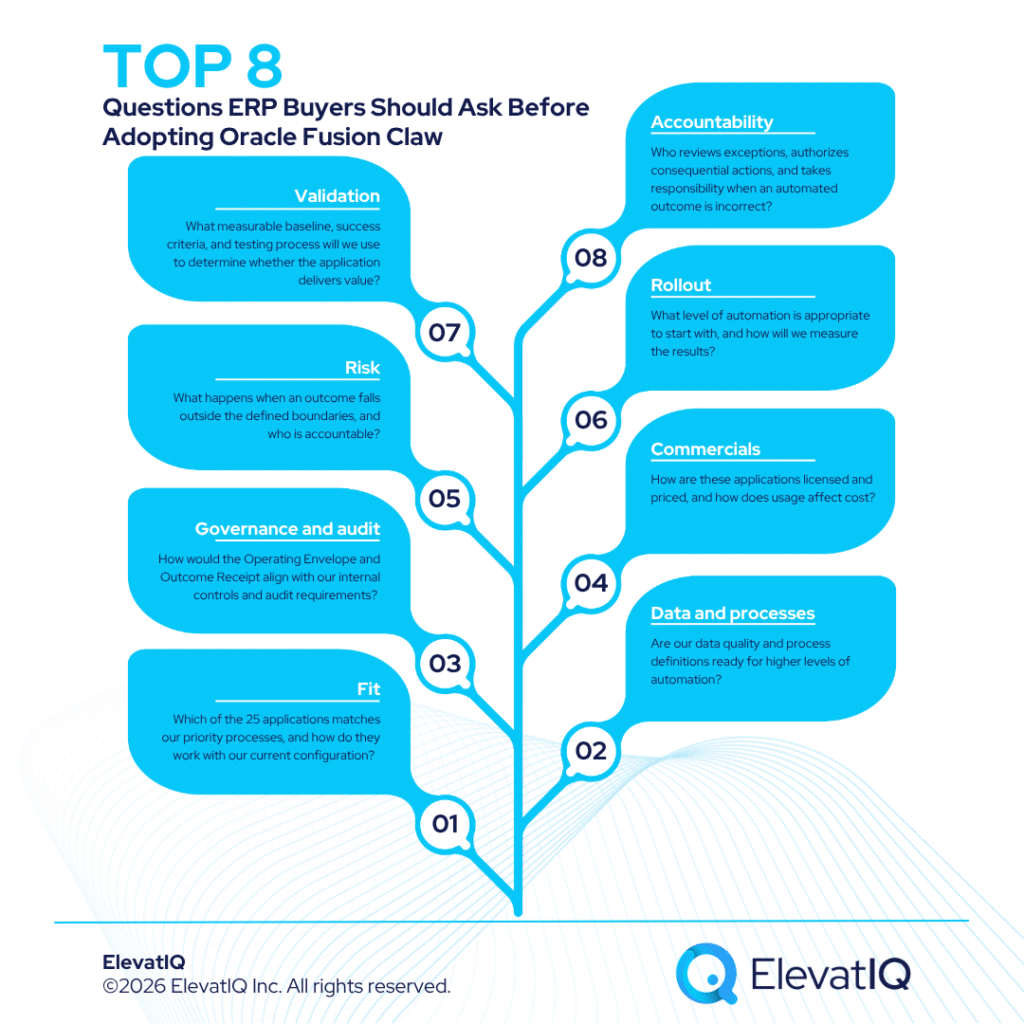
Questions to Ask Before Acting
The announcement is a press release, so it does not answer every practical question an ERP leader would have. These are worth raising with the vendor and internal teams:
| Area | Questions to consider |
| Fit | Which of the 25 applications match our priority processes, and how do they work with our current configuration? |
| Data and processes | Are our data quality and process definitions ready for higher levels of automation? |
| Governance and audit | How would the Operating Envelope and Outcome Receipt align with our internal controls and audit requirements? |
| Commercials | How are these applications licensed and priced, and how does usage affect cost? |
| Risk | What happens when an outcome falls outside the defined boundaries, and who is accountable? |
| Rollout | What level of automation is appropriate to start with, and how will we measure results? |
| Validation | What measurable baseline, success criteria, and testing process will we use to determine whether the application delivers value? |
| Accountability | Who reviews exceptions, authorizes consequential actions, and takes responsibility when an automated outcome is incorrect? |
Pricing, licensing terms, and availability details are not covered in the announcement, so it is best to confirm them directly with Oracle or an authorized partner.
An Independent View on Agentic AI in ERP
ElevatIQ approaches ERP selection and advisory from an independent, requirements-led perspective. For announcements such as Oracle Fusion Claw, the relevant question is not simply what a vendor says its technology can do, but how well those capabilities align with an organization’s business requirements, existing systems, governance needs, and implementation constraints.
Our ERP selection and advisory work typically focuses on helping organizations understand how new capabilities relate to their actual requirements, how ready their data and processes are, and how to plan adoption without overextending. Whether a company is comparing ERP platforms or optimizing an existing Oracle Fusion environment, a structured, vendor-neutral assessment can help separate what is relevant now from what can wait.
Final Thoughts
Oracle Fusion Claw illustrates a shift toward AI applications that can coordinate and execute multi-step business work rather than only assist users with individual tasks. Oracle’s stated approach combines delegated authority, execution controls, and records of completed outcomes. For ERP buyers, however, the practical value will depend on the processes being automated, the controls that can be configured and tested, the commercial terms, and the results achieved in the organization’s own environment.
Organizations evaluating ERP options or planning an Oracle Fusion roadmap should assess agentic AI against their business requirements, implementation constraints, governance needs, and long-term objectives. ElevatIQ can help evaluate these considerations as part of a structured ERP selection or advisory process., compare alternatives, assess migration complexity, and make a considered decision rather than a reactive one.

ERP Selection: The Ultimate Guide
This is an in-depth guide with over 80 pages and covers every topic as it pertains to ERP selection in sufficient detail to help you make an informed decision.
Related Posts: