
Last Updated on December 12, 2025 by Shrestha Dash
The enterprise software landscape has evolved dramatically, and nowhere is this more evident than in ERP deployments. Organizations increasingly find themselves operating in hybrid environments, where critical business systems span cloud platforms and on-premises infrastructure simultaneously. This shift has introduced unprecedented complexity into contract negotiations, requiring procurement teams to navigate licensing models that weren’t designed for such flexibility.
Hybrid ERP contracts represent a fundamental departure from traditional software agreements. Where businesses once chose between perpetual licenses for on-premises systems or subscription models for cloud services, today’s reality demands both—often running concurrently during extended migration periods or permanently as part of a strategic architecture.
The Hybrid ERP Reality
Modern enterprises rarely operate in pure cloud or pure on-premises environments anymore. According to recent industry analyses, over 70% of organizations run hybrid infrastructure, and ERP systems sit at the heart of this complexity. The challenge isn’t just technical; it’s contractual, financial, and strategic.
Why Organizations Choose Hybrid Deployments
A manufacturing company might keep production planning on-premises for latency reasons while moving HR and finance to the cloud. A retail chain could maintain legacy point-of-sale integrations on local servers while leveraging cloud analytics for real-time inventory optimization.
These hybrid ERP contracts emerge from practical necessity. Organizations face regulatory requirements that mandate certain data remain within specific geographic boundaries. They deal with legacy customizations representing years of investment that can’t be immediately replicated in cloud environments. They need time, sometimes years to migrate massive datasets and retrain thousands of users.
The Financial Challenge of Dual Environments
During these transitions, businesses pay for both environments, making contract terms absolutely critical to financial viability. Traditional ERP vendors structured their business models around deployment silos: you bought perpetual licenses for on-premises or subscriptions for cloud, but these were separate purchases with separate pricing. Hybrid environments expose the inadequacy of this approach, creating situations where organizations essentially pay twice for the same capabilities.
Licensing Portability: The Foundation of Flexibility
The single most important provision in hybrid ERP contracts is licensing portability—the ability to move licenses between deployment models without penalty or repurchase. Without this flexibility, organizations find themselves locked into deployment decisions that may no longer serve their business needs.
Understanding Licensing Portability
When negotiating licensing portability, focus on explicitly defining your rights to move workloads. The contract should specify whether you can convert perpetual licenses to cloud subscriptions at a predetermined exchange rate, or whether cloud licenses can be “parked” and reactivated for on-premises use if needed.
Some vendors offer “hybrid credits” or “cloud flex” programs that provide a pool of entitlements usable across both environments, but these programs vary wildly in their actual flexibility. Push for contractual language that eliminates barriers to movement.
Avoiding Conversion Penalties
If you purchase 500 licenses for on-premises deployment and later decide 300 users should move to cloud, the contract should outline exactly what you pay (if anything) for this transition, what happens to the remaining on-premises licenses, and whether you can reverse the decision later. Without explicit terms in your hybrid ERP contracts, you’ll face costly true-ups, forced upgrades, or worst of all, repurchasing licenses you’ve already paid for.
Negotiating Flexible Conversion Windows
Beware of “maintenance windows” that restrict portability. Some vendors only allow license conversion during annual renewal periods or require 90-day advance notice. These restrictions can strangle your ability to respond to business changes or technical issues. Negotiate for quarterly or even monthly conversion windows, with reasonable notice periods that align with your operational realities, not the vendor’s billing convenience.
Migration Rights: Protecting Your Transition Journey
Migration rights in hybrid ERP contracts protect your ability to move between deployment models over time without financial penalty or loss of functionality. These provisions recognize that migration isn’t an event but a journey that might take years and involve multiple phases, partial rollbacks, and iterative approaches.
Parallel Running Permissions
The most critical migration right is parallel running permissions. During migration, you’ll need to operate both environments simultaneously, possibly for months or years. Your hybrid ERP contracts should explicitly allow this without triggering duplicate licensing fees.
Some vendors claim that running both environments constitutes separate “production” systems requiring full licensing for each. Push back on this interpretation. The contract should recognize that testing, validation, training, and phased rollout require temporary duplication, and build this into pricing.
Data Portability Guarantees
Negotiate for data portability guarantees that go beyond generic promises. The contract should specify that you own your data, can extract it in industry-standard formats without vendor assistance fees, and face no technical or contractual obstacles to moving data between cloud and on-premises environments.
Include specific file formats, API access guarantees, and maximum extraction timeframes. Require the vendor to maintain migration tools and documentation throughout the contract term, not just at initial implementation.
Customization Migration
Address customization migration explicitly in hybrid ERP contracts. Organizations often have extensive customizations, integrations, and extensions built for on-premises systems. The contract should clarify whether these can be migrated to cloud environments, who bears responsibility for migration effort, and what happens if certain customizations can’t be replicated in the cloud. Negotiate for vendor support in assessing customization compatibility early in your contract term, not when you’re ready to migrate and discover incompatibilities.
Rollback Provisions
Include rollback provisions that protect you if cloud migration fails or doesn’t deliver expected value. The contract should allow you to return to on-premises deployment without penalty, maintain previous functionality levels, and receive vendor support for the on-premises environment even after initiating cloud migration. Without explicit rollback rights, vendors may consider on-premises support discontinued once cloud migration begins, leaving you stranded if the cloud approach proves unsuitable.renewal processes.
Leveraging Implementation Experience: Identifying Renewal PrioritiesDual Maintenance: Managing Costs Across Environments
Dual maintenance represents one of the most contentious aspects of hybrid ERP contracts—the requirement to pay maintenance fees for both cloud subscriptions and on-premises licenses during hybrid operation. Without careful negotiation, organizations find themselves paying essentially double maintenance costs during migrations that stretch for years.
Blended Maintenance Models
Negotiate for blended maintenance models that recognize hybrid reality. Rather than paying 22% annual maintenance on perpetual licenses plus full cloud subscription fees, push for a consolidated maintenance rate that accounts for your total footprint across both environments.
Some vendors offer “hybrid maintenance credits” where a portion of on-premises maintenance fees offset cloud subscription costs during migration periods. These arrangements can significantly reduce the financial burden of running dual environments.
Avoiding Duplicate Service Charges
Define what maintenance covers in each environment within your hybrid ERP contracts. Cloud maintenance typically includes infrastructure, upgrades, and support, while on-premises maintenance covers software updates and technical support but not infrastructure. Make sure you’re not paying twice for the same services. If you’re paying for cloud infrastructure management, you shouldn’t also pay for on-premises infrastructure support on the same workloads during parallel running. Clarify these boundaries explicitly in the contract.
Version Parity Requirements
Address version parity between cloud and on-premises environments. Some vendors maintain different feature sets, update schedules, or support levels for cloud versus on-premises deployments. Your contract should guarantee that both environments receive comparable functionality, security updates, and support responsiveness. Otherwise, you’ll face pressure to move to the cloud, not because it’s better for your business, but because the vendor degraded on-premises support to force migration.
Realistic Sunset Timelines
Negotiate sunset timelines for dual maintenance that align with realistic migration schedules. If vendors insist on time-limited hybrid support, ensure those timelines reflect the actual complexity of your environment—not arbitrary deadlines.
A global manufacturer with 50 locations across 20 countries needs a longer hybrid period than a single-office services firm. Build in extension options that don’t require renegotiation if migration takes longer than planned.
Version Alignment and Update Management
Hybrid ERP contracts must address how updates, patches, and version upgrades work across disparate deployment models. Cloud environments typically update automatically on vendor schedules, while on-premises systems update on customer timelines. This disconnect creates significant challenges for organizations running both.
Synchronized Security Updates
Negotiate for synchronized update windows where critical security patches and compliance updates roll out simultaneously to both cloud and on-premises environments. Your hybrid ERP contracts should prohibit vendors from forcing cloud updates that break integration with on-premises systems, or from withholding updates from on-premises environments that cloud customers receive immediately.
Testing Rights Across Environments
Secure testing rights that allow you to validate updates in non-production environments before they hit production systems. This is standard for on-premises deployments but often lacking in cloud ERP contracts, where vendors expect automatic updates. For hybrid environments, insist on sandbox access across both deployment models, with sufficient lead time to test cross-environment integrations before updates go live.
API and Integration Stability
Address API and integration stability in version management clauses. As cloud versions evolve rapidly while on-premises systems update more slowly, APIs and integration points can become misaligned. The contract should require vendors to maintain backward compatibility for integrations across version differences that exist during your hybrid operation, with sufficient deprecation notice if compatibility will end.


The 2026 Digital Transformation Report
Thinking of embarking on a ERP journey and looking for a digital transformation report? Want to learn the best practices of digital transformation? Then, you have come to the right place.
Vendor Lock-In and Exit Rights
Hybrid ERP contracts create unique lock-in risks because dependencies span multiple environments, technologies, and billing models. Organizations find themselves increasingly entangled with vendors across cloud infrastructure, on-premises software, professional services, and migration tooling.
Comprehensive Exit Provisions
Build explicit exit rights into hybrid ERP contracts that address both environments. If you decide to leave the vendor entirely, the contract should outline extraction processes, data formats, transition assistance, and costs for both cloud and on-premises components.
Many contracts address on-premises exits (return the software, stop paying maintenance) but ignore cloud exit complexity (data extraction, API shutdown, infrastructure disconnection).
Architecture Independence
Negotiate for architecture independence that prevents vendor lock-in through proprietary integration patterns. Your hybrid ERP contracts should allow you to use third-party integration tools, standard APIs, and open data formats rather than vendor-specific approaches that make future transitions more difficult. This is especially important in hybrid environments where integration complexity multiplies.
Cloud Provider Portability
Secure portability to alternative cloud providers within your hybrid ERP contracts. If you’re deploying the vendor’s cloud offering but later want to move to a competing cloud provider or your own cloud infrastructure, the contract should support this transition. Some vendors restrict their software to specific cloud platforms or impose penalties for moving to competitive clouds.
Performance and SLA Considerations
Hybrid ERP contracts must address performance expectations across both deployment models, acknowledging that cloud and on-premises environments have different characteristics, risks, and responsibilities.
Separate SLAs for Each Environment
Define separate SLAs for cloud and on-premises components, recognizing that availability, latency, and support responsibilities differ. Cloud SLAs typically cover infrastructure availability but may exclude application performance, while on-premises SLAs might address only software defects, not infrastructure issues you manage. Make sure your hybrid ERP contracts clearly delineate where vendor responsibility ends and yours begins in each environment.
Integration Performance Standards
Address integration performance explicitly. Hybrid environments depend on reliable, fast connections between cloud and on-premises components. The contract should specify acceptable latency, throughput, and reliability for these integrations, with remedies if integration performance degrades. Without this, vendors can claim each component meets its SLA even when the integrated system is unusable.
Unified Support Requirements
Negotiate for unified support that recognizes hybrid complexity. When issues arise in hybrid environments, finger-pointing between cloud and on-premises support teams is common. Your hybrid ERP contracts should require coordinated support with single points of contact who can troubleshoot across both environments rather than forcing you to manage separate support channels that blame each other.
Cost Management and Budget Predictability
The financial complexity of hybrid ERP contracts creates budget unpredictability that finance teams struggle to manage. Mixing perpetual license amortization with cloud subscription expenses, adding dual maintenance costs, and dealing with usage-based cloud pricing components creates forecasting challenges.
Negotiating Cost Caps
Negotiate for cost caps during hybrid operation that prevent runaway expenses. The contract should specify maximum combined costs for operating both environments, with clear formulas for how usage, user counts, and resource consumption affect pricing. Without caps, organizations discover that “flexible” cloud pricing flexibility works primarily in the vendor’s favor.
Transparent Cost Allocation
Push for transparent cost allocation models in hybrid ERP contracts that break down exactly what you’re paying for in each environment. Vendors often bundle cloud subscriptions to hide infrastructure margins, or allocate shared costs in ways that maximize their revenue. Require itemized pricing that shows compute, storage, licensing, support, and other components separately so you can make informed decisions about workload placement.
Volume Discount Protection
Secure volume discount protection that applies across your total ERP footprint, not separately to cloud and on-premises deployments. If you’re a 5,000-user organization, you should receive 5,000-user pricing regardless of how those users split between environments. Many vendors reset discount tiers separately for cloud and on-premises, effectively destroying your negotiated volume discounts during hybrid operation.
Value Realization Metrics
Build in success metrics and value realization checkpoints within hybrid ERP contracts. If the vendor promises specific benefits from cloud migration—cost savings, improved performance, faster innovation, tie contract terms to achieving these benefits. Include provisions to adjust pricing, extend timelines, or exit the agreement if promised value doesn’t materialize.
Security, Compliance, and Governance
Hybrid ERP contracts must address security and compliance complexity that multiplies when data and processes span cloud and on-premises environments with different control models, regulatory implications, and risk profiles.
Unified Security Standards
Negotiate for unified security standards that apply across both deployment models rather than accepting different security postures for cloud versus on-premises. Your hybrid ERP contracts should specify minimum security controls, encryption requirements, access management standards, and audit capabilities that apply regardless of where workloads run.
Data Residency and Sovereignty
Address data residency and sovereignty explicitly for hybrid deployments. Regulations like GDPR, data localization laws, and industry-specific compliance requirements affect where data can reside. The contract should clearly define which data remains on-premises for compliance reasons, which can move to cloud, and where cloud data centers must be located. Include provisions that address regulatory changes during the contract term.
Audit Rights Across Environments
Secure audit rights that extend across both environments. Your hybrid ERP contracts should allow you (or your auditors) to examine security controls, access logs, and compliance documentation for both cloud and on-premises components. Vendors sometimes restrict audit rights for cloud services while allowing full audit access on-premises, creating compliance gaps.
Consistent Liability Standards
Define liability and indemnification consistently across deployment models. If a security breach occurs in the cloud environment, the vendor should bear comparable liability to what they’d face for an on-premises breach caused by software vulnerabilities. Many cloud contracts include broad liability limitations that exceed on-premises terms, creating unbalanced risk allocation in hybrid environments.
Negotiating Hybrid ERP Contracts: Strategic Approach
Successfully negotiating hybrid ERP contracts requires preparation, leverage, and willingness to walk away from unreasonable terms. Vendors initially present contracts designed for their benefit, not yours. Your job is transforming these one-sided agreements into balanced instruments that protect your interests.
Building Your Negotiation Timeline
Start negotiations early, ideally 9-12 months before decisions must be finalized. Hybrid ERP contracts involve complex technical, financial, and legal considerations that require time to address properly. Rushed negotiations invariably favor vendors who know their contracts intimately while you’re learning on the fly.
Assembling Your Negotiation Team
Assemble a cross-functional negotiation team including procurement, IT, finance, legal, and business stakeholders. Hybrid ERP contracts affect all these areas, and negotiating effectively requires input from each perspective. Procurement understands vendor tactics, IT knows technical requirements, finance models total cost, legal protects contractual rights, and business stakeholders define success criteria.
Researching Vendor Flexibility
Research vendor flexibility before engaging. Talk to other customers, consult analyst firms, and leverage your professional networks to understand what others have negotiated. Vendors claim many terms are non-negotiable, but you’ll discover that almost everything is negotiable for customers who know what to ask for and have the leverage to demand it.
Using Your Leverage Strategically
Identify your leverage points and use them strategically. Large deals, competitive vendor situations, existing vendor relationships, and timing pressures on sales teams all create leverage. If you’re negotiating at quarter-end or year-end, vendors face pressure to close deals. If you’re considering multiple vendors, competition drives concessions. If you’re an existing customer, threatening to leave or not renew creates leverage.
Documentation Requirements
Document everything in the contract itself, not in side letters, emails, or verbal promises. Hybrid ERP contracts often involve multiple documents—master agreements, cloud terms, on-premises licenses, maintenance schedules, and statements of work. Ensure all terms are either in the master agreement or explicitly incorporated by reference. Verbal promises are worthless when disputes arise.
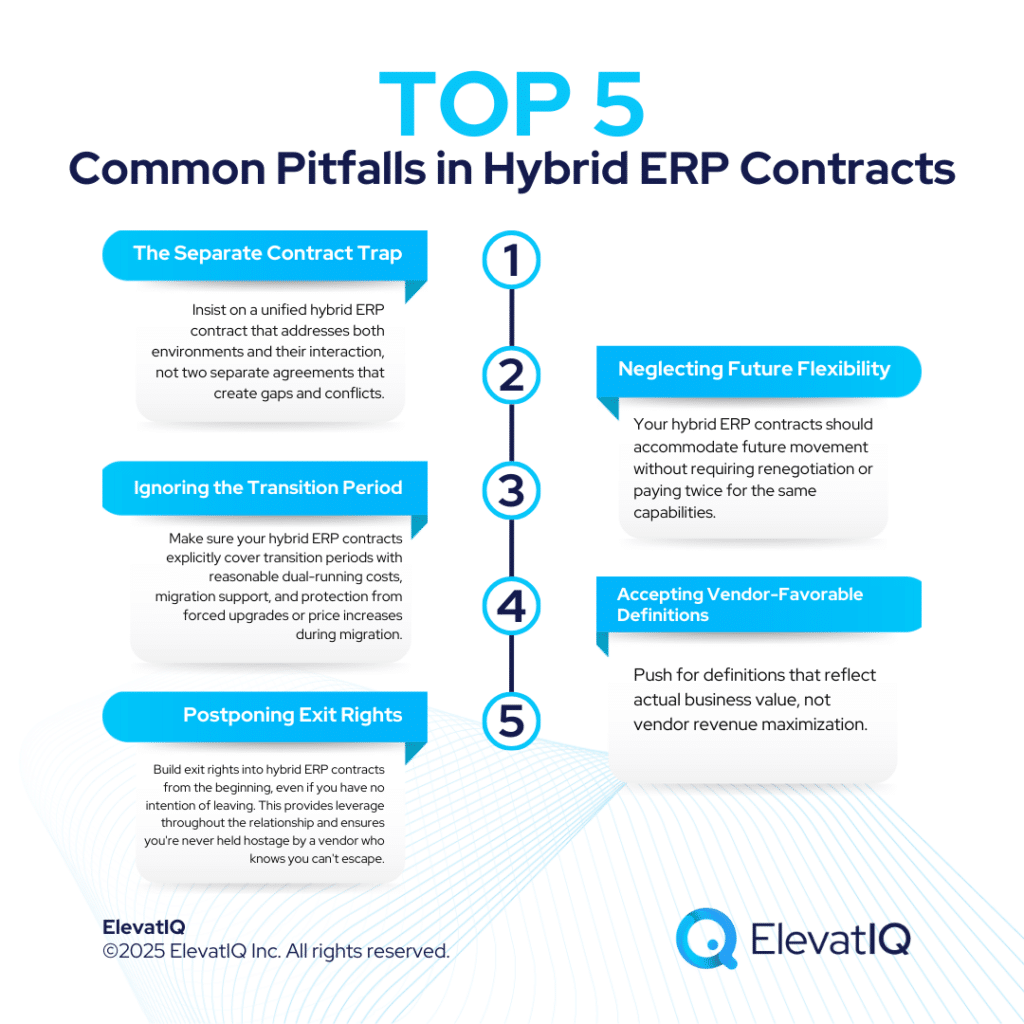
Common Pitfalls in Hybrid ERP Contracts
Organizations repeatedly make the same mistakes when negotiating hybrid ERP contracts, usually because they underestimate complexity, accept vendor framing, or fail to think through long-term implications.
The Separate Contract Trap
The biggest pitfall is accepting separate cloud and on-premises ERP contracts that don’t acknowledge hybrid operation. Vendors prefer this approach because it maximizes their revenue and minimizes your flexibility. Insist on a unified hybrid ERP contract that addresses both environments and their interaction, not two separate agreements that create gaps and conflicts.
Neglecting Future Flexibility
Another common mistake is negotiating only for current state rather than future flexibility. You might start with 90% on-premises and 10% cloud, but that will shift over time. Your hybrid ERP contracts should accommodate future movement without requiring renegotiation or paying twice for the same capabilities.
Ignoring the Transition Period
Organizations often fail to address the transition period adequately. They negotiate final-state cloud pricing and forget about the potentially years-long period when they’re running both environments. Make sure your hybrid ERP contracts explicitly cover transition periods with reasonable dual-running costs, migration support, and protection from forced upgrades or price increases during migration.
Accepting Vendor-Favorable Definitions
Many buyers accept vendor-favorable definitions of terms like “production,” “user,” “environment,” and “instance” without realizing how these definitions limit flexibility. In hybrid contexts, these definitions matter enormously. If “production” is defined to include disaster recovery, testing, or training environments, you’ll pay for licenses you don’t need. Push for definitions that reflect actual business value, not vendor revenue maximization.
Postponing Exit Rights
Organizations frequently neglect to negotiate exit and transition rights until they need them—and then discover they’re trapped. Build exit rights into hybrid ERP contracts from the beginning, even if you have no intention of leaving. This provides leverage throughout the relationship and ensures you’re never held hostage by a vendor who knows you can’t escape.
The Future of Hybrid ERP Contracts
As cloud adoption continues but organizations maintain on-premises infrastructure for specific workloads indefinitely, hybrid ERP contracts will become the norm rather than the exception. Vendors are slowly adapting their commercial models to this reality, but change comes slowly, especially when existing models are highly profitable.
Evolution Toward True Hybrid Licensing
Forward-thinking organizations should push vendors toward true hybrid licensing that treats cloud and on-premises as deployment options rather than separate products. The contract should provide a pool of entitlements usable anywhere, with pricing based on actual business value (users, transactions, outcomes) rather than deployment model. Some vendors are experimenting with such approaches, but most still cling to deployment-specific licensing because it maximizes revenue.
Multi-Cloud Contract Considerations
As multi-cloud strategies become more common, hybrid ERP contracts will need to address deployment across multiple cloud providers plus on-premises infrastructure. Organizations should begin negotiating cloud-neutral contract terms that don’t lock them into specific providers or impose penalties for moving between clouds.
Regulatory Complexity Drivers
Regulatory complexity will continue driving hybrid deployments as different jurisdictions impose different data residency and sovereignty requirements. Contracts must evolve to address increasingly complex regulatory landscapes where some data must remain local while other data can flow globally.
Success Factors for Future Contracts
The most successful hybrid ERP contracts will be those that provide maximum flexibility at minimum cost, protect organizations during transitions, and maintain balanced risk allocation between vendor and customer. Achieving this requires sophisticated negotiation, unwillingness to accept vendor-standard terms, and recognition that contracts fundamentally shape your relationship with critical technology partners.
Conclusion
Hybrid ERP contracts represent a fundamental shift in how organizations procure and manage enterprise software. The complexity of spanning cloud and on-premises environments creates new challenges in licensing, support, migration, cost management, and risk allocation.
Organizations that approach these negotiations strategically—with clear requirements, cross-functional teams, and willingness to push back on unreasonable terms—will achieve contracts that provide flexibility, control costs, and protect their interests throughout the hybrid journey. Those that rush into standard vendor agreements will find themselves trapped in expensive, inflexible arrangements that constrain their technology strategy for years to come.
FAQs
Related Posts: