
Last Updated on October 15, 2026 by Shrestha Dash
Key Highlights
- Macola, originally built for manufacturers and distributors, has undergone several changes in corporate ownership or control since 2001. This also includes transactions involving private equity investors. The most recent was announced in February 2025. There was no formal end-of-life announcement for Macola in ECI’s current public materials.
- The most recent transaction saw Apax Partners. They first invested in ECi in 2017, increasing its equity stake to become a co-control owner alongside Leonard Green & Partners. Along with GIC joining as a new investor. This makes evaluating Macola ERP alternatives a reasonable planning exercise for legacy customers. Not because of any announced sunset, but because ownership changes provide context for assessing product investment, roadmap communication, and long-term strategic positioning.
- The February 2025 announcement should not, by itself, be interpreted as evidence of declining investment in ECI or Macola. The investors described continued growth, investment in core products, and expansion in ECI’s existing verticals as priorities. For Macola customers, the more relevant question is whether those broader priorities translate into continued investment and roadmap clarity for Macola specifically.
- None of this means Macola customers need to migrate immediately. It does mean that understanding the ownership history, alongside observable product investment, release activity, and roadmap communication, is a reasonable input into any ERP planning discussion.

Introduction
Not every signal worth acting on comes in the form of an announced end-of-life date. Sometimes the more useful signal is a pattern. For Macola ERP customers, that pattern is a private equity ownership history that has changed hands repeatedly over the past several years. Most recently in a transaction announced on February 28, 2025.
Macola has roots dating to 1971 in Marion, Ohio, built specifically for the operational needs of manufacturers and distributors. It was acquired by Exact Software in 2001. Since then, Macola’s corporate ownership has changed multiple times, including transactions involving private equity investors. Macola has, at various points, operated within larger software portfolios alongside other products serving different markets and industries.
This piece walks through what’s actually been confirmed about Macola’s ownership history. Why a pattern of repeated PE transactions matters differently than a single end-of-life date, and how legacy Macola customers should think about evaluating Macola ERP alternatives, independently of any single ownership event.
What’s Actually Been Confirmed About Macola’s Ownership History
Understanding why some legacy customers are starting to evaluate Macola ERP alternatives starts with laying out the confirmed ownership timeline in full, since it’s more layered than a single acquisition story.
Macola’s Ownership Timeline: Confirmed Transactions
| Date | Transaction |
| 2001 | Exact Software, a Netherlands-based enterprise software company, acquires Macola |
| August 2017 | Apax Partners agrees to acquire ECi Software Solutions from affiliates of The Carlyle Group and Level Equity, with Carlyle retaining a minority ownership position. Concurrently, Exact Software’s Macola, JobBOSS, and MAX businesses are combined with ECi |
| 2020 | Leonard Green & Partners agrees to acquire a majority stake in ECi from Apax Partners and The Carlyle Group; upon completion, Apax retains a minority stake |
| February 28, 2025 | Apax Funds announce a definitive agreement to increase their equity stake in ECI; upon completion, Apax will become a co-control owner alongside Leonard Green & Partners, with GIC making a substantial new investment |
Four changes in corporate ownership or control across roughly two decades is not unusual for enterprise software broadly, but it is a meaningfully more layered history than many legacy Macola customers may realize when evaluating the product’s stability today.


ERP Selection Requirements Template
This resource provides the template that you need to capture the requirements of different functional areas, processes, and teams.
Why Ownership History Is Relevant to ERP Planning
A single change in ownership does not, by itself, establish anything about a product’s future. For customers, the more useful approach is to examine the broader ownership history alongside observable indicators such as product investment, release activity, roadmap communication, and the product’s position within the owner’s portfolio.
ECi Software Solutions is a diversified provider of industry-specific business software, with Macola serving as one product among a portfolio that spans manufacturing, distribution, field services, building and construction, and other verticals. That structure isn’t unique to ECi, but it is a relevant factor when evaluating how the product is positioned within the broader portfolio and whether its roadmap and investment priorities remain clear.
What Repeated PE Ownership Changes Typically Signal, and What They Don’t
| Signal | What It Suggests | What It Doesn’t Confirm |
| Multiple ownership changes over time | A reason to examine whether product strategy, investment priorities, or roadmap communication have changed | That any specific product, including Macola, is being discontinued |
| A product positioned as one of several inside a larger portfolio | Product investment and roadmap priorities should be evaluated against the broader portfolio | That the product in question is receiving less investment than others in the portfolio |
| No formal end-of-life announcement identified in current public materials | There is no publicly stated sunset date to plan against | That the product’s roadmap and update cadence will remain unchanged indefinitely |
The February 2025 ownership announcement also provides an important counterpoint. Apax stated that its earlier investment had supported ECI’s core products, international expansion, and M&A, while the new transaction was framed around continued growth and expansion. The ownership change therefore should not be treated as evidence of declining investment on its own. For Macola customers, the practical question is whether ECI’s broader investment strategy is translating into visible product development, roadmap clarity, and continued support for Macola.

ERP System Scorecard Matrix
This resource provides a framework for quantifying the ERP selection process and how to make heterogeneous solutions comparable.
Evaluating Macola ERP Alternatives, and What Belongs in That Evaluation
For a legacy Macola customer, the absence of a publicly identified formal end-of-life announcement means there is currently no publicly stated sunset deadline forcing an immediate migration decision. That’s different from having no reason to evaluate options at all. A reasonable approach treats the ownership history as one input among several, not as a standalone reason to migrate.
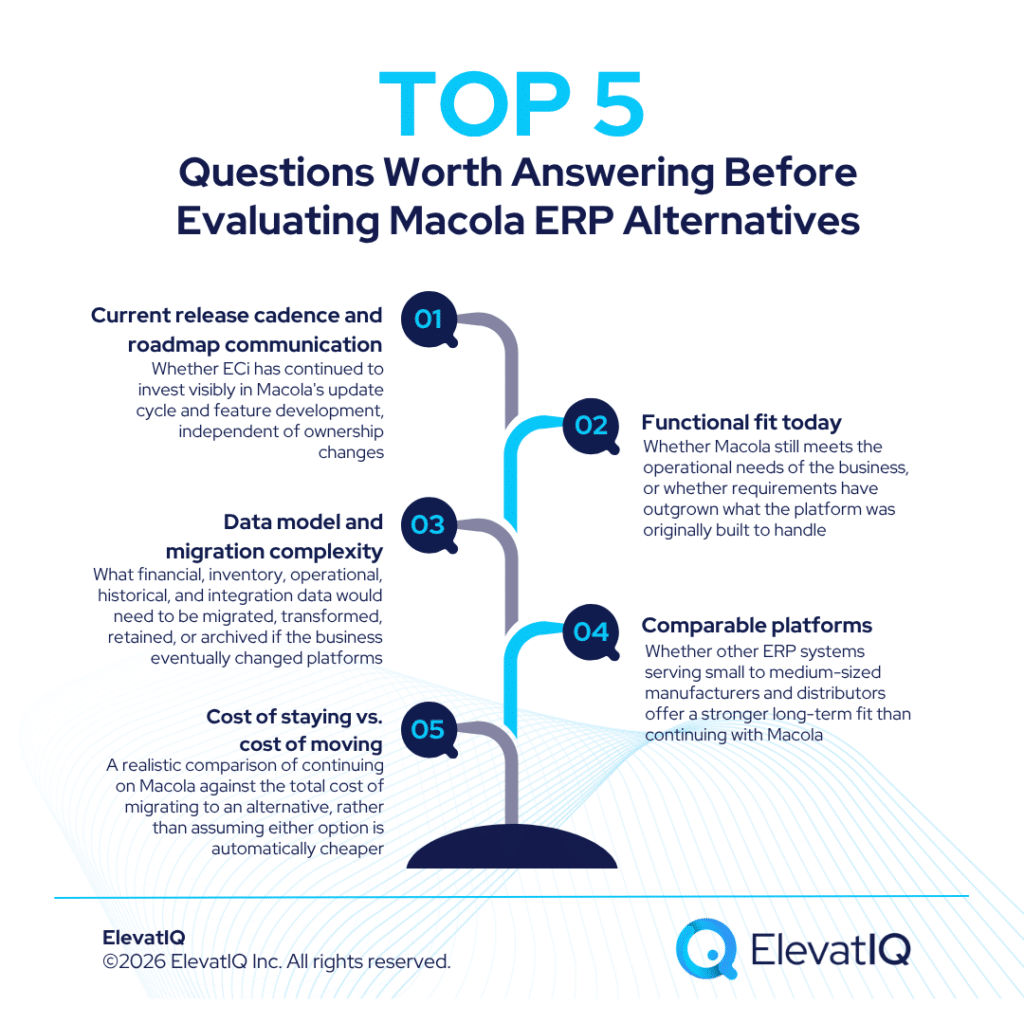
| Evaluation Area | Why It Matters for Legacy Macola Customers |
| Current release cadence and roadmap communication | Whether ECi has continued to invest visibly in Macola’s update cycle and feature development, independent of ownership changes |
| Functional fit today | Whether Macola still meets the operational needs of the business, or whether requirements have outgrown what the platform was originally built to handle |
| Data model and migration complexity | What financial, inventory, operational, historical, and integration data would need to be migrated, transformed, retained, or archived if the business eventually changed platforms |
| Comparable platforms | Whether other ERP systems serving small to medium-sized manufacturers and distributors offer a stronger long-term fit than continuing with Macola |
| Cost of staying vs. cost of moving | A realistic comparison of continuing on Macola against the total cost of migrating to an alternative, rather than assuming either option is automatically cheaper |
An evaluation built on these questions is a different exercise than reacting to ownership news as though it were an end-of-life notice. It treats the ownership pattern as context for a decision the business would eventually need to make anyway, on its own timeline.
Managing the Decision Through ERP Independent Advisory
For legacy, vertical-specific ERP platforms like Macola, ownership and roadmap signals may be less straightforward for customers to interpret than a formal vendor announcement. Without a structured ERP evaluation process, businesses may instead wait for a formal trigger or assume continuity without periodically validating the product’s fit and roadmap.
Reactive Assumptions vs. Independent, Evidence-Based Evaluation
| Approach | Reactive Default | Independent, Evidence-Based Approach |
| Reading ownership news | Treated as background noise unless a formal end-of-life notice is issued | Treated as one data point in an ongoing assessment of product investment and roadmap continuity |
| Timing of evaluation | Delayed until a forcing event, such as a support deadline or major failure | Started proactively, using ownership changes alongside product fit, roadmap, release activity, and other observable indicators |
| Comparison against alternatives | Limited or skipped entirely absent a clear trigger | Conducted periodically, regardless of whether a trigger event has occurred |
| Decision basis | Assumption of continuity, or reaction to a single headline | A documented comparison of current fit, cost, and available Macola ERP alternatives |
At ElevatIQ, we help legacy ERP customers evaluate platform stability and fit based on the actual evidence available, including ownership history, release cadence, and functional requirements, rather than waiting for a formal vendor announcement to prompt the conversation. As an independent ERP and business software consulting firm, we don’t sell software and don’t receive commissions from vendors, which means our assessment of Macola, or any other platform, is shaped by what a business’s operations actually require, not by which platform we have an incentive to place. For a Macola customer weighing whether now is the time to look seriously at Macola ERP alternatives, that independent, evidence-based evaluation is what turns an ownership pattern into an informed decision rather than a reaction.
Conclusion
Macola’s ownership history is not, by itself, a reason to migrate immediately. There was no formal end-of-life announcement for Macola in ECI’s current public materials, and ECI continues to list Macola as a product for existing small to medium-sized manufacturing and distribution customers. The four changes in corporate ownership or control since 2001, including the February 2025 transaction, are worth factoring into the planning discussion, not a detail to set aside because no deadline has been attached to it.
A few signals tend to indicate a legacy Macola customer should start evaluating Macola ERP alternatives sooner rather than later:
- The business has not reviewed Macola’s recent release cadence, product updates, or roadmap communication
- The business’s current operational requirements have outgrown Macola’s capabilities or require functionality that the business cannot reasonably support through its current environment
- Macola ERP alternatives haven’t been evaluated at all, even informally, in recent memory
- The business’s current plan is to wait for a formal lifecycle announcement before evaluating whether a change is necessary
Starting that evaluation before a formal lifecycle announcement, if one is ever made, gives a legacy Macola customer more time to validate requirements, compare alternatives, assess migration complexity, and make a considered decision rather than a reactive one.

ERP Selection: The Ultimate Guide
This is an in-depth guide with over 80 pages and covers every topic as it pertains to ERP selection in sufficient detail to help you make an informed decision.
Related Posts: