
ERP Vendor Shortlisting Mistakes: How Can ERP Buyers Fix Them?
Reaching the ERP vendor shortlist feels like crossing a major finish line. Your team has sat through discovery calls, reviewed capability decks, and narrowed a crowded field down to two or three serious contenders. There is a natural sense of relief at this stage and that relief, more often than not, is exactly where the trouble starts.
In practice, the phase between vendor shortlisting and final ERP contract signing is where some of the most consequential ERP vendor shortlisting mistakes quietly take root. The decisions made or skipped during this window frequently determine whether an implementation succeeds or struggles, regardless of which system ends up getting selected.
These are not exotic edge cases unique to poorly run projects. They are the same patterns, showing up across different industries and company sizes, often made by experienced teams who simply did not know what they did not know at this specific stage of the process. The good news is that each of them is recognizable in advance and fixable, if you know what to look for.
This blog walks through the most common ERP vendor shortlisting mistakes we observe, why they tend to happen at this particular stage, and what the corrective path looks like for each one. The goal is straightforward: if your organization is currently navigating the shortlist phase, or approaching it, understanding these ERP vendor shortlisting mistakes should help you structure it more deliberately.

Why the Post-Shortlist Phase Is Riskier Than It Looks
Most ERP selection frameworks focus heavily on the front end of the process. Such as, requirements gathering, longlist development, scoring frameworks, and demo planning. That attention is well placed. But the shortlist phase tends to receive comparatively less structured guidance, and that gap creates consistent exposure.
There are a few reasons for this:
- Momentum shifts toward procurement. Once vendors are shortlisted, internal focus often pivots to contract negotiation and timeline planning, activities that feel productive but can crowd out continued evaluation rigor.
- Vendor influence intensifies. Shortlisted vendors know they are in a competitive final stage. Commercial pressure, relationship-building, and deal-timeline urgency all increase. This is normal, but it can subtly compress the space for independent ERP assessment.
- Organizational fatigue is real. By the time a shortlist is reached, many teams have been in evaluation mode for weeks or months. Decision fatigue can lower the quality of scrutiny at exactly the moment it needs to remain high.
Understanding these dynamics does not eliminate the risk, but it helps explain why capable organizations consistently make the same ERP vendor shortlisting mistakes at this stage. ERP vendor shortlisting mistakes at this stage.
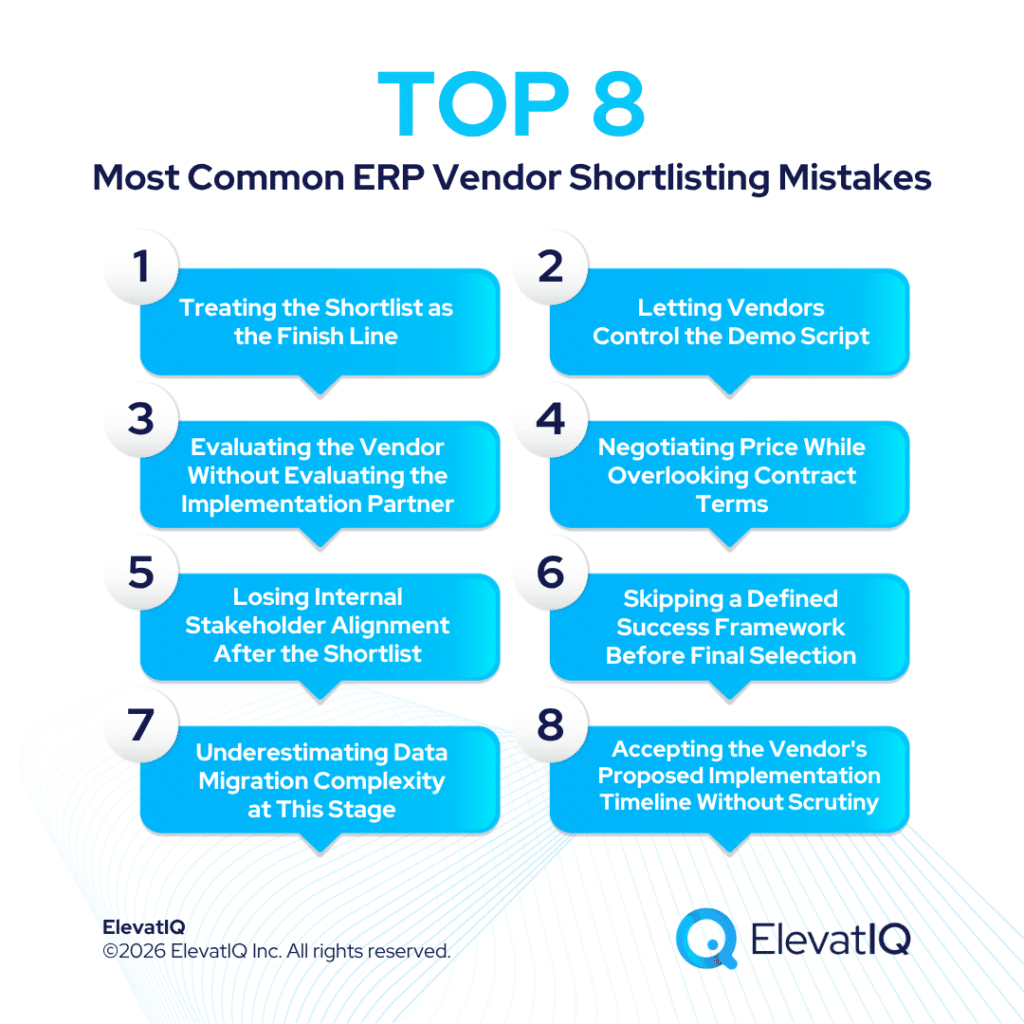
The 8 Most Common ERP Vendor Shortlisting Mistakes
Treating the Shortlist as the Finish Line
The most common of all ERP vendor shortlisting mistakes is also the most understandable one. Once a long list of vendors is condensed to a shortlist, many organizations mentally shift into execution mode. Particularly, negotiating contracts, aligning timelines, and briefing stakeholders before the real evaluation work is actually done. Shortlisting narrows the field based on broad fit. It does not confirm deep fit. The gap between those two things matters significantly when the system goes live and real transactions start running through it.
What this looks like in practice: Teams skip structured scenario-based demos in favor of general presentations. Reference checks happen informally, if at all. Scoring criteria that were defined earlier in the process are not rigorously applied to shortlisted vendors because the decision already feels made.
The Fix: Treat the shortlist as the beginning of the detailed ERP evaluation phase, not the end of it. Define a structured shortlist-to-selection process with its own scope such as scripted scenario demos, weighted scoring against your actual requirements, and reference checks designed around your industry and transaction complexity.
Letting Vendors Control the Demo Script
Demo presentations are where ERP vendors are at their most polished. Most vendors are genuinely skilled at showing their system at its best, and there is nothing inherently wrong with that it is a reasonable part of any sales process. The problem arises when organizations passively accept the vendor’s standard demo script and treat the output as a reliable picture of how the system would actually behave in their environment. Standard demos are built to highlight strengths. They rarely surface the scenarios most likely to be complex or problematic for your specific business.
Common demo blind spots that go undetected:
| Business Scenario | Why It Gets Skipped in Standard Demos |
| Multi-entity consolidation | Requires specific configuration not set up in demo environments |
| Complex inventory workflows | Generic demos show simple warehousing, not layered fulfillment logic |
| Landed cost calculations | Rarely demoed; usually covered with vague confirmation of capability |
| Regulated reporting requirements | Industry-specific outputs are seldom pre-built in demo tenants |
| Integration with existing legacy systems | Vendor focuses on native functionality, not integration edge cases |
The Fix: Require scripted demos built around your actual business scenarios. Before the demo, prepare a set of specific use cases drawn from your current process pain points and your most complex transaction types. Ask vendors to walk through those scenarios live not from a pre-loaded environment, but using configurations representative of your business model. Document the business process gaps you observe. They will matter far more than the features that work seamlessly.


ERP Selection Requirements Template
This resource provides the template that you need to capture the requirements of different functional areas, processes, and teams.
Evaluating the Vendor Without Evaluating the Implementation Partner
ERP systems are not implemented by the software vendor alone. In most mid-market and enterprise implementations, a separate implementation partner, a systems integrator or consulting firm does the majority of the configuration, data migration, integration development, and go-live support work. The quality of that implementation partner frequently has as much influence on project outcomes as the software itself.
It is surprisingly common for organizations to reach final contract negotiations with a shortlisted ERP vendor without having clearly identified which ERP implementation partner will be involved, or having evaluated that partner’s capabilities for their specific industry and project scope. Implementation partner selection often gets treated as a downstream decision, something to sort out after the software contract is signed. By that point, leverage is limited and the risk is already embedded in the project structure.
The Fix: Evaluate implementation partners in parallel with the software evaluation, not after it.
- Ask each shortlisted vendor to identify their recommended partners for your region and industry vertical.
- Request separate capability demonstrations from those partners not just the software vendor presenting their ecosystem.
- Check references on the specific partner’s delivery track record, not just the software’s general customer base.
- Treat implementation partner fit as a meaningful factor in your final vendor decision, because operationally, it is.
Negotiating Price While Overlooking Contract Terms
Among the costlier ERP vendor shortlisting mistakes, negotiating price while overlooking ERP contract terms is one that tends to surface only after the contract is signed. End-of-quarter pricing conversations and license discount negotiations can absorb a disproportionate share of attention during the post-shortlist phase. Securing a favorable per-user rate feels like a tangible win and it often is but it can come at the cost of careful attention to the contract terms that govern the entire relationship going forward.
The commercial terms embedded in ERP contracts frequently contain provisions that create significant financial exposure over time:
- Indirect access definitions that expand licensing obligations as third-party integrations grow
- Auto-renewal clauses with compressed notification windows that eliminate renegotiation leverage
- Support tier structures that separate base entitlements from critical incident response capabilities
- Acceptance criteria language that is vague enough to create disputes when system performance falls short after go-live
- Price escalation provisions embedded in multi-year subscription terms
None of these are inherently bad-faith provisions. They are standard commercial structures that vendors have refined over many contract cycles. But buyers who are focused primarily on headline pricing often accept these terms without fully understanding the downstream implications.
The Fix: Treat ERP contract review as a parallel workstream to price negotiation not a formality that follows it. Pay particular attention to the difference between response time SLA commitments and resolution time commitments. Review how indirect access is defined, especially if your architecture will include third-party integrations or API-connected systems. Ensure acceptance criteria are specific enough to be enforceable if system performance falls short post-go-live.

ERP System Scorecard Matrix
This resource provides a framework for quantifying the ERP selection process and how to make heterogeneous solutions comparable.
Losing Internal Stakeholder Alignment After the Shortlist
ERP evaluations typically build strong internal momentum in the early phases such as discovery workshops, stakeholder interviews, cross-functional requirement sessions. By the time a shortlist is reached, that engagement tends to taper off. Leadership may have shifted focus to other priorities. End users who participated in the requirements phase may not have been informed of how their input influenced the shortlist. Functional department heads who were active contributors early on often feel progressively disconnected as the process becomes increasingly IT- and procurement-led.
This erosion of alignment creates a specific and predictable problem: by the time the final vendor is selected and implementation planning begins, organizational buy-in for the project has quietly deteriorated. The resulting change management challenge is substantially harder to address than it would have been if stakeholder engagement had been maintained throughout.
Signs that alignment is eroding post-shortlist:
- Department heads stop attending evaluation-related meetings
- Questions about the selection rationale resurface after the decision is announced
- Key functional users express skepticism about whether their requirements were heard
- Implementation kickoff meetings reveal assumptions that differ significantly across teams
The Fix: Keep cross-functional stakeholders actively informed and involved throughout the shortlist-to-selection phase. Share demo observations with department representatives. Be transparent about evaluation criteria and scoring. When the final decision is made, communicate the rationale clearly not just to executive leadership, but to the functional teams who will actually use the system. The teams who understand why a decision was made are meaningfully more likely to support the implementation that follows.
Skipping a Defined Success Framework Before Final Selection
One of the quieter gaps in post-shortlist evaluation is the absence of a formally defined success framework. A clear articulation of what a successful ERP implementation actually looks like, in measurable terms, before the contract is signed.
Without this, there is no shared baseline against which implementation progress can be assessed. Vendors and implementation partners may define milestones in ways that satisfy contractual obligations without necessarily delivering business outcomes. Go-live becomes the de facto definition of success, even when the system’s actual performance against real business requirements has not been validated.
Success criteria defined after contract signing are significantly harder to make enforceable. Criteria defined before signing and referenced in the contract itself, provide the foundation for genuine accountability throughout the project.
What a success framework should include:
| Dimension | Example Criteria |
| System performance | Transaction processing time thresholds under peak load |
| Data migration accuracy | Acceptable error rates for master data and open transactions |
| Integration functionality | Verified data flow between ERP and key connected systems |
| User acceptance | Functional sign-off from department leads before go-live approval |
| Reporting capability | Confirmed generation of required regulatory and operational reports |
The Fix: Before finalizing ERP vendor selection, document a set of specific, measurable success criteria tied to your actual business processes. Ensure these criteria are referenced in the contract’s milestone and acceptance provisions not left as informal expectations that become impossible to enforce when performance gaps emerge post-implementation.
Underestimating Data Migration Complexity at This Stage
Post-shortlist discussions tend to focus heavily on software capabilities and commercial terms. Data migration, the process of extracting, cleaning, transforming, and loading data from legacy systems into the new ERP often receives minimal attention until implementation planning begins in earnest.
This is a costly deferral. Data quality issues that exist in legacy systems do not disappear when a new ERP is implemented. They surface during migration, often in ways that create significant delays and cost overruns. Organizations that have not begun to assess the state of their data at the shortlist stage frequently encounter data remediation as an unplanned project within the project, one that compresses timelines and inflates budgets that were established without accounting for it.
The Fix: During the shortlist phase, initiate a preliminary data readiness assessment. This does not require a complete data audit, but should involve a structured review of key data domains:
- Customer and vendor master records
- Item and product masters
- Open purchase orders and sales orders
- Historical transactional data required for reporting continuity
- Chart of accounts and financial period structures
Understanding the scale of data remediation required will affect implementation timeline estimates, partner resource requirements, and in some cases, the final vendor decision itself. Particularly when system-to-system migration complexity varies across shortlisted options.
Accepting the Vendor’s Proposed Implementation Timeline Without Scrutiny
Vendor-proposed ERP implementation timelines are constructed during the sales process, and that context matters. A shorter, more confident timeline is a commercial asset. It signals capability, reduces perceived disruption, and makes the overall investment look more manageable. The problem is not bad faith. It is that these timelines are almost always built on best-case assumptions: clean data, available internal resources, straightforward integrations, and a configuration scope that reflects high-level requirements rather than real-world complexity.
Organizations that accept these timelines without independent scrutiny sign contracts anchored to go-live dates that are structurally difficult to meet. When dates begin to slip, the pressure to recover schedule creates predictable downstream damage. The scope gets compressed, user acceptance testing gets shortened, training gets rushed, and data migration quality checks get deprioritized. The go-live happens on time, but the system is not ready for it.
What drives timeline slippage most often:
- Data migration complexity is underestimated because no readiness assessment has been completed at contract signing
- Internal resource availability is assumed at levels that conflict with ongoing operational responsibilities
- Integration development timelines assume first-pass success with no rework cycles
- Change management and training are scheduled in parallel with configuration rather than sequentially
The Fix: Validate any vendor-proposed timeline against reference checks from organizations of similar size and complexity that implemented the same system. Ask specifically how actual timelines are compared to original proposals. Conduct an internal resource availability assessment before accepting the schedule. Where the timeline cannot be independently validated, negotiate milestone structures with formal review points rather than locking a go-live date before ERP implementation scope is fully understood.
The Conclusion
Most of the ERP vendor shortlisting mistakes described above share a common thread: they happen when the post-shortlist phase is treated primarily as a procurement exercise rather than as a continuation of the evaluation and planning process. The vendor shortlisting decision narrows the field to credible options. It does not on its own, guarantee a successful implementation. The work that happens between shortlist and contract signing often determines whether the organization is set up for a manageable project or a preventable struggle.
Avoiding ERP vendor shortlisting mistakes at this stage requires more than good intentions — it requires a structured process that keeps evaluation rigor, stakeholder alignment, and commercial scrutiny running in parallel, even as the finish line feels close. Independent advisory support tends to be most valuable at precisely this stage. The decisions being made are high-stakes, the vendor relationships are actively influencing the process, and internal teams are often managing competing priorities that make it difficult to maintain the necessary depth of scrutiny. An outside perspective, one with no commercial stake in which vendor gets selected or which implementation partner gets the work, helps organizations ask the questions that are easy to defer until it is too late to ask them effectively.
If your organization is currently navigating the post-shortlist phase, or approaching it, ElevatIQ’s independent ERP advisory practice works with companies to structure this phase in a way that reduces implementation risk before contracts are signed. As a vendor-agnostic firm with no ERP resale relationships or implementation revenue, the guidance is structured entirely around your organization’s outcomes not ours. The post-shortlist phase is short. The consequences of the decisions made during it are not. It is worth getting right.

ERP Selection: The Ultimate Guide
This is an in-depth guide with over 80 pages and covers every topic as it pertains to ERP selection in sufficient detail to help you make an informed decision.
ERP Vendor Shortlisting Mistakes: How Can ERP Buyers Fix Them? Read More »