
Last Updated on October 26, 2026 by Shrestha Dash
Key Highlights
- On October 6, 2026, Infor unveiled its expanded Infor Industry AI architecture and the next evolution of the Infor Velocity Suite at Infor Velocity Week 2026 in Orlando.
- Infor Industry AI is organized around four pillars: Precise Outcomes, Open & Connected, Easy to Use, and Governed.
- Infor describes the Infor Velocity Suite as a single package that combines industry AI agents, generative AI, process mining, automation, and implementation expertise from forward-deployed engineers.
- Infor’s second Enterprise AI Adoption Impact Index, a survey of 2,111 decision-makers in seven markets, found that 68% believe off-the-shelf AI does not adequately address their industry’s needs.
- Infor highlighted governance and accountability as core elements of its architecture, including human-approval workflows, agent permissions, and audit trails. ERP buyers should verify how these controls operate in practice and whether they meet their organization’s requirements.
- Performance figures cited in the announcement come from Infor, so buyers should validate them against their own processes and environment.
Introduction
Every year, ERP vendor events provide a useful window into where the industry is heading. At Infor Velocity Week 2026, the clear message was that agentic AI is moving from experimentation toward execution inside core business processes, and that Infor intends to deliver this through its industry-specific approach. The centerpiece was the expanded Infor Velocity Suite.
This recap of the Infor Velocity Suite summarizes what Infor announced, what its executives and customers discussed in published sessions, and what ERP buyers may want to consider as they evaluate these ideas. It is based on Infor’s announcement, independent media coverage, and recorded interviews from the event. Performance figures and research results are Infor’s own, and this blog does not independently verify them.
What Is the Infor Velocity Suite?
Infor is positioning the Infor Velocity Suite as a bundled way for existing and prospective customers to adopt industry-specific AI and automation. Rather than evaluating each capability in isolation, ERP buyers should examine the package as a whole: which tools and use cases are included, how they connect to current systems, what implementation support is provided, and what contractual limits apply.
| Component | What Infor says it provides |
| Infor Industry AI agents | Agents built with industry-specific context, tied to the customer’s Industry Process Catalog |
| Agentic Orchestrator | A layer that coordinates work across Infor applications |
| Process mining and automation | Tools to identify and automate processes |
| Generative AI | Capabilities including the Infor GenAI Assistant and Infor GenAI Knowledge Hub |
| Prebuilt industry use cases | Out-of-the-box use cases, with more than 350 in the catalog |
| Implementation expertise | Forward-deployed engineers and industry experts who help put use cases into production |
Infor also describes a commercial model with a single offer and unlimited access within fair business use. Infor describes the Velocity Suite as a single commercial offer with unlimited access within fair business use. Before purchasing the Infor Velocity Suite, organizations should confirm the pricing structure, contract duration, usage conditions, exclusions, and any additional implementation or service charges directly with Infor or an authorized partner.


ERP Selection Requirements Template
This resource provides the template that you need to capture the requirements of different functional areas, processes, and teams.
The Four Pillars of Infor Industry AI
Infor organized the announcement around four platform pillars, with the related capabilities accessed through the Infor Velocity Suite:
| Pillar | What Infor describes | Performance claims and figures reported by Infor | What ERP buyers should evaluate |
| Precise Outcomes | Industry AI agents grounded in Industry CloudSuites, Industry Process Catalogs, and industry-specific domain language models; Infor GenAI Knowledge Hub now generally available for building custom agents | Shipments processed up to 60% faster for customers using this layer | Can the agents handle the organization’s actual industry-specific rules, exceptions, and data? |
| Open & Connected | An open platform that connects to non-Infor applications and existing orchestration and analytics tools; agents coordinate through Infor IQ, a semantic layer | More than 350 out-of-the-box use cases | Which external systems are supported, and what integration work remains the customer’s responsibility? |
| Easy to Use | Adaptive UX that assembles a role-aware view of what a decision requires, and works through the Infor GenAI Assistant or other AI assistants customers already use | Up to 90% time savings across procurement, supply chain, manufacturing, and sales workflows | Are the claimed time savings relevant to the customer’s workflows, and how will they be measured? |
| Governed | Human-approval workflows, agentic permission structures, audit trails, and immutable logging within the orchestration layer | Up to a 90% reduction in auditing costs tied to access management | Can permissions, approvals, logs, and exception handling meet the organization’s control requirements? |
These results are reported by Infor, and actual outcomes will vary with each organization’s processes, data, and starting point.

ERP System Scorecard Matrix
This resource provides a framework for quantifying the ERP selection process and how to make heterogeneous solutions comparable.
Why Industry Context Was the Central Theme
A recurring idea across the sessions was that AI agents perform better when they understand the specific details of an industry. Infor leaders gave practical examples. Receiving processes can differ even within food and beverage, for instance between dairy and red meat. For ERP buyers, the practical question is whether industry context is reflected in the rules, data structures, validations, and exception handling that govern actual transactions. Industry-specific terminology alone does not establish that an agent can execute a process reliably. Buyers should test representative transactions, including exceptions, before expanding automation.
Infor says its architecture exposes business-level process interfaces, such as purchase-order creation, rather than requiring agents to coordinate numerous granular technical calls. Combined with its shared semantic layer and industry-specific context, this design is intended to reduce errors and token usage. These are stated design goals; their impact on accuracy, reliability, and cost should be assessed in the relevant operating environment.
This is one vendor’s approach, delivered through the Infor Velocity Suite, to a broader industry question. Other ERP vendors are pursuing agentic AI through their own architectures, and buyers will want to compare how each handles industry fit, data context, openness, and governance against their specific requirements.
What the Infor Research Found
Alongside the Infor Velocity Suite announcement, Infor released the second edition of its Enterprise AI Adoption Impact Index. The research was conducted by YouGov on behalf of Infor in August 2026, surveying 2,111 business decision-makers in the UK, US, Singapore, Japan, France, Australia, and Germany.
| Finding | Result |
| Off-the-shelf AI does not adequately address industry needs | 68% of businesses, with a majority holding this view in six of the seven markets |
| Expect AI investment to increase over the next 12 months | 59% of businesses globally |
| Comfortable with autonomous agents fully executing critical processes without human input at every step | 54% of global leaders |
| Prefer humans to make high-stakes decisions with no AI input | 11% of leaders |
| Cite data security, sovereignty, or compliance as the single greatest barrier to AI strategy | 33% |
| Have a Chief AI Officer role | About 10% globally |
| Manufacturing respondents who said off-the-shelf AI does not fit their needs | 73% (distribution at 76%, retail at 69%) |
One finding stood out for governance. When asked who is accountable if AI gets something wrong, answers were spread out: 23% pointed to the CEO or executive leadership, 22% to the CIO or CTO, 15% to an AI committee or governance group, and 10% to department heads. Another 15% said no one person has primary responsibility, or that it is unclear.
The Index was commissioned by Infor and conducted by YouGov. Its findings reflect the responses of 2,111 business decision-makers across seven markets, rather than all businesses globally. Readers should consult the full Enterprise AI Adoption Impact Index report and methodology and consider the survey sample, question wording, and geographic coverage when interpreting the results.
For ERP buyers, the findings point to two separate evaluation questions: whether AI can address the requirements of a specific industry and whether the organization has clear accountability when automated decisions go wrong. The survey provides context on decision-makers’ reported views, but it does not establish that any particular AI architecture will resolve these challenges. Buyers should evaluate capabilities against their own processes, risk thresholds, and governance requirements.
Governance and Human Oversight
Infor executives emphasized that trust is as important as capability when agents take on decisions. In a published interview, Infor’s president and chief technology officer described an approach that begins with a human reviewing agent recommendations, then adds observability, auditability, and access controls that treat each agent much like another participant in the enterprise.
Another Infor executive gave an example of how autonomy can be calibrated: routine steps such as order creation can run autonomously, while higher-stakes decisions, such as reallocating customer demand, are routed for human approval. Infor describes a governance, risk, and compliance layer intended to apply controls and logging to agent actions. ERP buyers should confirm how permissions, approval requirements, explanations, exception handling, and audit records are implemented for the specific processes they intend to automate.
For ERP buyers evaluating the Infor Velocity Suite, the practical takeaway is that the level of autonomy is a design choice. Organizations can decide which processes warrant full automation and which need human approval.
Forward-Deployed Engineers and Time to Value
A notable part of Infor’s model is its Forward-Deployed Engineers, described as industry and process specialists who work with customers to build and refine use cases. Infor says its Forward-Deployed Engineers work with customers to develop and refine industry-specific use cases. The company has highlighted faster prototyping and deployment as benefits of this model, although actual timelines will depend on project scope, data readiness, integration complexity, testing, and organizational change.
A customer perspective was also shared in the announcement, where the CTO of Team Air Distributing described the pairing of Infor’s agents with forward-deployed engineers as a way to reduce manual work and build trust one process at a time. Timelines, as always, depend on scope, data readiness, and organizational change.
Adoption After Go-Live
In another session, Infor’s chief customer officer described a framework of optimize, adopt, and innovate for guiding customers beyond go-live. She argued that standardizing core processes helps make AI more effective and affordable, and discussed Infor Value+, a self-service evolution of the company’s customer success tools, along with micro-vertical benchmarking so customers can see how they compare with similar peers. She also pointed to inertia, rather than technology, as the biggest barrier, with many organizations unsure where to begin.
For ERP customers adopting the Infor Velocity Suite, post-go-live adoption should be evaluated through process performance, user adoption, exception rates, and measurable business outcomes. Before expanding AI use, organizations should establish a baseline and define how improvements will be monitored over time. This helps distinguish the availability of new capabilities from their actual contribution to business performance.
What ERP Buyers and Infor Customers Should Consider
For organizations evaluating ERP platforms or running Infor CloudSuites today, several themes from the event about the Infor Velocity Suite and Infor Industry AI are worth reflecting on:
- Start with a defined use case. Selecting one high-impact process and measuring results can be more productive than a broad automation program.
- Standardized processes and clean data matter. Industry-specific agents depend on well-defined processes and reliable master data.
- Decide accountability early. The research suggests many organizations have not settled who is responsible when AI makes a mistake.
- Assess openness. Consider how any agentic capability connects with your existing applications, orchestration tools, and data.
- Understand total cost. Infor’s own research cited in one session indicated that many organizations do not fully understand their long-term AI costs, so clarity on commercial terms is important.
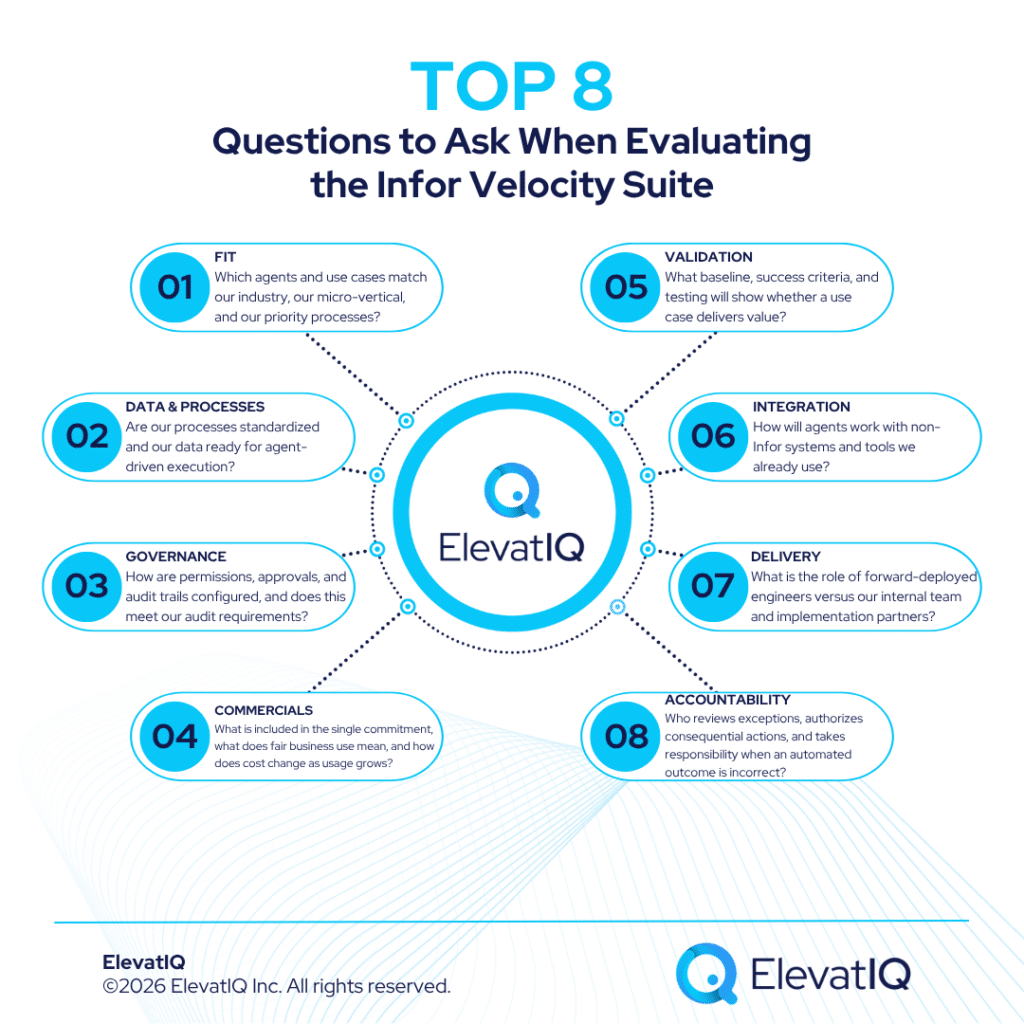
| Area | Questions to ask |
| Fit | Which agents and use cases match our industry, our micro-vertical, and our priority processes? |
| Data and processes | Are our processes standardized and our data ready for agent-driven execution? |
| Governance | How are permissions, approvals, and audit trails configured, and does this meet our audit requirements? |
| Commercials | What is included in the single commitment, what does fair business use mean, and how does cost change as usage grows? |
| Validation | What baseline, success criteria, and testing will show whether a use case delivers value? |
| Integration | How will agents work with non-Infor systems and tools we already use? |
| Delivery | What is the role of forward-deployed engineers versus our internal team and implementation partners? |
| Accountability | Who reviews exceptions, authorizes consequential actions, and takes responsibility when an automated outcome is incorrect? |
An Independent Perspective
ElevatIQ approaches ERP selection and advisory from an independent, requirements-led perspective. When events like Infor Velocity Week introduce new capabilities, our focus is on helping organizations separate what is relevant to their business from what can wait. In practice, this often means assessing process and data readiness, defining requirements, comparing platforms on a like-for-like basis, and planning adoption in a measured way. Whether you are selecting a new ERP, evaluating the Infor Velocity Suite as part of an existing Infor environment, or planning your approach to agentic AI, a vendor-neutral assessment can bring clarity.
Final Thoughts
The expanded Infor Velocity Suite reflects a broader shift in enterprise software toward agents that execute work, supported by industry context and governance. Infor’s emphasis on micro-vertical expertise, interoperability, human oversight, and embedded implementation support illustrates its approach to enterprise AI. For buyers, the real test will be how well these capabilities perform against specific processes, controls, and commercial expectations.

ERP Selection: The Ultimate Guide
This is an in-depth guide with over 80 pages and covers every topic as it pertains to ERP selection in sufficient detail to help you make an informed decision.
Related Posts: