There is a pattern that surfaces repeatedly in ERP advisory conversations. It rarely comes from organizations that are just starting their evaluation. It comes from organizations that went live twelve to eighteen months ago. Now they are looking at their renewal invoice or a new statement of work, and are trying to understand why the numbers look so different from what was budgeted.
The answer, more often than not, is not fraud or bad faith. It is something more structural. The way modern ERP contracts are designed means that Year 1 is often the most favorable year financially. The costs that matter most, the ones that compound, escalate, and expand. They tend to concentrate in Year 2 and beyond. Hence, understanding ERP contract costs year 2 is something most organizations do too late.
ERP contract costs year 2 surprises are now one of the most consistent themes in post-go-live advisory conversations. Yet almost no organization budgets for them at contract signing, because the Year 1 numbers look manageable. The vendor relationship feels strong after a successful go-live, and the categories driving the escalation often do not appear prominently in the original pricing proposal.
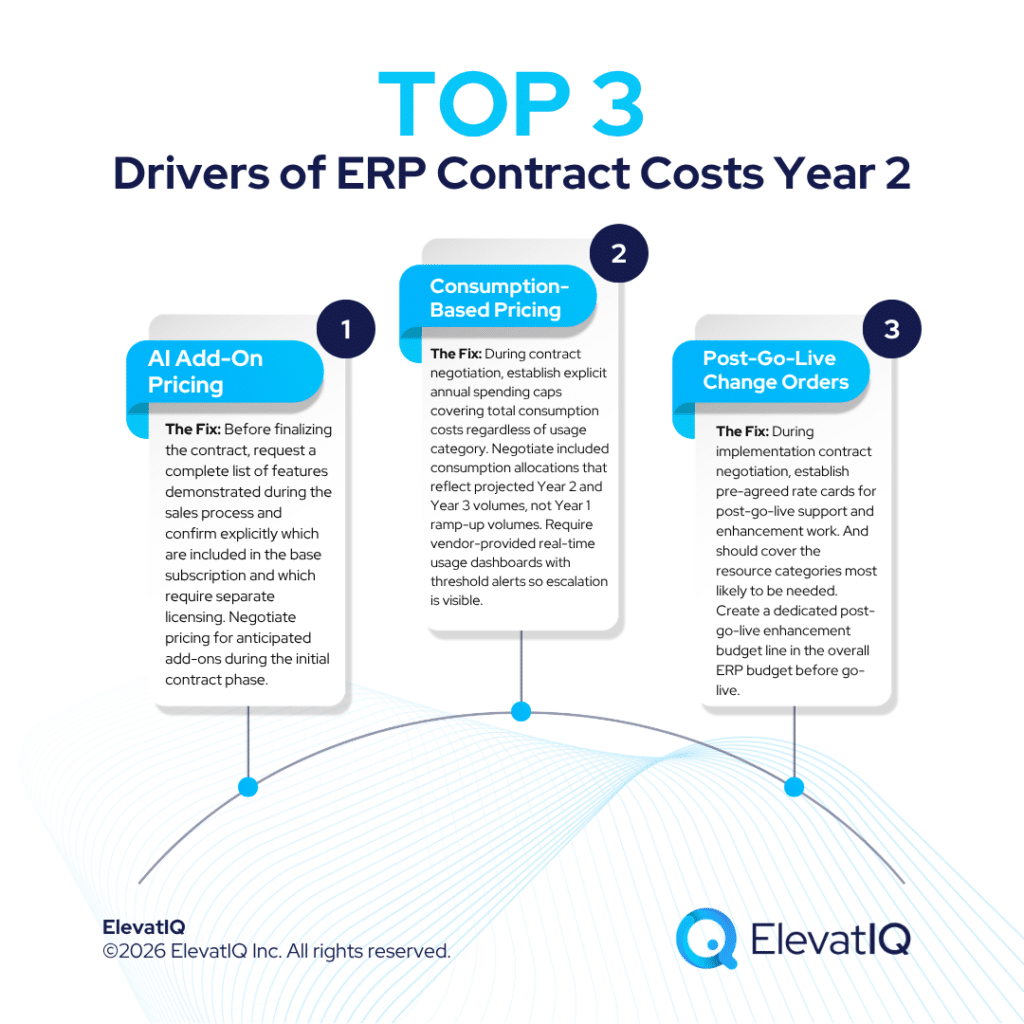
This blog breaks down the three primary drivers of post-go-live ERP cost escalation. Why do they tend to crystallize in Year 2 specifically? And also, what organizations can do to anticipate them before the invoice arrives.
Why Year 1 Feels Affordable
Year 1 of an ERP contract is structured, in most cases, to minimize sticker shock. Initial license or subscription pricing is heavily negotiated, implementation costs are scoped tightly to secure the deal, and consumption charges are low because the system is not yet running at full operational volume. Discounts secured during procurement such as end-of-quarter concessions, bundled module pricing, waived onboarding fees usually apply in Year 1 and rarely carry forward at the same level.
By the time Year 2 begins, the system is live, the organizational dependency on it is real, and the negotiating leverage that existed before contract signing has largely disappeared. That is the environment in which ERP contract costs year 2 take effect.
The Three Drivers of ERP Contract Costs Year 2
AI Add-On Pricing: The Module That Wasn’t in the Original Scope
Most major ERP vendors have embedded AI-powered features such as intelligent automation, predictive analytics, anomaly detection, natural language interfaces, and generative document creation. Many are positioned as value-adds during the sales process, demonstrated during pre-sale demos as part of the core platform experience. What frequently becomes clear after go-live is that many of these AI capabilities are not included in the base subscription. They are licensed separately, often through an add-on module structure with its own pricing tier.
How this plays out in Year 2:
During ERP implementation, AI features are either turned off or in trial mode, so they do not affect Year 1 costs.
After go-live, end users begin requesting capabilities they saw in the demo which included AI-assisted forecasting, automated three-way match, intelligent expense categorization but only to discover these require additional licensing.
The vendor provides a quote. The quote was not in the original budget. Because the system is live and the business case is now visible, internal pressure to proceed is high but the leverage window closed at original contract signing.
Many vendors have also structured AI capabilities under consumption-based pricing models, meaning costs scale with usage volume rather than a predictable flat rate. This connects directly to the second driver.
The Fix: Before finalizing the original ERP contract, request a complete list of features demonstrated during the sales process and confirm explicitly which are included in the base subscription and which require separate licensing. Negotiate pricing for anticipated add-ons during the initial contract phase. This is the only point at which meaningful price protection is achievable.ve. They will matter far more than the features that work seamlessly.
ERP Selection Requirements Template
This resource provides the template that you need to capture the requirements of different functional areas, processes, and teams.
Consumption-Based Pricing: The Cost That Grows With Your Success
Consumption pricing charges organizations based on actual resource utilization. Like, transaction volumes processed, API calls made, data storage consumed, compute capacity used, and increasingly, AI inference credits generated. In practice, it creates budget unpredictability that almost always manifests most acutely in Year 2.
During ERP implementation and the first months of go-live, transaction volumes are artificially low. Consumption charges in Year 1 reflect this reduced volume and they set a baseline expectation anchored in the budget for Year 2. By Year 2, the system is running at full operational capacity and the consumption charges reflect actual operations, representing a meaningful increase over Year 1 figures.
Common consumption categories that escalate in Year 2:
Consumption Category
Why It Escalates Post-Go-Live
Transaction processing
Full operational volume replaces partial rollout volumes
API call volumes
Integrations run at scale; third-party system connections multiply
Data storage
Transactional history accumulates; archive policies not yet established
AI inference credits
Features enabled post-go-live; usage grows as adoption increases
Report generation
Scheduled reports and ad-hoc queries increase as user confidence grows
By the time charges arrive in Year 2, the conversation about what was or was not contractually protected has already passed its point of influence
The Fix: During ERP contract negotiation, establish explicit annual spending caps covering total consumption costs regardless of usage category. Negotiate included consumption allocations that reflect projected Year 2 and Year 3 volumes, not Year 1 ramp-up volumes. Require vendor-provided real-time usage dashboards with threshold alerts so escalation is visible before the invoice arrives, not after.
ERP System Scorecard Matrix
This resource provides a framework for quantifying the ERP selection process and how to make heterogeneous solutions comparable.
Post-Go-Live Change Orders: The Budget Line Nobody Created
Change orders are perhaps the most predictable source of Year 2 ERP cost escalation. Yet they remain, consistently, the budget line that organizations fail to create. A separate and significant change order dynamic plays out after go-live that tends to be underestimated because it does not look like implementation scope creep. It looks like business-as-usual enhancement requests.
What post-go-live change orders actually look like in Year 2:
A report flagged as a post-go-live enhancement is now actively needed by the finance team for a regulatory requirement.
An integration requires rework because a third-party system was updated and the connection broke.
A new business unit requires configuration and data migration not included in the original scope.
Each generates a change order priced at whatever rate the implementation partner charges for post-go-live work, which in most cases was never negotiated. Organizations arrive at Year 2 with a queue of enhancement requests and an implementation partner no longer operating under competitive pressure.
The Fix: During ERP implementation contract negotiation, establish pre-agreed rate cards for post-go-live support and enhancement work. These rates should be locked for a defined period (typically 24 to 36 months after go-live). And should cover the resource categories most likely to be needed: functional consultants, developers, project managers, and integration specialists. Create a dedicated post-go-live enhancement budget line in the overall ERP budget before go-live, not in response to the first invoice. more likely to support the implementation that follows.
Why Clients Almost Never Budget for This
In advisory conversations, the pattern is consistent: organizations build detailed implementation budgets that account for software licensing, implementation services, data migration, training, and change management. They do not, in most cases, build a Year 2 budget that accounts for the categories described above.
There are structural reasons for this.
First, the budget cycle for ERP implementations tends to be organized around go-live as the financial finish line. Capital expenditure approvals, funding requests, and cost justifications are built around the implementation project. The ongoing operational cost structure including post-go-live escalation, receives comparatively less planning attention because it sits in a future budget cycle.
Second, vendors do not make Year 2 cost visibility easy. AI add-on pricing is often not surfaced clearly in initial proposals. Consumption pricing is quoted at ramp-up volumes that understate Year 2 actuals. Post-go-live support rates are not always included in implementation proposals because implementation partners prefer to quote those separately, closer to when the work begins and leverage has shifted.
Third, there is a natural optimism bias around go-live that compresses concern about future costs. After a successful implementation, the instinct is to celebrate the achievement rather than immediately analyze the forward cost trajectory.
The result is that ERP contract costs year 2 arrive as a surprise not because they were hidden, but because nobody created the model to anticipate them.
Conclusion
Year 1 of an ERP contract is designed to look affordable. Year 2 is where the commercial structure of modern ERP agreements begins to reflect the full ERP contract costs year 2 reality of running a live system at operational scale.
The three drivers: AI add-on pricing, consumption escalation, and post-go-live change orders are not surprises if they are anticipated. They become surprises because most organizations do not have a process for modeling ERP contract costs year 2 before the contract is signed, and because the categories involved are structured in ways that are easy to underestimate during procurement.
The best time to address all three is during the original contract phase. That is when competitive pressure gives buyers leverage over add-on pricing, when consumption cap language can be negotiated into the agreement, and when post-go-live rate cards can be locked. Once the system is live, that leverage is largely gone.
If your organization is currently in ERP contract negotiations or approaching renewal, ElevatIQ’s independent ERP advisory practice works with teams to model total cost of ownership across the full contract lifecycle, including the Year 2 cost structure that most procurement processes leave unmodeled. The advisory engagement is structured with no vendor affiliations and no implementation revenue, so the analysis reflects your commercial interests, not a vendor’s renewal incentives. Post-go-live is not the finish line. For ERP contract costs, it is often the starting line.
ERP Selection: The Ultimate Guide
This is an in-depth guide with over 80 pages and covers every topic as it pertains to ERP selection in sufficient detail to help you make an informed decision.
When enterprise organizations evaluate ERP systems, most of the attention lands on functionality, deployment options, and licensing fees. Support models rarely get the same scrutiny, and vendors often structure offerings accordingly. Over the past several years, ERP vendor support models have undergone a quiet but consequential transformation. One that is reshaping what buyers actually receive once the contract is signed and the implementation is complete.
Understanding these shifts is not optional. For organizations committing to multi-year ERP relationships, often in the seven-figure range. The support model embedded in your agreement directly determines what kind of help you get. Also, how fast, and at what additional cost, when things go wrong or when business needs evolve.
How ERP Vendor Support Models Are Shifting Beyond Pricing
The industry-wide migration from perpetual licensing to subscription-based arrangements is well documented. What is less discussed is how this shift has quietly restructured the nature of support itself.
Under the traditional perpetual license model, annual maintenance fees, typically range from 15 to 22 percent of the original license cost. It usually covers a fairly clear set of entitlements. It often includes product updates, bug fixes, access to support portals, and some level of direct vendor assistance. Buyers understood what they were paying for, even if the fees were substantial.
The subscription model collapses these elements into a single recurring fee and presents it as a simplification. In practice, it is often anything but simple.
Bundled Does Not Mean Comprehensive
Cloud-based ERP subscriptions typically include what vendors describe as a “base level” of support. What falls outside that base level is where buyers frequently encounter surprises. Premium support tiers which offer faster response times, dedicated account management, or access to senior engineers, are increasingly sold as separate add-ons, often at meaningful additional annual cost.
A buyer who compares subscription pricing across vendors may not be comparing equivalent support entitlements at all. One vendor’s standard tier may include 24-hour critical incident response, while another’s requires an upgraded ERP contract to access the same.
Consumption-Based Complexity
Several major ERP vendors have also introduced consumption-based licensing layers within their subscription frameworks. Charges tied to document volumes, API call thresholds, data storage consumption, and indirect user access have become standard features of cloud ERP commercial structures. These mechanics can generate cost exposure that was not anticipated at contract signing. Particularly, as transaction volumes grow or as more third-party systems interact with the ERP.
From a support perspective, this matters because consumption overages often create service disruptions or throttling situations. Resolving them may require navigating vendor escalation paths that are only available to customers on higher-tier support arrangements.
ERP Selection Requirements Template
This resource provides the template that you need to capture the requirements of different functional areas, processes, and teams.
SLA Dilution in ERP Vendor Support Models: The Detail Hiding in Plain Sight
Service level agreements are the contractual backbone of vendor support obligations. Yet in modern ERP agreements, SLA language has evolved in ways that may reduce practical accountability in certain scenarios while maintaining the appearance of strong commitments.
Response Time vs. Resolution Time
One of the most important distinctions buyers overlook is the difference between response time and resolution time. Most ERP vendor SLAs guarantee response times which is the interval between logging a ticket and receiving an acknowledgment. Very few offer enforceable resolution time commitments, meaning the vendor is contractually obligated only to acknowledge the problem, not to fix it within any defined period.
For mission-critical ERP environments, this gap is significant. A system availability issue affecting order processing, financial close, or supply chain operations can remain unresolved for extended periods while remaining technically within SLA compliance.
Tiered Priority Definitions
SLA structures in cloud ERP contracts increasingly rely on vendor-defined priority classifications commonly labeled P1 through P4 or equivalent. The challenge is that what qualifies as a critical incident under the vendor’s internal definitions may not align with what the customer experiences as business-critical. Vendors often retain the right to reclassify incident severity. This can, in some cases, affect response commitments without any breach of contract.
Shared Infrastructure Caveats
In multi-tenant cloud environments, SLA uptime guarantees are often measured at the infrastructure level rather than the application level. A vendor may maintain 99.9 percent platform uptime while specific application modules experience availability issues that fall outside the reported metric. Buyers negotiating ERP agreements should ensure that SLA measurements reflect application-level availability relevant to their operational workflows, not just platform-level metrics.nal complexity increase significantly in subsequent deployments.
ERP System Scorecard Matrix
This resource provides a framework for quantifying the ERP selection process and how to make heterogeneous solutions comparable.
The commercial dynamics behind ERP vendor support models are not difficult to understand once they are surfaced. The problem is that procurement teams and IT leaders often engage with support terms late in the evaluation process. Usually, after commercial positions have already been established.
The Long-Term Cost Curve
A frequently cited advantage of subscription models is predictable costs. Over a long horizon, however, subscription costs are not fixed, they are subject to annual escalation clauses, often embedded in ERP contract terms that receive limited attention during negotiation. On-premises annual maintenance fees historically drew scrutiny because they were line items on a perpetual license agreement. Cloud subscription escalations are structurally equivalent but are sometimes framed differently.
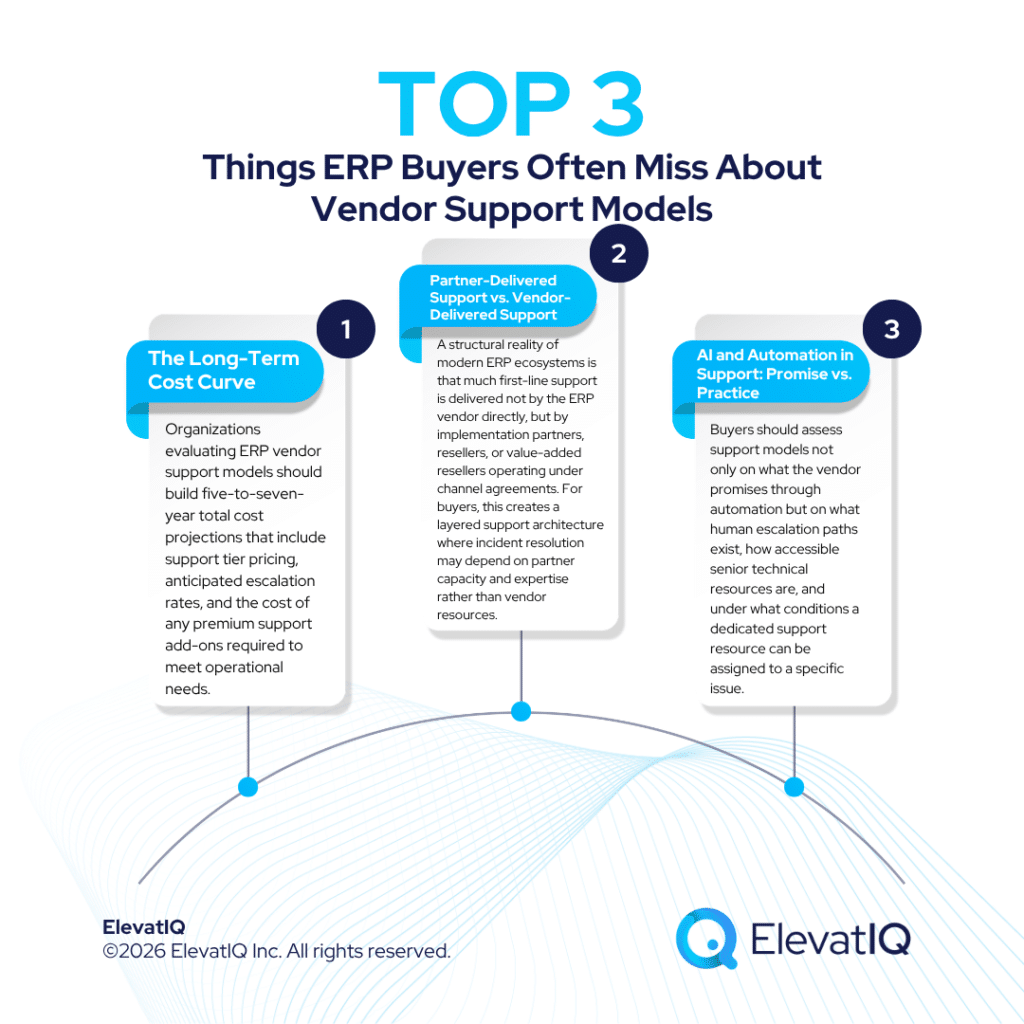
Organizations evaluating ERP vendor support models should build five-to-seven-year total cost projections that include support tier pricing, anticipated escalation rates, and the cost of any premium support add-ons required to meet operational needs.
Partner-Delivered Support vs. Vendor-Delivered Support
A structural reality of modern ERP ecosystems is that much first-line support is delivered not by the ERP vendor directly, but by implementation partners, resellers, or value-added resellers operating under channel agreements. For buyers, this creates a layered support architecture where incident resolution may depend on partner capacity and expertise rather than vendor resources.
This arrangement is not inherently problematic, but it requires clarity in the contract about who owns which support obligation, what escalation paths exist to the vendor when the partner cannot resolve an issue, and how response time commitments are measured across the partner-vendor boundary. Evaluating ERP vendor support models means mapping this layered accountability before it becomes an operational problem.
AI and Automation in Support: Promise vs. Practice
ERP vendors are increasingly promoting AI-assisted support capabilities – automated ticket triage, self-service knowledge bases, virtual assistants for common queries. These tools have genuine utility for routine support scenarios. They are less suited to the kind of complex, environment-specific issues that enterprise ERP customers typically face when something goes wrong.
Buyers should assess support models not only on what the vendor promises through automation but on what human escalation paths exist, how accessible senior technical resources are, and under what conditions a dedicated support resource can be assigned to a specific issue.
Key Questions to Ask Before Agreeing to ERP Vendor Support Models
Organizations evaluating ERP vendor support models should bring a specific set of questions into contract negotiations rather than accepting standard terms at face value:
What is explicitly covered under the base support tier, and what requires an upgraded contract?
How does the vendor define incident severity levels, and does the buyer have any input into priority classification?
Are resolution time commitments included anywhere in the SLA, or only response time acknowledgments?
How are SLA metrics measured — at the platform level or at the application and process level?
What escalation path exists if the implementation partner cannot resolve a critical issue?
Are there annual escalation clauses in support pricing, and at what rate?
What data portability and exit support provisions exist if the relationship ends?
These questions do not require adversarial negotiating postures. They represent a reasonable baseline for understanding what an organization is actually purchasing when it commits to an ERP vendor relationship.
Evaluating ERP Vendor Support Models as Part of Vendor Selection
Support model assessment should not occur as a final contract review step. It belongs in the vendor evaluation phase, alongside functional fit and commercial benchmarking.
When comparing ERP vendors, buyers benefit from mapping support tier structures side by side rather than comparing headline subscription prices. The effective cost of a support model that requires a premium add-on to meet operational requirements may be meaningfully higher than a competitor’s all-inclusive arrangement, even if the base subscription appears lower.
Reference checks with existing customers should include specific questions about support experience, not just product satisfaction. Customers who have been through major incidents, upgrade cycles, or environment-specific issues offer the most relevant perspective on what vendor support actually looks like in practice.
The Conclusion
ERP vendor support models are a legitimate and complex area of commercial risk. The shift toward subscription-based delivery has introduced genuine benefits, including reduced infrastructure burden, faster update cycles, and cleaner commercial structures, alongside structural changes in how support obligations are defined and enforced.
Independent ERP advisors can provide meaningful value at this stage of the process, not by negotiating on a buyer’s behalf but by helping organizations understand what standard terms look like across the vendor landscape, where the material risks in specific contract structures are concentrated, and what provisions are genuinely negotiable versus standard boilerplate.
Organizations navigating ERP selection and contract review can benefit from the kind of vendor-neutral perspective that ElevatIQ’s independent advisory practice brings to enterprise technology selection. Understanding what you are actually buying, not just what the sales deck describes, is the foundation of a successful long-term ERP relationship.
ERP Selection: The Ultimate Guide
This is an in-depth guide with over 80 pages and covers every topic as it pertains to ERP selection in sufficient detail to help you make an informed decision.
Are ERP support models negotiable, or are they standardized?
Support tiers and SLA terms vary by vendor and by the size and strategic value of the customer relationship. Larger organizations with significant contract value generally have more leverage to negotiate support terms. That said, standard templates exist for a reason — vendors work from defined commercial structures, and buyers benefit from knowing what is genuinely flexible versus what is policy-level.
What is the difference between a support tier and a maintenance fee?
In on-premises ERP agreements, annual maintenance fees typically cover product updates, bug fixes, and access to support resources. In cloud subscription models, support is often bundled into the subscription but stratified into tiers with different response commitments and resource access levels. The functional distinction matters less than understanding exactly what each structure covers in your specific agreement.
How often do ERP vendors change their support terms?
Vendors reserve the right to update support policies, and cloud-era agreements often include provisions that allow modification of support terms with defined notice periods. Organizations should monitor vendor communications about support policy changes and understand what contractual recourse exists if terms are modified materially.
In the first week of November 2025, Tennant Company (NYSE: TNC) cut over to a new company-wide SAP cloud-based ERP system in North America. It is a Minnesota-based global manufacturer of industrial cleaning equipment, with approximately $1.3 billion in annual revenue. Within days, the business could no longer reliably process or ship customer orders.
The financial damage disclosed on February 24, 2026, was immediate and concrete. They were as follows:
Approximately $30 million in lost net sales in Q4 2025
A $22 million reduction in Q4 adjusted EBITDA
Over $20 million in unplanned remediation costs for 2026, against an original remediation budget of roughly $5 million
Gross profit margin collapsing from 41.3% in Q4 2024 to 34.6% in Q4 2025
Tennant’s stock falling 23.4% in a single trading session, from $82.30 to $63.02. Thus, erasing approximately $343 million in market capitalization
The EMEA go-live, previously scheduled for the following quarter, paused indefinitely
The combined revenue and EBITDA impact in a single quarter was approximately $52 million. The total ERP program investment since 2023 reached approximately $98 million. Multiple securities law firms launched investigations into whether Tennant had accurately represented the project’s progress and risk to investors before the North American disclosure.
An ERP go-live failure of this scale from a company that appeared to follow standard ERP implementation practices, phased its rollout, and acknowledged project risk publicly deserves close examination. Tennant had flagged the project publicly for years. It has acknowledged the risks openly and followed what appeared to be industry best practice in phasing the rollout geographically. The company assessed the Asia-Pacific deployment in September 2025 as successful. Then, it followed with a North American go-live described as extensively prepared. And it still failed.
The Setup: A Legitimate Transformation with a Sound Rationale
Tennant’s ERP consolidation was not an opportunistic initiative. In the Q4 2023 earnings call, CEO Dave Huml articulated the rationale directly. The company was running eight separate ERP systems globally on aging infrastructure. He described that consolidating them onto a single SAP cloud-based platform was essential to the company’s three-year growth strategy. The company estimated the program would cost approximately $75 million in total capital and operating expenditure through 2025, with around $37 million expected in 2024 alone.
The case for consolidation was well-reasoned. Eight fragmented ERP instances make data visibility, operational efficiency, compliance, and cybersecurity governance significantly more difficult to maintain. Bringing the entire enterprise onto a unified platform addresses all of those problems simultaneously.
Throughout 2024 and into 2025, Tennant provided investors with regular progress updates. The company characterized the project as “progressing as we’ve anticipated” and “on time and on budget.” By Q3 2025, it had completed the Asia-Pacific go-live and described it as successful. It had North America underway and scheduled EMEA for the following quarter. Then the Q4 2025 results hit. The ERP go-live failure in North America significantly offset the efficiency gains the consolidation program was designed to deliver over time.
What Actually Went Wrong
In CEO Dave Huml’s own words from the Q4 2025 earnings call:
“Despite a successful go-live in the APAC region in September and extensive preparation in North America, the cut-over of the ERP system in the first week of November introduced severe system functionality issues that limited our ability to enter orders, ship products, and service our customers.”
Three operational functions failed simultaneously at go-live: order entry, product shipment, and customer service. For a manufacturer whose revenue model depends on processing equipment orders and delivering them reliably, this is a failure in the core of the business, not in a peripheral administrative function.
The scale of the disruption indicates this was not a brief cutover hiccup that self-corrected within days. Stabilization challenges extended well beyond the initial go-live window, requiring significant additional investment. The 4x overrun on the original remediation budget is the clearest evidence of that. The company has paused the EMEA deployment indefinitely while North America continues its recovery.
ERP Selection Requirements Template
This resource provides the template that you need to capture the requirements of different functional areas, processes, and teams.
Why the Asia-Pacific Success Did Not Predict the North American Failure
One of the most instructive aspects of the Tennant case is the regional asymmetry. The Asia-Pacific rollout was assessed as successful in September 2025. Eight weeks later, the North American go-live failed.
Organizations commonly observe this pattern in phased ERP programs: earlier phases succeed, while the largest and most complex region experiences ERP go-live failure. Several structural factors explain it:
Transaction volume and complexity. North America is typically the largest revenue region for a global manufacturer. It concentrates the highest order volumes, the densest customer base, and the most complex fulfillment workflows. A system that processes APAC-scale transaction loads without incident may surface entirely different failure modes when exposed to North American peak volumes.
Integration depth. The number of systems, processes, and dependencies connected to the ERP grows with operational scale. North American operations typically carry more integration complexity, more third-party logistics connections, more distributor relationships, more legacy system touchpoints, than earlier-phase deployments.
Process variability. Even within a single ERP program, process configurations differ meaningfully across regions. Workflows validated in APAC may not accurately represent the configuration paths used in North America, meaning that testing results from the earlier go-live carry limited predictive value for the later one.
Cutover execution at scale. The mechanics of cutover including data migration, parallel running, fallback procedures, become materially more complex at North American scale than at APAC scale. Issues that are manageable at a smaller scale can cascade at a larger scale.
As noted in its analysis: phased rollouts do not eliminate risk, they redistribute it. Success in one region does not guarantee stability at scale, particularly when process and geography variability and operational complexity increase significantly in subsequent deployments.
ERP System Scorecard Matrix
This resource provides a framework for quantifying the ERP selection process and how to make heterogeneous solutions comparable.
The Investor Communication Dimension: A New Category of ERP Risk
The Tennant case introduces a risk dimension that most ERP implementation guides do not address: investor communication liability.
Following the February 24 disclosure, securities law firms including Bleichmar Fonti & Auld LLP and Hagens Berman launched investigations into whether Tennant’s prior statements about the ERP rollout accurately represented the project’s progress and risk. The central allegation is that the company characterized the project as on track and the Asia-Pacific go-live as successful in its investor communications, while North America was experiencing or heading toward problems that those communications did not reflect.
These are investigations, not proven findings. They do not establish wrongdoing. But their existence and the speed with which they were launched highlight an important structural point: publicly listed organizations now recognize ERP implementations as material business events subject to the same disclosure expectations as financial restatements and operational incidents.
The gap between internal awareness of ERP go-live failure risk and external communication of that risk is no longer purely a reputational concern. It has become a legal one. For enterprise leaders, including those at privately held companies, where the audience is lenders, private equity sponsors, or boards rather than public investors, the broader principle applies: governance structures must ensure that decision-makers receive timely, honest program health reporting rather than filtered status updates calibrated to maintain organizational momentum.
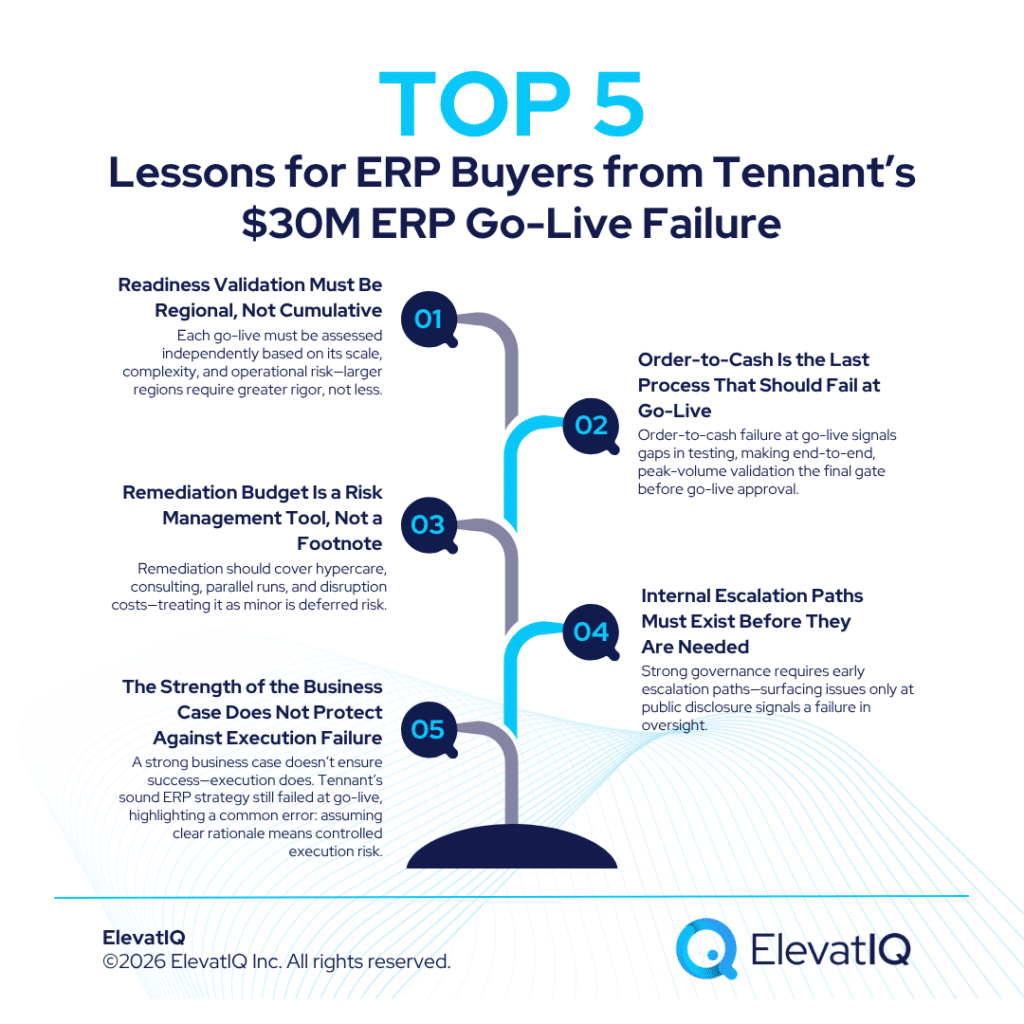
Five Lessons Enterprise Buyers Must Apply
The Tennant ERP go-live failure is not an isolated anomaly. It reflects failure patterns that appear consistently in large-scale ERP programs. Each of the following lessons is directly traceable to what the Tennant case reveals.
1. Readiness Validation Must Be Regional, Not Cumulative
The North American go-live was preceded by extensive preparation, per the CEO’s own account. The Asia-Pacific success was cited as evidence that the program was proceeding well. Neither was sufficient.
Go-live ERP readiness assessments must be conducted fresh against the specific conditions of each deployment. Its transaction volumes, integration dependencies, cutover complexity, and operational criticality, not inherited from prior phases. The fact that APAC completed without an ERP go-live failure does not reduce the rigor required for North America. In many cases, it should increase it, precisely because North America carries materially higher operational stakes.
2. Order-to-Cash Is the Last Process That Should Fail at Go-Live
The inability to enter orders, ship products, and service customers is a failure in the revenue-generating core of the business. ERP go-live failure in these processes converts immediately and visibly into lost sales, customer relationship damage, and market reaction.
Any ERP program that allows order-to-cash to fail at go-live may indicate gaps in integration testing or cutover validation and an ERP go-live failure in order fulfillment is among the most damaging outcomes possible for a manufacturer. Testing the order-to-cash workflow, including every system that touches a customer order from entry through shipment confirmation under realistic peak-volume conditions should be the final gate before any go-live authorization is granted.
3. Remediation Budget Is a Risk Management Tool, Not a Footnote
Tennant’s remediation costs for 2026 exceeded $20 million against a planned $5 million. A 4x overrun on the remediation line alone, on top of a total program that had already grown from an estimated $75 million to approximately $98 million. This reflects a pattern often observed in failed ERP programs: remediation is budgeted as a small post-go-live support line rather than as a genuine contingency against stabilization failure.
A realistic ERP remediation budget accounts for extended hypercare, emergency consulting, parallel running costs, potential module re-implementation, and the customer-facing costs of fulfillment disruption. Treating remediation as a minor budget item is not conservatism, it is deferred risk.
4. Internal Escalation Paths Must Exist Before They Are Needed
The Tennant CEO’s statement that North America was extensively prepared before go-live, combined with the severity of the failure, raises a question that is relevant to every complex ERP program: at what point was the executive leadership team receiving signals that the North American go-live carried elevated risk, and what were the escalation and decision-making structures that processed those signals?
Clear internal escalation paths and transparent external communication plans should be in place well before go-live. A program governance structure that surfaces problems only at the point of public disclosure has failed its primary purpose.
5. The Strength of the Business Case Does Not Protect Against Execution Failure
Tennant’s consolidation rationale, eliminating eight fragmented ERP instances, building unified digital infrastructure, enabling growth, was sound and publicly stated. The investment was authorized and progressed over multiple years with board involvement. None of that protects the organization from the consequences of an ERP go-live failure in the most operationally critical region.
The business case justifies the investment decision. Execution discipline determines the outcome. They are separate matters, and conflating the two, using the clarity of the rationale as evidence that the execution risk is under control, is one of the most common governance errors in large technology programs.
What This Means for Organizations Currently Mid-Program
For enterprise buyers already in an ERP program, approaching a regional go-live or preparing a North American or full-scale deployment after earlier phases – the Tennant case raises questions that deserve honest answers before the go-live window closes:
Has a fresh, independent readiness assessment been completed specifically for this deployment, not carried over from the prior phase?
Has the order-to-cash workflow been stress-tested under peak-volume conditions with all integration dependencies active?
Does the remediation budget reflect a realistic worst-case stabilization scenario, not just planned hypercare?
Are internal program health reports providing honest risk visibility to executive leadership, or are they filtered through project team optimism?
Is the board or audit committee receiving implementation risk updates on a cadence appropriate to the business materiality of the go-live?
None of these questions require an ERP go-live failure to answer. They are commonly considered elements of rigorous program governance, the kind that separates ERP implementations that stabilize quickly from those that generate $52 million in combined revenue and EBITDA impact in a single quarter.
Conclusion
Tennant Company’s ERP go-live failure is a costly, current, and exceptionally well-documented case study in what happens when the largest and most operationally complex deployment in a phased ERP program is not validated to a standard commensurate with its complexity and business criticality. The $30 million in lost sales, the 23.4% single-day stock drop, the paused EMEA rollout, the ongoing securities investigations, and the multi-year distraction from strategic priorities are the measurable cost of that gap.
The company had a sound rationale. It followed a phased approach. It acknowledged the risk publicly. The available evidence suggests the issue was less about strategy and more about execution validation at the point where failure could no longer be contained. For enterprise buyers at any stage of their own ERP journey, this case reinforces what independent ERP advisors emphasize consistently: the business case for transformation is rarely the problem. The problem is almost always in the governance, testing discipline, and escalation structures that determine whether the go-live delivers on that case or undermines it.
ElevatIQ’s enterprise technology selection and implementation advisory services are specifically designed to provide the independent oversight that internal teams – under deadline pressure and organizational momentum, can find difficult to sustain. As independent ERP advisors, ElevatIQ works with organizations to ensure that go-live readiness is assessed against the actual conditions of each deployment, not against the success of the phase that came before it.
ERP Selection: The Ultimate Guide
This is an in-depth guide with over 80 pages and covers every topic as it pertains to ERP selection in sufficient detail to help you make an informed decision.
Tennant’s Q4 2023 earnings call confirmed the company was consolidating its eight existing ERP systems onto a SAP cloud-based solution as part of a program originally estimated at approximately $75 million through 2025.
What exactly failed during Tennant’s North American go-live?
Per CEO Dave Huml’s statement in the Q4 2025 earnings call, the cutover in the first week of November 2025 introduced severe system functionality issues that limited Tennant’s ability to enter orders, ship products, and service customers. All three represent core revenue-generating operational functions.
How much has the Tennant ERP program cost in total?
The program was originally estimated at approximately $75 million in total capital and operating expenditure. By 2026, total investment since 2023 had reached approximately $98 million, with 2026 remediation costs expected to exceed $20 million against an original plan of roughly $5 million.
When ERP systems go down, the financial consequences accumulate fast. Order processing halts. Financial close cycles stall. Production schedules break. Customer commitments are missed. For organizations running mission-critical operations on a single ERP platform, unplanned downtime is not an inconvenience. It is a direct operational and financial crisis.
Yet when most buyers negotiate ERP contracts, disaster recovery provisions receive far less scrutiny than pricing, licensing terms, or implementation scope. The result is that disaster recovery in ERP contracts is silent or vague. Especially, on exactly the commitments that matter most when something goes wrong.
Disaster recovery in ERP contracts deserves dedicated negotiation effort. This blog covers what buyers need to address – RTO and RPO commitments, backup requirements, cloud provider responsibilities, and the testing rights that determine whether any of it actually works in practice.
Why Disaster Recovery in ERP Contracts Gets Overlooked
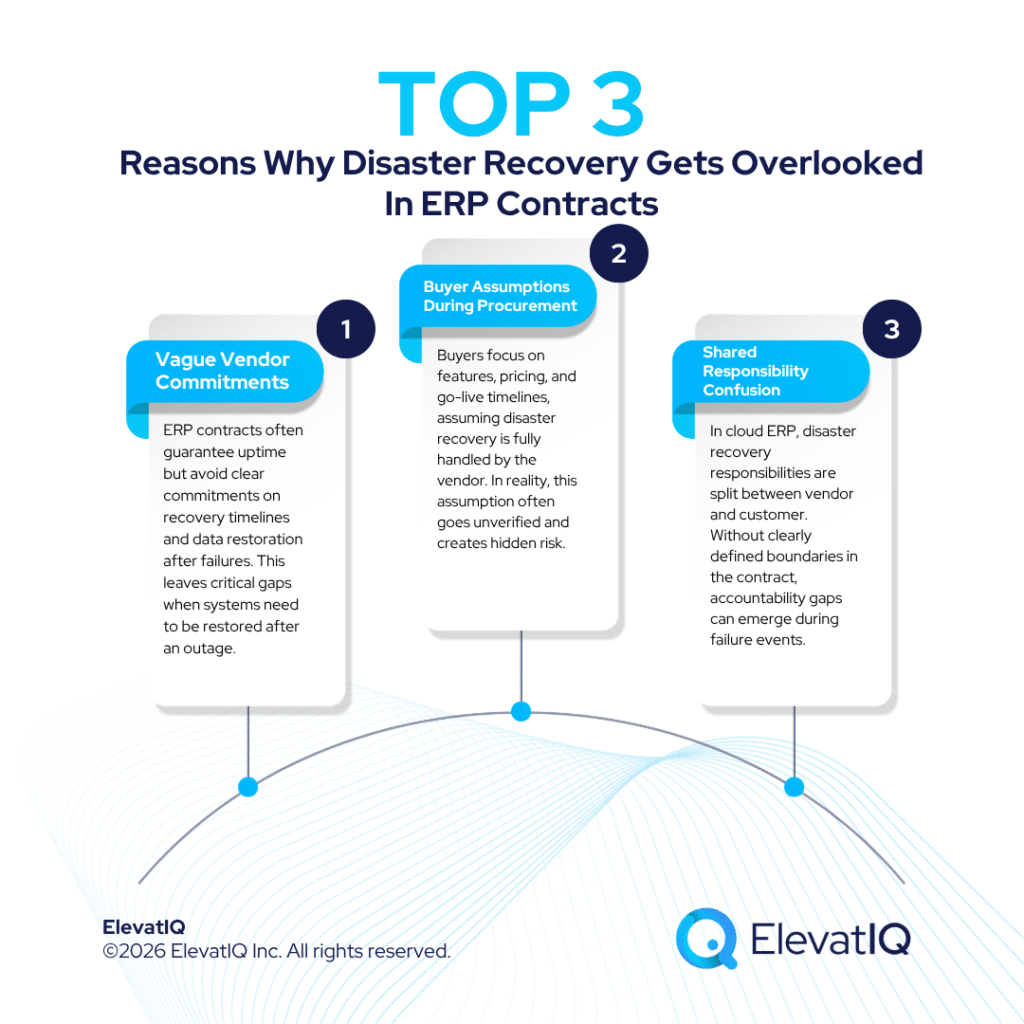
The gap in many ERP contracts is not always accidental. Vendors may benefit from vague language. Standard SaaS agreements typically guarantee infrastructure uptime, the availability of the platform but stop well short of committing to specific data recovery timelines or functional restoration standards after a failure event.
Buyers, focused on features, price, and go-live timelines during contract negotiations, often accept this framing. The assumption, especially for cloud ERP deployments, is that the vendor is handling disaster recovery as part of the service. That assumption is often incorrect, and addressing disaster recovery in ERP contracts before signing is far less costly than discovering the gap after an outage.
The distinction matters most in the cloud context, where the shared responsibility model explicitly divides accountability between vendor and customer. Understanding exactly where that line falls and negotiating contract language that locks it down is a foundational step in any ERP procurement.
RTO and RPO: The Two Numbers That Define Your Risk Exposure
Recovery Time Objective (RTO) and Recovery Point Objective (RPO) are the two core metrics that any discussion of disaster recovery in ERP contracts must address. They are not technical details for the IT team to handle separately, they are business risk decisions that belong in the contract itself.
Recovery Time Objective (RTO) defines the maximum amount of time the ERP system can be offline before the outage becomes operationally unacceptable. It answers the question: how quickly must the system be restored? An RTO of four hours means the vendor is committing to have the system operational within four hours of a declared disaster event.
Recovery Point Objective (RPO) defines the maximum amount of data loss, measured in time, that the organization can tolerate. It answers the question: how current must the data be when we recover? An RPO of one hour means the system will be restored with no more than one hour of transactional data lost.
Both metrics look in different directions from the point of failure. RPO looks backward – how recent was the last recoverable backup? RTO looks forward – how long until systems are back online?
Setting Appropriate Targets for Mission-Critical ERP
Not all ERP modules carry the same criticality, and RTO/RPO targets should reflect that. A financial close system processing period-end entries carries different risk than a secondary reporting module. Buyers should conduct a Business Impact Analysis (BIA) before contract negotiations to understand the operational and financial cost of downtime per hour across core ERP functions. This analysis anchors RTO/RPO discussions in business reality rather than arbitrary benchmarks.
As a general orientation, enterprise-class ERP providers running managed hosting environments may support RPO targets as tight as 30 minutes and RTO windows in the two- to four-hour range for high-priority workloads. However, achieving tighter targets requires both the right infrastructure architecture and explicit contractual commitments, not assumptions. Buyers should press vendors on what specific RTO and RPO figures they can commit to contractually, not just what they claim is technically possible.
What Contract Language Should Capture
Vague language like “best efforts to restore within a reasonable timeframe” is not enforceable and provides no recourse. Disaster recovery in ERP contracts must specify:
Named RTO and RPO figures, expressed in hours or minutes, not qualitative terms
The definition of a “disaster event” that triggers these commitments including whether ransomware, accidental deletion, and partial system failures are covered alongside infrastructure outages
Whether the committed RTO and RPO apply to the full ERP system or only to specific components
Financial remedies – service credits or penalties, that apply if the vendor misses committed recovery targets
Escalation procedures and communication timelines during a declared disaster event
ERP Selection Requirements Template
This resource provides the template that you need to capture the requirements of different functional areas, processes, and teams.
Understanding Cloud Provider Responsibilities: The Shared Responsibility Gap
One of the most consequential misunderstandings in disaster recovery in ERP contracts is the assumption that moving to cloud ERP transfers disaster recovery responsibility to the vendor. It does not, at least not entirely.
Every major cloud provider including those underpinning ERP platforms like SAP S/4HANA Cloud, Oracle Fusion ERP, and Microsoft Dynamics 365 operates under a shared responsibility model. The specifics vary by deployment type, but the general principle is consistent:
The cloud provider is responsible for the availability and resilience of the infrastructure – the physical data centers, the network, the compute and storage layers, and the platform uptime.
The customer retains responsibility for how data is configured, replicated, governed, and recovered at the application and data level.
Oracle has stated this plainly in its cloud documentation: while OCI is responsible for resilience of the cloud, the customer is responsible for resilience in the cloud. Microsoft’s Azure shared responsibility documentation makes the same distinction. Customers who design and implement DR strategies including cross-region replication, failover configurations, and recovery runbooks – are better protected than those who rely on platform-level availability SLAs alone.
For buyers, this means disaster recovery in ERP contracts must address two distinct layers:
Data center redundancy and geographic failover capability
Platform uptime SLA (typically 99.9% or higher, but note this governs availability, not recovery from failure)
Incident notification timelines and communication protocols during outages
Application and data-level commitments (negotiated boundary)
Backup frequency and retention period for the customer’s ERP data
Geographic location of backup copies (same-region vs. geo-redundant)
Who is responsible for executing recovery steps – the vendor’s managed services team, or the customer’s IT organization
Whether the vendor provides a managed DR service as part of the standard subscription or as a separately priced add-on
Many SaaS ERP contracts may not explicitly address the second set of items, leaving buyers to assume coverage they do not have. Explicit contract language assigning responsibility for each layer is essential.
Backup Requirements: Frequency, Retention, and Access
Backup provisions are the operational foundation of any DR commitment. Disaster recovery in ERP contracts should define:
Backup frequency: How often is a full backup of the ERP environment taken? For most enterprise ERP deployments, daily full backups with continuous log archiving between snapshots is commonly considered a baseline approach. Buyers with tighter RPO requirements should ask whether intraday or near-continuous replication is available and contractually committed.
Retention period: How long are backup copies retained? Standard commercial terms often default to 30 days. Organizations with compliance, audit, or regulatory obligations – financial services, healthcare, government contractors, frequently need longer retention periods, sometimes 90 days or more. This needs to be in the contract, not handled as a configuration default that can change.
Geographic redundancy: Are backup copies stored in a separate geographic region from the primary system? Single-region backups are vulnerable to the same regional event that caused the primary outage. Geo-redundant storage ensures that a natural disaster, data center failure, or regional infrastructure incident does not take out both the primary system and its backups simultaneously.
Buyer access to backups: Can the buyer independently access backup data, or must all recovery operations go through the vendor? This matters both for operational control and for scenarios where the vendor relationship has terminated or the vendor has gone out of business. Contracts should guarantee buyer access to backup data regardless of contract status.
ERP System Scorecard Matrix
This resource provides a framework for quantifying the ERP selection process and how to make heterogeneous solutions comparable.
DR Testing Rights: The Provision Most Contracts Omit
Of all the elements of disaster recovery in ERP contracts, DR testing rights are the most commonly absent and their absence can turn a written commitment into an unverified assumption.
A vendor can document robust RTO and RPO targets in a contract. Without regular, verified testing, neither the buyer nor the vendor actually knows whether those targets are achievable. Hardware configurations change. Data volumes grow. Integration dependencies evolve. A DR plan that worked eighteen months ago may not perform the same way today.
DR testing rights that buyers should negotiate into any ERP contract
Annual failover testing: The right to require the vendor to execute a full DR failover test at least once per year, demonstrating that systems can be restored to the contracted RTO and RPO targets under realistic conditions.
Tabletop exercise participation: The right to participate in or independently conduct tabletop exercises that walk through disaster scenarios, validate escalation procedures, and confirm that both vendor and customer teams understand their respective roles.
Access to test results: The right to receive written documentation of DR test outcomes, including whether RTO and RPO targets were met, what issues were identified, and what remediation steps were taken.
Unannounced testing rights: For the most risk-sensitive organizations, the right to request a DR test on reasonable notice – say, 30 days, without having to wait for an annually scheduled exercise.
Remediation obligations: If a DR test reveals that the vendor cannot meet committed RTO or RPO targets, the contract should specify a remediation timeline and an escalation path if issues are not resolved.
The absence of testing rights means the buyer has a paper commitment that has never been verified. For mission-critical ERP systems where downtime costs thousands of dollars per hour, that may not be an acceptable position for many organizations.
On-Premises vs. Cloud ERP: How DR Responsibilities Differ
Disaster recovery in ERP contracts looks different depending on the deployment model, and buyers should approach negotiation accordingly.
Cloud SaaS ERP: The vendor manages infrastructure, platform, and often application-layer backups as part of the service. The risk for buyers is assuming that this coverage is complete without verifying what is and is not included. The shared responsibility gap described above is most pronounced here. Key negotiation focus: defining the exact scope of vendor-managed DR, locked-down RTO/RPO commitments, and testing rights.
Cloud IaaS/PaaS (customer-managed ERP on cloud infrastructure): The buyer is responsible for a broader range of DR decisions such as replication configuration, failover architecture, and recovery runbook design, while the cloud provider manages the underlying infrastructure. Key negotiation focus: infrastructure availability SLAs, support for DR architecture implementation, and contractual clarity on where provider responsibility ends.
On-premises ERP: The buyer owns the full DR stack, but the ERP vendor’s contract still plays a role, specifically around support during recovery events, access to disaster recovery licenses for standby systems, and the vendor’s own obligations if software bugs contributed to a data loss event. Key negotiation focus: DR-specific license terms, support response commitments during outages, and vendor liability for data loss attributable to defective software.
Connecting DR Commitments to Broader Business Continuity Planning
Disaster recovery in ERP contracts does not exist in isolation. ERP is typically one of several interconnected systems such as EDI integrations, financial reporting tools, third-party logistics platforms, CRM, that together enable business operations. A contractual DR commitment that covers the ERP platform but not its integration dependencies leaves the organization partially protected at best.
Buyers should ensure that DR contract provisions account for:
Integration recovery sequencing: In what order must interconnected systems be restored for the ERP to function usefully after a failover?
Dependency mapping: Which third-party systems or APIs does the ERP rely on, and what are those providers’ DR commitments?
Data reconciliation procedures: After recovery, how are data discrepancies between the ERP and connected systems identified and resolved?
These cross-system considerations are frequently outside the scope of standard vendor contract templates, which is exactly why they need to be raised explicitly during negotiation.
Conclusion
Disaster recovery in ERP contracts is not a technical afterthought – it is a direct expression of how much operational risk an organization is willing to accept without contractual protection. ERP systems are among the most mission-critical platforms in any enterprise. The cost of unplanned downtime measured in lost transactions, missed reporting deadlines, and broken customer commitments, is too high to leave DR provisions to standard vendor language.
Buyers who invest the effort to negotiate specific RTO and RPO targets, clear backup requirements, defined cloud provider responsibilities, and enforceable testing rights are far better positioned than those who accept default contract terms and discover the gaps only when something goes wrong. Getting disaster recovery in ERP contracts right is not inherently complex but it does require knowing what to ask for.
Working with independent ERP advisors who have evaluated DR provisions across dozens of vendor agreements gives organizations the benchmarking intelligence to know what is achievable, what is negotiable, and what red flags to watch for in standard vendor templates. ElevatIQ’s enterprise technology selection and IT procurement advisory services include contract review support specifically designed to surface gaps in disaster recovery, SLA, and business continuity provisions helping organizations secure the protections they need from independent ERP advisors who negotiate vendor agreements every day.
ERP Selection: The Ultimate Guide
This is an in-depth guide with over 80 pages and covers every topic as it pertains to ERP selection in sufficient detail to help you make an informed decision.
What are RTO and RPO, and why are they critical in ERP contracts?
RTO (Recovery Time Objective) defines how quickly the ERP system must be restored after a disruption, while RPO (Recovery Point Objective) defines how much data loss is acceptable. These are not just technical metrics—they directly determine business risk. Without clearly defined and contractually committed RTO and RPO targets, organizations have no guarantee on recovery timelines or data integrity after an outage.
Does moving to cloud ERP mean the vendor fully handles disaster recovery?
No. Cloud ERP operates under a shared responsibility model. While vendors manage infrastructure availability, customers are often still responsible for aspects like data configuration, replication, and recovery processes. Many contracts do not clearly define these boundaries, which can leave critical gaps unless explicitly addressed during negotiation.
Why are disaster recovery testing rights important in ERP contracts?
Testing rights ensure that disaster recovery plans actually work in practice, not just on paper. Without regular failover testing, tabletop exercises, and access to test results, there is no way to verify whether the vendor can meet committed RTO and RPO targets. For mission-critical ERP systems, untested recovery plans can create significant operational and financial risk during real outages.
Signing an ERP implementation contract is one of the highest-stakes procurement decisions an organization will make. Yet many buyers focus almost entirely on software licensing costs and give far less scrutiny to the one document that determines who absorbs the financial pain when things go wrong: the implementation services agreement itself.
The choice between a fixed price and a time and materials (T&M) ERP implementation contract is rarely about which model is inherently superior. It is about which one is appropriate for your specific project conditions and whether you have negotiated enough protections within that model to keep risk where it belongs.
This blog examines both ERP implementation contract models in depth, covering how each allocates risk, what change order provisions should look like, and what buyers should demand regardless of which model they choose.
What the Two Contract Models Actually Mean
Before evaluating risk, it helps to be precise about what each model commits both parties to.
Fixed Price Contracts
Under a fixed price model, the vendor agrees to deliver a defined scope of work for a predetermined total fee. Payments are typically structured around project milestones, for example, a portion at kickoff, another at user acceptance testing, and the final amount at go-live.
Key characteristics:
Scope, deliverables, and timeline are defined and locked before work begins
The vendor absorbs the financial risk if their estimates are wrong or work takes longer than planned
Any requirement not explicitly covered in the contract scope is subject to a formal change order and additional fees
Vendors typically build a risk contingency buffer into their pricing to protect against uncertainty
The last point matters more than most buyers realize. Because vendors are accepting delivery risk, they price that risk into the contract. Fixed price contracts tend to include contingency buffers for unknowns, which can inflate the project cost by 15% to 30% or more, and the client pays this premium regardless of whether the risks ever materialize.
Time and Materials Contracts
Under a T&M model, the buyer pays for actual hours worked at pre-agreed rates, plus any direct project expenses. There is no guaranteed final price; the total depends entirely on how long the work takes.
Key characteristics:
The scope can evolve throughout the project without formal ERP renegotiation
The buyer absorbs the financial risk if implementation takes longer than expected
Vendor invoices are based on actual time spent, requiring the buyer to monitor hours closely
There may be limited direct incentive for vendors to optimize efficiency, since they are paid for the time and materials utilized, without the same direct time-based incentive to complete the project quickly.
The flexibility of T&M suits projects where requirements are not fully defined or where significant customization is anticipated. However, without spending controls built into the contract, T&M can expose buyers to runaway costs when scope expands or technical complexity proves greater than expected.
The vendor carries execution risk – if they underestimate effort, they absorb the cost overrun. This sounds like a buyer-friendly arrangement, and in theory it is. In practice, vendors manage this risk through two mechanisms that shift it back to buyers:
Scope inflation at the change order stage. Because any work not explicitly described in the contract can be classified as out-of-scope, vendors may have an incentive to define scope narrowly and then bill for changes. Vague or incomplete ERP requirements documentation creates fertile ground for change order disputes.
Risk premium pricing. Vendors build uncertainty buffers into fixed price bids. If the project runs smoothly, the buyer may have paid more than the actual delivery cost. If disputes arise over scope, the buyer may face both the premium already paid and additional change order fees.
Under a Time and Materials Contract
The buyer carries cost risk, if the project expands or takes longer, their costs rise proportionally. Industry studies suggest that approximately 47% of ERP implementation projects experience cost overruns.Separately, among organizations that did exceed their budgets, nearly 35% said the initial project scope was expanded NetSuite – the exact dynamic that T&M contracts leave financially unprotected by default.
Vendors operating under T&M also face reduced accountability for delivery quality. Since they are compensated regardless of outcomes, contractual performance standards and acceptance criteria become even more important under this model than under fixed price.
ERP System Scorecard Matrix
This resource provides a framework for quantifying the ERP selection process and how to make heterogeneous solutions comparable.
Change Order Procedures: Where Contracts Succeed or Fail
Regardless of which model a buyer selects, change order procedures are where the practical protection lives. Both ERP implementation contract models are vulnerable to disputes when change order language is weak. Under a fixed price contract, every request the vendor classifies as outside the original scope becomes a potential change order. Without clear definitions of what constitutes a legitimate change versus a clarification of vague scope, vendors can impose additional fees on items a reasonable buyer would consider implied by the original requirements.
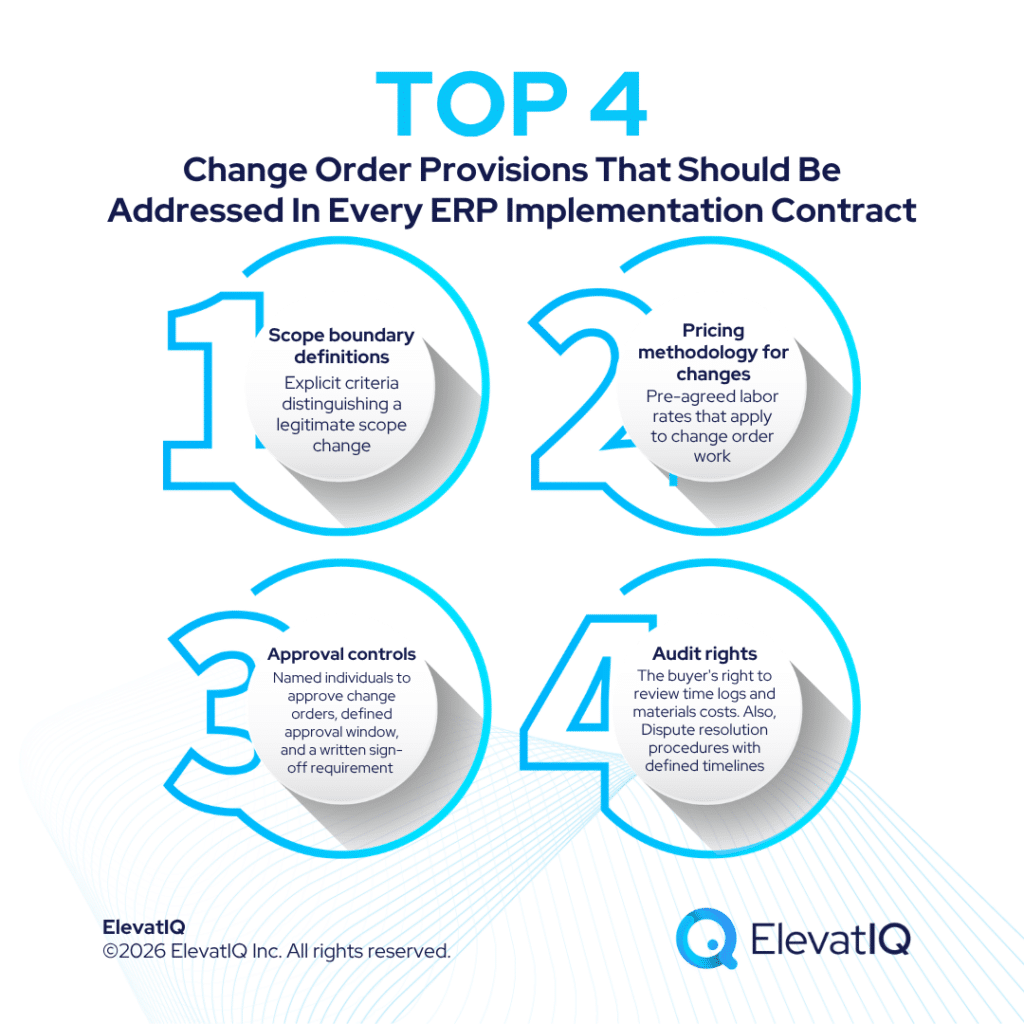
Under a T&M contract, scope changes have no formal gate – work simply continues. Without a structured change request process, it becomes difficult to track what was originally agreed upon, what was added, and at whose request. Strong change order provisions should address the following regardless of which ERP implementation contract model is in use:
Scope boundary definitions
Explicit criteria distinguishing a legitimate scope change from a clarification or correction of ambiguous vendor documentation
A process for the buyer to dispute vendor claims that work falls outside original scope
Pricing methodology for changes
Pre-agreed labor rates that apply to change order work, preventing vendors from charging premium rates for out-of-scope items
A cap on change order markup or overhead percentages
Written itemized estimates for each change request before work begins
Approval and authorization controls
Named individuals on the buyer side with authority to approve change orders
A defined approval window (e.g., five business days) to prevent delays from authorization bottlenecks
A written sign-off requirement before any out-of-scope work commences
Audit rights
The buyer’s right to review time logs and materials costs supporting any change order invoice
Dispute resolution procedures with defined timelines if a buyer contests a change order
One practical note: change order disputes are commonly cited as a major source of conflict in ERP projects. High-profile cases like the MillerCoors vs. HCL dispute which resulted in a $100 million lawsuit before eventual settlement, were attributed by outside observers to contracts that were loosely defined and left substantial room for disagreement about what each party had committed to deliver.
Cost Controls Buyers Should Negotiate Into Either Model
Beyond change order language, buyers can negotiate additional protections into any ERP implementation contract – fixed price or T&M alike.
For Fixed Price Contracts
Scope completeness warranty: Require the vendor to warrant that their fixed price proposal reflects a complete and accurate assessment of the work required to meet documented requirements. This limits the vendor’s ability to reclassify work as out of scope based on their own estimating errors.
Acceptance criteria with teeth: Define functional acceptance criteria that must be met before milestone payments are released. “Substantially conforms to documentation” is not an acceptable standard. Require documented test cases with pass/fail criteria.
Change order volume caps: Negotiate a threshold beyond which aggregate change order costs trigger a contract renegotiation or an ERP independent assessment. This prevents a nominally fixed price contract from becoming variable in practice through uncontrolled scope additions.
For Time and Materials Contracts
Not-to-Exceed (NTE) clauses: A Not-to-Exceed cap establishes a ceiling on total billable hours or total project cost, beyond which the vendor cannot charge without a formal, buyer-approved change order. This hybrid approach offers the best of both worlds – the project operates on a flexible T&M basis, but is bound by a firm budget ceiling, providing the adaptability of T&M with the budget protection of a fixed price model.
Spending authorization thresholds: Require vendor notification when cumulative costs reach defined percentages of the project budget, for example, at 50%, 75%, and 90% of the NTE cap. This builds early warning into the contract rather than surfacing overruns only at invoice time.
Role-based rate schedules: Pre-agree specific hourly rates for each resource category (project manager, functional consultant, technical consultant, integration specialist). This prevents vendors from staffing projects with senior resources at premium rates for work that does not require that level of seniority.
Time-log transparency: When internal resources run low, organizations frequently use a software vendor’s services team or third-party consultants more than planned, with experienced ERP consultants typically running $150–175 per hour plus travel expenses. NetSuite requires weekly time-log submissions broken down by task, resource, and project phase, which gives buyers the visibility to govern these costs proactively.
Which Model Is Right for Your ERP Project?
There is no universally correct answer. It depends on the state of your requirements and your organization’s capacity to govern the implementation actively.
Fixed price contracts are generally more appropriate when:
Requirements are fully documented, stable, and unlikely to change significantly during implementation
The organization needs budget certainty for internal planning or board-level approvals
The buyer has limited bandwidth to monitor vendor activity on a day-to-day basis
Time and materials contracts are generally more appropriate when:
Requirements are still evolving or involve significant business process redesign
The project involves heavy customization or complex integrations where effort is genuinely hard to estimate upfront
The organization has strong internal project management capability and can monitor vendor hours closely
Speed of iteration is a priority and formal change order cycles would slow progress unacceptably
A hybrid approach – T&M for early discovery and design phases, transitioning to fixed price for defined build phases – is also worth considering for complex ERP implementations. This structure is well-suited to large ERP rollouts: fixed price for well-scoped modules where the vendor has repeatable implementation patterns, and T&M for integration, customization, and cutover support.It allows requirements to stabilize through T&M engagement before locking a price, reducing the vendor’s justification for large contingency buffers.
The Question Buyers Often Miss
Most discussions about ERP implementation contract models focus on which model is less risky. The more useful question is: which model are you actually equipped to manage?
A fixed price contract with weak scope definitions and no change order controls does not protect a buyer. Neither does a T&M contract with no spending caps and no time-log visibility requirements. The contract model is a framework. The protection comes from the specific language within it.
The MillerCoors case underscores a broader lesson: when ERP contracts are poorly defined and loosely based, neither party has a clear definition of success or responsibility – setting the stage for disputes where the cost of legal escalation can quickly eclipse the original project investment.Organizations that lack internal expertise in technology contract negotiation frequently discover this distinction only after costs have escalated.
Conclusion
Both fixed price and T&M ERP implementation contract models offer legitimate paths to a well-governed ERP project – under the right conditions and with the right provisions in place. Fixed price shifts execution risk to the vendor but requires precise scope documentation and disciplined change order controls to prevent that protection from eroding. T&M preserves flexibility but demands NTE caps, rate transparency, and active buyer oversight to remain cost-controlled.
For most mid-market and enterprise buyers, the single most important step is engaging qualified support before the contract is signed, not after disputes arise. Independent ERP advisors – those without financial relationships with the software vendors or system integrators on the other side of the table – are best positioned to evaluate which model fits a specific project and negotiate the provisions that make it enforceable.
ElevatIQ’s enterprise technology selection and IT procurement advisory services support buyers through both the vendor selection process and the contract negotiation stage. Working as independent ERP advisors, the team reviews proposed contract structures, flags risk allocation gaps, and helps organizations secure language that improves vendor accountability regardless of which pricing model is on the table.
ERP Selection: The Ultimate Guide
This is an in-depth guide with over 80 pages and covers every topic as it pertains to ERP selection in sufficient detail to help you make an informed decision.
Which ERP implementation contract model is less risky: fixed price or time and materials?
Neither model is inherently less risky—it depends on the project and how well the contract is structured. Fixed price shifts execution risk to the vendor but can lead to higher upfront costs and change order disputes if scope is unclear. Time and materials offers flexibility but shifts cost risk to the buyer unless controls like not-to-exceed (NTE) caps and spending thresholds are in place.
Why do change orders become a major problem in ERP implementation contracts?
Change orders often become a problem because of unclear scope definitions. In fixed price contracts, vendors may classify additional work as out-of-scope and charge extra. In time and materials contracts, changes can accumulate without clear tracking or approval. Without strong change order procedures—such as defined scope boundaries, pricing rules, and approval controls—costs can escalate quickly and lead to disputes.
What protections should buyers negotiate regardless of the contract model?
Buyers should negotiate protections such as clear acceptance criteria, transparent pricing for changes, audit rights over vendor billing, and defined approval processes for additional work. For fixed price contracts, this includes scope completeness warranties and limits on change order volume. For time and materials, key protections include NTE caps, rate controls, and time-log transparency to prevent cost overruns.
Software license audits are often perceived as extending beyond pure compliance checks. For most large ERP vendors, they can also serve as a revenue-generating mechanism. That is, a structured process for identifying gaps between what customers technically owe under a complex licensing agreement and what they actually paid for. Understanding ERP audit rights before you sign a contract is one of the most financially consequential steps an organization can take. Yet it rarely receives the attention it deserves during procurement.
This blog breaks down how vendor audit clauses work. What makes them dangerous, and what ERP audit rights protections buyers should negotiate. Especially, before they find themselves on the receiving end of a multi-million dollar true-up demand.
Why ERP Vendors Are Auditing More Aggressively Than Ever
Software license audits are not new. But the frequency and financial stakes have shifted considerably in recent years. Industry data published in 2025 indicates that 62% of companies faced software vendor audits in 2024. Thus, up by 40% the previous year. For organizations with more than 5,000 employees, that figure climbed to 66%. The same research found that nearly one in three organizations incurred financial liabilities exceeding one million dollars from audits in 2024. This is more than three times the share from just two years prior.
The drivers behind this surge are not difficult to identify. Enterprise software vendors face consistent pressure to grow revenue year over year. And audits have become a reliable mechanism for achieving that. Especially in mature markets where new customer acquisition has slowed. When a vendor’s quarterly earnings fall short of analyst expectations, audit activity may increase. The relationship is not coincidental.
Oracle, SAP, and VMware (under Broadcom) have consistently ranked among the most active audit initiators in the enterprise software market. Each brings a distinct approach. Oracle has long been known for aggressive enforcement around database and Java licensing. SAP is particularly active around indirect access and integration usage. And, Broadcom’s acquisition of VMware triggered a significant escalation in audit activity alongside sweeping licensing model changes. Vendor audit teams are often embedded within the sales organization and incentivized to convert findings into revenue-generating amendments. A structural fact that should inform how buyers approach every audit interaction.
What ERP Audit Rights Clauses Actually Say
Most enterprise ERP contracts contain an audit rights clause. This grants the vendor the ability to examine a customer’s systems and usage data to verify licensing compliance. These clauses are typically presented as standard, non-negotiable provisions. In practice, many are neither.
Standard audit rights language tends to be broad and buyer-unfavorable. It may grant the vendor the right to conduct audits with little advance notice, at any time, and any frequency. Also, using audit methodologies and tools of the vendor’s own choosing. The clause may also specify that any identified shortfall must be remediated at current list prices rather than the discounted rates the customer originally negotiated.
Providers have inserted audit right language within clients’ contracts, providing legal authority to conduct audits of a client’s environment using both human and technical tools. Also, including scripts that listen to a customer’s environment and generate reports identifying potential non-compliance. This automatically places the client in a defensive position.
There is also a deliberate ambiguity problem. ERP contract language can sometimes be ambiguous regarding permissible use. Customers often find architecture-based compliance the most difficult area to monitor and govern. A common example involves connecting an ERP system to development and test environments, or linking it to a CRM platform via API. Scenarios that many buyers assume are standard practice, but that some vendors can characterize as unlicensed usage.
The Indirect Access Problem
No audit trigger has generated more unexpected costs for ERP customers than indirect access. This refers to any scenario where an external system – a third-party application, a web portal, a robotic process automation tool, or a custom integration- accesses ERP functionality without going through a direct, licensed user login.
SAP indirect access remains one of the top triggers for license compliance audits. Organizations have faced surprise bills in the tens of millions of dollars when such indirect usage was deemed out of compliance. In 2025, SAP indirect access audits became stricter than ever. SAP expects customers to have addressed indirect usage either by assigning proper named-user licenses or adopting its Digital Access licensing model. The grace period for organizations that delayed addressing this has effectively ended.
The practical implication is significant. Every time an organization adds a new integration between its ERP and another platform, it may be creating a new compliance exposure without realizing it. Every connection between an ERP and an outside platform made through APIs may be identified by the ERP provider as a missed charge. Along with retroactive billing initiated from the date the connection was established.
ERP Selection Requirements Template
This resource provides the template that you need to capture the requirements of different functional areas, processes, and teams.
A true-up is the process by which a customer reconciles actual software usage against purchased licenses and pays for any excess. In principle, true-ups are a reasonable mechanism. In practice, they frequently become financial traps.
The issue is timing and pricing. When a vendor-initiated audit identifies a compliance gap whether from user count overages, indirect access, or architectural configuration, the demand for remediation often comes at current list prices rather than the discounted rates the customer negotiated at the time of purchase. For organizations that secured significant discounts during the initial deal, this creates a substantial and asymmetric cost exposure.
Non-compliance identified during an SAP audit can result in a requirement to purchase licenses for the excess at list price, along with back maintenance fees going back up to two years on those licenses. Beyond the pricing mechanics, audit findings are frequently overstated. The audit report generated by vendors to justify the imposition of additional fees may be subject to interpretation and should be carefully reviewed, and should never be taken at face value.
Organizations that accept initial audit findings without challenge routinely overpay relative to what a legitimate, carefully negotiated resolution would require. Industry experience suggests that customers who engage proactively and push back on initial findings can often reduce the exposure substantially.
ERP System Scorecard Matrix
This resource provides a framework for quantifying the ERP selection process and how to make heterogeneous solutions comparable.
Not all audits are triggered by usage anomalies. Common audit triggers include:
Contract renewals, merger activity, inconsistent usage reports, or significant shifts in IT infrastructure.
Organizations approaching a renewal, undergoing an acquisition, or migrating between deployment models should treat these as elevated-risk periods and review their licensing position before the vendor does.
Software audits are not random. If an organization is selected for audit, the vendor believes there is a revenue opportunity with the customer’s use of the software.
Negotiating ERP Audit Rights: What Protections to Demand
Understanding which ERP audit rights protections are achievable, and making them a negotiation priority, is something procurement teams should plan for before a contract is signed. Once the licensing agreement is in place, buyers have significantly less leverage to modify its terms. The following protections are achievable in most enterprise negotiations when raised during the procurement phase.
Frequency Limits
Unconstrained audit frequency creates continuous compliance anxiety and operational disruption. Buyers should negotiate an explicit limit on how often audits can occur.
A fair audit clause from the customer’s perspective would allow audits no more than once per year. Requires at least 30 days’ advance notice and also restricts audits to normal business hours. It also specifies that if non-compliance is found, the vendor cannot initiate another audit for six to twelve months.
An annual frequency cap is a reasonable and achievable negotiation position for most enterprise customers.
Some organizations are able to negotiate an 18-month or two-year interval. Particularly during large multi-year deals when the buyer has significant leverage.
Notice and Scope Requirements
Advance notice provisions serve two purposes:
They give buyers time to prepare
They prevent the ambush dynamic that vendors sometimes use to generate maximally unfavorable findings.
A 30-day written notice requirement is the baseline; 45 to 60 days is preferable for organizations with complex, multi-system environments. Equally important is scope limitation.
Vendors running proprietary measurement scripts on customer environments have a built-in incentive to generate findings neutral or pre-agreed tools to reduce that conflict.
Audit rights clauses should specify what the vendor can and cannot examine, which systems and data the audit covers, and what measurement tools and methodologies are considered acceptable.
True-Up Pricing at Contract Rates
Perhaps the most financially consequential audit protection is a clause requiring that any compliance shortfall identified during an audit be remediated at the discount rates the customer originally negotiated, not at current list prices.
Procurement teams should negotiate an annual true-up clause that allows self-reporting of any overuse and purchase of needed licenses at normal discounted rates once per year, rather than facing retroactive penalties at list price. Locking true-up pricing to contracted rates eliminates one of the most common and damaging financial outcomes of vendor-initiated audits.
Cure Periods Before Penalties Apply
Standard audit clauses treat identified compliance gaps as immediate violations subject to retroactive fees. A cure period provision changes that dynamic by giving the organization time to respond to findings before financial penalties attach.
Modifying the audit clause so that indirect usage findings are not automatically deemed non-compliant and requiring that SAP or any vendor review findings with the customer first and allow a cure period of 60 to 90 days to resolve or license any shortfall before penalties apply. This ensures a fair chance to address audit questions before they escalate into formal compliance claims. Cure periods are particularly important for indirect access findings, where technical architecture decisions rather than intentional misuse are often the root cause.
Dispute Resolution Procedures
Standard audit clauses frequently leave dispute resolution undefined. Which means buyers have no contractual mechanism to formally contest findings they believe are inaccurate. Negotiating an explicit dispute resolution process. It includes independent review rights, defined escalation timelines, and binding arbitration options. All of which gives organizations meaningful protection against inflated claims.
The right to conduct an independent self-audit, using the customer’s own interpretation of the contract, is a related and valuable provision. Conducting a self-audit based on your own reasonable interpretation of the contract before or during a vendor-initiated audit can provide invaluable baseline data for pushing back on vendor allegations and demands for additional fees.
Reciprocal Audit Rights
Audit provisions are typically one-directional: vendors can audit customers, but not vice versa. Buyers should negotiate reciprocal rights to verify vendor compliance with service level commitments, ERP implementation deliverables, and other contractual obligations. While vendors rarely agree to full reciprocity, the request creates negotiating leverage and signals to the vendor that the buyer is approaching the contract as a genuinely bilateral agreement.
Building Internal Defenses Against Audit Risk
Contractual protections reduce exposure but do not eliminate it. Organizations also need internal processes that maintain continuous awareness of their licensing position.
Software Asset Management
A formal software asset management (SAM) program creates the internal visibility necessary to understand actual usage against purchased entitlements at any point. Without this, organizations are effectively flying blind. They may not have full visibility into their compliance position until a vendor audit tells them otherwise, by which point they have lost control of the process.
Effective SAM programs track user counts, integration connections, and environmental usage across production, development, and test systems. They also monitor changes in licensing agreements, because vendor model updates such as SAP’s introduction of Digital Access licensing for indirect use, can create new compliance obligations from existing deployments without any corresponding change in the customer’s actual usage.
Pre-Audit Self-Assessments
Conducting internal mock audits on a regular cadence typically annually, aligned to any contractual true-up cycle, surfaces potential exposure before vendors do. Identifying gaps internally provides the opportunity to remediate them at contracted rates, document the resolution, and close the exposure before it becomes an audit finding. Always perform a mock audit before submitting official measurement data to a vendor. Once data has been submitted, it cannot be retracted, and an invoice for non-compliance can be generated quickly.
Indirect Access Governance
Given that indirect access is among the most common and costly audit triggers, organizations should maintain a documented map of all integrations between their ERP and external systems, updated whenever new connections are established. Every API connection, middleware deployment, or third-party portal that touches ERP data should be reviewed against licensing terms before deployment — not after. CIOs should right-size their environments with audit compliance in mind and not assume that gray areas that may have been overlooked in the past will continue to go unenforced.
Responding to an Audit Notice
Receiving an audit notice from a vendor is not an emergency, but it does require a measured and coordinated response. The instinct to cooperate fully and immediately is often counterproductive.
The first step is to review the contract carefully. To understand exactly what the vendor is entitled to examine. What notice they were required to provide, and what methodology they are permitted to use. If the audit notice does not comply with ERP contractual requirements, this is immediately relevant. Organizations should not panic or self-incriminate when receiving an audit notice. They should acknowledge receipt, consult legal or advisory resources, and clarify audit timelines, tools, and data sources before proceeding.
Engaging experienced independent ERP advisors at this stage, before submitting any data or responding to scope requests, tends to substantially improve outcomes. The percentage of organizations utilizing third-party assistance for software audits rose to 52 percent in 2025, up from 34 percent in 2023, reflecting growing recognition that traditional internal approaches are often inadequate when facing a well-resourced vendor audit team.
The Conclusion
All of the protections described in this blog are far easier to obtain before a contract is signed than after. Once an organization is locked into a multi-year ERP agreement, the leverage to modify these terms largely disappears until the next renewal cycle.
ERP vendors are commercially sophisticated organizations with experienced contract teams. Their default terms are written to protect their interests, not their customers’. Buyers who approach contract negotiations without equivalent expertise or independent advisory support frequently accept provisions they later regret, sometimes to the tune of seven or eight figures in unexpected true-up demands.
ElevatIQ works with organizations preparing to select, negotiate, or renew ERP contracts to ensure that licensing terms, audit provisions, and true-up mechanics reflect the buyer’s actual risk profile and long-term interests. Our vendor-agnostic perspective, with no commercial relationships with any ERP vendor, means our analysis is focused solely on protecting your organization’s position.
ERP Selection: The Ultimate Guide
This is an in-depth guide with over 80 pages and covers every topic as it pertains to ERP selection in sufficient detail to help you make an informed decision.
What are ERP audit rights, and why should buyers care before signing a contract?
ERP audit rights are contractual provisions that allow vendors to review a customer’s system usage to verify license compliance. Buyers should care because these clauses often give vendors broad authority to conduct audits and enforce true-up payments—sometimes at list prices. If not negotiated upfront, they can lead to significant and unexpected financial exposure later.
What is indirect access, and why does it create major audit risk?
Indirect access occurs when external systems (such as e-commerce platforms, APIs, or automation tools) interact with the ERP without licensed user logins. Vendors may classify these interactions as unlicensed usage, leading to retroactive charges. Many organizations unintentionally create this exposure through integrations, making indirect access one of the most common and costly audit triggers.
How can organizations reduce financial risk from ERP audits?
Organizations can reduce risk by negotiating key protections during procurement, including limits on audit frequency, advance notice requirements, true-up pricing at contracted rates, and defined cure periods. Internally, maintaining strong software asset management practices, conducting regular self-audits, and tracking integrations can help identify and resolve compliance gaps before vendors initiate audits.
When Epicor announced the end of on-premise development for Kinetic, Prophet 21, and BisTrack in late 2024, the messaging emphasized “security, scalability, and cognitive ERP capabilities.” What the announcement may not have fully emphasized is the financial reality facing 20,000+ organizations now evaluating cloud migration: the Epicor migration cost extends far beyond subscription license fees, with hidden expenses in customization conversion, data migration, integration rebuilding, and compounding subscription escalations which can, in some cases, result in a 10-year financial commitment exceeding the original on-premise total cost of ownership.
For CFOs and finance decision-makers evaluating Epicor’s cloud migration path, understanding true costs requires looking beyond vendor-provided migration calculators and Ascend program fixed-fee promises. The real question is not “what does Epicor quote for migration?” but “what will this actually cost our organization over the contract lifecycle when we account for customization rebuilds, subscription price escalation, and operational changes that cloud architecture mandates?”
This analysis examines cost categories that vendors may not fully emphasize during migration sales cycles, compares perpetual license TCO to subscription pricing across realistic timelines, identifies contract lock-in provisions that can significantly reduce negotiating leverage post-migration, and provides CFOs with the financial framework to evaluate whether Epicor cloud migration, extended on-premise operation, or alternative vendor selection represents the optimal financial path.
Epicor Migration Cost: Quotes vs. What You’ll Actually Pay
Understanding Epicor migration cost requires separating vendor-provided estimates from the full financial burden organizations experience when migrations are complete. Vendors quote software, implementation services, and data migration. Reality includes customization conversion failures, integration rebuilding, subscription escalation, and operational inefficiencies during transition periods.
What Epicor Quotes: The Ascend Program “Fixed Fee” Narrative
Epicor promotes its Ascend with Epicor program as providing “AI-powered readiness assessments, proven migration methodologies, and fixed-fee pricing to reduce risk.” The fixed-fee positioning suggests budget certainty, but examining what’s included reveals substantial cost categories that fall outside Ascend scope.
Ascend program typically includes:
Software license conversion from perpetual to subscription (first-year subscription credit for perpetual license trade-in value)
Core data migration for standard entities (customers, vendors, items, transactions)
Base system configuration to replicate on-premise setup in cloud environment
Standard integration migration for supported third-party systems
User training for cloud-specific interface changes
What this means financially: For a mid-market manufacturer with 75 users, Ascend program costs might be quoted at $150,000–$250,000 for migration services plus first-year subscription fees of $150,000–$180,000 ($150–$200 per user monthly). Total Year 1 investment: $300,000–$430,000, which appears competitive against ongoing on-premise maintenance costs.
What You’ll Actually Pay: The Hidden Cost Reality
The gap between quoted Epicor migration cost and realized expenses emerges when organizations discover what Ascend programs exclude and which operational realities cloud architecture creates.
Customization Conversion ($100,000–$500,000+)
On-premise Epicor deployments typically include extensive customizations, including custom reports, modified workflows, specialized dashboards, and industry-specific functionality built over years of incremental development. Cloud architecture uses different frameworks, APIs, and development models, meaning on-premise customizations cannot simply “lift and shift” to cloud.
Organizations face three options for each customization:
Rebuild using cloud-compatible frameworks: Requires developer time to recreate functionality using Epicor’s Business Activity Query (BAQ), Epicor Functions, or Kinetic cloud development tools. Cost: $15,000–$50,000 per complex customization depending on scope.
Replace with standard cloud features: Accept that cloud’s out-of-box functionality is “close enough” to custom workflows. Cost: Zero dollars, but operational impact from lost functionality that drove competitive advantage or compliance requirements.
Accept functional gaps: Abandon customizations entirely and operate without the capability. Cost: Productivity loss, manual workarounds, or process inefficiency that compounds annually.
For organizations with 20+ customizations (common in mature Epicor deployments), conversion costs can range from approximately $200,000–$500,000 depending on complexity.
Integration Rebuilding ($50,000–$200,000)
Cloud ERP architecture changes integration models. On-premise direct database connections, file-based integrations, and middleware tools designed for on-premise environments may not function with cloud deployments. Organizations must rebuild integrations using cloud-compatible APIs, web services, or Epicor’s Integration as a Service (IaaS) platform.
Common integrations requiring rebuilding:
E-commerce platforms (Shopify, BigCommerce, custom web stores)
Business intelligence and reporting tools (Power BI, Tableau)
Manufacturing execution systems (MES)
Electronic data interchange (EDI) with suppliers and customers
Each integration rebuild can cost approximately $10,000–$40,000 depending on complexity. Organizations with 5–10 integrations budget $50,000–$200,000 for this category alone.
Epicor cloud subscriptions include annual price escalation clauses, typically 3–5% per year tied to CPI or vendor discretion. While Year 1 subscription costs appear manageable, compounding escalation dramatically increases 10-year TCO.
Annual escalation: 4% (industry standard for ERP subscriptions)
Year 5 subscription: $211,000 annually
Year 10 subscription: $266,000 annually
10-year cumulative subscription cost: $2,190,000
Compare this to on-premise TCO: $320,000 perpetual licenses (75 users × $4,000/user) plus 20% annual maintenance ($64,000/year) = $960,000 over 10 years. In this illustrative scenario, the subscription model results in approximately 2.3× higher costs over the same period before accounting for migration and customization conversion expenses.
Data Migration Complexity ($30,000–$100,000)
Ascend programs cover “standard” data migration, but organizations with complex data scenarios pay additional costs for:
Multi-company consolidation (subsidiaries, divisions with separate databases)
Historical data beyond standard retention periods (7+ years of transactional history)
Data cleansing and quality remediation (duplicate records, inconsistent formats)
Custom field mapping for industry-specific data structures
Organizations should budget $30,000–$100,000 beyond Ascend fees for comprehensive data migration that preserves operational continuity.
ERP Selection Requirements Template
This resource provides the template that you need to capture the requirements of different functional areas, processes, and teams.
Subscription vs. Perpetual: The 10-Year TCO Comparison CFOs Need
The shift from perpetual licensing to subscription fundamentally changes ERP cost structures, cash flow implications, and financial statement treatment. CFOs evaluating Epicor migration cost must model TCO across realistic timelines, not just Year 1 comparisons vendors emphasize.
Perpetual License TCO Model (On-Premise Extended Operation)
Organizations choosing to stay on-premise through Epicor’s Sustaining Support period (begins January 2030) face this cost structure:
Upfront investment (already sunk for existing customers):
Internal IT support (0.5 FTE): $45,000 annually (reduced from on-premise)
10-year TCO: $700,000 (migration) + $2,190,000 (subscription over 10 years) + $450,000 (reduced IT support) = $3,340,000 total.
Illustrative Comparison: Cloud Costs Approximately 87% More Over 10 Years
Comparing future commitments (since perpetual licenses are sunk costs):
On-premise future costs (10 years): $1,790,000
Cloud migration total costs (10 years): $3,340,000
Cloud premium in this scenario: approximately $1,550,000 (about 87% higher)
This analysis assumes 4% subscription escalation. If Epicor increases prices 5–6% annually (which may occur in situations where vendor lock-in significantly reduces available alternatives), the cloud premium exceeds 100%.
ERP System Scorecard Matrix
This resource provides a framework for quantifying the ERP selection process and how to make heterogeneous solutions comparable.
The financial analysis above assumes organizations can exit cloud subscriptions if costs become prohibitive. Reality: cloud migration creates operational dependencies that make switching vendors financially and operationally infeasible, reducing the leverage available to negotiate favorable renewal terms.
The Dependency Trap Cloud Architecture Creates
Once organizations migrate to Epicor Cloud, switching costs include:
Technical switching costs:
Data migration from Epicor Cloud to alternative vendor: $100,000–$300,000
Re-implementation of business processes: $500,000–$1,500,000
Integration rebuilding (again): $150,000–$400,000
Customization recreation in new platform: $200,000–$600,000
Operational switching costs:
Business disruption during 12–18 month re-implementation
User productivity loss during transition and retraining
Risk of go-live failures that halt operations
Total switching costs can range from approximately $1,000,000–$3,000,000 or more depending on scope and complexity for mid-market organizations, making vendor change economically prohibitive once cloud migration is complete.
What This Means for Subscription Renewal Negotiations
When switching costs exceed $1–$3 million, subscription renewal pricing reflects that reality. Organizations cannot credibly threaten to leave, so vendors may have limited incentive to limit price increases beyond contractual escalation caps (which themselves compound over time).
Renewal pricing patterns in locked-in cloud ERP:
Years 1–3: Contractual escalation (3–5% annually as agreed)
Years 4–5: First major renewal, vendors may seek higher increases (e.g., 8–12%) depending on market conditions and contract terms, often citing “market rates”
Years 6–10: Annual increases of 6–10% may occur in some cases as alternatives disappear
The initial $180,000 annual subscription could increase significantly over time (e.g., exceeding $300,000 annually by Year 10 in some scenarios) through aggressive renewal pricing enabled by lock-in.
What Independent ERP Advisors Reveal About True Options
The challenge CFOs face in evaluating Epicor migration cost is information asymmetry. Epicor sales teams may focus on migration costs and emphasize subscription affordability, while placing less emphasis on long-term TCO considerations. Internal IT teams lack visibility into how other organizations have navigated similar decisions and what costs they actually incurred.
Independent ERP advisors provide:
Benchmark data on actual migration costs organizations experienced (not vendor quotes, but realized expenses documented 12–24 months post-migration)
TCO modeling across all three paths (Epicor Cloud, extended on-premise, alternative vendors) using organization-specific customization counts, integration complexity, and user growth projections
Contract negotiation leverage to secure subscription escalation caps, multi-year pricing locks, and exit provisions that preserve optionality if cloud costs escalate beyond budgets
The return on advisory engagement is measurable. An advisor fee of $75,000 that identifies $500,000 in hidden migration costs Epicor’s Ascend program excludes, negotiates 3% vs. 5% subscription escalation (saving $200,000+ over 10 years), and provides alternative vendor options that reduce switching costs could deliver significant ROI (e.g., 9× in an illustrative scenario) before implementation begins.
The Conclusion
Epicor migration cost determination happens in two phases: the quoted phase during migration sales cycles when vendors compete for business, and the realized phase 12–36 months post-migration when hidden costs, subscription escalations, and operational dependencies become financially material. Organizations that accept vendor migration quotes as comprehensive TCO analyses often discover that costs may exceed initial projections by a significant margin in some cases once customization conversion, integration rebuilding, and long-term subscription escalation are included.
The financial decision is not “should we migrate because on-premise is sunset” but “which path – Epicor Cloud, extended on-premise through Sustaining Support, or alternative vendor, delivers the lowest 10-year TCO given our customization complexity, integration requirements, and subscription escalation projections?” That analysis requires modeling all cost categories vendors may not fully emphasize, comparing perpetual vs. subscription structures across realistic timelines, and understanding contract lock-in implications before operational dependencies significantly reduce negotiating leverage.
For CFOs and finance leaders currently evaluating Epicor’s cloud migration mandate, the team at ElevatIQ provides independent ERP advisory support across TCO modeling, migration cost benchmarking, contract negotiation, and alternative vendor evaluation, at exactly the stage where these decisions determine whether cloud migration creates long-term value or 10-year cost escalation locked in through vendor dependency.
All cost estimates represent industry benchmarks and documented pricing ranges. Actual costs vary based on organizational complexity, customization requirements, and vendor negotiations.
ERP Selection: The Ultimate Guide
This is an in-depth guide with over 80 pages and covers every topic as it pertains to ERP selection in sufficient detail to help you make an informed decision.
Why does Epicor cloud migration often cost more than initial estimates?
Initial quotes typically include software, basic implementation, and standard data migration. However, actual costs often increase due to customization rebuilds, integration redesign, complex data migration, and ongoing subscription price escalation. These factors can significantly raise total cost of ownership over time, sometimes exceeding on-premise costs in long-term scenarios.
Is the cloud subscription model always more cost-effective than on-premise ERP?
Not necessarily. While cloud reduces upfront infrastructure and maintenance costs, long-term subscription fees—especially with annual escalation—can result in higher overall costs. In some modeled scenarios, subscription-based ERP can cost significantly more over a 10-year period compared to maintaining an on-premise system.
Why is it difficult to negotiate pricing after migrating to Epicor Cloud?
Once organizations migrate, the ERP system becomes deeply embedded in operations, making switching vendors costly and disruptive. This creates vendor dependency, reducing negotiating leverage. As a result, vendors may have limited incentive to offer favorable pricing during renewals or expansions, especially when switching is not a viable option.
Usually, standard ERP contracts price user licenses in volume tiers. For example, 1-100 users at $150 per user, 101-500 at $125, 501-1,000 at $100. What vendors may not always emphasize during initial sales cycles is that these tier breakpoints can reset at renewal. Tier pricing often applies only to current purchases unless otherwise negotiated. And, may pay higher per-user rates for incremental licenses unless future tier pricing was locked in before operational dependency.
For growth companies – startups scaling from Series A to Series C, private equity portfolio companies rolling up acquisitions, mid-market organizations expanding internationally this pricing structure creates a trap. The ERP you select at 150 users becomes mission-critical infrastructure by the time you reach 600 users. At which point the vendor knows you cannot switch platforms. Also, tier pricing negotiations happen from a position of increased dependency rather than strong competitive leverage.
ERP volume discount contract negotiation determines whether growth translates into escalating per-user costs that strain budgets. Or whether, expansion happens at pre-negotiated rates that were secured when vendors competed for your business. Organizations that negotiate volume discount provisions during initial procurement can realize significant cost savings over contract lifecycles. Organizations that defer these negotiations until they need additional users discover that vendors often have limited incentive to offer additional discounts when switching ERP is operationally and financially prohibitive.
This blog examines how ERP volume discount structures actually work. Why standard tier pricing penalizes growth. Which contract provisions lock in future expansion pricing, and how growth companies can secure favorable rates before dependency eliminates leverage.
How ERP Volume Discount Tiers Actually Work
Understanding ERP volume discount contract negotiation requires distinguishing between how vendors present tier pricing during sales versus how tier structures actually function in contracts and at renewal.
The Sales Pitch: “You’ll Save Money as You Grow”
Vendors present volume tier pricing as growth-friendly: start small at higher per-user rates, then automatically move to lower tiers as headcount increases. The implication is that tier pricing benefits customers by making expansion affordable.
Typical tier structure presentation:
Tier 1 (1-100 users): $150 per user per month
Tier 2 (101-500 users): $125 per user per month
Tier 3 (501-1,000 users): $100 per user per month
Tier 4 (1,001+ users): $85 per user per month
A company starting with 150 users pays: (100 × $150) + (50 × $125) = $21,250 monthly. If they grow to 600 users, the assumption is they’ll pay (100 × $150) + (400 × $125) + (100 × $100) = $75,000 monthly, a blended rate of $125 per user.
The Contract Reality: Tier Pricing Resets and Requires Renegotiation
What vendor sales presentations omit: tier pricing often applies only to the current purchase transaction unless cumulative provisions are included. More critically, tier structures may reset at contract renewal depending on negotiated terms, and incremental user additions mid-contract may be priced at current tier rates rather than volume tier rates.
How contracts actually price growth:
Mid-contract additions: If you start with 150 users (Tier 1/2 pricing) and add 100 users six months later, those incremental users may be priced at your current tier rate – not at the volume discount tier they would qualify for if purchased initially. The 100 new users might be $150 each, not $125, because the contract treats additions separately from initial purchases.
Renewal resets: When your 3-year contract expires, tier pricing does not automatically continue at the rates negotiated initially. Vendors re-price based on “current pricing” which may reflect updated list rates that can increase over time since initial signature. Even if your user count qualifies for Tier 3 volume discounts, the vendor may argue that renewal pricing starts from updated list rates, not the rates you negotiated three years prior.
No cumulative volume credit: Unless explicitly negotiated, tier discounts generally do not accumulate unless explicitly negotiated, based on total users licensed over the contract term. A company that grows from 200 to 800 users over three years has licensed 800 users cumulatively but may not receive Tier 3 pricing unless the contract explicitly provides volume credit for cumulative licensing.
As a result, growth companies that assume tier pricing automatically rewards expansion discover that vendors structure contracts to reset pricing at every opportunity, increasing vendor revenue when customers have the least leverage to negotiate.
Why Growth Companies Have Leverage During Initial Procurement
The fundamental dynamic in ERP volume discount contract negotiation is that leverage shifts dramatically from pre-signature (when vendors compete for business) to post-implementation (when operational dependency makes switching prohibitive).
Pre-Signature: Competitive Leverage Creates Negotiating Power
During vendor selection, organizations evaluate multiple ERP platforms. Vendors know that aggressive pricing and favorable contract terms influence selection decisions. This competitive environment creates the strongest negotiating leverage customers will ever have.
Why vendors negotiate during procurement:
Deal closure pressure: Sales teams face quarterly quotas and annual targets. Closing deals before fiscal periods end drives concessions on pricing, contract terms, and future growth provisions.
Reference customer value: Vendors want successful ERP implementations they can reference to win future business. For growth companies with expansion plans, becoming a reference customer across multiple geographies or business units carries additional value.
Market share competition: In competitive deals where customers evaluate SAP, Oracle, Microsoft, and NetSuite simultaneously, vendors discount aggressively to win market share and prevent competitors from gaining a foothold.
Land-and-expand strategy: Vendors accept lower initial pricing if they believe the customer will grow substantially, reasoning that future expansion revenue, even at discounted rates, exceeds the cost of initial concessions.
This leverage window closes the moment contracts are signed and implementation begins. Once data migrates to the new ERP, business processes are redesigned around system workflows, and users are trained, switching costs become prohibitive.
Twelve months post-go-live, when a company needs to add 200 users to support a new business unit, the negotiation dynamic has reversed completely. Vendors generally recognize that:
Switching costs can reach millions of dollars: Re-implementation, data migration, business disruption, and user retraining make platform changes financially unfeasible for growth-stage companies.
Timeline constraints prevent alternatives: Launching a new business unit or completing an acquisition often requires ERP access within relatively short timeframes, not the 12-18 months required to implement an alternative platform.
Operational disruption is unacceptable: Businesses dependent on ERP for order processing, financial close, inventory management, and compliance reporting cannot tolerate transition periods during platform switches.
Vendor pricing for incremental users may reflect this dynamic. Why offer volume discounts when the customer cannot credibly threaten to switch platforms? The only negotiating leverage remaining is delayed purchase timing and even that is limited when business growth creates immediate ERP capacity needs.
ERP System Scorecard Matrix
This resource provides a framework for quantifying the ERP selection process and how to make heterogeneous solutions comparable.
The Contract Provisions That Lock In Future Volume Pricing
Effective ERP volume discount contract negotiation requires explicit contract language that pre-commits vendors to specific pricing for future user additions, tier structures that apply cumulatively rather than transactionally, and renewal pricing protections that prevent arbitrary escalation.
Provision 1: Pre-Negotiated Expansion Pricing
Rather than accepting contracts that leave future pricing to “then-current rates” or “market pricing,” growth companies should negotiate specific per-user rates for anticipated expansion tiers.
Recommended contract language:
“Customer may add users at any time during the Term at the following pre-negotiated rates, regardless of then-current list pricing:
Users 1-500: $125 per user per month
Users 501-1,000: $100 per user per month
Users 1,001-2,500: $85 per user per month
Users 2,501+: $75 per user per month
These rates apply to all user additions through [Contract Expiration Date + 2 years] and are not subject to increase except as provided in Section [Annual Escalation]. Customer may add users in any quantity without minimum purchase requirements.”
This creates absolute pricing certainty. A company that starts with 200 users and grows to 1,200 users knows exactly what every incremental license costs – there is no renegotiation, no “market rate” ambiguity, no vendor leverage to extract premium pricing during growth phases.
Provision 2: Cumulative Volume Credit for Tier Qualification
Standard tier structures evaluate each purchase transaction independently. Organizations should negotiate cumulative tier qualification that recognizes total users licensed over the contract term.
Recommended contract language:
“Volume tier pricing shall be calculated based on cumulative users licensed during the Term, not per-transaction user counts. If Customer licenses total users exceeding any tier threshold during the Term, all future user additions shall be priced at the tier corresponding to cumulative user count.
Example: If Customer begins Term with 150 users (Tier 1) and subsequently adds 400 users (cumulative 550 users, qualifying for Tier 3), all future user additions during Term shall be priced at Tier 3 rates. Customer shall receive retroactive credits for any users previously licensed at higher tiers once cumulative count qualifies for lower tier.”
This approach prevents companies from paying Tier 1 rates on incremental additions after licensing 800 cumulative users over three years, since vendors would otherwise evaluate each transaction independently.
Provision 3: Renewal Pricing Locks with Defined Escalation Caps
Renewal periods are when vendors attempt to reset pricing to current market rates, often 20-30% above initial contract rates. Growth companies should negotiate renewal pricing that continues pre-negotiated tier rates with defined annual escalation caps.
Recommended contract language:
“Upon expiration of the Initial Term, this Agreement shall automatically renew for successive [1-year] Renewal Terms unless either party provides [90] days written notice of non-renewal. Pricing during Renewal Terms shall continue at the rates specified in Exhibit [Pricing Schedule] as adjusted by the Annual Escalation Rate, defined as the lesser of (a) [3%] or (b) CPI-U. Vendor shall not increase pricing during Renewal Terms except as provided by Annual Escalation Rate. Volume tier thresholds and rates negotiated in Initial Term shall continue through all Renewal Terms subject only to Annual Escalation Rate adjustments.”
This prevents vendors from arguing that renewals trigger re-pricing to “then-current” rates that have increased substantially since initial negotiations.
Provision 4: No Minimum Purchase Requirements for Volume Tier Access
Some vendors structure tier pricing with minimum purchase requirements arguing that Tier 3 discounts require committing to 500+ users upfront, not qualifying for Tier 3 rates after cumulative additions reach 500.
Recommended contract language:
“Customer qualifies for volume tier pricing based on actual user count, not minimum purchase commitments. Customers are not required to license minimum quantities to access any pricing tier. Tier qualification is determined by cumulative users licensed as of the date of each user addition. Vendor shall not require Customer to pre-purchase or commit to minimum user quantities to qualify for volume tier rates.”
This ensures that tier discounts apply based on actual usage growth, not artificial commitment thresholds that force organizations to over-license to access favorable pricing.
How Pre-Negotiated Volume Pricing Saves Hundreds of Thousands
The financial impact of ERP volume discount contract negotiation becomes clear when comparing costs under vendor-standard contracts versus negotiated expansion pricing provisions.
Illustrative Scenario
Series B Startup Scaling From 200 to 1,200 Users Over 4 Years
Vendor-Standard Pricing (No Pre-Negotiated Expansion Rates):
Year 1: 200 users at $150/user = $360,000 annually
Year 2: Add 300 users at $150/user (vendor argues current tier) = $810,000 annually
Year 3: Add 400 users at $140/user (vendor grants modest discount) = $1,450,000 annually
Year 4: Add 300 users at $130/user = $1,840,000 annually
Total 4-year cost: $4,460,000
Pre-Negotiated Volume Tier Pricing:
Year 1: 200 users at $125/user (negotiated starting rate) = $300,000 annually
Year 2: Add 300 users at $125/user (pre-negotiated Tier 2) = $750,000 annually
Year 3: Add 400 users at $100/user (cumulative 900 users qualifies Tier 3) = $1,080,000 annually
Year 4: Add 300 users at $85/user (cumulative 1,200 users qualifies Tier 4) = $1,224,000 annually
Total 4-year cost: $3,354,000
Illustrative savings: (approximately $1.1 million over 4 years) achieved entirely through contract provisions negotiated before the first user was licensed. This does not account for renewal pricing resets under vendor-standard contracts, which could add another 15-25% cost escalation in Years 5-7 without pre-negotiated renewal rate protections.
What Independent ERP Advisors Leverage Here
The structural challenge in ERP volume discount contract negotiation is that growth companies lack visibility into what pricing terms are negotiable, what tier structures other organizations have secured, and which contract provisions create enforceable protections versus vendor promises that evaporate at renewal.
Independent ERP advisors provide:
Benchmark data on volume tier pricing negotiated by comparable organizations (commonly observed ranges: approximately 15–25% off list rates for Tier 1, 30-40% for Tier 3+)
Contract language templates that explicitly pre-negotiate expansion pricing, cumulative tier qualification, and renewal rate protections
Vendor negotiation leverage vendors recognize that experienced advisors understand which provisions are negotiable and will walk away from contracts that lack adequate growth protections
The financial return on advisory engagement is measurable. An advisor fee of $40,000 that secures pre-negotiated expansion pricing saving $1.1 million over four years could generate a significant return (e.g., 27x in an illustrative scenario) before considering any implementation cost reductions, better SLA terms, or liability protections achieved through the same engagement.
The Conclusion
ERP volume discount contract negotiation determines whether organizational growth translates into escalating software costs that strain budgets or pre-negotiated rates that remain stable regardless of vendor leverage. Organizations that treat volume tier pricing as vendor-controlled ‘market rates’ rather than negotiable contract terms consistently pay premium prices for expansion instead of securing discounts during initial procurement.
The leverage window for negotiating favorable expansion pricing is narrow and significantly diminishes once contracts are signed and ERP implementations begin. Vendors typically have limited incentive to provide volume discounts when operational dependency makes switching prohibitive. The time to negotiate future pricing is before you need it – when competitive pressure, deal closure timelines, and vendor growth expectations create the leverage necessary to secure terms that protect against cost escalation throughout the contract lifecycle.
For organizations currently evaluating ERP platforms, negotiating initial contracts, or approaching renewals with substantial user growth since last negotiation, the team at ElevatIQ provides independent ERP advisory support across volume pricing negotiation, tier structure analysis, and growth provision development at exactly the stage where these decisions determine whether expansion happens at pre-negotiated rates or at pricing levels determined by the vendor’s prevailing commercial terms from operationally dependent customers.
All commentary represents an independent ERP advisory perspective based on contract benchmarks, pricing analysis, and cited primary sources.
ERP Selection: The Ultimate Guide
This is an in-depth guide with over 80 pages and covers every topic as it pertains to ERP selection in sufficient detail to help you make an informed decision.
Do ERP volume discounts automatically apply as my company grows?
Not necessarily. While vendors present tiered pricing as automatically lowering costs with growth, in reality, these discounts often apply only to the initial purchase unless explicitly negotiated. Without provisions for cumulative volume or pre-negotiated expansion pricing, additional users may be priced at higher rates, and tier structures may reset at renewal.
Why is it harder to negotiate pricing after ERP implementation?
Once an ERP system is implemented, switching costs—such as re-implementation, data migration, and operational disruption—can be significant. This creates dependency on the vendor, reducing your negotiating leverage. As a result, vendors may have limited incentive to offer favorable pricing for additional users or renewals.
What contract terms should companies negotiate to control long-term ERP costs?
Companies should focus on securing pre-negotiated pricing for future user expansion, ensuring cumulative volume discounts apply across the contract term, and locking in renewal pricing with defined escalation caps. These provisions help ensure that growth does not lead to unexpectedly higher per-user costs over time.
In September 2025, SAP India suspended software services to Nayara Energy, India’s second-largest single-site refinery. Also, citing European Union sanctions against the company for refining Russian oil. The suspension affected SAP’s Enterprise Resource Planning (ERP) Central Component, which Nayara described in Delhi High Court filings as its “central nervous system,” supporting finance, accounting, supply chain, plant maintenance, quality management, and tax compliance across its 20-million-ton-per-year refinery and 7,000-petrol-pump retail network.
By March 2026, Nayara remained locked in litigation, reporting difficulties generating GST 2.0-compliant invoices, tax reports, and accessing software updates required for regulatory compliance. Switching vendors would be technically complex and financially prohibitive due to 18 years of SAP customization and integration across Nayara’s operations.
SAP cannot restore services. Its German parent company faces EU legal liability if it supports a sanctioned entity, even through its Indian subsidiary. This case transforms ERP vendor lock-in from a commercial negotiation problem into a geopolitical risk. This also raises concerns for national infrastructure dependencies. When a foreign vendor can unilaterally suspend mission-critical ERP services to a company representing a significant share of India’s refining capacity, the dependency is not just operational. It is a sovereignty vulnerability.
The Suspension: When Software Services Become Sanctions Enforcement
SAP’s September 2025 suspension notice informed Nayara that services were being terminated due to EU sanctions imposed in July 2025 against Nayara for its ties to Russia and refining of Russian crude oil. The EU sanctions targeted Nayara specifically because Russian oil giant Rosneft owns 49.13% of the company.
What “suspension of services” means in ERP context:
SAP did not shut down Nayara’s ERP system remotely. The software continues running. What stopped was:
Software updates and patches: Including critical tax compliance updates required for India’s GST 2.0 regime implementation
Technical support: No assistance for system errors, performance issues, or configuration problems
Access to new modules or functionality: Preventing Nayara from implementing operational improvements or regulatory changes
License renewals and maintenance contracts: Creating legal uncertainty about Nayara’s right to continue using the software
The immediate operational impact focused on GST 2.0 compliance. India implemented new Goods and Services Tax invoicing requirements that required software changes to generate compliant invoices. Without SAP support to deploy the India-specific tax module, Nayara could not issue legally valid invoices, meaning it could sell fuel but could not bill customers in compliance with Indian tax law.
This creates a cascading operational risk: difficulties generating compliant invoices can disrupt revenue recognition, customer billing processes, and expose the company to potential tax authority penalties.
The Legal Argument: Indian Contract vs. Extraterritorial Sanctions
Nayara’s lawsuit in Delhi High Court centers on a straightforward legal question: can a contract between two Indian companies (Nayara Energy and SAP India Private Limited) be suspended based on foreign sanctions that have no legal force in India?
Nayara’s position:
The contract is governed by Indian law, executed between Indian entities, and provides services to critical Indian infrastructure. EU sanctions against Nayara do not create legal obligations for SAP India, an Indian company operating under Indian jurisdiction. Suspending services based on foreign sanctions constitutes “extraterritorial application of law” that undermines Indian sovereignty.
SAP’s defense:
SAP India cannot provide services without support from its German parent company. The corporate structure makes SAP India dependent on SAP SE (Germany) for software development, patches, updates, and technical expertise. If SAP SE provides support that indirectly benefits a sanctioned entity, German executives face criminal liability under EU law, potentially including imprisonment.
Senior Advocate Amit Sibal, representing SAP, stated explicitly: officials “would end up in a German jail for violating the EU sanctions if it were to restore the services to Nayara.”
The Delhi High Court initially denied urgent relief in September 2025, stating “It is not a straightforward issue” and requiring SAP to file a written response before ruling. The case is scheduled for hearing on March 16, 2026 – six months after the suspension, during which Nayara has operated with degraded ERP functionality and mounting compliance risks.
ERP Selection Requirements Template
This resource provides the template that you need to capture the requirements of different functional areas, processes, and teams.
The 18-Year Lock-In: Why Migration Is Not an Option
Nayara’s court petition explicitly states that SAP software “is fully integrated and customized to every operation of (Nayara) over a period of 18 years and (Nayara) cannot change to any alternative.” This is ERP vendor lock-in at its most severe. Unlike commercial software where switching vendors involves data export, ERP system selection, and re-implementation, Nayara’s SAP deployment is embedded in every operational process:
Financial operations: Chart of accounts, cost center structures, profit center hierarchies, and internal reporting all built on SAP-specific data models that do not map one-to-one to competitor ERP systems.
Supply chain management: Vendor master data, procurement workflows, inventory valuation methods, and logistics integration customized for petroleum refining operations — an industry with unique material tracking, quality testing, and regulatory requirements.
Plant maintenance: Equipment maintenance schedules, work order management, and asset lifecycle tracking configured for refinery-specific machinery, safety systems, and compliance documentation.
Tax compliance: GST calculations, customs duty processing, excise tax reporting, and treasury management built on SAP’s India-specific tax engine with 18 years of configuration refinements.
Retail network integration: 7,000 petrol pumps connected to SAP for inventory allocation, pricing updates, and revenue reconciliation.
The software license fees usually do not measure the cost to migrate this level of integration. It is measured in:
Implementation timeline: 3–5 years for full migration of operations this complex
Business disruption: Running parallel systems during transition, with high error risk during cutover
Re-customization costs: potentially tens of millions of dollars to rebuild years of SAP-specific business process automation in an alternative platform
Operational risk: Refinery operations cannot be interrupted. Migration failures could halt production
For context, Nayara’s refinery processes 400,000 barrels per day. A single day of refinery disruption could represent tens of millions of dollars in lost revenue. Migration risks that could cause even temporary operational failures make switching commercially prohibitive.
ERP System Scorecard Matrix
This resource provides a framework for quantifying the ERP selection process and how to make heterogeneous solutions comparable.
The Geopolitical Dimension: ERP as National Infrastructure Vulnerability
Nayara’s case exposes a vulnerability that extends beyond one company: when critical national infrastructure depends on foreign-owned ERP systems, geopolitical conflicts can create operational leverage points.
India’s petroleum supply chain exposure:
Nayara produces approximately 8% of India’s petroleum products and operates 7% of the country’s retail fuel network. The company’s operations directly affect:
Fuel availability for transportation, agriculture, and industrial operations
Government petroleum revenue (Nayara’s tax contributions are substantial)
Energy security in a nation of 1.4 billion people dependent on petroleum imports
When a foreign software vendor suspends services due to sanctions compliance, it highlights how geopolitical decisions outside India can affect domestic energy operations.
The precedent risk:
If Delhi High Court rules in favor of SAP, allowing foreign parent company compliance with EU sanctions to override Indian contractual obligations. It establishes precedent that any Indian company using foreign-headquartered ERP could face service suspension if the parent company’s home jurisdiction imposes sanctions.
This creates incentive for Indian companies in strategic sectors (defense, energy, telecommunications, financial services) to either:
Accept ongoing exposure to foreign policy weaponization of enterprise software dependencies
Migrate to Indian-developed ERP systems (expensive, technically risky, limited vendor options currently)
Demand contractual protections against geopolitical service suspension (vendors unlikely to accept)
The Microsoft Precedent: Why Nayara Thought It Had Leverage
Nayara’s legal strategy was informed by a July 2025 incident where Microsoft suspended services (Outlook, Teams, data access) after EU sanctions, then reversed the suspension after Nayara filed suit in Delhi High Court. Microsoft restored access before the case proceeded to judgment. The Microsoft reversal likely created expectations that SAP would follow the same pattern: suspend services for compliance show, face legal pressure, restore services quietly. SAP has not followed that script.
The difference appears to be the depth of ERP integration versus productivity software. Microsoft email and collaboration tools are operationally important but not structurally embedded in every business transaction. Nayara could theoretically switch to Google Workspace, Zoho, or other collaboration platforms with moderate disruption.
SAP ERP is the transaction engine for the entire business. There is no quick alternative. This gives SAP less commercial incentive to restore services – the lock-in is so complete that Nayara cannot credibly threaten vendor switch, even in litigation.
What the Delhi High Court Decision Means for Global ERP
The March 16, 2026 hearing will address questions that affect every multinational ERP deployment:
Question 1: Can foreign parent company legal obligations override Indian subsidiary contractual commitments?
Yes: Indian companies using SAP, Oracle, Microsoft, Workday, or any foreign-headquartered ERP face potential service suspension based on home country foreign policy. This affects sovereignty and infrastructure resilience.
No: Global ERP vendors operating in India face legal exposure when home country compliance requirements conflict with Indian contractual obligations. This could push vendors to restructure corporate entities or limit India operations.
Question 2: Can software vendors unilaterally suspend services based on sanctions against customers rather than against the vendor?
Yes: Vendors gain extraordinary power to terminate relationships without contractual breach by customer, based solely on third-party political decisions.
No: Vendors must maintain services even when doing so creates legal risk in home jurisdictions, potentially requiring vendors to choose between markets (serve India or comply with EU, not both).
Question 3: Does critical infrastructure status create heightened contractual obligations for ERP vendors?
Yes: Vendors serving energy, defense, finance, or telecommunications sectors may face legal requirements to ensure service continuity regardless of geopolitical disruptions.
No: National infrastructure can be held hostage to foreign vendor decisions with no Indian legal remedy.
The Conclusion
For decades, ERP vendor lock-in has been framed as a commercial problem: organizations pay premium prices for upgrades, accept unfavorable ERP contract terms, and struggle with expensive migrations because switching costs are prohibitive. Nayara’s case suggests that ERP vendor lock-in can create geopolitical vulnerabilities where foreign sanctions or regulatory actions indirectly disrupt domestic operations.
The lesson for organizations in strategic sectors is unambiguous: ERP vendor selection is no longer just a technology decision or financial decision, it is a sovereignty and risk management decision. Dependence on foreign-headquartered ERP vendors creates exposure to sanctions, policy changes, and geopolitical conflicts that can suspend critical business operations without warning and without contractual remedies.
For organizations currently evaluating ERP vendors, negotiating contracts, or managing long-term ERP dependencies, the questions Nayara faces should inform planning:
What happens if our ERP vendor faces legal prohibition on supporting our operations due to foreign sanctions or policy changes?
Can our contract include service continuation guarantees that override vendor home-country legal obligations?
What is our realistic migration timeline and cost if we must switch vendors under crisis conditions?
Do we have fallback capabilities (manual processes, alternative systems) if ERP services are suspended?
For organizations seeking independent ERP advisory support for ERP vendor evaluation, contract negotiation, or geopolitical risk assessment in enterprise technology dependencies, the team at ElevatIQ provides consulting services across vendor strategy, contract risk mitigation, and operational resilience planning.
All commentary represents an independent editorial perspective based on publicly reported court filings, legal analysis, and ERP vendor dependency standards.
ERP Selection: The Ultimate Guide
This is an in-depth guide with over 80 pages and covers every topic as it pertains to ERP selection in sufficient detail to help you make an informed decision.
SAP suspended services in September 2025 due to European Union sanctions imposed on Nayara Energy for its ties to Russian oil. Although the ERP system continued running, SAP halted critical support services such as updates, patches, and technical assistance, creating operational and compliance challenges for Nayara.
Why can’t Nayara easily switch to another ERP vendor?
Nayara’s SAP system has been deeply customized and integrated across its operations for over 18 years. Migrating to another ERP would take 3–5 years, involve significant costs, and pose high operational risks, including potential disruption to refinery operations that process 400,000 barrels per day.
What broader risks does this case highlight for ERP users?
The case highlights that ERP vendor lock-in can become a geopolitical risk. Companies relying on foreign ERP vendors may face service disruptions due to sanctions or foreign policy decisions, turning what was once a commercial dependency into a potential threat to operational continuity and national infrastructure.
When Zimmer Biomet filed a $172 million lawsuit against Deloitte in September 2024, alleging that a failed SAP S/4HANA implementation “seriously disrupted our business” and “put patient care at risk,” the case highlighted a question that most ERP contracts systematically avoid answering until litigation forces the issue: who bears the financial risk when enterprise software implementations collapse?
In many cases, for organizations that sign vendor-provided agreements without extensive negotiation, the majority of financial risk remains with the customer. Standard ERP vendor contracts limit supplier liability to 6–12 months of fees paid, meaning a $2 million license with a $5 million implementation partner contract caps vendor exposure at $2–4 million, while the customer may absorb substantial losses, including publicly reported figures such as over $100 million in remediation costs (MillerCoors), significant revenue disruption (Lamb Weston), and tens of millions in operational impact (Zimmer Biomet).
ERP contract liability and indemnification provisions determine financial responsibility when software fails, integrators breach obligations, or implementations miss critical deadlines. Yet these clauses receive less procurement attention than pricing schedules, despite representing one of the most significant contractual risk factors in a multi-million-dollar technology investment. Organizations negotiate 5% off license fees while accepting standard limitation of liability language that caps their recovery at fractions of actual damages.
This blog examines how ERP contract liability and indemnification provisions actually work, why vendor-provided templates systematically favor suppliers over customers, what happens when ERP implementations fail and contracts prohibit adequate recovery, and which specific contractual mechanisms organizations should negotiate before signing, when leverage exists to shift risk allocation closer to balanced.
Why ERP Liability Matters More Than Organizations Realize
The structural challenge with ERP contract liability and indemnification provisions is that most organizations negotiate them during procurement, when everyone expects success. But enforce them post-failure, when operational disruption, financial losses, and board-level accountability have transformed theoretical contract language into consequential legal constraints.
The Hidden Imbalance in Standard Vendor Contracts
Standard ERP vendor and integrator agreements include multi-layered liability limitations designed to minimize supplier exposure while maximizing customer risk absorption. The structure typically includes:
Exclusion of consequential damages: Vendors disclaim liability for lost profits, lost revenue, business interruption, data loss, reputational damage, or any indirect or consequential damages, categories that often represent the most significant financial impact of ERP failures. Lamb Weston’s $135 million Q3 revenue loss would be classified as “consequential damages” and excluded from recovery under standard contract language.
Cap on direct damages: Even for breach of contract claims that survive the consequential damages exclusion, vendors limit total liability to fees paid over a defined period, typically 6–12 months. For a $2 million annual subscription, that caps direct damages at $1–2 million regardless of actual losses. For implementation partner contracts, the cap is often tied to fees paid for specific work orders or project phases, not total contract value.
Time limitations for claims: Vendors impose contractual statutes of limitations requiring customers to bring claims within 12–24 months of the breach or failure. Organizations that spend 18 months attempting internal remediation before recognizing the ERP implementation cannot be salvaged may find themselves time-barred from recovery.
Broadly worded disclaimer of warranties: Beyond express warranties (which vendors draft narrowly), standard contracts disclaim all implied warranties including merchantability, fitness for particular purpose, and non-infringement. This forces customers to prove breach of specific written commitments rather than relying on reasonable expectations about software functionality or implementation quality.
The combined effect is a liability structure where the vendor’s maximum exposure is capped at low single-digit millions while the customer’s operational, financial, and reputational exposure is uncapped and potentially catastrophic.
What Happens When Implementations Fail
The mechanics of ERP implementation failures reveal why ERP contract liability and indemnification provisions matter more than procurement teams typically appreciate during vendor selection.
MillerCoors vs. HCL Technologies (2016): MillerCoors (now Molson Coors) filed a $100 million lawsuit alleging HCL failed to deliver a functional ERP system, staffed the project inadequately, and failed to follow its own methodology. The complaint stated: “HCL’s failure to staff the project with a sufficient number of people and failure to follow its own methodology and quality assurance processes was done knowingly, or with reckless disregard for the impact such actions would have on MillerCoors.”
The case eventually settled, but the litigation costs, management distraction, and years of operational disruption exceeded any amount recoverable under standard ERP contract terms. The limitation of liability clause in the original agreement would have capped HCL’s exposure to a fraction of MillerCoors’ actual damages, which is precisely why the case required litigation rather than contractual remedy.
Waste Management vs. SAP (2008): Waste Management abandoned a $100 million SAP implementation and sued for breach of contract and fraud, alleging SAP misrepresented system capabilities and implementation readiness. SAP’s defense included invoking contractual disclaimers and liability limitations. The case settled after years of litigation.
The pattern across ERP implementation lawsuits is consistent: customers allege material breaches, misrepresentations, or failures to deliver promised functionality, while vendors invoke contractual liability limitations and warranties disclaimers that make recovery mathematically impossible within the agreement’s remedies framework. Litigation often becomes necessary not because the contract lacks dispute resolution mechanisms, but because the contract’s remedy provisions may be insufficient to address the scale of failure.
ERP Selection Requirements Template
This resource provides the template that you need to capture the requirements of different functional areas, processes, and teams.
Understanding how ERP contract liability and indemnification provisions actually operate requires examining the specific components that determine when liability is triggered, what damages are recoverable, and which carve-outs create exceptions to standard limitations.
The Two-Tiered Liability Structure
Vendor-provided ERP contracts typically use a two-tiered limitation structure:
Tier 1 — Exclusion of Damages by Type:
Standard language: “In no event shall Vendor be liable for any indirect, incidental, consequential, special, exemplary, or punitive damages, including but not limited to lost profits, lost revenue, loss of data, loss of use, business interruption, or cost of substitute goods or services, arising out of or relating to this Agreement, regardless of the form of action or theory of liability, whether in contract, tort, negligence, strict liability, or otherwise, even if Vendor has been advised of the possibility of such damages.”
This clause significantly limits vendor responsibility for precisely the damages ERP failures cause most frequently: revenue disruption, operational losses, and business continuation costs. Such clauses are generally enforceable in many jurisdictions, subject to applicable law and specific contractual carve-outs.
Tier 2 — Cap on Remaining Liability:
Standard language: “Vendor’s total cumulative liability arising out of or relating to this Agreement, whether in contract, tort, negligence, or otherwise, shall not exceed the amounts paid or payable by Customer to Vendor during the twelve (12) month period immediately preceding the event giving rise to liability.”
This caps direct damages, typically limited to breach of contract or warranty claims – at a rolling 12-month fee window. For subscription-based SaaS ERP, this means liability is capped at annual subscription fees ($500K–$5M depending on organization size). For implementation partner agreements billed on time-and-materials basis, the cap often references fees paid for the specific work order or project phase where the breach occurred, not total contract value.
ERP System Scorecard Matrix
This resource provides a framework for quantifying the ERP selection process and how to make heterogeneous solutions comparable.
Effective negotiation of ERP contract liability and indemnification requires identifying which risks justify exclusions from standard liability limitations and which carve-outs vendors will accept.
Data Loss and Security Breaches
Standard limitation language typically disclaims liability for data loss. This is unacceptable for ERP implementations where vendor or integrator actions could corrupt financial data, customer records, or operational history.
Recommended contract language:
“Notwithstanding any other provision in this Agreement, the limitation of liability shall not apply to: (a) Customer data loss or corruption caused by Vendor’s acts or omissions; (b) security breaches resulting from Vendor’s failure to maintain industry-standard security controls; (c) unauthorized access to Customer systems due to Vendor’s negligence or breach of security obligations. For claims arising under this Section, Vendor’s liability shall not exceed [3x annual fees OR a specified dollar amount based on risk assessment].”
This creates a separate, higher liability cap for data-related failures while avoiding unlimited liability that vendors will not accept.
Intellectual Property Indemnification
IP indemnification is the provision requiring the vendor to defend the customer against third-party claims that the software infringes patents, copyrights, or trade secrets. This is typically uncapped — meaning it is excluded from the general limitation of liability because vendors control the software’s development and are best positioned to assess IP risk.
Recommended contract language:
“Vendor shall indemnify, defend, and hold harmless Customer from and against any and all third-party claims alleging that the Software or Services infringe or misappropriate any patent, copyright, trademark, or trade secret. This indemnification obligation is not subject to the limitation of liability in Section [X] and shall include all costs of defense, settlement amounts, and damages awarded.”
Without explicit uncapped indemnification language, some vendor contracts attempt to subject even IP indemnification to the general liability cap. Thus, leaving customers exposed to third-party infringement claims while the vendor’s indemnity obligation is capped at inadequate amounts.
Gross Negligence and Willful Misconduct
Courts in many jurisdictions may decline to enforce limitation of liability clauses that protect parties from liability for gross negligence or intentional wrongdoing. However, relying on courts to invalidate unconscionable contract terms requires litigation.
Recommended contract language:
“The limitation of liability shall not apply to claims arising from: (a) fraud, willful misconduct, or criminal acts by either party; (b) gross negligence; (c) breach of confidentiality obligations; (d) violation of applicable law or regulation.”
This makes explicit what courts would likely enforce anyway, and creates contractual clarity that these behaviors carry full financial liability regardless of damage type or amount.
Implementation Failure Leading to Go-Live Postponement
Many ERP implementations fail not because the software never works, but because it works inadequately at planned go-live, forcing postponement, remediation, and extended parallel operations. Standard limitation language treats these as “delay damages” subject to exclusion.
Recommended contract language:
“If Software or Services fail to meet Acceptance Criteria at scheduled Go-Live Date due to Vendor or Implementation Partner’s breach of obligations under this Agreement or the Project Plan, and such failure results in postponement of Go-Live by [30] days or more, Vendor shall reimburse Customer for: (a) costs of extended parallel operations; (b) additional third-party consultant fees incurred for remediation; (c) incremental internal labor costs for rework. These reimbursements are not subject to the general limitation of liability and shall be calculated based on actual documented costs.”
This creates contractual recovery for a common type of ERP failure, a system that cannot launch on schedule due to vendor performance issues.
Indemnification: Who Defends When Third Parties Sue?
While limitation of liability addresses financial responsibility between contracting parties, indemnification addresses responsibility for third-party claims. In ERP contexts, indemnification becomes critical when implementation failures create downstream liability to customers, regulators, or business partners.
The Mechanics of Indemnification Obligations
An indemnification clause requires one party (the indemnitor) to defend, reimburse, or hold harmless the other party (the indemnitee) against specified third-party claims or losses.
Standard vendor indemnification language: “Vendor shall indemnify Customer against third-party claims alleging that the Software infringes intellectual property rights.”
This is narrow — covering only IP claims, not operational failures, data breaches affecting customer data, or regulatory violations.
What Indemnification Should Cover in ERP Contracts
Effective ERP contract liability and indemnification provisions require expanding indemnification scope beyond the narrow IP-only protection vendors offer by default.
Indemnification for Data Breaches Affecting Customer’s Customers:
When an ERP system stores customer data (common in e-commerce, distribution, and services businesses) and a vendor-caused security breach exposes that data, the customer faces regulatory fines, customer notification costs, credit monitoring obligations, and potential class-action litigation.
Recommended contract language:
“Vendor shall indemnify, defend, and hold harmless Customer from and against any and all third-party claims, including regulatory actions, arising from: (a) unauthorized access to or disclosure of data stored in the Software due to Vendor’s failure to maintain security controls documented in Exhibit [Security Standards]; (b) breach of data protection laws (including GDPR, CCPA, or successor legislation) caused by Vendor’s acts or omissions. Vendor’s indemnification obligations under this Section include all costs of regulatory response, customer notification, credit monitoring, legal defense, settlements, and judgments.”
This shifts responsibility for vendor-caused data breaches to the party that controls the security infrastructure.
Indemnification for Regulatory Non-Compliance:
ERP systems in regulated industries (pharmaceuticals, medical devices, financial services, food and beverage) must support compliance with industry-specific regulations. When vendor-delivered functionality fails to meet regulatory requirements and results in regulatory action, the customer should not bear sole responsibility.
Recommended contract language:
“If Software fails to provide functionality documented in Exhibit [Regulatory Requirements] and such failure results in Customer’s non-compliance with applicable regulations, Vendor shall: (a) indemnify Customer for fines, penalties, and remediation costs imposed by regulatory authorities; (b) promptly modify Software at no additional charge to achieve compliance; (c) reimburse Customer’s costs of implementing temporary workarounds pending Software modification.”
This creates contractual accountability for regulatory functionality commitments that vendors make during sales cycles but disclaim in standard ERP contract terms.
Mutual vs. Unilateral Indemnification
Vendor-provided contracts typically include unilateral indemnification — the customer indemnifies the vendor, but the vendor’s indemnification of the customer is limited to narrow IP claims.
What customers indemnify vendors for (standard language):
“Customer shall indemnify Vendor against any claims arising from: (a) Customer’s use of the Software in violation of applicable law; (b) Customer’s breach of confidentiality obligations; (c) claims by Customer’s employees, contractors, or customers arising from Customer’s use of the Software; (d) combination of the Software with Customer’s systems or third-party products.”
What vendors indemnify customers for (standard language):
“Vendor shall indemnify Customer against third-party claims that the Software infringes intellectual property rights.”
This imbalance means customers agree to broad protection of vendors while receiving narrow IP-only protection in return.
Recommended approach:
Negotiate for mutual indemnification where each party indemnifies the other for claims arising from that party’s breach, negligence, or failure to perform contractual obligations. This creates balanced risk allocation rather than the standard one-sided structure.
The Insurance Backstop That Often Doesn’t Exist
Even when organizations negotiate improved limitation of liability and indemnification provisions, contractual remedies are only as valuable as the vendor’s or integrator’s ability to pay. Insurance requirements provide the financial backstop.
What Insurance Vendors Should Carry
Standard ERP contracts require vendors to maintain commercial general liability and workers’ compensation insurance but omit coverage types that are particularly relevant for ERP implementation failures.
Professional liability (errors and omissions) insurance: Covers claims arising from professional services failures, including implementation partner negligence, inadequate staffing, failure to follow methodology, or delivery of defective work product. This is the coverage that would respond to claims like MillerCoors alleged against HCL.
Cyber liability insurance: Covers data breaches, security failures, ransomware incidents, and regulatory fines. This is the coverage that would respond when vendor security failures compromise customer data.
Technology errors and omissions insurance: Covers software failures, functionality defects, and system performance issues. This is the coverage that would respond when delivered software fails to meet specifications.
Recommended contract language:
“Vendor shall maintain, at Vendor’s expense, the following insurance coverage throughout the Term and for [24] months following termination: (a) Professional Liability Insurance with limits of not less than $[X] per claim and $[Y] aggregate; (b) Cyber Liability Insurance with limits of not less than $[X] per claim; (c) Technology Errors and Omissions Insurance with limits of not less than $[X] per claim. Vendor shall name Customer as an additional insured on all applicable policies and shall provide certificates of insurance evidencing such coverage upon request.”
The coverage limits should be scaled to contract value and risk exposure — typically 1x–2x total contract value for implementation partners, and higher for software vendors supporting mission-critical operations.
The Certificate of Insurance Isn’t Enough
Requiring insurance certificates at contract signing creates compliance documentation but doesn’t ensure coverage remains in force throughout multi-year implementations. Vendors can cancel policies, change carriers, or reduce coverage limits mid-contract.
Recommended contract language:
“Vendor shall provide Customer with [30] days’ advance written notice of any cancellation, non-renewal, material change in coverage, or reduction in policy limits for any insurance required under this Agreement. Failure to maintain required insurance constitutes a material breach permitting Customer to terminate for cause and recover damages.”
This creates contractual consequences for lapses in coverage and provides advance warning before protection disappears.
The Question Every Board Should Ask Before Signing
Organizations that treat ERP contract liability and indemnification as boilerplate legal terms rather than strategic risk allocation decisions systematically underestimate their exposure when implementations fail. The board-level question is not “did we negotiate a discount on license fees?” but rather “if this implementation collapses at go-live, what percentage of our actual losses are contractually recoverable?”
For most organizations operating under vendor-provided contract templates, the answer is often a small fraction of total losses, in some cases less than 10%. A $135 million revenue loss subject to a $2 million liability cap which could represent recovery in the low single-digit percentage range.
The Three Contract Provisions That Matter Most
If contract negotiation resources are limited, prioritize these three provisions over all others:
1. Expand consequential damages carve-outs for mission-critical failures
Negotiate specific exclusions from the consequential damages disclaimer for failures that create operational disruption, revenue loss, or customer impact. Define these scenarios explicitly rather than relying on general language.
2. Increase the liability cap to meaningful multiples of contract value
Move from 12-month fee caps to 24–36 month caps, or negotiate fixed dollar amounts scaled to actual risk exposure (e.g., 2x–3x total contract value). For critical implementations, advocate for separate higher caps for specific high-risk scenarios (data loss, security breaches, regulatory non-compliance).
3. Require insurance coverage that matches contractual indemnification obligations
Ensure vendors carry professional liability, cyber liability, and technology E&O insurance at limits sufficient to cover their indemnification obligations. Verify coverage remains in force throughout the contract term with notification requirements for lapses.
What Independent ERP Advisors Identify That Internal Teams Miss
The structural challenge in negotiating ERP contract liability and indemnification is that procurement teams lack visibility into how other organizations have structured these provisions, what terms are genuinely negotiable, and where vendors draw non-negotiable lines.
Benchmark data on liability caps negotiated by comparable organizations (median: 18–24 months of fees; aggressive: 36 months or fixed amounts of 2x–3x contract value)
Contract language templates that explicitly address data loss, security breaches, regulatory non-compliance, and go-live postponement, the scenarios that standard vendor terms often exclude
Vendor negotiation leverage — vendors recognize that experienced advisors understand which provisions are enforceable, which create litigation risk for vendors, and where compromise is achievable
The financial return on advisory engagement is measurable. An advisor fee of $50,000 that secures contractual recovery rights for 25% of actual damages rather than the vendor-template 5% creates $20 million in potential downside protection on a $100 million implementation failure, a 400x return if the worst-case scenario materializes.
The Conclusion
ERP contract liability and indemnification provisions determine financial consequences when implementations fail. Organizations that treat these as standard legal boilerplate rather than strategic risk allocation decisions consistently underestimate their exposure and overestimate their contractual remedies.
The uncomfortable reality is that standard vendor contracts often allocate a significant portion of implementation risk to customers while capping vendor exposure at levels that may be insufficient to address the full scale of potential failure consequences. A $2 million liability cap provides no meaningful protection against a $135 million operational collapse. An IP-only indemnification clause provides no protection against the data breaches, regulatory violations, or business continuity failures that represent the majority of ERP implementation risks.
Effective negotiation requires identifying which risks justify exclusions from standard limitation language, which indemnification obligations vendors will accept, and which insurance requirements create financial backstops when contractual remedies prove inadequate. These negotiations occur during procurement when leverage exists, not after go-live when operational dependency has eliminated negotiating power.
For organizations currently evaluating ERP platforms, mid-negotiation, or reviewing draft contracts before signature, the team at ElevatIQ provides independent ERP advisory support across contract negotiation, liability provision benchmarking, and vendor engagement strategy at exactly the stage where these decisions determine whether implementation risk remains manageable or becomes catastrophic.
All commentary and analysis represent an independent ERP advisory perspective based on industry standards, legal precedent, and cited primary sources.
ERP Selection: The Ultimate Guide
This is an in-depth guide with over 80 pages and covers every topic as it pertains to ERP selection in sufficient detail to help you make an informed decision.
Why do ERP contracts often leave customers exposed to most of the financial risk?
Standard ERP contracts are typically structured to limit vendor liability through clauses such as caps on damages (often tied to 6–12 months of fees) and exclusions of consequential damages like lost revenue or business disruption. As a result, even when implementations fail, customers may only recover a small portion of their actual losses unless these terms are actively negotiated before signing.
What is the difference between limitation of liability and indemnification in ERP contracts?
Limitation of liability defines how much a vendor can be held financially responsible for under the contract, while indemnification determines who is responsible for defending and covering costs related to third-party claims (such as IP infringement or data breaches). Both provisions play a critical role in risk allocation, but standard contracts often provide limited indemnification and strict liability caps that favor vendors.
What are the most important contract terms ERP buyers should negotiate to reduce risk?
ERP buyers should prioritize negotiating (1) carve-outs from consequential damage exclusions for mission-critical failures, (2) higher or more meaningful liability caps aligned with actual risk exposure, and (3) broader indemnification coverage for data breaches, regulatory non-compliance, and operational failures. These terms must be addressed during procurement, as leverage significantly decreases after implementation begins.