ERP Migration

Migrate Oracle EBS or Switch ERP: Which One Is Better?

Migrate Oracle EBS or Switch ERP: Which One Is Better?

Every organization running Oracle E-Business Suite eventually arrives at the same decision point: what comes next? For most of the last decade, the assumed answer was Oracle Fusion Cloud. Oracle’s own cloud ERP platform, positioned as the natural destination for EBS customers and marketed accordingly. Oracle’s messaging on this has been consistent. Its migration tooling has improved, and its partner ecosystem is oriented around making that path visible.

What receives considerably less attention is the question that should come before it. Is Oracle Fusion Cloud the right destination for your organization specifically, or is it the right destination for Oracle?

The decision to migrate Oracle EBS or switch ERP platforms entirely is one of the most consequential technology choices an EBS organization will make. It deserves a process that begins with business requirements, not with a vendor’s preferred roadmap. This blog works through the criteria that should drive that decision. The scenarios where each path makes more sense. And also, why “switching ERPs” is not inherently riskier than migrating to Fusion when the analysis is done honestly.

AI-Readiness 2026 - Watch On-Demand

The Fork in the Road: Two Paths Out of EBS

When an EBS organization decides to move off the platform, the core question of whether to migrate Oracle EBS or switch ERP entirely presents two broad paths.

  • Path 1: Migrate to Oracle Fusion Cloud. This is an in-family transition, moving from Oracle’s on-premise ERP to Oracle’s cloud ERP. It preserves the Oracle relationship. It allows for module-level data mapping from EBS to Fusion counterparts. It also keeps the organization within Oracle’s support and licensing ecosystem. For organizations deeply embedded in Oracle’s broader technology stack, this path has real continuity advantages.
  • Path 2: Replace EBS with a different cloud ERP. This means evaluating ERP alternatives such as SAP S/4HANA, Microsoft Dynamics 365 Finance, NetSuite, Infor CloudSuite, or other platforms depending on industry and scale and selecting the one that best fits the organization’s requirements, independent of the existing Oracle relationship.

The framing that Path 2 is inherently riskier or more disruptive than Path 1 does not hold up under scrutiny. Both paths require data migration, process re-engineering, integration rebuilds, and organizational change management. The key variables such as complexity, cost, timeline, and fit often depend on the organization’s specific EBS environment and requirements. Not usually on whether the destination is Oracle or someone else.

The assumption that staying with Oracle is the lower-risk path is one of the most consistent pieces of received wisdom in the EBS migration conversation. The independent ERP analysis frequently does not support this.

The Criteria Checklist: What Should Actually Drive the Decision

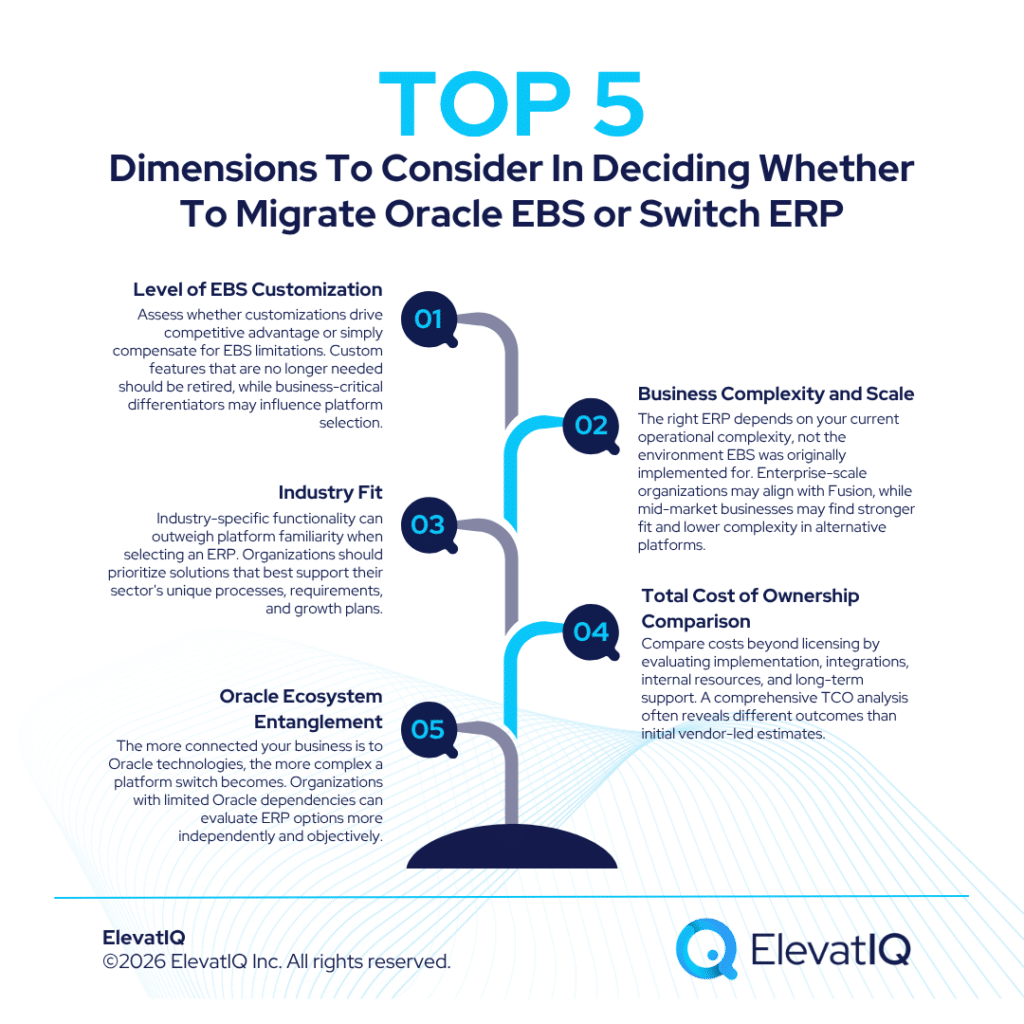
Deciding whether to migrate Oracle EBS or switch ERP requires honest evaluation across five dimensions. The answers are organization-specific which is exactly why a vendor-influenced process produces worse outcomes than an independent one.

1. Level of EBS Customization

For any organization working through whether to migrate Oracle EBS or switch ERP, this is the most operationally significant variable. Organizations that have accumulated deep EBS customizations such as extensive PL/SQL development, custom Forms, bespoke workflow logic, industry-specific extensions. They often face a rationalization decision regardless of destination. Both Fusion Cloud and alternative platforms require that EBS-era customizations be evaluated against the destination platform’s standard capabilities.

The question is not simply “how much customization exists?”. But “how much of that customization reflects genuine business differentiation versus working around EBS limitations?”. Customizations that compensate for EBS constraints that the destination platform solves natively are candidates for retirement, not rebuilding. Organizations with very high EBS customization debt that traces to business-specific logic may find that a platform purpose-built for their industry is now, regardless of what the current announced support horizon reads.


ERP Selection Requirements Template

This resource provides the template that you need to capture the requirements of different functional areas, processes, and teams.

2. Business Complexity and Scale

Oracle Fusion Cloud is an ERP built for large enterprise complexity including multi-entity structures, multi-currency operations, global supply chains, complex procurement workflows, and deep financial management requirements. For organizations at that scale and complexity, Fusion is a credible destination with genuine fit.

For mid-market organizations that have outgrown the scale at which EBS was originally appropriate or that were running EBS as a legacy choice rather than because it was the best fit, the calculus looks different. NetSuite, for instance, is widely recognized as the leading mid-market cloud ERP for organizations with multi-entity global financial requirements at a scale that does not require the full complexity of Fusion. Microsoft Dynamics 365 Finance serves organizations with strong Microsoft ecosystem alignment and a preference for lower total cost of ownership at enterprise scale. The right destination depends on where the organization actually sits on the complexity spectrum, not where it sat when it originally implemented EBS.

3. Industry Fit

Industry fit is a legitimate differentiator in any decision to migrate Oracle EBS or switch ERP. It often can outweigh platform familiarity considerations.

SAP S/4HANA has the deepest industry-specific functionality for discrete and process manufacturing, retail, and utilities at global scale. Infor CloudSuite was purpose-built for specific verticals. They include industrial manufacturing, healthcare, and distribution. Along with pre-configured industry processes that reduce implementation complexity for those sectors. Oracle Fusion Cloud has strong cross-industry capability but narrower industry-specific depth than SAP in some manufacturing verticals. Microsoft Dynamics 365 Finance has strong integration with Microsoft’s broader ecosystem and established presence in professional services and distribution.

An EBS organization in discrete manufacturing with complex production planning requirements has a different industry fit conversation than a financial services organization primarily running Oracle Financials. Treating them as the same decision type produces poorly calibrated recommendations.


ERP System Scorecard Matrix

This resource provides a framework for quantifying the ERP selection process and how to make heterogeneous solutions comparable.

4. Total Cost of Ownership Comparison

TCO comparisons between Oracle Fusion Cloud and alternative platforms are frequently undermodeled in EBS migration conversations. In part because Oracle’s migration tooling and Oracle-affiliated advisory makes Fusion the path of least resistance to scope, and in part because the dual-run licensing costs during a Fusion migration are often not fully reflected in initial estimates.

A realistic TCO comparison should include: licensing costs over a three-to-five year horizon, implementation services for each platform given the organization’s specific complexity profile, integration rebuild costs (which depend on the destination’s integration architecture), internal resource burden during ERP implementation, and post-go-live support and enhancement costs. Organizations that conduct this comparison rigorously, across multiple platforms, consistently find that the cost differential between Fusion and alternatives is more variable and in some cases more favorable to alternatives, than the initial Oracle-oriented scoping suggested.

5. Oracle Ecosystem Entanglement

Some organizations are more embedded in Oracle’s ecosystem than others. Organizations running Oracle Database, Oracle Middleware, Oracle EPM, or Oracle HCM alongside EBS have integration and licensing interdependencies that make a full platform switch more complex than a straight ERP-to-ERP comparison would suggest. For these organizations, the switching cost calculation needs to include the Oracle ecosystem layer, not just the ERP layer.

Organizations running EBS largely in isolation with integrations primarily to non-Oracle systems, have a cleaner comparison. The ERP decision can be made on its merits without the added weight of ecosystem entanglement.

When Oracle Fusion Cloud Makes Sense

There are genuine scenarios where Oracle Fusion Cloud is the right answer when organizations migrate Oracle EBS or switch ERP, and stating that clearly is part of what makes an independent ERP analysis credible.

Oracle Fusion makes the most sense when: the organization is a large enterprise with global operations, multi-entity complexity, and a financial management footprint that Fusion’s architecture is specifically designed to serve; when the organization is already running Oracle EPM, HCM, or SCM Cloud and consolidation on a single Oracle platform produces real integration and licensing benefits; when the organization’s EBS modules map closely to Fusion equivalents and the customization rationalization analysis shows that most EBS customizations can be retired in favor of standard Fusion capabilities; and when Oracle is offering commercial incentives such as migration credits, license conversion programs, or implementation funding, that materially change the TCO comparison in Fusion’s favor.

In these scenarios, the Fusion path is not just the convenient choice, it is the defensible one.

When a Different ERP May Serve the Organization Better

The scenarios where an alternative platform deserves serious consideration when organizations migrate Oracle EBS or switch ERP are equally real, and they are underrepresented in conversations that begin with Oracle-affiliated advisory.

A different ERP may be the better fit when: the organization is mid-market in scale and does not need Fusion’s enterprise complexity or pricing tier; when the primary EBS usage has been Oracle Financials and the organization’s requirements are well-served by NetSuite or Dynamics 365 at meaningfully lower total cost; when the organization’s industry has a platform with deeper native fit, Infor for industrial manufacturing, for example that would reduce implementation complexity and customization requirements compared to a Fusion deployment; when the organization’s existing technology stack is Microsoft-oriented and Dynamics 365 Finance offers better ecosystem alignment and lower integration overhead; and when the TCO comparison across a five-year horizon shows a material cost advantage for an alternative that the organization’s finance leadership should be able to evaluate.

None of these scenarios represents a second-best outcome. They represent outcomes where the right tool for the job is not Fusion and where an evaluation process that started with an open scope rather than an assumed destination would have identified the better path earlier.

Switching ERPs Is Not Necessarily Riskier Than Migrating to Fusion

The risk framing that positions Oracle Fusion migration as the lower-risk path relative to switching platforms entirely deserves direct examination, because it shapes decision-making in ways that are not always accurate.

Both paths require the same foundational work: a customization inventory, data cleansing, process re-engineering, integration rebuilds, testing, and change management. The Fusion path has some continuity advantages in module mapping and Oracle support tooling. The alternative path may have advantages in industry fit, total cost, and the ability to start with a clean architecture rather than carrying forward EBS-era decisions into a new platform.

Risk in ERP migration is driven primarily by how well the assessment phase is conducted, how realistic the scoping is, how effectively change management is executed, and how experienced the implementation team is with the destination platform, not by whether the destination is inside or outside the Oracle family. An organization that makes a well-evaluated decision to migrate to Dynamics 365 or NetSuite, with a clear understanding of the ERP implementation requirements and a capable implementation team, is in a more defensible position than one that defaulted to Fusion without a rigorous comparison and discovers scope and cost surprises mid-implementation.

The perceived safety of staying with Oracle is real for some organizations in some scenarios. It is not a universal truth.

What Independent ERP Selection Looks Like for EBS Organizations

The structural challenge for EBS organizations evaluating whether to migrate Oracle EBS or switch ERP is that most of the advisory resources available to them have directional interests. Oracle and its implementation partners have revenue reasons to recommend Fusion. Alternative platform vendors have revenue reasons to recommend their own products. Even well-intentioned advice from peers or industry analysts is shaped by which platforms those sources have more experience with.

Independent ERP selection means conducting the evaluation without those incentives in the process. That means building a requirements framework from the business up starting with what the organization needs the ERP to do, not what any platform is capable of doing. It means issuing an RFP that allows multiple platforms to respond on a structured basis, rather than scoping a single-vendor evaluation. It means running a demo process that evaluates each platform against the same scenarios, not against each vendor’s preferred use cases. And it means modeling TCO with consistent assumptions across all platforms under consideration, not accepting each vendor’s projection of its own cost competitiveness.

For EBS organizations, the RFP and demo process should include Oracle Fusion Cloud alongside the alternatives that genuinely match the organization’s complexity and industry profile. Fusion should win that evaluation on merit when it is the right fit and it should not win it by default when it is not.

The advisory relationship that serves EBS organizations best in this context is one with no commission relationship with any ERP vendor, no implementation revenue tied to any particular destination, and no incentive to prefer one platform’s outcome over another.

Conclusion

The decision to migrate Oracle EBS or switch ERP platforms entirely is not a question with a universal correct answer. It is a question with an organization-specific correct answer, one that depends on the scale and complexity of the EBS environment, the depth and nature of existing customizations, the industry fit of available platforms, a rigorous TCO comparison across realistic options, and the degree of Oracle ecosystem entanglement that creates genuine switching costs.

What the decision does not depend on is which path Oracle’s advisory ecosystem finds most convenient to recommend. EBS organizations that begin this evaluation with an independent, open-scope process consistently produce better decisions than those that begin with an assumed destination.

The right question in 2026 is not “how do we migrate to Fusion?” It is “what is the right ERP for our organization at this stage of our operations, and what does a realistic path to get there look like?” Those are different questions and the answers are not always the same.


ERP Selection: The Ultimate Guide

This is an in-depth guide with over 80 pages and covers every topic as it pertains to ERP selection in sufficient detail to help you make an informed decision.
Migrate Oracle EBS or Switch ERP: Which One Is Better? Read More »

Oracle EBS End of Support: What Companies Still Running EBS Should Do in 2026

Oracle EBS End of Support: What Companies Still Running EBS Should Do in 2026

If your organization is still running Oracle E-Business Suite, you are not alone. The situation is more nuanced than most of the headlines suggest. Oracle has extended Premier Support for EBS 12.2 through at least 2037, rolling the date forward one year at a time under its Continuous Innovation model. On paper, that sounds like a comfortable runway.

In practice, it is not. Understanding why requires a clearer view of how Oracle’s support lifecycle works, what “at least 2037” actually means contractually, and what the realistic ERP planning timeline looks like for organizations that still need to migrate. This is not an argument for panic. It is an argument for honesty about where EBS customers stand in 2026 and what the right planning posture looks like right now.

The Ultimate ERP Playbook for Electronics Manufacturing - Tanner Rogers - Watch On-Demand

Understanding Oracle EBS Support Tiers: What You Are Actually Getting

To navigate Oracle EBS end-of-support decisions effectively, it helps to understand what each support tier actually delivers because the differences between them are material.

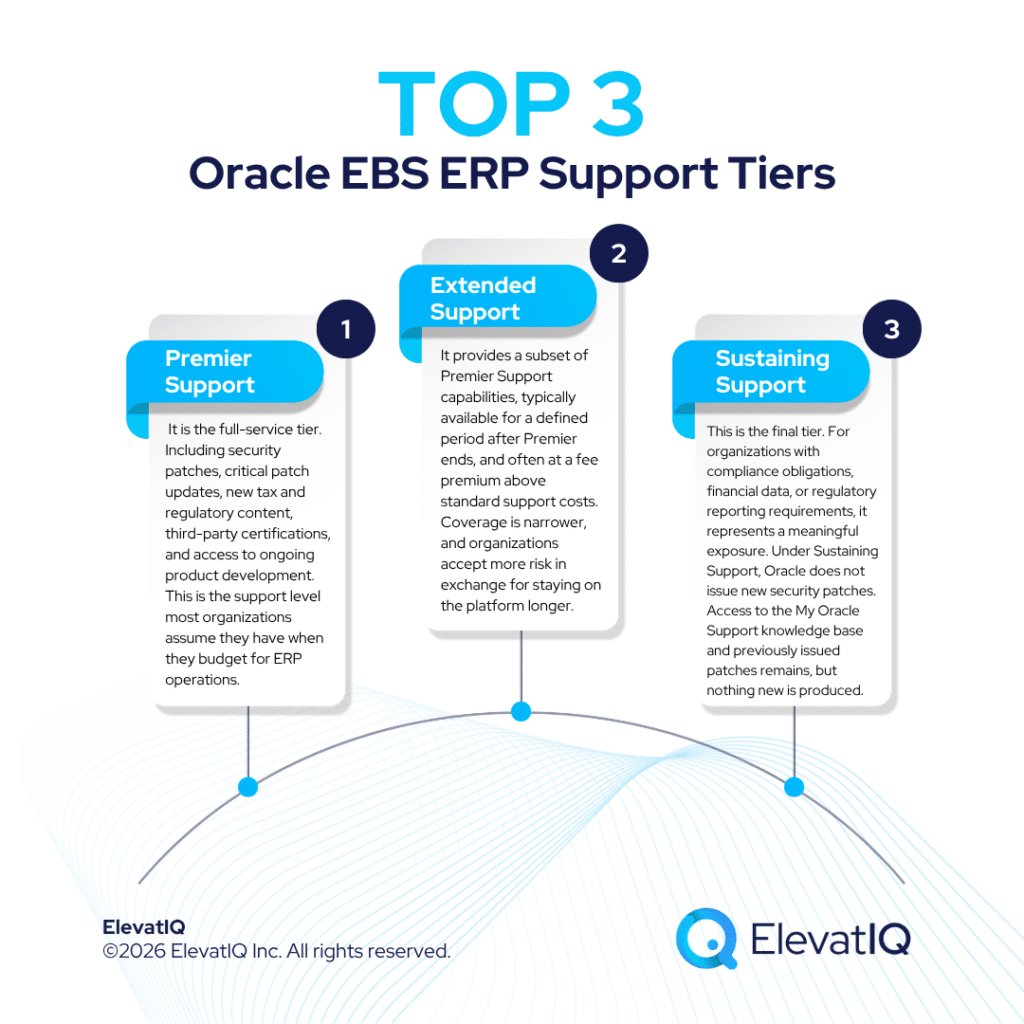
  • Premier Support. It is the full-service tier. Including security patches, critical patch updates, new tax and regulatory content, third-party certifications, and access to ongoing product development. This is the support level most organizations assume they have when they budget for ERP operations.
  • Extended Support. It provides a subset of Premier Support capabilities, typically available for a defined period after Premier ends, and often at a fee premium above standard support costs. Coverage is narrower, and organizations accept more risk in exchange for staying on the platform longer.
  • Sustaining Support. This is the final tier. For organizations with compliance obligations, financial data, or regulatory reporting requirements, it represents a meaningful exposure. Under Sustaining Support, Oracle does not issue new security patches. No new Critical Patch Updates. No new tax or regulatory content. No new certified interoperability with third-party software. Access to the My Oracle Support knowledge base and previously issued patches remains, but nothing new is produced.

For organizations operating under frameworks such as SOC 2, ISO 27001, or PCI DSS, operating unsupported ERP software may create compliance, security, and audit concerns that require additional risk management controls, not just a technology one.

Where EBS Customers Stand in 2026

The Oracle EBS end-of-support picture in 2026 splits cleanly into two populations.

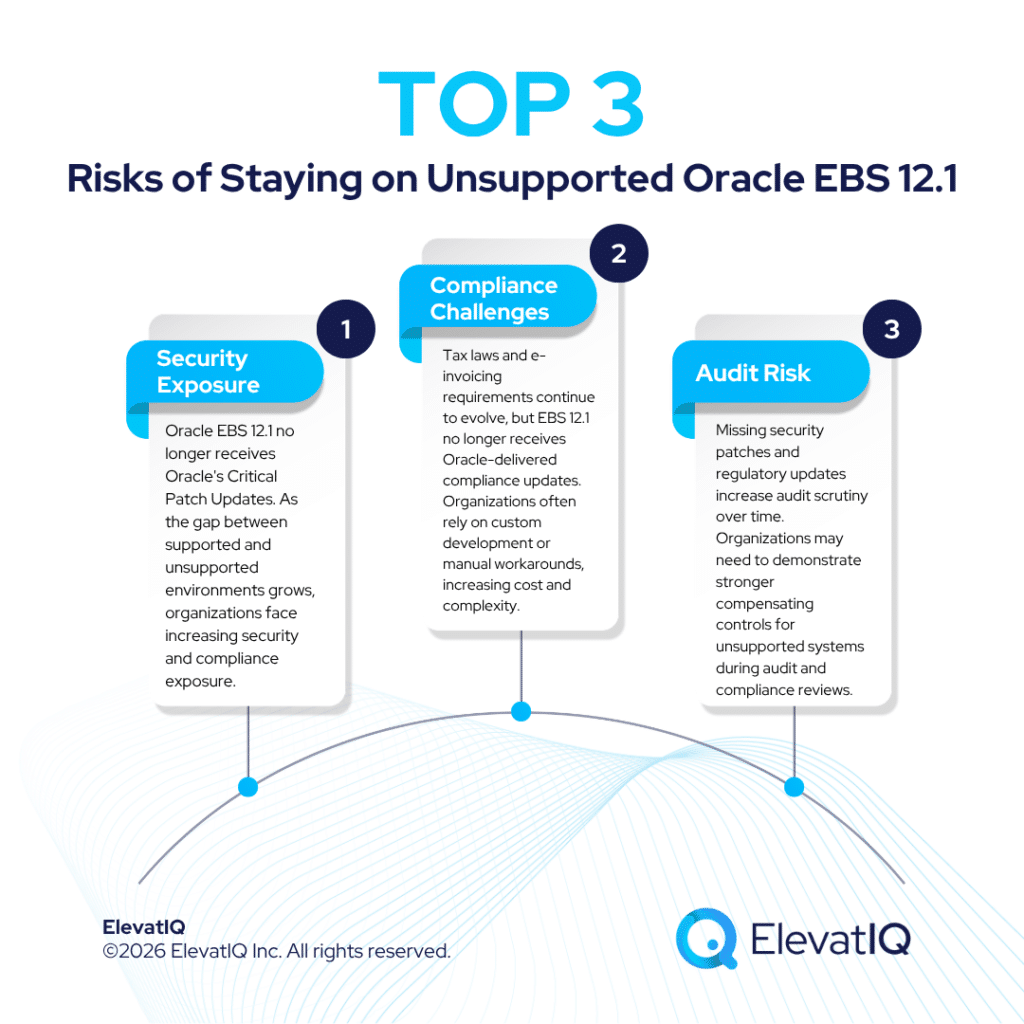
  • If you are on EBS 12.1: Premier Support for Oracle E-Business Suite 12.1 ended several years ago, and organizations remaining on 12.1 are now operating under Sustaining Support. The migration argument here is not theoretical; it is immediate.
  • If you are on EBS 12.2: Oracle’s most recently announced Premier Support date extends through at least 2037. Oracle has maintained a practice of extending this date by one year annually, as part of its Continuous Innovation commitment. The current announcement is genuine as Oracle has consistently honored these extensions since first making the commitment in 2018.

What the 2037 date does not provide is a permanent contractual guarantee. Historically, Oracle has extended Premier Support on a recurring basis, typically adding an additional year to the support horizon. The word “at least” is doing meaningful work in that commitment. Organizations that build their ERP strategy around a specific date that Oracle has not permanently locked in are taking a planning risk that may not be apparent until the window narrows.

That structural ambiguity is one reason migration planning for EBS 12.2 organizations should begin now, regardless of what the current announced support horizon reads.


ERP Selection Requirements Template

This resource provides the template that you need to capture the requirements of different functional areas, processes, and teams.

The Planning Lead Time Argument: Why 2026 Is the Right Year to Start

The most common framing around Oracle EBS end of support is deadline-driven: organizations wait for a hard date, then begin planning. That framing works poorly for ERP migrations, for a straightforward reason.

Complex Oracle EBS environments. Particularly, those with significant customizations, deep integrations, multiple business units, and years of accumulated configuration do not migrate in six months. Realistic planning timelines for organizations of that type run 18 to 36 months for the migration itself, and frequently longer when pre-migration assessment, data cleansing, process redesign, and organizational change management are included.

An organization that begins migration planning in 2026 and executes through 2028 or 2029 is in a defensible position. An organization that waits until 2034 to begin planning for a 2037 deadline has almost no margin for the delays, scope changes, and re-scoping that are normal features of large ERP migrations, not exceptions.

There is also a resource availability dimension. As the EBS support horizon firms up and the migration wave accelerates, experienced implementation resources, both Oracle-side and independent, become constrained. Organizations that begin planning early have more access to the consultants who know EBS deeply and can navigate the translation to Oracle Fusion Cloud with realistic expectations. Organizations that delay planning may face increased competition for experienced ERP implementation resources as migration activity grows.


ERP System Scorecard Matrix

This resource provides a framework for quantifying the ERP selection process and how to make heterogeneous solutions comparable.

Customization Debt: The Underestimated Migration Complication

One of the structural realities of Oracle EBS is that it was designed to be heavily customizable. Most long-running EBS deployments took full advantage of that. For organizations evaluating their Oracle EBS end-of-support position, customization debt is frequently the factor that most directly determines migration complexity and cost. Over ten, fifteen, or twenty years of operation, organizations accumulated customizations that solved real business problems at the time they were built. Many of those customizations are now undocumented, maintained by people who have left the organization, or built on Oracle APIs and data structures that do not translate directly to Oracle Fusion Cloud.

Customization debt is often the single largest variable in EBS migration complexity and cost. It is also the variable most likely to be underestimated during initial migration scoping, because the full picture of what has been customized and how deeply it is embedded in current operations rarely surfaces until the assessment work begins.

This is a reason to start the assessment process earlier rather than later. Understanding the true scope of customization debt before entering vendor negotiations or ERP implementation partner conversations gives organizations much more realistic data for budgeting and timeline planning, and it surfaces tradeoffs (rebuild vs. retire vs. reconfigure in standard) that are better made with time to deliberate than under schedule pressure.

The Oracle Fusion Cloud Migration Decision: What Independent Guidance Looks Like

When Oracle and its implementation partners discuss EBS migration paths, the natural direction of that conversation is toward Oracle Fusion Cloud. Oracle Fusion Cloud offers continuous updates and an expanding set of AI-enabled capabilities across many business processes. For many organizations working through Oracle EBS end-of-support planning, it will be the right destination.

But “right for Oracle” and “right for your organization” are not always the same determination. Some EBS organizations have business requirements, integration architectures, or regulatory environments that make a different destination. That determination requires an evaluation that is not shaped by vendor incentives.

Independent ERP advisory in the EBS migration context means starting with the business requirements and working outward to the technology decision, rather than starting with the destination and working backward. It also means having candid conversations about the realistic total cost of an Oracle Fusion Cloud migration, not just the licensing costs. But also, the implementation services, data migration, integration rework, change management, and the post-go-live stabilization period that often extends longer than the original implementation timeline. For organizations with significant EBS customization debt, the process of rationalizing that customization against Fusion Cloud’s standard capabilities is itself a substantial body of work, one that shapes the entire cost and timeline of the migration project.

Conclusion

Oracle EBS end of support is not a single date; it is a layered timeline with different urgency levels depending on which version you are running and what your compliance obligations require. For EBS 12.1 organizations, the migration argument is immediate. For EBS 12.2 organizations, the Premier Support runway is real, but the year-by-year rollover structure, the planning lead time requirements, and the complexity of customization rationalization all make 2026 the right year to begin serious ERP migration planning, not the year to defer the conversation until the horizon firms up further. The organizations that navigate EBS migrations most successfully are the ones that begin the process with an honest assessment of where they are, not a vendor’s roadmap for where they should go.


ERP Selection: The Ultimate Guide

This is an in-depth guide with over 80 pages and covers every topic as it pertains to ERP selection in sufficient detail to help you make an informed decision.
Oracle EBS End of Support: What Companies Still Running EBS Should Do in 2026 Read More »

ERP Data Migration Failure: Lessons from SAAQ's Digital Platform

ERP Data Migration Failure: Lessons from SAAQ’s Digital Platform

In February 2023, Quebec’s Société de l’assurance automobile du Québec (SAAQ) launched SAAQclic, a digital platform intended to modernize driver licensing and vehicle registration services for millions of Quebecers. Within days, the system became synonymous with failure. Which means overloaded servers, multi-hour service queues, and a customer service crisis that exposed fundamental flaws in the ERP implementation approach.

Two years later, Quebec’s auditor general delivered a damning verdict: the $1.1 billion digital transformation represents “a total failure” with a system that “still doesn’t work properly.” A critical contributor to the disaster was an ERP data migration failure that provides critical lessons for organizations undertaking similar transformations. This was not simply a technology problem, it was a comprehensive breakdown in data migration strategy, readiness validation, and risk management.

Understanding what went wrong with SAAQ’s data migration, why decision-makers proceeded despite clear warning signs, and how organizations can avoid similar outcomes is essential for anyone planning digital transformations involving legacy system replacement and large-scale data conversion.

Your ERP Strategy Is About to Break - Sandeep Chopra - Watch On-Demand

The SAAQ Digital Transformation: Ambitious Vision, Catastrophic Execution

The SAAQ’s CASA modernization program aimed to drag a decades-old licensing and registration system into the digital age. At its core was SAAQclic, an online platform where Quebec residents could renew licenses, schedule driver tests, update vehicle registrations, and conduct transactions previously requiring in-person visits to crowded service centers.

The Scope and Scale

The digital transformation involved replacing legacy systems that had served the SAAQ for over 30 years with modern SAP technology implemented by LGS, an IBM subsidiary. The scope included driver licensing systems managing millions of active licenses, vehicle registration databases tracking vehicle ownership and transactions, insurance records linking vehicles to coverage, payment processing systems, appointment scheduling, and integration with multiple government agencies.

The initial $638 million budget over 10 years appeared reasonable for a transformation of this magnitude. However, the auditor general’s investigation revealed the true cost would exceed $1.1 billion—a cost overrun of $500 million, or 78% above original estimates. More significantly, despite this massive investment, the system fundamentally failed to deliver on its core promise.

The Launch Disaster

When SAAQclic went live in February 2023, immediate problems became apparent. The platform experienced severe performance issues with overloaded servers unable to handle user loads. Multi-hour queues formed at physical service centers as citizens unable to use the broken online system sought in-person assistance. System outages occurred frequently, with services unreliable for weeks during the initial rollout period. Data integrity issues emerged where information in the new system did not match legacy records.

Quebec auditor general Guylaine Leclerc concluded that “there was no indication that this system functioned correctly” at launch. The failure was so severe that more people visited physical SAAQ outlets after SAAQclic launched than before, exactly the opposite of the intended outcome.

The Data Migration Failure at the Core

One of the foundational contributors to SAAQclic’s failure was the ERP data migration failure, which cascaded through every aspect of the implementation. The auditor general’s report identified critical data migration deficiencies that doomed the project from the start.

Reliability and Integrity Not Assured

According to Leclerc’s findings, “the SAAQ migrated SAAQclic online without assuring the reliability and integrity of the system or the data.” This represents a fundamental violation of data migration best practices. Organizations cannot successfully launch systems when data quality and system reliability remain unvalidated.

What this means in practice:

  • Unvalidated data conversion: The migration from legacy systems to SAP occurred without comprehensive validation that converted data matched source records accurately
  • Missing data quality gates: No formal approval process required, demonstrating that migrated data met quality standards before go-live
  • Incomplete testing: Data-dependent business processes were not adequately tested with production data volumes and real-world scenarios
  • No reconciliation processes: Systems lacked robust mechanisms to identify and correct data discrepancies between legacy and new platforms

The Extended Service Outage

The launch of SAAQclic involved replacing the old computer system with the new digital platform in what implementation teams call a “big bang” cutover. During this transition, the system was down or unreliable for weeks, an extended service outage that created massive operational disruption.

This extended outage affected not just SAAQ customers but entire industries dependent on SAAQ services. Collision repair facilities across Quebec rely on SAAQ services to verify vehicle ownership, process salvage claims, and coordinate repairs on vehicles involved in insurance claims. The outage meant repairers could not access necessary data, creating cascading delays throughout the automotive service sector.

Ongoing Data Problems

Two years after launch, SAAQclic continues to experience data-related failures. In May 2025, a major IT outage affecting SAAQ servers disrupted services across Quebec, with service centers and partner locations forced to close. While officials attributed this incident to Microsoft Azure hosting issues rather than SAAQclic itself, the pattern of recurring outages suggests deeper systemic problems with data architecture and system reliability.

The auditor general reported that the SAAQ expects to reduce system errors to “an acceptable level” by December 2025, nearly three years after launch. This timeline indicates fundamental data quality and system stability issues that should have been resolved before production deployment.


ERP Selection Requirements Template

This resource provides the template that you need to capture the requirements of different functional areas, processes, and teams.

Why the Data Migration Failed: Root Causes

Understanding why SAAQ’s ERP data migration failure occurred requires examining multiple contributing factors that combined to create a perfect storm of dysfunction.

Inadequate Pre-Migration Data Assessment

Organizations cannot successfully migrate data they do not understand. Effective data migration requires comprehensive assessment of source data quality, completeness, consistency, and structure before designing conversion processes. The evidence suggests SAAQ underinvested in this foundational activity.

Critical assessment activities that appear to have been insufficient:

  • Data profiling: Systematic analysis of legacy data to identify duplicates, missing values, format inconsistencies, and referential integrity violations
  • Data volume and complexity analysis: Understanding the sheer scale of records, relationships, and dependencies being migrated
  • Historical data decisions: Determining how much transaction history to migrate versus archive
  • Master data governance: Establishing authoritative sources and resolution processes for conflicting data

Without thorough data assessment, migration teams cannot design effective conversion processes, identify cleansing requirements, or estimate realistic timelines.

Compressed Timeline and Scope Pressure

The auditor general’s report revealed that labor hours were underestimated by over one million hours, according to audit findings and sworn testimony. Thus, triggering disputes with the IT supplier LGS. This massive underestimation suggests that project planners fundamentally misunderstood the complexity of data migration requirements.

When timelines prove inadequate, organizations face difficult choices: delay go-live to complete necessary work properly, or proceed on schedule despite clear indicators of unreadiness. SAAQ chose the latter, with disastrous consequences.

The decision-making breakdown:

  • Deadline prioritization: Transport Minister François Bonnardel was described as focused on delivery timelines rather than financial details or quality indicators
  • Warning signs ignored: Companies flagged problems with the portal before launch, but decision-makers proceeded anyway
  • Ministerial pressure: Government ministers received presentations indicating the project was on track when reality told a different story
  • Transparency failures: Karl Malenfant, former vice-president of digital experience, admitted he assured senior ministers in 2021 and 2022 that the project was within budget when scope was actually expanding significantly

Lack of “Load Early, Load Often” Approach

Industry best practice for complex data migrations follows the “load early, load often” methodology, conducting multiple test migrations throughout the project to identify and resolve issues progressively. Each iteration reveals data quality problems, mapping errors, and transformation logic flaws when they can still be corrected efficiently.

The SAAQ ERP implementation appears to have skipped or inadequately executed this critical practice. The severe data problems discovered immediately after go-live suggest that comprehensive data migration testing did not occur with production data volumes and real-world scenarios.

Insufficient Change Management and User Preparation

Data migration is not purely technical, it requires users to understand how data structures, naming conventions, and access patterns change in new systems. The dramatic increase in physical service center visits after SAAQclic launch indicates that users found the new system so confusing and unreliable that they abandoned it in favor of in-person service.

This pattern suggests:

  • Inadequate training: Users were not prepared for how the new system organized and presented data differently than legacy systems
  • Poor data accessibility: Information users needed was difficult to locate or unavailable due to incomplete migration
  • Trust erosion: Early data quality problems destroyed confidence in system reliability


ERP System Scorecard Matrix

This resource provides a framework for quantifying the ERP selection process and how to make heterogeneous solutions comparable.

The Cascading Impact of Data Migration Failure

The consequences of SAAQ’s ERP data migration failure extended far beyond technical problems, creating operational, financial, political, and reputational damage that continues years later.

Operational Catastrophe

The immediate operational impact was severe:

  • Service delivery collapse: The platform intended to reduce physical service center visits instead increased them, overwhelming staff
  • Multi-hour queues: Citizens faced extended wait times as online services failed and in-person alternatives became overloaded
  • Industry disruption: Collision repair facilities, car dealers, and other businesses dependent on SAAQ services faced weeks of system unavailability
  • Reduced functionality: Two years post-launch, users still report that the system has fewer features and is more difficult to use than the pre-SAAQclic website

Financial Disaster

The cost implications are staggering:

  • $500 million cost overrun: Original $638 million budget ballooned to $1.1 billion, representing 78% overrun
  • No value delivered: Despite the massive investment, the system fails to function as intended
  • Ongoing remediation costs: Additional spending continues as SAAQ attempts to fix fundamental problems
  • Hidden costs: Government resources diverted to crisis management, public inquiries, and damage control

Political Fallout

The failure triggered significant political consequences:

  • Ministerial resignation: Éric Caire, Quebec’s minister responsible for cybersecurity and digital technology, resigned after intense criticism
  • Executive termination: The SAAQ’s president and CEO Denis Marsolais was fired in April 2023
  • Public inquiry: Premier François Legault ordered a public inquiry led by retired judge Denis Gallant
  • Anti-corruption investigation: Quebec’s anti-corruption squad (UPAC) launched an investigation
  • Government credibility damage: The failure became emblematic of the Legault government’s inability to manage large-scale technology projects

Reputational Destruction

The damage to organizational credibility will take years to repair:

  • Vendor relationship damage: Disputes with LGS over underestimated labor hours and contract modifications
  • Public trust erosion: Citizens lost confidence in SAAQ’s ability to deliver reliable services
  • Auditor general condemnation: Official finding that the implementation was “a total failure” with “no indication that this system functioned correctly”
  • National embarrassment: Coverage of the failure spread beyond Quebec, becoming a cautionary tale of government IT incompetence

Lessons Learned: Preventing Data Migration Disasters

The SAAQ case provides invaluable lessons for organizations planning data migrations as part of ERP implementations or digital transformations.

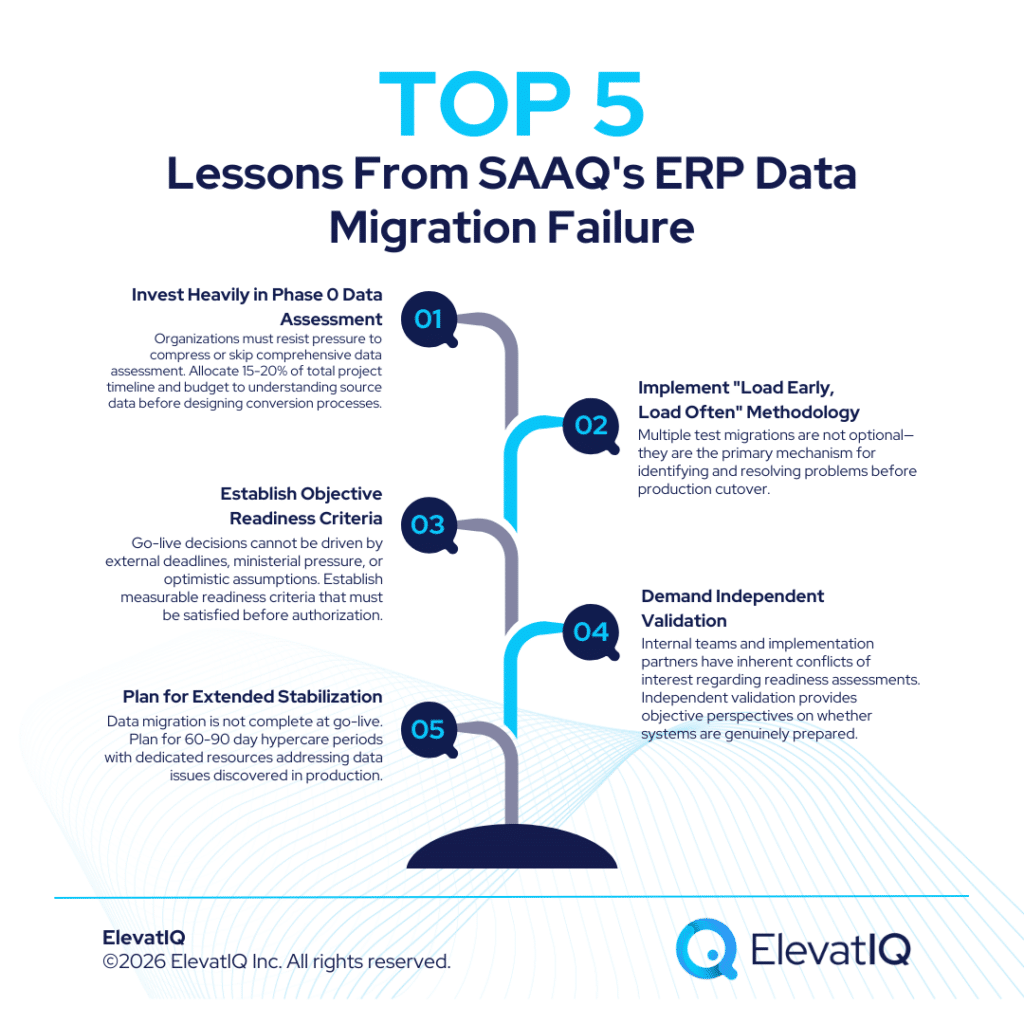
Lesson 1: Invest Heavily in Phase 0 Data Assessment

Organizations must resist pressure to compress or skip a comprehensive data assessment. Allocate 15-20% of the total project timeline and budget to understanding the source data before designing conversion processes.

Essential Phase 0 activities:

  • Conduct comprehensive data profiling to identify quality issues, duplicates, and inconsistencies
  • Document data lineage, understanding where data originates and how it flows through systems
  • Establish data governance frameworks defining ownership, standards, and resolution processes
  • Create detailed data maps showing relationships between legacy and target data structures
  • Develop data quality metrics and acceptance criteria that must be met before migration

Lesson 2: Implement “Load Early, Load Often” Methodology

Multiple test migrations are not optional—they are the primary mechanism for identifying and resolving problems before production cutover.

Proven approach:

  • First migration (6-9 months before go-live): Identify major data quality issues, mapping errors, and transformation logic problems
  • Second migration (4-6 months before go-live): Validate that corrections from the first migration worked and identify remaining issues
  • Third migration (2-3 months before go-live): Confirm data quality meets acceptance criteria with production volumes
  • Final migration (go-live): Execute with confidence, knowing data conversion processes have been thoroughly validated

Organizations that conduct only one migration attempt during final cutover invariably discover problems when options for correction are severely limited.

Lesson 3: Establish Objective Readiness Criteria

Go-live decisions cannot be driven by external deadlines, ministerial pressure, or optimistic assumptions. Establish measurable readiness criteria that must be satisfied before authorization.

Data migration readiness criteria should include:

CriterionMeasurementAcceptance Threshold
Data completenessPercentage of required fields populated100% for critical fields, >95% overall
Data accuracySample validation matching source records>99% accuracy on validated samples
Referential integrityOrphaned records without valid parent references<0.1% of total records
PerformanceQuery response times, transaction processing speedMeet or exceed legacy system performance
User acceptanceBusiness user validation of migrated dataFormal sign-off from all departments

Lesson 4: Demand Independent Validation

Internal teams and implementation partners have inherent conflicts of interest regarding readiness assessments. Independent ERP validation provides objective perspectives on whether systems are genuinely prepared.

Independent validation should assess:

  • Data quality against established criteria
  • Completeness of migration documentation
  • Adequacy of testing coverage with production scenarios
  • Accuracy of vendor/partner assertions about progress and readiness
  • Risk assessment of proceeding versus delaying go-live

Lesson 5: Plan for Extended Stabilization

Data migration is not complete at go-live. Plan for 60-90 day hypercare periods with dedicated resources addressing data issues discovered in production.

Stabilization planning includes:

  • War rooms with 24/7 support for first 2-4 weeks
  • Data reconciliation processes comparing legacy and new system outputs
  • Issue triage categorizing problems by business impact
  • Rapid correction processes for critical data errors
  • Communication protocols keeping stakeholders informed

Working with Independent ERP Advisors

Organizations planning data migrations often lack internal expertise to assess vendor claims, validate data quality, or make informed readiness decisions. Implementation partners have utilization targets and margin pressures that can influence recommendations. Internal teams face career implications if projects fail.

This is where independent ERP advisors provide essential oversight that protects organizational interests.

At ElevatIQ, we help organizations avoid ERP data migration failure through:

  • Data Migration Strategy Development: We assess source data landscapes, recommend data cleansing approaches, design conversion methodologies, and establish realistic timelines based on actual data complexity.
  • Readiness Validation: We conduct independent assessments at critical gates to validate whether data quality meets criteria for go-live or requires additional preparation time.
  • Quality Assurance: We review data profiling results, validate test migration outcomes, assess completeness of data reconciliation, and identify gaps in conversion processes before production cutover.
  • Risk Assessment: We evaluate data migration risks objectively, without commercial pressures to minimize timelines or understate complexity, providing realistic effort estimates and risk mitigation strategies.

Our independent position means recommendations focus on sustainable success rather than meeting arbitrary deadlines or protecting vendor/partner revenue.

Conclusion

The SAAQ SAAQclic disaster represents a textbook ERP data migration failure where fundamental best practices were violated, warning signs were ignored, and deadline pressure overrode quality concerns. The $500 million cost overrun and system that continues to experience significant functional and reliability issues two years after launch demonstrate the catastrophic consequences of underestimating data migration complexity.

Organizations can learn from SAAQ’s mistakes by investing heavily in Phase 0 data assessment, implementing “load early, load often” methodologies with multiple test migrations, establishing objective readiness criteria validated independently, resisting pressure to proceed when data quality is inadequate, and planning for extended post-go-live stabilization periods.

Data migration is the foundation upon which successful ERP implementations are built. Poor data quality creates problems that permeate every aspect of operations—inaccurate reporting, flawed analytics, broken integrations, and user distrust that undermines adoption. The cost of proper data migration planning and execution is minimal compared to the exposure from failures like SAAQ’s.

(This content is based on publicly available vendor statements, industry research, analyst insights, and practitioner experience and is provided for informational purposes only.)


ERP Selection: The Ultimate Guide

This is an in-depth guide with over 80 pages and covers every topic as it pertains to ERP selection in sufficient detail to help you make an informed decision.
FAQs

ERP Data Migration Failure: Lessons from SAAQ’s Digital Platform Read More »

ERP Migration Risks: Lessons from Forced ERP Transitions

ERP Migration Risks: Lessons from Forced ERP Transitions

ERP migrations represent some of the highest-risk technology initiatives organizations undertake. When migrations are strategic choices driven by business needs and executed with adequate planning, they frequently deliver substantial operational improvements. However, when organizations face forced migrations, driven by vendor product sunsets, end-of-support deadlines, or compliance requirements, the risk profile changes dramatically.

Research consistently shows concerning patterns: Multiple industry studies indicate that a significant percentage of discrete manufacturing ERP implementations fail to fully meet original objectives, where cost overruns frequently exceed 200% in complex ERP implementations. Industry analysts estimate that ERP migration inefficiencies could result in tens of billions of dollars in wasted spend over the coming years. These are not inevitable outcomes, but they reflect common ERP migration risks that organizations can identify and mitigate through systematic approaches.

Understanding what distinguishes successful forced migrations from failed ones requires examining real-world cases, identifying consistent failure patterns, and implementing protective strategies that reduce risk. For organizations facing vendor-mandated migrations, this knowledge transforms potentially chaotic transitions into manageable transformation programs.

AI-Readiness 2026 - Watch On-Demand

Understanding Forced Migration Scenarios

Forced ERP migrations occur when external factors rather than internal business requirements drive the transition timeline. These scenarios create unique pressures that amplify standard ERP migration risks and require distinct management approaches.

Common Forced Migration Drivers

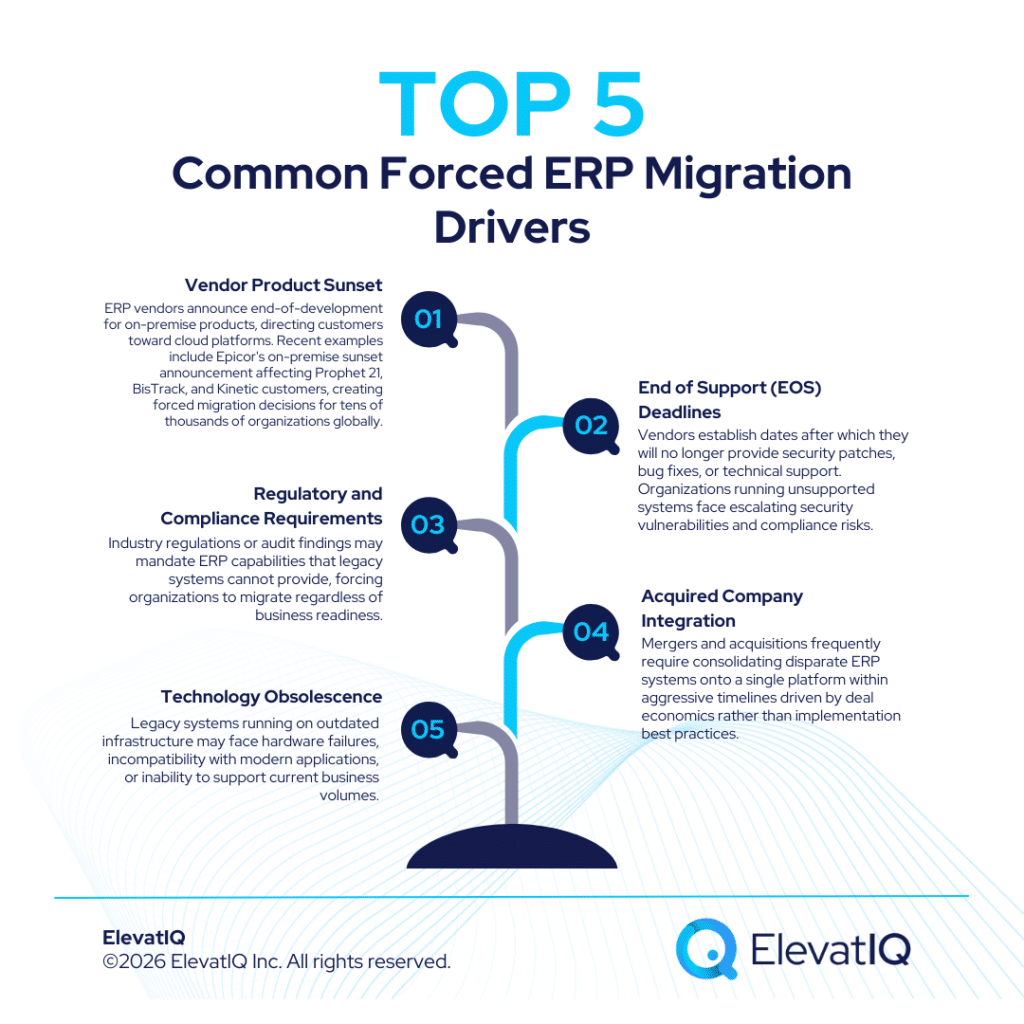
  • Vendor Product Sunset: ERP vendors announce end-of-development for on-premise products, directing customers toward cloud platforms. Recent examples include Epicor’s on-premise sunset announcement affecting Prophet 21, BisTrack, and Kinetic customers, creating forced migration decisions for tens of thousands of organizations globally.
  • End of Support (EOS) Deadlines: Vendors establish dates after which they will no longer provide security patches, bug fixes, or technical support. Organizations running unsupported systems face escalating security vulnerabilities and compliance risks.
  • Regulatory and Compliance Requirements: Industry regulations or audit findings may mandate ERP capabilities that legacy systems cannot provide, forcing organizations to migrate regardless of business readiness.
  • Acquired Company Integration: Mergers and acquisitions frequently require consolidating disparate ERP systems onto a single platform within aggressive timelines driven by deal economics rather than implementation best practices.
  • Technology Obsolescence: Legacy systems running on outdated infrastructure may face hardware failures, incompatibility with modern applications, or inability to support current business volumes.

How Forced Migrations Differ from Strategic Migrations

The fundamental difference lies in control over timing and scope decisions:

DimensionStrategic MigrationForced Migration
Timeline ControlOrganization sets schedule based on readinessExternal deadline constrains preparation time
Scope FlexibilityCan phase implementation across business unitsOften requires “big bang” transitions to meet deadlines
Budget PlanningMulti-year funding cycles align with project phasesCompressed timelines may require emergency budget allocation
Vendor SelectionCompetitive evaluation of multiple alternativesLimited evaluation time may constrain options
Risk ToleranceCan delay if readiness criteria are not metExternal pressure to proceed despite warning signs

These differences do not make forced migrations inherently doomed to failure. However, they do require organizations to be more deliberate about risk mitigation and governance.

Common Failure Patterns in Forced Migrations

Analysis of failed forced migrations reveals consistent patterns that transcend specific vendors, industries, or migration types. Understanding these patterns helps organizations recognize warning signs early when corrective action remains possible.

Pattern 1: Inadequate Pre-Migration Planning

Research suggests these factors account for a majority of failures and are largely addressable through proper planning, inadequate change management, poor data migration, and inexperienced teams.

What goes wrong:

Organizations facing external deadlines frequently compress or skip Phase 0 planning activities. Business process mapping receives insufficient attention. Data quality assessments are deferred until after migration design is complete. Change management becomes an afterthought rather than a foundational element.

Real-world manifestation:

A supermarket chain’s SAP implementation required heavy customization because the organization insisted on maintaining existing inventory management processes rather than adapting to best practices. After spending nearly €500 million over seven years, the project was eventually abandoned. The root cause was inadequate upfront process analysis and unwillingness to adapt business operations to leverage standard ERP capabilities.

Prevention approach:

Allocate approximately 15-20% of total project budget and timeline to comprehensive pre-migration planning. This includes detailed current-state documentation, thorough data quality assessment, gap analysis between current and future-state processes, and stakeholder impact analysis. Organizations that invest adequately in Phase 0 consistently achieve better outcomes than those that rush into configuration.

Pattern 2: Data Migration Underestimation

Data migration represents one of the most consistent sources of ERP migration risks. Organizations routinely underestimate the complexity, timeline requirements, and resource demands of data conversion.

What goes wrong:

Legacy systems accumulate years of duplicate records, inconsistent formats, orphaned transactions, and incomplete master data. Research across enterprise systems shows that a majority of data and security incidents involve human error or poor data handling, with incomplete or corrupted data migration leading to financial discrepancies and audit failures. Without comprehensive data cleansing before migration, these quality issues transfer to the new system and multiply. Users discover duplicate customer records, inventory counts that do not reconcile, and financial reports with unexplained variances. Trust in the new system erodes rapidly.

Real-world manifestation:

One manufacturing company discovered during post-migration validation that their inventory data was fundamentally corrupted. Products listed as available did not exist in warehouses. Items marked as discontinued were actually their best-selling products. The ERP system functioned correctly, but garbage data made accurate reporting impossible, requiring months of manual correction.

Prevention approach:

Implement the “load early, load often” strategy where smaller data sets are migrated to the target environment at regular intervals throughout the project. This approach provides earlier issue detection where mapping errors and data quality problems are identified months before final migration when fixes are faster and cheaper. Multiple data migration iterations allow progressive cleansing and validation rather than discovering all problems during final cutover.


ERP Selection Requirements Template

This resource provides the template that you need to capture the requirements of different functional areas, processes, and teams.

Pattern 3: Unrealistic Timeline Pressure

External deadlines create pressure to go live before systems are genuinely ready, resulting in operational disruptions that cost far more to remediate than delaying launch would have required.

What goes wrong:

Organizations establish go-live dates based on vendor sunset deadlines, fiscal year-end requirements, or M&A integration commitments. As implementation progresses, warning signs emerge that the system is not ready—incomplete testing, unresolved data quality issues, inadequate user training, or configuration gaps. However, deadline pressure overrides readiness concerns, and organizations proceed with go-live despite clear indicators of problems.

Real-world manifestation:

Mission Produce upgraded its enterprise software in 2022 to improve supply chain management. When the system went live, there were order processing delays, inventory inaccuracies, and communication issues among business units. The company suddenly could not determine how many avocados it had on hand or their ripeness levels, resulting in fruit becoming unfit for sale. They had to purchase from other suppliers to meet delivery commitments, taking margin hits, while also experiencing delays in automated customer invoicing.

The CEO acknowledged: “Despite the countless hours we spent planning and preparing for this conversion, we nevertheless experienced significant challenges with the implementation. While we were not naïve to the risk of disruption to the business, the extent and magnitude was greater than we anticipated.”

Prevention approach:

Establish objective, measurable readiness criteria that must be satisfied before go-live authorization. Conduct independent readiness assessments with authority to recommend delays. Resist pressure to go live when criteria are not met, regardless of external deadline constraints. Organizations should negotiate contingency plans with vendors or regulatory bodies when readiness assessments indicate additional time is needed.

Pattern 4: Insufficient Change Management

Technology implementations succeed or fail based on user adoption. Organizations that treat change management as optional or ancillary rather than core to implementation strategy consistently experience adoption challenges.

What goes wrong:

Implementation teams focus extensively on technical configuration while underinvesting in preparing users for change. Training occurs too close to go-live, covers system features rather than job-specific workflows, and fails to address emotional resistance to new processes. Business users do not understand why change is necessary or how new systems will benefit them personally. According to research, inadequate change management accounts for 42% of implementation failures. This is not a technical problem—it is a human problem that technical solutions cannot resolve.

Real-world manifestation:

Organizations experience patterns where power users maintain shadow spreadsheets “until the system gets fixed,” undermining the ERP investment entirely. Department heads express lack of confidence in system data to senior leadership. User adoption rates remain below 50% months after go-live, with employees finding workarounds to avoid using the new system.

Prevention approach:

Allocate approximately 15-20% of project budget specifically to change management activities. Engage business users early and continuously throughout implementation, not just during User Acceptance Testing. Establish change champion networks within departments to provide peer-to-peer support. Conduct training that focuses on job-specific scenarios and workflows rather than generic system features. Create support structures that provide extended post-go-live assistance when users need help most.

Pattern 5: Vendor and Implementation Partner Selection Failures

Organizations facing forced migrations often feel pressure to select vendors and implementation partners quickly rather than conducting rigorous evaluation. Research indicates that vendor and implementation partner selection issues represent a significant contributor to ERP implementation failures, with impacts that extend far beyond initial vendor choice.

What goes wrong:

Organizations select implementation partners based on existing relationships rather than demonstrated capability for the specific migration scope. Proposals are not validated through reference checks with organizations that have similar requirements. Resource qualifications are accepted at face value without verification that proposed team members have directly relevant experience.

Prevention approach:

Even under timeline pressure, conduct structured evaluations with 2-3 qualified implementation partners. Require detailed methodology descriptions with specific applicability to forced migration scenarios. Request named resources with verified experience on similar migrations, not just general platform knowledge. Conduct thorough reference checks with specific questions about execution quality, timeline adherence, and issue resolution effectiveness.


ERP System Scorecard Matrix

This resource provides a framework for quantifying the ERP selection process and how to make heterogeneous solutions comparable.

Risk Mitigation Strategies for Forced Migrations

Organizations cannot eliminate all ERP migration risks, but they can substantially reduce exposure through systematic risk mitigation approaches. These strategies apply whether migrations are forced or strategic, but they become particularly critical when external deadlines constrain flexibility.

Strategy 1: Establish Strong Governance from Day One

Effective governance creates transparency, enables rapid issue resolution, and prevents small problems from becoming project-ending disasters. Research consistently indicates that large-scale ERP projects with immature governance face significantly higher risk of failure and disruption.

Key governance elements:

  • Executive Steering Committee: Senior leaders with decision authority who meet bi-weekly during active implementation phases
  • Independent Technical Review: Third-party advisors who validate vendor and implementation partner assertions about progress and readiness
  • Clear Escalation Paths: Defined processes for surfacing and resolving issues without delay
  • Transparent Reporting: Status reports that present problems and risks alongside progress, not optimistic narratives that hide challenges

Organizations with mature governance structures identify issues early when they can be resolved efficiently through course corrections. Those with weak governance discover problems late when options are limited and remediation costs are high.

Strategy 2: Implement Phased Approaches Where Possible

Even when overall migration deadlines are fixed, phasing implementation across modules, business units, or geographies can substantially reduce risk. A global manufacturer migrating to SAP S/4HANA chose to migrate finance modules first, followed by supply chain and HR. This step-by-step approach allowed validation of each stage while running core operations without interruption, reducing downtime from weeks to just a few hours.

Phasing advantages:

  • Issues discovered in early phases can be addressed before affecting the entire organization
  • Users gain familiarity progressively rather than facing wholesale change simultaneously
  • Implementation teams learn from early phases and refine approaches for subsequent waves
  • Rollback complexity is reduced because only portions of the business are affected if problems emerge

When phasing is not possible:

Some forced migrations require “big bang” cutovers due to integration dependencies or vendor requirements. In these cases, organizations should implement extensive sandbox testing in controlled environments before production go-live.

Strategy 3: Prioritize Data Quality from Project Start

Data migration complexity is not a late-stage concern to address during cutover preparation. It requires attention from the beginning of the migration program and dedicated resources throughout the project lifecycle.

Proven data migration approach:

Months 1-2: Conduct comprehensive data quality assessment profiling existing data for completeness, accuracy, consistency, and compliance. Identify duplicate records, missing required fields, format inconsistencies, and orphaned transactions.

Months 2-4: Develop data cleansing strategy with business stakeholders making decisions about what data is correct, what should be merged, and what should be archived. IT cannot make these decisions, only business users who understand customer relationships, product lifecycles, and vendor histories can.

Months 4-8: Execute systematic data cleansing using a hybrid approach where automated tools handle format standardization and duplicate detection while business users resolve judgment-based decisions.

Months 6-12: Perform multiple test migrations (load early, load often) with validation cycles between each iteration. The first migration will reveal issues that require correction before subsequent attempts.

Organizations that treat data migration as a technical exercise rather than a business transformation consistently encounter post-go-live problems.

Strategy 4: Build Comprehensive Testing Regimens

Without structured testing, production becomes the experiment. Industry studies indicate that a substantial portion of post-launch failures occur within the first several weeks, and many are preventable with adequate pre-production validation.

Critical testing layers:

Testing TypePurposeTimeline
Unit TestingValidate individual configurations function as designedDuring configuration
Integration TestingVerify modules work together correctlyAfter module completion
User Acceptance TestingConfirm system supports actual business processes6-8 weeks before go-live
Performance TestingEnsure system handles production transaction volumes4-6 weeks before go-live
Parallel OperationsRun legacy and new systems simultaneously to compare results2-4 weeks before cutover

Sandbox environments and role-based walkthroughs catch failures before they affect customers, revenue, or user trust in the new system.

Strategy 5: Plan for Post-Go-Live Reality

Migration is not finished at go-live, that is when real risks surface. Without post-launch monitoring and support structures, issues multiply, users get frustrated, and confidence in the ERP collapses.

Essential post-go-live elements:

  • War Rooms: Dedicated support teams available 24/7 for first 2-4 weeks after go-live to address issues immediately
  • Hypercare Period: 60-90 days of elevated support with specialized resources addressing system stabilization
  • Performance Monitoring: Real-time tracking of system performance, transaction processing times, and error rates
  • Issue Triage: Structured processes for categorizing, prioritizing, and resolving problems based on business impact
  • Continuous Training: Ongoing education as users discover features and workflows they did not encounter during initial training

Organizations should plan for a meaningful portion of the total implementation cost to be allocated to post-go-live stabilization and support.

The Critical Value of Independent Oversight

Organizations facing forced migrations often lack internal expertise to objectively assess vendor claims, validate implementation partner work quality, or make informed readiness decisions. Vendors have commercial incentives to keep projects on schedule. Implementation partners have utilization targets and margin pressures. Internal teams face career implications if projects fail. This creates an environment where independent ERP advisors provide essential oversight that protects organizational interests.

Why Independence Matters

Independent advisors bring three critical capabilities to forced migration programs:

  • Objective Risk Assessment: Independent advisors can identify ERP migration risks that internal teams may overlook due to proximity or that implementation partners may downplay due to commercial pressures. They provide unbiased evaluation of whether projects are truly ready for go-live or require additional preparation time.
  • Market Intelligence: Advisors maintain current knowledge of vendor product roadmaps, implementation partner capabilities, industry benchmarks for similar migrations, and contract structures that protect client interests. This intelligence helps organizations make informed decisions rather than relying solely on vendor guidance.
  • Negotiation Leverage: Experienced advisors understand vendor flexibility, know which contract provisions are negotiable, and have track records of securing favorable terms for data migration subsidies, implementation support, subscription pricing locks, and post-go-live assistance commitments.

How ElevatIQ Supports Forced Migrations

At ElevatIQ, we help organizations navigate forced ERP migrations through:

  • Readiness Assessments: We conduct independent evaluations at critical project gates to validate whether systems are genuinely prepared for go-live or require additional work. Our assessments identify data quality issues, configuration gaps, testing deficiencies, and change management weaknesses before they become post-production disasters.
  • Vendor and Implementation Partner Evaluation: When organizations face forced migrations, vendor selection decisions occur under time pressure. We accelerate evaluation processes while maintaining rigor, conducting reference checks that go beyond vendor-provided contacts, validating proposed resource qualifications, and ensuring methodology alignment with specific migration requirements.
  • Governance Framework Design: We establish governance structures appropriate to forced migration complexity, including steering committee charter and meeting cadence, issue escalation protocols, transparent reporting frameworks, and independent technical review processes.
  • Contract Negotiation: We help secure contract terms that protect organizational interests including migration subsidies or fixed-fee pricing, subscription rate locks extending 3-5 years, data migration support and tooling, post-go-live hypercare commitments, and remediation obligations if systems do not perform as specified.

Our independent position means recommendations focus on your long-term success rather than vendor revenue targets or implementation partner utilization rates.

Conclusion

Forced ERP migrations carry elevated ERP migration risks due to compressed timelines and reduced flexibility, but they are not inherently doomed to failure. The difference between success and failure comes down to recognizing unique challenges and maintaining implementation discipline despite external pressures. Research consistently indicates that top failure causes—inadequate change management, poor data migration, and inexperienced teams, are preventable through proper planning. Organizations that invest approximately 15-20% of timeline and budget in comprehensive Phase 0 activities achieve better outcomes than those rushing into configuration to “save time.”

The key lessons from failed forced migrations are clear: external deadlines do not eliminate the need for fundamental implementation best practices. Compressed timelines make rigorous planning, strong governance, data quality focus, comprehensive testing, and adequate post-go-live support more critical, not less relevant. Organizations must resist pressure to shortcut essential steps, maintain objective readiness criteria validated through independent oversight, and delay go-live when necessary rather than proceeding with unprepared systems. The cost of delaying launch by 30-60 days to address critical issues is often lower than remediating post-production disasters.

Working with independent advisors who understand forced migration dynamics and can provide objective readiness validation substantially improves success rates. The investment in expert guidance represents a fraction of the exposure from failed ERP implementations. Forced migrations are challenging but manageable. Organizations that approach them with appropriate seriousness, invest in risk mitigation, and maintain discipline despite external pressures successfully navigate these transitions and emerge with modernized ERP platforms that support business objectives for years to come.


ERP Selection: The Ultimate Guide

This is an in-depth guide with over 80 pages and covers every topic as it pertains to ERP selection in sufficient detail to help you make an informed decision.
FAQs

ERP Migration Risks: Lessons from Forced ERP Transitions Read More »

FREE RESOURCE

2026 Digital Transformation Report

This digital transformation report summarizes our annual research on ERP and digital transformation trends and forecasts for the year 2026. 

Send this to a friend