ERP News Story

SAP: Business Data Cloud, A New Partnership With Databricks

SAP: Business Data Cloud, A New Partnership With Databricks

SAP has introduced the SAP Business Data Cloud, a new solution developed in collaboration with Databricks, aimed at unifying and governing SAP and third-party data across organizations. The platform integrates data engineering and analytics functionalities, offering businesses a streamlined approach to data management and AI-driven decision-making. Utilizing Databricks’ technology, SAP Business Data Cloud provides real-time insights and supports AI-powered automation. Early adopters, including Henkel, have begun exploring its potential to enhance data infrastructure and support strategic initiatives.

Let’s Break It Down

  • Introduction of SAP Business Data Cloud: SAP has launched the SAP Business Data Cloud, a data management solution developed with Databricks to unify and govern SAP and third-party data across organizations.
  • Integration with Databricks: The platform integrates Databricks’ data engineering and AI capabilities, supporting real-time insights and AI-driven decision-making.
  • Data Product Economy: It introduces the concept of a data product economy, providing business-ready datasets for finance, supply chain, and HR analytics.
  • Enhanced AI Capabilities: SAP Business Data Cloud automates workflows and enhances decision-making through AI, including deeper cross-functional insights with SAP’s Joule AI copilot.
  • Real-Time Data Integration: The solution enables real-time data integration, reducing the need for complex transformations.
  • Early Adopters: Companies such as Henkel are exploring its potential to optimize data infrastructure and support strategic initiatives.


The 2026 Digital Transformation Report

Thinking of embarking on a ERP journey and looking for a digital transformation report? Want to learn the best practices of digital transformation? Then, you have come to the right place.

Introduction of SAP Business Data Cloud

SAP has introduced “Business Unleashed,” a new strategy that includes a cloud-based Business Suite integrating functional modules along process chains. This builds on the company’s existing on-premises Business Suite and expands its cloud ERP offerings. The move is expected to influence competition among ERP vendors, prompting further innovation in the market. For existing customers, transitioning from on-premises to cloud solutions may present challenges, including potential short-term disruptions.



ERP Selection: The Ultimate Guide

This is an in-depth guide with over 80 pages and covers every topic as it pertains to ERP selection in sufficient detail to help you make an informed decision.

Core Elements: Processes, Data, and AI

SAP’s new strategy emphasizes three core elements: processes, data, and AI. The approach aims to help companies design process chains and prepare data for AI-driven insights. However, smaller vendors could face challenges in keeping pace with SAP’s technological advancements.
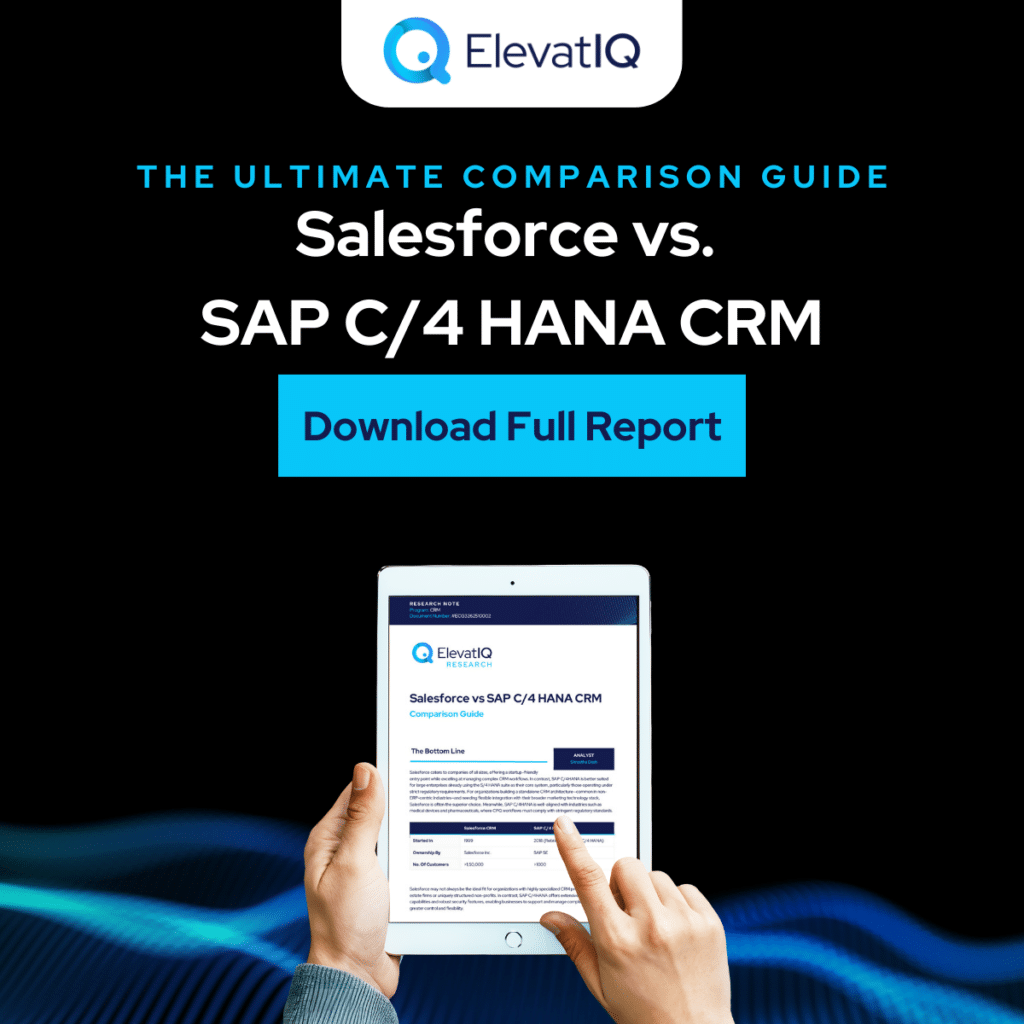
Salesforce vs SAP C/4 HANA CRM

Integrated Modules

The cloud-based Business Suite includes integrated modules such as SAP ECC, SAP CRM, SAP SRM, SAP SCM, and SAP PLM. The inclusion of these modules within a unified suite may increase competition for vendors offering standalone applications.

Business Technology Platform

The new Business Suite is built on the BTP platform, which integrates various technology stacks and cloud services to enable end-to-end processes in the cloud. This foundation provides a unified platform for business operations, reinforcing SAP’s position in the market.



ERP Selection Requirements Template

This resource provides the template that you need to capture the requirements of different functional areas, processes, and teams.

Business Data Cloud

SAP introduces the SAP Business Data Cloud (BDC) to create a uniform semantic level for data from SAP systems and third-party providers. The introduction of BDC simplifies data management and harmonization, setting a new benchmark for data integration. This development may lead to increased competition among vendors to offer more efficient and user-friendly data management solutions.

AI Integration

The new Business Suite is designed to prepare data for AI applications, supporting data-driven decision-making and process optimization through AI-driven tools.

Customer Hesitation

SAP aims to address customer hesitations about migrating business-critical applications to the cloud with its new SAP Business Data Cloud Suite. The transition may require investment and effort, leading to potential short-term disruptions.

End-to-End Processes

The SAP Business Data Cloud Suite enables the integration of entire user process chains within a single package, offering a comprehensive approach to business operations in a cloud environment.

Analyst’s Take

From an analyst’s perspective, SAP’s introduction of the SAP Business Data Cloud, in collaboration with Databricks is a strategic move that aligns with the company’s growth objectives and industry trends. Here are some key points to consider:

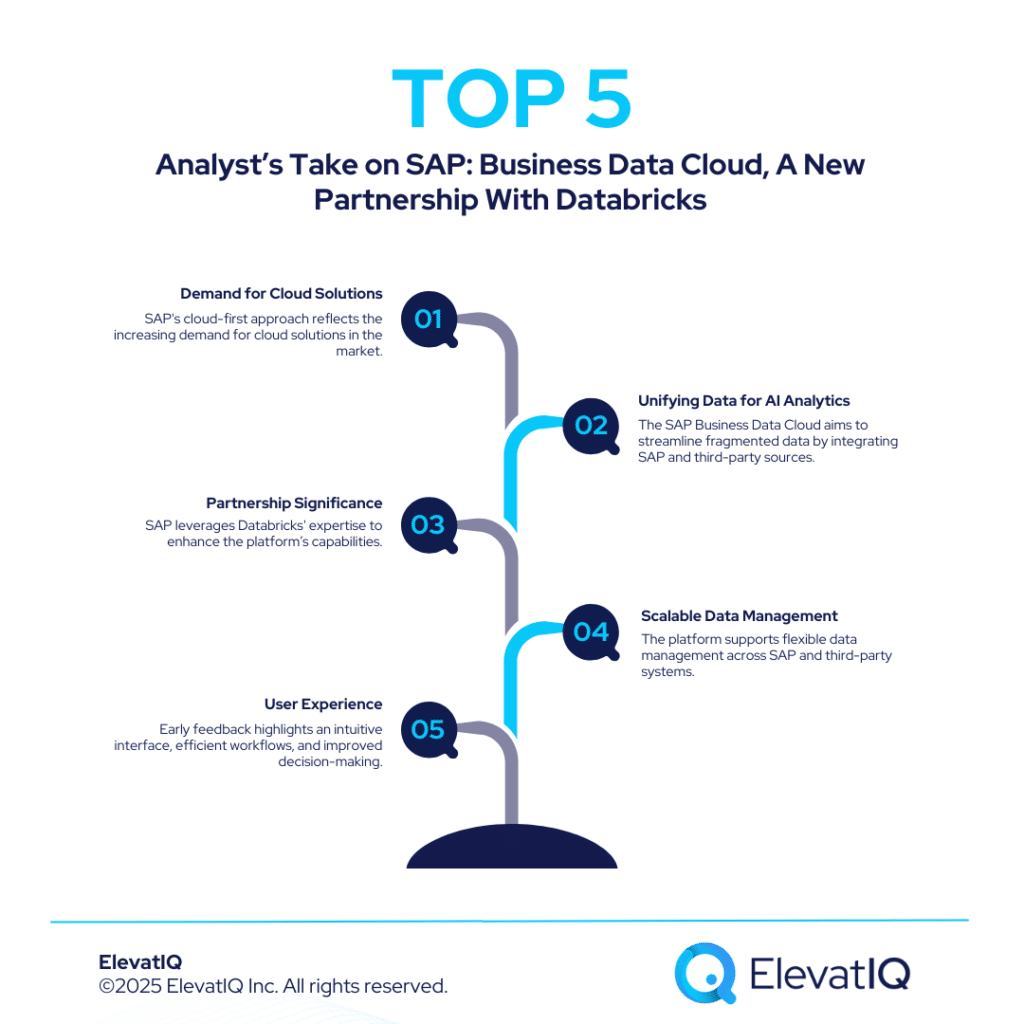
  • Demand for Cloud Solutions: SAP’s cloud-first approach reflects the increasing demand for cloud solutions in the market.
  • Unifying Data for AI Analytics: The SAP Business Data Cloud aims to streamline fragmented data by integrating SAP and third-party sources.
  • Partnership Significance: SAP leverages Databricks’ expertise to enhance the platform’s capabilities.
  • Scalable Data Management: The platform supports flexible data management across SAP and third-party systems.
  • User Experience: Early feedback highlights an intuitive interface, efficient workflows, and improved decision-making.

What Should You Know As An ERP Buyer?

Overall, this is very exciting news for both enterprise software buyers as well as SAP. With this alignment, enterprise software buyers receive pre-built and pre-integrated data connections populating the majority of SAP datasets as well as third-party industry standards. Databricks is a market-leading platform among data platform providers without requiring an army of data engineers to build enterprise decision support workloads. But some considerations for buyers as they plan to take advantage of SAP Business Data Cloud offering.

  1. Implementation Challenges: Transitioning to a technology, even if it is pre-baked, requires careful planning due to complexities in data migration, system integration, and user training.
  2. Data Security: Businesses must implement strong security measures to protect sensitive information and comply with data protection regulations.
  3. Vendor Lock-In: With the proprietary IP sitting on top of Databricks from SAP, buyers need to understand their vendor lock-in obligations especially if they don’t prefer as much vendor lock-in.
  4. Cost Considerations: While cloud solutions may reduce infrastructure costs, expenses related to implementation, subscription fees, and maintenance should be evaluated.
  5. Customization Limitations: The data applications don’t impact the operational state as much, but the underlying data structures must support the end-to-end data flows to work and the decision support system to work effectively.
  6. Resistance to Change: Employees may be hesitant to adopt a new system, requiring effective change management and training programs.
FAQs

SAP: Business Data Cloud, A New Partnership With Databricks Read More »
AIRSYS Selects Rootstock ERP for Global Expansion and Efficiency

Rootstock: AIRSYS Selects it for Global Expansion and Efficiency

In a significant move to modernize its operations and support its rapid global expansion, AIRSYS Cooling Technologies has selected Rootstock ERP to replace its legacy ERP solution. This decision is particularly driven by the need for a scalable and integrated ERP system that can enhance manufacturing processes, supply chain visibility, and reporting capabilities. This blog will delve into the details of this news, provide an analyst’s perspective on the implications of this decision, and also conclude with the potential impact on AIRSYS’s future growth.

Company Background

AIRSYS Cooling Technologies, founded in 1995 by Yunshui Chen in China, is a global leader particularly in mission-critical cooling solutions. The company provides sustainable, advanced, and also data-driven cooling solutions. It is particularly designed for industries such as telecommunications, data centers, semiconductor manufacturing, and medical imaging. With customers in over 100 countries, AIRSYS has grown into a global enterprise. It now has its headquarters in the United States.


The 2026 Digital Transformation Report

Thinking of embarking on a ERP journey and looking for a digital transformation report? Want to learn the best practices of digital transformation? Then, you have come to the right place.

ERP Selection

AIRSYS has chosen Rootstock ERP to replace its legacy ERP solution. The need for a modern, and also scalable ERP solution to support its global supply chain and rapid expansion drove the decision. Rootstock ERP is built on the Salesforce platform, thus allowing seamless integration with Salesforce Sales Cloud and Propel Software. This creates an interconnected technology stack, enabling real-time visibility, automated processes, and also enhanced decision-making capabilities.


ERP Selection: The Ultimate Guide

This is an in-depth guide with over 80 pages and covers every topic as it pertains to ERP selection in sufficient detail to help you make an informed decision.

Integration With Salesforce

One of the key reasons for selecting Rootstock ERP is its integration with the Salesforce platform. AIRSYS has been using Salesforce Sales Cloud for at least five years and wanted an ERP solution that would work seamlessly with this platform. Rootstock ERP, being built on the same platform, also ensures that customer data is already hosted on the same platform, eliminating the need for complex integrations.

Global Deployement

The deployment of Rootstock ERP will cover AIRSYS’s operations in the United States, China, and Europe. The implementation will begin with the manufacturing division, scheduled to go live in Q1 2025, followed by the U.S. operations. This phased approach ensures a smooth transition and minimizes disruptions to ongoing operations.

Consulting Partner

AIRSYS has partnered with Nagarro, a consulting firm, to implement Rootstock ERP. Nagarro will leverage its global and local teams to ensure a seamless implementation that supports AIRSYS’s innovation and global supply chain alignment. This collaboration showcases Nagarro’s expertise in delivering sophisticated ERP and digital transformation projects across geographies.


ERP Selection Requirements Template

This resource provides the template that you need to capture the requirements of different functional areas, processes, and teams.

Strategic Goals

The selection of Rootstock ERP is part of AIRSYS’s strategic plan to modernize and consolidate its enterprise solutions, enabling the company to scale for exponential growth over the next three to five years. The company operates in rapidly evolving industries, including AI semiconductors and medical imaging, and needs a modern, scalable ERP solution to support its global supply chain.

New Facility

AIRSYS is expanding its business with a new manufacturing and distribution center in Greer, South Carolina, which will serve as the company’s global headquarters. This new facility will support the company’s growth and enhance its manufacturing and distribution capabilities.

Analyst’s Take

From an analyst’s perspective, AIRSYS’s decision to select Rootstock ERP is a strategic move that aligns with the company’s growth objectives and industry trends. Here are some key points to consider:

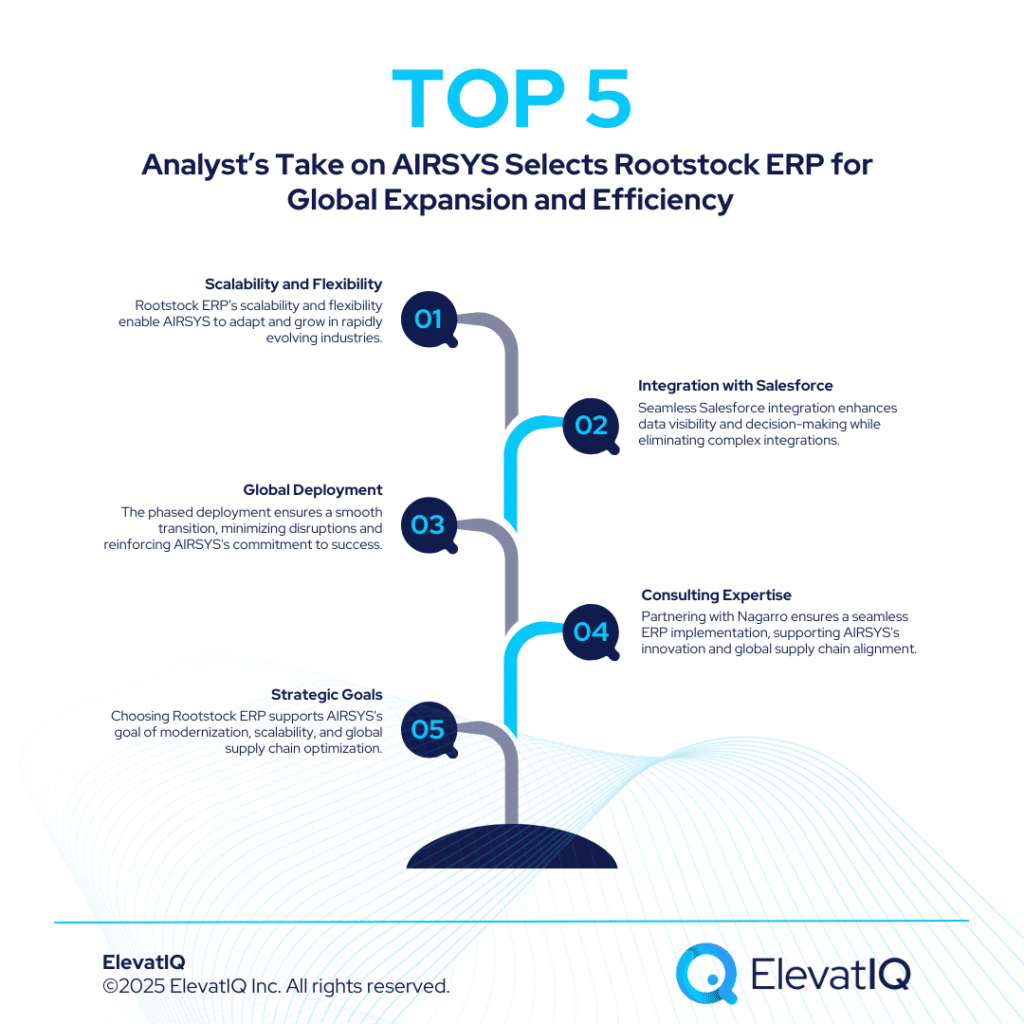
  1. Scalability and Flexibility: Rootstock ERP’s scalability and flexibility make it an ideal choice for AIRSYS, which operates in rapidly evolving industries. The ERP solution can adapt to changing business needs and support the company’s growth over the next few years.
  2. Integration with Salesforce: The seamless integration with Salesforce is a significant advantage, as it ensures that customer data is already hosted on the same platform. This eliminates the need for complex integrations and enhances data visibility and decision-making capabilities.
  3. Global Deployment: The phased deployment approach ensures a smooth transition and minimizes disruptions to ongoing operations. This strategic approach demonstrates AIRSYS’s commitment to a successful ERP implementation.
  4. Consulting Expertise: Partnering with Nagarro, a consulting firm with expertise in delivering sophisticated ERP and digital transformation projects, ensures a seamless implementation that supports AIRSYS’s innovation and global supply chain alignment.
  5. Strategic Goals: The selection of Rootstock ERP aligns with AIRSYS’s strategic goals of modernizing and consolidating its enterprise solutions. This move will enable the company to scale for exponential growth and support its global supply chain.
  6. Industry Trends: AIRSYS operates in industries that are rapidly evolving, such as AI semiconductors and medical imaging. The adoption of a modern, scalable ERP solution positions the company to stay ahead of industry trends and meet the demands of its customers.

The AIRSYS and Rootstock ERP collaboration highlights several key industry trends that are shaping the future of ERP solutions.

  • Cloud Integration: The integration of ERP solutions with cloud platforms like Salesforce is becoming increasingly popular. This trend is driven by the need for real-time data visibility, seamless integration, and enhanced decision-making capabilities.
  • Focus on Scalability: Companies are prioritizing scalable ERP solutions that can support their growth and adapt to changing business needs. This is particularly important for industries that are rapidly evolving, such as AI semiconductors and medical imaging.
  • Global Deployment: The trend of deploying ERP solutions across global operations is evident. Companies are looking for ERP systems that can support their international supply chains and streamline operations across multiple regions.
  • Partnerships with Consulting Firms: Partnering with consulting firms for ERP implementation is a growing trend, as these firms bring expertise and resources to ensure successful deployments.
  • Focus on Innovation: Businesses are prioritizing ERP solutions that support innovation and digital transformation to stay competitive in their industries.

Is It Good For All?

The selection of Rootstock ERP addresses AIRSYS’s need for a modern, scalable ERP solution that supports their global supply chain and rapid expansion. The integration with Salesforce ensures a seamless transition and enhances their operational efficiency.
For Rootstock, the partnership with AIRSYS showcases their ERP solution’s capabilities and strengthens their reputation in the market. Nagarro benefits from demonstrating their expertise in delivering sophisticated ERP implementations, enhancing their credibility and attracting future clients.

What ERP Buyers like AIRSYS must know/might not know?

While the decision to adopt Rootstock ERP brings numerous benefits, there are several potential concerns that AIRSYS must address to ensure a smooth and successful implementation.

  • Implementation Challenges: Deploying a new ERP system across global operations can be complex and may face challenges such as data migration, user training, and system integration. AIRSYS must have a robust implementation plan and support from experienced partners like Nagarro.
  • Change Management: Adopting a new ERP system requires significant changes in business processes and workflows. AIRSYS must ensure that employees are adequately trained and supported during the transition to minimize disruptions and maximize the benefits of the new system.
  • Data Security: With the integration of cloud-based ERP solutions, data security becomes a critical concern. AIRSYS must implement strong security measures to protect sensitive business data and also ensure compliance with data protection regulations.

FAQs

Rootstock: AIRSYS Selects it for Global Expansion and Efficiency Read More »

FREE RESOURCE

2026 Digital Transformation Report

This digital transformation report summarizes our annual research on ERP and digital transformation trends and forecasts for the year 2026. 

Send this to a friend