ERP end-of life

Infor Velocity Suite: Key Takeaways From Infor Velocity Week 2026 For ERP Buyers

Infor Velocity Suite: Key Takeaways From Infor Velocity Week 2026 For ERP Buyers

Key Highlights

  • On October 6, 2026, Infor unveiled its expanded Infor Industry AI architecture and the next evolution of the Infor Velocity Suite at Infor Velocity Week 2026 in Orlando.
  • Infor Industry AI is organized around four pillars: Precise Outcomes, Open & Connected, Easy to Use, and Governed.
  • Infor describes the Infor Velocity Suite as a single package that combines industry AI agents, generative AI, process mining, automation, and implementation expertise from forward-deployed engineers.
  • Infor’s second Enterprise AI Adoption Impact Index, a survey of 2,111 decision-makers in seven markets, found that 68% believe off-the-shelf AI does not adequately address their industry’s needs.
  • Infor highlighted governance and accountability as core elements of its architecture, including human-approval workflows, agent permissions, and audit trails. ERP buyers should verify how these controls operate in practice and whether they meet their organization’s requirements.
  • Performance figures cited in the announcement come from Infor, so buyers should validate them against their own processes and environment.
The State of ERP 2026 - Watch On-Demand

Introduction

Every year, ERP vendor events provide a useful window into where the industry is heading. At Infor Velocity Week 2026, the clear message was that agentic AI is moving from experimentation toward execution inside core business processes, and that Infor intends to deliver this through its industry-specific approach. The centerpiece was the expanded Infor Velocity Suite.

This recap of the Infor Velocity Suite summarizes what Infor announced, what its executives and customers discussed in published sessions, and what ERP buyers may want to consider as they evaluate these ideas. It is based on Infor’s announcement, independent media coverage, and recorded interviews from the event. Performance figures and research results are Infor’s own, and this blog does not independently verify them.

What Is the Infor Velocity Suite?

Infor is positioning the Infor Velocity Suite as a bundled way for existing and prospective customers to adopt industry-specific AI and automation. Rather than evaluating each capability in isolation, ERP buyers should examine the package as a whole: which tools and use cases are included, how they connect to current systems, what implementation support is provided, and what contractual limits apply.

ComponentWhat Infor says it provides
Infor Industry AI agentsAgents built with industry-specific context, tied to the customer’s Industry Process Catalog
Agentic OrchestratorA layer that coordinates work across Infor applications
Process mining and automationTools to identify and automate processes
Generative AICapabilities including the Infor GenAI Assistant and Infor GenAI Knowledge Hub
Prebuilt industry use casesOut-of-the-box use cases, with more than 350 in the catalog
Implementation expertiseForward-deployed engineers and industry experts who help put use cases into production

Infor also describes a commercial model with a single offer and unlimited access within fair business use. Infor describes the Velocity Suite as a single commercial offer with unlimited access within fair business use. Before purchasing the Infor Velocity Suite, organizations should confirm the pricing structure, contract duration, usage conditions, exclusions, and any additional implementation or service charges directly with Infor or an authorized partner. 



ERP Selection Requirements Template

This resource provides the template that you need to capture the requirements of different functional areas, processes, and teams.

The Four Pillars of Infor Industry AI

Infor organized the announcement around four platform pillars, with the related capabilities accessed through the Infor Velocity Suite:

PillarWhat Infor describesPerformance claims and figures reported by InforWhat ERP buyers should evaluate
Precise OutcomesIndustry AI agents grounded in Industry CloudSuites, Industry Process Catalogs, and industry-specific domain language models; Infor GenAI Knowledge Hub now generally available for building custom agentsShipments processed up to 60% faster for customers using this layerCan the agents handle the organization’s actual industry-specific rules, exceptions, and data?
Open & ConnectedAn open platform that connects to non-Infor applications and existing orchestration and analytics tools; agents coordinate through Infor IQ, a semantic layerMore than 350 out-of-the-box use casesWhich external systems are supported, and what integration work remains the customer’s responsibility?
Easy to UseAdaptive UX that assembles a role-aware view of what a decision requires, and works through the Infor GenAI Assistant or other AI assistants customers already useUp to 90% time savings across procurement, supply chain, manufacturing, and sales workflowsAre the claimed time savings relevant to the customer’s workflows, and how will they be measured?
GovernedHuman-approval workflows, agentic permission structures, audit trails, and immutable logging within the orchestration layerUp to a 90% reduction in auditing costs tied to access managementCan permissions, approvals, logs, and exception handling meet the organization’s control requirements?

These results are reported by Infor, and actual outcomes will vary with each organization’s processes, data, and starting point.



ERP System Scorecard Matrix

This resource provides a framework for quantifying the ERP selection process and how to make heterogeneous solutions comparable.

Why Industry Context Was the Central Theme

A recurring idea across the sessions was that AI agents perform better when they understand the specific details of an industry. Infor leaders gave practical examples. Receiving processes can differ even within food and beverage, for instance between dairy and red meat. For ERP buyers, the practical question is whether industry context is reflected in the rules, data structures, validations, and exception handling that govern actual transactions. Industry-specific terminology alone does not establish that an agent can execute a process reliably. Buyers should test representative transactions, including exceptions, before expanding automation.

Infor says its architecture exposes business-level process interfaces, such as purchase-order creation, rather than requiring agents to coordinate numerous granular technical calls. Combined with its shared semantic layer and industry-specific context, this design is intended to reduce errors and token usage. These are stated design goals; their impact on accuracy, reliability, and cost should be assessed in the relevant operating environment.

This is one vendor’s approach, delivered through the Infor Velocity Suite, to a broader industry question. Other ERP vendors are pursuing agentic AI through their own architectures, and buyers will want to compare how each handles industry fit, data context, openness, and governance against their specific requirements.

What the Infor Research Found

Alongside the Infor Velocity Suite announcement, Infor released the second edition of its Enterprise AI Adoption Impact Index. The research was conducted by YouGov on behalf of Infor in August 2026, surveying 2,111 business decision-makers in the UK, US, Singapore, Japan, France, Australia, and Germany.

FindingResult
Off-the-shelf AI does not adequately address industry needs68% of businesses, with a majority holding this view in six of the seven markets
Expect AI investment to increase over the next 12 months59% of businesses globally
Comfortable with autonomous agents fully executing critical processes without human input at every step54% of global leaders
Prefer humans to make high-stakes decisions with no AI input11% of leaders
Cite data security, sovereignty, or compliance as the single greatest barrier to AI strategy33%
Have a Chief AI Officer roleAbout 10% globally
Manufacturing respondents who said off-the-shelf AI does not fit their needs73% (distribution at 76%, retail at 69%)

One finding stood out for governance. When asked who is accountable if AI gets something wrong, answers were spread out: 23% pointed to the CEO or executive leadership, 22% to the CIO or CTO, 15% to an AI committee or governance group, and 10% to department heads. Another 15% said no one person has primary responsibility, or that it is unclear.

The Index was commissioned by Infor and conducted by YouGov. Its findings reflect the responses of 2,111 business decision-makers across seven markets, rather than all businesses globally. Readers should consult the full Enterprise AI Adoption Impact Index report and methodology and consider the survey sample, question wording, and geographic coverage when interpreting the results.

For ERP buyers, the findings point to two separate evaluation questions: whether AI can address the requirements of a specific industry and whether the organization has clear accountability when automated decisions go wrong. The survey provides context on decision-makers’ reported views, but it does not establish that any particular AI architecture will resolve these challenges. Buyers should evaluate capabilities against their own processes, risk thresholds, and governance requirements.

Governance and Human Oversight

Infor executives emphasized that trust is as important as capability when agents take on decisions. In a published interview, Infor’s president and chief technology officer described an approach that begins with a human reviewing agent recommendations, then adds observability, auditability, and access controls that treat each agent much like another participant in the enterprise.

Another Infor executive gave an example of how autonomy can be calibrated: routine steps such as order creation can run autonomously, while higher-stakes decisions, such as reallocating customer demand, are routed for human approval. Infor describes a governance, risk, and compliance layer intended to apply controls and logging to agent actions. ERP buyers should confirm how permissions, approval requirements, explanations, exception handling, and audit records are implemented for the specific processes they intend to automate.

For ERP buyers evaluating the Infor Velocity Suite, the practical takeaway is that the level of autonomy is a design choice. Organizations can decide which processes warrant full automation and which need human approval.

Forward-Deployed Engineers and Time to Value

A notable part of Infor’s model is its Forward-Deployed Engineers, described as industry and process specialists who work with customers to build and refine use cases. Infor says its Forward-Deployed Engineers work with customers to develop and refine industry-specific use cases. The company has highlighted faster prototyping and deployment as benefits of this model, although actual timelines will depend on project scope, data readiness, integration complexity, testing, and organizational change.

A customer perspective was also shared in the announcement, where the CTO of Team Air Distributing described the pairing of Infor’s agents with forward-deployed engineers as a way to reduce manual work and build trust one process at a time. Timelines, as always, depend on scope, data readiness, and organizational change.

Adoption After Go-Live

In another session, Infor’s chief customer officer described a framework of optimize, adopt, and innovate for guiding customers beyond go-live. She argued that standardizing core processes helps make AI more effective and affordable, and discussed Infor Value+, a self-service evolution of the company’s customer success tools, along with micro-vertical benchmarking so customers can see how they compare with similar peers. She also pointed to inertia, rather than technology, as the biggest barrier, with many organizations unsure where to begin.

For ERP customers adopting the Infor Velocity Suite, post-go-live adoption should be evaluated through process performance, user adoption, exception rates, and measurable business outcomes. Before expanding AI use, organizations should establish a baseline and define how improvements will be monitored over time. This helps distinguish the availability of new capabilities from their actual contribution to business performance.

What ERP Buyers and Infor Customers Should Consider

For organizations evaluating ERP platforms or running Infor CloudSuites today, several themes from the event about the Infor Velocity Suite and Infor Industry AI are worth reflecting on:

  • Start with a defined use case. Selecting one high-impact process and measuring results can be more productive than a broad automation program.
  • Standardized processes and clean data matter. Industry-specific agents depend on well-defined processes and reliable master data.
  • Decide accountability early. The research suggests many organizations have not settled who is responsible when AI makes a mistake.
  • Assess openness. Consider how any agentic capability connects with your existing applications, orchestration tools, and data.
  • Understand total cost. Infor’s own research cited in one session indicated that many organizations do not fully understand their long-term AI costs, so clarity on commercial terms is important.
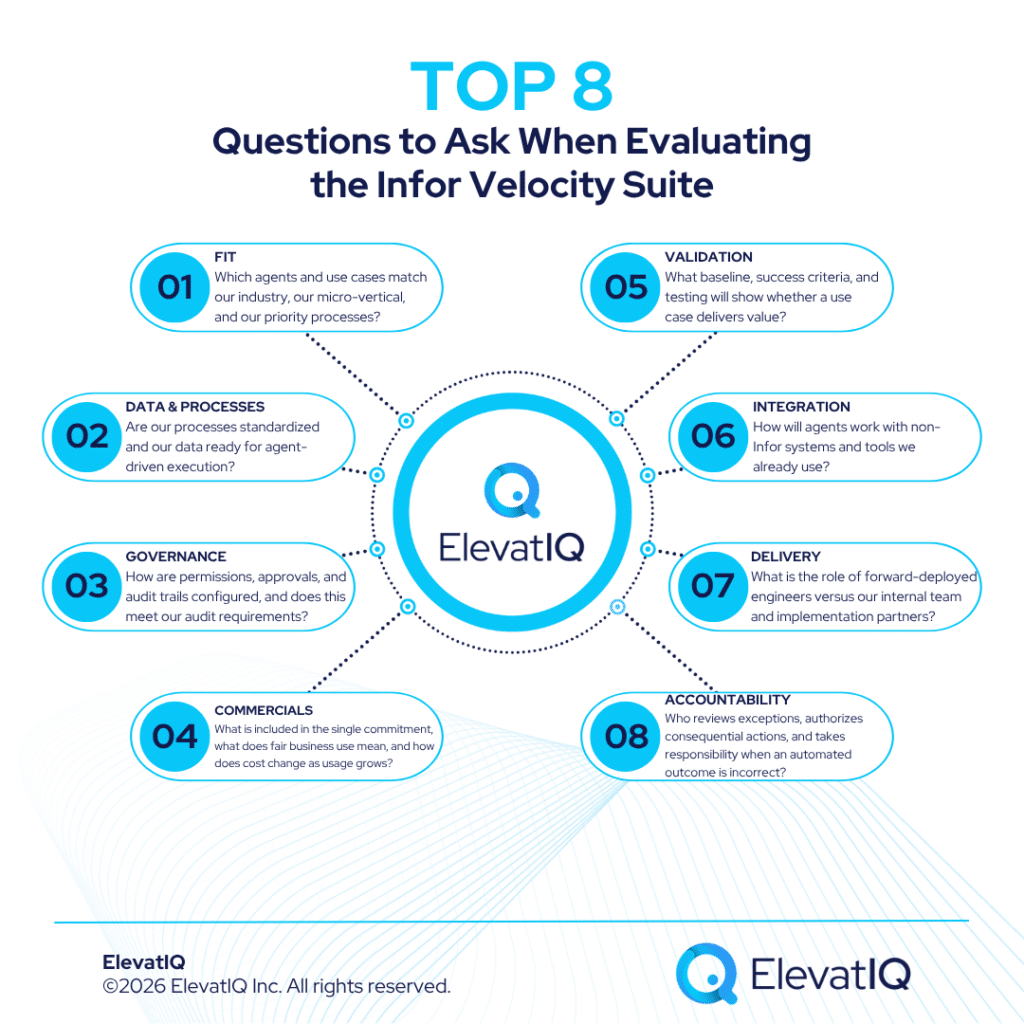
AreaQuestions to ask
FitWhich agents and use cases match our industry, our micro-vertical, and our priority processes?
Data and processesAre our processes standardized and our data ready for agent-driven execution?
GovernanceHow are permissions, approvals, and audit trails configured, and does this meet our audit requirements?
CommercialsWhat is included in the single commitment, what does fair business use mean, and how does cost change as usage grows?
ValidationWhat baseline, success criteria, and testing will show whether a use case delivers value?
IntegrationHow will agents work with non-Infor systems and tools we already use?
DeliveryWhat is the role of forward-deployed engineers versus our internal team and implementation partners?
AccountabilityWho reviews exceptions, authorizes consequential actions, and takes responsibility when an automated outcome is incorrect?

An Independent Perspective

ElevatIQ approaches ERP selection and advisory from an independent, requirements-led perspective. When events like Infor Velocity Week introduce new capabilities, our focus is on helping organizations separate what is relevant to their business from what can wait. In practice, this often means assessing process and data readiness, defining requirements, comparing platforms on a like-for-like basis, and planning adoption in a measured way. Whether you are selecting a new ERP, evaluating the Infor Velocity Suite as part of an existing Infor environment, or planning your approach to agentic AI, a vendor-neutral assessment can bring clarity.

Final Thoughts

The expanded Infor Velocity Suite reflects a broader shift in enterprise software toward agents that execute work, supported by industry context and governance. Infor’s emphasis on micro-vertical expertise, interoperability, human oversight, and embedded implementation support illustrates its approach to enterprise AI. For buyers, the real test will be how well these capabilities perform against specific processes, controls, and commercial expectations.



ERP Selection: The Ultimate Guide

This is an in-depth guide with over 80 pages and covers every topic as it pertains to ERP selection in sufficient detail to help you make an informed decision.

Infor Velocity Suite: Key Takeaways From Infor Velocity Week 2026 For ERP Buyers Read More »
Oracle Fusion Claw: What The New Agentic Execution Runtime Means For ERP Buyers And Fusion Customers

Oracle Fusion Claw: What The New Agentic Execution Runtime Means For ERP Buyers And Fusion Customers

Key Highlights

  • Oracle announced Oracle Fusion Claw on September 29, 2026, as a governed agentic execution runtime for Oracle Fusion Agentic Applications.
  • According to Oracle, it combines AI reasoning with deterministic enterprise computation, so AI is applied where intelligence is needed and conventional computation handles high-volume execution.
  • Oracle announced 25 new Claw-powered Agentic Applications, described as capable of full-auto execution within delegated authority. These applications are additions to Oracle’s broader portfolio of 75 Agentic Applications, according to the company, with examples spanning finance, HR, supply chain, and sales.
  • Governance is built around an Enterprise Operating Envelope, an Outcome Trust Harness, and an Outcome Receipt that records what happened in each run.
  • Customers can choose how much automation a process gets, from quick assistance to governed full auto execution within delegated authority.
  • ERP buyers and existing Fusion customers should evaluate process readiness, data quality, governance, and costs before expanding autonomy.
The State of ERP 2026 - Watch On-Demand

Introduction

Agentic AI has moved quickly from an interesting concept to a feature that ERP vendors are building directly into their suites. The latest example is Oracle Fusion Claw, announced by Oracle on September 29, 2026. For finance, HR, supply chain, and IT leaders who run or are considering Oracle Fusion Cloud Applications, it raises a practical question: what does it actually do, and how should we think about it?

This blog summarizes Oracle’s announcement, explains the key concepts in plain language, and outlines what organizations should evaluate before acting on it. The analysis is based primarily on Oracle’s September 29, 2026 announcement and related product documentation. It describes Oracle’s stated capabilities and should not be interpreted as independent verification of product performance, cost savings, or compliance outcomes.

What Is Oracle Fusion Claw?

Oracle describes Oracle Fusion Claw as a governed agentic execution runtime for Oracle Fusion Agentic Applications. In simpler terms, it is the engine that lets agentic applications take on larger, longer-running, and more complex pieces of work, while operating within rules that the organization defines.

Oracle positions Agentic Applications as outcome-based applications, where people define the objectives, authority, and accountability, and the applications coordinate the process to reach an outcome. Oracle Fusion Claw is intended to extend that model to specialist-grade work such as deep research, computation, simulation, modeling, and continuous re-planning.y more layered history than many legacy Macola customers may realize when evaluating the product’s stability today.


ERP Selection Requirements Template

This resource provides the template that you need to capture the requirements of different functional areas, processes, and teams.

How Oracle Fusion Claw Works: Reasoning Plus Deterministic Computation

One of the central ideas in the announcement is the separation between reasoning and execution. According to Oracle, each Claw outcome begins with an advanced AI model that reasons and plans the work, with the ability to adapt as execution progresses. Fusion Claw then uses deterministic enterprise computation to carry out the work precisely and at scale.

StageWhat happensWhy it matters (per Oracle)
ReasoningA frontier model plans the approach, learns, and adaptsAI intelligence is applied where judgment is needed
ExecutionDeterministic enterprise computation performs the high-volume workDesigned to support consistent execution at scale, with potential cost benefits that depend on the process and implementation
Re-planningThe plan is adjusted as conditions changeLonger-running work can adapt rather than start over

Oracle states that this separation provides customers with a potential economic advantage, since AI reasoning is used only where it is needed. As with any vendor claim about cost efficiency, the actual impact will depend on each organization’s processes, volumes, and pricing terms.

The announcement also notes that Oracle Fusion Claw runs on Oracle Cloud Infrastructure and is powered by frontier models including Gemini and OpenAI, with support for additional frontier models planned over time.


ERP System Scorecard Matrix

This resource provides a framework for quantifying the ERP selection process and how to make heterogeneous solutions comparable.

The Governance Layer: Operating Envelope, Trust Harness, and Receipt

For ERP leaders, the most relevant question about autonomous AI is usually not what it can do, but how it is controlled. Oracle’s announcement describes three governance components of Oracle Fusion Claw:

ComponentWhat it isWhat it covers
Enterprise Operating EnvelopeThe organization’s boundaries for autonomous workObjectives, standard operating procedures, policies, constraints, permissions, risk thresholds, decision rights, approval requirements, and escalation boundaries
Outcome Trust HarnessEnforcement of the envelope on each outcome runIdentity, capabilities, data, and actions
Outcome ReceiptAn auditable record produced when an outcome is completeAuthority applied, evidence used, decisions made, actions and transactions executed, and the result

This structure is designed to give finance, audit, and compliance teams a way to understand what an automated process did and under whose authority. Whether it meets a particular organization’s audit and regulatory requirements is something each company would need to assess for itself.

Choosing the Level of Automation

Oracle also states that customers can decide what level of automation a process should have, ranging from quick assistance to governed full auto execution within explicitly delegated authority. Organizations may wish to begin with lower-risk, measurable use cases and expand autonomy as controls and results are validated. The appropriate starting point will depend on process criticality, the potential consequences of errors, existing controls, and the organization’s readiness for automation.

Examples of the 25 Claw-Powered Agentic Applications

Oracle reports that 25 Claw-powered, full auto-capable Agentic Applications are available, as part of a portfolio of 75 Agentic Applications. The announcement highlights four examples:

ApplicationBusiness areaWhat Oracle says it helps with
LedgerFinanceImproving close readiness and resolving accounting exceptions faster by reconciling large volumes of entries and investigating anomalies
Workforce StaffingHRCreating executable staffing plans that balance skills, availability, schedules, labor rules, costs, and coverage, with continuous re-planning
Shipping ConsolidationSupply chainReducing shipping costs by modeling consolidation alternatives across timing, capacity, service commitments, and cost
Account Territory Growth PlanSalesImproving coverage and opportunity allocation by modeling and comparing territory scenarios

These examples show a common theme: problems with many constraints and large volumes of data, where planning, simulation, and re-planning are valuable.

Where Oracle Fusion Claw Fits in the Wider Oracle AI Ecosystem

According to the announcement, the Claw-powered applications are part of a broader Fusion AI ecosystem anchored by Oracle AI Agent Studio for Fusion Applications. With the Agentic Applications Builder and AI Studio Skill capabilities, organizations can create and manage agentic applications using reusable Oracle, partner, and external agents. Oracle also describes observability, ROI measurement, and safety controls within its broader agentic AI ecosystem. ERP buyers should establish how these capabilities are configured, what metrics they expose, and whether the resulting evidence is sufficient for their operational and governance requirements.

What Oracle Fusion Claw Means for ERP Buyers and Existing Fusion Customers

For organizations evaluating ERP platforms, or already running Oracle Fusion Cloud Applications, announcements like this are a useful prompt to review readiness and priorities. A few themes are worth considering:

  • AI capability is becoming part of ERP evaluation. Agentic features should be assessed alongside functional fit, total cost of ownership, implementation complexity, integration requirements, and long-term support. Buyers should distinguish between capabilities available today, those requiring additional configuration, and benefits that still need to be demonstrated in their own operating environment.
  • Foundations still matter. Agentic applications work with an organization’s data, processes, and policies. Clean master data, well-defined processes, and clear approval rules are likely to influence how much value any such capability delivers.
  • Governance needs to be designed, not assumed. Defining decision rights, risk thresholds, and escalation paths is an organizational exercise as much as a technical one.
  • Change management is part of the picture. Moving from AI assistance to AI execution changes how teams work, review, and take accountability.

Organizations should not assume that a new agentic capability, on its own, justifies an ERP change or an expanded automation programme. For some businesses, the priority may be improving data quality, standardizing processes, or making better use of existing ERP functionality. Others may have specific, high-volume processes where greater autonomy warrants a structured pilot. The appropriate path depends on business requirements, readiness, risk tolerance, and measurable results rather than the announcement alone.

Questions to Ask Before Acting

The announcement is a press release, so it does not answer every practical question an ERP leader would have. These are worth raising with the vendor and internal teams:

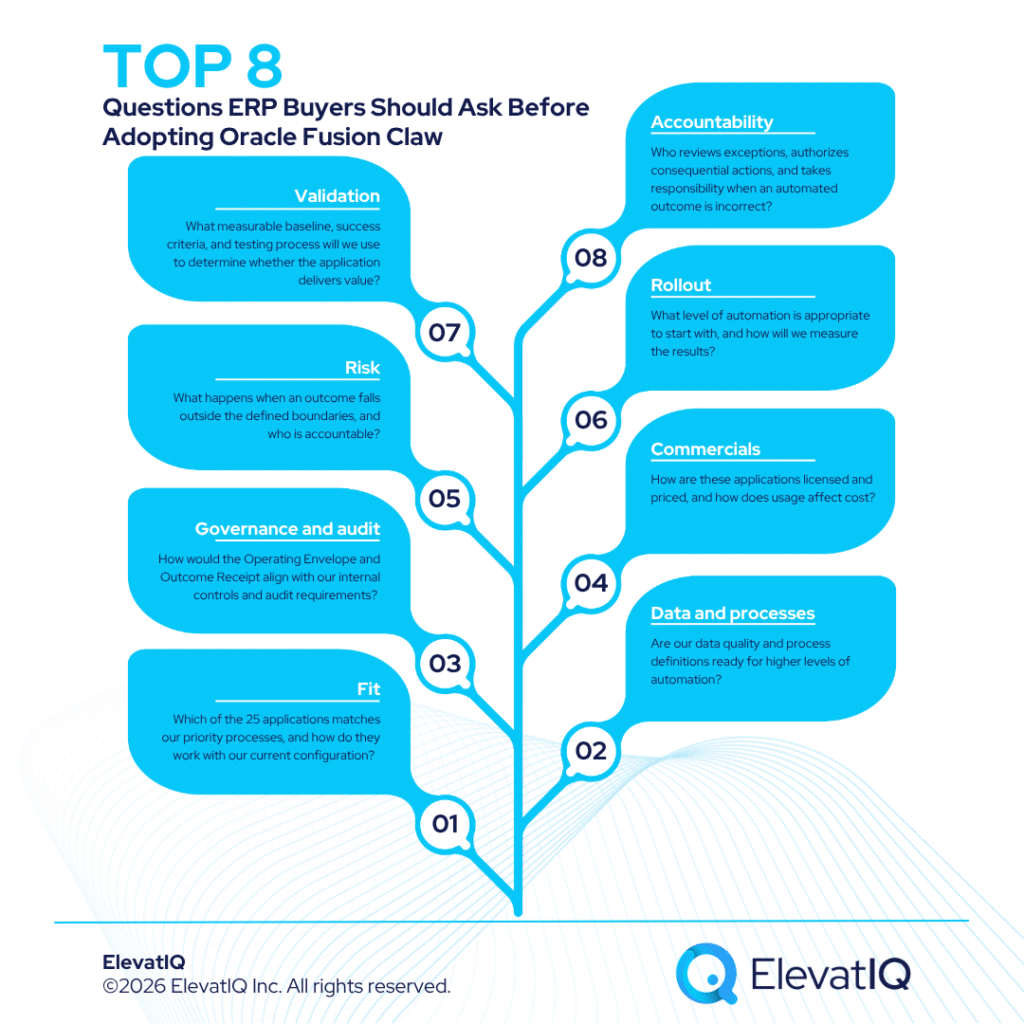
AreaQuestions to consider
FitWhich of the 25 applications match our priority processes, and how do they work with our current configuration?
Data and processesAre our data quality and process definitions ready for higher levels of automation?
Governance and auditHow would the Operating Envelope and Outcome Receipt align with our internal controls and audit requirements?
CommercialsHow are these applications licensed and priced, and how does usage affect cost?
RiskWhat happens when an outcome falls outside the defined boundaries, and who is accountable?
RolloutWhat level of automation is appropriate to start with, and how will we measure results?
ValidationWhat measurable baseline, success criteria, and testing process will we use to determine whether the application delivers value?
AccountabilityWho reviews exceptions, authorizes consequential actions, and takes responsibility when an automated outcome is incorrect?

Pricing, licensing terms, and availability details are not covered in the announcement, so it is best to confirm them directly with Oracle or an authorized partner.

An Independent View on Agentic AI in ERP

ElevatIQ approaches ERP selection and advisory from an independent, requirements-led perspective. For announcements such as Oracle Fusion Claw, the relevant question is not simply what a vendor says its technology can do, but how well those capabilities align with an organization’s business requirements, existing systems, governance needs, and implementation constraints.

Our ERP selection and advisory work typically focuses on helping organizations understand how new capabilities relate to their actual requirements, how ready their data and processes are, and how to plan adoption without overextending. Whether a company is comparing ERP platforms or optimizing an existing Oracle Fusion environment, a structured, vendor-neutral assessment can help separate what is relevant now from what can wait.

Final Thoughts

Oracle Fusion Claw illustrates a shift toward AI applications that can coordinate and execute multi-step business work rather than only assist users with individual tasks. Oracle’s stated approach combines delegated authority, execution controls, and records of completed outcomes. For ERP buyers, however, the practical value will depend on the processes being automated, the controls that can be configured and tested, the commercial terms, and the results achieved in the organization’s own environment.

Organizations evaluating ERP options or planning an Oracle Fusion roadmap should assess agentic AI against their business requirements, implementation constraints, governance needs, and long-term objectives. ElevatIQ can help evaluate these considerations as part of a structured ERP selection or advisory process., compare alternatives, assess migration complexity, and make a considered decision rather than a reactive one.


ERP Selection: The Ultimate Guide

This is an in-depth guide with over 80 pages and covers every topic as it pertains to ERP selection in sufficient detail to help you make an informed decision.

Oracle Fusion Claw: What The New Agentic Execution Runtime Means For ERP Buyers And Fusion Customers Read More »

Macola ERP Alternatives: What Its Ownership History Means for Legacy Customers

Macola ERP Alternatives: What Its Ownership History Means for Legacy Customers

Key Highlights

  • Macola, originally built for manufacturers and distributors, has undergone several changes in corporate ownership or control since 2001. This also includes transactions involving private equity investors. The most recent was announced in February 2025. There was no formal end-of-life announcement for Macola in ECI’s current public materials.
  • The most recent transaction saw Apax Partners. They first invested in ECi in 2017, increasing its equity stake to become a co-control owner alongside Leonard Green & Partners. Along with GIC joining as a new investor. This makes evaluating Macola ERP alternatives a reasonable planning exercise for legacy customers. Not because of any announced sunset, but because ownership changes provide context for assessing product investment, roadmap communication, and long-term strategic positioning.
  • The February 2025 announcement should not, by itself, be interpreted as evidence of declining investment in ECI or Macola. The investors described continued growth, investment in core products, and expansion in ECI’s existing verticals as priorities. For Macola customers, the more relevant question is whether those broader priorities translate into continued investment and roadmap clarity for Macola specifically.
  • None of this means Macola customers need to migrate immediately. It does mean that understanding the ownership history, alongside observable product investment, release activity, and roadmap communication, is a reasonable input into any ERP planning discussion.
Your ERP Strategy Is About to Break - Sandeep Chopra - Watch On-Demand

Introduction

Not every signal worth acting on comes in the form of an announced end-of-life date. Sometimes the more useful signal is a pattern. For Macola ERP customers, that pattern is a private equity ownership history that has changed hands repeatedly over the past several years. Most recently in a transaction announced on February 28, 2025.

Macola has roots dating to 1971 in Marion, Ohio, built specifically for the operational needs of manufacturers and distributors. It was acquired by Exact Software in 2001. Since then, Macola’s corporate ownership has changed multiple times, including transactions involving private equity investors. Macola has, at various points, operated within larger software portfolios alongside other products serving different markets and industries.

This piece walks through what’s actually been confirmed about Macola’s ownership history. Why a pattern of repeated PE transactions matters differently than a single end-of-life date, and how legacy Macola customers should think about evaluating Macola ERP alternatives, independently of any single ownership event.

What’s Actually Been Confirmed About Macola’s Ownership History

Understanding why some legacy customers are starting to evaluate Macola ERP alternatives starts with laying out the confirmed ownership timeline in full, since it’s more layered than a single acquisition story.

Macola’s Ownership Timeline: Confirmed Transactions

DateTransaction
2001Exact Software, a Netherlands-based enterprise software company, acquires Macola
August 2017Apax Partners agrees to acquire ECi Software Solutions from affiliates of The Carlyle Group and Level Equity, with Carlyle retaining a minority ownership position. Concurrently, Exact Software’s Macola, JobBOSS, and MAX businesses are combined with ECi
2020Leonard Green & Partners agrees to acquire a majority stake in ECi from Apax Partners and The Carlyle Group; upon completion, Apax retains a minority stake
February 28, 2025Apax Funds announce a definitive agreement to increase their equity stake in ECI; upon completion, Apax will become a co-control owner alongside Leonard Green & Partners, with GIC making a substantial new investment

Four changes in corporate ownership or control across roughly two decades is not unusual for enterprise software broadly, but it is a meaningfully more layered history than many legacy Macola customers may realize when evaluating the product’s stability today.


ERP Selection Requirements Template

This resource provides the template that you need to capture the requirements of different functional areas, processes, and teams.

Why Ownership History Is Relevant to ERP Planning

A single change in ownership does not, by itself, establish anything about a product’s future. For customers, the more useful approach is to examine the broader ownership history alongside observable indicators such as product investment, release activity, roadmap communication, and the product’s position within the owner’s portfolio.

ECi Software Solutions is a diversified provider of industry-specific business software, with Macola serving as one product among a portfolio that spans manufacturing, distribution, field services, building and construction, and other verticals. That structure isn’t unique to ECi, but it is a relevant factor when evaluating how the product is positioned within the broader portfolio and whether its roadmap and investment priorities remain clear.

What Repeated PE Ownership Changes Typically Signal, and What They Don’t

SignalWhat It SuggestsWhat It Doesn’t Confirm
Multiple ownership changes over timeA reason to examine whether product strategy, investment priorities, or roadmap communication have changedThat any specific product, including Macola, is being discontinued
A product positioned as one of several inside a larger portfolioProduct investment and roadmap priorities should be evaluated against the broader portfolioThat the product in question is receiving less investment than others in the portfolio
No formal end-of-life announcement identified in current public materialsThere is no publicly stated sunset date to plan againstThat the product’s roadmap and update cadence will remain unchanged indefinitely

The February 2025 ownership announcement also provides an important counterpoint. Apax stated that its earlier investment had supported ECI’s core products, international expansion, and M&A, while the new transaction was framed around continued growth and expansion. The ownership change therefore should not be treated as evidence of declining investment on its own. For Macola customers, the practical question is whether ECI’s broader investment strategy is translating into visible product development, roadmap clarity, and continued support for Macola.


ERP System Scorecard Matrix

This resource provides a framework for quantifying the ERP selection process and how to make heterogeneous solutions comparable.

Evaluating Macola ERP Alternatives, and What Belongs in That Evaluation

For a legacy Macola customer, the absence of a publicly identified formal end-of-life announcement means there is currently no publicly stated sunset deadline forcing an immediate migration decision. That’s different from having no reason to evaluate options at all. A reasonable approach treats the ownership history as one input among several, not as a standalone reason to migrate.

Evaluation AreaWhy It Matters for Legacy Macola Customers
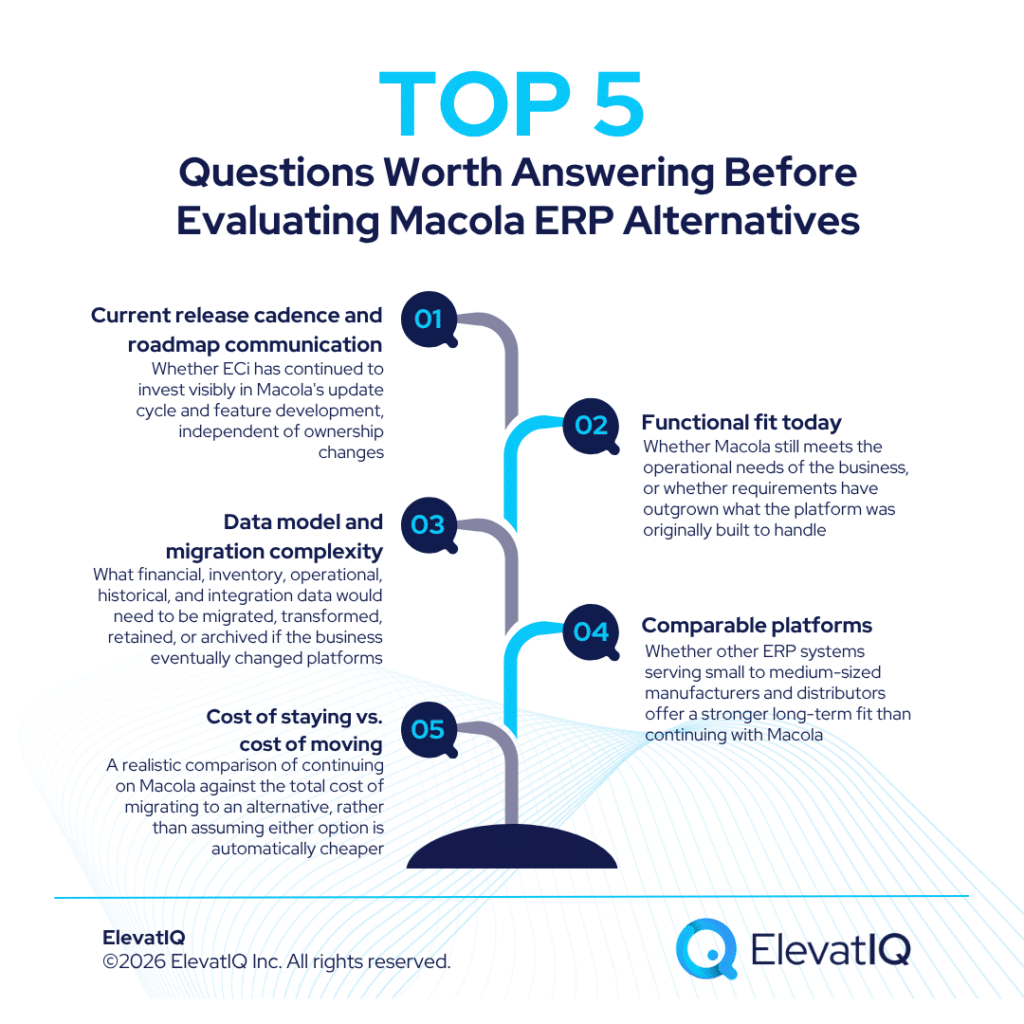
Current release cadence and roadmap communicationWhether ECi has continued to invest visibly in Macola’s update cycle and feature development, independent of ownership changes
Functional fit todayWhether Macola still meets the operational needs of the business, or whether requirements have outgrown what the platform was originally built to handle
Data model and migration complexityWhat financial, inventory, operational, historical, and integration data would need to be migrated, transformed, retained, or archived if the business eventually changed platforms
Comparable platformsWhether other ERP systems serving small to medium-sized manufacturers and distributors offer a stronger long-term fit than continuing with Macola
Cost of staying vs. cost of movingA realistic comparison of continuing on Macola against the total cost of migrating to an alternative, rather than assuming either option is automatically cheaper

An evaluation built on these questions is a different exercise than reacting to ownership news as though it were an end-of-life notice. It treats the ownership pattern as context for a decision the business would eventually need to make anyway, on its own timeline.

Managing the Decision Through ERP Independent Advisory

For legacy, vertical-specific ERP platforms like Macola, ownership and roadmap signals may be less straightforward for customers to interpret than a formal vendor announcement. Without a structured ERP evaluation process, businesses may instead wait for a formal trigger or assume continuity without periodically validating the product’s fit and roadmap.

Reactive Assumptions vs. Independent, Evidence-Based Evaluation

ApproachReactive DefaultIndependent, Evidence-Based Approach
Reading ownership newsTreated as background noise unless a formal end-of-life notice is issuedTreated as one data point in an ongoing assessment of product investment and roadmap continuity
Timing of evaluationDelayed until a forcing event, such as a support deadline or major failureStarted proactively, using ownership changes alongside product fit, roadmap, release activity, and other observable indicators
Comparison against alternativesLimited or skipped entirely absent a clear triggerConducted periodically, regardless of whether a trigger event has occurred
Decision basisAssumption of continuity, or reaction to a single headlineA documented comparison of current fit, cost, and available Macola ERP alternatives

At ElevatIQ, we help legacy ERP customers evaluate platform stability and fit based on the actual evidence available, including ownership history, release cadence, and functional requirements, rather than waiting for a formal vendor announcement to prompt the conversation. As an independent ERP and business software consulting firm, we don’t sell software and don’t receive commissions from vendors, which means our assessment of Macola, or any other platform, is shaped by what a business’s operations actually require, not by which platform we have an incentive to place. For a Macola customer weighing whether now is the time to look seriously at Macola ERP alternatives, that independent, evidence-based evaluation is what turns an ownership pattern into an informed decision rather than a reaction.

Conclusion

Macola’s ownership history is not, by itself, a reason to migrate immediately. There was no formal end-of-life announcement for Macola in ECI’s current public materials, and ECI continues to list Macola as a product for existing small to medium-sized manufacturing and distribution customers. The four changes in corporate ownership or control since 2001, including the February 2025 transaction, are worth factoring into the planning discussion, not a detail to set aside because no deadline has been attached to it.

A few signals tend to indicate a legacy Macola customer should start evaluating Macola ERP alternatives sooner rather than later:

  • The business has not reviewed Macola’s recent release cadence, product updates, or roadmap communication
  • The business’s current operational requirements have outgrown Macola’s capabilities or require functionality that the business cannot reasonably support through its current environment
  • Macola ERP alternatives haven’t been evaluated at all, even informally, in recent memory
  • The business’s current plan is to wait for a formal lifecycle announcement before evaluating whether a change is necessary

Starting that evaluation before a formal lifecycle announcement, if one is ever made, gives a legacy Macola customer more time to validate requirements, compare alternatives, assess migration complexity, and make a considered decision rather than a reactive one.


ERP Selection: The Ultimate Guide

This is an in-depth guide with over 80 pages and covers every topic as it pertains to ERP selection in sufficient detail to help you make an informed decision.

Macola ERP Alternatives: What Its Ownership History Means for Legacy Customers Read More »

Evosus Legacy End of Life: What ERP Buyers Should Know Before 2029

Evosus Legacy End of Life: What ERP Buyers Should Know Before 2029

Key Highlights

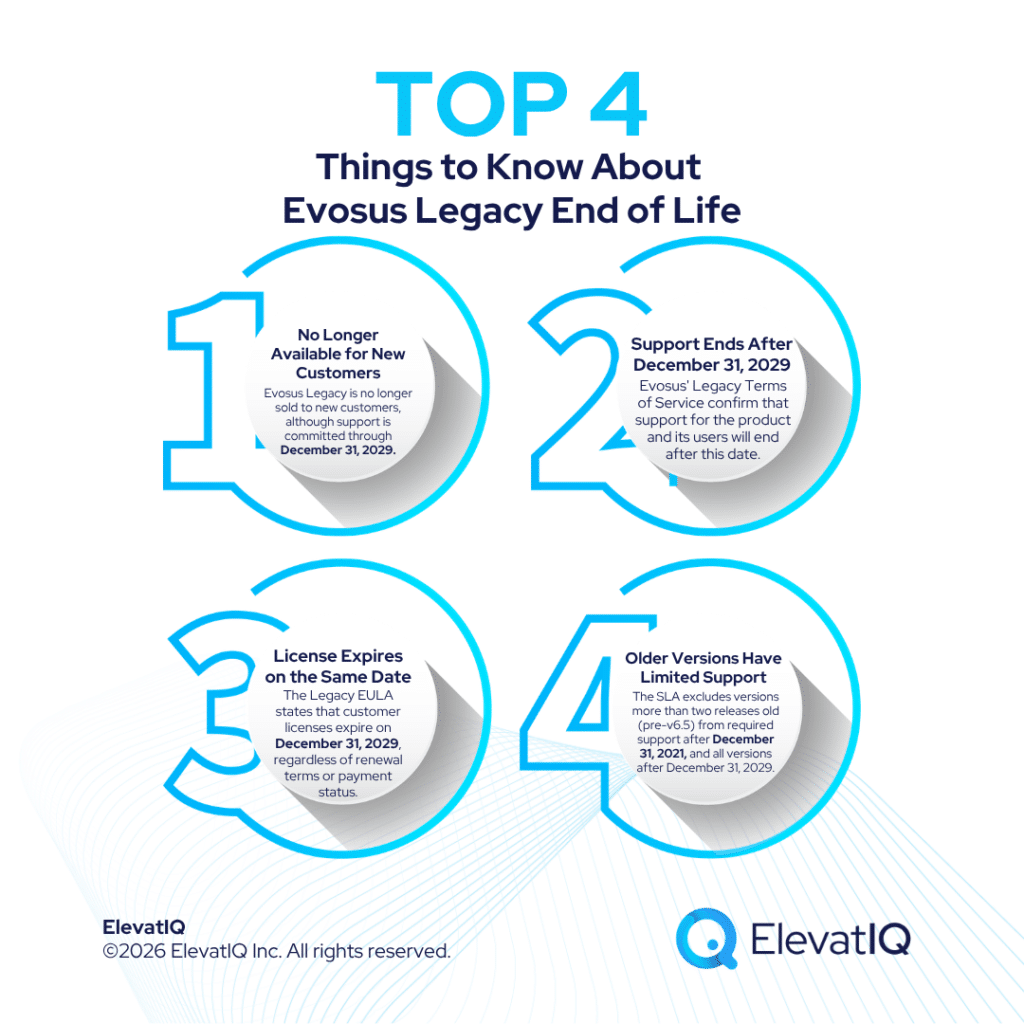
  • Evosus has confirmed the Evosus Legacy end of life. The business management software is no longer sold to new customers. And also support for the product will end after December 31, 2029. The date is specified in Evosus’ Legacy Terms, EULA, and Service Level Agreement.
  • Evosus has also specified version-based support limitations for Legacy. Versions more than two releases old, defined by Evosus as versions earlier than v6.5, are not required to receive support after December 31, 2021. As a result, some dealers and retailers may already have limited or no vendor support. This also depends on the Legacy version they are running.
  • Evosus’s own migration path is its cloud platform LOU. The multi-year transition window gives dealers and retailers time to plan ahead of the final cutoff. Pool, spa, and hearth dealers and retailers still need to independently evaluate whether LOU, or an alternative platform, is the better long-term fit for their specific business.
  • Waiting until close to the Evosus Legacy end of life can concentrate cost. This also concentrates staff training and data migration risk into a shorter window. It also may leave dealers and retailers with less time to compare platforms and negotiate commercial terms.
Your ERP Strategy Is About to Break - Sandeep Chopra - Watch On-Demand

Introduction

Software end-of-life announcements are common across the ERP and business management software industry. But the details of each one matter more than the headline. Evosus is a business management platform built specifically for pool, spa, and hearth (fireplace and stove) dealers and retailers. It has confirmed that its Legacy product is no longer available for purchase by new customers. And also confirmed that support for existing Legacy customers will end on December 31, 2029.

For a niche, vertical-specific platform like Evosus Legacy, this kind of announcement often gets less attention than a similar move from a major horizontal ERP vendor. But the operational stakes for the dealers and retailers who depend on it are just as real. Pool, spa, and hearth dealers and retailers use platforms like Evosus Legacy to run service scheduling, retail point of sale, inventory, and accounting in a single system. This also means a required transition away from Legacy because the Evosus Legacy end of life can touch nearly every part of daily operations.

This piece looks at what’s actually been confirmed about the Evosus Legacy end of life timeline. What a phased support and end-of-life policy like this means in practice. And also how a dealer and retailer should approach the transition decision independently of the vendor’s own recommended path.

What Evosus Has Actually Confirmed

Understanding the real urgency behind the Evosus Legacy end of life starts with separating the marketing message from the contractual language. Since the two are usually more specific than they first appear.

Evosus Legacy Timeline: Marketing Language vs. Contractual Terms

SourceWhat It States
Evosus Legacy product pageLegacy software is no longer for sale; support is committed through December 31, 2029
Legacy Terms of ServiceEvosus will discontinue support for the Legacy product and its users after December 31, 2029 (the “Expiration Date”)
Legacy EULAA customer’s Legacy Product License itself expires on December 31, 2029, regardless of renewal terms or payment status
Service Level AgreementEvosus is not required to support any Legacy version more than two releases old (pre-v6.5) after December 31, 2021, and won’t support any version after December 31, 2029

The SLA detail is worth sitting with. A dealer and retailer running an older, unpatched version of Legacy may already be outside the vendor’s support obligations well ahead of the because of the Evosus Legacy end of life in 2029, independent of the final cutoff date. That’s a distinction that’s easy to miss if a business only pays attention to the year printed on the marketing page.


ERP Selection Requirements Template

This resource provides the template that you need to capture the requirements of different functional areas, processes, and teams.

Why a Multi-Year Runway Is Both a Relief and a Trap

A multi-year support window ahead of the Evosus Legacy end of life gives dealers and retailers meaningful time to plan a transition before the final cutoff. Evosus has also been transparent about the technical reasoning: the top layer of Legacy’s programming sits on VB6, an aging technology stack, and the company evaluated how long it could realistically continue supporting the full stack underneath it before settling on the 2029 date.

The trap isn’t the timeline itself, it’s what a long runway tends to do to decision-making inside a dealer and retailer business.

Common Patterns in Long-Runway Software Transitions

PatternWhat Typically Happens
“We have years, no rush”Evaluation gets deprioritized against day-to-day operational demands
Migration planning starts in the final 12–18 monthsData migration, staff retraining, and integration work all get compressed into a shorter window than the vendor intended
Single-vendor defaultThe business moves to the vendor’s own successor platform without comparing it against alternatives, simply because it’s the path of least resistance
Version driftDealers and retailers running older Legacy versions discover they’ve already lost pieces of vendor support well before the final deadline

None of this is unique to Evosus. These are common risks in software transitions with distant deadlines, and it’s precisely why treating a 2029 date as “not yet a priority” is a different decision than treating it as “not yet urgent, but already worth planning.”


ERP System Scorecard Matrix

This resource provides a framework for quantifying the ERP selection process and how to make heterogeneous solutions comparable.

Evaluating LOU, and What Else Belongs in the Conversation

Planning around the Evosus Legacy end of life means engaging with Evosus’s own recommended path for Legacy customers, which is its cloud-based successor platform LOU. The company positions LOU as unifying service, retail, inventory, and accounting in one system, with continuous updates handled in the cloud rather than through periodic on-premises releases. In a September 2024 discussion with Legacy customers, Evosus said it expected most dealers and retailers to move to LOU around 2027 into 2028, ahead of the final 2029 cutoff tied to the Evosus Legacy end of life.

For a Legacy customer, LOU is a reasonable starting point for evaluation, since it’s built by the same team with direct knowledge of what Legacy customers actually use day to day. But a starting point for evaluation is not the same as an automatic decision, and this is where the distinction between a vendor’s recommended migration path and an independently evaluated one matters most.

Questions Worth Answering Before Committing to Any Platform, Including LOU

Evaluation AreaWhy It Matters for Pool, Spa, and Hearth Dealers and Retailers
Feature parity timelineWhether functionality a dealer and retailer currently relies on in Legacy is available in the new platform now, or on a future roadmap
Data migration scopeHow cleanly service history, inventory records, and customer data actually transfer, and what gets left behind or requires manual re-entry
Total cost over the transition periodLicensing, training, potential parallel-running costs, and any hardware or integration changes required
Integration footprintWhether existing point-of-sale, payment processing, or accounting integrations are supported on day one
Alternative platformsWhether a broader look at other retail, service, and inventory management platforms serving specialty dealers and retailers surfaces a better long-term fit than staying within the Evosus product family

A vendor’s own successor product can be a reasonable option, but it is also the option most directly presented and supported by the incumbent vendor. That makes independent comparison against the same requirements important. An independent ERP evaluation treats it as one candidate among several, evaluated against the same criteria as anything else.

Managing the Transition Through Independent Advisory

Navigating the Evosus Legacy end of life well ahead of the deadline is where independent, vendor-agnostic evaluation matters most. Vertical, dealer- and retailer-specific software like Evosus Legacy often gets less structured evaluation support than mainstream ERP transitions. It is largely because the market is smaller and less served by general enterprise software consultants. That gap tends to leave dealers and retailers choosing between doing the evaluation entirely in-house or defaulting to whatever path the incumbent vendor lays out.

In-House Transition Planning vs. Independent Evaluation

PhaseIn-House DefaultIndependent, Requirements-First Approach
Requirements gatheringBuilt around what the current system already doesBuilt around what the business actually needs going forward, including gaps in the current system
Platform comparisonLimited to the vendor’s own recommended pathEvaluated against other platforms serving specialty retail and service dealers and retailers
Migration timelineReactive, often starting close to the support deadlinePlanned with enough lead time to avoid compressed, high-risk migration windows
Negotiating positionLimited, since the deadline is approaching and options feel narrowStronger, since evaluation starts early enough to walk away from a poor-fit deal

At ElevatIQ, we work with dealers, retailers, and specialty service businesses to define system requirements based on actual operational needs. Rather than defaulting to whichever platform a vendor’s own transition messaging points toward. As an independent ERP and business software consulting firm, we don’t sell software and don’t receive commissions from vendors, which means our recommendations are shaped by what a dealer and retailer’s operations actually require, not by which platform we have an incentive to place. For a pool, spa, or hearth dealer and retailer weighing when and how to move off Evosus Legacy, that independent, requirements-first evaluation is what determines whether the eventual system genuinely fits the business or simply replicates the current one in a newer interface.

Conclusion

The Evosus Legacy end of life does not require every dealer and retailer to migrate immediately, but it does warrant proactive planning. December 31, 2029, the date set for the Evosus Legacy end of life, is still several years away, and Evosus has been more transparent than many vendors about its reasoning and its intended transition path. But a distant deadline is exactly the kind of signal that’s easy to deprioritize until it isn’t, and the businesses that end up doing rushed, high-risk migrations are rarely the ones that started planning too early.

A few signals tend to indicate a dealer and retailer should start evaluating options sooner rather than later:

  • The business is running a Legacy version more than two releases old, meaning some support may already be limited ahead of the final 2029 date
  • No one inside the business has mapped out what a realistic migration timeline and cost actually look like
  • LOU, or any other platform, hasn’t been evaluated against a clear list of the business’s actual operational requirements
  • The plan is currently “we’ll deal with it closer to 2029”

Starting the evaluation well ahead of the deadline gives dealers and retailers more time to compare platforms, validate requirements, plan the migration, and negotiate commercial terms before the support cutoff approaches.


ERP Selection: The Ultimate Guide

This is an in-depth guide with over 80 pages and covers every topic as it pertains to ERP selection in sufficient detail to help you make an informed decision.

Evosus Legacy End of Life: What ERP Buyers Should Know Before 2029 Read More »

FREE RESOURCE

2026 Digital Transformation Report

This digital transformation report summarizes our annual research on ERP and digital transformation trends and forecasts for the year 2026. 

Send this to a friend