ERP

This category allows you to find ERP-related content on ElevatIQ.com

ERP Contract Terms: It Can Make or Break Your Deal

ERP Contract Terms: It Can Make or Break Your Deal

The difference between a successful ERP investment and a problematic deployment that drains resources often lies not in the software selection itself, but in the contract terms governing the relationship. While organizations invest months evaluating functionality, features, and vendor capabilities, many rush through contract negotiations without recognizing which specific clauses will determine long-term success or create years of operational and financial challenges.

ERP contracts contain dozens of provisions addressing licensing, pricing, implementation, support, liability, and termination. Understanding which terms critically impact your organization and how to negotiate favorable language in each area separates buyers who protect their interests from those who unknowingly accept one-sided agreements that favor vendors at their expense. This comprehensive analysis examines the ERP contract terms that truly make or break deals, explaining what each provision means, why it matters, and how to negotiate language that serves your long-term interests.

Licensing Terms: The Foundation of Your ERP Investment

Licensing provisions establish the fundamental economic model for your ERP relationship, determining not just initial costs but ongoing expenses and operational flexibility for the duration of your system usage.

User Definition and Licensing Models

How contracts define “users” and structure licensing directly impacts both immediate costs and future flexibility. The distinction between named user and concurrent user licensing creates vastly different economic outcomes.

  • Named User Licensing assigns licenses to specific individuals who may access the system, regardless of actual usage patterns. This model generates higher revenue for vendors from organizations with many occasional users who rarely access the ERP simultaneously.
  • Concurrent User Licensing allows a defined number of simultaneous users from a larger population. Organizations with many users who access the system intermittently typically achieve better economics with concurrent licensing.

Beyond the basic model, user definitions require precise negotiation. Vague definitions like “any individual with system access” enable vendors to claim license violations during audits for users you never intended to count. Negotiate explicit definitions that clearly specify which roles require licensing and which do not.

Critical licensing terms to negotiate include:

  • Precise user definitions that limit who requires licenses
  • Transfer rights allowing license reassignment between employees without fees
  • Internal use provisions clarifying that testing, training, and development environments don’t require separate production licenses
  • Contractor and temporary worker treatment establishing whether short-term staff require full licenses
top ERP vendors

Volume Tiers and Growth Provisions

Most ERP vendors structure pricing in volume tiers, with per-user costs decreasing as license counts increase. However, contracts often include provisions that penalize growth by resetting pricing to higher tiers or requiring minimum purchase quantities that exceed actual needs.

Negotiate pricing that:

  • Locks in volume discounts for your current size
  • Establishes pre-agreed pricing for anticipated growth
  • Eliminates minimum purchase requirements when adding users incrementally
  • Provides step-down pricing as you cross volume thresholds naturally

Entity and Geographic Scope

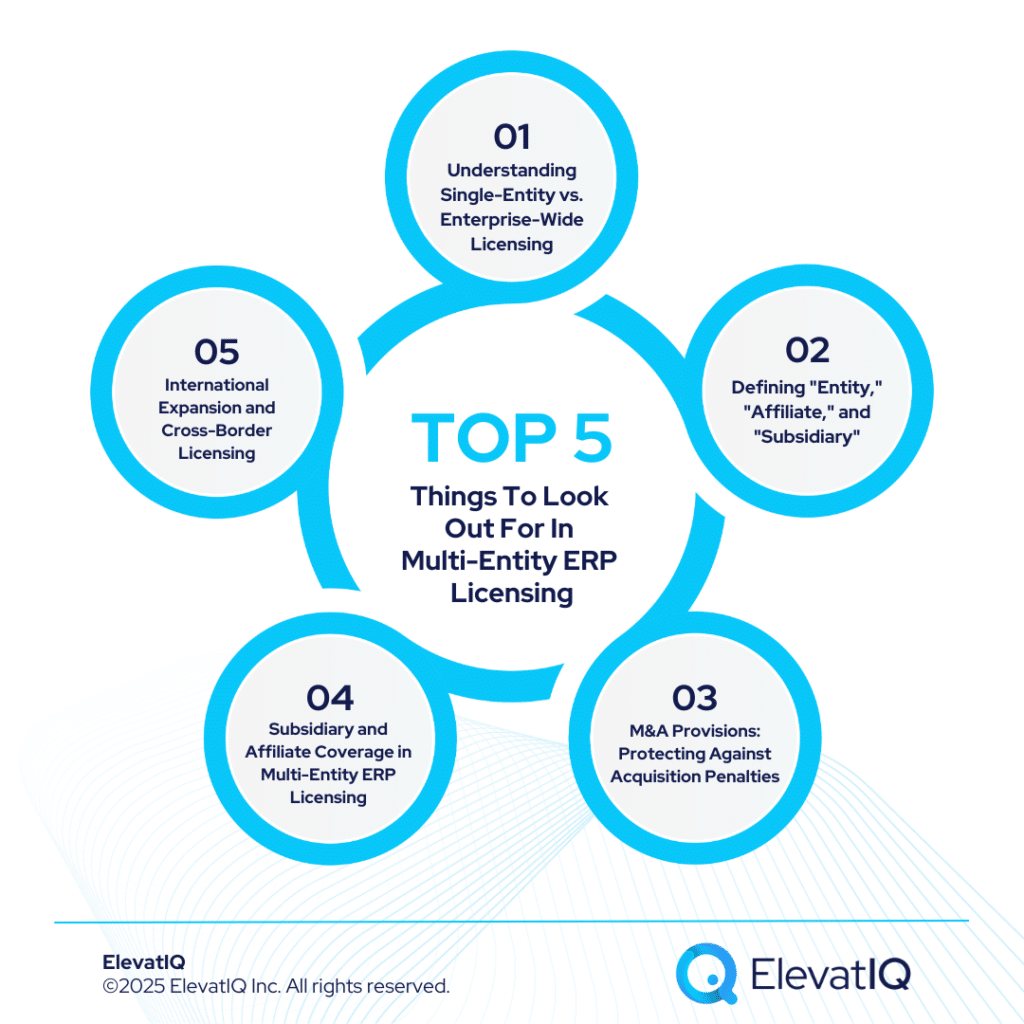
Organizations with multiple legal entities or international operations must ensure licensing covers their entire corporate structure without additional fees. Standard contracts often limit licenses to single entities or geographies, creating unexpected costs when you deploy across subsidiaries or countries.

Negotiate enterprise-wide licensing that:

  • Defines “affiliate” broadly to include acquired companies
  • Covers all current and future subsidiaries
  • Extends to all geographies without additional fees
  • Allows license pooling across entities
Top ERP Systems

Pricing and Payment Terms: Controlling Financial Obligations

Beyond licensing structure, specific pricing and payment provisions determine cash flow impacts, cost predictability, and total ownership economics.

Maintenance and Support Fees

Annual maintenance represents vendors’ most profitable revenue stream, typically starting at 18-22% of license value but increasing annually through escalation clauses that compound over time. A $1 million annual maintenance fee increasing 5% annually grows to $1.63 million within ten years—a 63% increase that many buyers fail to anticipate.

Negotiate maintenance terms that:

  • Establish service credits when vendors fail to meet support commitments
  • Cap annual increases at specific percentages (ideally 2-3%, tied to CPI)
  • Lock in multi-year pricing to prevent arbitrary escalation
  • Specify included services clearly, preventing vendors from charging separately for items maintenance should cover

Price Protection for Future Purchases

Initial contracts rarely include all modules, users, or capabilities you’ll eventually need. Without price protection provisions, vendors can charge premium pricing for additions once they recognize you’re locked into their platform.

Secure commitments for:

  • Most-favored-customer pricing on future module purchases
  • Pre-agreed discount levels for additional users
  • Defined pricing for specific modules you anticipate adding
  • Protection against vendors discontinuing favorable pricing programs after you commit

Payment Terms and Schedules

Payment timing significantly impacts cash flow and provides leverage to ensure vendor performance. Standard vendor terms often demand large upfront payments before delivery, reducing your leverage if problems arise.

Negotiate payment structures that:

  • Tie payments to milestone completion and acceptance
  • Retain meaningful percentages until final acceptance
  • Extend payment terms to improve cash flow
  • Separate license payments from implementation services to maintain leverage


The 2026 Digital Transformation Report

Thinking of embarking on a ERP journey and looking for a digital transformation report? Want to learn the best practices of digital transformation? Then, you have come to the right place.

Implementation Contract Provisions: Defining Scope and Accountability

ERP implementation agreements determine project execution frameworks, risk allocation, and remedies when vendors fail to deliver as promised.

Scope Definition and Deliverables

Vague scope language creates the primary source of implementation disputes and cost overruns. Every ambiguous phrase represents potential future disagreement over whether functionality is in-scope or requires additional payment.

Demand exhaustive scope documentation including:

  • Detailed functional specifications describing exactly what the system will do
  • Explicit deliverables lists with clear descriptions and formats
  • Acceptance criteria defining how you’ll verify deliverable completion
  • Assumptions and exclusions clearly stating what’s not included

Avoid phrases like “best practices configuration,” “reasonable efforts,” or “industry-standard functionality” that allow interpretation disputes. Require specific, measurable descriptions of deliverables.

Fixed Price vs. Time and Materials

Implementation pricing models allocate risk differently between buyers and vendors. Fixed-price contracts place delivery risk on vendors but require extremely precise scope definition. Time and materials arrangements provide flexibility but need robust controls to prevent budget overruns.

For fixed-price implementations, negotiate:

  • Comprehensive scope documentation that defines all deliverables
  • Clear change order procedures with pricing methodologies
  • Vendor accountability for efficiency and timeline adherence
  • Meaningful penalties for vendor-caused delays

For time and materials engagements, establish:

  • Pre-agreed rates for different resource levels
  • Not-to-exceed caps that limit total spending
  • Required approvals for work beyond defined budgets
  • Regular progress reporting and budget consumption tracking

Change Order Procedures

Regardless of implementation pricing models, projects encounter scope changes requiring formal change order processes. Without clear procedures, vendors can inflate change order pricing or claim every deviation from imprecisely defined scope requires additional payment.

Negotiate change management provisions that:

  • Define what constitutes a legitimate change vs. clarification of vague scope
  • Establish pricing methodologies for different change types
  • Require written approvals before change order work begins
  • Limit vendor’s ability to claim changes for items reasonably implied by documented scope

Resource Qualifications and Stability

Vendor proposals showcase senior resources during sales cycles, then assign less experienced staff to actual implementations. Without contractual protections, you may find junior consultants handling critical tasks while paying premium rates.

Secure commitments regarding:

  • Minimum experience levels for key project roles
  • Specific named resources for critical positions
  • Vendor approval requirements before substituting resources
  • Remedies when vendors assign unqualified staff

Performance, Warranties, and Liability: Ensuring Vendor Accountability

Standard vendor contracts typically include minimal performance commitments and limit vendor liability to amounts paid, leaving buyers bearing most implementation risk.

Performance Warranties and Guarantees

Without specific performance warranties, vendors face limited accountability for delivering functional systems that meet documented requirements. Standard contracts often disclaim warranties entirely or provide only that software will “substantially conform” to documentation.

Negotiate warranties that:

  • Guarantee system will perform specific business processes documented in scope
  • Define clear performance standards (transaction volume, response times, uptime)
  • Extend warranty periods to meaningful durations (12+ months post-go-live)
  • Specify remedies when systems fail to meet warranted performance

Service Level Agreements

Support responsiveness directly impacts operational continuity when issues arise. Vague support commitments like “reasonable efforts” or “commercially reasonable response times” provide no meaningful accountability.

Demand specific SLAs addressing:

  • Response time commitments by issue severity
  • Resolution timeframes for different problem categories
  • Support availability (hours, days, contact methods)
  • Escalation procedures when initial support fails to resolve issues
  • Service credits when vendors breach SLA commitments

Limitation of Liability

Perhaps the most one-sided provisions in standard contracts, liability limitations typically cap vendor financial exposure to amounts paid while providing unlimited liability for buyers. These terms mean vendors face minimal consequences for catastrophic failures that cost buyers millions.

While complete elimination of liability caps remains unrealistic, negotiate:

  • Higher liability caps that reflect actual potential damages (2-3x annual contract value)
  • Carve-outs from caps for specific breach types (gross negligence, willful misconduct, IP infringement)
  • Mutual liability limitations that apply equally to both parties
  • Insurance requirements ensuring vendors can actually pay if liability is triggered

This upfront clarity provides the foundation for evaluating vendor proposals and engaging in focused negotiations that address terms most critical to your organization.

Data Rights and Intellectual Property: Protecting Your Assets

ERP systems contain your organization’s most critical operational data. Contract terms governing data ownership and intellectual property rights determine your control over this strategic asset.

Data Ownership and Access

While data ownership seems obvious—it’s your data—standard contracts often include ambiguous language that could enable vendor claims to data rights or restrict your access and usage.

Negotiate explicit provisions stating:

  • You own all data entered into or generated by the system
  • You can access and extract your data at any time in standard formats
  • No vendor rights to use, analyze, or commercialize your data without explicit permission
  • Data remains your property regardless of contract termination

Customization and Intellectual Property

Organizations frequently require customizations to address unique requirements. Without clear IP provisions, disputes arise over ownership of custom code, configurations, and integrations.

Establish that:

  • You own all custom code developed specifically for your organization
  • You receive source code for customizations
  • You can modify customizations without vendor involvement
  • Vendor cannot charge additional fees for accessing or modifying customizations you own

Data Portability and Exit Rights

Eventually, contracts end—whether through normal expiration, vendor business changes, or your decision to switch platforms. Data portability provisions determine whether you can transition smoothly or face barriers that effectively lock you into vendors despite unsatisfactory service.

Negotiate comprehensive exit provisions including:

  • Standard format data exports within defined timeframes
  • Complete data extraction at no additional charge
  • Reasonable transition assistance periods
  • Access to system documentation necessary for migration

Compliance, Audit, and Security: Managing Risk and Governance

Organizations in regulated industries or with specific security requirements need contract terms that address compliance obligations and security standards.

Compliance Warranties

If you operate in regulated environments (healthcare, finance, government), ensure contracts include specific compliance warranties rather than generic “compliance with applicable law” language that provides limited protection.

Require:

  • Warranties that system meets specific regulatory requirements (HIPAA, SOX, GDPR)
  • Vendor responsibility for maintaining compliance as regulations evolve
  • Audit rights to verify compliance capabilities
  • Indemnification for compliance failures stemming from system deficiencies

Security Standards and Breach Notification

Data breaches create significant liability. Contract terms should establish clear security standards vendors must maintain and procedures for breach notification and remediation.

Negotiate provisions addressing:

  • Specific security standards vendors must meet (SOC 2, ISO 27001)
  • Regular security testing and vulnerability assessment requirements
  • Immediate breach notification obligations
  • Vendor liability for breaches caused by inadequate security

Audit Rights

While vendors typically demand license compliance audit rights, these provisions should be balanced to prevent abuse while ensuring appropriate oversight.

Establish:

  • Limitations on audit frequency (annually at most)
  • Advance notice requirements (60-90 days)
  • Restrictions on auditor selection and costs
  • Reciprocal rights to audit vendor’s service delivery compliance

Renewal and Termination: Maintaining Flexibility

Contract duration, renewal terms, and termination provisions determine your long-term flexibility and ability to exit relationships that no longer serve your interests.

Automatic Renewal Provisions

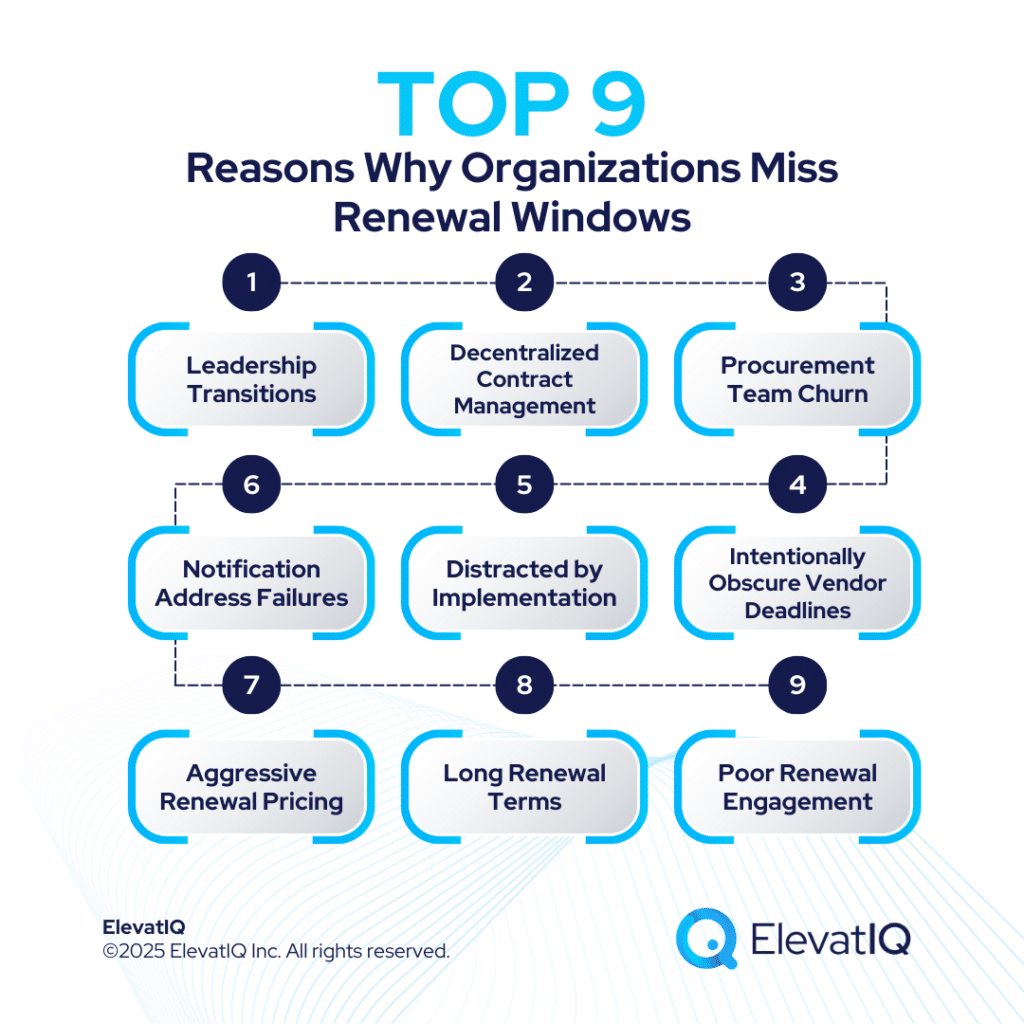
Many contracts include automatic renewal clauses requiring 60-90 days advance notice to prevent renewal. Missing these deadlines locks you into additional contract terms, often with embedded price increases.

Negotiate:

  • Explicit renewals requiring affirmative action from both parties
  • Longer notification periods (120+ days) to prevent inadvertent renewals
  • No price increases upon renewal without separate negotiation
  • Mutual renewal rights, allowing either party to decline

Termination Rights and Procedures

Beyond normal contract expiration, organizations need termination rights for various circumstances including vendor performance failures, business changes, or strategic technology shifts.

Secure termination rights for:

  • Material vendor breaches with cure periods
  • Vendor business changes (acquisition, bankruptcy)
  • Your business changes (mergers, divestitures)
  • Convenience (with reasonable notice and fees)

Ensure termination procedures clearly define:

  • Notice requirements and procedures
  • Data transition obligations
  • Refund calculations for prepaid amounts
  • Ongoing obligations post-termination

Negotiating Contract Terms That Protect Your Interests

ERP contracts contain numerous provisions that seem standard or innocuous but significantly impact long-term outcomes. The terms explored here represent areas where thoughtful negotiation creates substantial value through cost savings, risk mitigation, and operational flexibility.

Organizations that understand which contract terms truly matter and invest effort in negotiating favorable language establish foundations for successful implementations and productive vendor relationships. Conversely, accepting standard vendor terms without thorough negotiation creates financial surprises, operational constraints, and limited recourse when problems arise. The contract terms you negotiate today determine your organization’s ERP experience for years to come. Investing time and expertise to secure favorable terms in each critical area represents one of the highest-return activities in the entire procurement process.

For organizations navigating ERP contract negotiations, independent advisory support provides the specialized knowledge and market intelligence necessary to secure contract terms that protect interests while enabling successful implementations.

Top 15 Digital Transformation Trends - Download

FAQs

ERP Contract Terms: It Can Make or Break Your Deal Read More »

ERP Contract Negotiation: Why It Matters And Where To Start

ERP Contract Negotiation: Why It Matters And Where To Start

Enterprise resource planning implementations represent transformational investments that reshape how organizations operate, compete, and grow. Yet despite their strategic importance, many companies approach ERP contract negotiations as a procurement formality rather than a critical success factor that determines project outcomes for years to come.

The financial stakes alone demand serious attention. Mid-sized organizations typically invest $1-10 million in ERP implementations, while large enterprises often exceed $50 million when accounting for software licensing, implementation services, infrastructure, and ongoing support. Beyond these direct costs, poorly negotiated contracts create hidden financial burdens, operational constraints, and risk exposures that compound throughout the system lifecycle. Understanding why ERP contract negotiation matters and how to approach it strategically separates successful implementations from problematic deployments that fail to deliver expected business value.

The Strategic Importance of ERP Contract Negotiations

ERP contracts function as the constitutional documents governing technology relationships that typically span 5-10 years or longer. These agreements establish not just pricing but the fundamental terms that determine operational flexibility, cost predictability, vendor accountability, and your organization’s ability to adapt as business requirements evolve.

Financial Impact Beyond Initial Pricing

While upfront license and implementation costs capture immediate attention, the total cost of ownership extends far beyond initial expenditures. Annual maintenance fees, upgrade costs, additional user licenses, supplemental modules, and professional services for customizations create ongoing financial obligations that often exceed original licensing investments over time.

For cloud ERP deployments, subscription models create ongoing costs that compound through annual price increases, user expansion charges, and consumption-based billing that escalates with transaction volumes or data storage growth. Organizations without negotiated pricing protections frequently encounter 5-10% annual subscription increases that dramatically inflate total ownership costs over multi-year contracts.

On-premises deployments still prevalent in many enterprises face similar long-term cost pressures through annual maintenance fees (typically 18-22% of license value) that increase 3-8% annually through escalation clauses. A $500,000 annual maintenance obligation can grow to over $900,000 within a decade through compounding increases—a financial reality many organizations fail to anticipate during initial negotiations. Strategic contract negotiation addresses these long-term financial implications upfront, establishing cost controls, price protection mechanisms, and clear boundaries around future expenditures that preserve budget predictability throughout the contract lifecycle.

top ERP vendors

Operational Flexibility and Business Agility

Business conditions change constantly. Organizations merge, divest business units, expand internationally, enter new markets, and fundamentally transform their operating models. ERP contracts either enable or constrain your ability to adapt technology investments to evolving business requirements.

Restrictive licensing terms, inflexible contract structures, and poorly defined scope boundaries create friction when business changes demand technology adjustments. Companies discovering they cannot reassign user licenses across acquired entities, add international subsidiaries without prohibitive costs, or modify implementations to support new business models find themselves locked into arrangements that inhibit rather than enable business agility. Negotiating contracts with operational flexibility in mind ensures your ERP investment adapts to future business needs rather than becoming a constraint on strategic initiatives.

Risk Allocation and Vendor Accountability

ERP implementations carry substantial execution risk. Despite careful planning, projects encounter scope disagreements, timeline delays, budget overruns, and performance issues that threaten business operations. How contracts allocate risk between buyers and vendors fundamentally impacts who bears the financial and operational consequences when problems emerge.

Standard vendor contracts typically limit liability to amounts paid, provide minimal performance guarantees, and place execution risk primarily on buyers. These one-sided terms leave organizations vulnerable to project failures while vendors face limited accountability for poor delivery. Strategic negotiation rebalances risk allocation, establishing clear performance expectations, meaningful remedies for vendor failures, and protections that align vendor incentives with successful project outcomes.

Top ERP Systems

Understanding ERP Implementation Failure Rates

The urgency of effective contract negotiation becomes clear when examining industry implementation success rates. Research indicates ERP failure rates can reach 50-75%, depending on industry and project scope, with failures ranging from partial functionality shortfalls to complete project abandonment.

While many factors contribute to implementation challenges, contract terms directly influence several critical success elements. Vague scope definitions enable disputes over deliverables. Weak performance commitments reduce vendor accountability. Inadequate change management provisions create cost escalation. Limited liability protections leave organizations bearing financial consequences of vendor failures.

Organizations that invest effort in comprehensive contract negotiations before implementation begins establish stronger foundations for project success by clarifying expectations, aligning incentives, and creating accountability mechanisms that drive effective vendor performance.

Common Misconceptions About ERP Contract Negotiations

Several misconceptions prevent organizations from approaching ERP contract negotiations with appropriate strategic focus.

“Vendors Won’t Negotiate Standard Terms”

Enterprise software vendors maintain standard contract templates that heavily favor their interests. However, the notion that these terms are non-negotiable represents vendor negotiation positioning rather than reality. Virtually every contract element remains open to negotiation for buyers who understand leverage points and approach discussions strategically. Vendors negotiate thousands of agreements annually and expect sophisticated buyers to push back on standard terms. Sales representatives operate with significant pricing and terms flexibility, particularly when facing competitive pressure or approaching fiscal deadlines.

“Negotiation Damages Vendor Relationships”

Some organizations avoid aggressive negotiation, fearing it will create adversarial relationships that undermine implementation partnerships. This concern confuses professional negotiation with unprofessional behavior. Vendors respect buyers who negotiate competently and establish clear, fair contractual frameworks. Strong negotiation creates mutual understanding of expectations and obligations, actually strengthening long-term relationships by preventing the disputes that arise from ambiguous, one-sided agreements.

What damages relationships is dishonest negotiating tactics, unrealistic demands, or adversarial approaches that demonstrate lack of good faith. Professional, informed negotiation builds respect and establishes productive working partnerships.

“We Can Renegotiate Later If Problems Arise”

Perhaps the most dangerous misconception suggests organizations can address unfavorable contract terms later if issues emerge. In reality, renegotiating existing agreements from a position of operational dependency provides minimal leverage. Once implementation begins, vendors recognize you cannot easily switch platforms. Your negotiating position deteriorates dramatically as you become locked into their technology, processes, and ecosystems. The time to negotiate optimal terms is before commitment, when competitive alternatives provide meaningful leverage.


The 2026 Digital Transformation Report

Thinking of embarking on a ERP journey and looking for a digital transformation report? Want to learn the best practices of digital transformation? Then, you have come to the right place.

Where to Start: Building Your ERP Contract Negotiation Foundation

Effective ERP contract negotiation requires systematic preparation that begins well before engaging vendors in formal discussions.

Assembling Your Negotiation Team

Successful negotiations engage diverse expertise across multiple organizational functions. No single individual possesses all the knowledge required to evaluate complex ERP contracts comprehensively.

Your core negotiation team should include:

  • Procurement Leadership: Brings vendor management expertise, negotiation tactics knowledge, and contract structuring experience. Procurement understands how to create competitive tension, identify leverage points, and navigate vendor negotiation dynamics.
  • IT Leadership: Provides technical perspective on implementation requirements, integration complexity, infrastructure dependencies, and operational support needs. IT evaluates whether proposed technical terms and service commitments align with organizational capabilities and requirements.
  • Finance Leadership: Models total cost of ownership, evaluates payment terms, analyzes budget impacts, and ensures financial terms align with organizational standards and cash flow considerations.
  • Legal Counsel: Reviews contract structure, liability provisions, intellectual property terms, compliance requirements, and risk allocation. Legal ensures agreements protect organizational interests while meeting regulatory and governance standards.
  • Business Operations Representatives: Contribute functional requirements knowledge, process expertise, and practical perspective on how contractual terms impact day-to-day operations and business objectives.

This cross-functional team structure ensures comprehensive evaluation while preventing any single perspective from dominating decisions that require balanced consideration across multiple dimensions.

Defining Your Requirements and Priorities

Before engaging vendors, establish clear understanding of what you need from both the ERP system and the contract terms governing your relationship.

  • Functional Requirements: Document specific business processes, capabilities, and outcomes the ERP must deliver. These requirements directly inform scope definitions, acceptance criteria, and performance expectations embedded in contracts.
  • Technical Requirements: Define integration needs, infrastructure dependencies, security standards, performance expectations, and technical specifications that contracts must address.
  • Commercial Priorities: Establish your negotiation priorities across pricing, payment terms, licensing models, maintenance commitments, and financial protections. Understanding which terms matter most guides where to invest negotiation effort and where to offer flexibility.
  • Risk Tolerance: Clarify organizational risk appetite regarding implementation approaches (fixed price vs. time and materials), liability limitations, performance guarantees, and vendor accountability mechanisms.

This upfront clarity provides the foundation for evaluating vendor proposals and engaging in focused negotiations that address terms most critical to your organization.

Understanding Your Negotiation Leverage

Leverage determines negotiation outcomes. Organizations that accurately assess and strategically deploy their leverage achieve significantly better contract terms than those negotiating without clear understanding of their negotiating position.

Primary leverage sources include:

  • Competitive Alternatives: Credible alternative vendors provide the most powerful leverage. Vendors make their best offers when facing genuine risk of losing opportunities to competitors. This leverage requires conducting legitimate competitive evaluations rather than artificial positioning vendors recognize as tactical maneuvering.
  • Timing: Vendor fiscal calendars create negotiation pressure points. Sales representatives facing quarter-end or year-end booking targets demonstrate increased flexibility as deadlines approach. Strategic timing of procurement processes to align with these pressure periods enhances leverage.
  • Deal Size and Strategic Value: Larger opportunities and accounts vendors view as strategically important (reference potential, market expansion, competitive wins) generate more aggressive terms. Understanding how vendors value your opportunity informs realistic expectations.
  • Market Conditions: Broader market dynamics influence vendor negotiating positions. Economic downturns, competitive intensity, and vendor growth pressures all create environments where vendors become more accommodating to secure business.

Engaging Independent Advisory Support

The complexity of ERP contracts and the specialized knowledge required for effective negotiation make independent advisory support valuable for most organizations. Enterprise technology selection consultants bring several advantages:

  • Market Intelligence: Independent advisors maintain current visibility into pricing trends, contract terms, and negotiation outcomes across multiple vendors and industries. This market knowledge establishes realistic negotiation targets and identifies favorable terms other buyers achieve.
  • Negotiation Expertise: Advisors specializing in ERP contracts understand vendor negotiation tactics, recognize standard contract traps, and deploy proven strategies that improve outcomes.
  • Objective Perspective: Independent consultants without implementation practices or vendor partnerships provide unbiased guidance focused exclusively on buyer interests rather than mixed incentives.
  • Negotiation Bandwidth: ERP contract negotiations demand substantial time and effort. Advisory support augments internal resources, allowing your team to focus on strategic decisions while consultants manage detailed contract review and negotiation execution.

Organizations that engage independent advisors typically achieve contract improvements that far exceed advisory costs through better pricing, more favorable terms, and avoided contractual pitfalls.

Establishing Your Negotiation Timeline

ERP contract negotiations require adequate time for thorough execution. Rushing through negotiations under artificial deadlines weakens your position and increases the likelihood of accepting unfavorable terms. A realistic negotiation timeline typically spans 4-8 weeks after vendor selection, depending on contract complexity and organizational decision processes. This timeframe allows for:

  • Detailed contract review and issue identification
  • Internal stakeholder alignment on priorities and positions
  • Multiple negotiation rounds addressing key terms
  • Legal review and risk assessment
  • Executive approval processes

Organizations should plan procurement schedules that provide sufficient negotiation time while potentially aligning final negotiations with vendor fiscal pressure points that enhance leverage.

Preparing for Successful ERP Contract Negotiations

The art of ERP contract negotiation begins with recognizing its strategic importance, understanding common pitfalls, and investing in thorough preparation before engaging vendors in formal discussions. Organizations that approach negotiations strategically—assembling appropriate expertise, defining clear requirements, understanding leverage sources, and allocating sufficient time—establish foundations for securing contract terms that protect interests, control costs, and enable successful implementations.

The investment in effective negotiation preparation delivers returns throughout the ERP lifecycle, preventing the budget surprises, operational constraints, and risk exposures that plague organizations that treat contracts as procurement formalities rather than strategic agreements that warrant serious attention.

As you prepare for ERP contract negotiations, remember that the time to establish favorable terms is before commitment, when competitive alternatives provide leverage and vendors compete for your business. Once implementation begins, your negotiating position weakens dramatically as operational dependencies limit your ability to switch platforms. For organizations beginning their ERP selection journey, understanding negotiation fundamentals before engaging vendors ensures you enter discussions prepared to secure terms that support long-term success rather than create ongoing challenges.

Top 15 Digital Transformation Trends - Download

FAQs

ERP Contract Negotiation: Why It Matters And Where To Start Read More »

digital adoption consultant guide for O-AMP

Digital Adoption Consultant Guide For O-AMP Grant

Ontario’s automotive sector stands at a critical juncture. As global markets shift toward electric vehicles, autonomous systems, and advanced manufacturing technologies, companies throughout the automotive supply chain must modernize rapidly or risk being left behind. The Ontario Automotive Modernization Program (O-AMP) offers a strategic lifeline, providing substantial funding to help automotive businesses navigate this complex transformation. That’s where we come in as your Digital Adoption Consultant Partner.

Understanding O-AMP

The Ontario Automotive Modernization Program represents the provincial government’s commitment to maintaining the province’s position as a North American automotive manufacturing hub. Unlike generic business grants, O-AMP specifically targets the unique challenges facing automotive companies as they adapt to Industry 4.0 requirements.

This program recognizes that automotive modernization extends beyond simple equipment upgrades. True transformation requires comprehensive strategic planning, process re-engineering, workforce development, and technology integration—precisely the areas where expert consultation from a qualified digital adoption consultant becomes invaluable.

O-AMP Funding Structure and Scope

Program Overview: The O-AMP provides significant financial support for small- and medium-sized companies in the automotive sector to improve operational efficiency, competitiveness, and expand product offerings through the adoption of Industry 4.0 related technologies.

Three Core Funding Categories

A. Technology Adoption for Process Efficiency

Support for adopting advanced manufacturing hardware, software and/or training to improve processes and enhance competitiveness, including ERP systems, production tracking systems and advanced hardware implementation.

B. Tools and Technologies to Support New Product Development

Support for adopting technology and tools to assist with engineering and design of new products such as Computer-Aided Design & Computer-Aided Manufacturing (CAD/CAM) systems, Finite Element Analysis (FEA) software, Design for Manufacturing (DFM) tools, rapid-prototyping tools, or other tools to support the New Product Introduction (NPI) process.

C. Lean Manufacturing

Support for improving operational efficiency and competitiveness through adoption of Lean Manufacturing techniques, including procuring services of external mentor/consultants with automotive industry expertise in Lean Manufacturing process efficiency.

Top ERP Systems

Financial Support Structure

  • Up to $150,000 for eligible project costs
  • Projects must be no more than two years in duration
  • Applicant must contribute at least 50% of eligible project costs through internal resources or private/bank financing
  • Rolling application basis with specific intake periods

Eligible Applicants and Critical Requirements

Company Eligibility (All Criteria Must Be Met)

  • Small- and medium-sized Ontario-based enterprises with fewer than 500 employees in Ontario
  • Consolidated global revenues of less than $1 billion in most recently completed fiscal year
  • Critical Revenue Requirement: At least 50% of the company’s total sales revenue must come from the automotive sector
  • Must have a CRA Business Number
  • Must be in the automotive supply chain to Original Equipment Manufacturers (OEMs) of passenger and commercial vehicles
  • Important Exclusion: Aftermarket parts industry is NOT eligible
  • Must be a for-profit legal entity or limited partnership registered to carry on business in Ontario
  • Must be owner or lessee in actual possession of a manufacturing facility in Ontario by project start date


The 2026 Digital Transformation Report

Thinking of embarking on a ERP journey and looking for a digital transformation report? Want to learn the best practices of digital transformation? Then, you have come to the right place.

Required Financial Documentation

  • Minimum of two consecutive years of financial statements (auditor or accountant reviewed)
  • Must include balance sheets, income statements, and cash flow statements
  • Must be submitted as two separate documents
  • Letter of financial attestation from signing authority confirming financial resources to complete the project
  • Ontario Tax Compliance Verification (TCV) number required in application
  • Ontario TCV certificate required before fund disbursement
  • Compliant with all applicable laws
  • Free and clear of any fees, levies, charges, or taxes owed to Ontario government
  • Compliant with Accessibility for Ontarians with Disabilities Act, 2005
  • Compliance with Ministry of Labour, Immigration, Training, and Skills Development
  • Compliance with Ministry of the Environment, Conservation and Parks

Critical Program Restrictions and Conditions

Funding Limitations

  • Stacking Prohibition: Stacking with other provincial programs is not permitted
  • Total funding from federal sources plus O-AMP cannot exceed 50% of total eligible project costs
  • Companies with previous O-AMP projects must have successfully completed them by the intake deadline before reapplying

Project Requirements

  • Projects must be achievable with demonstrated financing, project management structure, skills and experience
  • Must demonstrate alignment with O-AMP objectives including economic gains, business improvements, and operational improvements
  • Project scope cannot be significantly altered after Review Committee presentation
  • Total eligible project costs cannot be reduced by more than 10% of original project cost

The Automotive Industry’s Digital Imperative

The automotive sector faces unprecedented disruption. Electric vehicle adoption, autonomous driving technology, and changing consumer preferences are reshaping the entire industry. Simultaneously, supply chain pressures, skilled labor shortages, and increasing quality requirements demand sophisticated technological solutions.

Key Transformation Drivers

  • Electrification requiring new manufacturing processes and materials
  • Autonomous vehicle components demanding higher precision and reliability
  • Connectivity features necessitating software integration capabilities
  • Sustainability requirements driving process efficiency improvements
  • Global competition requiring cost optimization without quality compromise

ElevatIQ’s Automotive Modernization Expertise: Your Digital Adoption Consultant

ElevatIQ brings specialized experience in automotive sector digital transformation, understanding both the technical complexities and business realities facing modern automotive companies. As your dedicated digital adoption consultant, we provide comprehensive guidance throughout the O-AMP application and implementation process.

Our Comprehensive Methodology:

  • Current State Assessment: We begin by thoroughly analyzing your existing manufacturing processes, technology architecture, and operational capabilities, ensuring alignment with O-AMP’s three core categories and the critical 50% automotive revenue requirement.
  • Future State Visioning: Working closely with your leadership team, we develop a comprehensive understanding of your strategic objectives, market positioning goals, and operational excellence targets that align with O-AMP’s program objectives.
  • Gap Analysis and Roadmap Development: Our detailed analysis identifies specific technology, process, and capability gaps that must be addressed to achieve your transformation objectives while ensuring compliance with all program requirements.
  • Implementation Planning: We develop detailed project plans with realistic timelines under the two-year maximum duration, resource requirements, and risk mitigation strategies that demonstrate project achievability to the Review Committee.

O-AMP Application Process and Timeline

Current Application Round

  • Program Opens: June 10, 2025
  • Application Deadline: July 22, 2025
  • Assessment Timeline: Applications will be assessed within 60 business days of submission deadline

Mandatory Application Steps

1. Transfer Payment Ontario (TPON) Registration
  • Create ONe-key account and ID
  • Register company on TPON (can take up to 5 business days)
  • Requires CRA Business Number, Legal Name, Operating Name, and two organizational contacts
2. Required Application Documents (PDF Format Only)
  • Completed TPON Application Form signed by individual with authority to bind company
  • Copy of Articles of Incorporation or Limited Partnership Agreement
  • Two consecutive years of financial statements (balance sheets, income statements, cash flow statements)
  • Quotes from contractors/vendors for eligible cost items
  • Letter of financial attestation from signing authority
  • Project team member resumes
  • Ontario Tax Compliance Verification (TCV) number
3. Optional Support Resources
  • Automotive Parts Manufacturers’ Association (APMA) assistance: o-amp@apma.ca
  • Ministry Senior Business Advisors by region
  • Note: Using external consultants for application preparation has no bearing on success and costs are NOT eligible project expenses

Evaluation Process and Criteria

Review Committee Assessment

Applications are evaluated on completeness, clarity, project feasibility, and alignment with O-AMP goals and objectives. Funding decisions are at the Ministry’s sole discretion.

Two-Tier Review Process
Smaller Projects (up to $50,000 O-AMP funding)
  • Review Committee assessment comprising external domain expert and Ministry reviewers
  • May request presentations and/or site visits at Committee’s discretion
Larger Projects ($50,000 to $150,000 O-AMP funding)
  • Initial Review Committee assessment
  • Potential invitation for in-person or virtual presentation
  • Possible site visits, particularly for Lean Manufacturing components
  • Final funding recommendation based on both review stages

Post-Approval Requirements and Conditions

Mandatory Conditions Before Fund Disbursement

  • Signed funding agreement with Ontario government
  • Evidence of project financing
  • Proof of insurance
  • Compliance verification with multiple ministries
  • Ontario Tax Compliance Certificate
  • Supplier Registration Form completion

Ongoing Reporting Requirements

  • Interim Progress Reports at project midpoint
  • Final Report within 30 days of project completion
  • Detailed proof of expenditures and financial attestations
  • Seven-year record retention requirement for all financial documents

ElevatIQ’s Comprehensive O-AMP Support Services

Application Development

  • Technical project scoping within O-AMP categories
  • Financial projections and budget development
  • Risk assessment and mitigation planning
  • Compliance verification assistance
  • Review Committee presentation preparation

Post-Approval Implementation

  • Project management and milestone tracking
  • Vendor selection and procurement support
  • Compliance monitoring and reporting
  • Interim and final report preparation
  • Performance optimization and continuous improvement

Program Limitations and Important Considerations

Critical Program Restrictions

  • O-AMP is a discretionary, non-entitlement program with limited funding
  • Meeting all eligibility criteria does not guarantee approval
  • Funding decisions are at Ministry’s sole discretion
  • Projects may be publicly announced and reported

Successful Applicant Obligations

  • Mandatory performance measures and milestone reporting
  • Potential fund repayment if terms and conditions are not met
  • Ongoing compliance with all applicable laws and regulations
  • Participation in program evaluation and reporting activities

Your O-AMP Journey Starts Here

The Ontario automotive sector’s future depends on the modernization decisions made today. O-AMP funding provides an unprecedented opportunity to access both financial resources and expert guidance necessary for successful transformation, but success requires meticulous attention to program requirements and strategic application development.

ElevatIQ’s combination of automotive industry expertise, government funding program knowledge, and proven transformation methodology positions us as the ideal digital adoption consultant partner for your O-AMP journey. We understand the critical importance of the 50% automotive revenue requirement, the complexities of the two-tier review process, and the stringent compliance requirements that can make or break an application.

Top 15 Digital Transformation Trends - Download

FAQs

Digital Adoption Consultant Guide For O-AMP Grant Read More »

Digital Adoption Consultant Guide For DMAP

Digital Adoption Consultant Guide For DMAP Grant

Small and medium enterprises across Ontario are increasingly recognizing that digital transformation isn’t just an option. It’s a necessity for survival and growth in today’s competitive marketplace. The Ontario government’s Digital Modernization and Adoption Plan (DMAP) grant offers a strategic opportunity for businesses to accelerate their digital journey while reducing financial barriers.

What is the DMAP Grant?

The Digital Modernization and Adoption Plan (DMAP) is a government-funded initiative designed to help Ontario SMEs assess their current technology landscape and develop comprehensive digital transformation strategies. Unlike traditional funding programs that focus solely on technology acquisition, DMAP takes a holistic approach by emphasizing strategic planning and adoption readiness through qualified digital adoption consultant partnerships. The program operates under Ontario’s Digitalization Competence Centre (DCC), which connects businesses with qualified Digital Adoption Consultants (DACs) who provide expert guidance throughout the assessment and planning process.

DMAP Grant Breakdown: Funding Structure and Benefits

Financial Support

  • Program Contribution: Up to 50% of total eligible project costs, capped at $15,000
  • Applicant Contribution: Remaining 50% of total eligible project costs
  • Maximum Total Project Value: $30,000

This cost-sharing model ensures businesses maintain ownership of their digital transformation strategy while accessing professional expertise at a significantly reduced cost.

Key Program Benefits

  • Risk mitigation strategies for digital transformation
  • Comprehensive current-state technology assessment
  • Strategic digital adoption roadmap development
  • Vendor-agnostic technology recommendations
  • Implementation timeline and cost projections
  • ROI analysis and business case development
Top ERP Systems

DMAP Eligibility Requirements

To qualify for DMAP funding, businesses must meet specific criteria and work with an approved digital adoption consultant:

Business Requirements

  • Must work with a qualified Digital Adoption Consultant
  • Incorporated federally or provincially with a valid Business Number
  • For-profit, privately owned business
  • Between 1-499 full-time equivalent employees

Project Requirements

  • Commit to plan implementation within 24 months
  • Engage a qualified Digital Adoption Consultant (DAC)
  • Complete comprehensive business and technology assessment
  • Develop actionable digital adoption plan

What’s Included in a DMAP Assessment?

A comprehensive DMAP plan encompasses several critical components:

Current State Analysis

  • Skills Gap Analysis: Current team capabilities versus digital transformation requirements
  • Business Information Review: Revenue streams, operational processes, market positioning
  • Technology Infrastructure Assessment: Existing systems, software, hardware, and digital capabilities
  • SWOT Analysis: Strengths, weaknesses, opportunities, and threats in current digital landscape


The 2026 Digital Transformation Report

Thinking of embarking on a ERP journey and looking for a digital transformation report? Want to learn the best practices of digital transformation? Then, you have come to the right place.

Digital Adoption Strategy

  • Technology Recommendations: Vendor-agnostic solutions aligned with business objectives
  • Process Optimization: Identifying automation opportunities and efficiency improvements
  • Data Strategy: Information management and analytics capabilities development
  • Cybersecurity Assessment: Risk evaluation and security enhancement recommendations

Implementation Roadmap

  • Phased Approach: Prioritized implementation timeline focusing on high-impact, low-risk initiatives
  • Resource Requirements: Skill development needs and staffing considerations
  • Budget Planning: Detailed cost projections and financing options
  • ROI Projections: Expected returns and performance metrics
  • Risk Management: Potential challenges and mitigation strategies

The ElevatIQ Advantage: Your DMAP Digital Adoption Consultant

ElevatIQ serves as your qualified digital adoption consultant, bringing extensive experience in digital transformation and a proven methodology that aligns perfectly with DMAP requirements. As an experienced digital adoption consultant, we understand the unique challenges facing Ontario SMEs in their digitalization journey.

Our Comprehensive Approach

  • Assessment Phase: We begin with a thorough evaluation of your current processes and technology architecture. This includes analyzing your existing systems, identifying integration challenges, and understanding your operational workflows.
  • Strategic Planning: Following the assessment, we develop a comprehensive digital roadmap containing necessary changes to processes, data management, and systems architecture to achieve your desired future state.
  • Executive Alignment: We work closely with your executive team and board to ensure strategic alignment, presenting clear business cases and implementation plans that demonstrate tangible value.
  • Action Plan Development: Our phased approach prioritizes lowest-hanging fruit with highest financial rewards, whether through system selection, implementation, or optimization of current technologies.
Specialized Services Include
  • Transformation readiness assessment
  • Vendor-agnostic digital process architecture development
  • Business process re-engineering and documentation
  • Digital roadmap and business case development
  • Enterprise technology selection support
  • Requirement and project management
  • RFP development and contract negotiation support

Application Process and Timeline

  • Step 1: Initial Consultation – Contact ElevatIQ to discuss your digital transformation objectives and assess DMAP eligibility.
  • Step 2: Application Preparation – We assist in preparing comprehensive application documentation, including project scope definition and expected outcomes.
  • Step 3: Application Submission – Apply through the official Ontario government portal with ElevatIQ as your designated digital adoption consultant.
  • Step 4: Project Execution – Upon approval, begin comprehensive assessment and plan development process.
  • Step 5: Plan Delivery – Receive detailed DMAP report with actionable recommendations and implementation roadmap.

Maximizing Your DMAP Investment

To ensure maximum value from your DMAP investment, consider these strategic approaches:

  • Timing Considerations: Apply when your organization has capacity to engage meaningfully in the assessment process and implement recommendations.
  • Stakeholder Engagement: Ensure key decision-makers are available throughout the assessment period for optimal results.
  • Implementation Readiness: Prepare for post-assessment implementation by considering budget allocation and resource availability.
  • Long-term Vision: Align DMAP planning with broader strategic objectives and growth plans.

Why Digital Transformation Can’t Wait

Recent market research indicates that digitally mature companies demonstrate significantly higher revenue growth, operational efficiency, and customer satisfaction compared to their traditional counterparts. The DMAP grant removes financial barriers that often prevent SMEs from accessing professional digital transformation expertise from a qualified digital adoption consultant. Moreover, the competitive landscape continues evolving rapidly. Businesses that delay digital adoption risk losing market share to more agile competitors who leverage technology for enhanced customer experiences, streamlined operations, and data-driven decision-making.

Getting Started With ElevatIQ As Your Digital Adoption Consultant

ElevatIQ’s track record as a trusted digital adoption consultant in digital transformation consulting and deep understanding of government funding programs positions us as the ideal partner for your DMAP journey. Our vendor-agnostic approach ensures recommendations are tailored to your specific needs rather than influenced by technology partnerships.

Top 15 Digital Transformation Trends - Download

FAQs

Digital Adoption Consultant Guide For DMAP Grant Read More »

NICE: "Industry First" Solution for Customer Service

NICE: “Industry First” Solution for Customer Service

At Enterprise Connect 2025, NICE unveiled what it calls an “industry-first” orchestration platform aimed at reimagining how businesses manage customer service workflows. Dubbed the NICE Industry First Solution, the newly introduced CXone Mpower Orchestrator offers a comprehensive approach to automating customer interactions by integrating third-party applications, coordinating workflows, and embedding artificial intelligence (AI) across processes.

The announcement of the NICE Industry First Solution has created a stir among contact center and customer experience professionals, largely because of its potential to simplify complex systems and unify fragmented service environments. Here’s a detailed look at what this development means for the industry, how the solution works, and what experts are predicting for its impact on stakeholders and NICE as a company.

Breakdown of the Announcement of NICE Industry First Solution

Seamless Orchestration with AI at the Core

At the heart of the NICE Industry First Solution is the ability to orchestrate workflows across multiple systems, connecting NICE’s own CXone CCaaS platform with third-party tools. The solution is layered over CXone—NICE’s reengineered cloud contact center platform—allowing it to act as a central control system for customer service operations.

Over the past two years, NICE has been embedding AI deeply into its infrastructure, including its proprietary Enlighten AI. The launch of Mpower Orchestrator signals a further evolution of that vision. By not only embedding AI but also orchestrating interactions across platforms, NICE aims to eliminate the silos that typically plague customer service systems.

The NICE Industry First Solution also promises dynamic process analysis and optimization. It proactively identifies performance gaps and implements improvements, creating a self-evolving ecosystem of customer experience.

Addressing the Issue of Siloed Workflows

Traditional customer service setups often rely on various unconnected platforms. This leads to operational silos, delayed resolutions, and a disjointed customer experience. According to Elizabeth Tobey, VP of Marketing at NICE, these issues have long complicated service delivery.

The NICE Industry First Solution tackles this head-on by integrating AI-driven processes across all systems. By aligning workflows, agents, and data into a cohesive unit, the platform aims to deliver a more seamless, responsive service environment.

Salesforce vs SAP C/4 HANA CRM

Key Features that Set It Apart

NICE has packed the CXone Mpower Orchestrator with features designed to provide both visibility and control over service operations. Each feature is built to either enhance efficiency or optimize customer experiences.


The 2026 Digital Transformation Report

Thinking of embarking on a ERP journey and looking for a digital transformation report? Want to learn the best practices of digital transformation? Then, you have come to the right place.

Workflow Insights

This feature offers a complete view of operational metrics like volume, automation levels, containment, and resolution rates. Using Enlighten AI, the system identifies potential issues and offers real-time solutions. Thus, empowering service leaders to act immediately.

Workflow Orchestrator

Through historical and real-time data analysis, this tool recommends changes that involve both AI and human agents. Suggested optimizations can be tested before implementation, allowing for evidence-based decision-making.

Autopilot Conversation Flow

Instead of manually creating automated conversations, this component uses past successful interactions to develop workflows. This not only ensures best practices are followed but also allows the system to continually refine its responses.

Reverse Feedback and Experience Memory (XM)

Human agents can directly provide feedback on AI performance, which the system uses to improve future responses. Meanwhile, XM compiles a comprehensive view of each customer interaction, supporting proactive improvements across operations.

Usability and Human-Centered Design

One notable advantage of the NICE Industry First Solution is its intuitive design. Styled like a copilot, the platform does not require extensive training. NICE emphasizes that ease of use was a central design consideration, ensuring teams can adopt the tool quickly and efficiently.

Expert Endorsement and Industry Buzz

The NICE Industry First Solution has already caught the attention of analysts. Sheila McGee-Smith, President of McGee-Smith Analytics, highlighted the importance of the launch at Enterprise Connect 2025. She noted that the platform enables full customer journey orchestration—from self-service through live agent interaction to workflow completion, all on a single interface built on AI. She emphasized that each AI-assisted interaction can help improve the next, creating a feedback loop that continuously refines customer engagement.

Analyst Take: Impact on Stakeholders and the Market

For Contact Centers

The NICE Industry First Solution could be a game-changer. For years, service leaders have been overwhelmed by a clutter of disconnected AI tools that add complexity rather than reducing it. This orchestration solution aims to unify those scattered elements into a single, intelligent system—making it easier to manage, monitor, and optimize customer service workflows.

For Agents

With improved workflow automation and AI-assisted support, agents may find themselves relieved of repetitive tasks and better equipped to handle complex interactions. Feedback mechanisms also allow agents to directly shape how AI supports them.

For Customers

Faster issue resolution, more consistent experiences, and fewer disjointed handoffs are likely outcomes. As automation becomes more refined, customers can expect a smoother and more personalized interaction journey.

Market Outlook and Future Predictions

The launch of the NICE Industry First Solution marks a significant step forward for both NICE and the broader CCaaS industry. As AI continues to permeate every layer of customer service, orchestration tools like Mpower Orchestrator could become essential components of modern service strategies.

NICE’s recent introduction of an AI Calculator—meant to show businesses how much time and money they can save using AI—complements this move. It suggests that the company is positioning itself as not just a vendor but also a thought leader in AI-powered customer experience.

Going forward, it’s likely that other vendors will respond with their own orchestration platforms, potentially leading to a wave of innovation across the industry. However, NICE’s head start and focus on usability may give it a lasting competitive edge.

Top 15 Digital Transformation Trends - Download

FAQs

NICE: “Industry First” Solution for Customer Service Read More »

SAP: Joule Introduced for Developers

SAP: Joule Introduced for Developers

SAP has expanded its AI assistant, SAP Joule, making it available for developers within its ecosystem. Previously introduced for business users in core SAP cloud products, SAP Joule now supports a wider range of users across SAP Build Process Automation, SAP Build Apps, SAP Build Code, and ABAP Cloud. The goal is to improve developer productivity by providing AI-driven assistance specifically tuned for SAP environments. Here’s a detailed breakdown of the announcement, its potential impact, and key industry insights.

SAP Joule’s Expansion for Developers

SAP initially launched Joule to help business users interact with SAP applications through natural language prompts. The company has now extended this capability to technical users, specifically developers, aiming to streamline the software development process across its platforms. Joule assists developers with several tasks, including:

  • Writing code in Java, JavaScript, and ABAP
  • Creating user interfaces for applications
  • Building data models and generating sample data
  • Refactoring and improving existing code
  • Writing unit tests for newly developed features

It also helps automate workflows by generating business rules from simple instructions. By analyzing input prompts, Joule suggests relevant templates and patterns from a library of over 400 prebuilt SAP applications. According to SAP, Joule is not designed to replace developers but to serve as an intelligent assistant that enhances developer productivity without removing the need for human expertise.

Specialization Within SAP Environments

Unlike general-purpose AI tools, SAP Joule is specifically trained to understand SAP’s platforms, standards, and programming practices. This specialization enables it to provide more accurate and relevant support compared to broader AI assistants that may lack enterprise-specific context.
In SAP Build Code, for example, Joule assists with coding best practices and security considerations unique to SAP’s environment. For ABAP Cloud, it offers suggestions aligned with SAP’s clean core principles, ensuring that generated code maintains compatibility and upgradability.

Salesforce vs SAP C/4 HANA CRM

SAP has introduced internal validation and guardrails within Joule to minimize AI hallucinations and enhance output quality. This is critical because enterprise development requires a higher level of trust, precision, and compliance compared to consumer applications.


The 2026 Digital Transformation Report

Thinking of embarking on a ERP journey and looking for a digital transformation report? Want to learn the best practices of digital transformation? Then, you have come to the right place.

Analyst’s Take on SAP Joule

Industry analysts have responded positively to SAP’s extension of Joule into developer tools. Arnal Dayaratna, Research Vice President of Software Development at IDC, commented, “What SAP is doing is providing an AI-based developer productivity assistant that’s specialized for their development environments.”

Jason Andersen, Principal Analyst at GigaOm, noted, “The expansion of Joule into SAP Build Process Automation and SAP Build Apps is a smart move that will help developers across the skill spectrum.

Analysts have highlighted that the biggest advantage of Joule is its deep integration into SAP’s development ecosystem, offering developers AI help that understands the specific frameworks, business processes, and governance models used by SAP customers.

Impact on Stakeholders

The rollout of SAP Joule for developers impacts multiple groups within the SAP ecosystem:

  • Developers: With access to AI-assisted coding, testing, and automation, developers can expect reduced development cycles, fewer repetitive tasks, and more time to focus on complex problem-solving.
  • Business Users and Project Managers: Faster development timelines and enhanced automation capabilities will enable quicker delivery of business solutions.
  • SAP Customers: Organizations using SAP solutions can benefit from more reliable and faster deployment of custom applications and automations, potentially reducing total cost of ownership.
  • SAP Itself: Offering Joule strengthens SAP’s position in the enterprise AI tools market, differentiating it from competitors such as Salesforce’s Einstein and GitHub Copilot.

Future Predictions and Industry Trends

The expansion of SAP Joule fits within a broader trend of creating domain-specific AI assistants rather than relying on generalized AI models. Enterprises increasingly demand AI tools that understand industry-specific language, workflows, and compliance requirements. Looking ahead, SAP is likely to enhance Joule further, deepening its integration with ABAP Cloud and SAP Build solutions. Future updates may introduce new support for cross-application workflows, deeper analytics integration, and multi-language support for global developer teams.

There is also potential for SAP to expand Joule into areas like predictive business process management, AI-driven security auditing, and intelligent debugging. These expansions would align with broader enterprise priorities around AI governance, observability, and resilience. Other vendors in the enterprise technology space are moving in a similar direction, indicating that specialization, trustworthiness, and enterprise readiness will become the defining characteristics of successful AI assistants over the next several years.

Key Considerations and Challenges

While SAP Joule offers clear benefits, certain challenges must be addressed:

  • Reliability of Outputs: Despite SAP’s efforts to prevent hallucinations, enterprises will need rigorous validation processes before deploying AI-generated code or workflows into production.
  • Security and Data Privacy: As SAP Joule operates within sensitive development environments, ensuring full compliance with GDPR, HIPAA, and other regulatory standards remains critical.
  • Developer Training and Change Management: To leverage SAP Joule effectively, developers must be trained not just on usage but also on understanding when to trust, edit, or override AI-generated suggestions.
  • Scope and Flexibility: SAP Joule currently focuses on SAP environments. Organizations using mixed vendor stacks or custom cloud architectures might need complementary AI tools outside of SAP’s ecosystem.
  • Cost Considerations: As with any AI integration, businesses will need to evaluate the cost-benefit balance, considering licensing, training, and support costs associated with adopting SAP Joule widely across their development teams.
Top 15 Digital Transformation Trends - Download

FAQs

SAP: Joule Introduced for Developers Read More »

Zendesk: Acquisition Of Local Measure To Strengthen AI-Powered Voice Solutions

Zendesk: Acquisition Of Local Measure To Strengthen AI-Powered Voice Solutions

Zendesk, a leader in AI-driven customer service solutions, recently announced its agreement to acquire Local Measure, an Australian-based Contact Center as a Service (CCaaS) provider. This Zendesk acquisition is aimed at expanding its AI-powered voice capabilities and deepening its integration with Amazon Connect, AWS’s cloud-based contact center solution. The move signifies Zendesk’s commitment to enhancing its position in the enterprise customer service market, especially in high-volume, complex service environments.

The Zendesk acquisition of Local Measure aligns with the broader industry trend of consolidating AI-driven customer experience platforms. As businesses increasingly shift towards cloud-based and AI-enhanced customer service operations, this deal could mark a significant milestone in redefining how companies approach customer interactions through voice technology. This article provides a detailed breakdown of the Zendesk Acquisition and an analysis of its potential impact on businesses, stakeholders, and the broader industry.

Breakdown of the Zendesk Acquisition

The Zendesk acquisition of Local Measure strengthens its AI-powered voice automation and deepens integration with Amazon Connect. This breakdown will explore the strategic intent behind the acquisition, its financial and legal aspects, and leadership perspectives.

Strategic Intent and Expansion into AI-Powered Voice Solutions

The Zendesk acquisition of Local Measure is a strategic move to strengthen its offerings in AI-powered voice automation. Local Measure specializes in enhancing customer interactions using AI-driven automation, intelligent call routing, and real-time insights. By acquiring this technology, Zendesk aims to provide a seamless, scalable, and intelligent voice solution for enterprises handling high customer volumes.

This acquisition will allow Zendesk to:

  • Provide businesses with enhanced customer service analytics and real-time decision-making tools.
  • Improve AI-driven automation and call routing.
  • Offer a fully integrated voice solution with Amazon Connect.

Strengthening AWS Integration with Amazon Connect

A key highlight of the Zendesk acquisition is the deeper integration with Amazon Web Services (AWS). Local Measure has been known for its seamless compatibility with Amazon Connect, a cloud-based contact center platform. The acquisition will likely boost Zendesk’s ability to offer cloud-native AI-powered voice solutions by leveraging AWS’s security, scalability, and automation features.

For Zendesk, this means:

  • A more robust partnership with AWS.
  • Better cloud-native capabilities for large enterprises.
  • Faster deployment of AI-driven customer support tools.

With AWS becoming a dominant player in the cloud contact center space, this Zendesk acquisition could position the company as a formidable alternative to traditional CCaaS providers.

Salesforce vs Zendesk, Comparison Report

The Zendesk acquisition of Local Measure is being executed under Australian corporate law through a scheme of arrangement. The deal, which is expected to close by May 2025, is subject to shareholder, regulatory, and court approvals. While exact financial details have not been disclosed, industry estimates suggest the deal values Local Measure at around $100 million.

The financial structure of the acquisition reflects Zendesk’s strategic investment in long-term growth rather than a short-term revenue boost. With AI-powered voice services gaining traction, this Zendesk acquisition could provide long-term competitive advantages, particularly in enterprise-level customer service markets.

Leadership Perspectives and Market Positioning

Zendesk’s leadership has emphasized that this Zendesk acquisition is a step toward providing a fully integrated AI-powered voice solution. CEO Tom Eggemeier stated, “With the acquisition of Local Measure, Zendesk is accelerating its ability to provide a fully integrated, AI-powered voice solution that combines the best of our platform with the flexibility, security, and scalability of Amazon Connect.”

From Local Measure’s perspective, CEO Jonathan Barouch remarked, “This acquisition means faster deployment, reduced complexity, and cloud-native innovation. Together with Zendesk, we are bringing a fresh alternative to legacy contact center providers.”


The 2026 Digital Transformation Report

Thinking of embarking on a ERP journey and looking for a digital transformation report? Want to learn the best practices of digital transformation? Then, you have come to the right place.

Analyst’s Take on the Zendesk Acquisition

The Zendesk acquisition of Local Measure reflects key industry trends, including the shift toward AI-powered customer service, cloud-based platforms, and market consolidation. This section will analyze how the acquisition aligns with these trends, its impact on various stakeholders, and potential challenges Zendesk may face in execution and adoption.

The Zendesk acquisition of Local Measure aligns with several key industry trends:

  • Shift to AI-powered Customer Service: Enterprises are increasingly investing in AI-driven voice solutions to enhance customer interactions.
  • Cloud-based Customer Experience Platforms: More businesses are moving away from on-premise solutions to cloud-based contact centers, integrating AI and automation.
  • Consolidation in the CCaaS Market: Major players are acquiring specialized companies to strengthen their AI and automation capabilities.

Impact on Stakeholders

The Zendesk acquisition is expected to affect various stakeholders in different ways:

  • Customers: Zendesk’s existing customers will likely benefit from a more comprehensive AI-powered voice solution. The integration with AWS could lead to improved scalability and security.
  • Competitors: CCaaS providers like Five9, Genesys, and NICE may face increased competition as Zendesk strengthens its AI-powered voice offerings.
  • Investors: If the integration succeeds Zendesk’s market position could strengthen, potentially leading to long-term stock growth.
  • Employees: Local Measure’s team will likely integrate with Zendesk’s AI and customer service divisions, contributing to product innovation.

Challenges and Potential Risks

While the Zendesk acquisition presents significant opportunities, there are potential challenges:

  • Integration Complexity: Merging AI-driven voice capabilities with Zendesk’s existing infrastructure could pose technical and operational challenges.
  • Regulatory Approvals: The acquisition must pass regulatory scrutiny in multiple jurisdictions, which could delay the timeline.
  • Competition from Other CCaaS Providers: Established CCaaS providers are also investing heavily in AI, which means Zendesk will need to differentiate itself in a crowded market.
  • Customer Adoption: While AI-driven voice solutions are growing, some enterprises may still be hesitant to transition from legacy systems.
Top 15 Digital Transformation Trends - Download

FAQs

Zendesk: Acquisition Of Local Measure To Strengthen AI-Powered Voice Solutions Read More »

SAP: Joule AI Agents Redefining Business Process Automation

SAP: Joule AI Agents Redefining Business Process Automation

 SAP has unveiled Joule AI Agents, an expansion of its generative AI copilot, Joule, aimed at transforming enterprise collaboration and automation. By integrating AI-driven agents across business functions like finance, sales, and customer service, SAP seeks to streamline processes, reduce inefficiencies, and enable faster decision-making. These AI agents leverage SAP Business Data Cloud and SAP Knowledge Graph to ensure accurate, context-driven actions. This article provides a detailed breakdown of SAP’s announcement, the key components of Joule AI Agents, and an analysis of its potential impact on businesses, stakeholders, and the broader industry.

Breakdown of SAP’s Joule AI Agents

Joule AI Agents are designed to streamline business operations by improving cross-functional collaboration and leveraging enterprise data effectively. With features like automated classification, knowledge management, and dispute resolution, Joule AI Agents enhance workflow efficiency across various departments.

Addressing Cross-Functional Collaboration Challenges

One of the primary objectives of Joule AI Agents is to resolve inefficiencies in business workflows, where different departments operate in silos. Many organizations struggle with aligning data, decisions, and actions, leading to delays and miscommunications. Joule AI Agents aim to bridge these gaps, ensuring seamless coordination across business functions.

Foundation: SAP Business Data Cloud & SAP Knowledge Graph

SAP highlights that AI effectiveness depends on access to high-quality, unified data. The SAP Business Data Cloud serves as a centralized data layer, combining SAP and non-SAP sources to provide AI agents with relevant business context. Additionally, the SAP Knowledge Graph acts as a semantic bridge, helping Joule AI Agents understand relationships between data and processes. This allows the agents to make informed, context-aware decisions rather than relying solely on generic AI models.

Salesforce vs SAP C/4 HANA CRM

Key AI Agents Introduced by SAP

SAP has launched ready-to-use Joule agents across multiple business functions, with further expansions planned in 2025. Some of the notable agents include:

  • Cash Collection Agent: Analyzes and resolves disputes in seconds by working across finance, customer service, and operations.
  • Q&A Agent: Proactively identifies customer questions and provides accurate answers based on internal knowledge bases.
  • Knowledge Creation Agent: Converts new case resolutions into structured knowledge articles, improving knowledge management.
  • Case Classification Agent: Intelligently classifies and routes customer inquiries, even when specific keywords are missing.

These AI agents work collaboratively, enabling end-to-end process automation. For example, the Case Classification Agent can detect a billing dispute and immediately assign it to the Cash Collection Agent, reducing resolution time.

Customization with Joule Studio

SAP plans to launch a custom agent builder within Joule Studio, allowing businesses to create AI agents tailored to their specific processes. This no-code/low-code tool will empower companies to design AI-driven workflows using SAP Build, ensuring adaptability to unique business needs.

AI Orchestration: Beyond a Copilot

SAP positions Joule not just as an AI assistant but as an AI orchestrator capable of managing multiple AI agents across different business areas. By coordinating out-of-the-box and custom AI agents, SAP aims to create a fully automated, adaptive AI ecosystem within enterprises.


The 2026 Digital Transformation Report

Thinking of embarking on a ERP journey and looking for a digital transformation report? Want to learn the best practices of digital transformation? Then, you have come to the right place.

Analyst’s Take: Observations & Implications

The introduction of Joule AI Agents aligns with the growing trend of AI-driven enterprise automation, positioning SAP alongside key industry players. As businesses integrate Joule AI Agents, factors like data security, AI adoption challenges, and evolving workforce roles will shape the long-term impact of this technology.

  • The rise of agentic AI, where AI systems autonomously complete complex, multi-step processes, is a growing trend. Competitors like Microsoft Copilot, Salesforce Einstein AI, and Google Duet AI are also moving towards AI-powered workflow automation.
  • SAP’s focus on trusted business data differentiates Joule from general-purpose AI assistants, as data governance and reliability are major concerns in enterprise AI adoption.

Future Predictions

  • SAP’s planned expansion of Joule AI Agents across its Business Suite suggests a long-term vision where AI becomes deeply embedded in ERP systems, potentially reducing human intervention in routine processes.
  • The introduction of a custom AI agent builder signals an upcoming trend where businesses will increasingly develop tailored AI solutions rather than relying on pre-built AI models.

Impact on Stakeholders

  • Enterprises: Organizations using SAP’s ERP solutions can expect faster decision-making, reduced manual effort, and enhanced process efficiency. However, they may need to invest in AI training and integration to maximize benefits.
  • Employees: While AI-driven automation can increase productivity, concerns over job displacement in areas like customer support and finance may arise. Instead of replacing roles, AI is likely to augment human workers by handling repetitive tasks.
  • SAP Partners & Developers: The Joule Studio AI agent builder presents opportunities for developers and SAP partners to create and monetize custom AI solutions.

Challenges & Considerations

  • Data Privacy & Security: As AI agents access sensitive business data, ensuring compliance with GDPR, CCPA, and enterprise security policies will be critical.
  • Integration Complexity: Businesses operating on hybrid IT infrastructures (SAP + non-SAP applications) may face challenges in achieving seamless AI integration.
  • User Adoption: Despite automation benefits, enterprise AI adoption often faces resistance due to concerns over AI reliability and trust. SAP may need to focus on AI explainability and user training.
Top 15 Digital Transformation Trends - Download

FAQs

SAP: Joule AI Agents Redefining Business Process Automation Read More »

ThoughtSpot: Analyst Studio Unveiled to Support AI-Driven Data Analysis

ThoughtSpot: Analyst Studio Unveiled to Support AI-Driven Data Analysis

ThoughtSpot Analyst Studio, a new data preparation and analytics platform, has been launched to enhance efficiency for data teams. Designed to streamline workflows, it aims to address challenges such as slow time-to-value, data silos, high costs, and limited technical capabilities. By incorporating AI-assisted tools, the platform empowers analysts to optimize data readiness for AI and business intelligence.

As organizations increasingly depend on AI-driven insights, the demand for seamless, cost-effective data preparation has grown. ThoughtSpot Analyst Studio bridges the gap between raw data and actionable intelligence, offering tools to prepare AI-ready datasets, reduce costs, and improve accessibility. Below is a detailed breakdown of its features, target audience, technical aspects, and strategic implications.

Purpose and Benefits

Solving Key Challenges in Data Preparation

ThoughtSpot Analyst Studio is built to address several pain points for data teams and organizations:

  • Eliminating Data Silos: It integrates various sources into a unified workspace, ensuring seamless data access.
  • Reducing Analytics Costs: Features like Datasets allow users to choose between real-time or periodic data snapshots, optimizing cloud expenditure.
  • Enhancing AI Readiness: The AI-assisted SQL editor and real-time collaboration tools help analysts prepare structured datasets for AI applications.
Business Benefits of ThoughtSpot Analyst Studio
  • Faster Decision-Making: Businesses can reduce the time spent on data preparation, enabling quicker insights.
  • Improved Collaboration: The platform fosters cross-functional teamwork between analysts, engineers, and business teams.
  • Optimized Cloud Resource Utilization: With configurable data extraction and live querying, organizations can balance performance and cost efficiency.

Key Features and Functionality

AI-Ready Data Preparation
  • ThoughtSpot Analyst Studio enables direct connectivity to multiple data sources, including cloud data warehouses, databases, and applications like Google Sheets.
  • The AI-assisted SQL editor includes autocomplete, query history tracking, and NLP-based query generation, making it faster and more accessible for users of all skill levels.
End-to-End Analytics Workflow
  • ThoughtSpot Analyst Studio combines ad-hoc analysis and advanced data science, eliminating the need for multiple tools.
  • Users can choose between live data connections and extracted datasets, helping them optimize cloud performance and costs.
Unique Features Compared to Other Data Preparation Tools
  • Seamless Multi-Language Support: The platform supports SQL, Python, and R within a single interface, eliminating the need for separate tools.
  • Datasets for Performance Optimization: The “Datasets” feature allows users to work with either static snapshots or real-time data feeds, ensuring efficient resource usage and cost control.


The 2026 Digital Transformation Report

Thinking of embarking on a ERP journey and looking for a digital transformation report? Want to learn the best practices of digital transformation? Then, you have come to the right place.

Target Audience and Usability

Who Can Benefit from ThoughtSpot Analyst Studio?
  • Data Analysts: Gain access to AI-assisted SQL querying and seamless integration with major cloud platforms.
  • Business Teams: The platform enables real-time collaboration, reducing reliance on technical teams.
  • Enterprises and SMBs: While large enterprises may see the most impact, smaller businesses can also leverage its advanced tools for cost and performance optimization.
Compatibility with Cloud Platforms
  • The tool is designed to be user-friendly, with AI assistance making it accessible to both technical and non-technical users.
  • ThoughtSpot Analyst Studio integrates with leading data platforms like Snowflake, Databricks, and Google BigQuery.

Strategic Value and Industry Relevance

Industry Trends Driving the Launch
  • Self-service analytics is growing, increasing demand for user-friendly data tools.
  • AI-powered query generation and automated data preparation are becoming key differentiators in the analytics market.
  • Businesses are seeking cost-optimized cloud solutions as cloud computing expenses continue to rise.
Enhancing Collaboration Between Data and Business Teams
  • ThoughtSpot Analyst Studio supports multi-language data manipulation and real-time collaboration, thus ensuring smoother workflows.
  • The ability to perform ad-hoc analysis without needing additional tools particularly reduces dependency on IT and data engineers.
Future Developments and AI Expansion
  • Potential expansions could include automated data cleansing, predictive analytics, and also customizable AI models.
  • While no specific enhancements have been announced, ThoughtSpot’s investment in AI suggests further AI-driven features may be introduced.

Practical Details and Access

Availability and Pricing
  • For Existing ThoughtSpot Customers: ThoughtSpot Analyst Studio is available as an add-on for ThoughtSpot Cloud users.
  • Pricing: While exact pricing is not disclosed, interested users can contact ThoughtSpot for customized pricing based on their requirements.
Adoption Considerations
  • Learning Curve: While AI-assisted tools simplify workflows, organizations may require training to maximize usage.
  • Vendor Lock-in Risks: Businesses using Tableau or Power BI may face integration challenges when transitioning.
  • Cost-Benefit Analysis: Organizations should assess whether live vs. extracted datasets align with their budget and data usage needs.

Analyst’s Take: Key Considerations and Market Impact

Impact on Different Stakeholders
  • Data Analysts: Gain greater control over data preparation, thus reducing IT dependency.
  • Business Leaders: Improved data accessibility accelerates AI-driven decision-making.
  • Data Engineers: Workloads may shift as analysts take on more data transformation tasks.
Competitive Landscape
  • ThoughtSpot Analyst Studio vs. Tableau, Looker, and Power BI: The platform is positioned as a self-service, AI-powered alternative but will compete with established BI tools.
  • AI in Analytics: AI-assisted query generation and automation are likely to become industry standards, particularly making ThoughtSpot Analyst Studio increasingly relevant.
Challenges and Considerations for Buyers
  • Integration Complexity: Businesses must ensure ThoughtSpot Analyst Studio integrates smoothly with their existing stack.
  • Long-Term Viability: Buyers should assess whether ThoughtSpot’s AI-driven approach aligns with their long-term analytics strategy.
Top 15 Digital Transformation Trends - Download

FAQs

ThoughtSpot: Analyst Studio Unveiled to Support AI-Driven Data Analysis Read More »

smartsheet acquisition

Smartsheet: Blackstone & Vista Equity Partners Finalize $8.4B Acquisition

Blackstone and Vista Equity Partners have completed their Smartsheet acquisition, a work management and collaboration platform, in an $8.4 billion all-cash transaction. Smartsheet shareholders received $56.50 per share, a price reflecting an 8.5% premium over the company’s last closing price before the announcement and a 41% premium over its 90-day volume-weighted average stock price as of July 17, 2024. Following the completion of the deal, Smartsheet has officially transitioned into private ownership and has been delisted from the New York Stock Exchange.

The Smartsheet acquisition is part of a broader trend of private equity firms investing in high-growth SaaS companies, particularly those that integrate AI and automation into enterprise workflows. With Blackstone and Vista Equity Partners taking control, the focus will likely shift toward enhancing Smartsheet’s AI capabilities, expanding its market reach, and improving operational efficiency. This transition raises key questions about its impact on customers, employees, and the competitive landscape of the work management software industry.

Breakdown of the Smartsheet Acquisition

The Smartsheet acquisition agreement includes several key elements:

  • Transaction Value and Premium: The deal was completed at $56.50 per share, representing an 8.5% increase from Smartsheet’s last closing price before the announcement and a 41% premium over its 90-day volume-weighted average stock price as of July 17, 2024.
  • Go-Shop Period: The agreement allowed Smartsheet a 45-day “go-shop” period to explore alternative acquisition offers. However, no competing proposals emerged.
  • Delisting from NYSE: With the Smartsheet acquisition finalized, the company’s shares have been removed from public trading, making it a privately held firm.

This deal highlights the growing interest of private equity firms in the SaaS market, where recurring revenue models and AI-driven automation make companies like Smartsheet attractive investment opportunities.

Strategic Rationale for the Smartsheet Acquisition

Blackstone and Vista Equity Partners have been actively investing in enterprise SaaS platforms. Their investment in Smartsheet signals confidence in its potential for long-term growth and scalability. The Smartsheet acquisition is expected to enable the company to:

  • Enhance AI and Automation Capabilities: AI-driven automation is a key focus area in work management software. With additional investment, Smartsheet is likely to integrate more AI-powered features, such as predictive analytics and workflow automation.
  • Improve Operational Efficiencies: Private equity firms often streamline operations in acquired companies, which could lead to restructuring efforts aimed at enhancing profitability and cost management.
  • Expand Market Reach: Smartsheet may prioritize global expansion and deeper penetration into the enterprise sector.

These strategic priorities align with broader trends in SaaS, where automation and AI-driven solutions are becoming critical competitive differentiators.


The 2026 Digital Transformation Report

Thinking of embarking on a ERP journey and looking for a digital transformation report? Want to learn the best practices of digital transformation? Then, you have come to the right place.

Impact of the Smartsheet Acquisition on Stakeholders

The acquisition of Smartsheet by Blackstone and Vista Equity Partners is expected to bring changes across multiple stakeholder groups, including customers, employees, and competitors. Here’s how each group may be impacted by this acquisition.

For Smartsheet Customers

Existing users of Smartsheet may see continued investment in AI-driven features, though potential adjustments to service structures could occur.

  • AI and Automation Advancements: Smartsheet is expected to introduce new AI-powered tools to enhance workflow efficiency.
  • Potential Pricing Adjustments: Private equity ownership often leads to reevaluated pricing models. While no immediate changes have been announced, customers may see modifications in subscription tiers.
  • Long-Term Product Development: The Smartsheet acquisition provides the company with financial backing to innovate further, but its long-term direction will depend on the priorities set by Blackstone and Vista.


ERP Selection: The Ultimate Guide

This is an in-depth guide with over 80 pages and covers every topic as it pertains to ERP selection in sufficient detail to help you make an informed decision.

For Smartsheet Employees

Employees at Smartsheet may experience changes as the company transitions to private ownership.

  • Expanded AI and Product Development: With increased investment, teams focused on AI and automation could see greater opportunities.
  • Potential Organizational Adjustments: Private equity acquisitions sometimes lead to restructuring efforts aimed at streamlining operations.

While private equity ownership brings financial discipline, it may also introduce shifts in corporate culture and management strategies.

For Competitors in the Work Management Market

The Smartsheet acquisition could have implications for competitors such as Asana, Monday.com, and Atlassian.

  • Increased Market Competition: Backed by Blackstone and Vista, Smartsheet may enhance its enterprise positioning, prompting rivals to strengthen their offerings.
  • Potential Industry Consolidation: The deal signals a trend of private equity investments in SaaS, which could lead to more mergers and acquisitions.
  • Shifts in Market Strategy: Competing vendors may need to refine pricing models, introduce new integrations, or differentiate their AI capabilities.

With AI and automation becoming key drivers of innovation, competitors will likely accelerate their technological advancements to remain competitive.

Analyst’s Take on the Smartsheet Acquisition

The Smartsheet acquisition by Blackstone and Vista Equity Partners presents both opportunities and challenges as the company transitions to private ownership. While increased financial flexibility could support long-term innovation, a shift in strategic priorities—such as profitability and operational efficiency, may influence its future direction.

Smartsheet’s Future Under Private Ownership

The Smartsheet acquisition presents both opportunities and challenges. While private ownership offers financial flexibility to pursue long-term innovation, new priorities, such as profitability and operational efficiency could shape Smartsheet’s future direction.

Key factors influencing its trajectory include:

  • Operational Adjustments: Changes in pricing, service structures, or internal processes could affect users and employees.
  • AI and Automation Integration: Continued advancements in AI-driven tools could reinforce Smartsheet’s market position.
  • Expansion Strategy: The company may focus on international markets and enterprise growth.


ERP Selection Requirements Template

This resource provides the template that you need to capture the requirements of different functional areas, processes, and teams.

The Smartsheet acquisition reflects a larger movement in which private equity firms are actively investing in SaaS.

  • Potential for Market Consolidation: More acquisitions in the SaaS industry could reshape competitive dynamics.
  • Recurring Revenue Models: SaaS companies offer predictable revenue, making them attractive investment opportunities.
  • AI and Automation Focus: Increasing AI adoption in enterprise software is shaping investment strategies.

Challenges and Risks of the Smartsheet Acquisition

While the acquisition presents several growth opportunities, potential risks include:

  • Operational Execution Risks: Ensuring a smooth transition while maintaining innovation will be critical for Smartsheet’s success.
  • Regulatory Scrutiny: Large technology deals sometimes face regulatory reviews, particularly regarding competition.
  • Customer Adaptation: If service models change significantly, user retention could be impacted.
+

ERP Implementation Failure Recovery

Learn how Frederick Wildman struggled with Microsoft Dynamics 365 ERP implementation failure even after spending over $5M and what options they had for recovery.

FAQs

Smartsheet: Blackstone & Vista Equity Partners Finalize $8.4B Acquisition Read More »

FREE RESOURCE

2026 Digital Transformation Report

This digital transformation report summarizes our annual research on ERP and digital transformation trends and forecasts for the year 2026. 

Send this to a friend