News Story

Macola ERP Alternatives: What Its Ownership History Means for Legacy Customers

Macola ERP Alternatives: What Its Ownership History Means for Legacy Customers

Key Highlights

  • Macola, originally built for manufacturers and distributors, has undergone several changes in corporate ownership or control since 2001. This also includes transactions involving private equity investors. The most recent was announced in February 2025. There was no formal end-of-life announcement for Macola in ECI’s current public materials.
  • The most recent transaction saw Apax Partners. They first invested in ECi in 2017, increasing its equity stake to become a co-control owner alongside Leonard Green & Partners. Along with GIC joining as a new investor. This makes evaluating Macola ERP alternatives a reasonable planning exercise for legacy customers. Not because of any announced sunset, but because ownership changes provide context for assessing product investment, roadmap communication, and long-term strategic positioning.
  • The February 2025 announcement should not, by itself, be interpreted as evidence of declining investment in ECI or Macola. The investors described continued growth, investment in core products, and expansion in ECI’s existing verticals as priorities. For Macola customers, the more relevant question is whether those broader priorities translate into continued investment and roadmap clarity for Macola specifically.
  • None of this means Macola customers need to migrate immediately. It does mean that understanding the ownership history, alongside observable product investment, release activity, and roadmap communication, is a reasonable input into any ERP planning discussion.
Your ERP Strategy Is About to Break - Sandeep Chopra - Watch On-Demand

Introduction

Not every signal worth acting on comes in the form of an announced end-of-life date. Sometimes the more useful signal is a pattern. For Macola ERP customers, that pattern is a private equity ownership history that has changed hands repeatedly over the past several years. Most recently in a transaction announced on February 28, 2025.

Macola has roots dating to 1971 in Marion, Ohio, built specifically for the operational needs of manufacturers and distributors. It was acquired by Exact Software in 2001. Since then, Macola’s corporate ownership has changed multiple times, including transactions involving private equity investors. Macola has, at various points, operated within larger software portfolios alongside other products serving different markets and industries.

This piece walks through what’s actually been confirmed about Macola’s ownership history. Why a pattern of repeated PE transactions matters differently than a single end-of-life date, and how legacy Macola customers should think about evaluating Macola ERP alternatives, independently of any single ownership event.

What’s Actually Been Confirmed About Macola’s Ownership History

Understanding why some legacy customers are starting to evaluate Macola ERP alternatives starts with laying out the confirmed ownership timeline in full, since it’s more layered than a single acquisition story.

Macola’s Ownership Timeline: Confirmed Transactions

DateTransaction
2001Exact Software, a Netherlands-based enterprise software company, acquires Macola
August 2017Apax Partners agrees to acquire ECi Software Solutions from affiliates of The Carlyle Group and Level Equity, with Carlyle retaining a minority ownership position. Concurrently, Exact Software’s Macola, JobBOSS, and MAX businesses are combined with ECi
2020Leonard Green & Partners agrees to acquire a majority stake in ECi from Apax Partners and The Carlyle Group; upon completion, Apax retains a minority stake
February 28, 2025Apax Funds announce a definitive agreement to increase their equity stake in ECI; upon completion, Apax will become a co-control owner alongside Leonard Green & Partners, with GIC making a substantial new investment

Four changes in corporate ownership or control across roughly two decades is not unusual for enterprise software broadly, but it is a meaningfully more layered history than many legacy Macola customers may realize when evaluating the product’s stability today.



ERP Selection Requirements Template

This resource provides the template that you need to capture the requirements of different functional areas, processes, and teams.

Why Ownership History Is Relevant to ERP Planning

A single change in ownership does not, by itself, establish anything about a product’s future. For customers, the more useful approach is to examine the broader ownership history alongside observable indicators such as product investment, release activity, roadmap communication, and the product’s position within the owner’s portfolio.

ECi Software Solutions is a diversified provider of industry-specific business software, with Macola serving as one product among a portfolio that spans manufacturing, distribution, field services, building and construction, and other verticals. That structure isn’t unique to ECi, but it is a relevant factor when evaluating how the product is positioned within the broader portfolio and whether its roadmap and investment priorities remain clear.

What Repeated PE Ownership Changes Typically Signal, and What They Don’t

SignalWhat It SuggestsWhat It Doesn’t Confirm
Multiple ownership changes over timeA reason to examine whether product strategy, investment priorities, or roadmap communication have changedThat any specific product, including Macola, is being discontinued
A product positioned as one of several inside a larger portfolioProduct investment and roadmap priorities should be evaluated against the broader portfolioThat the product in question is receiving less investment than others in the portfolio
No formal end-of-life announcement identified in current public materialsThere is no publicly stated sunset date to plan againstThat the product’s roadmap and update cadence will remain unchanged indefinitely

The February 2025 ownership announcement also provides an important counterpoint. Apax stated that its earlier investment had supported ECI’s core products, international expansion, and M&A, while the new transaction was framed around continued growth and expansion. The ownership change therefore should not be treated as evidence of declining investment on its own. For Macola customers, the practical question is whether ECI’s broader investment strategy is translating into visible product development, roadmap clarity, and continued support for Macola.



ERP System Scorecard Matrix

This resource provides a framework for quantifying the ERP selection process and how to make heterogeneous solutions comparable.

Evaluating Macola ERP Alternatives, and What Belongs in That Evaluation

For a legacy Macola customer, the absence of a publicly identified formal end-of-life announcement means there is currently no publicly stated sunset deadline forcing an immediate migration decision. That’s different from having no reason to evaluate options at all. A reasonable approach treats the ownership history as one input among several, not as a standalone reason to migrate.

Evaluation AreaWhy It Matters for Legacy Macola Customers
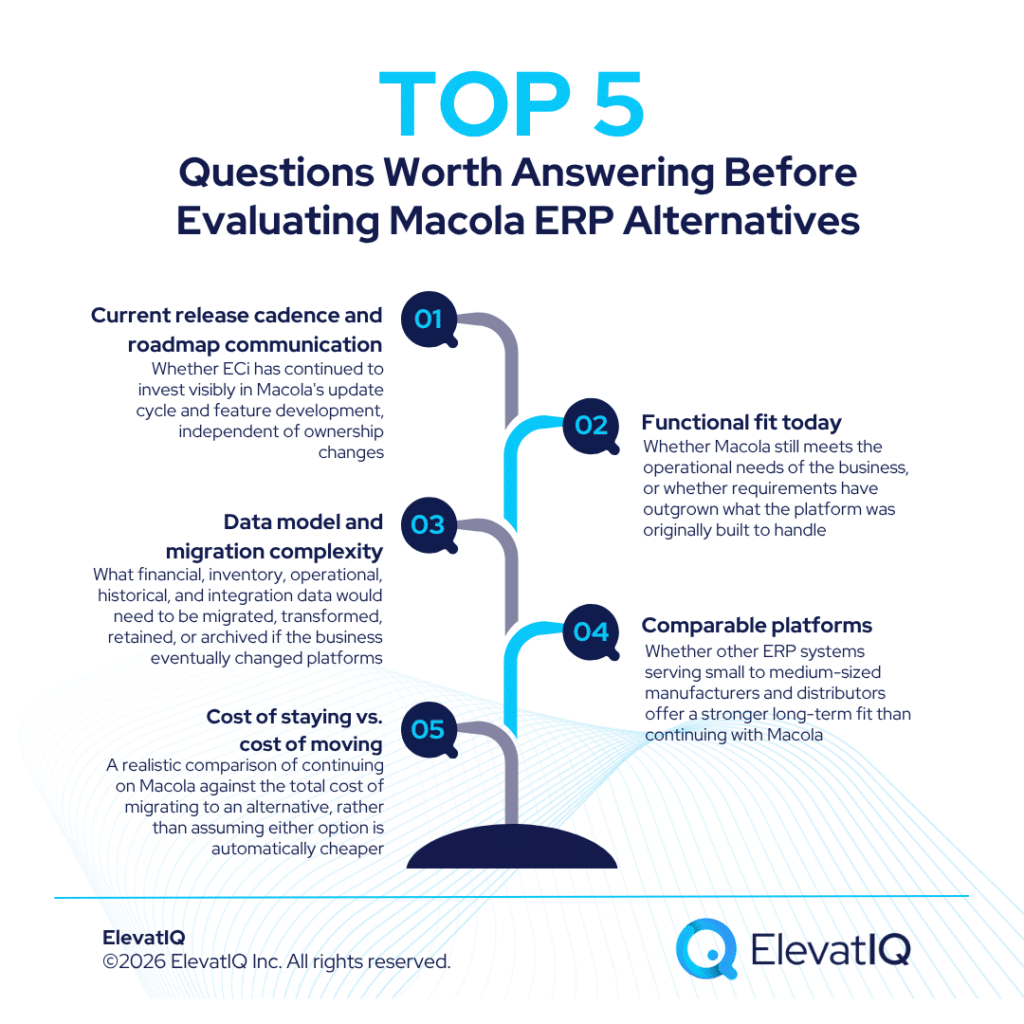
Current release cadence and roadmap communicationWhether ECi has continued to invest visibly in Macola’s update cycle and feature development, independent of ownership changes
Functional fit todayWhether Macola still meets the operational needs of the business, or whether requirements have outgrown what the platform was originally built to handle
Data model and migration complexityWhat financial, inventory, operational, historical, and integration data would need to be migrated, transformed, retained, or archived if the business eventually changed platforms
Comparable platformsWhether other ERP systems serving small to medium-sized manufacturers and distributors offer a stronger long-term fit than continuing with Macola
Cost of staying vs. cost of movingA realistic comparison of continuing on Macola against the total cost of migrating to an alternative, rather than assuming either option is automatically cheaper

An evaluation built on these questions is a different exercise than reacting to ownership news as though it were an end-of-life notice. It treats the ownership pattern as context for a decision the business would eventually need to make anyway, on its own timeline.

Managing the Decision Through ERP Independent Advisory

For legacy, vertical-specific ERP platforms like Macola, ownership and roadmap signals may be less straightforward for customers to interpret than a formal vendor announcement. Without a structured ERP evaluation process, businesses may instead wait for a formal trigger or assume continuity without periodically validating the product’s fit and roadmap.

Reactive Assumptions vs. Independent, Evidence-Based Evaluation

ApproachReactive DefaultIndependent, Evidence-Based Approach
Reading ownership newsTreated as background noise unless a formal end-of-life notice is issuedTreated as one data point in an ongoing assessment of product investment and roadmap continuity
Timing of evaluationDelayed until a forcing event, such as a support deadline or major failureStarted proactively, using ownership changes alongside product fit, roadmap, release activity, and other observable indicators
Comparison against alternativesLimited or skipped entirely absent a clear triggerConducted periodically, regardless of whether a trigger event has occurred
Decision basisAssumption of continuity, or reaction to a single headlineA documented comparison of current fit, cost, and available Macola ERP alternatives

At ElevatIQ, we help legacy ERP customers evaluate platform stability and fit based on the actual evidence available, including ownership history, release cadence, and functional requirements, rather than waiting for a formal vendor announcement to prompt the conversation. As an independent ERP and business software consulting firm, we don’t sell software and don’t receive commissions from vendors, which means our assessment of Macola, or any other platform, is shaped by what a business’s operations actually require, not by which platform we have an incentive to place. For a Macola customer weighing whether now is the time to look seriously at Macola ERP alternatives, that independent, evidence-based evaluation is what turns an ownership pattern into an informed decision rather than a reaction.

Conclusion

Macola’s ownership history is not, by itself, a reason to migrate immediately. There was no formal end-of-life announcement for Macola in ECI’s current public materials, and ECI continues to list Macola as a product for existing small to medium-sized manufacturing and distribution customers. The four changes in corporate ownership or control since 2001, including the February 2025 transaction, are worth factoring into the planning discussion, not a detail to set aside because no deadline has been attached to it.

A few signals tend to indicate a legacy Macola customer should start evaluating Macola ERP alternatives sooner rather than later:

  • The business has not reviewed Macola’s recent release cadence, product updates, or roadmap communication
  • The business’s current operational requirements have outgrown Macola’s capabilities or require functionality that the business cannot reasonably support through its current environment
  • Macola ERP alternatives haven’t been evaluated at all, even informally, in recent memory
  • The business’s current plan is to wait for a formal lifecycle announcement before evaluating whether a change is necessary

Starting that evaluation before a formal lifecycle announcement, if one is ever made, gives a legacy Macola customer more time to validate requirements, compare alternatives, assess migration complexity, and make a considered decision rather than a reactive one.



ERP Selection: The Ultimate Guide

This is an in-depth guide with over 80 pages and covers every topic as it pertains to ERP selection in sufficient detail to help you make an informed decision.

Macola ERP Alternatives: What Its Ownership History Means for Legacy Customers Read More »
Evosus Legacy End of Life: What ERP Buyers Should Know Before 2029

Evosus Legacy End of Life: What ERP Buyers Should Know Before 2029

Key Highlights

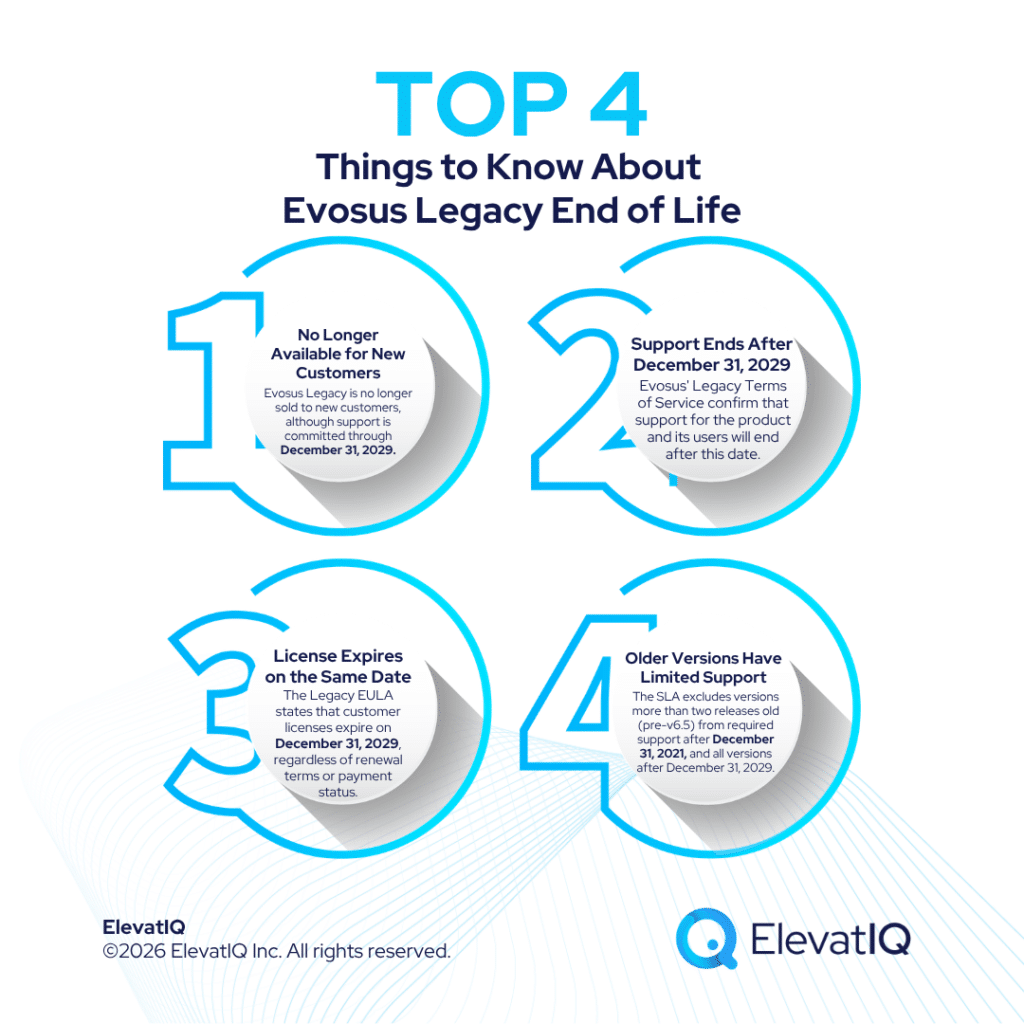
  • Evosus has confirmed the Evosus Legacy end of life. The business management software is no longer sold to new customers. And also support for the product will end after December 31, 2029. The date is specified in Evosus’ Legacy Terms, EULA, and Service Level Agreement.
  • Evosus has also specified version-based support limitations for Legacy. Versions more than two releases old, defined by Evosus as versions earlier than v6.5, are not required to receive support after December 31, 2021. As a result, some dealers and retailers may already have limited or no vendor support. This also depends on the Legacy version they are running.
  • Evosus’s own migration path is its cloud platform LOU. The multi-year transition window gives dealers and retailers time to plan ahead of the final cutoff. Pool, spa, and hearth dealers and retailers still need to independently evaluate whether LOU, or an alternative platform, is the better long-term fit for their specific business.
  • Waiting until close to the Evosus Legacy end of life can concentrate cost. This also concentrates staff training and data migration risk into a shorter window. It also may leave dealers and retailers with less time to compare platforms and negotiate commercial terms.
Your ERP Strategy Is About to Break - Sandeep Chopra - Watch On-Demand

Introduction

Software end-of-life announcements are common across the ERP and business management software industry. But the details of each one matter more than the headline. Evosus is a business management platform built specifically for pool, spa, and hearth (fireplace and stove) dealers and retailers. It has confirmed that its Legacy product is no longer available for purchase by new customers. And also confirmed that support for existing Legacy customers will end on December 31, 2029.

For a niche, vertical-specific platform like Evosus Legacy, this kind of announcement often gets less attention than a similar move from a major horizontal ERP vendor. But the operational stakes for the dealers and retailers who depend on it are just as real. Pool, spa, and hearth dealers and retailers use platforms like Evosus Legacy to run service scheduling, retail point of sale, inventory, and accounting in a single system. This also means a required transition away from Legacy because the Evosus Legacy end of life can touch nearly every part of daily operations.

This piece looks at what’s actually been confirmed about the Evosus Legacy end of life timeline. What a phased support and end-of-life policy like this means in practice. And also how a dealer and retailer should approach the transition decision independently of the vendor’s own recommended path.

What Evosus Has Actually Confirmed

Understanding the real urgency behind the Evosus Legacy end of life starts with separating the marketing message from the contractual language. Since the two are usually more specific than they first appear.

Evosus Legacy Timeline: Marketing Language vs. Contractual Terms

SourceWhat It States
Evosus Legacy product pageLegacy software is no longer for sale; support is committed through December 31, 2029
Legacy Terms of ServiceEvosus will discontinue support for the Legacy product and its users after December 31, 2029 (the “Expiration Date”)
Legacy EULAA customer’s Legacy Product License itself expires on December 31, 2029, regardless of renewal terms or payment status
Service Level AgreementEvosus is not required to support any Legacy version more than two releases old (pre-v6.5) after December 31, 2021, and won’t support any version after December 31, 2029

The SLA detail is worth sitting with. A dealer and retailer running an older, unpatched version of Legacy may already be outside the vendor’s support obligations well ahead of the because of the Evosus Legacy end of life in 2029, independent of the final cutoff date. That’s a distinction that’s easy to miss if a business only pays attention to the year printed on the marketing page.


ERP Selection Requirements Template

This resource provides the template that you need to capture the requirements of different functional areas, processes, and teams.

Why a Multi-Year Runway Is Both a Relief and a Trap

A multi-year support window ahead of the Evosus Legacy end of life gives dealers and retailers meaningful time to plan a transition before the final cutoff. Evosus has also been transparent about the technical reasoning: the top layer of Legacy’s programming sits on VB6, an aging technology stack, and the company evaluated how long it could realistically continue supporting the full stack underneath it before settling on the 2029 date.

The trap isn’t the timeline itself, it’s what a long runway tends to do to decision-making inside a dealer and retailer business.

Common Patterns in Long-Runway Software Transitions

PatternWhat Typically Happens
“We have years, no rush”Evaluation gets deprioritized against day-to-day operational demands
Migration planning starts in the final 12–18 monthsData migration, staff retraining, and integration work all get compressed into a shorter window than the vendor intended
Single-vendor defaultThe business moves to the vendor’s own successor platform without comparing it against alternatives, simply because it’s the path of least resistance
Version driftDealers and retailers running older Legacy versions discover they’ve already lost pieces of vendor support well before the final deadline

None of this is unique to Evosus. These are common risks in software transitions with distant deadlines, and it’s precisely why treating a 2029 date as “not yet a priority” is a different decision than treating it as “not yet urgent, but already worth planning.”


ERP System Scorecard Matrix

This resource provides a framework for quantifying the ERP selection process and how to make heterogeneous solutions comparable.

Evaluating LOU, and What Else Belongs in the Conversation

Planning around the Evosus Legacy end of life means engaging with Evosus’s own recommended path for Legacy customers, which is its cloud-based successor platform LOU. The company positions LOU as unifying service, retail, inventory, and accounting in one system, with continuous updates handled in the cloud rather than through periodic on-premises releases. In a September 2024 discussion with Legacy customers, Evosus said it expected most dealers and retailers to move to LOU around 2027 into 2028, ahead of the final 2029 cutoff tied to the Evosus Legacy end of life.

For a Legacy customer, LOU is a reasonable starting point for evaluation, since it’s built by the same team with direct knowledge of what Legacy customers actually use day to day. But a starting point for evaluation is not the same as an automatic decision, and this is where the distinction between a vendor’s recommended migration path and an independently evaluated one matters most.

Questions Worth Answering Before Committing to Any Platform, Including LOU

Evaluation AreaWhy It Matters for Pool, Spa, and Hearth Dealers and Retailers
Feature parity timelineWhether functionality a dealer and retailer currently relies on in Legacy is available in the new platform now, or on a future roadmap
Data migration scopeHow cleanly service history, inventory records, and customer data actually transfer, and what gets left behind or requires manual re-entry
Total cost over the transition periodLicensing, training, potential parallel-running costs, and any hardware or integration changes required
Integration footprintWhether existing point-of-sale, payment processing, or accounting integrations are supported on day one
Alternative platformsWhether a broader look at other retail, service, and inventory management platforms serving specialty dealers and retailers surfaces a better long-term fit than staying within the Evosus product family

A vendor’s own successor product can be a reasonable option, but it is also the option most directly presented and supported by the incumbent vendor. That makes independent comparison against the same requirements important. An independent ERP evaluation treats it as one candidate among several, evaluated against the same criteria as anything else.

Managing the Transition Through Independent Advisory

Navigating the Evosus Legacy end of life well ahead of the deadline is where independent, vendor-agnostic evaluation matters most. Vertical, dealer- and retailer-specific software like Evosus Legacy often gets less structured evaluation support than mainstream ERP transitions. It is largely because the market is smaller and less served by general enterprise software consultants. That gap tends to leave dealers and retailers choosing between doing the evaluation entirely in-house or defaulting to whatever path the incumbent vendor lays out.

In-House Transition Planning vs. Independent Evaluation

PhaseIn-House DefaultIndependent, Requirements-First Approach
Requirements gatheringBuilt around what the current system already doesBuilt around what the business actually needs going forward, including gaps in the current system
Platform comparisonLimited to the vendor’s own recommended pathEvaluated against other platforms serving specialty retail and service dealers and retailers
Migration timelineReactive, often starting close to the support deadlinePlanned with enough lead time to avoid compressed, high-risk migration windows
Negotiating positionLimited, since the deadline is approaching and options feel narrowStronger, since evaluation starts early enough to walk away from a poor-fit deal

At ElevatIQ, we work with dealers, retailers, and specialty service businesses to define system requirements based on actual operational needs. Rather than defaulting to whichever platform a vendor’s own transition messaging points toward. As an independent ERP and business software consulting firm, we don’t sell software and don’t receive commissions from vendors, which means our recommendations are shaped by what a dealer and retailer’s operations actually require, not by which platform we have an incentive to place. For a pool, spa, or hearth dealer and retailer weighing when and how to move off Evosus Legacy, that independent, requirements-first evaluation is what determines whether the eventual system genuinely fits the business or simply replicates the current one in a newer interface.

Conclusion

The Evosus Legacy end of life does not require every dealer and retailer to migrate immediately, but it does warrant proactive planning. December 31, 2029, the date set for the Evosus Legacy end of life, is still several years away, and Evosus has been more transparent than many vendors about its reasoning and its intended transition path. But a distant deadline is exactly the kind of signal that’s easy to deprioritize until it isn’t, and the businesses that end up doing rushed, high-risk migrations are rarely the ones that started planning too early.

A few signals tend to indicate a dealer and retailer should start evaluating options sooner rather than later:

  • The business is running a Legacy version more than two releases old, meaning some support may already be limited ahead of the final 2029 date
  • No one inside the business has mapped out what a realistic migration timeline and cost actually look like
  • LOU, or any other platform, hasn’t been evaluated against a clear list of the business’s actual operational requirements
  • The plan is currently “we’ll deal with it closer to 2029”

Starting the evaluation well ahead of the deadline gives dealers and retailers more time to compare platforms, validate requirements, plan the migration, and negotiate commercial terms before the support cutoff approaches.


ERP Selection: The Ultimate Guide

This is an in-depth guide with over 80 pages and covers every topic as it pertains to ERP selection in sufficient detail to help you make an informed decision.

Evosus Legacy End of Life: What ERP Buyers Should Know Before 2029 Read More »

Acumatica R2 2025 Features: An Independent Review

Acumatica R2 2025 Features: An Independent Review

Acumatica R2 2025 features mark the second major update in the company’s biannual release cycle. Designed to improve usability, strengthen automation, and enhance industry-specific workflows, this release reflects Acumatica’s continued focus on putting people at the center of enterprise technology. While many organizations view ERP updates as incremental, the new version emphasizes a “human-first” approach that highlights how technology should adapt to user needs, not the other way around. This article takes a closer look at the Acumatica R2 2025 features, their business impact, potential challenges, and what enterprises should consider when evaluating whether to adopt them.

Overview of Acumatica R2 2025

Acumatica follows a predictable release cycle with two updates each year — R1 in spring and R2 in fall. The Acumatica R2 2025 features continue this cadence, reflecting the company’s strategy of delivering enhancements in smaller, more manageable increments rather than large, disruptive upgrades. The overarching theme of this release is usability. Acumatica’s “human-first leap,” as described in industry commentary, underscores that ERP systems succeed only when employees across finance, operations, sales, and supply chain can use them effectively. This philosophy translates into new user experience upgrades, workflow simplifications, and a stronger emphasis on automation.

According to Acumatica’s Chief Product Officer Ali Jani, the human-first approach emerged directly from customer feedback. When discussing AI capabilities with customers, multiple organizations responded by asking about putting humans first—a perspective that shaped the entire release strategy. The decision to frame this release around human-centered design is significant. Too often, ERP implementations fail not because of technical deficiencies, but because users find systems difficult to navigate or counterintuitive. By addressing these friction points directly, Acumatica acknowledges that the most sophisticated features deliver little value if employees cannot or will not use them consistently.

top ERP vendors

Key Acumatica R2 2025 Features

The Acumatica R2 2025 features span multiple areas of the platform, from core financials to industry editions. Below are the highlights that stand out for enterprise users.

Redesigned User Interface

One of the most notable Acumatica R2 2025 features is its completely redesigned user interface, which is now the default experience. This represents more than a cosmetic update. The new interface offers deep personalization capabilities that allow users to configure every screen, from individual fields and tabs to entire layouts, without creating IT bottlenecks. The interface empowers users with both flexibility and control. Importantly, users can revert changes easily if needed, ensuring that empowerment doesn’t lead to chaos. This approach addresses a common concern in ERP environments: giving users customization capabilities while maintaining system stability and preventing configuration sprawl.

By focusing on how employees interact with the ERP, Acumatica positions itself as a platform that prioritizes adoption and usability, which are often overlooked during ERP rollouts. The personalization features allow individuals to configure their workspace based on role-specific priorities, reducing the cognitive load on users who previously had to navigate through irrelevant information to reach their core tasks.

Top ERP Systems

AI Studio: Democratizing Automation

Among the Acumatica R2 2025 features, AI Studio represents a significant advancement in making AI accessible to business users. First unveiled at Acumatica’s Summit in January 2025, AI Studio is now generally available as a configurable toolkit that empowers business users and partners to create their own automations by describing desired workflows in plain English.

This no-code approach to automation removes technical barriers that previously prevented business users from implementing process improvements. The AI Studio combines a large language model automation engine with an anomaly detection engine, allowing it to not only execute tasks but also identify insights and feed them into automated processes.

Practical applications include summarizing support ticket histories, generating detailed product descriptions, and automating complex multi-step workflows. For businesses that struggle with resource constraints, AI Studio reduces manual workloads and allows teams to focus on higher-value tasks without requiring programming expertise or IT intervention for every automation need.

Industry-Specific Enhancements

Acumatica’s sector-focused editions are a core part of its product strategy, and the Acumatica R2 2025 features include targeted improvements for industries such as construction, manufacturing, and distribution.

Construction: Project 360 Dashboard and AI-First Document Management

Construction firms gain significant capabilities through the new Project 360 Dashboard, which provides comprehensive, real-time project visibility. This centralized view helps project managers maintain oversight across multiple dimensions of project performance. The release also introduces an AI-first document management system that fundamentally changes how construction firms organize project documentation. Instead of relying on traditional folder structures, the system uses metadata tagging. When users upload files or media, the system can automatically tag documents, use AI to generate detailed descriptions, and make everything fully searchable.

This approach addresses a persistent challenge in construction project management: finding specific documents quickly. The ability to locate any document, PDF, or media file associated with a project through intelligent search saves time, reduces errors, and enables faster decision-making across every project stage. For an industry where margin pressures are constant and project complexity continues to increase, these capabilities address genuine operational challenges.

Distribution: Order Fulfillment Orchestration

Distributors benefit from Advanced Order Management featuring Order Fulfillment Orchestration, which automates warehouse selection to optimize for both speed and cost. This AI-assisted system considers multiple factors simultaneously—including inventory availability, shipping costs, and even customer preferences or sentiment about specific carriers.

This automation transforms a task that previously required hours of manual analysis into a nearly instantaneous process. Recognizing that many businesses aren’t ready to fully trust AI decision-making, Acumatica has built in an optional human review step. This balanced approach allows organizations to gain efficiency benefits while maintaining appropriate oversight. The Order Fulfillment Orchestration helps distributors meet customer expectations for faster delivery while minimizing carrying costs and shipping expenses—a balancing act that defines success in modern distribution operations.


The 2026 Digital Transformation Report

Thinking of embarking on a ERP journey and looking for a digital transformation report? Want to learn the best practices of digital transformation? Then, you have come to the right place.

Manufacturing: Advanced Planning and Scheduling Optimization

Manufacturers gain significant performance improvements in Advanced Planning and Scheduling (APS), with processing times reduced from hours to minutes through AI optimization. This dramatic improvement in computational speed enables manufacturers to run more frequent planning scenarios and respond more quickly to changing conditions on the shop floor.

The release also introduces enhanced lot and serial traceability with metadata tagging at the lot or individual serial number level. For quality and compliance managers, this granular data provides detailed audit trails to meet regulatory requirements and reduce risk. In the event of a product recall, manufacturers can instantly identify exactly which lots are affected, protecting customers and minimizing financial and reputational damage.

These updates reflect Acumatica’s goal of aligning ERP capabilities with the practical realities of different industries. Rather than forcing businesses to adapt generic software to specialized needs, the industry editions acknowledge that construction project management differs fundamentally from discrete manufacturing or wholesale distribution.

What the Acumatica R2 2025 Features Mean for Businesses

The Acumatica R2 2025 features hold different implications depending on the audience within an organization:

  • End-Users Across Functions: A more intuitive interface and the ability to personalize screens make everyday tasks less time-consuming. When software gets out of the way and lets people focus on their work rather than struggling with the tool, job satisfaction improves alongside productivity.
  • CFOs and Finance Teams: Greater automation through AI Studio reduces manual reconciliation work and repetitive processes, improving accuracy in financial reporting. The ability to close books faster and with greater confidence supports better financial planning and more responsive business management.
  • Operations Leaders: The redesigned user interface means faster onboarding for staff and less reliance on IT support. When employees can navigate the system intuitively and customize their own workflows, operations managers spend less time troubleshooting software issues and more time optimizing processes. This becomes particularly valuable in industries facing labor shortages or high turnover rates.
  • IT Managers: Industry-specific updates and AI Studio reduce the need for custom development, lowering the burden on internal teams. Rather than building and maintaining custom modules to address industry-specific requirements or business user automation requests, IT resources can focus on integration with emerging technologies and strategic initiatives that differentiate the business.
  • Project Managers (Construction): The Project 360 Dashboard and AI-first document management eliminate time wasted searching for project documents and provide real-time visibility needed for proactive decision-making.
  • Supply Chain and Distribution Managers: Order Fulfillment Orchestration automates complex shipping decisions, reducing labor costs while improving delivery speed and customer satisfaction.
  • Production and Quality Managers (Manufacturing): APS performance improvements enable more frequent planning cycles, while enhanced traceability provides the granular data needed for compliance and rapid response to quality issues.

Challenges to Consider Before Upgrading

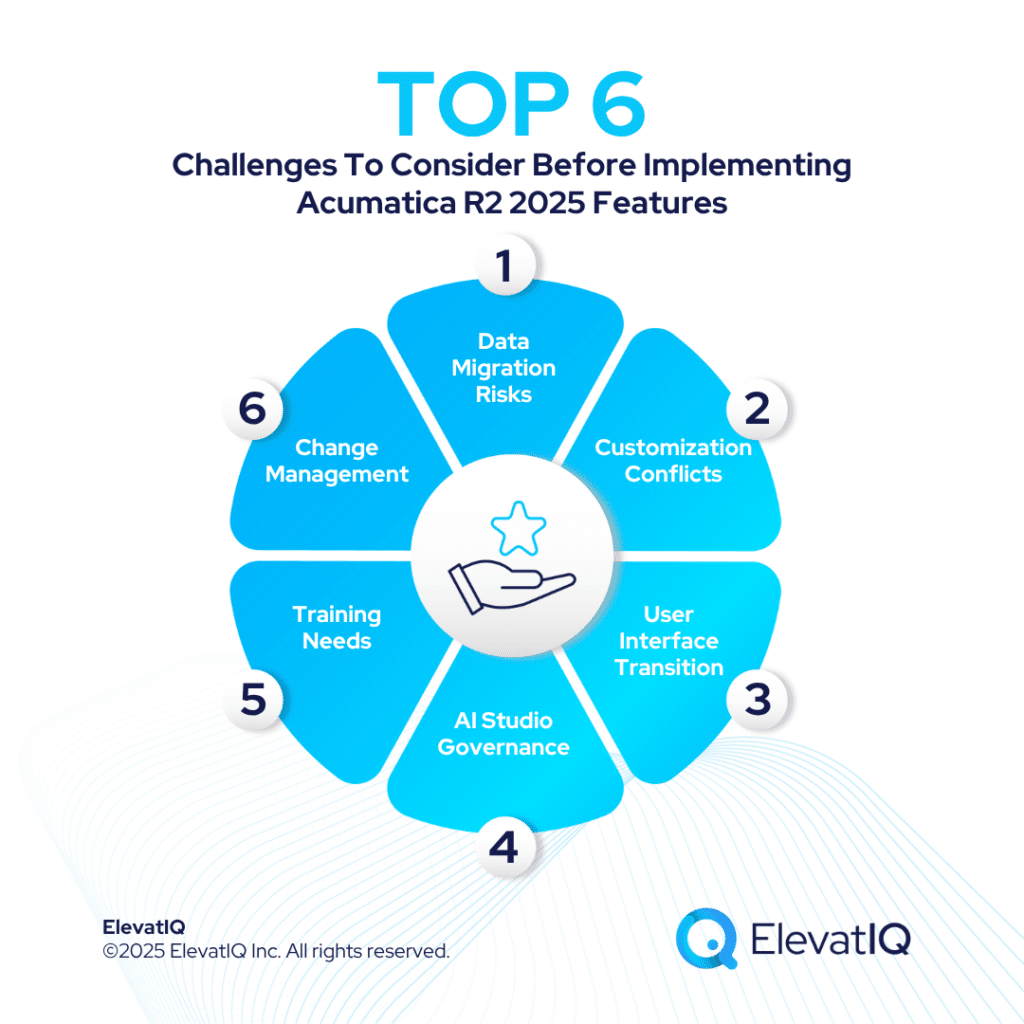
While the Acumatica R2 2025 features bring measurable benefits, businesses must also prepare for potential challenges.

Data Migration Risks

Even incremental upgrades can create issues with data integrity, especially for organizations using multiple third-party integrations. Historical data may need transformation to align with new structures, and integration points require testing to ensure continued functionality. What appears to be a straightforward update can reveal unexpected data quality issues that require resolution before proceeding.

Customization Conflicts

Companies that have heavily customized their ERP environment may need additional testing to ensure compatibility. Custom code, workflows, or reports built for previous versions might behave unexpectedly with new features, requiring remediation before deployment. Organizations with extensive customizations should allocate extra time and resources for compatibility testing.

User Interface Transition

While the redesigned interface offers significant improvements, users accustomed to the previous interface will need time to adjust. The personalization capabilities, while powerful, require users to understand configuration options. Organizations should plan for an adjustment period even though the new interface is designed to be more intuitive.

AI Studio Governance

The democratization of automation through AI Studio creates new governance considerations. Organizations need policies around who can create automations, testing procedures for user-created workflows, and monitoring to ensure automations perform as intended. Without appropriate guardrails, user empowerment could lead to inconsistent processes or unexpected system behavior.

Training Needs

Usability improvements do not eliminate the need for training. Employees must understand new features to take full advantage of them. While the interface may be more intuitive, the expanded capabilities—particularly AI Studio and industry-specific enhancements—still require explanation and practice for users to develop proficiency. Underestimating training requirements is one of the most common mistakes organizations make when adopting new ERP functionality.

Change Management

Resistance to new workflows is common. Without proper communication, even positive changes can create disruptions. Employees comfortable with existing processes may view updates as unwelcome complications rather than improvements, especially if the business case for change is not clearly communicated. Effective change management begins with explaining why updates matter and how they benefit individual users, not just the organization as a whole.

What organizations should do is conduct thorough testing in a sandbox environment, review documentation, and plan structured training before rolling out the Acumatica R2 2025 features across the enterprise. Rushing ERP implementation without adequate preparation increases the risk of business disruption and user frustration.

Independent Guidance for ERP Buyers

Adopting new ERP features is not just a technical decision—it’s a strategic one. The value of the Acumatica R2 2025 features depends on how well they align with broader business goals such as digital transformation, automation, and scalability.

This is where independent ERP consulting partners can make a difference. Firms like ElevatIQ specialize in helping organizations evaluate ERP updates in the context of long-term strategy. Unlike vendor-aligned consultants, independent advisors provide unbiased assessments of whether a particular feature set supports an organization’s roadmap.

For example, ElevatIQ assists businesses with:

  • ERP selection and implementation roadmaps, ensuring that upgrades support growth objectives. This includes evaluating whether new features like AI Studio address genuine business needs or represent capabilities the organization is not prepared to utilize effectively. Not every feature provides equal value to every organization, and independent advisors help prioritize based on actual requirements rather than vendor marketing messages.
  • Change management and user adoption strategies, minimizing disruption during transitions. Independent consultants bring experience from multiple implementations, helping organizations anticipate challenges like user interface transitions and deploy proven mitigation strategies. This cross-industry perspective often reveals solutions that internal teams, focused on their specific context, might overlook.
  • Integration with adjacent systems such as CRM, supply chain, or data analytics platforms, creating a unified digital ecosystem. The value of ERP features multiplies when data flows seamlessly between systems, and independent advisors help architect these connections without vendor bias. They evaluate integration options based on technical merit and organizational fit rather than vendor partnerships or preferred solutions.
  • Governance framework development for capabilities like AI Studio, helping organizations establish appropriate policies and oversight mechanisms that balance empowerment with control.

Strategic Considerations for Implementation

Organizations evaluating the Acumatica R2 2025 features should consider several strategic factors beyond the immediate technical capabilities:

  • Timing matters. Does the organization have the bandwidth to implement updates effectively, or would delaying adoption until a less busy period produce better results? Sometimes waiting for the right organizational moment yields better outcomes than rushing to adopt the latest version during peak business cycles. Organizations should also consider whether they want to adopt immediately or wait for early adopters to identify any unforeseen issues.
  • Phasing deserves attention. Should all features be implemented simultaneously, or would a phased approach that introduces capabilities incrementally work better? For example, organizations might deploy the new user interface first, allow users to adjust, and then introduce AI Studio capabilities once teams are comfortable with the foundational changes. Gradual rollout allows teams to adapt to changes without overwhelming users, though it requires careful planning to ensure phases build logically on one another.
  • Measurement is essential. What metrics will the organization use to evaluate whether the Acumatica R2 2025 features deliver expected value? Establishing clear success criteria before implementation enables objective assessment of outcomes and helps justify the investment to stakeholders. Relevant metrics might include user adoption rates, time saved through automation, reduction in document search time, or improvement in planning cycle frequency.
  • Capability readiness requires honest assessment. Not every organization is ready to fully leverage advanced capabilities like AI Studio. Organizations should evaluate whether they have the data quality, process maturity, and user sophistication needed to benefit from democratized automation. Sometimes achieving foundational capabilities delivers more value than rushing to adopt advanced features prematurely.

Conclusion

The Acumatica R2 2025 features reflect a clear shift toward usability, automation, and industry-specific optimization. For businesses already on Acumatica, the release provides opportunities to improve efficiency and empower employees. For prospective buyers, it highlights the platform’s commitment to evolving with user needs and delivering capabilities that address real operational challenges. At the same time, adopting new ERP functionality requires careful planning. Organizations must balance the appeal of new features with the realities of integration, training, and long-term digital strategy. Independent advisors such as ElevatIQ play an essential role in helping enterprises make these decisions with clarity and objectivity.

As ERP systems continue to evolve, releases like Acumatica R2 2025 serve as a reminder that technology should adapt to people—and not the other way around. The emphasis on user interface personalization, plain-English automation through AI Studio, and industry-specific enhancements demonstrates a commitment to making powerful technology accessible and practical for everyday users.

The most sophisticated features deliver value only when implemented thoughtfully, with attention to how they fit within the broader context of organizational goals, culture, and operational realities. Organizations that approach the Acumatica R2 2025 features strategically—assessing them against specific business needs rather than adopting them simply because they are new—position themselves to extract maximum value while minimizing disruption. In an era where technology changes rapidly, this measured approach to ERP evolution represents the difference between chasing trends and building sustainable competitive advantages.

Top 15 Digital Transformation Trends - Download

FAQs

Acumatica R2 2025 Features: An Independent Review Read More »

Oracle AI World ERP Revolution - An Independent Review

Oracle AI World ERP Revolution: An Independent Review

Oracle announced that its flagship event CloudWorld would be renamed Oracle AI World. According to Oracle, the rebrand emphasizes the company’s commitment to helping customers take advantage of AI innovations to move faster, reduce costs, make informed decisions, and build businesses. This change reflects Oracle’s positioning of artificial intelligence as central to its enterprise resource planning strategy.

Background of the Rebranding Decision

Oracle stated that the name change emphasizes its commitment to helping customers and partners take advantage of the latest AI innovations. The event, previously known as CloudWorld, focused primarily on cloud infrastructure and migration strategies. The Oracle AI World ERP revolution represents a shift from cloud-centric messaging to AI integration as the primary value proposition.

Oracle’s decision aligns with broader industry trends where ERP vendors are integrating AI capabilities into core system functions rather than offering them as separate modules. This Oracle AI World ERP revolution indicates Oracle’s belief that AI has become fundamental to ERP operations rather than supplementary.

top ERP vendors

Current AI Integration in Oracle ERP Systems

Oracle has implemented AI features across its ERP portfolio, including Oracle Fusion Cloud ERP and NetSuite. These implementations include:

Financial Management AI Features

Oracle ERP systems now include automated reconciliation processes, anomaly detection in financial data, and predictive cash flow modeling. These features use machine learning to identify patterns in financial transactions and flag unusual activities for review.

Supply Chain Intelligence

AI-powered supply chain management in Oracle systems provides demand forecasting, inventory optimization, and supplier risk assessment. The Oracle AI World ERP revolution includes predictive analytics that analyze historical data to anticipate supply chain disruptions.

Human Resources Automation

Oracle’s HCM Cloud incorporates AI for resume screening, employee retention prediction, and compliance monitoring. These tools analyze employee data to identify patterns that may indicate turnover risk or compliance issues.

Top ERP Systems

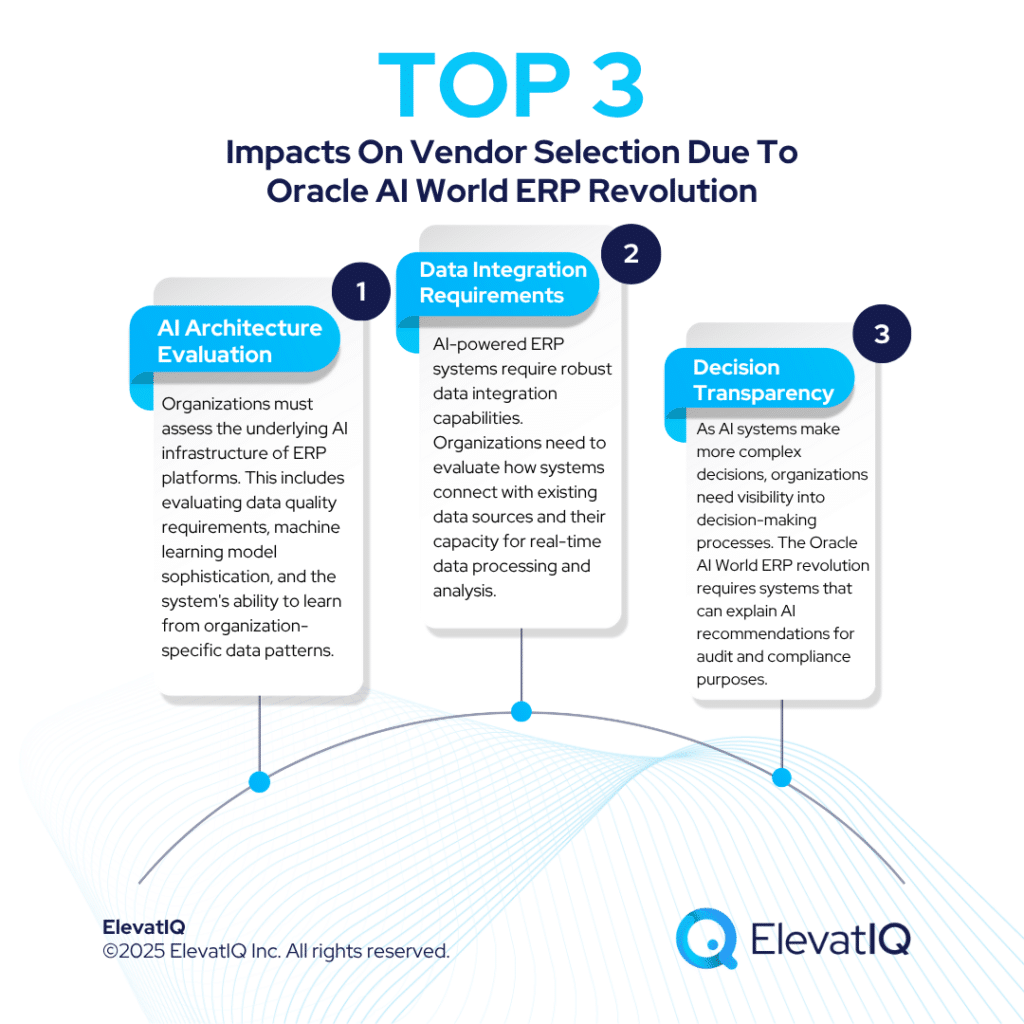
Impact on ERP Vendor Selection

The Oracle AI World ERP revolution changes the evaluation criteria for organizations selecting ERP systems. Traditional factors like functional coverage and integration capabilities remain important, but new considerations have emerged:

AI Architecture Evaluation

Organizations must assess the underlying AI infrastructure of ERP platforms. This includes evaluating data quality requirements, machine learning model sophistication, and the system’s ability to learn from organization-specific data patterns.

Data Integration Requirements

AI-powered ERP systems require robust data integration capabilities. Organizations need to evaluate how systems connect with existing data sources and their capacity for real-time data processing and analysis.

Decision Transparency

As AI systems make more complex decisions, organizations need visibility into decision-making processes. The Oracle AI World ERP revolution requires systems that can explain AI recommendations for audit and compliance purposes.

Implementation Considerations

Organizations implementing AI-integrated ERP systems face different challenges than traditional ERP deployments. The Oracle AI World ERP revolution requires modified implementation approaches:

Training Requirements

Users need training on interpreting AI recommendations, understanding when to override automated decisions, and working with intelligent systems. This differs from traditional ERP training that focused on system navigation and process execution.

Process Redesign

AI-integrated ERP systems require organizations to redesign business processes. Companies must determine which processes benefit from automation versus those requiring human judgment and oversight.

Organizations navigating these implementation challenges often engage independent ERP consultants with experience in AI-integrated ERP systems. These consultants provide vendor-agnostic guidance on system selection and implementation strategies, helping organizations evaluate AI capabilities across multiple platforms while maintaining objectivity in decision-making processes.


The 2026 Digital Transformation Report

Thinking of embarking on a ERP journey and looking for a digital transformation report? Want to learn the best practices of digital transformation? Then, you have come to the right place.

Professional Role Evolution

The Oracle AI World ERP revolution affects career paths for ERP professionals. Traditional roles focused on system configuration, report creation, and process documentation are expanding to include:

AI Strategy Development

ERP professionals need skills in AI model interpretation, data governance, and human-AI workflow design. The ability to connect AI technical capabilities with business objectives becomes increasingly valuable.

Enhanced Analysis Capabilities

As AI systems handle routine tasks, human professionals focus on exception management, strategic analysis, and process optimization. This requires stronger analytical and problem-solving skills.

Continuous Skill Development

The rapid evolution of AI capabilities requires ongoing education. ERP professionals need an understanding of machine learning principles, large language models, and AI ethics alongside traditional ERP functional knowledge.

Industry Response and Competition

The Oracle AI World ERP revolution influences competitive dynamics across the enterprise software market. Other major ERP vendors are developing their own AI initiatives in response:

Vendor Differentiation Strategies

As basic AI capabilities become standard, vendors differentiate through implementation quality, industry-specific AI models, and integration sophistication rather than AI presence alone.

Partnership Development

The complexity of AI-integrated ERP systems has led to partnerships between software vendors, implementation consultants, and specialized AI service providers. Organizations benefit from selecting partners with demonstrated AI integration experience across multiple vendor platforms.

Organizational Preparation Requirements

Organizations planning to implement AI-integrated ERP systems in the context of the Oracle AI World ERP revolution should begin preparation before vendor selection:

Data Quality Assessment

AI effectiveness depends on data quality and accessibility. Organizations should audit existing data sources, identify integration requirements, and establish data governance protocols before beginning ERP selection.

Change Management Planning

AI-powered ERP systems require comprehensive change management addressing technical and cultural transformation. Users need support adapting to AI-augmented workflows and decision-making processes.

Skills Gap Analysis

Organizations should identify current skill gaps and develop training programs for AI-integrated ERP environments. This includes both technical skills and cognitive abilities required for human-AI collaboration.

Market Analysis and Future Outlook

The Oracle AI World ERP revolution represents early stages of broader enterprise software transformation. Current market indicators suggest:

Adoption Timeline

Organizations implementing AI-integrated ERP systems report longer implementation timelines but improved operational efficiency once systems are fully deployed. Early adopters gain competitive advantages through improved decision-making speed and accuracy.

Investment Requirements

AI-integrated ERP systems typically require higher initial investment in data preparation, training, and change management. However, organizations report reduced operational costs through process automation and improved accuracy.

Technology Evolution

The rapid advancement of AI capabilities means ERP systems will continue evolving. Organizations must plan for ongoing system updates and user training as AI features expand and improve.

Strategic Considerations

The Oracle AI World ERP revolution requires organizations to view AI integration as strategic transformation rather than technical upgrade. Success factors include:

Leadership Commitment

Successful AI-integrated ERP implementations require executive support for organizational change and investment in user training and process redesign.

Gradual Implementation

Organizations achieve better results through phased AI integration rather than attempting comprehensive deployment immediately. This allows teams to adapt to AI-augmented processes gradually.

Performance Measurement

Organizations need metrics to evaluate AI system performance and identify areas for improvement. This includes measuring both technical performance and business impact.

The transformation represented by Oracle AI World reflects broader changes in enterprise software. Organizations that understand these changes and plan accordingly will be better positioned for the increasingly AI-driven business environment. The Oracle AI World ERP revolution indicates that future ERP success will depend on effective AI integration rather than traditional functional capabilities alone.

Top 15 Digital Transformation Trends - Download

FAQs

Oracle AI World ERP Revolution: An Independent Review Read More »

Sage AI Finance Automation

Sage AI Finance Automation: An Independent Review

Sage’s announcement of enhanced AI capabilities within Sage Intacct marks a significant advancement in enterprise financial software automation. The latest developments introduce Sage AI finance automation tools designed to address persistent challenges in financial operations, from month-end close processes to accounts payable management.

According to industry analysis, the enhancements specifically target operational inefficiencies that have historically consumed finance team resources. The Sage AI finance automation framework encompasses intelligent reconciliation, embedded payment solutions, and sustainability reporting capabilities that reflect broader market demands for streamlined financial operations.

Research conducted by Sage indicates that 84% of finance leaders seek to accelerate book closing processes, while 87% actively pursue more sophisticated accounts payable automation solutions. These statistics underscore the market demand driving AI-powered financial software development across the enterprise technology landscape.

Financial Operations Automation Landscape

The evolution of Sage AI finance automation occurs within a broader context of digital transformation initiatives affecting finance departments globally. Organizations increasingly recognize that manual financial processes create bottlenecks that limit strategic capabilities and operational agility.

Market Drivers for AI Finance Tools

Enterprise finance teams face mounting pressure to deliver faster, more accurate financial reporting while managing increasing transaction volumes and regulatory requirements. Traditional approaches to financial operations management often prove insufficient for organizations experiencing growth or operating in complex business environments. Industry observers note that financial software vendors have responded to these challenges by developing AI-powered solutions that automate routine tasks while maintaining accuracy and compliance standards. The Sage AI finance automation initiative represents this broader trend toward intelligent financial operations management.

Competitive analysis suggests that finance automation capabilities are becoming standard expectations rather than differentiating features. Organizations evaluating financial software increasingly prioritize AI capabilities alongside traditional functionality and integration requirements. Understanding these market dynamics provides essential context for examining how Sage has structured its AI-powered solutions to address specific operational challenges while supporting broader digital transformation objectives.

top ERP vendors

Technology Integration Considerations

The Sage AI finance automation architecture integrates artificial intelligence capabilities directly within existing Sage Intacct workflows, minimizing disruption while maximizing functionality enhancement. This approach differs from solutions that require separate AI platforms or extensive system modifications. Technical specifications indicate that the AI-powered features operate within the established Sage Intacct environment, enabling organizations to leverage existing user training and system integrations. This integrated approach addresses common implementation challenges associated with introducing new technology capabilities into established financial operations.

AI-Powered Financial Process Enhancement

While market drivers explain the demand for automation, the practical value of Sage AI finance automation depends on specific capabilities that address operational pain points in financial management processes.

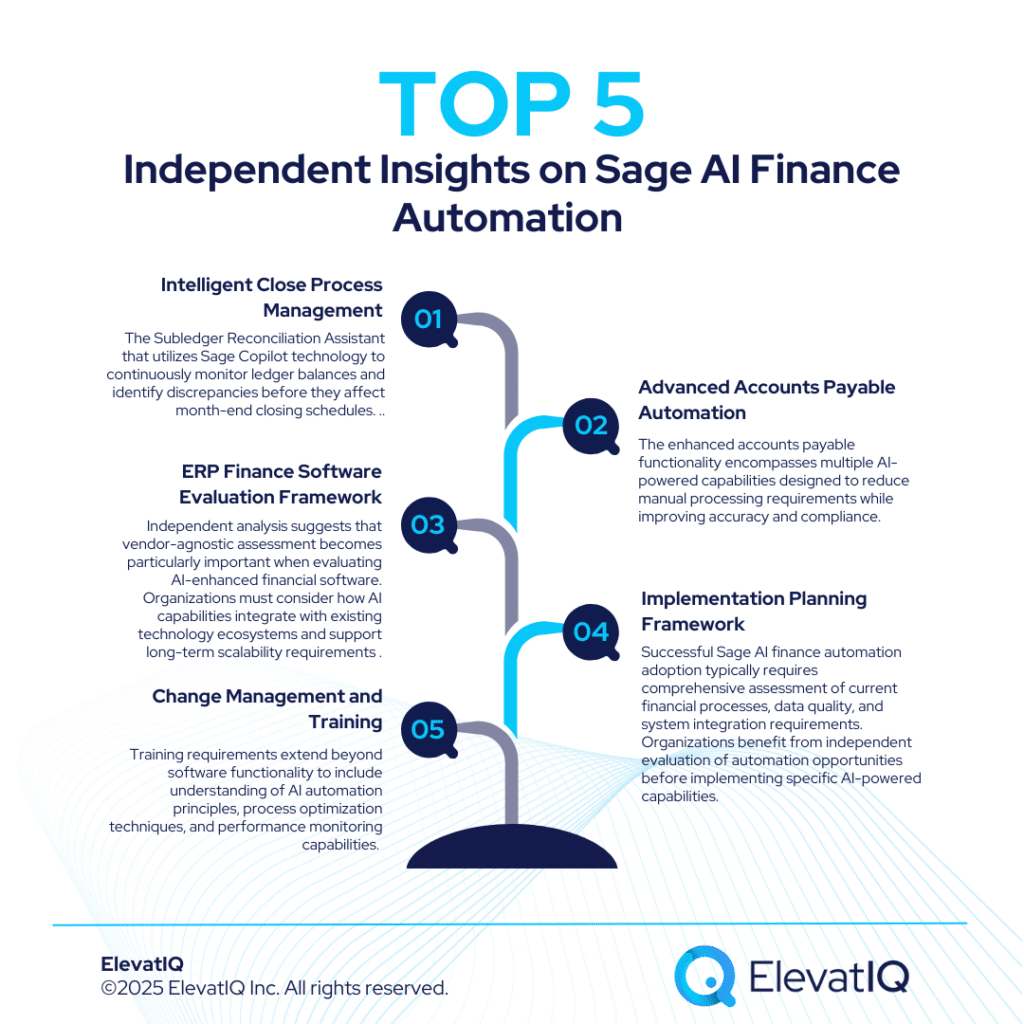
Intelligent Close Process Management

The AI-Powered Close functionality introduces a Subledger Reconciliation Assistant that utilizes Sage Copilot technology to continuously monitor ledger balances and identify discrepancies before they affect month-end closing schedules. This proactive approach represents a significant advancement over traditional reconciliation processes that rely on manual review and correction. Industry analysis suggests that month-end close acceleration has remained a persistent challenge for finance teams across various industries. The Sage AI finance automation framework addresses this challenge through standardized close tasks, customizable templates, and real-time notification systems that coordinate team activities and track progress.

The Close Workspace functionality provides centralized management of closing activities, enabling finance teams to maintain visibility across multiple process streams while ensuring completion of required tasks. This systematic approach to close management could significantly reduce the time and effort required for monthly financial reporting cycles. These AI-powered close capabilities demonstrate how artificial intelligence can enhance existing financial processes without requiring fundamental changes to established accounting practices or organizational structures. Moving beyond close process management, the Sage AI finance automation platform addresses operational challenges in accounts payable and procurement workflows that affect daily financial operations.

Top ERP Systems

Advanced Accounts Payable Automation

The enhanced accounts payable functionality encompasses multiple AI-powered capabilities designed to reduce manual processing requirements while improving accuracy and compliance. Sage Vendor Payments, powered by MineralTree technology, embeds payment processing directly within the Intacct environment. Payment processing capabilities include ACH transfers, check generation, and virtual card payments with integrated fraud protection and enhanced visibility into payment status. This embedded approach eliminates the need for separate payment systems while providing comprehensive payment management functionality.

AI-powered Line-Level Matching automatically correlates invoice details with purchase order information, reducing the manual effort required for accounts payable processing. This capability addresses a common source of inefficiency in financial operations where invoice processing creates bottlenecks that affect cash flow management and vendor relationships. The Sage Intacct eProcurement expansion provides embedded vendor punchout capabilities that enable direct vendor interaction with automated order data capture. This integration streamlines procurement processes while maintaining visibility and control over purchasing activities.

Strategic Implications for Financial Technology Architecture

The availability of Sage AI finance automation capabilities creates new considerations for organizations planning their financial technology infrastructure and vendor relationships.

ERP Finance Software Evaluation Framework

The introduction of AI-powered financial capabilities influences how organizations evaluate enterprise resource planning software and financial management systems. Traditional evaluation criteria focused primarily on functional capabilities and integration requirements must now incorporate AI functionality and automation potential. Independent analysis suggests that vendor-agnostic assessment becomes particularly important when evaluating AI-enhanced financial software. Organizations must consider how AI capabilities integrate with existing technology ecosystems and support long-term scalability requirements across multiple business functions.

Industry experts emphasize the importance of building comprehensive enterprise architecture that considers data flows between financial systems, operational applications, and reporting platforms. This approach enables organizations to maximize AI automation benefits while maintaining flexibility for future technology evolution. The complexity of evaluating enterprise software across categories such as ERP, financial management, business intelligence, and compliance tools requires structured assessment processes that consider both current capabilities and future development trajectories. Moving from evaluation considerations to practical implementation, organizations must develop frameworks for deploying Sage AI finance automation tools while ensuring integration with existing financial processes and systems.

Implementation Strategy Development

Successful Sage AI finance automation adoption typically requires comprehensive assessment of current financial processes, data quality, and system integration requirements. Organizations benefit from independent evaluation of automation opportunities before implementing specific AI-powered capabilities. Business process documentation becomes critical when introducing AI automation into financial workflows. Organizations must clearly define current-state processes, identify automation opportunities, and establish metrics for measuring improvement outcomes. An AI-augmented approach to business process optimization can help identify the most beneficial automation targets while ensuring compliance with financial reporting requirements.

The complexity of financial software implementation often necessitates specialized expertise spanning accounting practices, technology architecture, and change management. Organizations typically require support covering ERP selection and optimization, process re-engineering, and user training across their financial transformation initiatives.

Competitive Dynamics and Market Response

The Sage AI finance automation announcement occurs within a competitive landscape where multiple vendors are developing AI-powered financial capabilities to address similar market demands.

Industry Vendor Response Analysis

Technology industry analysts have characterized Sage’s AI finance automation development as part of broader market trends toward intelligent financial operations management. Similar capabilities are emerging across major ERP platforms, including SAP S/4HANA Finance, Oracle NetSuite, and Workday Financial Management. Competitive analysis indicates that AI-powered financial capabilities are becoming baseline expectations rather than differentiating features across major ERP platforms. Organizations evaluating financial software must consider not only current AI functionality but also vendor roadmaps for continued capability development.

Market research suggests that Sage AI finance automation adoption may accelerate broader digital transformation initiatives that have been constrained by manual financial processes. Organizations previously limited by traditional financial software capabilities now have access to automation tools that support more strategic financial management approaches. The competitive landscape demonstrates how financial software vendors are responding to market demands through AI integration rather than separate AI solutions, reflecting customer preferences for embedded capabilities over standalone automation platforms. Understanding competitive dynamics provides context for examining how different market segments and regional requirements influence Sage AI finance automation adoption patterns.

Market Segment Adoption Patterns

Different industry sectors face varying requirements for financial automation based on transaction volumes, regulatory environments, and operational complexity. Manufacturing organizations may prioritize procurement automation and cost accounting integration, while service companies might focus on revenue recognition and project profitability analysis. Small and medium-sized businesses represent a key target market for Sage AI finance automation tools, as these organizations often lack the resources to develop custom automation solutions but require the efficiency benefits of AI-powered financial processes.

Large enterprises with complex financial operations may find value in AI automation for specific process areas while maintaining existing systems for other functions. This selective adoption approach requires careful integration planning to ensure data consistency and process coordination across different automation levels.


The 2026 Digital Transformation Report

Thinking of embarking on a ERP journey and looking for a digital transformation report? Want to learn the best practices of digital transformation? Then, you have come to the right place.

Professional Services and Implementation Support

The complexity of Sage AI finance automation implementation creates demand for specialized expertise in financial process optimization, AI integration, and change management strategies.

Expertise and Advisory Requirements

Sage AI finance automation implementation requires specialized knowledge spanning financial accounting practices, AI technology capabilities, and system integration requirements. Organizations typically benefit from independent advisory services during evaluation and planning phases, particularly when assessing automation opportunities across multiple financial process areas. The complexity of financial software architecture often necessitates support for enterprise technology selection, requirement definition, and vendor negotiation processes. These services help organizations navigate technical specifications while addressing specific operational requirements and compliance considerations.

  • A structured, vendor-agnostic approach to digital transformation planning ensures that AI automation investments align with broader organizational objectives and existing technology infrastructure. This comprehensive evaluation process considers integration requirements across enterprise software categories including ERP, business intelligence, and compliance management systems.
  • Business process optimization becomes particularly important when implementing Sage AI finance automation solutions. Organizations must align existing workflows with AI automation capabilities while maximizing efficiency gains and maintaining financial control standards.
  • Beyond technical implementation, successful AI automation adoption requires comprehensive organizational change management strategies that address user training, process modification, and performance measurement requirements.

Change Management and User Adoption

AI finance automation often requires updated procedures, role definitions, and skill development for finance team members. Organizations benefit from comprehensive change management support to ensure successful transition from manual processes to AI-powered workflows. Training requirements extend beyond software functionality to include understanding of AI automation principles, process optimization techniques, and performance monitoring capabilities. These skills are essential for maximizing Sage AI finance automation investment value and maintaining operational effectiveness.

Future Outlook for AI Finance Automation

Technology advancement in AI finance automation occurs within a dynamic market environment where customer demands, regulatory requirements, and competitive pressures continue to shape capability development and adoption patterns.

Technology Evolution Trends

Industry forecasts suggest that AI finance automation capabilities will expand beyond current Sage offerings as market demand increases and technology maturity improves. Additional vendors are likely to develop similar AI-powered solutions addressing comparable operational challenges in financial management.

AI capability evolution within financial software may accelerate as organizations gain experience with automation implementation and identify additional optimization opportunities. The Sage AI finance automation development could influence broader market adoption of AI technologies in financial operations across various industry sectors. Technology development occurs within regulatory environments that continue to evolve regarding financial reporting, data privacy, and AI governance requirements. Sage AI finance automation solutions must adapt to changing compliance landscapes while maintaining operational efficiency and accuracy standards.

Market Maturity and Adoption Acceleration

The success of Sage AI finance automation implementation across different organizations may influence similar initiatives from other financial software vendors, potentially creating more comprehensive AI automation ecosystems for financial operations management. Organizations that successfully implement AI finance automation may achieve competitive advantages through improved operational efficiency, faster financial reporting cycles, and enhanced analytical capabilities. These benefits could drive broader market adoption as organizations seek to maintain competitive positioning.

Conclusion

Sage’s AI finance automation initiative represents a significant development in enterprise financial software evolution. By addressing persistent challenges in financial operations while enabling enhanced analytical capabilities, the initiative demonstrates how AI technology can transform traditional financial management approaches. Organizations evaluating AI finance automation options benefit from independent assessment of operational requirements, technology integration implications, and long-term strategic alignment. The complexity of these implementations typically requires specialized expertise spanning financial process optimization, technology selection, and organizational change management.

The Sage AI finance automation framework illustrates how software vendors are embedding AI capabilities directly within established business applications rather than developing separate AI platforms. This trend suggests continued evolution toward intelligent business systems that enhance operational efficiency while maintaining familiar user experiences. Success in AI finance automation adoption depends on careful planning, appropriate expertise engagement, and alignment with broader digital transformation objectives. Organizations that approach these initiatives strategically position themselves to achieve significant operational improvements while maintaining financial accuracy and compliance standards.

Industry Expertise Note: Independent technology consultants specializing in vendor-agnostic digital transformation planning provide valuable perspective during AI finance automation evaluation processes. Organizations benefit from objective assessment of automation opportunities, integration requirements, and strategic implications when considering major financial software investments such as Sage AI finance automation implementations. Expert guidance in enterprise software selection across 200+ categories—from ERP and AI platforms to financial management and business intelligence tools—ensures that AI automation decisions support comprehensive operational optimization strategies rather than creating isolated technology investments.

Top 15 Digital Transformation Trends - Download

FAQs

Sage AI Finance Automation: An Independent Review Read More »

SAP Sovereign Cloud Expansion

SAP Sovereign Cloud Expansion: An Independent Review

SAP’s announcement of expanding its SAP sovereign cloud services with a new data center in France marks a significant development in the European enterprise software landscape. The initiative addresses longstanding concerns about data sovereignty while enabling access to artificial intelligence capabilities that have remained largely inaccessible to regulated industries across Europe.

According to industry reports, the expansion specifically targets public sector organizations, healthcare providers, and critical infrastructure operators who have faced regulatory barriers to cloud adoption. The SAP sovereign cloud framework ensures customer data remains within national boundaries while providing access to advanced AI functionalities.

Regulatory Landscape Driving Sovereign Cloud Demand

Understanding these regulatory pressures provides essential context for examining how SAP has structured its technical architecture to meet compliance requirements while delivering advanced functionality.

Data Protection Requirements Shape Market

European organizations have navigated complex regulatory requirements since the implementation of GDPR in 2018. The subsequent Schrems II decision further complicated cross-border data transfers, creating what industry analysts describe as a “compliance bottleneck” for cloud adoption. Research indicates that European public sector organizations have delayed AI implementation due to data sovereignty concerns. The SAP sovereign model, addresses these challenges by ensuring data processing occurs exclusively within EU jurisdiction under local personnel oversight.

Industry observers note that this development reflects broader market trends toward localized cloud infrastructure. Major technology vendors have increasingly recognized that regulatory compliance requirements necessitate region-specific solutions rather than global standardization.

top ERP vendors

Technical Architecture and Compliance Framework

The SAP sovereign cloud operates through partnerships with local providers, ensuring physical and legal data containment within national borders. This approach differs from traditional hyperscaler models that often involve cross-jurisdictional data processing. Technical specifications indicate that the sovereign framework encompasses the complete SAP technology stack, including S/4HANA Cloud, Business Technology Platform (BTP), and AI services. This integrated approach addresses compliance requirements at the infrastructure, platform, and application levels simultaneously.

AI Capabilities Within Sovereign Boundaries

Moving beyond general capabilities, the sovereign cloud framework enables specific industry applications that demonstrate the practical impact of compliant AI implementation across different regulated sectors.

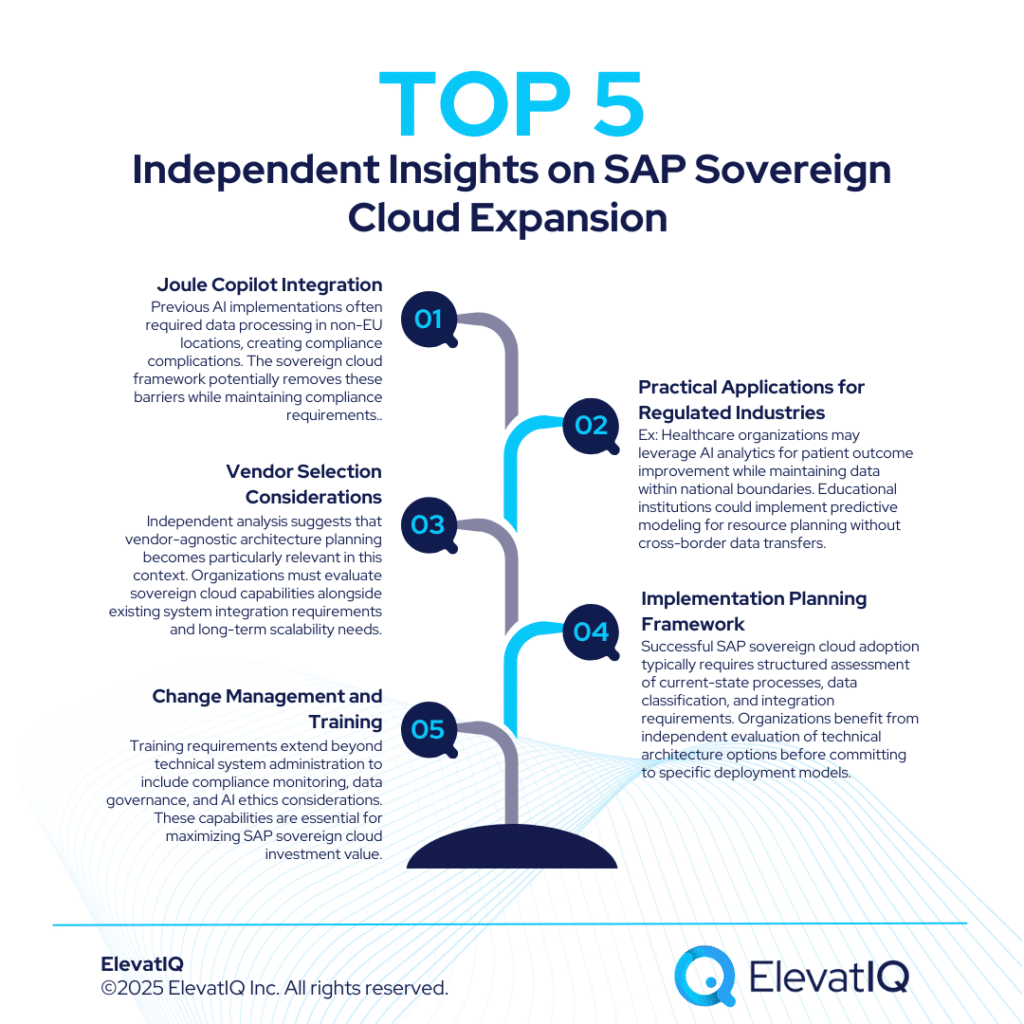
Joule Copilot Integration

The integration of SAP’s Joule Copilot AI assistant within the SAP sovereign cloud environment represents a notable development for European organizations. Previous AI implementations often required data processing in non-EU locations, creating compliance complications. Industry analysis suggests that AI-powered process optimization has remained largely theoretical for many European public sector organizations due to regulatory constraints. The sovereign cloud framework potentially removes these barriers while maintaining compliance requirements.

Reported capabilities include automated workflow optimization, predictive analytics for resource allocation, and intelligent document processing. These functionalities could address common challenges in public administration, healthcare management, and citizen service delivery.

Practical Applications for Regulated Industries

Healthcare organizations may leverage AI analytics for patient outcome improvement while maintaining data within national boundaries. Educational institutions could implement predictive modeling for resource planning without cross-border data transfers. Public administration agencies might utilize AI for citizen service automation, fraud detection in social programs, and infrastructure maintenance planning. These applications previously required careful legal review due to data sovereignty considerations.

Financial services organizations operating under additional regulatory frameworks could explore AI-driven risk assessment and compliance monitoring while adhering to sector-specific data protection requirements.

Top ERP Systems

Strategic Implications for Enterprise Architecture

These AI capabilities translate from theoretical possibilities into concrete implementations across various sectors, each with distinct regulatory requirements and operational challenges

Vendor Selection Considerations

The SAP sovereign cloud offering introduces new variables in enterprise technology selection processes. Organizations previously faced tradeoffs between advanced capabilities and compliance requirements. Independent analysis suggests that vendor-agnostic architecture planning becomes particularly relevant in this context. Organizations must evaluate sovereign cloud capabilities alongside existing system integration requirements and long-term scalability needs.

Industry experts emphasize the importance of building vendor-agnostic architecture that considers data flows between different entities, departments, processes, and systems. This approach enables organizations to maintain flexibility while addressing immediate compliance requirements.

Implementation Planning Framework

Successful SAP sovereign cloud adoption typically requires structured assessment of current-state processes, data classification, and integration requirements. Organizations benefit from independent evaluation of technical architecture options before committing to specific deployment models. Business process documentation becomes critical when migrating to sovereign cloud environments. Organizations must clearly define data flows, processing requirements, and compliance touchpoints to ensure successful implementation.

The complexity of sovereign cloud deployment often necessitates specialized expertise in both technical architecture and regulatory compliance. Organizations typically require support spanning ERP optimization, business process re-engineering, and change management.

Market Response and Competitive Dynamics

While industry-wide trends provide valuable context, the practical implementation of sovereign cloud solutions reveals significant differences across European markets due to varying national regulatory frameworks and business environments.

Industry Analyst Perspectives

Technology industry analysts have characterized SAP’s sovereign cloud expansion as a strategic response to European market demands rather than a purely technical advancement. The move addresses specific regulatory requirements that have limited cloud adoption in regulated sectors. Competitive analysis indicates that hyperscale cloud providers offer sovereign solutions, but SAP’s integrated approach encompasses the complete enterprise application stack. This end-to-end sovereignty model may appeal to organizations seeking simplified vendor management and unified compliance frameworks.

Market research suggests that SAP sovereign cloud adoption may accelerate broader digital transformation initiatives that have been delayed due to compliance concerns. Organizations previously operating legacy systems due to data sovereignty requirements now have clear migration pathways.

Regional Variations in Adoption

Different European markets face varying regulatory requirements and data protection interpretations. French organizations benefit directly from the new data center location, while organizations in other EU countries must evaluate cross-border data transfer implications. German healthcare providers and financial institutions may find particular value in the sovereign framework given national data protection requirements. UK organizations post-Brexit face different considerations regarding data adequacy and transfer mechanisms.


The 2026 Digital Transformation Report

Thinking of embarking on a ERP journey and looking for a digital transformation report? Want to learn the best practices of digital transformation? Then, you have come to the right place.

Professional Services and Implementation Considerations

While technical expertise forms the foundation of successful implementation, organizations must also address the human and organizational dimensions of sovereign cloud adoption to ensure long-term success.

Expertise Requirements

SAP sovereign cloud implementation requires specialized knowledge spanning enterprise architecture, regulatory compliance, and SAP technical capabilities. Organizations typically benefit from independent advisory services during evaluation and planning phases. The complexity of sovereign cloud architecture often necessitates support for enterprise technology selection, requirement management, and contract negotiation. These services help organizations navigate technical specifications while addressing specific compliance requirements. Business process optimization becomes particularly important when implementing SAP sovereign cloud solutions. Organizations must align existing workflows with sovereign data processing requirements while maximizing AI capability utilization.

Change Management and Training

Sovereign cloud adoption often requires updated governance frameworks, security protocols, and operational procedures. Organizations benefit from comprehensive change management support to ensure a successful transition. Training requirements extend beyond technical system administration to include compliance monitoring, data governance, and AI ethics considerations. These capabilities are essential for maximizing SAP sovereign cloud investment value.

Future Outlook for Sovereign Cloud Adoption

Technology advancement occurs within a dynamic regulatory environment, where policy changes and legislative developments continue to shape the requirements and opportunities for sovereign cloud solutions.

Technology Evolution Trends

Industry forecasts suggest that sovereign cloud capabilities will expand beyond current SAP offerings as market demand increases. Additional vendors are likely to develop region-specific solutions addressing similar compliance requirements. AI capability evolution within sovereign frameworks may accelerate as regulatory clarity improves and organizations gain confidence in compliant implementation approaches. The SAP sovereign cloud expansion could catalyze broader market adoption of AI technologies in regulated sectors.

Regulatory Development

European regulatory frameworks continue evolving, with proposed legislation addressing AI governance and data protection requirements. Sovereign cloud solutions must adapt to changing compliance landscapes while maintaining operational continuity. The success of SAP sovereign cloud implementation in France may influence similar initiatives in other European markets, potentially creating region-specific sovereign cloud ecosystems.

Conclusion

SAP’s sovereign cloud expansion represents a significant development in European enterprise technology adoption. By addressing data sovereignty concerns while enabling AI capability access, the initiative potentially removes barriers that have limited digital transformation in regulated sectors. Organizations evaluating sovereign cloud options benefit from independent assessment of technical requirements, compliance implications, and long-term strategic alignment. The complexity of these implementations typically requires specialized expertise spanning technology selection, business process optimization, and regulatory compliance.

The SAP sovereign cloud framework demonstrates how technology vendors are adapting to regional regulatory requirements rather than pursuing global standardization. This trend suggests continued evolution toward localized cloud solutions that balance innovation capabilities with compliance requirements. Success in sovereign cloud adoption depends on careful planning, appropriate expertise engagement, and alignment with broader digital transformation objectives. Organizations that approach these initiatives strategically position themselves to leverage advanced AI capabilities while maintaining regulatory compliance standards.

Industry Expertise Note: Independent technology consultants specializing in vendor-agnostic digital transformation planning provide valuable perspective during sovereign cloud evaluation processes. Organizations benefit from objective assessment of technical architecture options, regulatory compliance requirements, and long-term strategic implications when considering major enterprise technology investments such as SAP sovereign cloud implementations.

Top 15 Digital Transformation Trends - Download

FAQs

SAP Sovereign Cloud Expansion: An Independent Review Read More »

Sage ERP Expense Management: Enhanced Through Fyle Acquisition

Sage ERP Expense Management: Enhanced Through Fyle Acquisition

Sage has acquired Fyle, an AI-powered expense management platform, expanding their ERP expense management capabilities for organizations seeking integrated financial solutions. For ERP buyers currently evaluating business management systems, this acquisition provides insight into how this enhancement will evolve and what it means for implementation decisions.

Understanding the Sage ERP Expense Management Enhancement

The acquisition of Fyle represents Sage’s strategic approach to strengthening their Sage ERP expense management offerings without developing these capabilities internally. This move addresses a common operational challenge that many organizations face when implementing comprehensive ERP solutions.

Key Details About Fyle

Here is the brief overview of Fyle:

Company Background

  • Founded in 2016, focusing on expense management automation
  • Developed AI-powered receipt tracking and reconciliation technology
  • Serves small and mid-sized businesses seeking streamlined expense processes
  • Built integration capabilities with multiple accounting platforms

Core Technology Features

  • AI engine for automated expense categorization and tracking
  • Mobile-first design allowing expense submission via text messages
  • Real-time receipt processing and data extraction
  • Automated approval workflows and policy compliance checking

Current Integration Status: Fyle already integrates with Sage Intacct and Sage 300 Construction and Real Estate, demonstrating established connectivity with Sage’s ecosystem. This existing integration framework provides a foundation for expanding Sage’s expense management across the broader product portfolio, thereby strengthening its offerings without the need to develop these capabilities internally. This move addresses a common operational challenge that many organizations face when implementing comprehensive ERP solutions.

top ERP vendors

Strategic Context for ERP Buyers

Dan Miller, Sage’s EVP of Financials and ERP, explained the acquisition’s purpose: “In 2025, financial leaders are expected to play much more strategic roles than ever before and are looking for every way to get a high-performance edge.” This statement reflects how Sage ERP expense management needs have evolved beyond basic transaction processing. Organizations now require expense management systems that reduce administrative overhead while providing strategic financial insights.

Current Sage ERP Expense Management Capabilities

Understanding what’s available today versus future enhancements is crucial for ERP buyers making implementation decisions.

Existing Integration Features

Fyle’s current integration capabilities provide a solid foundation for organizations evaluating expense management solutions within the Sage ecosystem.

Immediate Capabilities:

  • Fyle’s platform continues operating with current Sage Intacct users
  • Existing workflow automation remains functional during transition
  • Third-party accounting system support maintained
  • Mobile expense submission capabilities available now

Integration Strengths: The current integration demonstrates several technical capabilities that ERP buyers should evaluate:

  • Real-time data synchronization between expense platform and ERP system
  • Automated general ledger posting with proper account coding
  • Multi-currency support for organizations with international operations
  • Configurable approval hierarchies that align with organizational structure

Planned Enhancement Timeline

The roadmap ahead outlines progressive improvements that will strengthen the integration between Fyle and Sage’s comprehensive ERP platform.

Short-term Expectations

  • Enhanced user interface consistency across modules
  • Improved reporting integration with existing Sage financial reporting tools
  • Streamlined user provisioning and security management

Medium-term Development

  • Native integration across the full Sage ERP product portfolio
  • Advanced analytics and spend visibility features
  • Enhanced mobile capabilities for field-based employees

Long-term Vision

  • AI-powered expense policy enforcement and fraud detection
  • Predictive analytics for budget planning and spend forecasting
  • Integration with Sage’s broader AI copilot initiative
Top ERP Systems

ERP Selection Considerations for Expense Management

Organizations evaluating ERP solutions should assess Sage ERP expense management capabilities within their broader system requirements.

Critical Evaluation Questions

For Current Sage Users: ERP buyers already using Sage products should consider how this acquisition affects their current operations:

  • Will existing expense management processes require modification?
  • What training will be needed for enhanced Sage ERP expense management features?
  • How will data migration from current expense systems be handled?
  • What additional costs might be associated with upgraded capabilities?

For Prospective ERP Buyers: Organizations considering Sage should evaluate Sage ERP expense management within their total system requirements:

  • What implementation timeline is realistic for full integration?
  • How do current capabilities compare to immediate business needs?
  • What risks exist in basing selection decisions on promised future features?
  • How does Sage ERP expense management compare to competitive solutions?

Competitive Analysis Framework

ERP buyers should evaluate Sage ERP expense management against these criteria:

Current Functionality Assessment

  • Available features today versus promised enhancements
  • Integration maturity with core financial modules
  • User experience consistency across expense and ERP workflows
  • Mobile capabilities for remote and field-based employees

Vendor Capability Analysis

  • Total cost of ownership including implementation and ongoing fees
  • Sage’s track record with similar acquisitions and integrations
  • Technical support quality during transition periods
  • Development timeline reliability for promised features


The 2026 Digital Transformation Report

Thinking of embarking on a ERP journey and looking for a digital transformation report? Want to learn the best practices of digital transformation? Then, you have come to the right place.

Implementation Planning for Sage ERP Expense Management

Organizations planning to implement enhanced Sage ERP expense management should consider practical deployment factors.

Timeline and Resource Planning

Immediate Implementation Considerations: For organizations implementing Sage ERP expense management today, several factors require attention:

  • Current Fyle users can continue normal operations during integration
  • New implementations should plan for potential feature changes during transition
  • Training requirements may evolve as native integration develops
  • Data backup and migration planning becomes more critical

Resource Allocation: Successful Sage ERP expense management implementation requires dedicated resources for:

  • User training on new workflows and mobile capabilities
  • Process documentation updates reflecting integrated functionality
  • Change management to ensure adoption across finance teams
  • Performance monitoring to validate system integration success

Risk Mitigation Strategies

Technical Risk Management: ERP buyers implementing Sage ERP expense management should plan for potential integration challenges:

  • Maintain backup processes during system transitions
  • Establish performance benchmarks for integrated workflows
  • Plan phased rollouts to minimize business disruption
  • Develop contingency procedures for integration issues

Organizational Change Management: Successful Sage ERP expense management adoption requires attention to user experience factors:

  • Support systems for users transitioning from legacy expense processes
  • Feedback mechanisms to identify and address adoption barriers
  • Comprehensive training programs for new mobile submission workflows
  • Clear communication about process changes and benefits

Market Context and Competitive Positioning

The Fyle acquisition positions Sage ERP expense management within broader market trends affecting ERP selection decisions.

Industry Trends Impacting ERP Selection

  • AI Integration Acceleration: ERP buyers increasingly expect AI-powered automation in financial processes. Sage ERP expense management enhanced with Fyle’s AI capabilities addresses this market demand, though buyers should evaluate actual AI functionality versus marketing claims.
  • Mobile-First Expectations: Modern expense management requires mobile-native functionality for remote and field-based employees. The text message submission capability in Sage ERP expense management reflects this trend, though implementation success depends on user adoption and system reliability.
  • Integration Complexity Reduction: Organizations prefer unified platforms over multiple point solutions. Enhanced Sage ERP expense management offers this integration, though buyers should verify actual workflow efficiency gains during evaluation processes.

Competitive Comparison Factors

ERP buyers should evaluate Sage ERP expense management against alternative solutions using these criteria:

  • Feature Completeness: How do current capabilities compare to comprehensive expense management requirements? 
  • Integration Maturity: What level of native integration exists today versus promised future development? 
  • Implementation Complexity: How much technical and organizational effort is required for successful deployment? 
  • Total Cost Analysis: What are the complete costs including software, implementation, training, and ongoing support?

Strategic Recommendations for ERP Buyers

Organizations evaluating ERP solutions should approach Sage ERP expense management enhancement as one factor in comprehensive system selection.

Decision Framework Elements

Requirements-Based Evaluation: Successful ERP selection prioritizes business requirements over vendor announcements. ERP buyers should:

  • Document specific expense management workflow requirements
  • Evaluate current Sage ERP expense management capabilities against these needs
  • Assess risks of implementing systems with promised but undelivered features
  • Compare total solution value across multiple vendors

Vendor-Neutral Assessment: Independent evaluation helps ensure objective analysis of Sage ERP expense management options:

  • Work with experienced ERP consultants for unbiased capability assessment
  • Request detailed demonstrations of current functionality, not future promises
  • Validate integration claims through reference customer discussions
  • Analyze vendor track record with similar acquisitions and integrations

Implementation Success Factors

Realistic Timeline Planning: Organizations implementing Sage ERP expense management should establish realistic expectations:

  • Plan implementation based on current capabilities, not promised enhancements
  • Allow additional time for integration testing and user training
  • Build flexibility for feature changes during product evolution
  • Establish success metrics based on business outcomes, not technical features

Change Management Priority: Technology acquisition success depends more on organizational adoption than technical capabilities:

  • Invest in comprehensive user training for new Sage ERP expense management workflows
  • Develop communication strategies explaining benefits and process changes
  • Create support systems for users adapting to integrated expense processes
  • Monitor adoption metrics and address barriers proactively

Looking Forward: Practical Expectations

The Sage-Fyle acquisition enhances Sage ERP expense management capabilities, but organizations should maintain realistic expectations about implementation impact and timeline.

Value Realization Timeline

  • Immediate Benefits: Current Sage Intacct users may see improved expense submission workflows and mobile functionality within existing integration framework.
  • Medium-term Enhancements: Native integration across Sage’s ERP portfolio will likely provide workflow efficiency gains, though timeline and scope remain uncertain.
  • Long-term Strategic Value: AI-powered expense analytics and policy enforcement may deliver significant operational improvements, but require successful integration execution.

Success Measurement

Organizations implementing enhanced Sage ERP expense management should establish concrete success metrics:

  • Reduction in expense report processing time and administrative overhead
  • Improved compliance with expense policies through automated enforcement
  • Enhanced spend visibility and financial reporting accuracy
  • User satisfaction with mobile submission and approval workflows

The acquisition represents a positive development for Sage ERP expense management capabilities, but success will depend on execution quality and alignment with specific organizational requirements. ERP buyers should evaluate these enhancements within comprehensive system selection processes that prioritize business needs over individual feature announcements. For organizations currently in ERP selection processes, maintaining focus on proven capabilities while staying informed about emerging functionality provides the best foundation for successful implementation decisions.

Top 15 Digital Transformation Trends - Download

FAQs

Sage ERP Expense Management: Enhanced Through Fyle Acquisition Read More »

SAP Solution Manager: End of Life 2027 Review

SAP Solution Manager End of Life 2027: Strategic Migration Planning and Alternatives

The SAP Solution Manager end-of-life announcement has created urgency across enterprise IT departments worldwide. With support ending in 2027, organizations face critical decisions about their application lifecycle management (ALM) strategy. This transition affects thousands of companies currently relying on SAP Solution Manager for change management, monitoring, and IT service management functions. The discontinuation impacts more than just software support. It also represents a fundamental shift in how organizations manage their SAP ecosystems. Companies must evaluate multiple pathways forward while considering operational continuity, compliance requirements, and long-term strategic alignment.

Understanding the SAP Solution Manager End-of-Life Impact

SAP Solution Manager has served as the central ALM platform for many enterprises, providing integrated capabilities for:

  • Transport management across landscapes
  • Change Request Management (ChaRM)
  • IT Service Management (ITSM)
  • System monitoring and alerting
  • Test management and coordination
top ERP vendors

The 2027 end-of-support date means no security patches, bug fixes, or feature updates beyond that point. Organizations can potentially extend support until 2030 through SAP’s Extended Maintenance program, though this comes with significantly higher costs and limited functionality improvements. This timeline creates planning pressure for IT teams who must balance operational stability with strategic modernization goals. The complexity increases for organizations with heavily customized Solution Manager implementations or those with strict regulatory compliance requirements.

Evaluating SAP Solution Manager Alternatives

Organizations have several pathways to consider when planning their post-Solution Manager strategy.

SAP Cloud ALM

SAP’s official successor offers cloud-native ALM capabilities designed for modern SAP environments. Cloud ALM provides:

  • Process monitoring and optimization
  • Implementation project management
  • Test automation coordination
  • Integration with SAP Business Technology Platform

However, Cloud ALM doesn’t replicate all Solution Manager functionality. Notable gaps include comprehensive change management capabilities and certain on-premises integration features that many organizations currently depend on.

Top ERP Systems

SAP Focused Run

Designed for complex SAP landscapes requiring advanced monitoring and security capabilities, Focused Run targets organizations with:

  • Multiple SAP system instances
  • Stringent performance monitoring needs
  • Advanced security and compliance requirements
  • Hybrid cloud-on-premises architectures

Focused Run requires significant technical expertise and may not suit every organization’s operational model or resource constraints.

Third-Party ALM Solutions

Independent software vendors offer specialized solutions that can replace specific Solution Manager functions:

  • Change Management Tools: Platforms focusing specifically on SAP transport and change coordination
  • ITSM Integration Solutions: Tools that connect SAP systems with enterprise service management platforms
  • Monitoring and Analytics: Specialized applications for SAP system performance and business process monitoring

These solutions often provide faster implementation timelines and more flexible integration capabilities compared to SAP’s native offerings.


The 2026 Digital Transformation Report

Thinking of embarking on a ERP journey and looking for a digital transformation report? Want to learn the best practices of digital transformation? Then, you have come to the right place.

Strategic Considerations for Migration Planning

Beyond evaluating available alternatives, organizations must assess their specific operational context and strategic requirements to determine the most suitable migration approach. This assessment spans multiple dimensions that directly impact both the complexity and success of the transition.

Operational Continuity Assessment

Organizations must evaluate their current Solution Manager usage patterns to understand migration complexity:

  • Heavy ChaRM Users: Companies with extensive change management processes face the most significant transition challenges, as no direct Cloud ALM equivalent exists
  • Monitoring-Focused Implementations: Organizations primarily using Solution Manager for system monitoring may find easier migration paths
  • Integrated ITSM Environment: Companies with deep Solution Manager-ITSM integrations require careful planning to maintain service management capabilities

Compliance and Audit Requirements

Regulatory environments influence migration decisions significantly. Organizations in highly regulated industries must ensure any alternative maintains:

  • Audit trail capabilities
  • Change documentation standards
  • Approval workflow integrity
  • Historical data accessibility

Independent ERP consultants often help organizations navigate these requirements objectively, ensuring compliance considerations receive appropriate attention without vendor bias.

Enterprise Architecture Alignment

Migration decisions should align with broader digital transformation strategies. Key considerations include:

  • Cloud-First vs. Hybrid Strategies: Organizations committed to cloud transformation may prioritize different solutions than those maintaining on-premises systems
  • Integration Architecture: Current and planned system integrations influence which alternatives provide optimal connectivity
  • Scalability Requirements: Future growth plans should inform platform selection criteria

Implementation Timeline and Resource Planning

With the 2027 deadline creating a defined timeframe, organizations need a structured approach to migration planning that balances thorough preparation with timely execution. A phased timeline allows teams to progress systematically while maintaining operational stability throughout the transition.

Near-Term Actions

  • Current State Assessment: Document existing Solution Manager functionality and dependencies
  • Alternative Evaluation: Research and test potential replacement solutions
  • Stakeholder Alignment: Ensure business and IT leadership agree on migration priorities

Mid-Term Planning

  • Pilot Implementation: Test chosen alternatives in non-production environments
  • Change Management: Prepare teams for new processes and tools
  • Integration Development: Build connections between new tools and existing systems

Migration Execution

  • Phased Rollout: Implement alternatives in stages to minimize operational disruption
  • Data Migration: Transfer historical information where feasible and necessary
  • Knowledge Transfer: Ensure teams understand new platforms and processes

The Role of Independent ERP Selection Consultants

Enterprise software selection requires objective evaluation of multiple factors beyond vendor marketing claims. Independent consultants provide value through:

  • Vendor-Agnostic Analysis: Evaluation based on organizational needs rather than vendor relationships
  • Industry Experience: Understanding of how similar organizations have addressed comparable transitions
  • Technical Assessment: Deep evaluation of integration capabilities and implementation complexity

This independence becomes particularly valuable when evaluating SAP Solution Manager alternatives, as organizations benefit from unbiased assessment of both SAP and third-party options.

Financial Considerations and Total Cost of Ownership

Migration costs extend beyond software licensing. It also includes: 

Direct Implementation Costs

The initial investment encompasses all expenses required to establish the new ALM environment:

  • Software licensing for new platforms
  • Professional services for implementation
  • System integration development
  • Data migration activities

Operational Transition Costs

During the migration period, organizations incur additional expenses while maintaining business continuity:

  • Team training and certification
  • Temporary dual-system operation
  • Process redesign and documentation
  • Change management activities

Long-Term Operational Costs

Post-implementation expenses continue throughout the solution’s lifecycle and should factor into ROI calculations:

  • Ongoing licensing and support
  • Administrative overhead
  • Integration maintenance
  • Future upgrade investments

Organizations should model total cost of ownership across multiple years when comparing SAP Solution Manager alternatives, considering both immediate transition expenses and long-term operational costs.

Making the Strategic Decision

The SAP Solution Manager end of life creates an opportunity for organizations to modernize their ALM approach while addressing current limitations. Success requires:

  1. Comprehensive Assessment: Understanding current functionality usage and future requirements
  2. Objective Evaluation: Comparing alternatives based on organizational needs rather than vendor preferences
  3. Strategic Alignment: Ensuring migration decisions support broader digital transformation goals
  4. Stakeholder Engagement: Building consensus among business and technical teams

Organizations approaching this transition thoughtfully can emerge with more capable, efficient ALM platforms that better serve their long-term objectives.

The 2027 deadline approaches quickly, but organizations that begin planning now have sufficient time to evaluate alternatives thoroughly and execute migrations successfully. Whether choosing SAP’s cloud solutions, specialized third-party tools, or hybrid approaches, the key lies in making informed decisions based on specific organizational requirements rather than default assumptions.

Enterprise software selection expertise becomes invaluable during these transitions, helping organizations navigate complex technical and strategic considerations to identify optimal solutions for their unique environments and objectives.

Top 15 Digital Transformation Trends - Download

FAQs

SAP Solution Manager End of Life 2027: Strategic Migration Planning and Alternatives Read More »

SAP SmartRecruiters : HCM Selection & Implementation Insights

SAP SmartRecruiters: HCM Selection & Implementation Insights

SAP’s announcement to acquire talent acquisition software provider SmartRecruiters marks a significant development in the human capital management (HCM) space. For organizations currently evaluating their HR technology stack or considering HCM selection and implementation, this acquisition signals broader consolidation trends that could impact future software strategies.

Understanding the Strategic Rationale Behind the Deal

The acquisition addresses a notable gap in SAP’s SuccessFactors suite, particularly around high-volume recruiting capabilities. SmartRecruiters brings proven expertise in recruitment automation and AI-enabled candidate experience to over 4,000 customers, including major enterprises like Amazon, Visa, and McDonald’s. According to SAP Executive Board member Muhammad Alam, the combination will enable customers to “manage the entire candidate lifecycle—from sourcing and interviewing to onboarding and beyond—all in a single system.” This integrated approach represents what many organizations seek during HCM selection and implementation projects: unified platforms that eliminate data silos and streamline workflows.

top ERP vendors

For HCM buyers, this consolidation trend suggests that major vendors are prioritizing comprehensive HCM suites over best-of-breed approaches. Organizations planning HCM implementations should consider how this shift might influence their vendor selection criteria.

What This Means for Current SAP SuccessFactors Users

Existing SAP SuccessFactors customers stand to benefit from enhanced talent acquisition capabilities without requiring separate platform integrations. The acquisition promises to deliver AI-enabled recruiting and hiring capabilities that will make applicant tracking and candidate screening more efficient.

However, questions remain about the integration timeline and potential impacts on current SuccessFactors Recruiting module users. SAP has not disclosed whether SmartRecruiters will replace existing recruiting functionality or operate as a complementary solution. This uncertainty highlights the importance of working with independent HCM consultants who can provide vendor-agnostic guidance during such transitions.

Organizations currently using SuccessFactors should evaluate their existing recruiting processes and consider how enhanced AI capabilities might impact their workflows. Those planning HCM selection and implementation projects should factor in these upcoming capabilities when assessing platform requirements.

Top ERP Systems

Impact on the Broader HCM Software Market

This acquisition represents SAP’s first major HCM investment since acquiring SuccessFactors in 2011. The move signals renewed focus on human capital management as a strategic priority, potentially spurring competitive responses from other enterprise software vendors.

For buyers evaluating HCM solutions, this consolidation creates both opportunities and considerations:

Market Opportunities:

  • Increased investment in AI-powered recruiting tools across vendors
  • Enhanced integration capabilities between HR modules
  • Greater focus on candidate experience optimization

Buyer Considerations:

  • Potential price adjustments as market consolidation continues
  • Need to assess vendor roadmaps more carefully
  • Importance of flexible integration architectures

Independent HCM selection consultants can help organizations navigate these market dynamics while maintaining focus on specific business requirements rather than vendor marketing messages.

AI and Ethics in Recruiting: A Critical Evaluation

Both SAP and SmartRecruiters emphasize their commitment to responsible AI usage, with established governance frameworks to combat bias in recruiting algorithms. SmartRecruiters’ Winston AI companion includes explainability features that show users how recommendations are generated.


The 2026 Digital Transformation Report

Thinking of embarking on a ERP journey and looking for a digital transformation report? Want to learn the best practices of digital transformation? Then, you have come to the right place.

However, organizations implementing AI-enabled talent acquisition solutions should maintain healthy skepticism about vendor claims. The effectiveness of bias mitigation tools varies significantly across platforms, and internal governance remains crucial regardless of vendor assurances.

During HCM selection and implementation processes, buyers should specifically evaluate:

  • Algorithm transparency and explainability features
  • Bias testing methodologies and results
  • Data governance and compliance capabilities
  • Training requirements for HR teams using AI tools

Timeline and Integration Considerations

The transaction expects closure in Q4 2025, subject to regulatory approvals. SAP has indicated no immediate plans to change SmartRecruiters’ availability as a standalone option, suggesting a measured integration approach. This extended timeline creates planning opportunities for organizations considering HCM implementations. Those currently evaluating talent acquisition solutions might benefit from waiting to see how the integrated platform develops, while others may prefer to proceed with current options rather than face potential integration uncertainties.

Organizations working with independent HCM consultants can develop contingency plans that account for various integration scenarios while maintaining project momentum.

Financial and Competitive Implications

SAP’s decision to withhold financial details makes it difficult to assess the acquisition’s strategic importance relative to other enterprise software investments. However, the move clearly signals SAP’s intention to compete more aggressively in the talent acquisition space against specialized vendors.

For HCM buyers, this acquisition could benefit organizations through:

  • Increased innovation in HCM capabilities
  • More comprehensive platform offerings
  • Potentially better negotiating positions with vendors

What HCM Buyers Should Do Now

Organizations currently planning or considering HCM selection and implementation should take the following practical steps:

Immediate Actions:

  • Document current recruiting technology gaps and requirements
  • Evaluate whether to proceed with current vendor assessments or wait for integrated SAP offerings
  • Review existing contracts for flexibility around platform changes

Strategic Considerations:

  • Assess whether integrated suites or best-of-breed approaches better serve long-term objectives
  • Consider working with vendor-agnostic HCM implementation specialists who can navigate changing market dynamics
  • Evaluate internal change management capabilities for potential future platform transitions

Due Diligence Focus Areas:

  • Vendor roadmap stability and integration timelines
  • Data migration and integration capabilities
  • Training and support resources for AI-enabled features
  • Total cost of ownership projections across different scenarios

The Role of Independent Consulting in HCM Transformations

Market consolidation like the SAP-SmartRecruiters acquisition underscores the value of independent HCM selection and implementation guidance. Vendor-agnostic consultants can help organizations maintain focus on business requirements rather than vendor positioning.

ElevatIQ’s structured approach to HCM selection and implementation includes vendor-agnostic enterprise architecture definition and comprehensive software evaluation across multiple categories. This methodology becomes particularly valuable during periods of market change, when vendor messaging may not align with customer needs. Independent consultants can also provide crucial perspectives on emerging technologies like AI recruiting tools, helping organizations separate genuine capabilities from marketing claims during the evaluation process.

Future Outlook for HCM Technology

The SAP-SmartRecruiters acquisition likely represents the beginning of broader HCM market consolidation. Organizations should expect continued investment in AI-powered HR capabilities, increased platform integration, and potentially higher switching costs as vendors build more comprehensive ecosystems. For HCM buyers, success in this evolving landscape requires maintaining flexibility while making strategic technology investments. Working with experienced HCM implementation partners can help organizations navigate these changes while achieving their human capital management objectives.

The key is balancing the benefits of integrated platforms against the risks of vendor lock-in, ensuring that HCM selection and implementation decisions support long-term organizational agility rather than short-term convenience. As the acquisition moves toward completion, organizations should continue monitoring integration developments while focusing on their specific HCM requirements. The most successful implementations will be those that maintain strategic alignment with business objectives regardless of vendor market positioning.

For organizations considering HCM selection and implementation projects, ElevatIQ provides vendor-agnostic consulting services designed to optimize technology investments across changing market landscapes. Our structured approach helps organizations navigate complex vendor ecosystems while maintaining focus on business outcomes.

Top 15 Digital Transformation Trends - Download

FAQs

SAP SmartRecruiters: HCM Selection & Implementation Insights Read More »

SYSPRO DATASCOPE: ERP Acquisition Strategy Analysis

SYSPRO DATASCOPE: ERP Acquisition Strategy Analysis

The enterprise software landscape witnessed another significant consolidation move in August 2025. SYSPRO announced its acquisition of warehouse management systems provider DATASCOPE. This marks SYSPRO’s second acquisition in 2025, following the July 2025 riteSOFT deal and the late 2024 NexSys acquisition, signaling an aggressive ERP acquisition strategy that manufacturing companies should understand when evaluating their manufacturing ERP selection options. For organizations seeking guidance through this evolving landscape, this article provides crucial insights into how these strategic moves impact WMS ERP integration decisions.

Understanding the SYSPRO DATASCOPE Acquisition Impact

SYSPRO’s ERP acquisition strategy with DATASCOPE represents more than a typical software company buyout. The 20-year partnership between these companies suggests this move was designed to create seamless WMS ERP integration rather than forcing together incompatible systems. For manufacturing companies currently navigating manufacturing ERP selection processes, this acquisition demonstrates the growing importance of integrated supply chain capabilities that independent ERP consultants frequently emphasize in their recommendations.

According to SYSPRO CEO Jaco Maritz, “DATASCOPE has been a long-standing strategic partner, with a solution built to complement and enhance the SYSPRO ERP experience.” This statement indicates that the WMS ERP integration challenges typically associated with acquisitions may be minimized, though manufacturing companies should still conduct thorough due diligence during their manufacturing ERP selection process.

top ERP vendors

The current wave of ERP vendor acquisition trends reflects several market pressures that manufacturing companies should understand when working with independent ERP consultants:

  • Industry Specialization Demand: Cloud ERP vendors like Acumatica and NetSuite have increasingly included basic WMS capabilities within their ERP packages, creating competitive pressure on traditional ERP providers. SYSPRO’s acquisition strategy with DATASCOPE appears to fill this portfolio gap. Thus, bringing their solution closer to parity with other cloud ERP solutions that offer integrated warehouse management functionality alongside manufacturing digital transformation solutions.
  • Integration Complexity Reduction: Rather than forcing customers to manage multiple vendor relationships, companies are acquiring complementary technologies to offer unified supply chain ERP solutions with improved WMS ERP integration.
  • Competitive Differentiation: As ERP markets mature, vendors are seeking unique capabilities to differentiate themselves in manufacturing ERP selection processes, making the role of independent ERP consultants even more critical for objective evaluation.

However, manufacturing companies should approach these ERP vendor acquisition trends cautiously. While consolidation can offer benefits, it also reduces vendor choice and may impact ERP pricing negotiations during manufacturing ERP selection initiatives.

Top ERP Systems

How ERP Acquisitions Affect Manufacturing Companies

Manufacturing companies evaluating ERP systems during periods of vendor consolidation face both opportunities and challenges that experienced independent ERP consultants help navigate:

Potential Benefits

  • Faster Innovation: Combined development resources may accelerate feature development, benefiting future manufacturing ERP selection evaluations
  • Reduced Integration Risk: Pre-integrated solutions may minimize warehouse management system integration complexities that often challenge manufacturing ERP selection projects
  • Single Vendor Accountability: One point of contact for ERP and WMS support, simplifying the WMS ERP integration management process

Potential Concerns

  • Pricing Power: Reduced competition may affect future pricing negotiations in manufacturing ERP selection processes
  • Feature Evolution: ERP acquisition strategy priorities may not align with your specific WMS ERP integration needs
  • Support Continuity: Changes in support structure during integration periods can impact existing implementations

Manufacturing companies should work with independent ERP consultants for manufacturing to evaluate how vendor consolidation affects their specific requirements and risk tolerance during manufacturing ERP selection initiatives.


The 2026 Digital Transformation Report

Thinking of embarking on a ERP journey and looking for a digital transformation report? Want to learn the best practices of digital transformation? Then, you have come to the right place.

Benefits of Integrated ERP and WMS Systems

While SYSPRO’s messaging emphasizes the benefits of integrated ERP and WMS systems, manufacturing companies should examine these claims objectively:

  • Inventory Visibility: Integrated systems can provide real-time inventory tracking across production and warehouse operations, though companies should verify this capability meets their specific visibility requirements.
  • Operational Efficiency: Eliminating data synchronization between separate ERP and WMS systems may reduce errors and improve workflow efficiency, but organizations should assess whether their current integration challenges justify this approach.
  • Supply Chain Control: A unified platform may offer better supply chain oversight, though companies should evaluate whether this integration provides meaningful advantages over their current systems.

The key question for manufacturing companies isn’t whether integration is theoretically beneficial, but whether the specific integration offered by SYSPRO-DATASCOPE addresses their operational challenges better than alternatives.

What to Consider When Choosing ERP with WMS Capabilities

Manufacturing companies evaluating ERP systems with integrated warehouse management should consider several factors:

Functional Requirements AssessmentIntegration ArchitectureVendor Stability and Strategy
Does the WMS functionality match your warehouse complexity?How deep is the actual integration between ERP and WMS modules?How will ongoing acquisitions affect product development priorities?
Can the system handle your specific inventory management requirements?Can you implement ERP without WMS initially if needed?What is the vendor’s long-term commitment to your industry segment?
Are industry-specific features adequately addressed?What customization options exist for unique requirements?How does pricing compare to best-of-breed alternatives?

The Independent Consultant Perspective 

From an independent ERP consultant’s viewpoint, SYSPRO’s ERP acquisition strategy presents both advantages and considerations for manufacturing companies pursuing manufacturing ERP selection.

Advantages: The company’s focus on manufacturing and distribution creates deep industry expertise that benefits WMS ERP integration projects. The acquisition of longtime partners like DATASCOPE suggests lower integration risk compared to acquisitions of unrelated technologies, which independent ERP consultants recognize as a positive factor in manufacturing ERP selection decisions.

Considerations: Manufacturing companies should evaluate whether SYSPRO’s specific ERP acquisition strategy aligns with their operational requirements and growth plans. The company’s acquisition activity, while potentially strengthening WMS ERP integration capabilities, also creates uncertainty about future product direction.

Manufacturing companies can benefit from working with vendor-neutral independent ERP consultants who can objectively assess how these ERP acquisition strategy developments affect their specific situation. Independent evaluation becomes particularly important during periods of vendor consolidation when marketing messages may not fully address WMS ERP integration realities.

Implications for Manufacturing ERP Selection Processes

The SYSPRO-DATASCOPE acquisition highlights several considerations for manufacturing ERP selection that independent ERP consultants emphasize when guiding clients through ERP acquisition strategy evaluations.

Vendor Evaluation Criteria

  • Product Roadmap Stability: How will the ERP acquisition strategy affect future development priorities and WMS ERP integration capabilities?
  • Integration Maturity: Are acquired capabilities truly integrated or simply bundled in the manufacturing ERP selection offering?
  • Industry Focus: Does the vendor’s specialization align with your manufacturing segment’s WMS ERP integration requirements?

Due Diligence Requirements

  • Reference Customer Analysis: Speak with customers using both ERP and WMS components to understand real WMS ERP integration experiences
  • Implementation Complexity: Understand real-world deployment experiences that independent ERP consultants can help evaluate
  • Support Structure: Evaluate how the ERP acquisition strategy affects customer support quality during manufacturing ERP selection implementation

Negotiation Considerations

  • Pricing Transparency: Understand how bundled solutions affect cost structures in manufacturing ERP selection projects
  • Implementation Flexibility: Ensure you can implement WMS ERP integration components independently if needed
  • Contract Protection: Include provisions addressing future vendor changes resulting from ongoing ERP acquisition strategy activities

Making Informed Decisions in a Consolidating Market

Manufacturing companies navigating today’s evolving ERP landscape need objective guidance to make informed manufacturing ERP selection decisions. The SYSPRO-DATASCOPE acquisition illustrates why independent ERP consultants provide valuable perspective during vendor evaluation processes, especially when evaluating complex WMS ERP integration requirements and ERP acquisition strategy implications.

At ElevatIQ, our experience with manufacturing ERP selection projects provides insight into how vendor consolidation affects implementation outcomes. We help manufacturing companies evaluate acquisitions like SYSPRO-DATASCOPE objectively, focusing on how these ERP acquisition strategy changes impact specific WMS ERP integration requirements rather than vendor marketing claims.

Our vendor-neutral approach ensures manufacturing companies understand both the opportunities and risks associated with consolidated platforms during their manufacturing ERP selection process. Whether evaluating SYSPRO’s enhanced WMS ERP integration capabilities or comparing alternatives, independent ERP consultants help clients make decisions based on thorough analysis of functional requirements, implementation complexity, and long-term strategic fit.

Key Takeaways for Manufacturing Companies

The SYSPRO-DATASCOPE acquisition represents a significant development in manufacturing ERP selection, but its impact depends on individual company requirements:

  1. Evaluate Integration Claims: Verify that integrated ERP and WMS capabilities address your specific operational challenges
  2. Consider Alternatives: Compare consolidated solutions against best-of-breed approaches
  3. Assess Vendor Strategy: Understand how acquisition activity aligns with your long-term technology strategy
  4. Seek Independent Advice: Work with experienced consultants who can provide objective evaluation of vendor claims

The evolving ERP landscape requires manufacturing companies to approach vendor selection with both opportunity awareness and appropriate caution. While acquisitions like SYSPRO-DATASCOPE may offer genuine benefits, thorough evaluation remains essential for making decisions that support long-term operational success.

Understanding how ERP acquisitions affect manufacturing companies requires expertise in both technology evaluation and industry requirements. As the consolidation trend continues, independent guidance becomes increasingly valuable for navigating complex vendor landscapes and making informed technology investments.

Top 15 Digital Transformation Trends - Download

FAQs

SYSPRO DATASCOPE: ERP Acquisition Strategy Analysis Read More »

FREE RESOURCE

2026 Digital Transformation Report

This digital transformation report summarizes our annual research on ERP and digital transformation trends and forecasts for the year 2026. 

Send this to a friend