ERP

This category allows you to find ERP-related content on ElevatIQ.com

Cloud ERP Contract Negotiations: What's Different in 2025

Cloud ERP Contract Negotiations: Essential Strategies for Buyers

The shift from on-premises to cloud ERP has fundamentally transformed how organizations approach contract negotiations. While many buyers apply traditional perpetual licensing strategies to cloud deals, they quickly discover that subscription-based ERP contracts introduce entirely new complexity, cost structures, and negotiation dynamics that demand different expertise and tactics.

Cloud ERP agreements present unique challenges around consumption-based pricing, data storage costs, multi-tenant SaaS terms, and subscription escalation clauses that can dramatically inflate total cost of ownership if not negotiated strategically. Organizations migrating from on-premises systems often underestimate how differently cloud contracts function, leading to budget overruns, operational constraints, and missed opportunities to secure favorable long-term terms.

Understanding what makes cloud ERP contract negotiations fundamentally different—and how to approach them strategically—separates buyers who protect their interests from those who discover unfavorable terms only after operational dependencies eliminate negotiating leverage.

The Fundamental Shift: Subscription vs. Perpetual Licensing

The most obvious difference between cloud and on-premises ERP contracts lies in the licensing model itself. This shift creates cascading implications for contract structure, cost predictability, and negotiation strategies.

Perpetual Licensing: The Traditional Model

On-premises ERP historically operated on perpetual licensing, where organizations paid substantial upfront fees for indefinite software usage rights. Following the initial license purchase, companies paid annual maintenance fees (typically 18-22% of license value) for updates, patches, and technical support.

This model created clear ownership. Once you purchased licenses, you controlled the software deployment, customization freedom, and upgrade timing. If vendors raised maintenance fees excessively, you could theoretically stop paying and continue using your licensed version indefinitely, though without support or updates.

Subscription Licensing: The Cloud Reality

Cloud ERP operates entirely differently. Organizations pay recurring subscription fees—typically annually—for continued system access rather than purchasing perpetual rights. Stop paying subscriptions, and access terminates immediately. You own nothing beyond your data.

This fundamental shift transfers power to vendors in several ways:

  • Continuous Payment Obligation: Unlike perpetual licenses you could use indefinitely, cloud subscriptions require ongoing payments. This creates vendor leverage at every renewal cycle when they can adjust pricing, terms, and included services.
  • Limited Exit Options: Terminating cloud ERP subscriptions means losing system access entirely, while on-premises systems continued functioning even without vendor support. This dependency strengthens vendor negotiating positions significantly.
  • Vendor-Controlled Upgrades: Cloud ERP providers push updates on their schedules, eliminating your ability to skip problematic versions or delay upgrades for operational reasons. Contracts must address how mandatory updates affect your operations and what recourse exists for disruptive changes.
top ERP vendors

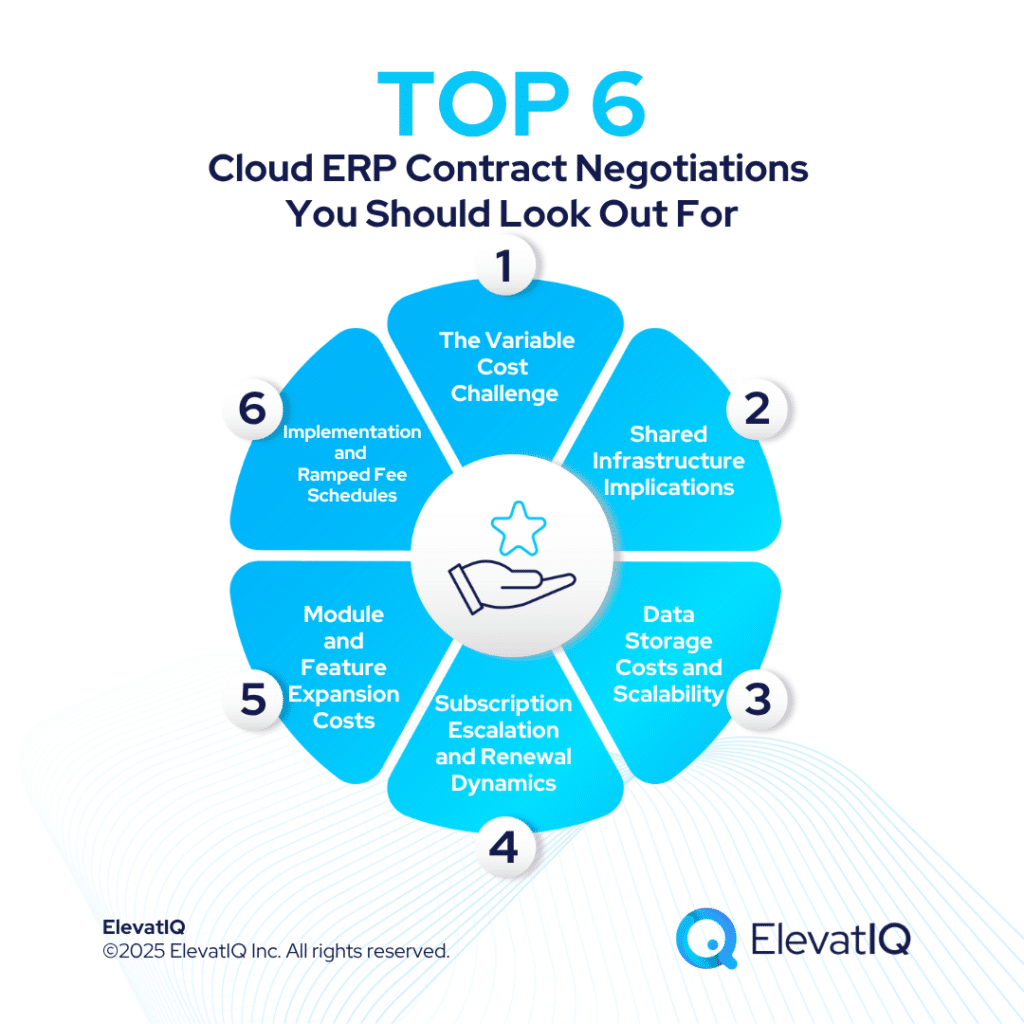
Consumption-Based Pricing: The Variable Cost Challenge

Beyond subscription versus perpetual licensing, cloud ERP introduces consumption-based pricing elements that create cost unpredictability absent from traditional models.

Understanding Consumption Models

Modern cloud ERP increasingly employs consumption-based pricing where costs tie directly to usage volumes—data processed, storage consumed, transactions executed, or API calls made. Unlike fixed subscription fees, consumption pricing fluctuates with your actual system usage.

Common consumption elements in cloud ERP contracts include:

  • Data Storage: Most cloud ERP subscriptions include baseline storage allocations, with additional capacity charged incrementally. Organizations can face unexpected costs when data volume exceeds included storage—for example, a manufacturer discovering their invoice attachment storage exceeded limits by 2TB mid-term, requiring additional capacity purchases.
  • Transaction Volumes: Some vendors charge based on transaction counts—orders processed, invoices generated, or financial transactions recorded. High-volume periods can trigger overage charges unless contracts include sufficient capacity or consumption caps.
  • Integration and API Calls: Connecting cloud ERP to other systems generates API calls that some vendors meter and charge beyond included allocations. Complex integration architectures can drive substantial unexpected costs.
  • User Tier Jumps: Cloud ERP often includes usage tiers where crossing thresholds triggers significant price increases. A company with 95 users paying for a 100-user tier might face dramatic per-user cost increases when adding the 101st user if it forces them into a new pricing bracket.

Negotiating Consumption Protections

Smart cloud ERP contract negotiations establish protections against consumption-based cost escalation:

  • Consumption Caps: Negotiate maximum monthly or annual consumption charges regardless of actual usage. These caps protect against unexpect unexpected cost spikes during high-volume periods or data growth phases.
  • Included Baselines: Ensure contracts clearly define included consumption allocations—storage terabytes, monthly transactions, API calls—with specific thresholds before overage charges apply.
  • Predictable Overage Pricing: When consumption exceeds included amounts, negotiate pre-agreed per-unit overage rates rather than accepting vendor discretion to set prices later when you lack leverage.
  • Growth Provisions: For organizations anticipating expansion, negotiate tiered consumption pricing that provides volume discounts as usage increases rather than linear cost growth.
Top ERP Systems

Multi-Tenant SaaS Architecture: Shared Infrastructure Implications

Cloud ERP typically deploys on multi-tenant architectures where multiple customers share underlying infrastructure, creating contract considerations absent from dedicated on-premises deployments.

Security and Isolation Requirements

Multi-tenant environments raise data security concerns as your information resides alongside other organizations’ data in shared infrastructure. Ensuring the cloud ERP system meets your organization’s security standards is non-negotiable, with costs associated with enhanced security measures and data encryption factored into overall expenses.

Contract negotiations must address:

  • Data Isolation Guarantees: Explicit contractual commitments that your data remains logically separated from other tenants with technical controls preventing cross-tenant access.
  • Security Certifications: Requirements that vendors maintain relevant security certifications (SOC 2, ISO 27001) with audit rights to verify compliance.
  • Breach Notification: Specific timeframes for vendor notification if security incidents occur, including details about what information must be disclosed and remediation obligations.
  • Regulatory Compliance: Industry-specific compliance requirements (HIPAA for healthcare, SOX for public companies) with warranties that the multi-tenant architecture maintains compliance.

Performance and Availability

Shared infrastructure means your ERP performance depends partly on other tenants’ activities. Poorly designed multi-tenant systems can suffer “noisy neighbor” problems where one customer’s heavy usage degrades others’ performance.

Negotiate specific service level agreements covering:

  • Uptime Commitments: Minimum availability percentages (typically 99.5-99.9%) with service credits when vendors fail to meet commitments.
  • Response Time Guarantees: Maximum transaction processing times and system responsiveness with measurement methodologies clearly defined.
  • Capacity Management: Vendor obligations to maintain sufficient infrastructure capacity to meet committed performance levels regardless of other tenants’ usage patterns.

Data Storage Costs and Scalability

While perpetual on-premises licenses didn’t directly charge for data growth, cloud ERP subscriptions typically include data storage pricing that escalates as your information volumes increase.

Storage Pricing Models

Cloud ERP vendors structure storage pricing in various ways, from included allocations with per-GB charges for overages to fully consumption-based models charging for all storage.

Common structures include:

  • Tiered Storage: Base subscriptions include specified storage (e.g., 1TB), with additional capacity sold in blocks. Understanding block pricing prevents surprises when modest data growth forces you into larger, more expensive capacity tiers.
  • Per-GB Pricing: Some vendors charge incrementally for all data storage, with rates varying based on total volumes. While this provides cost granularity, it creates budget unpredictability as data accumulates.
  • Environment Multiplication: Organizations typically need multiple environments—production, testing, development, training—and vendors may charge separately for each environment’s storage and capacity, multiplying costs beyond production requirements alone.

Negotiating Storage Terms

Protect against storage cost escalation through:

  • Generous Included Storage: Negotiate substantially more included storage than your current needs, accounting for several years of data growth without triggering overages.
  • Storage Price Caps: Lock in maximum per-GB storage rates for the contract duration, preventing vendors from arbitrarily increasing prices as your dependency grows.
  • Data Archiving Rights: Ensure contracts allow you to archive historical data to lower-cost storage tiers or export data to your own storage without vendor restrictions.
  • Environment Pricing: Negotiate inclusion of non-production environments at no additional cost or heavily discounted rates, recognizing their necessity for proper system management.


The 2026 Digital Transformation Report

Thinking of embarking on a ERP journey and looking for a digital transformation report? Want to learn the best practices of digital transformation? Then, you have come to the right place.

Subscription Escalation and Renewal Dynamics

Cloud ERP’s subscription model creates ongoing cost escalation risks absent from one-time perpetual purchases, making renewal protections critical.

Annual Increase Clauses

Most cloud ERP contracts include provisions allowing vendors to increase subscription prices at renewal. Without negotiated protections, vendors typically increase prices by 3-5% annually, compounding over contract lifecycles to substantially inflate costs.

A $500,000 annual subscription increasing 4% yearly grows to $740,000 by year ten—a 48% increase that dramatically impacts long-term total cost of ownership. Multiply this across large enterprise ERP investments and escalation clauses can create millions in unnecessary additional spending.

Renewal Leverage Asymmetry

Contract renewals represent particularly vulnerable moments in cloud ERP relationships. Once your organization operates on a vendor’s cloud platform, switching carries enormous cost, disruption, and risk. Vendors recognize customers lack practical alternatives at renewal, compromising negotiation leverage significantly compared to initial contract discussions.

This dynamic means the initial contract negotiation represents your strongest leverage point. Terms secured upfront—particularly multi-year price protections—deliver value throughout the relationship when renegotiating from positions of operational dependency becomes far more difficult.

Renewal Protection Strategies

Protect long-term pricing through:

  • Multi-Year Price Locks: Negotiate subscription pricing that remains fixed for 3-5 years rather than accepting annual adjustment rights. This provides cost predictability and removes vendor leverage during initial contract terms.
  • Capped Escalation: When complete price locks prove unrealistic, negotiate maximum annual increase percentages (ideally 2-3%, tied to CPI) rather than accepting vendor discretion.
  • Renewal Pricing Commitments: Secure written commitments that renewal pricing will not exceed specified discount percentages off then-current list prices, preventing vendors from offering new customers better terms than they extend to existing, loyal clients.
  • Most-Favored-Customer Clauses: Negotiate provisions ensuring you receive pricing no less favorable than vendors offer similarly-situated customers, protecting against discriminatory renewal pricing.

Module and Feature Expansion Costs

Cloud ERP vendors increasingly adopt modular architectures where core functionality comes standard but advanced capabilities require additional module purchases or feature subscriptions.

Understanding Modular Pricing

Organizations typically purchase specific functional modules—financials, procurement, project management—with each carrying separate subscription costs. While modularity allows starting with essential functions, it creates expansion cost risks as business needs evolve.

Common expansion cost scenarios include:

  • AI and Advanced Analytics: Many vendors now sell AI capabilities, advanced analytics, and sustainability features à la carte rather than including them in base subscriptions, creating substantial additional costs for functionality many organizations consider essential.
  • Industry-Specific Modules: Specialized vertical functionality (manufacturing execution, retail point-of-sale integration, healthcare compliance) typically carries premium pricing beyond core ERP subscriptions.
  • Geographic Expansion: Some vendors charge additional fees when deploying across new countries or regions, despite cloud infrastructure making geographic expansion technically simple.
  • Integration Platforms: Connecting cloud ERP to other systems may require separate integration platform subscriptions rather than including unlimited integration in base pricing.

Locking In Expansion Pricing

Avoid future module price gouging by:

  • Pre-Negotiated Module Pricing: Even for modules you don’t need initially, negotiate specific pricing you can activate later at pre-agreed rates rather than accepting vendor discretion when you’ve lost leverage.
  • Bundled Discounts: Consider purchasing broader module sets upfront at bundled discount rates even if you won’t activate everything immediately, provided total cost remains reasonable.
  • Most-Favored-Pricing for Additions: Negotiate clauses ensuring future module additions receive the same discount percentages as your initial purchase, preventing vendors from charging premium rates for expansion.
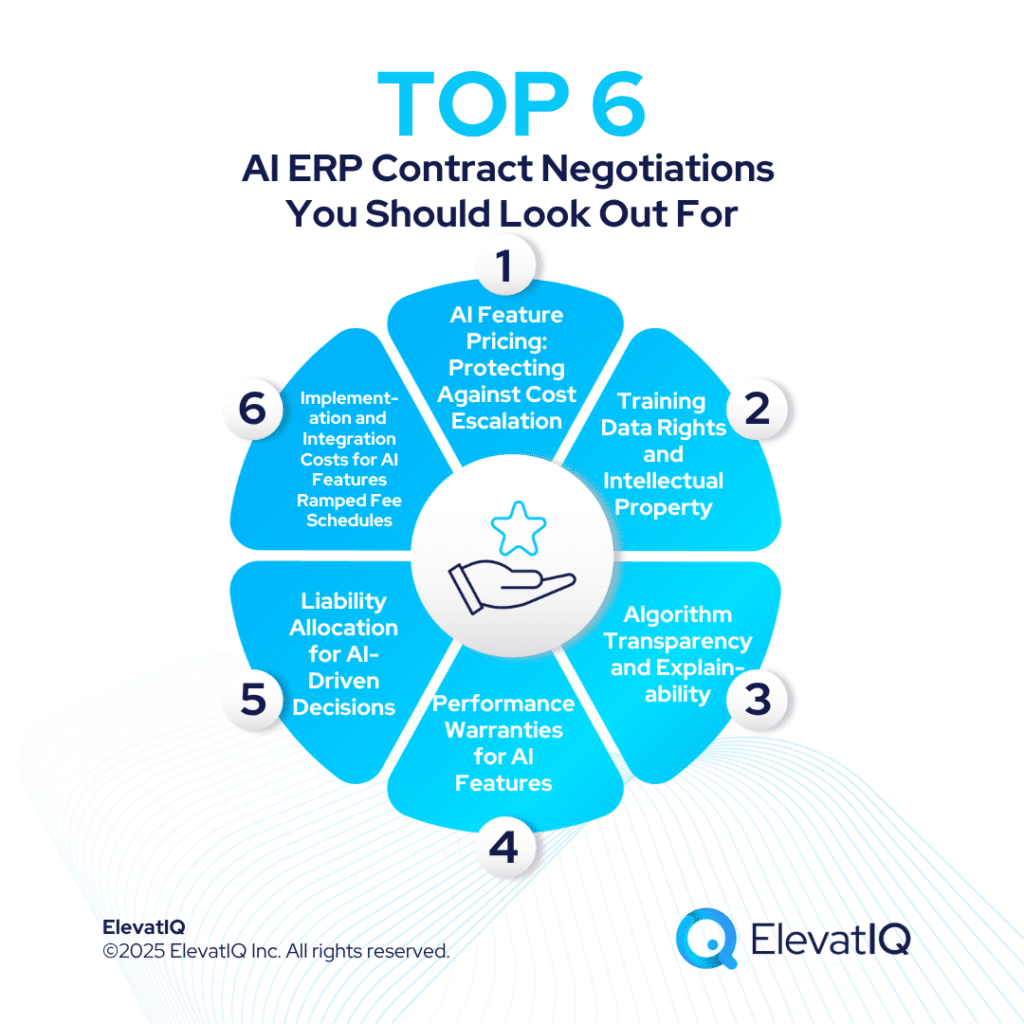
  • AI Feature Protections: Given rapid AI feature proliferation, negotiate specific terms addressing AI capability pricing rather than allowing vendors unlimited discretion to charge separately for AI-powered functionality.

Implementation and Ramped Fee Schedules

Cloud ERP implementations typically span multiple phases as organizations migrate from legacy systems, creating opportunities to structure payments matching your deployment timeline rather than paying for full capacity immediately.

Ramped Fee Structures

Progressive deployment schedules allow ramped subscription fees where first-year costs remain minimal during initial implementation, increasing annually as you deploy modules and user populations. This approach can save over $1 million compared to standard schedules requiring full subscription payments from day one.

For example, an organization planning 500 eventual users might structure subscriptions as:

  • Year 1: 100 users during pilot phase
  • Year 2: 250 users as initial rollout completes
  • Year 3: 500 users at full deployment

Rather than paying for 500 users from day one when only 100 will use the system initially, ramped schedules align costs with value received.

Negotiating Implementation Pricing

Beyond ramped subscription fees, cloud ERP implementation services warrant careful negotiation:

  • Fixed-Price vs. Consumption: Some vendors now offer cloud implementation services on consumption models rather than fixed prices. While this provides flexibility, ensure contracts include not-to-exceed caps preventing runaway costs.
  • Included Implementation Hours: Negotiate inclusion of specified implementation hours within subscription pricing rather than paying separately for all professional services.
  • Training and Change Management: Clarify what training and change management support subscriptions include versus services requiring additional payment.

Strategic Cloud ERP Contract Negotiation

Successfully negotiating cloud ERP contracts in 2025 requires recognizing how fundamentally subscription models differ from traditional perpetual licensing while addressing the unique considerations around consumption pricing, data storage, multi-tenant architectures, and renewal dynamics.Organizations that approach cloud ERP negotiations strategically—understanding these differences, establishing appropriate protections, and leveraging initial contract discussions when they hold maximum leverage—position themselves for cost-effective, operationally sound cloud ERP relationships.

Conversely, buyers who apply on-premises contract strategies to cloud deals or rush through negotiations without addressing consumption protections, renewal terms, and expansion pricing discover too late that cloud ERP contracts require different expertise and more comprehensive negotiation than traditional models. For organizations navigating cloud ERP procurement, independent advisory expertise provides essential guidance through the complex dynamics of subscription contracts, consumption pricing, and vendor-specific terms that can dramatically impact long-term success. The specialized knowledge advisors bring to cloud ERP negotiations typically delivers value far exceeding advisory costs through improved terms, avoided pitfalls, and strategic protections that serve organizations throughout their cloud ERP lifecycle.

Top 15 Digital Transformation Trends - Download

FAQs

Cloud ERP Contract Negotiations: Essential Strategies for Buyers Read More »

ERP Contract Negotiation: Essential Strategies for Buyers in 2025

ERP Contract Negotiation: Essential Strategies for Buyers

Enterprise resource planning implementations represent some of the largest technology investments organizations make, often reaching millions of dollars over the contract lifecycle. Yet many buyers approach ERP contract negotiations without recognizing the significant leverage they hold or understanding the terms that will impact their organizations for years to come.

Standard vendor contracts heavily favor the seller, embedding escalation clauses, restrictive licensing terms, and vague service commitments that can dramatically inflate costs over time. The difference between accepting initial terms and conducting strategic ERP contract negotiation can save organizations 20-40% on total contract value while securing more favorable operational terms. This article provides ERP buyers with proven negotiation strategies, critical contract terms that demand attention, and timing tactics that maximize leverage throughout the procurement process.

Understanding ERP Vendor Negotiation Dynamics

Successful ERP contract negotiations begin with understanding your vendor’s position and motivations. Enterprise software vendors operate under intense revenue recognition pressures, with sales teams measured quarterly on bookings and annual recurring revenue growth.

How Vendor Sales Cycles Create Negotiation Opportunities

Sales representatives face escalating pressure as fiscal quarters and years approach their end. This cyclical dynamic creates natural negotiation windows where vendors become significantly more flexible on pricing, terms, and concessions. Organizations that time their procurement processes to align with these pressure points consistently achieve better outcomes.

The Reality Behind ERP Software Pricing

The gap between list prices and actual market rates in enterprise software often exceeds 40-60%. Initial proposals rarely represent the vendor’s true walk-away price. Vendors build substantial margin into opening offers, expecting sophisticated buyers to negotiate aggressively. Organizations that accept initial pricing without thorough negotiation effectively subsidize discounts other customers receive.

Understanding market pricing requires either extensive procurement experience or engagement with independent advisors who maintain visibility across multiple negotiations and can benchmark proposed terms against actual market rates.

top ERP vendors

Critical ERP Contract Terms Every Buyer Must Negotiate

While pricing captures most buyer attention during ERP contract negotiations, numerous other terms significantly impact total cost of ownership and operational flexibility over the contract lifecycle.

ERP Software Licensing Structure and User Rights

Licensing models fundamentally determine ongoing costs and operational flexibility. The choice between named user and concurrent user licensing can create hundreds of thousands of dollars in cost variance for mid-sized organizations.

Named user licenses assign access to specific individuals, regardless of actual system usage. Concurrent user licenses allow a defined number of simultaneous users from a larger population. Organizations with many occasional users typically achieve better economics with concurrent licensing, though vendors often push named user models that generate higher revenue.

Critical licensing terms to negotiate include:

  • User definition clarity: Precisely define what constitutes a user to prevent future disputes and expansion charges
  • Transfer rights: Ensure you can reassign licenses between employees without additional fees
  • Growth volume discounts: Lock in tier pricing for future user additions
  • Development and testing environments: Clarify whether non-production environments require separate licensing

Maintenance and Support Agreement Negotiation

Annual maintenance fees typically start at 18-22% of license value and represent the vendor’s primary profit center. Without negotiated protection, these fees can increase 3-8% annually, compounding over time to dramatically inflate total cost of ownership.

Negotiate specific caps on annual maintenance increases, ideally tied to established indices like CPI. Secure multi-year pricing commitments that prevent arbitrary escalation. Additionally, ensure maintenance agreements include clear service level agreements with meaningful remedies for vendor failures to meet response time commitments.

Implementation Contract Terms and Scope Management

ERP implementation represents where initial budgets most frequently expand through scope creep and change orders. Thorough negotiation of implementation terms protects against uncontrolled cost escalation.

Demand detailed scope documentation that clearly defines:

  • Specific deliverables with acceptance criteria
  • Project milestones with completion dates
  • Change order procedures with pricing methodologies
  • Resource qualifications and assignment commitments
  • Knowledge transfer and training deliverables

Fixed-price implementation contracts transfer risk to vendors but require extremely precise scope definition. Time and materials arrangements provide flexibility but need robust change control procedures and spending caps to prevent budget overruns.

Exit Clauses and Data Portability Rights

Organizations must protect their ability to change vendors or bring operations in-house without prohibitive barriers. Comprehensive exit provisions ensure you retain control over your data and business processes.

Essential exit terms include:

  • Data ownership confirmation: Explicitly state that all operational data remains your property
  • Export capabilities: Require standard format data exports within defined timeframes
  • Transition assistance: Define vendor obligations to support migration to alternative systems
  • Source code escrow: For business-critical systems, ensure access to source code if vendor operations cease

Price Protection and Future Cost Controls

Negotiations should address not just current costs but future pricing for additional modules, users, and services. Lock in pricing for anticipated expansion to prevent vendors from leveraging your dependency during future growth.

Secure commitments for:

  • Protection against retroactive license true-ups
  • Most-favored-customer pricing on future purchases
  • Defined pricing for specific modules you may add later
  • Volume discount tiers that apply automatically as you grow
Top ERP Systems

Strategic Timing: When to Negotiate ERP Contracts for Maximum Leverage

Timing significantly influences negotiation outcomes in enterprise software procurement. Understanding vendor motivations and fiscal pressures allows buyers to maximize leverage.

Quarter-End and Year-End Negotiation Tactics

Enterprise software vendors typically operate on calendar fiscal years with quarterly bookings targets. Sales representatives and their management chains face intense pressure during the final weeks of each quarter, with pressure multiplying at year-end.

Organizations can leverage this dynamic by structuring procurement timelines to reach final negotiations during these high-pressure periods. However, this strategy requires beginning evaluation and vendor selection processes months earlier to reach genuine purchase readiness when timing creates maximum advantage. Avoid artificial deadline manipulation that vendors recognize as tactical positioning. Instead, align legitimate procurement timelines with vendor fiscal calendars when possible.

Using Competitive Alternatives as Leverage

Credible competitive alternatives represent the most powerful negotiation leverage available to buyers. Vendors make significantly more aggressive offers when facing genuine risk of losing opportunities to competitors.

Conducting parallel evaluations of multiple vendors creates natural competitive pressure. However, this approach requires substantial organizational effort and should focus on genuinely viable alternatives rather than including vendors you have no intention of selecting. Independent ERP selection consultants help organizations efficiently manage competitive processes while maintaining vendor engagement and leverage throughout negotiations.

Common ERP Contract Pitfalls Buyers Must Avoid

Even experienced procurement teams encounter contractual traps that create future problems and unexpected costs. Understanding common pitfalls allows buyers to proactively address them during negotiations.

Vague Implementation Scope Definitions

Ambiguous scope language enables vendors to classify legitimate requirements as out-of-scope change orders. Every “reasonable efforts” or “best practices” reference in scope documentation represents a potential dispute and cost escalation.

Demand specific, measurable deliverables with clear acceptance criteria. If certain scope elements remain undefined during contracting, establish pricing methodologies and approval processes for addressing them rather than leaving terms entirely open.

Automatic Renewal and Price Escalation Clauses

Many enterprise software contracts include automatic renewal provisions with notification windows requiring 60-90 days advance notice to prevent renewal. Missing these deadlines locks organizations into additional contract terms, often with embedded price increases.

Negotiate explicit renewal processes requiring affirmative action from both parties. Ensure renewal terms cannot include price increases exceeding negotiated caps. Some organizations successfully negotiate declining pricing for renewal periods, reflecting reduced vendor acquisition costs.

Vendor Audit Rights That Favor the Seller

Compliance audit provisions often grant vendors broad rights to examine your systems and operations to verify licensing compliance. These audits frequently identify technical violations of complex licensing rules, generating significant unexpected costs.

Negotiate limitations on audit frequency, advance notice requirements, and dispute resolution procedures. Ensure audit rights are reciprocal, allowing you to verify vendor compliance with service level commitments and other contractual obligations.


The 2026 Digital Transformation Report

Thinking of embarking on a ERP journey and looking for a digital transformation report? Want to learn the best practices of digital transformation? Then, you have come to the right place.

The Role of Independent ERP Contract Advisors

Enterprise software contract negotiation requires specialized expertise that extends beyond general procurement capabilities. The complexity of licensing models, technical dependencies, and long-term operational implications demands focused domain knowledge.

How Independent Consultants Add Negotiation Leverage

Independent ERP advisors bring several advantages to contract negotiations. They maintain current visibility into market pricing across multiple vendors and industries, providing benchmark data that establishes realistic negotiation targets.

Their vendor neutrality allows more aggressive negotiation postures without damaging relationships organizations need to maintain post-implementation. Vendors recognize that experienced advisors understand their pricing flexibility and cannot be easily misled by artificial constraints.

Avoiding Conflicts of Interest in Contract Review

Implementation partners who also provide selection and contract advisory services face inherent conflicts of interest. Their ongoing relationships with software vendors may influence their negotiation advocacy, potentially disadvantaging buyers.

Organizations achieve optimal outcomes by engaging truly independent advisors without implementation practices that create mixed incentives. This separation ensures contract negotiations prioritize buyer interests exclusively.

Building Your ERP Contract Negotiation Strategy

Successful negotiations require structured preparation and coordinated execution across multiple organizational stakeholders.

Assembling Your Negotiation Team

Effective ERP contract negotiations engage expertise from procurement, IT, legal, finance, and business operations. Each function contributes essential perspectives:

  • Procurement: Negotiation tactics and vendor management
  • IT: Technical requirements and operational implications
  • Legal: Contract structure and risk allocation
  • Finance: Total cost of ownership modeling and budget authority
  • Business operations: Functional requirements and process impacts

Designate a single negotiation lead with authority to make binding commitments, preventing vendors from playing stakeholders against each other.

Creating Competitive Tension Ethically

While competitive pressure improves outcomes, organizations must balance negotiation tactics with relationship integrity. Dishonest representations about competing offers or fabricated deadlines damage credibility and future vendor relationships.

Maintain genuine competitive processes with vendors you seriously consider. Share high-level information about competitive offers without breaching confidentiality or misrepresenting actual positions. Vendors respect honest competition more than transparent manipulation.

Setting Walk-Away Thresholds

Establish clear criteria that define unacceptable terms before beginning final negotiations. These thresholds might include maximum total cost, minimum required service levels, or essential contractual protections.

Communicating genuine walk-away positions to vendors demonstrates seriousness and often prompts previously unavailable concessions. However, organizations must be prepared to follow through, making this tactic effective only when alternative options genuinely exist.

Securing Fair ERP Contract Terms for Long-Term Success

ERP contract negotiations significantly impact not just immediate costs but operational flexibility and total ownership economics throughout the system lifecycle. Organizations that approach negotiations strategically, understand vendor dynamics, and focus on comprehensive terms rather than just price achieve substantially better outcomes.

The complexity of enterprise software contracts and the specialized knowledge required for effective negotiation make independent advisory support valuable for most organizations. Engaging experienced advisors who understand both contract structures and market dynamics helps ensure negotiations protect your interests while establishing productive vendor relationships.

Thorough contract negotiation represents one of the highest-return activities in enterprise software procurement, often delivering millions in savings and operational benefits that compound throughout the implementation and beyond.

For organizations navigating ERP selection and contract negotiations, enterprise software selection expertise provides the independent perspective and market knowledge that transforms procurement outcomes. The investment in proper negotiation support typically returns multiples through improved pricing, terms, and reduced long-term risk.

Top 15 Digital Transformation Trends - Download

FAQs

ERP Contract Negotiation: Essential Strategies for Buyers Read More »

ERP Contract Negotiation: Tactics, Pitfalls, and Post-Contract Best Practices

ERP Contract Negotiation: Tactics, Pitfalls, and Post-Contract Best Practices

Understanding why ERP contract negotiations matter and which terms require attention provides essential foundational knowledge for successful ERP implementation. However, translating this understanding into favorable contract outcomes requires mastering the tactical execution of negotiations, avoiding common pitfalls that undermine even well-prepared buyers, and implementing post-contract practices that preserve negotiated value throughout the implementation and beyond.

This comprehensive article explores proven negotiation tactics that maximize leverage, examines the critical mistakes that compromise outcomes, and outlines the contract management practices that ensure your carefully negotiated terms translate into actual operational and financial benefits.

Strategic Negotiation Tactics for ERP Contracts

Effective negotiation combines preparation, timing, psychology, and tactical execution. While every negotiation unfolds differently based on specific circumstances, certain tactics consistently improve outcomes when deployed strategically.

Creating and Maintaining Competitive Tension

Competitive pressure represents the most powerful lever available to buyers in negotiations. Vendors make significantly more aggressive offers when facing genuine risk of losing opportunities to competitors than when negotiating with buyers who have clearly committed to their platform.

Conducting Legitimate Competitive Evaluations: The foundation of competitive leverage requires genuinely evaluating multiple vendors rather than using competitors as artificial negotiating props. Vendors quickly recognize when buyers conduct superficial competitive processes while having already decided on their preferred choice. Maintain meaningful competitive evaluation through final negotiations. Even after selecting a preferred vendor, continue engaging alternatives until contracts are fully executed. This approach keeps pressure on your chosen vendor while maintaining your ability to switch if negotiations reach impasses.

Communicating Competitive Position Ethically: Share high-level information about competitive offers without breaching confidentiality or misrepresenting positions. Statements like “we have a more attractive offer from Vendor B in terms of maintenance escalation caps” create pressure without dishonest tactics that damage credibility. Avoid fabricating competitive positions or exaggerating alternatives. Vendors respect honest competition but lose trust when they discover dishonest ERP negotiating tactics, potentially hardening their positions or withdrawing offers entirely.

top ERP vendors

Leveraging Vendor Fiscal Timing

Enterprise software vendors operate under intense quarterly and annual revenue recognition pressures. Sales representatives and their management chains face escalating pressure as fiscal periods end, with peak flexibility typically emerging in the final weeks of quarters and years.

  • Aligning Procurement Timelines: Structure your procurement schedule to reach final negotiations during vendor fiscal pressure periods. This requires beginning ERP evaluation and selection processes months earlier to ensure genuine purchase readiness coincides with optimal timing windows. Organizations that artificially delay decisions hoping to leverage quarter-end timing often discover vendors recognize the tactic and refuse to offer better terms without legitimate time pressure driving their own urgency.
  • Understanding Multiple Pressure Points: Most enterprise ERP vendors operate on calendar fiscal years, creating quarterly pressure in March, June, September, and December, with maximum pressure at year-end. However, some vendors use different fiscal calendars—Oracle’s May fiscal year-end, for example—requiring research into specific vendor timing.
  • Exploiting the Final Week: The last 5-7 days of fiscal periods typically see the most dramatic vendor flexibility as sales leaders scramble to meet bookings targets. However, leveraging this timing requires having all other negotiation elements resolved, with only final pricing and key terms remaining for last-minute concessions.

Anchoring Negotiations with Market Intelligence

Negotiation outcomes significantly improve when buyers establish realistic targets based on actual market rates rather than vendor initial offers. Independent ERP advisory support provides visibility into pricing and terms other similarly-situated buyers achieve, establishing informed negotiation anchors.

Benchmarking Pricing Proposals: Initial vendor proposals typically include 40-60% margin above actual walk-away pricing. Understanding market rates for your specific situation—industry, company size, deployment complexity—enables you to anchor negotiations at realistic targets rather than accepting vendor suggestions that proposals already represent “best pricing.”

Leveraging Contract Term Precedents: Beyond pricing, understanding which contract terms other buyers negotiate successfully establishes realistic targets for your own negotiations. Knowing that maintenance caps of 2-3% are standard, or that competitors provide more favorable liability limitations, strengthens your negotiating position.

Top ERP Systems

Using Silence and Patience Strategically

One of the most underutilized yet effective negotiation tactics involves strategic silence and demonstrated patience. Vendors operate under time pressure that buyers typically don’t face, creating asymmetric urgency that favors patient negotiators.

  • Resisting Pressure for Premature Decisions: Sales representatives will create artificial urgency through expiring discounts, limited-time offers, or pressure to “close by quarter-end to get this pricing.” While legitimate fiscal timing provides advantages, fabricated urgency deserves skepticism. Respond to pressure tactics with patience: “We understand your timeline preferences, but we’re committed to thorough evaluation of all terms before making a decision of this magnitude. We’ll move forward when we’re confident the contract protects our interests adequately.”
  • The Power of Silent Pauses: After vendors present offers or respond to counterproposals, strategic silence creates discomfort that often prompts additional concessions. Rather than immediately responding to proposals, pause, review materials thoughtfully, and allow silence to work in your favor. This tactic proves particularly effective in face-to-face negotiations where silence creates interpersonal tension that drives conversational movement.

Escalating Strategically Through Vendor Organizations

Different levels of vendor organizations possess different authority and flexibility. Understanding escalation paths and strategically engaging senior stakeholders increases your ability to secure favorable terms.

  • Sales Representative Limitations: Individual sales reps operate within defined discount authority, typically 20-30% off list pricing. Beyond these limits, they require management approval for additional concessions. When ERP contract negotiations reach representative authority limits, request escalation to regional or national sales management. Present this as collaborative problem-solving rather than threats: “I appreciate your efforts, but we haven’t reached terms that work for our organization. Can we engage your manager to explore additional flexibility?”
  • Engaging Executive Sponsors: For large, strategic opportunities, vendors often assign executive sponsors. These senior leaders possess broader authority and motivation to close significant deals. Engage them selectively for impasses on critical terms after exhausting lower-level negotiations.
  • Leveraging Vendor Competitive Dynamics: Reference competition when escalating: “We’re leaning toward your solution, but Vendor B has offered more favorable terms in several critical areas. Is there flexibility to help us choose you confidently?”


The 2026 Digital Transformation Report

Thinking of embarking on a ERP journey and looking for a digital transformation report? Want to learn the best practices of digital transformation? Then, you have come to the right place.

Common ERP Negotiation Pitfalls to Avoid

Even well-prepared organizations make mistakes that compromise negotiation outcomes. Understanding common pitfalls helps you avoid these expensive errors.

Negotiating Without Clear Walk-Away Thresholds

Organizations that enter negotiations without predetermined walk-away thresholds frequently accept unfavorable terms under pressure rather than exercising their most powerful option: walking away.

Before entering final negotiations, establish clear criteria defining unacceptable terms. These might include:

  • Maximum total cost of ownership
  • Minimum required service level commitments
  • Essential liability protections
  • Critical operational flexibility provisions

Document these thresholds with your team and executives, ensuring alignment before negotiations begin. This preparation prevents in-the-moment capitulation when vendors refuse to meet reasonable requirements.

The Credibility of Walking Away: Walk-away positions only work when you’re genuinely prepared to follow through. Vendors test whether walk-away statements represent serious positions or negotiating bluffs. If you threaten to walk away but ultimately accept unacceptable terms, you destroy credibility and weaken your position in future negotiations.

Focusing Exclusively on Price While Ignoring Terms

Price captures attention because it’s measurable and immediately comparable. However, unfavorable contract terms often cost more than the savings achieved through aggressive price negotiations. A contract with 25% better pricing but allowing 8% annual maintenance increases, restrictive licensing, and minimal liability protections may ultimately cost more and provide less value than a contract with moderate pricing but favorable long-term terms.

Balance price negotiations with equal attention to:

  • Maintenance escalation caps
  • Future module pricing protections
  • Licensing flexibility and growth provisions
  • Liability and performance guarantees
  • Exit rights and data portability

Calculate total cost of ownership across 5-10 years, modeling how different contract terms impact long-term costs and operational outcomes.

Accepting Vague Language to “Keep Negotiations Moving”

Under pressure to complete negotiations, organizations sometimes accept imprecise contract language, planning to clarify details during ERP implementation. This approach creates disputes when parties disagree about vague provisions’ meanings. Every instance of ambiguous language—”reasonable efforts,” “industry standard,” “best practices,” “appropriate resources”—represents a potential future disagreement. Insist on specific, measurable language even when doing so extends negotiation timelines. If certain elements genuinely cannot be defined precisely during contracting, establish clear processes and pricing methodologies for addressing them rather than leaving them entirely open-ended.

Revealing Your Timeline and Urgency

Vendors probe to understand your deadline pressures and decision urgency. Organizations that reveal pressing timelines or executive pressure for quick decisions lose negotiating leverage as vendors recognize reduced walk-away credibility. Maintain ambiguity about your timeline: “We’re moving forward deliberately to ensure we make the right decision” rather than “We need to decide by end of quarter to meet our July 1st go-live target.” If legitimate timeline pressure exists (planned go-live dates, expiring legacy support contracts), avoid sharing this information directly with vendors. Instead, structure your internal timeline to complete negotiations well before external deadlines.

Negotiating with Implementation Partners Instead of Software Vendors

For certain enterprise software platforms, implementation partners rather than software publishers provide professional services. These arrangements create complexity as partners may claim limited authority to adjust software licensing terms beyond standard publisher pricing.

Ensure you separately negotiate:

  • Software Licensing Terms directly with publishers, securing optimal pricing and contractual protections at the license level.
  • Implementation Services with partners, focusing on delivery terms, resource qualifications, pricing, and accountability provisions.

Don’t allow partners to bundle software and services pricing without transparency into underlying license costs and their service margins. This bundling obscures whether you’re receiving competitive pricing on both components.

Accepting Vendor Contract Templates Without Legal Review

Standard vendor contracts heavily favor seller interests. Accepting these templates without experienced legal counsel review exposes organizations to risks they don’t recognize until problems emerge.

Engage legal counsel with technology contract expertise to review:

  • Liability limitations and exclusions
  • Warranty disclaimers
  • Indemnification provisions
  • Intellectual property rights
  • Dispute resolution procedures
  • Governing law and venue

Legal review often identifies risk exposures that seem acceptable to business stakeholders but create significant liability from legal perspectives.

Rushing Final Execution Under Artificial Deadline Pressure

Vendors frequently create urgency around “expiring” offers or “quarter-end pricing” only available if you execute immediately. While legitimate fiscal timing provides benefits, artificial urgency deserves skepticism. Take time to review final contract documents thoroughly, even when vendors pressure immediate execution. Last-minute contract changes sometimes alter negotiated terms, and careful final review ensures the executed agreement reflects your understanding. If vendors claim offers expire, call their bluff: “We need adequate time for final review. If you need to withdraw the offer, we’ll engage alternative vendors.” Most “expiring” offers quickly become available again when vendors face losing opportunities.

Post-Contract Best Practices for Long-Term Success

Negotiating favorable contract terms represents only half the equation. Converting negotiated terms into actual operational and financial benefits requires diligent post-contract management throughout implementation and the ongoing relationship.

Comprehensive Contract Administration

Many organizations negotiate favorable terms but fail to track, enforce, and leverage these provisions throughout the contract lifecycle. Establishing robust contract administration processes ensures you realize negotiated value.

Centralized Contract Repository: Maintain accessible, organized contract documentation including:

  • Executed agreements with all amendments
  • Statements of work and change orders
  • Service level agreements
  • Pricing schedules and discount structures
  • Renewal dates and notification requirements

Key Date Tracking: Monitor critical contractual dates including:

  • Payment milestones and due dates
  • Implementation phase completions
  • Warranty expiration dates
  • Renewal notification deadlines
  • SLA measurement periods

Missing key dates—particularly renewal notifications—can lock you into unfavorable automatic renewals with embedded price increases.

Designated Contract Owner: Assign specific individuals responsibility for contract administration, ensuring someone actively manages vendor performance against contractual commitments rather than assuming it happens automatically.

Vendor Performance Monitoring and Accountability

Contracts establish performance standards, but organizations must actively monitor whether vendors meet these commitments and enforce remedies when they don’t.

Service Level Agreement Tracking: Document whether vendors meet SLA commitments regarding:

  • Support response times
  • Issue resolution timeframes
  • System availability and uptime
  • Performance metrics

When vendors breach SLAs, enforce contractual remedies such as service credits. Failing to enforce SLA violations signals that commitments lack teeth, reducing vendor motivation for strong performance.

Implementation Milestone Verification: Track ERP implementation progress against contractual milestones, deliverables, and acceptance criteria. Don’t accept vendor claims that deliverables are complete without thorough testing against documented acceptance criteria. Hold payment pending verified deliverable acceptance. Once you’ve paid for incomplete or substandard work, leverage to demand remediation drops dramatically.

Change Order Discipline

Even with comprehensive scope documentation, implementations require adjustments. However, undisciplined change order processes create the budget overruns that plague ERP projects.

Formal Change Request Procedures: Require written change requests for any scope modifications, with clear documentation of:

  • Specific changes requested
  • Business justification and urgency
  • Pricing and timeline impacts
  • Alternative approaches considered

Change Review Authority: Establish formal approval processes for change orders, typically requiring:

  • Project manager review and recommendation
  • Budget owner approval for financial impacts
  • Steering committee approval above defined thresholds

Vendor Change Order Limitations: Challenge vendor change order claims that seem to represent clarifications of vague scope rather than legitimate scope additions. Reference original requirements documentation when vendors claim functionality is out-of-scope.

Leveraging Negotiated Price Protections

Contracts with effective price protection provisions create financial benefits only if you actively leverage them when adding users, modules, or services.

  • Most-Favored-Customer Clause Enforcement: When contracts include most-favored-customer pricing, monitor whether vendors offer better terms to comparable customers. If they do, demand equivalent pricing based on your contractual protections.
  • Pre-Negotiated Expansion Pricing: Reference pre-agreed pricing when adding licensed users or purchasing additional modules. Don’t accept vendor attempts to charge higher rates than contracts specify.
  • Volume Discount Enforcement: Ensure vendors apply contracted volume discounts automatically as your user count crosses tier thresholds. Don’t allow them to delay discount application or require renegotiation of terms you already secured.

Relationship Management Without Compromising Standards

Successful long-term ERP vendor relationships balance collaboration with firm accountability. Some organizations mistake healthy vendor relationships for accepting substandard performance or not enforcing contractual commitments.

Professional but Firm Communication: Address performance issues directly but professionally. “Our contract specifies 2-hour response times for severity 1 issues. We’ve experienced 8-hour delays twice this month. We need immediate corrective action to maintain relationships while enforcing standards.”

Escalation When Necessary: When vendor performance issues persist despite engagement with operational contacts, escalate to management levels with decision authority. Your contract defines performance expectations; enforcing them maintains rather than damages healthy relationships.

Regular Business Reviews: Schedule periodic business reviews examining:

  • Contract performance against commitments
  • Relationship health and satisfaction
  • Upcoming needs and strategic plans
  • Process improvement opportunities

These structured reviews provide forums for addressing concerns before they escalate while maintaining collaborative relationships.

Preparing for Eventual Contract Renewal or Transition

Even successful vendor relationships eventually reach contract expiration, requiring renewal negotiations or transition to alternatives. Preparation for this inflection point should begin years before contracts end.

  • Continuous Market Monitoring: Stay informed about competitive alternatives, market pricing trends, and vendor strategic directions. Organizations that wait until contract expiration to assess alternatives negotiate from weak positions.
  • Relationship Diversification: Avoid excessive dependency on single vendors that constrains your ability to negotiate effectively or transition if necessary. When feasible, maintain multi-vendor strategies that preserve competitive options.
  • Data Portability Readiness: Even with strong contractual data portability provisions, ensure you can actually extract, migrate, and utilize your data if contract transitions become necessary. Test data export capabilities periodically rather than discovering limitations when you need to exit.

Winning ERP Negotiations Through Strategic Execution

Favorable ERP contract outcomes result from strategic preparation, tactical negotiation excellence, avoidance of common pitfalls, and diligent post-contract management. Organizations that master these elements achieve dramatically better results than those treating contracts as procurement formalities. The negotiation tactics explored here—creating competitive tension, leveraging fiscal timing, anchoring with market intelligence, and using patience strategically—provide concrete approaches for improving outcomes. Understanding common pitfalls helps avoid expensive mistakes. Post-contract best practices ensure you realize negotiated value throughout the relationship lifecycle.

ERP contracts govern multi-million dollar relationships spanning years. The investment in strategic negotiation and ongoing contract management returns multiples through cost savings, risk mitigation, and operational flexibility that enable rather than constrain business objectives. For organizations seeking to maximize ERP contract outcomes, independent ERP advisory expertise provides the market intelligence, negotiation experience, and strategic perspective that transforms procurement results. The specialized knowledge advisors bring to contract negotiations typically delivers value far exceeding advisory costs through improved pricing, terms, and avoided pitfalls.

Top 15 Digital Transformation Trends - Download

FAQs

ERP Contract Negotiation: Tactics, Pitfalls, and Post-Contract Best Practices Read More »

ERP Contract Terms: It Can Make or Break Your Deal

ERP Contract Terms: It Can Make or Break Your Deal

The difference between a successful ERP investment and a problematic deployment that drains resources often lies not in the software selection itself, but in the contract terms governing the relationship. While organizations invest months evaluating functionality, features, and vendor capabilities, many rush through contract negotiations without recognizing which specific clauses will determine long-term success or create years of operational and financial challenges.

ERP contracts contain dozens of provisions addressing licensing, pricing, implementation, support, liability, and termination. Understanding which terms critically impact your organization and how to negotiate favorable language in each area separates buyers who protect their interests from those who unknowingly accept one-sided agreements that favor vendors at their expense. This comprehensive analysis examines the ERP contract terms that truly make or break deals, explaining what each provision means, why it matters, and how to negotiate language that serves your long-term interests.

Licensing Terms: The Foundation of Your ERP Investment

Licensing provisions establish the fundamental economic model for your ERP relationship, determining not just initial costs but ongoing expenses and operational flexibility for the duration of your system usage.

User Definition and Licensing Models

How contracts define “users” and structure licensing directly impacts both immediate costs and future flexibility. The distinction between named user and concurrent user licensing creates vastly different economic outcomes.

  • Named User Licensing assigns licenses to specific individuals who may access the system, regardless of actual usage patterns. This model generates higher revenue for vendors from organizations with many occasional users who rarely access the ERP simultaneously.
  • Concurrent User Licensing allows a defined number of simultaneous users from a larger population. Organizations with many users who access the system intermittently typically achieve better economics with concurrent licensing.

Beyond the basic model, user definitions require precise negotiation. Vague definitions like “any individual with system access” enable vendors to claim license violations during audits for users you never intended to count. Negotiate explicit definitions that clearly specify which roles require licensing and which do not.

Critical licensing terms to negotiate include:

  • Precise user definitions that limit who requires licenses
  • Transfer rights allowing license reassignment between employees without fees
  • Internal use provisions clarifying that testing, training, and development environments don’t require separate production licenses
  • Contractor and temporary worker treatment establishing whether short-term staff require full licenses
top ERP vendors

Volume Tiers and Growth Provisions

Most ERP vendors structure pricing in volume tiers, with per-user costs decreasing as license counts increase. However, contracts often include provisions that penalize growth by resetting pricing to higher tiers or requiring minimum purchase quantities that exceed actual needs.

Negotiate pricing that:

  • Locks in volume discounts for your current size
  • Establishes pre-agreed pricing for anticipated growth
  • Eliminates minimum purchase requirements when adding users incrementally
  • Provides step-down pricing as you cross volume thresholds naturally

Entity and Geographic Scope

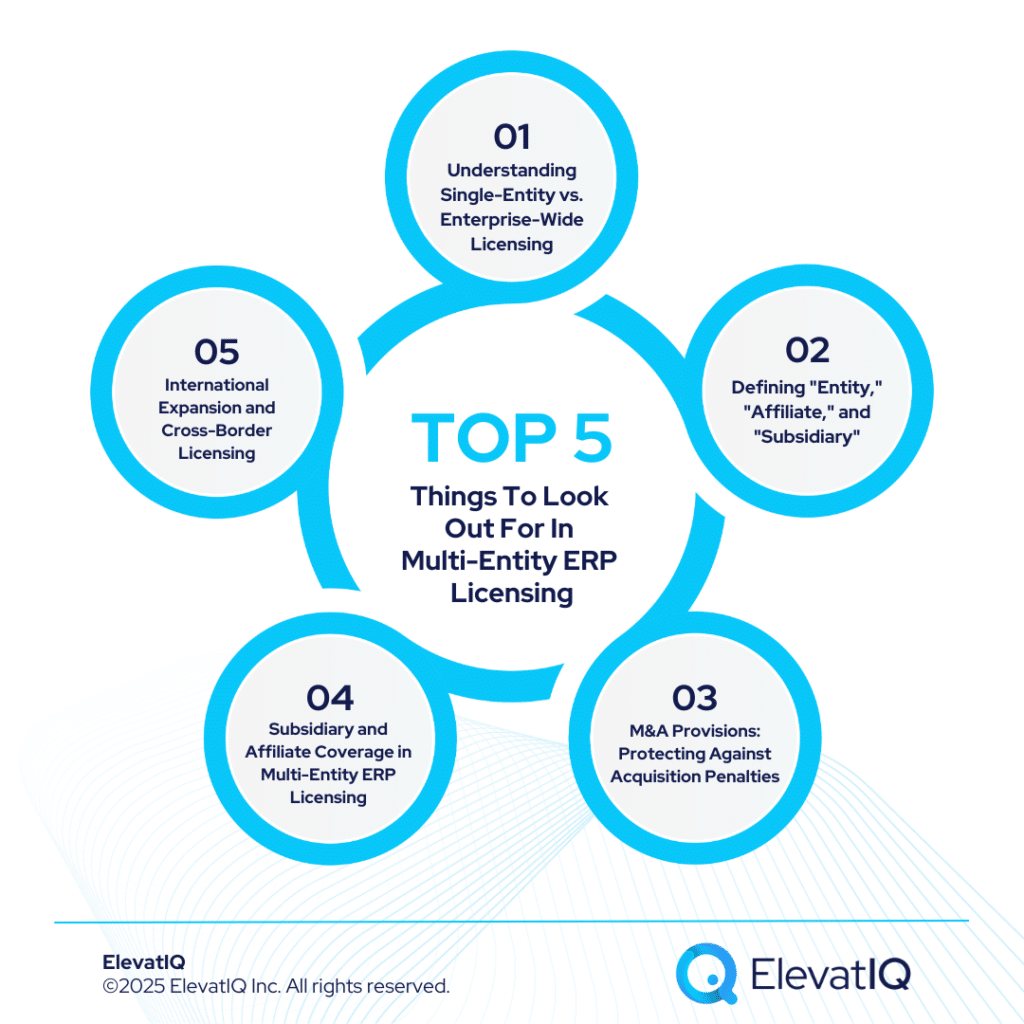
Organizations with multiple legal entities or international operations must ensure licensing covers their entire corporate structure without additional fees. Standard contracts often limit licenses to single entities or geographies, creating unexpected costs when you deploy across subsidiaries or countries.

Negotiate enterprise-wide licensing that:

  • Defines “affiliate” broadly to include acquired companies
  • Covers all current and future subsidiaries
  • Extends to all geographies without additional fees
  • Allows license pooling across entities
Top ERP Systems

Pricing and Payment Terms: Controlling Financial Obligations

Beyond licensing structure, specific pricing and payment provisions determine cash flow impacts, cost predictability, and total ownership economics.

Maintenance and Support Fees

Annual maintenance represents vendors’ most profitable revenue stream, typically starting at 18-22% of license value but increasing annually through escalation clauses that compound over time. A $1 million annual maintenance fee increasing 5% annually grows to $1.63 million within ten years—a 63% increase that many buyers fail to anticipate.

Negotiate maintenance terms that:

  • Establish service credits when vendors fail to meet support commitments
  • Cap annual increases at specific percentages (ideally 2-3%, tied to CPI)
  • Lock in multi-year pricing to prevent arbitrary escalation
  • Specify included services clearly, preventing vendors from charging separately for items maintenance should cover

Price Protection for Future Purchases

Initial contracts rarely include all modules, users, or capabilities you’ll eventually need. Without price protection provisions, vendors can charge premium pricing for additions once they recognize you’re locked into their platform.

Secure commitments for:

  • Most-favored-customer pricing on future module purchases
  • Pre-agreed discount levels for additional users
  • Defined pricing for specific modules you anticipate adding
  • Protection against vendors discontinuing favorable pricing programs after you commit

Payment Terms and Schedules

Payment timing significantly impacts cash flow and provides leverage to ensure vendor performance. Standard vendor terms often demand large upfront payments before delivery, reducing your leverage if problems arise.

Negotiate payment structures that:

  • Tie payments to milestone completion and acceptance
  • Retain meaningful percentages until final acceptance
  • Extend payment terms to improve cash flow
  • Separate license payments from implementation services to maintain leverage


The 2026 Digital Transformation Report

Thinking of embarking on a ERP journey and looking for a digital transformation report? Want to learn the best practices of digital transformation? Then, you have come to the right place.

Implementation Contract Provisions: Defining Scope and Accountability

ERP implementation agreements determine project execution frameworks, risk allocation, and remedies when vendors fail to deliver as promised.

Scope Definition and Deliverables

Vague scope language creates the primary source of implementation disputes and cost overruns. Every ambiguous phrase represents potential future disagreement over whether functionality is in-scope or requires additional payment.

Demand exhaustive scope documentation including:

  • Detailed functional specifications describing exactly what the system will do
  • Explicit deliverables lists with clear descriptions and formats
  • Acceptance criteria defining how you’ll verify deliverable completion
  • Assumptions and exclusions clearly stating what’s not included

Avoid phrases like “best practices configuration,” “reasonable efforts,” or “industry-standard functionality” that allow interpretation disputes. Require specific, measurable descriptions of deliverables.

Fixed Price vs. Time and Materials

Implementation pricing models allocate risk differently between buyers and vendors. Fixed-price contracts place delivery risk on vendors but require extremely precise scope definition. Time and materials arrangements provide flexibility but need robust controls to prevent budget overruns.

For fixed-price implementations, negotiate:

  • Comprehensive scope documentation that defines all deliverables
  • Clear change order procedures with pricing methodologies
  • Vendor accountability for efficiency and timeline adherence
  • Meaningful penalties for vendor-caused delays

For time and materials engagements, establish:

  • Pre-agreed rates for different resource levels
  • Not-to-exceed caps that limit total spending
  • Required approvals for work beyond defined budgets
  • Regular progress reporting and budget consumption tracking

Change Order Procedures

Regardless of implementation pricing models, projects encounter scope changes requiring formal change order processes. Without clear procedures, vendors can inflate change order pricing or claim every deviation from imprecisely defined scope requires additional payment.

Negotiate change management provisions that:

  • Define what constitutes a legitimate change vs. clarification of vague scope
  • Establish pricing methodologies for different change types
  • Require written approvals before change order work begins
  • Limit vendor’s ability to claim changes for items reasonably implied by documented scope

Resource Qualifications and Stability

Vendor proposals showcase senior resources during sales cycles, then assign less experienced staff to actual implementations. Without contractual protections, you may find junior consultants handling critical tasks while paying premium rates.

Secure commitments regarding:

  • Minimum experience levels for key project roles
  • Specific named resources for critical positions
  • Vendor approval requirements before substituting resources
  • Remedies when vendors assign unqualified staff

Performance, Warranties, and Liability: Ensuring Vendor Accountability

Standard vendor contracts typically include minimal performance commitments and limit vendor liability to amounts paid, leaving buyers bearing most implementation risk.

Performance Warranties and Guarantees

Without specific performance warranties, vendors face limited accountability for delivering functional systems that meet documented requirements. Standard contracts often disclaim warranties entirely or provide only that software will “substantially conform” to documentation.

Negotiate warranties that:

  • Guarantee system will perform specific business processes documented in scope
  • Define clear performance standards (transaction volume, response times, uptime)
  • Extend warranty periods to meaningful durations (12+ months post-go-live)
  • Specify remedies when systems fail to meet warranted performance

Service Level Agreements

Support responsiveness directly impacts operational continuity when issues arise. Vague support commitments like “reasonable efforts” or “commercially reasonable response times” provide no meaningful accountability.

Demand specific SLAs addressing:

  • Response time commitments by issue severity
  • Resolution timeframes for different problem categories
  • Support availability (hours, days, contact methods)
  • Escalation procedures when initial support fails to resolve issues
  • Service credits when vendors breach SLA commitments

Limitation of Liability

Perhaps the most one-sided provisions in standard contracts, liability limitations typically cap vendor financial exposure to amounts paid while providing unlimited liability for buyers. These terms mean vendors face minimal consequences for catastrophic failures that cost buyers millions.

While complete elimination of liability caps remains unrealistic, negotiate:

  • Higher liability caps that reflect actual potential damages (2-3x annual contract value)
  • Carve-outs from caps for specific breach types (gross negligence, willful misconduct, IP infringement)
  • Mutual liability limitations that apply equally to both parties
  • Insurance requirements ensuring vendors can actually pay if liability is triggered

This upfront clarity provides the foundation for evaluating vendor proposals and engaging in focused negotiations that address terms most critical to your organization.

Data Rights and Intellectual Property: Protecting Your Assets

ERP systems contain your organization’s most critical operational data. Contract terms governing data ownership and intellectual property rights determine your control over this strategic asset.

Data Ownership and Access

While data ownership seems obvious—it’s your data—standard contracts often include ambiguous language that could enable vendor claims to data rights or restrict your access and usage.

Negotiate explicit provisions stating:

  • You own all data entered into or generated by the system
  • You can access and extract your data at any time in standard formats
  • No vendor rights to use, analyze, or commercialize your data without explicit permission
  • Data remains your property regardless of contract termination

Customization and Intellectual Property

Organizations frequently require customizations to address unique requirements. Without clear IP provisions, disputes arise over ownership of custom code, configurations, and integrations.

Establish that:

  • You own all custom code developed specifically for your organization
  • You receive source code for customizations
  • You can modify customizations without vendor involvement
  • Vendor cannot charge additional fees for accessing or modifying customizations you own

Data Portability and Exit Rights

Eventually, contracts end—whether through normal expiration, vendor business changes, or your decision to switch platforms. Data portability provisions determine whether you can transition smoothly or face barriers that effectively lock you into vendors despite unsatisfactory service.

Negotiate comprehensive exit provisions including:

  • Standard format data exports within defined timeframes
  • Complete data extraction at no additional charge
  • Reasonable transition assistance periods
  • Access to system documentation necessary for migration

Compliance, Audit, and Security: Managing Risk and Governance

Organizations in regulated industries or with specific security requirements need contract terms that address compliance obligations and security standards.

Compliance Warranties

If you operate in regulated environments (healthcare, finance, government), ensure contracts include specific compliance warranties rather than generic “compliance with applicable law” language that provides limited protection.

Require:

  • Warranties that system meets specific regulatory requirements (HIPAA, SOX, GDPR)
  • Vendor responsibility for maintaining compliance as regulations evolve
  • Audit rights to verify compliance capabilities
  • Indemnification for compliance failures stemming from system deficiencies

Security Standards and Breach Notification

Data breaches create significant liability. Contract terms should establish clear security standards vendors must maintain and procedures for breach notification and remediation.

Negotiate provisions addressing:

  • Specific security standards vendors must meet (SOC 2, ISO 27001)
  • Regular security testing and vulnerability assessment requirements
  • Immediate breach notification obligations
  • Vendor liability for breaches caused by inadequate security

Audit Rights

While vendors typically demand license compliance audit rights, these provisions should be balanced to prevent abuse while ensuring appropriate oversight.

Establish:

  • Limitations on audit frequency (annually at most)
  • Advance notice requirements (60-90 days)
  • Restrictions on auditor selection and costs
  • Reciprocal rights to audit vendor’s service delivery compliance

Renewal and Termination: Maintaining Flexibility

Contract duration, renewal terms, and termination provisions determine your long-term flexibility and ability to exit relationships that no longer serve your interests.

Automatic Renewal Provisions

Many contracts include automatic renewal clauses requiring 60-90 days advance notice to prevent renewal. Missing these deadlines locks you into additional contract terms, often with embedded price increases.

Negotiate:

  • Explicit renewals requiring affirmative action from both parties
  • Longer notification periods (120+ days) to prevent inadvertent renewals
  • No price increases upon renewal without separate negotiation
  • Mutual renewal rights, allowing either party to decline

Termination Rights and Procedures

Beyond normal contract expiration, organizations need termination rights for various circumstances including vendor performance failures, business changes, or strategic technology shifts.

Secure termination rights for:

  • Material vendor breaches with cure periods
  • Vendor business changes (acquisition, bankruptcy)
  • Your business changes (mergers, divestitures)
  • Convenience (with reasonable notice and fees)

Ensure termination procedures clearly define:

  • Notice requirements and procedures
  • Data transition obligations
  • Refund calculations for prepaid amounts
  • Ongoing obligations post-termination

Negotiating Contract Terms That Protect Your Interests

ERP contracts contain numerous provisions that seem standard or innocuous but significantly impact long-term outcomes. The terms explored here represent areas where thoughtful negotiation creates substantial value through cost savings, risk mitigation, and operational flexibility.

Organizations that understand which contract terms truly matter and invest effort in negotiating favorable language establish foundations for successful implementations and productive vendor relationships. Conversely, accepting standard vendor terms without thorough negotiation creates financial surprises, operational constraints, and limited recourse when problems arise. The contract terms you negotiate today determine your organization’s ERP experience for years to come. Investing time and expertise to secure favorable terms in each critical area represents one of the highest-return activities in the entire procurement process.

For organizations navigating ERP contract negotiations, independent advisory support provides the specialized knowledge and market intelligence necessary to secure contract terms that protect interests while enabling successful implementations.

Top 15 Digital Transformation Trends - Download

FAQs

ERP Contract Terms: It Can Make or Break Your Deal Read More »

ERP Contract Negotiation: Why It Matters And Where To Start

ERP Contract Negotiation: Why It Matters And Where To Start

Enterprise resource planning implementations represent transformational investments that reshape how organizations operate, compete, and grow. Yet despite their strategic importance, many companies approach ERP contract negotiations as a procurement formality rather than a critical success factor that determines project outcomes for years to come.

The financial stakes alone demand serious attention. Mid-sized organizations typically invest $1-10 million in ERP implementations, while large enterprises often exceed $50 million when accounting for software licensing, implementation services, infrastructure, and ongoing support. Beyond these direct costs, poorly negotiated contracts create hidden financial burdens, operational constraints, and risk exposures that compound throughout the system lifecycle. Understanding why ERP contract negotiation matters and how to approach it strategically separates successful implementations from problematic deployments that fail to deliver expected business value.

The Strategic Importance of ERP Contract Negotiations

ERP contracts function as the constitutional documents governing technology relationships that typically span 5-10 years or longer. These agreements establish not just pricing but the fundamental terms that determine operational flexibility, cost predictability, vendor accountability, and your organization’s ability to adapt as business requirements evolve.

Financial Impact Beyond Initial Pricing

While upfront license and implementation costs capture immediate attention, the total cost of ownership extends far beyond initial expenditures. Annual maintenance fees, upgrade costs, additional user licenses, supplemental modules, and professional services for customizations create ongoing financial obligations that often exceed original licensing investments over time.

For cloud ERP deployments, subscription models create ongoing costs that compound through annual price increases, user expansion charges, and consumption-based billing that escalates with transaction volumes or data storage growth. Organizations without negotiated pricing protections frequently encounter 5-10% annual subscription increases that dramatically inflate total ownership costs over multi-year contracts.

On-premises deployments still prevalent in many enterprises face similar long-term cost pressures through annual maintenance fees (typically 18-22% of license value) that increase 3-8% annually through escalation clauses. A $500,000 annual maintenance obligation can grow to over $900,000 within a decade through compounding increases—a financial reality many organizations fail to anticipate during initial negotiations. Strategic contract negotiation addresses these long-term financial implications upfront, establishing cost controls, price protection mechanisms, and clear boundaries around future expenditures that preserve budget predictability throughout the contract lifecycle.

top ERP vendors

Operational Flexibility and Business Agility

Business conditions change constantly. Organizations merge, divest business units, expand internationally, enter new markets, and fundamentally transform their operating models. ERP contracts either enable or constrain your ability to adapt technology investments to evolving business requirements.

Restrictive licensing terms, inflexible contract structures, and poorly defined scope boundaries create friction when business changes demand technology adjustments. Companies discovering they cannot reassign user licenses across acquired entities, add international subsidiaries without prohibitive costs, or modify implementations to support new business models find themselves locked into arrangements that inhibit rather than enable business agility. Negotiating contracts with operational flexibility in mind ensures your ERP investment adapts to future business needs rather than becoming a constraint on strategic initiatives.

Risk Allocation and Vendor Accountability

ERP implementations carry substantial execution risk. Despite careful planning, projects encounter scope disagreements, timeline delays, budget overruns, and performance issues that threaten business operations. How contracts allocate risk between buyers and vendors fundamentally impacts who bears the financial and operational consequences when problems emerge.

Standard vendor contracts typically limit liability to amounts paid, provide minimal performance guarantees, and place execution risk primarily on buyers. These one-sided terms leave organizations vulnerable to project failures while vendors face limited accountability for poor delivery. Strategic negotiation rebalances risk allocation, establishing clear performance expectations, meaningful remedies for vendor failures, and protections that align vendor incentives with successful project outcomes.

Top ERP Systems

Understanding ERP Implementation Failure Rates

The urgency of effective contract negotiation becomes clear when examining industry implementation success rates. Research indicates ERP failure rates can reach 50-75%, depending on industry and project scope, with failures ranging from partial functionality shortfalls to complete project abandonment.

While many factors contribute to implementation challenges, contract terms directly influence several critical success elements. Vague scope definitions enable disputes over deliverables. Weak performance commitments reduce vendor accountability. Inadequate change management provisions create cost escalation. Limited liability protections leave organizations bearing financial consequences of vendor failures.

Organizations that invest effort in comprehensive contract negotiations before implementation begins establish stronger foundations for project success by clarifying expectations, aligning incentives, and creating accountability mechanisms that drive effective vendor performance.

Common Misconceptions About ERP Contract Negotiations

Several misconceptions prevent organizations from approaching ERP contract negotiations with appropriate strategic focus.

“Vendors Won’t Negotiate Standard Terms”

Enterprise software vendors maintain standard contract templates that heavily favor their interests. However, the notion that these terms are non-negotiable represents vendor negotiation positioning rather than reality. Virtually every contract element remains open to negotiation for buyers who understand leverage points and approach discussions strategically. Vendors negotiate thousands of agreements annually and expect sophisticated buyers to push back on standard terms. Sales representatives operate with significant pricing and terms flexibility, particularly when facing competitive pressure or approaching fiscal deadlines.

“Negotiation Damages Vendor Relationships”

Some organizations avoid aggressive negotiation, fearing it will create adversarial relationships that undermine implementation partnerships. This concern confuses professional negotiation with unprofessional behavior. Vendors respect buyers who negotiate competently and establish clear, fair contractual frameworks. Strong negotiation creates mutual understanding of expectations and obligations, actually strengthening long-term relationships by preventing the disputes that arise from ambiguous, one-sided agreements.

What damages relationships is dishonest negotiating tactics, unrealistic demands, or adversarial approaches that demonstrate lack of good faith. Professional, informed negotiation builds respect and establishes productive working partnerships.

“We Can Renegotiate Later If Problems Arise”

Perhaps the most dangerous misconception suggests organizations can address unfavorable contract terms later if issues emerge. In reality, renegotiating existing agreements from a position of operational dependency provides minimal leverage. Once implementation begins, vendors recognize you cannot easily switch platforms. Your negotiating position deteriorates dramatically as you become locked into their technology, processes, and ecosystems. The time to negotiate optimal terms is before commitment, when competitive alternatives provide meaningful leverage.


The 2026 Digital Transformation Report

Thinking of embarking on a ERP journey and looking for a digital transformation report? Want to learn the best practices of digital transformation? Then, you have come to the right place.

Where to Start: Building Your ERP Contract Negotiation Foundation

Effective ERP contract negotiation requires systematic preparation that begins well before engaging vendors in formal discussions.

Assembling Your Negotiation Team

Successful negotiations engage diverse expertise across multiple organizational functions. No single individual possesses all the knowledge required to evaluate complex ERP contracts comprehensively.

Your core negotiation team should include:

  • Procurement Leadership: Brings vendor management expertise, negotiation tactics knowledge, and contract structuring experience. Procurement understands how to create competitive tension, identify leverage points, and navigate vendor negotiation dynamics.
  • IT Leadership: Provides technical perspective on implementation requirements, integration complexity, infrastructure dependencies, and operational support needs. IT evaluates whether proposed technical terms and service commitments align with organizational capabilities and requirements.
  • Finance Leadership: Models total cost of ownership, evaluates payment terms, analyzes budget impacts, and ensures financial terms align with organizational standards and cash flow considerations.
  • Legal Counsel: Reviews contract structure, liability provisions, intellectual property terms, compliance requirements, and risk allocation. Legal ensures agreements protect organizational interests while meeting regulatory and governance standards.
  • Business Operations Representatives: Contribute functional requirements knowledge, process expertise, and practical perspective on how contractual terms impact day-to-day operations and business objectives.

This cross-functional team structure ensures comprehensive evaluation while preventing any single perspective from dominating decisions that require balanced consideration across multiple dimensions.

Defining Your Requirements and Priorities

Before engaging vendors, establish clear understanding of what you need from both the ERP system and the contract terms governing your relationship.

  • Functional Requirements: Document specific business processes, capabilities, and outcomes the ERP must deliver. These requirements directly inform scope definitions, acceptance criteria, and performance expectations embedded in contracts.
  • Technical Requirements: Define integration needs, infrastructure dependencies, security standards, performance expectations, and technical specifications that contracts must address.
  • Commercial Priorities: Establish your negotiation priorities across pricing, payment terms, licensing models, maintenance commitments, and financial protections. Understanding which terms matter most guides where to invest negotiation effort and where to offer flexibility.
  • Risk Tolerance: Clarify organizational risk appetite regarding implementation approaches (fixed price vs. time and materials), liability limitations, performance guarantees, and vendor accountability mechanisms.

This upfront clarity provides the foundation for evaluating vendor proposals and engaging in focused negotiations that address terms most critical to your organization.

Understanding Your Negotiation Leverage

Leverage determines negotiation outcomes. Organizations that accurately assess and strategically deploy their leverage achieve significantly better contract terms than those negotiating without clear understanding of their negotiating position.

Primary leverage sources include:

  • Competitive Alternatives: Credible alternative vendors provide the most powerful leverage. Vendors make their best offers when facing genuine risk of losing opportunities to competitors. This leverage requires conducting legitimate competitive evaluations rather than artificial positioning vendors recognize as tactical maneuvering.
  • Timing: Vendor fiscal calendars create negotiation pressure points. Sales representatives facing quarter-end or year-end booking targets demonstrate increased flexibility as deadlines approach. Strategic timing of procurement processes to align with these pressure periods enhances leverage.
  • Deal Size and Strategic Value: Larger opportunities and accounts vendors view as strategically important (reference potential, market expansion, competitive wins) generate more aggressive terms. Understanding how vendors value your opportunity informs realistic expectations.
  • Market Conditions: Broader market dynamics influence vendor negotiating positions. Economic downturns, competitive intensity, and vendor growth pressures all create environments where vendors become more accommodating to secure business.

Engaging Independent Advisory Support

The complexity of ERP contracts and the specialized knowledge required for effective negotiation make independent advisory support valuable for most organizations. Enterprise technology selection consultants bring several advantages:

  • Market Intelligence: Independent advisors maintain current visibility into pricing trends, contract terms, and negotiation outcomes across multiple vendors and industries. This market knowledge establishes realistic negotiation targets and identifies favorable terms other buyers achieve.
  • Negotiation Expertise: Advisors specializing in ERP contracts understand vendor negotiation tactics, recognize standard contract traps, and deploy proven strategies that improve outcomes.
  • Objective Perspective: Independent consultants without implementation practices or vendor partnerships provide unbiased guidance focused exclusively on buyer interests rather than mixed incentives.
  • Negotiation Bandwidth: ERP contract negotiations demand substantial time and effort. Advisory support augments internal resources, allowing your team to focus on strategic decisions while consultants manage detailed contract review and negotiation execution.

Organizations that engage independent advisors typically achieve contract improvements that far exceed advisory costs through better pricing, more favorable terms, and avoided contractual pitfalls.

Establishing Your Negotiation Timeline

ERP contract negotiations require adequate time for thorough execution. Rushing through negotiations under artificial deadlines weakens your position and increases the likelihood of accepting unfavorable terms. A realistic negotiation timeline typically spans 4-8 weeks after vendor selection, depending on contract complexity and organizational decision processes. This timeframe allows for:

  • Detailed contract review and issue identification
  • Internal stakeholder alignment on priorities and positions
  • Multiple negotiation rounds addressing key terms
  • Legal review and risk assessment
  • Executive approval processes

Organizations should plan procurement schedules that provide sufficient negotiation time while potentially aligning final negotiations with vendor fiscal pressure points that enhance leverage.

Preparing for Successful ERP Contract Negotiations

The art of ERP contract negotiation begins with recognizing its strategic importance, understanding common pitfalls, and investing in thorough preparation before engaging vendors in formal discussions. Organizations that approach negotiations strategically—assembling appropriate expertise, defining clear requirements, understanding leverage sources, and allocating sufficient time—establish foundations for securing contract terms that protect interests, control costs, and enable successful implementations.

The investment in effective negotiation preparation delivers returns throughout the ERP lifecycle, preventing the budget surprises, operational constraints, and risk exposures that plague organizations that treat contracts as procurement formalities rather than strategic agreements that warrant serious attention.

As you prepare for ERP contract negotiations, remember that the time to establish favorable terms is before commitment, when competitive alternatives provide leverage and vendors compete for your business. Once implementation begins, your negotiating position weakens dramatically as operational dependencies limit your ability to switch platforms. For organizations beginning their ERP selection journey, understanding negotiation fundamentals before engaging vendors ensures you enter discussions prepared to secure terms that support long-term success rather than create ongoing challenges.

Top 15 Digital Transformation Trends - Download

FAQs

ERP Contract Negotiation: Why It Matters And Where To Start Read More »

digital adoption consultant guide for O-AMP

Digital Adoption Consultant Guide For O-AMP Grant

Ontario’s automotive sector stands at a critical juncture. As global markets shift toward electric vehicles, autonomous systems, and advanced manufacturing technologies, companies throughout the automotive supply chain must modernize rapidly or risk being left behind. The Ontario Automotive Modernization Program (O-AMP) offers a strategic lifeline, providing substantial funding to help automotive businesses navigate this complex transformation. That’s where we come in as your Digital Adoption Consultant Partner.

Understanding O-AMP

The Ontario Automotive Modernization Program represents the provincial government’s commitment to maintaining the province’s position as a North American automotive manufacturing hub. Unlike generic business grants, O-AMP specifically targets the unique challenges facing automotive companies as they adapt to Industry 4.0 requirements.

This program recognizes that automotive modernization extends beyond simple equipment upgrades. True transformation requires comprehensive strategic planning, process re-engineering, workforce development, and technology integration—precisely the areas where expert consultation from a qualified digital adoption consultant becomes invaluable.

O-AMP Funding Structure and Scope

Program Overview: The O-AMP provides significant financial support for small- and medium-sized companies in the automotive sector to improve operational efficiency, competitiveness, and expand product offerings through the adoption of Industry 4.0 related technologies.

Three Core Funding Categories

A. Technology Adoption for Process Efficiency

Support for adopting advanced manufacturing hardware, software and/or training to improve processes and enhance competitiveness, including ERP systems, production tracking systems and advanced hardware implementation.

B. Tools and Technologies to Support New Product Development

Support for adopting technology and tools to assist with engineering and design of new products such as Computer-Aided Design & Computer-Aided Manufacturing (CAD/CAM) systems, Finite Element Analysis (FEA) software, Design for Manufacturing (DFM) tools, rapid-prototyping tools, or other tools to support the New Product Introduction (NPI) process.

C. Lean Manufacturing

Support for improving operational efficiency and competitiveness through adoption of Lean Manufacturing techniques, including procuring services of external mentor/consultants with automotive industry expertise in Lean Manufacturing process efficiency.

Top ERP Systems

Financial Support Structure

  • Up to $150,000 for eligible project costs
  • Projects must be no more than two years in duration
  • Applicant must contribute at least 50% of eligible project costs through internal resources or private/bank financing
  • Rolling application basis with specific intake periods

Eligible Applicants and Critical Requirements

Company Eligibility (All Criteria Must Be Met)

  • Small- and medium-sized Ontario-based enterprises with fewer than 500 employees in Ontario
  • Consolidated global revenues of less than $1 billion in most recently completed fiscal year
  • Critical Revenue Requirement: At least 50% of the company’s total sales revenue must come from the automotive sector
  • Must have a CRA Business Number
  • Must be in the automotive supply chain to Original Equipment Manufacturers (OEMs) of passenger and commercial vehicles
  • Important Exclusion: Aftermarket parts industry is NOT eligible
  • Must be a for-profit legal entity or limited partnership registered to carry on business in Ontario
  • Must be owner or lessee in actual possession of a manufacturing facility in Ontario by project start date


The 2026 Digital Transformation Report

Thinking of embarking on a ERP journey and looking for a digital transformation report? Want to learn the best practices of digital transformation? Then, you have come to the right place.

Required Financial Documentation

  • Minimum of two consecutive years of financial statements (auditor or accountant reviewed)
  • Must include balance sheets, income statements, and cash flow statements
  • Must be submitted as two separate documents
  • Letter of financial attestation from signing authority confirming financial resources to complete the project
  • Ontario Tax Compliance Verification (TCV) number required in application
  • Ontario TCV certificate required before fund disbursement
  • Compliant with all applicable laws
  • Free and clear of any fees, levies, charges, or taxes owed to Ontario government
  • Compliant with Accessibility for Ontarians with Disabilities Act, 2005
  • Compliance with Ministry of Labour, Immigration, Training, and Skills Development
  • Compliance with Ministry of the Environment, Conservation and Parks

Critical Program Restrictions and Conditions

Funding Limitations

  • Stacking Prohibition: Stacking with other provincial programs is not permitted
  • Total funding from federal sources plus O-AMP cannot exceed 50% of total eligible project costs
  • Companies with previous O-AMP projects must have successfully completed them by the intake deadline before reapplying

Project Requirements

  • Projects must be achievable with demonstrated financing, project management structure, skills and experience
  • Must demonstrate alignment with O-AMP objectives including economic gains, business improvements, and operational improvements
  • Project scope cannot be significantly altered after Review Committee presentation
  • Total eligible project costs cannot be reduced by more than 10% of original project cost

The Automotive Industry’s Digital Imperative

The automotive sector faces unprecedented disruption. Electric vehicle adoption, autonomous driving technology, and changing consumer preferences are reshaping the entire industry. Simultaneously, supply chain pressures, skilled labor shortages, and increasing quality requirements demand sophisticated technological solutions.

Key Transformation Drivers

  • Electrification requiring new manufacturing processes and materials
  • Autonomous vehicle components demanding higher precision and reliability
  • Connectivity features necessitating software integration capabilities
  • Sustainability requirements driving process efficiency improvements
  • Global competition requiring cost optimization without quality compromise

ElevatIQ’s Automotive Modernization Expertise: Your Digital Adoption Consultant

ElevatIQ brings specialized experience in automotive sector digital transformation, understanding both the technical complexities and business realities facing modern automotive companies. As your dedicated digital adoption consultant, we provide comprehensive guidance throughout the O-AMP application and implementation process.

Our Comprehensive Methodology:

  • Current State Assessment: We begin by thoroughly analyzing your existing manufacturing processes, technology architecture, and operational capabilities, ensuring alignment with O-AMP’s three core categories and the critical 50% automotive revenue requirement.
  • Future State Visioning: Working closely with your leadership team, we develop a comprehensive understanding of your strategic objectives, market positioning goals, and operational excellence targets that align with O-AMP’s program objectives.
  • Gap Analysis and Roadmap Development: Our detailed analysis identifies specific technology, process, and capability gaps that must be addressed to achieve your transformation objectives while ensuring compliance with all program requirements.
  • Implementation Planning: We develop detailed project plans with realistic timelines under the two-year maximum duration, resource requirements, and risk mitigation strategies that demonstrate project achievability to the Review Committee.

O-AMP Application Process and Timeline

Current Application Round

  • Program Opens: June 10, 2025
  • Application Deadline: July 22, 2025
  • Assessment Timeline: Applications will be assessed within 60 business days of submission deadline

Mandatory Application Steps

1. Transfer Payment Ontario (TPON) Registration
  • Create ONe-key account and ID
  • Register company on TPON (can take up to 5 business days)
  • Requires CRA Business Number, Legal Name, Operating Name, and two organizational contacts
2. Required Application Documents (PDF Format Only)
  • Completed TPON Application Form signed by individual with authority to bind company
  • Copy of Articles of Incorporation or Limited Partnership Agreement
  • Two consecutive years of financial statements (balance sheets, income statements, cash flow statements)
  • Quotes from contractors/vendors for eligible cost items
  • Letter of financial attestation from signing authority
  • Project team member resumes
  • Ontario Tax Compliance Verification (TCV) number
3. Optional Support Resources
  • Automotive Parts Manufacturers’ Association (APMA) assistance: o-amp@apma.ca
  • Ministry Senior Business Advisors by region
  • Note: Using external consultants for application preparation has no bearing on success and costs are NOT eligible project expenses

Evaluation Process and Criteria

Review Committee Assessment

Applications are evaluated on completeness, clarity, project feasibility, and alignment with O-AMP goals and objectives. Funding decisions are at the Ministry’s sole discretion.

Two-Tier Review Process
Smaller Projects (up to $50,000 O-AMP funding)
  • Review Committee assessment comprising external domain expert and Ministry reviewers
  • May request presentations and/or site visits at Committee’s discretion
Larger Projects ($50,000 to $150,000 O-AMP funding)
  • Initial Review Committee assessment
  • Potential invitation for in-person or virtual presentation
  • Possible site visits, particularly for Lean Manufacturing components
  • Final funding recommendation based on both review stages

Post-Approval Requirements and Conditions

Mandatory Conditions Before Fund Disbursement

  • Signed funding agreement with Ontario government
  • Evidence of project financing
  • Proof of insurance
  • Compliance verification with multiple ministries
  • Ontario Tax Compliance Certificate
  • Supplier Registration Form completion

Ongoing Reporting Requirements

  • Interim Progress Reports at project midpoint
  • Final Report within 30 days of project completion
  • Detailed proof of expenditures and financial attestations
  • Seven-year record retention requirement for all financial documents

ElevatIQ’s Comprehensive O-AMP Support Services

Application Development

  • Technical project scoping within O-AMP categories
  • Financial projections and budget development
  • Risk assessment and mitigation planning
  • Compliance verification assistance
  • Review Committee presentation preparation

Post-Approval Implementation

  • Project management and milestone tracking
  • Vendor selection and procurement support
  • Compliance monitoring and reporting
  • Interim and final report preparation
  • Performance optimization and continuous improvement

Program Limitations and Important Considerations

Critical Program Restrictions

  • O-AMP is a discretionary, non-entitlement program with limited funding
  • Meeting all eligibility criteria does not guarantee approval
  • Funding decisions are at Ministry’s sole discretion
  • Projects may be publicly announced and reported

Successful Applicant Obligations

  • Mandatory performance measures and milestone reporting
  • Potential fund repayment if terms and conditions are not met
  • Ongoing compliance with all applicable laws and regulations
  • Participation in program evaluation and reporting activities

Your O-AMP Journey Starts Here

The Ontario automotive sector’s future depends on the modernization decisions made today. O-AMP funding provides an unprecedented opportunity to access both financial resources and expert guidance necessary for successful transformation, but success requires meticulous attention to program requirements and strategic application development.

ElevatIQ’s combination of automotive industry expertise, government funding program knowledge, and proven transformation methodology positions us as the ideal digital adoption consultant partner for your O-AMP journey. We understand the critical importance of the 50% automotive revenue requirement, the complexities of the two-tier review process, and the stringent compliance requirements that can make or break an application.

Top 15 Digital Transformation Trends - Download

FAQs

Digital Adoption Consultant Guide For O-AMP Grant Read More »

Digital Adoption Consultant Guide For DMAP

Digital Adoption Consultant Guide For DMAP Grant

Small and medium enterprises across Ontario are increasingly recognizing that digital transformation isn’t just an option. It’s a necessity for survival and growth in today’s competitive marketplace. The Ontario government’s Digital Modernization and Adoption Plan (DMAP) grant offers a strategic opportunity for businesses to accelerate their digital journey while reducing financial barriers.

What is the DMAP Grant?

The Digital Modernization and Adoption Plan (DMAP) is a government-funded initiative designed to help Ontario SMEs assess their current technology landscape and develop comprehensive digital transformation strategies. Unlike traditional funding programs that focus solely on technology acquisition, DMAP takes a holistic approach by emphasizing strategic planning and adoption readiness through qualified digital adoption consultant partnerships. The program operates under Ontario’s Digitalization Competence Centre (DCC), which connects businesses with qualified Digital Adoption Consultants (DACs) who provide expert guidance throughout the assessment and planning process.

DMAP Grant Breakdown: Funding Structure and Benefits

Financial Support

  • Program Contribution: Up to 50% of total eligible project costs, capped at $15,000
  • Applicant Contribution: Remaining 50% of total eligible project costs
  • Maximum Total Project Value: $30,000

This cost-sharing model ensures businesses maintain ownership of their digital transformation strategy while accessing professional expertise at a significantly reduced cost.

Key Program Benefits

  • Risk mitigation strategies for digital transformation
  • Comprehensive current-state technology assessment
  • Strategic digital adoption roadmap development
  • Vendor-agnostic technology recommendations
  • Implementation timeline and cost projections
  • ROI analysis and business case development
Top ERP Systems

DMAP Eligibility Requirements

To qualify for DMAP funding, businesses must meet specific criteria and work with an approved digital adoption consultant:

Business Requirements

  • Must work with a qualified Digital Adoption Consultant
  • Incorporated federally or provincially with a valid Business Number
  • For-profit, privately owned business
  • Between 1-499 full-time equivalent employees

Project Requirements

  • Commit to plan implementation within 24 months
  • Engage a qualified Digital Adoption Consultant (DAC)
  • Complete comprehensive business and technology assessment
  • Develop actionable digital adoption plan

What’s Included in a DMAP Assessment?

A comprehensive DMAP plan encompasses several critical components:

Current State Analysis

  • Skills Gap Analysis: Current team capabilities versus digital transformation requirements
  • Business Information Review: Revenue streams, operational processes, market positioning
  • Technology Infrastructure Assessment: Existing systems, software, hardware, and digital capabilities
  • SWOT Analysis: Strengths, weaknesses, opportunities, and threats in current digital landscape


The 2026 Digital Transformation Report

Thinking of embarking on a ERP journey and looking for a digital transformation report? Want to learn the best practices of digital transformation? Then, you have come to the right place.

Digital Adoption Strategy

  • Technology Recommendations: Vendor-agnostic solutions aligned with business objectives
  • Process Optimization: Identifying automation opportunities and efficiency improvements
  • Data Strategy: Information management and analytics capabilities development
  • Cybersecurity Assessment: Risk evaluation and security enhancement recommendations

Implementation Roadmap

  • Phased Approach: Prioritized implementation timeline focusing on high-impact, low-risk initiatives
  • Resource Requirements: Skill development needs and staffing considerations
  • Budget Planning: Detailed cost projections and financing options
  • ROI Projections: Expected returns and performance metrics
  • Risk Management: Potential challenges and mitigation strategies

The ElevatIQ Advantage: Your DMAP Digital Adoption Consultant

ElevatIQ serves as your qualified digital adoption consultant, bringing extensive experience in digital transformation and a proven methodology that aligns perfectly with DMAP requirements. As an experienced digital adoption consultant, we understand the unique challenges facing Ontario SMEs in their digitalization journey.

Our Comprehensive Approach

  • Assessment Phase: We begin with a thorough evaluation of your current processes and technology architecture. This includes analyzing your existing systems, identifying integration challenges, and understanding your operational workflows.
  • Strategic Planning: Following the assessment, we develop a comprehensive digital roadmap containing necessary changes to processes, data management, and systems architecture to achieve your desired future state.
  • Executive Alignment: We work closely with your executive team and board to ensure strategic alignment, presenting clear business cases and implementation plans that demonstrate tangible value.
  • Action Plan Development: Our phased approach prioritizes lowest-hanging fruit with highest financial rewards, whether through system selection, implementation, or optimization of current technologies.
Specialized Services Include
  • Transformation readiness assessment
  • Vendor-agnostic digital process architecture development
  • Business process re-engineering and documentation
  • Digital roadmap and business case development
  • Enterprise technology selection support
  • Requirement and project management
  • RFP development and contract negotiation support

Application Process and Timeline

  • Step 1: Initial Consultation – Contact ElevatIQ to discuss your digital transformation objectives and assess DMAP eligibility.
  • Step 2: Application Preparation – We assist in preparing comprehensive application documentation, including project scope definition and expected outcomes.
  • Step 3: Application Submission – Apply through the official Ontario government portal with ElevatIQ as your designated digital adoption consultant.
  • Step 4: Project Execution – Upon approval, begin comprehensive assessment and plan development process.
  • Step 5: Plan Delivery – Receive detailed DMAP report with actionable recommendations and implementation roadmap.

Maximizing Your DMAP Investment

To ensure maximum value from your DMAP investment, consider these strategic approaches:

  • Timing Considerations: Apply when your organization has capacity to engage meaningfully in the assessment process and implement recommendations.
  • Stakeholder Engagement: Ensure key decision-makers are available throughout the assessment period for optimal results.
  • Implementation Readiness: Prepare for post-assessment implementation by considering budget allocation and resource availability.
  • Long-term Vision: Align DMAP planning with broader strategic objectives and growth plans.

Why Digital Transformation Can’t Wait

Recent market research indicates that digitally mature companies demonstrate significantly higher revenue growth, operational efficiency, and customer satisfaction compared to their traditional counterparts. The DMAP grant removes financial barriers that often prevent SMEs from accessing professional digital transformation expertise from a qualified digital adoption consultant. Moreover, the competitive landscape continues evolving rapidly. Businesses that delay digital adoption risk losing market share to more agile competitors who leverage technology for enhanced customer experiences, streamlined operations, and data-driven decision-making.

Getting Started With ElevatIQ As Your Digital Adoption Consultant

ElevatIQ’s track record as a trusted digital adoption consultant in digital transformation consulting and deep understanding of government funding programs positions us as the ideal partner for your DMAP journey. Our vendor-agnostic approach ensures recommendations are tailored to your specific needs rather than influenced by technology partnerships.

Top 15 Digital Transformation Trends - Download

FAQs

Digital Adoption Consultant Guide For DMAP Grant Read More »

NICE: "Industry First" Solution for Customer Service

NICE: “Industry First” Solution for Customer Service

At Enterprise Connect 2025, NICE unveiled what it calls an “industry-first” orchestration platform aimed at reimagining how businesses manage customer service workflows. Dubbed the NICE Industry First Solution, the newly introduced CXone Mpower Orchestrator offers a comprehensive approach to automating customer interactions by integrating third-party applications, coordinating workflows, and embedding artificial intelligence (AI) across processes.

The announcement of the NICE Industry First Solution has created a stir among contact center and customer experience professionals, largely because of its potential to simplify complex systems and unify fragmented service environments. Here’s a detailed look at what this development means for the industry, how the solution works, and what experts are predicting for its impact on stakeholders and NICE as a company.

Breakdown of the Announcement of NICE Industry First Solution

Seamless Orchestration with AI at the Core

At the heart of the NICE Industry First Solution is the ability to orchestrate workflows across multiple systems, connecting NICE’s own CXone CCaaS platform with third-party tools. The solution is layered over CXone—NICE’s reengineered cloud contact center platform—allowing it to act as a central control system for customer service operations.

Over the past two years, NICE has been embedding AI deeply into its infrastructure, including its proprietary Enlighten AI. The launch of Mpower Orchestrator signals a further evolution of that vision. By not only embedding AI but also orchestrating interactions across platforms, NICE aims to eliminate the silos that typically plague customer service systems.

The NICE Industry First Solution also promises dynamic process analysis and optimization. It proactively identifies performance gaps and implements improvements, creating a self-evolving ecosystem of customer experience.

Addressing the Issue of Siloed Workflows

Traditional customer service setups often rely on various unconnected platforms. This leads to operational silos, delayed resolutions, and a disjointed customer experience. According to Elizabeth Tobey, VP of Marketing at NICE, these issues have long complicated service delivery.

The NICE Industry First Solution tackles this head-on by integrating AI-driven processes across all systems. By aligning workflows, agents, and data into a cohesive unit, the platform aims to deliver a more seamless, responsive service environment.

Salesforce vs SAP C/4 HANA CRM

Key Features that Set It Apart

NICE has packed the CXone Mpower Orchestrator with features designed to provide both visibility and control over service operations. Each feature is built to either enhance efficiency or optimize customer experiences.


The 2026 Digital Transformation Report

Thinking of embarking on a ERP journey and looking for a digital transformation report? Want to learn the best practices of digital transformation? Then, you have come to the right place.

Workflow Insights

This feature offers a complete view of operational metrics like volume, automation levels, containment, and resolution rates. Using Enlighten AI, the system identifies potential issues and offers real-time solutions. Thus, empowering service leaders to act immediately.

Workflow Orchestrator

Through historical and real-time data analysis, this tool recommends changes that involve both AI and human agents. Suggested optimizations can be tested before implementation, allowing for evidence-based decision-making.

Autopilot Conversation Flow

Instead of manually creating automated conversations, this component uses past successful interactions to develop workflows. This not only ensures best practices are followed but also allows the system to continually refine its responses.

Reverse Feedback and Experience Memory (XM)

Human agents can directly provide feedback on AI performance, which the system uses to improve future responses. Meanwhile, XM compiles a comprehensive view of each customer interaction, supporting proactive improvements across operations.

Usability and Human-Centered Design

One notable advantage of the NICE Industry First Solution is its intuitive design. Styled like a copilot, the platform does not require extensive training. NICE emphasizes that ease of use was a central design consideration, ensuring teams can adopt the tool quickly and efficiently.

Expert Endorsement and Industry Buzz

The NICE Industry First Solution has already caught the attention of analysts. Sheila McGee-Smith, President of McGee-Smith Analytics, highlighted the importance of the launch at Enterprise Connect 2025. She noted that the platform enables full customer journey orchestration—from self-service through live agent interaction to workflow completion, all on a single interface built on AI. She emphasized that each AI-assisted interaction can help improve the next, creating a feedback loop that continuously refines customer engagement.

Analyst Take: Impact on Stakeholders and the Market

For Contact Centers

The NICE Industry First Solution could be a game-changer. For years, service leaders have been overwhelmed by a clutter of disconnected AI tools that add complexity rather than reducing it. This orchestration solution aims to unify those scattered elements into a single, intelligent system—making it easier to manage, monitor, and optimize customer service workflows.

For Agents

With improved workflow automation and AI-assisted support, agents may find themselves relieved of repetitive tasks and better equipped to handle complex interactions. Feedback mechanisms also allow agents to directly shape how AI supports them.

For Customers

Faster issue resolution, more consistent experiences, and fewer disjointed handoffs are likely outcomes. As automation becomes more refined, customers can expect a smoother and more personalized interaction journey.

Market Outlook and Future Predictions

The launch of the NICE Industry First Solution marks a significant step forward for both NICE and the broader CCaaS industry. As AI continues to permeate every layer of customer service, orchestration tools like Mpower Orchestrator could become essential components of modern service strategies.

NICE’s recent introduction of an AI Calculator—meant to show businesses how much time and money they can save using AI—complements this move. It suggests that the company is positioning itself as not just a vendor but also a thought leader in AI-powered customer experience.

Going forward, it’s likely that other vendors will respond with their own orchestration platforms, potentially leading to a wave of innovation across the industry. However, NICE’s head start and focus on usability may give it a lasting competitive edge.

Top 15 Digital Transformation Trends - Download

FAQs

NICE: “Industry First” Solution for Customer Service Read More »

SAP: Joule Introduced for Developers

SAP: Joule Introduced for Developers

SAP has expanded its AI assistant, SAP Joule, making it available for developers within its ecosystem. Previously introduced for business users in core SAP cloud products, SAP Joule now supports a wider range of users across SAP Build Process Automation, SAP Build Apps, SAP Build Code, and ABAP Cloud. The goal is to improve developer productivity by providing AI-driven assistance specifically tuned for SAP environments. Here’s a detailed breakdown of the announcement, its potential impact, and key industry insights.

SAP Joule’s Expansion for Developers

SAP initially launched Joule to help business users interact with SAP applications through natural language prompts. The company has now extended this capability to technical users, specifically developers, aiming to streamline the software development process across its platforms. Joule assists developers with several tasks, including:

  • Writing code in Java, JavaScript, and ABAP
  • Creating user interfaces for applications
  • Building data models and generating sample data
  • Refactoring and improving existing code
  • Writing unit tests for newly developed features

It also helps automate workflows by generating business rules from simple instructions. By analyzing input prompts, Joule suggests relevant templates and patterns from a library of over 400 prebuilt SAP applications. According to SAP, Joule is not designed to replace developers but to serve as an intelligent assistant that enhances developer productivity without removing the need for human expertise.

Specialization Within SAP Environments

Unlike general-purpose AI tools, SAP Joule is specifically trained to understand SAP’s platforms, standards, and programming practices. This specialization enables it to provide more accurate and relevant support compared to broader AI assistants that may lack enterprise-specific context.
In SAP Build Code, for example, Joule assists with coding best practices and security considerations unique to SAP’s environment. For ABAP Cloud, it offers suggestions aligned with SAP’s clean core principles, ensuring that generated code maintains compatibility and upgradability.

Salesforce vs SAP C/4 HANA CRM

SAP has introduced internal validation and guardrails within Joule to minimize AI hallucinations and enhance output quality. This is critical because enterprise development requires a higher level of trust, precision, and compliance compared to consumer applications.


The 2026 Digital Transformation Report

Thinking of embarking on a ERP journey and looking for a digital transformation report? Want to learn the best practices of digital transformation? Then, you have come to the right place.

Analyst’s Take on SAP Joule

Industry analysts have responded positively to SAP’s extension of Joule into developer tools. Arnal Dayaratna, Research Vice President of Software Development at IDC, commented, “What SAP is doing is providing an AI-based developer productivity assistant that’s specialized for their development environments.”

Jason Andersen, Principal Analyst at GigaOm, noted, “The expansion of Joule into SAP Build Process Automation and SAP Build Apps is a smart move that will help developers across the skill spectrum.

Analysts have highlighted that the biggest advantage of Joule is its deep integration into SAP’s development ecosystem, offering developers AI help that understands the specific frameworks, business processes, and governance models used by SAP customers.

Impact on Stakeholders

The rollout of SAP Joule for developers impacts multiple groups within the SAP ecosystem:

  • Developers: With access to AI-assisted coding, testing, and automation, developers can expect reduced development cycles, fewer repetitive tasks, and more time to focus on complex problem-solving.
  • Business Users and Project Managers: Faster development timelines and enhanced automation capabilities will enable quicker delivery of business solutions.
  • SAP Customers: Organizations using SAP solutions can benefit from more reliable and faster deployment of custom applications and automations, potentially reducing total cost of ownership.
  • SAP Itself: Offering Joule strengthens SAP’s position in the enterprise AI tools market, differentiating it from competitors such as Salesforce’s Einstein and GitHub Copilot.

Future Predictions and Industry Trends

The expansion of SAP Joule fits within a broader trend of creating domain-specific AI assistants rather than relying on generalized AI models. Enterprises increasingly demand AI tools that understand industry-specific language, workflows, and compliance requirements. Looking ahead, SAP is likely to enhance Joule further, deepening its integration with ABAP Cloud and SAP Build solutions. Future updates may introduce new support for cross-application workflows, deeper analytics integration, and multi-language support for global developer teams.

There is also potential for SAP to expand Joule into areas like predictive business process management, AI-driven security auditing, and intelligent debugging. These expansions would align with broader enterprise priorities around AI governance, observability, and resilience. Other vendors in the enterprise technology space are moving in a similar direction, indicating that specialization, trustworthiness, and enterprise readiness will become the defining characteristics of successful AI assistants over the next several years.

Key Considerations and Challenges

While SAP Joule offers clear benefits, certain challenges must be addressed:

  • Reliability of Outputs: Despite SAP’s efforts to prevent hallucinations, enterprises will need rigorous validation processes before deploying AI-generated code or workflows into production.
  • Security and Data Privacy: As SAP Joule operates within sensitive development environments, ensuring full compliance with GDPR, HIPAA, and other regulatory standards remains critical.
  • Developer Training and Change Management: To leverage SAP Joule effectively, developers must be trained not just on usage but also on understanding when to trust, edit, or override AI-generated suggestions.
  • Scope and Flexibility: SAP Joule currently focuses on SAP environments. Organizations using mixed vendor stacks or custom cloud architectures might need complementary AI tools outside of SAP’s ecosystem.
  • Cost Considerations: As with any AI integration, businesses will need to evaluate the cost-benefit balance, considering licensing, training, and support costs associated with adopting SAP Joule widely across their development teams.
Top 15 Digital Transformation Trends - Download

FAQs

SAP: Joule Introduced for Developers Read More »

Zendesk: Acquisition Of Local Measure To Strengthen AI-Powered Voice Solutions

Zendesk: Acquisition Of Local Measure To Strengthen AI-Powered Voice Solutions

Zendesk, a leader in AI-driven customer service solutions, recently announced its agreement to acquire Local Measure, an Australian-based Contact Center as a Service (CCaaS) provider. This Zendesk acquisition is aimed at expanding its AI-powered voice capabilities and deepening its integration with Amazon Connect, AWS’s cloud-based contact center solution. The move signifies Zendesk’s commitment to enhancing its position in the enterprise customer service market, especially in high-volume, complex service environments.

The Zendesk acquisition of Local Measure aligns with the broader industry trend of consolidating AI-driven customer experience platforms. As businesses increasingly shift towards cloud-based and AI-enhanced customer service operations, this deal could mark a significant milestone in redefining how companies approach customer interactions through voice technology. This article provides a detailed breakdown of the Zendesk Acquisition and an analysis of its potential impact on businesses, stakeholders, and the broader industry.

Breakdown of the Zendesk Acquisition

The Zendesk acquisition of Local Measure strengthens its AI-powered voice automation and deepens integration with Amazon Connect. This breakdown will explore the strategic intent behind the acquisition, its financial and legal aspects, and leadership perspectives.

Strategic Intent and Expansion into AI-Powered Voice Solutions

The Zendesk acquisition of Local Measure is a strategic move to strengthen its offerings in AI-powered voice automation. Local Measure specializes in enhancing customer interactions using AI-driven automation, intelligent call routing, and real-time insights. By acquiring this technology, Zendesk aims to provide a seamless, scalable, and intelligent voice solution for enterprises handling high customer volumes.

This acquisition will allow Zendesk to:

  • Provide businesses with enhanced customer service analytics and real-time decision-making tools.
  • Improve AI-driven automation and call routing.
  • Offer a fully integrated voice solution with Amazon Connect.

Strengthening AWS Integration with Amazon Connect

A key highlight of the Zendesk acquisition is the deeper integration with Amazon Web Services (AWS). Local Measure has been known for its seamless compatibility with Amazon Connect, a cloud-based contact center platform. The acquisition will likely boost Zendesk’s ability to offer cloud-native AI-powered voice solutions by leveraging AWS’s security, scalability, and automation features.

For Zendesk, this means:

  • A more robust partnership with AWS.
  • Better cloud-native capabilities for large enterprises.
  • Faster deployment of AI-driven customer support tools.

With AWS becoming a dominant player in the cloud contact center space, this Zendesk acquisition could position the company as a formidable alternative to traditional CCaaS providers.

Salesforce vs Zendesk, Comparison Report

The Zendesk acquisition of Local Measure is being executed under Australian corporate law through a scheme of arrangement. The deal, which is expected to close by May 2025, is subject to shareholder, regulatory, and court approvals. While exact financial details have not been disclosed, industry estimates suggest the deal values Local Measure at around $100 million.

The financial structure of the acquisition reflects Zendesk’s strategic investment in long-term growth rather than a short-term revenue boost. With AI-powered voice services gaining traction, this Zendesk acquisition could provide long-term competitive advantages, particularly in enterprise-level customer service markets.

Leadership Perspectives and Market Positioning

Zendesk’s leadership has emphasized that this Zendesk acquisition is a step toward providing a fully integrated AI-powered voice solution. CEO Tom Eggemeier stated, “With the acquisition of Local Measure, Zendesk is accelerating its ability to provide a fully integrated, AI-powered voice solution that combines the best of our platform with the flexibility, security, and scalability of Amazon Connect.”

From Local Measure’s perspective, CEO Jonathan Barouch remarked, “This acquisition means faster deployment, reduced complexity, and cloud-native innovation. Together with Zendesk, we are bringing a fresh alternative to legacy contact center providers.”


The 2026 Digital Transformation Report

Thinking of embarking on a ERP journey and looking for a digital transformation report? Want to learn the best practices of digital transformation? Then, you have come to the right place.

Analyst’s Take on the Zendesk Acquisition

The Zendesk acquisition of Local Measure reflects key industry trends, including the shift toward AI-powered customer service, cloud-based platforms, and market consolidation. This section will analyze how the acquisition aligns with these trends, its impact on various stakeholders, and potential challenges Zendesk may face in execution and adoption.

The Zendesk acquisition of Local Measure aligns with several key industry trends:

  • Shift to AI-powered Customer Service: Enterprises are increasingly investing in AI-driven voice solutions to enhance customer interactions.
  • Cloud-based Customer Experience Platforms: More businesses are moving away from on-premise solutions to cloud-based contact centers, integrating AI and automation.
  • Consolidation in the CCaaS Market: Major players are acquiring specialized companies to strengthen their AI and automation capabilities.

Impact on Stakeholders

The Zendesk acquisition is expected to affect various stakeholders in different ways:

  • Customers: Zendesk’s existing customers will likely benefit from a more comprehensive AI-powered voice solution. The integration with AWS could lead to improved scalability and security.
  • Competitors: CCaaS providers like Five9, Genesys, and NICE may face increased competition as Zendesk strengthens its AI-powered voice offerings.
  • Investors: If the integration succeeds Zendesk’s market position could strengthen, potentially leading to long-term stock growth.
  • Employees: Local Measure’s team will likely integrate with Zendesk’s AI and customer service divisions, contributing to product innovation.

Challenges and Potential Risks

While the Zendesk acquisition presents significant opportunities, there are potential challenges:

  • Integration Complexity: Merging AI-driven voice capabilities with Zendesk’s existing infrastructure could pose technical and operational challenges.
  • Regulatory Approvals: The acquisition must pass regulatory scrutiny in multiple jurisdictions, which could delay the timeline.
  • Competition from Other CCaaS Providers: Established CCaaS providers are also investing heavily in AI, which means Zendesk will need to differentiate itself in a crowded market.
  • Customer Adoption: While AI-driven voice solutions are growing, some enterprises may still be hesitant to transition from legacy systems.
Top 15 Digital Transformation Trends - Download

FAQs

Zendesk: Acquisition Of Local Measure To Strengthen AI-Powered Voice Solutions Read More »

FREE RESOURCE

2026 Digital Transformation Report

This digital transformation report summarizes our annual research on ERP and digital transformation trends and forecasts for the year 2026. 

Send this to a friend