ERP News Story

"Will AI Replace ERP": What the Goldman Sachs Report Means for ERP Buyers

“Will AI Replace ERP”: What the Goldman Sachs Report Means for ERP Buyers

Will AI replace ERP? It is the question rattling Wall Street, IT leaders, and enterprise software buyers in 2026. It deserves a more precise answer than the market has been giving it. Enterprise software stocks recorded one of their worst-performing quarters relative to the S&P 500 in recent history. The iShares Expanded Tech-Software Sector ETF (IGV) reportedly declined significantly in Q1 2026. It’s the steepest quarterly drop since the financial crisis of 2008. Salesforce, Adobe, and Workday also saw significant share price declines over the same period.

A key contributing factor was investor concern that AI agents could perform the same workflows. Which was previously handled by dedicated enterprise software platforms – making traditional SaaS subscriptions redundant.

In March 2026, Goldman Sachs published a formal research report titled “Will AI Eat Software? It is one of the most closely watched pieces of enterprise technology analysis in years. For CIOs, CFOs, and procurement teams asking will AI replace ERP, the conclusions in that report carry direct practical implications. This blog breaks down what the research actually found. Why ERP sits in a structurally different position from other software categories. Also, what it means for organizations currently evaluating or implementing ERP systems.
The State of ERP 2026 - Watch On-Demand

The Scope: What Triggered the 2026 Enterprise Software Selloff

The immediate catalyst was the launch of Anthropic’s enterprise AI agent plugins in early February 2026. Which extended AI automation into functions previously controlled by point software solutions — legal research, CRM workflows, data analytics, and customer support. Investors read this as a signal that AI could systematically hollow out the core revenue streams of traditional SaaS vendors.

The selloff that followed was swift and largely indiscriminate. Shortly after, major enterprise software stocks dropped sharply regardless of whether their business models were genuinely exposed to AI substitution. Short-selling activity across software stocks increased compared to recent years.

The core fear is straightforward: if an AI agent can handle the same workflow that previously required a dedicated software subscription, why would an enterprise continue paying per-seat SaaS fees? It is a legitimate question. But as Goldman Sachs’ research makes clear, it requires a much more precise answer than “yes” or “all software is at risk.”

What Goldman Sachs Actually Found

Goldman Sachs analyst Gabriela Borges assessed seven common bearish arguments investors were making about enterprise software, assigning each a risk score from 1 (low risk) to 5 (high risk). The framework is directly relevant to the question of will AI replace ERP because ERP appears at the center of the most important finding.

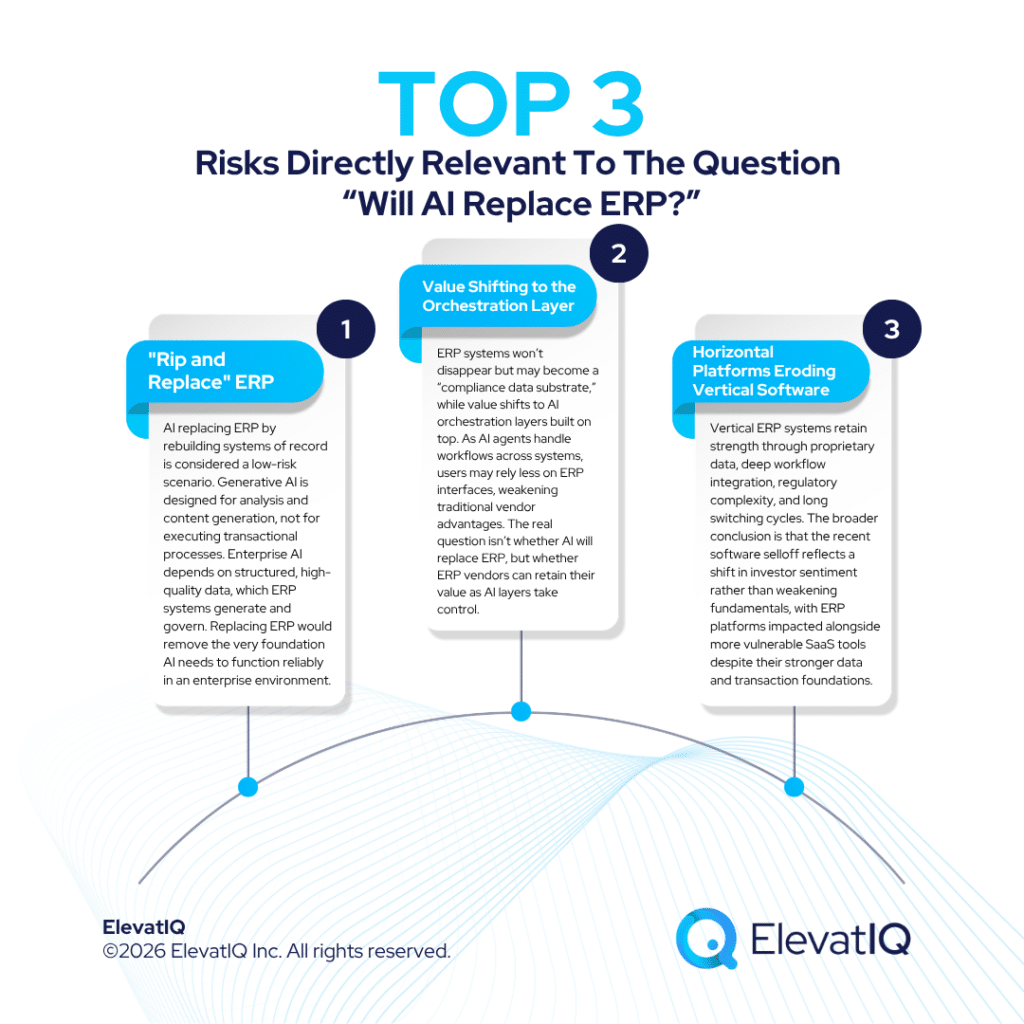
“Rip and Replace” ERP: Goldman Rates It Risk Score 1 (Lowest)

The most alarming version of the AI disruption thesis holds that new AI entrants will rebuild the systems-of-record layer from scratch, making foundational platforms like ERP, CRM, and HR software obsolete. Will AI replace ERP by making it structurally irrelevant? Goldman Sachs analysis rated this scenario as low risk of all seven arguments examined.

The reasoning is straightforward: generative AI is an analysis and generation engine, not a transaction engine. Enterprise-grade AI depends on large volumes of high-quality, structured, and traceable data and ERP systems serve as the primary containers and governance infrastructure that produce and maintain that data. Replacing the ERP to build AI on top of it would mean dismantling the very foundation AI agents need to function reliably in an enterprise context.

Value Shifting to the Orchestration Layer: Risk Score 4 (Elevated)

This is where Goldman sees the more realistic near-term risk. The report suggests ERP systems will not disappear but could become what Goldman calls a “compliance data substrate,” with commercial value increasingly captured by the orchestration layer sitting on top of them. AI agents can read, write, and reconcile across multiple systems of record, and over time, users may no longer need to directly access the original ERP interface. This weakens the moat ERP vendors have historically held through interface control, process dependency, and user habit.

This is the scenario enterprise buyers should be watching. The question is not will AI replace ERP, it is whether ERP vendors will maintain their value position as AI orchestration layers grow on top of them.

Horizontal Platforms Eroding Vertical Software: Risk Score 2 (Low to Moderate)

Goldman assessed the risk that horizontal AI tools allow buyers to build their own industry workflows, cutting into specialized vertical software pricing power. This was rated low to moderate risk. Vertical ERP platforms benefit from proprietary industry data, deep workflow integration, compliance barriers in regulated industries, and customer switching timelines measured in years, not months.

The overarching Goldman conclusion, as analyst Matthew Martino articulated: the recent repricing of software stocks reflects a rapid shift in investor sentiment rather than a sudden deterioration in fundamentals. The selloff appears to have been applied broadly rather than selectively, punishing ERP platforms alongside far more vulnerable narrow SaaS tools that lack their data depth and transaction criticality.



ERP Selection Requirements Template

This resource provides the template that you need to capture the requirements of different functional areas, processes, and teams.

Why Will AI Replace ERP Is the Wrong Question

Will AI replace ERP? The Goldman Sachs research says no but unpacking why reveals what enterprise buyers actually need to prepare for.

The key technical distinction is between deterministic and probabilistic systems.

  • Deterministic systems execute precise, repeatable transactions with zero tolerance for error. Financial ledgers, inventory movements, procurement approvals, payroll processing, and compliance reporting all fall into this category. An ERP system processing a multi-entity consolidation or a three-way purchase order match cannot afford to be correct most of the time. It must be correct every time, with a full audit trail.
  • Probabilistic systems including AI language models, produce outputs based on learned patterns. They excel at tasks where speed and approximation are acceptable: content generation, research summarization, customer support triage, and data analysis. A 95% accuracy rate is a strong result for AI-generated content. It is a catastrophic result for a financial ledger.

The architecture emerging across enterprise technology in 2026 reflects this reality. AI agents are increasingly functioning as the reasoning and interface layer. Thus, interpreting user intent, surfacing recommendations, and orchestrating cross-system workflows. ERP systems remain the execution layer where transactions are committed, financial controls are enforced, and regulatory compliance is maintained.

So rather than framing it as will AI replace ERP, the more accurate question is: how will AI sit on top of ERP and what does that mean for buyers evaluating systems today?



ERP System Scorecard Matrix

This resource provides a framework for quantifying the ERP selection process and how to make heterogeneous solutions comparable.

What This Means for Organizations Evaluating ERP Right Now

The debate playing out in financial markets has direct practical implications for enterprise buyers. There are three dimensions worth addressing.

ERP Vendors Are Embedding AI Fast

The notion that AI will replace ERP assumes that ERP vendors will stand still while new entrants build AI capabilities around them. That is not what is happening. SAP has launched Joule, its generative AI assistant, which draws on process and business data across S/4HANA to surface recommendations and automate workflows. Oracle has embedded AI throughout its Fusion ERP suite running on Oracle Cloud Infrastructure. Microsoft Dynamics 365 has integrated Copilot across its ERP and CRM modules. Workday acquired AI platform Sana specifically to extend its reach as an intelligent front door to enterprise workflows.

Legacy ERP vendors may actually have a structural advantage here. Their deeper backend architectures and richer longitudinal datasets make AI agent integration more straightforward than rebuilding AI-native applications from scratch. The AI-native ERP category is still young, and long-term reliability, governance, and compliance capabilities remain open questions for most new entrants.

The Real Risk Is Vendor Lock-In, Not ERP Replacement

While the research makes clear that “will AI replace ERP” answers to “no,” the more immediate risk for buyers is a different one: selecting ERP vendors or signing contracts that limit your ability to leverage AI as it matures.

Goldman Sachs’ own evaluation framework emphasizes system-of-record ownership and data integration moat, both of which favor established ERP platforms. But the report also stresses execution: vendors that actively integrate new AI capabilities are better positioned than those that bolt AI onto legacy interfaces cosmetically. For buyers, this translates into a concrete evaluation criterion: what is this vendor’s AI roadmap, how is it priced, and does it build on open standards or create new layers of proprietary lock-in?

ElevatIQ’s 2026 Digital Transformation Report flagged this tension directly: AI disruption is forcing traditional enterprise software vendors to redirect R&D investment, with on-premise products receiving minimal attention and some offerings approaching end-of-life. Organizations evaluating ERP need to assess whether their shortlisted systems position them to leverage AI capabilities over the next five years or whether they will find themselves locked into architectures with limited optionality.

AI Changes What You Should Evaluate, Not Whether You Need ERP

One of the most practical takeaways from the Goldman Sachs report is that AI does not eliminate the need for rigorous ERP selection, it raises the stakes. The nature of what to evaluate shifts, with new criteria sitting alongside traditional functional and integration assessments:

  • Does the vendor provide AI capabilities embedded in core workflows, or only as add-on modules at extra cost?
  • How does the vendor’s AI interact with your organization’s proprietary data and who governs that interaction?
  • How is the licensing model structured as agentic AI adds value independent of user headcount and will the vendor try to reprice based on agent consumption?
  • How does the ERP’s AI roadmap position your organization relative to the orchestration layers likely to sit above the ERP in future architecture?

These are not planning questions for three years from now. They belong in vendor RFPs and contract negotiations being written today.

The Buyer’s Takeaway

The organizations most exposed to the AI disruption narrative are not those running ERP. They are those that deferred ERP investment in favor of fragmented point solutions that now face genuine substitution risk from AI agents and those that signed rigid multi-year ERP contracts without provisions for AI flexibility.

Will AI replace ERP? The analysis suggests the answer is no. ERP’s role as the deterministic backbone of enterprise financial and operational data makes it structurally necessary for any AI-augmented enterprise architecture. But ERP buying decisions made today without factoring in vendor AI maturity, licensing flexibility, and architectural optionality carry real risk of aging poorly in a fast-moving environment.

Conclusion

The Goldman Sachs “Will AI Eat Software?” report is not a verdict on ERP obsolescence. It is a carefully structured analysis of where AI disruption risk is concentrated and where it is not. Will AI replace ERP? Based on the research and underlying technology considerations, the answer appears to be no. The ERP systems are the data foundation AI depends on, not a workflow layer AI can replicate. The risk for enterprise buyers lies not in ERP being replaced, but in selecting vendors or contract structures that limit their ability to benefit from the AI-augmented architecture now taking shape.

Working with independent ERP advisors, who have no commercial relationships with the vendors and system integrators they evaluate, gives organizations the objectivity to distinguish genuine AI capability from marketing claims.

ElevatIQ’s enterprise technology selection services are built on exactly that vendor-agnostic model. As independent ERP advisors, ElevatIQ helps organizations cut through the AI disruption noise, evaluate vendor roadmaps honestly, and make ERP decisions that hold up well beyond the current market cycle.

All commentary represents an independent editorial perspective based on publicly reported information.



ERP Selection: The Ultimate Guide

This is an in-depth guide with over 80 pages and covers every topic as it pertains to ERP selection in sufficient detail to help you make an informed decision.

FAQs

“Will AI Replace ERP”: What the Goldman Sachs Report Means for ERP Buyers Read More »
ERP Warehouse Implementation Timing Failure: Funko's $85 Million Timing Disaster

ERP Warehouse Implementation Timing Failure: Funko’s $85 Million Timing Disaster

In November 2022, Funko – the maker of Pop, vinyl collectible figures, reported third-quarter results that triggered a 59% single-day stock price collapse. The steepest decline in company history. The primary contributing factor was not a market crash or competitive threat. It was an operational disruption largely driven by implementing two massive infrastructure changes simultaneously. One, consolidating five Washington distribution facilities into a new 860,000-square-foot Arizona warehouse. At the same time, the ERP system was not fully operational at the required scale.

The result: $85 million in annual fulfillment expense increases despite similar throughput. $5 million in excess warehouse labor in Q3 2022 alone, inventory that ballooned 170% year-over-year to $234 million. And ultimately, a shareholder lawsuit alleging executives may have concealed ‘significantly larger delays’ in ERP implementation while proceeding with the warehouse move anyway. By May 2024, the federal court dismissed the securities fraud claims. But not before Funko settled derivative lawsuits for $2 million and documented one of the clearest examples of ERP warehouse implementation timing failure. Thus, creating catastrophic operational and financial consequences.

This case demonstrates what happens when organizations treat ERP go-live dates more as schedule commitments than as readiness gates. They move forward with dependent infrastructure changes even when foundational systems are not ready. Thus, creating compounding failures that destroy operational efficiency and credibility with investors.

The Ultimate ERP Playbook for Electronics Manufacturing - Tanner Rogers - Watch On-Demand

The Timeline: From Dual Infrastructure Projects to Operational Collapse

Funko’s ERP warehouse implementation timing failure unfolded across 18 months, during which executives publicly promoted both initiatives while privately managing escalating delays and cost overruns.

  • 2021–Early 2022: Funko announces plans to consolidate five Washington distribution facilities into a single 860,000-square-foot warehouse in Buckeye, Arizona. Simultaneously, the company begins implementing a new ERP system designed to improve inventory management, order fulfillment, and operational efficiency.
  • May 2022: Inventory totals $161.5 million, up 160.8% year-over-year. Funko attributes the increase to “supply chain disruptions and delayed inventory arrivals,” downplaying operational challenges related to the warehouse consolidation and ERP rollout.
  • Q2 2022: Inventory climbs to $234 million, up 170.9% year-over-year. The new Arizona warehouse is operational, but the ERP system that was supposed to manage inventory, order routing, and fulfillment workflows is not fully functional.
  • Q3 2022 (November 2022 earnings call): CEO Brian Mariotti discloses that Funko added approximately $85 million in annual fulfillment expenses despite similar overall throughput. The company paid $5 million in excess warehouse labor during Q3 alone to operate the consolidated fulfillment center without the intended software. Stock price collapses 59% on November 4, 2022.

CFO Jennifer Fall Jung states on the earnings call: “We had to put more bodies to get the goods out the door versus having the systems in place.” She adds that Funko will “continue to take on higher costs until the ERP transition is complete.”

To manage the operational chaos

Funko added third-party logistics providers and co-packer warehouses to assist with throughput — essentially outsourcing fulfillment because the new warehouse could not function efficiently without working ERP software.

  • March 2023: Funko announces plans to destroy at least $30 million worth of excess inventory accumulated during the warehouse and ERP transition period. The inventory write-down reflects the operational inability to manage stock levels without functioning inventory management software.
  • June 2023: Shareholders file securities class action lawsuit (Studen v. Funko) alleging executives concealed ERP delays and misled investors about the impact on operations and EBITDA margins.
  • May 2024: Federal court dismisses securities fraud claims, finding shareholders did not adequately prove materiality or scienter (intent to defraud). However, the court’s decision does not dispute that ERP delays occurred or that the warehouse move proceeded without functional software.
  • August 2024: Funko settles derivative shareholder lawsuits for $2 million, resolving claims that executives breached fiduciary duties through mismanagement of the ERP and warehouse projects.

The Root Cause: Moving Infrastructure Before Systems Work

The core ERP warehouse implementation timing failure at Funko was the decision to consolidate distribution operations into a new Arizona facility before the ERP system could support warehouse management, inventory allocation, order routing, and fulfillment workflows at the scale and complexity the consolidated facility required.

Why Timing Matters in ERP + Infrastructure Changes

ERP systems and physical distribution facilities are interdependent infrastructure. The ERP manages:

  • Inventory allocation: Which SKUs are stored in which warehouse locations
  • Order routing: Which orders are fulfilled from which facilities based on inventory availability, shipping costs, and customer proximity
  • Receiving and put-away: How incoming inventory is logged, quality-checked, and assigned to storage locations
  • Pick-pack-ship workflows: How orders are picked from shelves, packed, and shipped to customers
  • Cycle counting and physical inventory: How warehouse teams reconcile system inventory to actual stock on hand

The Problems Leading to the Compounding Failure

When an ERP system is not fully functional, meaning it cannot reliably perform these operations without manual intervention, system workarounds, or excessive error rates, moving to a new warehouse creates a compounding failure:

  • Manual processes don’t scale. Five smaller warehouses operating with manual workarounds can limp along because each facility handles a manageable subset of SKUs and orders. Consolidating into one 860,000-square-foot facility concentrates all that volume into a single operation where manual processes collapse under the scale.
  • Physical workflows are designed around software capabilities. The new Arizona warehouse layout, where products are stored, how pick paths are optimized, which loading docks serve which carriers, was presumably designed assuming the ERP would direct warehouse workers efficiently. Without working software, the physical design becomes a liability rather than an efficiency gain.
  • You cannot train users on systems that don’t work. Warehouse workers cannot be trained on ERP pick-pack-ship workflows if the software is still being debugged. The result is undertrained staff using manual workarounds in a facility designed for automated ERP-driven processes.

Funko’s decision to proceed with the warehouse consolidation while the ERP remained non-functional contributed to this failure cascade.


ERP Selection Requirements Template

This resource provides the template that you need to capture the requirements of different functional areas, processes, and teams.

The Financial Impact: $85M in Annual Costs, $30M Inventory Write-Off

The financial consequences of Funko’s ERP warehouse implementation timing failure were immediate, substantial, and ongoing.

$85 Million Annual Fulfillment Cost Increase

CEO Mariotti’s November 2022 disclosure –  “$85 million in annual fulfillment expenses despite similar overall throughput” quantifies the operational inefficiency created when warehouse operations run without proper ERP support.

What this means: Funko was processing approximately the same number of orders and shipping similar volumes as before the warehouse move, but operational costs increased by $85 million annually. This is not a one-time implementation expense or capital investment; it is ongoing annual operating cost inflation caused by operational inefficiency.

Where the costs came from:

  • Excess labor: $5 million in Q3 2022 alone for “more bodies to get the goods out the door” because ERP-driven automation and workflow optimization were unavailable
  • Third-party logistics and co-packers: Additional warehousing and fulfillment partners were brought in to handle overflow that the new Arizona facility could not process efficiently
  • Inventory management costs: Higher carrying costs for $234 million in inventory (170% above the prior year) accumulated due to the inability to accurately track stock levels and manage SKU assortments without working ERP

$30 Million Inventory Write-Off

By March 2023, Funko announced plans to destroy at least $30 million worth of excess inventory. This was not a defective product or regulatory compliance disposal; it was inventory accumulated during the ERP and warehouse transition that the company could no longer efficiently store or sell.

A key contributing factor: Without fully functional ERP inventory management, Funko may not have been able to:

  • Accurately track which SKUs were slow-moving and should not be reordered
  • Optimize inventory levels across the consolidated warehouse
  • Execute aged inventory reduction strategies before the stock becomes unsellable

The result was inventory bloat that eventually required write-offs when warehouse capacity constraints and carrying costs made holding the inventory more expensive than destroying it.


ERP System Scorecard Matrix

This resource provides a framework for quantifying the ERP selection process and how to make heterogeneous solutions comparable.

The Investor Disclosure Failure: What Funko Knew vs. What Funko Said

The shareholder lawsuits centered on a fundamental question: did Funko’s executives disclose the full extent of ERP delays and their operational impact to investors, or did they downplay the severity while proceeding with the warehouse move?

The Allegations

Shareholders alleged that Funko’s leadership “failed to disclose that: (i) Funko was experiencing significantly larger delays in implementing its ERP software than it was disclosing to investors; (ii) having moved into a new warehouse without functioning ERP software in place would lead to dramatically higher costs and poorer inventory management practices; and (iii) Funko’s inability to efficiently operate the new distribution center would have a substantial, undisclosed impact on the Company’s EBITDA margin.”

What this means in plain language: Executives knew the ERP was not ready, knew the warehouse move would fail without working ERP, and knew this would crater profitability — while public disclosures indicated the projects were progressing until the Q3 2022 earnings call when the operational issues became more visible.

The Court’s Ruling (And What It Doesn’t Resolve)

In May 2024, the federal court dismissed the securities fraud claims, finding that shareholders did not adequately prove:

  • Materiality: The undisclosed ERP delays were significant enough to affect investor decisions
  • Scienter: That executives specifically intended to defraud investors rather than simply mismanaging projects

However, the court’s ruling does not mean the ERP warehouse implementation timing failure didn’t occur. It means shareholders could not meet the legal standard to prove securities fraud. The court did not dispute that:

  • The ERP system experienced delays
  • The warehouse move proceeded without functional software
  • Operational costs increased by $85 million annually as a result
  • Inventory ballooned to unsustainable levels

The $2 million derivative lawsuit settlement in August 2024 further confirms that Funko’s board and management acknowledged some level of mismanagement, even if criminal fraud could not be proven.

The Lessons: What Organizations Must Learn From Funko’s Failure

Funko’s ERP warehouse implementation timing failure provides specific, actionable lessons for any organization planning simultaneous ERP implementations and infrastructure changes.

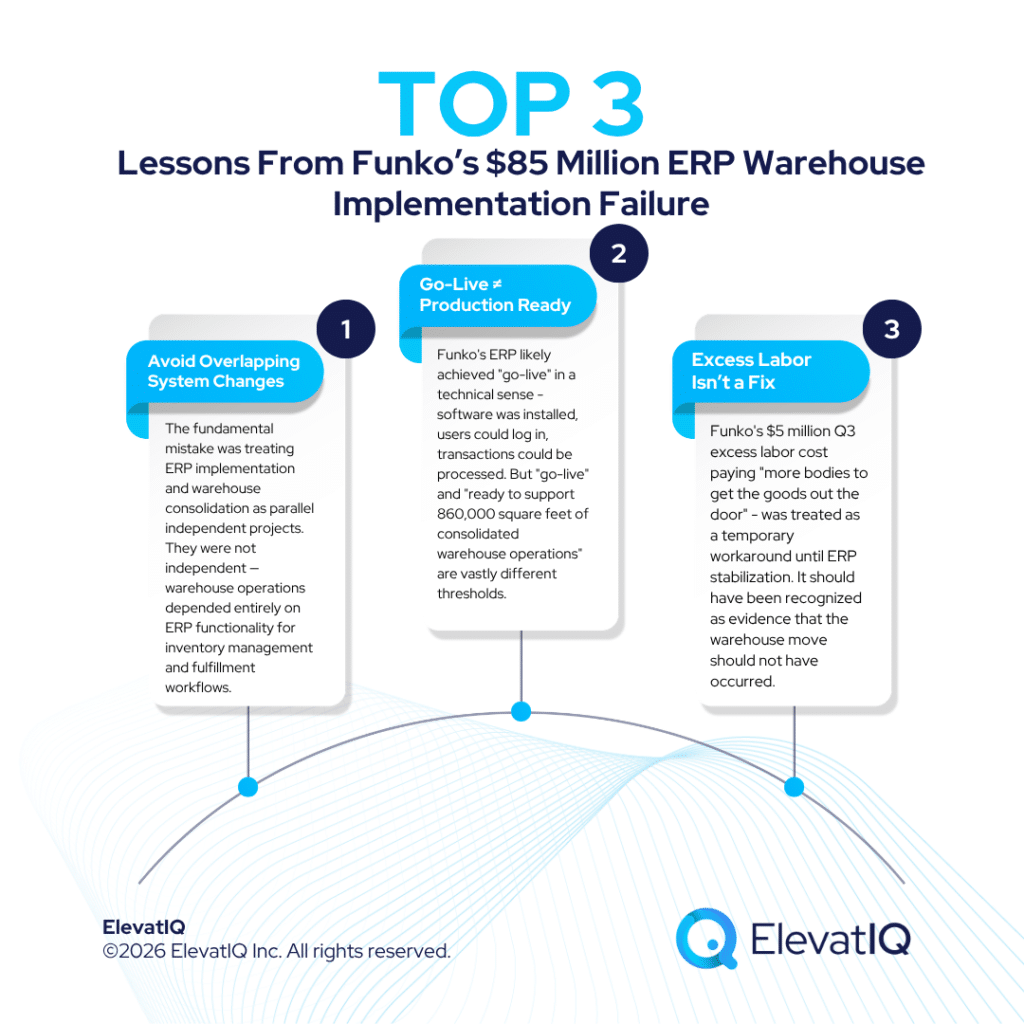
Dependent Infrastructure Changes Must Sequence, Not Overlap

The fundamental mistake was treating ERP implementation and warehouse consolidation as parallel, independent projects. They were not independent — warehouse operations depended entirely on ERP functionality for inventory management and fulfillment workflows.

The correct sequencing:

  1. Implement and stabilize ERP in existing warehouse facilities
  2. Operate for 3–6 months to validate ERP inventory management, order routing, and fulfillment workflows under production conditions
  3. Only after ERP stability is confirmed, begin warehouse consolidation using the proven ERP system

This sequencing adds a timeline potentially 6–12 months longer total but prevents the compounding failure where neither project can succeed because both are unstable simultaneously.

“Go-Live” Does Not Mean “Ready for Production Scale”

Funko’s ERP likely achieved “go-live” in a technical sense – software was installed, users could log in, and transactions could be processed. But “go-live” and “ready to support 860,000 square feet of consolidated warehouse operations” are vastly different thresholds.

Organizations should define production readiness separately:

  • Go-live: System is functional for basic transactions in a controlled environment
  • Production scale readiness: System can handle peak transaction volumes, user counts, and operational complexity without performance degradation or excessive error rates requiring manual intervention

Moving the warehouse before achieving production scale readiness significantly increased the risk of operational failure.

Excess Labor Costs Are a Red Flag, Not a Temporary Fix

Funko’s $5 million Q3 excess labor cost paying “more bodies to get the goods out the door” –  was treated as a temporary workaround until ERP stabilization. It should have been recognized as evidence that the warehouse move should not have occurred.

When labor costs spike post-implementation, it signals:

  • ERP workflows are not automating processes as designed
  • Manual interventions are replacing system-driven efficiency
  • The system is not ready to support operations at the current scale

Organizations that accept excess labor as ‘temporary’ may discover it persists for extended periods because the root cause of inadequate ERP functionality is never fully remediated.

The Conclusion

Funko’s $85 million annual cost increase, $30 million inventory write-off, 59% stock price collapse, and shareholder lawsuits largely stem from a critical timing decision: consolidating warehouse operations before ERP systems were ready to support them. This is not solely a software or vendor implementation issue; it primarily reflects a management decision to proceed with dependent infrastructure changes despite indications that foundational systems were not fully operational.

The ERP warehouse implementation timing failure lessons from Funko are unambiguous: infrastructure changes that depend on ERP functionality must sequence after ERP stability is confirmed under production conditions. Treating ERP go-live dates as schedule commitments rather than readiness gates can create significant operational challenges where manual processes cannot scale, costs explode, and investor confidence collapses.

For organizations planning ERP implementations alongside facility consolidations, system integrations, or other dependent infrastructure projects, the question is not “can we run these in parallel to save time?” The question is “what happens if the ERP isn’t ready when we need it to support the infrastructure change?” Funko answered that question with $85 million in annual costs, shareholder lawsuits, and operational chaos that took years to resolve.

For organizations seeking independent advisory support for ERP implementation sequencing, infrastructure dependency analysis, and operational readiness assessment, the team at ElevatIQ provides consulting services across implementation planning, risk mitigation, and project governance at exactly the stage where timing decisions determine whether ERP implementations enable operational excellence or create multi-year crisis management exercises.

All commentary represents an independent editorial perspective based on publicly reported court filings, earnings calls, and cited primary sources.


ERP Selection: The Ultimate Guide

This is an in-depth guide with over 80 pages and covers every topic as it pertains to ERP selection in sufficient detail to help you make an informed decision.

FAQs

ERP Warehouse Implementation Timing Failure: Funko’s $85 Million Timing Disaster Read More »

State Government ERP Payroll Failure: Rhode Island's $91 Million ERP Crisis

State Government ERP Payroll Failure: Rhode Island’s $91 Million ERP Crisis

In December 2025, Rhode Island deployed the payroll module of its $91.2 million Workday-based ERP system to 15,000+ state employees. By January 2026, employees reported missing wages, incorrect pay calculations, overtime errors, and benefits deduction failures. In February 2026, hundreds of state workers received W-2 tax forms listing their employer as the “State of Rhode Island Umbrella Company”. A system configuration label that was never intended for external distribution.

By March 2026, Governor Dan McKee had fired the Director of Administration. The state’s ERP remained in “hyper care” stabilization mode with implementation partner Accenture. And also unions were demanding accountability for what they characterized as “the latest and most embarrassing failure”. These payroll errors were affecting critical workers, including correctional officers, cancer patients on medical leave, and employees with decades of state service.

This state government ERP payroll failure represents the ERP implementation pattern that turns technically successful system deployments into operational disasters. The software may be technically operational and the integrations functioning. But the system appears to struggle with accurately processing the complex payroll rules, union agreements, and benefit structures that govern public sector compensation. The result is a system that is “live” in production but fundamentally unreliable. Especially for the core business process, it was implemented to support.

The State of ERP 2026 - Watch On-Demand

The Scope: A System Six Years in Planning That Failed in Four Pay Cycles

Rhode Island’s ERP modernization began planning in 2019. Nearly all Department of Administration internal processing remained manual. Timesheets submitted as hard copies or PDFs, payroll calculations performed on a decades-old COBOL-based mainframe system, and financial operations supported by spreadsheets. The state’s Director of Administration at the time characterized operations as “relying on typewriters and carbon paper.”

The modernization project proceeded in two phases:

  • Phase 1 (July 2025): Financial operations modules go live – accounts payable, general ledger, procurement, budgeting. This deployment occurred relatively smoothly with minimal reported disruptions.
  • Phase 2 (November 2025): Human Capital Management (HCM) and payroll modules deploy, replacing legacy COBOL payroll system. This is where the state government ERP payroll failure began.

Within four pay cycles (December 2025 through January 2026), the following payroll failures were documented by state employee unions:

  • Missing wages: Employees not receiving full pay for hours worked, with some paychecks thousands of dollars short
  • Incorrect overtime calculations: Shift differentials, hazard pay, and overtime formulas failing to calculate correctly across different union contracts
  • Benefits deduction errors: Health insurance, retirement contributions, and other deductions either not processed or processed incorrectly
  • Leave accrual failures: Vacation, sick leave, and other time-off balances not updating correctly, creating situations where employees with accrued leave showed as “leave without pay” in system records
  • Payment timing issues: Some employees receiving paychecks late or not at all during specific pay periods

The impact was immediate and personal for state employees who rely on predictable paychecks to manage mortgages, medical expenses, and family budgets. One correctional officer reported being shorted $6,300 in a single paycheck. An employee undergoing cancer treatment faced “leave without pay” status because required medical leave documentation was not processed during the ERP transition, potentially affecting health insurance coverage during active treatment.

The Root Cause Of the State Government ERP Payroll Failure

Rhode Island’s state government ERP payroll failure follows a pattern documented across government Workday implementations nationwide: the software is sophisticated and cloud-native, but government payroll requirements are more complex than the vendor’s standard functionality handles without extensive customization.

What makes government payroll different from private sector

According to Director of Administration testimony before the state legislature in March 2025, Rhode Island’s implementation required “going through 50-plus collective bargaining agreements and rules and regulations around payroll.” Each union contract contains unique compensation formulas:

  • Shift differentials that vary by time of day, day of week, and employee classification
  • Overtime calculation rules that differ across unions and may compound (overtime on holiday pay, overtime on shift differential, etc.)
  • Hazard pay provisions triggered by specific working conditions or assignments
  • Leave accrual formulas that vary based on years of service, classification, and contract provisions
  • Pension and retirement contribution calculations tied to specific pay categories and benefit tier structures

Workday’s standard payroll functionality is designed for conventional salaried and hourly employment structures. Government union contracts often introduce layered payroll rules where a single employee’s pay calculation may involve multiple simultaneous provisions that require extensive configuration and testing. The result: the system calculates payroll, but the calculations are frequently wrong. From a vendor perspective, the platform may be functioning as configured. For employees, however, the only metric that matters is whether the paycheck is correct,  and in many cases, it was not.


ERP Selection Requirements Template

This resource provides the template that you need to capture the requirements of different functional areas, processes, and teams.

The “Hyper Care” That Never Ends

ERP vendors typically include “hyper care” periods in implementation contracts, intensive post-go-live support lasting 30–90 days while the system stabilizes and remediation occurs for issues discovered in production. Rhode Island’s ERP has been in hyper care with implementation partner Accenture since the November 2025 payroll deployment, with support scheduled to continue through at least March 2026.

This extended hyper care period signals a fundamental problem: the system is not stabilizing, it is being actively managed to prevent operational collapse. Four months of continuous crisis support suggests the implementation did not achieve production readiness before go-live occurred.

What hyper care typically involves:

  • Dedicated vendor resources monitoring system performance in real time
  • Rapid response teams addressing critical errors as they emerge
  • Daily or weekly calls between vendor, implementation partner, and client to review open issues
  • Emergency configuration changes and patches deployed outside normal release cycles

What hyper care should not involve is fundamental reconfiguration of payroll calculation logic – yet Rhode Island’s ongoing support strongly suggests the system requires more than bug fixes and performance tuning. When hundreds of employees receive incorrect W-2 forms four months after go-live, the problems are not isolated edge cases but systemic configuration or data quality failures.

The financial implications are significant. Extended hyper care periods can add significant unplanned costs depending on vendor resource levels and support intensity. For Rhode Island, an extended hyper care period could represent additional unplanned costs beyond the $91.2 million contract value if stabilization support continues for several months.


ERP System Scorecard Matrix

This resource provides a framework for quantifying the ERP selection process and how to make heterogeneous solutions comparable.

The Political Accountability Of The ERP Failures Cost 

In March 2026, Governor McKee fired the Director of Administration following the W-2 “umbrella company” debacle. This executive-level accountability for state government ERP payroll failure is unusual – most ERP implementation problems result in vendor blame, consultant turnover, or mid-level staff reassignments, but rarely in cabinet-level terminations.

The Director of Administration termination signals political recognition that the ERP failure is not a technical IT problem but a governance and management crisis affecting 15,000+ employees and undermining public confidence in basic government operations.

Why this matters for future state ERP implementations

When executives face termination for ERP failures, it changes the risk calculation for successor leaders. The next Director of Administration inherits a partially functional system, ongoing vendor support costs, union grievances, and political pressure to “fix” problems without additional budget or timeline delays. This creates defensive decision-making: prioritize avoiding further visible failures over addressing root causes that might require system redesign or re-implementation.

Rhode Island has experienced this dynamic before. In 2016, a failed unified healthcare benefits portal (RIBridges) led to the resignation of the Health and Human Services Secretary and the Chief Technology Officer. That failure prompted a statewide IT project freeze and eventually a system rebuild. The pattern suggests Rhode Island struggles with large-scale ERP implementations across multiple administrations and vendors, pointing to organizational capacity or governance gaps that transcend individual technology choices.

The Lessons: What Others Must Learn From Rhode Island’s ERP Payroll Failure

Rhode Island’s state government ERP payroll failure provides specific, actionable lessons for any state or municipality planning government ERP implementations.

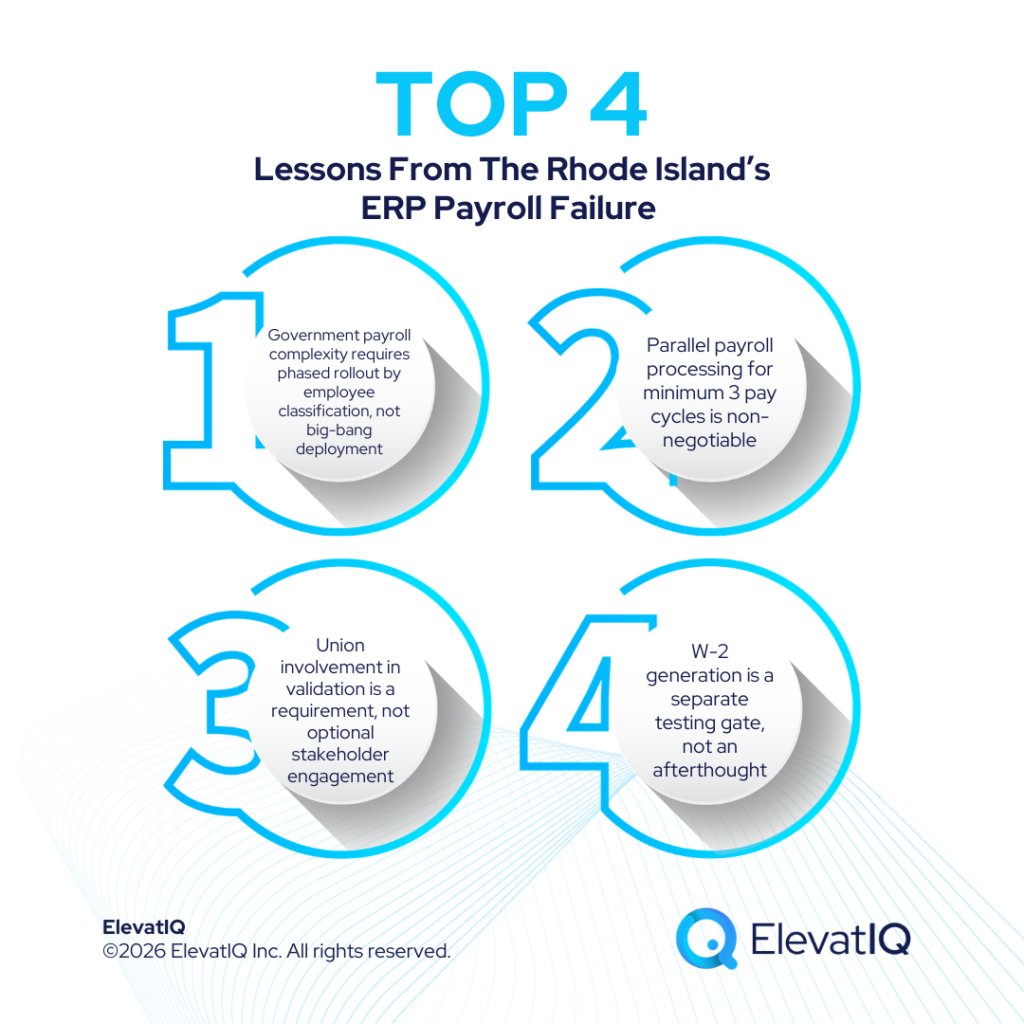
Government payroll complexity requires phased rollout by employee classification, not big-bang deployment

Rather than deploying payroll to all 15,000+ employees simultaneously across 50+ union contracts, Rhode Island should have implemented sequentially: start with salaried exempt employees with simple pay structures (no overtime, no shift differentials, standard benefits), validate calculations are correct, then add hourly non-exempt employees, then add complex union classifications incrementally.

This sequential approach allows configuration errors to be identified and fixed in controlled populations before cascading to the entire workforce. The timeline delay, potentially 6–12 months longer than big-bang deployment,  is far preferable to four months (and counting) of payroll errors affecting everyone.

Parallel payroll processing for minimum 3 pay cycles is non-negotiable

The state should have run parallel payroll, processing every paycheck in both the old COBOL system and the new Workday system simultaneously. And, reconciled every employee’s pay calculation before trusting Workday as the sole system of record. Only after 3+ cycles of perfect reconciliation should cutover have occurred. Rhode Island appears to have skipped parallel processing or conducted it inadequately, gambling that Workday configuration was correct based on testing with sample data rather than full employee population with real union contracts.

Union involvement in validation is a requirement, not optional stakeholder engagement

Government payroll is governed by collective bargaining agreements, which means union representatives are the subject matter experts on compensation rules. They should have been deeply involved in:

  • Validating that Workday configuration matched contract language
  • Reviewing test payroll calculations for sample employees from each classification
  • Signing off on payroll accuracy before go-live as a formal gate

Treating unions as stakeholders to be “managed” rather than validation partners creates the adversarial dynamic Rhode Island now faces, where unions publicly demand accountability while the state defends the vendor’s performance.

W-2 generation is a separate testing gate, not an afterthought

The “umbrella company” W-2 error reveals a specific failure: no one tested W-2 form generation before deployment. W-2s pull data from payroll records but format that data according to IRS requirements and employer configuration. Testing should have generated sample W-2s, verified all fields populated correctly, and validated employer information before distributing forms to employees and transmitting to IRS. This is an example of a downstream process (W-2 generation in February) failing due to inadequate configuration of an upstream system (Workday employer setup during ERP implementation). Comprehensive testing identifies these dependencies before they become public embarrassments.

The Conclusion

Four months after deployment, the system still required stabilization support, employees continued reporting payroll errors, unions were filing grievances, and the administration had replaced the Director of Administration. Taken together, these developments suggest the system may have gone live before full production readiness was achieved. The state government ERP payroll failure was predictable and preventable through longer testing, parallel processing, phased rollout, and union validation, all standard practices in government payroll ERP implementations.

The decision to proceed with big-bang deployment across 15,000+ employees and 50+ union contracts despite the known complexity was a risk management failure. That decision may have been driven by timeline pressure, budget constraints, or vendor commitments but regardless of cause, the result is the same: a $91.2 million system that cannot reliably perform the core function it was implemented to support. States and municipalities currently planning payroll modernization, Rhode Island’s experience provides a clear roadmap of what not to do. For those mid- ERP implementation, it demonstrates why independent validation, phased rollout, and union engagement are not bureaucratic delays but essential safeguards against operational disaster.

For organizations seeking independent advisory support for government ERP planning, vendor evaluation, or implementation oversight, the team at ElevatIQ provides specialized consulting for public sector technology implementations at exactly the stage where these decisions determine whether systems succeed or become multi-year crisis management exercises.

All commentary represents an independent editorial perspective based on publicly reported information and government ERP implementation standards.


ERP Selection: The Ultimate Guide

This is an in-depth guide with over 80 pages and covers every topic as it pertains to ERP selection in sufficient detail to help you make an informed decision.

FAQs

State Government ERP Payroll Failure: Rhode Island’s $91 Million ERP Crisis Read More »

NICE: "Industry First" Solution for Customer Service

NICE: “Industry First” Solution for Customer Service

At Enterprise Connect 2025, NICE unveiled what it calls an “industry-first” orchestration platform aimed at reimagining how businesses manage customer service workflows. Dubbed the NICE Industry First Solution, the newly introduced CXone Mpower Orchestrator offers a comprehensive approach to automating customer interactions by integrating third-party applications, coordinating workflows, and embedding artificial intelligence (AI) across processes.

The announcement of the NICE Industry First Solution has created a stir among contact center and customer experience professionals, largely because of its potential to simplify complex systems and unify fragmented service environments. Here’s a detailed look at what this development means for the industry, how the solution works, and what experts are predicting for its impact on stakeholders and NICE as a company.

Breakdown of the Announcement of NICE Industry First Solution

Seamless Orchestration with AI at the Core

At the heart of the NICE Industry First Solution is the ability to orchestrate workflows across multiple systems, connecting NICE’s own CXone CCaaS platform with third-party tools. The solution is layered over CXone—NICE’s reengineered cloud contact center platform—allowing it to act as a central control system for customer service operations.

Over the past two years, NICE has been embedding AI deeply into its infrastructure, including its proprietary Enlighten AI. The launch of Mpower Orchestrator signals a further evolution of that vision. By not only embedding AI but also orchestrating interactions across platforms, NICE aims to eliminate the silos that typically plague customer service systems.

The NICE Industry First Solution also promises dynamic process analysis and optimization. It proactively identifies performance gaps and implements improvements, creating a self-evolving ecosystem of customer experience.

Addressing the Issue of Siloed Workflows

Traditional customer service setups often rely on various unconnected platforms. This leads to operational silos, delayed resolutions, and a disjointed customer experience. According to Elizabeth Tobey, VP of Marketing at NICE, these issues have long complicated service delivery.

The NICE Industry First Solution tackles this head-on by integrating AI-driven processes across all systems. By aligning workflows, agents, and data into a cohesive unit, the platform aims to deliver a more seamless, responsive service environment.

Salesforce vs SAP C/4 HANA CRM

Key Features that Set It Apart

NICE has packed the CXone Mpower Orchestrator with features designed to provide both visibility and control over service operations. Each feature is built to either enhance efficiency or optimize customer experiences.


The 2026 Digital Transformation Report

Thinking of embarking on a ERP journey and looking for a digital transformation report? Want to learn the best practices of digital transformation? Then, you have come to the right place.

Workflow Insights

This feature offers a complete view of operational metrics like volume, automation levels, containment, and resolution rates. Using Enlighten AI, the system identifies potential issues and offers real-time solutions. Thus, empowering service leaders to act immediately.

Workflow Orchestrator

Through historical and real-time data analysis, this tool recommends changes that involve both AI and human agents. Suggested optimizations can be tested before implementation, allowing for evidence-based decision-making.

Autopilot Conversation Flow

Instead of manually creating automated conversations, this component uses past successful interactions to develop workflows. This not only ensures best practices are followed but also allows the system to continually refine its responses.

Reverse Feedback and Experience Memory (XM)

Human agents can directly provide feedback on AI performance, which the system uses to improve future responses. Meanwhile, XM compiles a comprehensive view of each customer interaction, supporting proactive improvements across operations.

Usability and Human-Centered Design

One notable advantage of the NICE Industry First Solution is its intuitive design. Styled like a copilot, the platform does not require extensive training. NICE emphasizes that ease of use was a central design consideration, ensuring teams can adopt the tool quickly and efficiently.

Expert Endorsement and Industry Buzz

The NICE Industry First Solution has already caught the attention of analysts. Sheila McGee-Smith, President of McGee-Smith Analytics, highlighted the importance of the launch at Enterprise Connect 2025. She noted that the platform enables full customer journey orchestration—from self-service through live agent interaction to workflow completion, all on a single interface built on AI. She emphasized that each AI-assisted interaction can help improve the next, creating a feedback loop that continuously refines customer engagement.

Analyst Take: Impact on Stakeholders and the Market

For Contact Centers

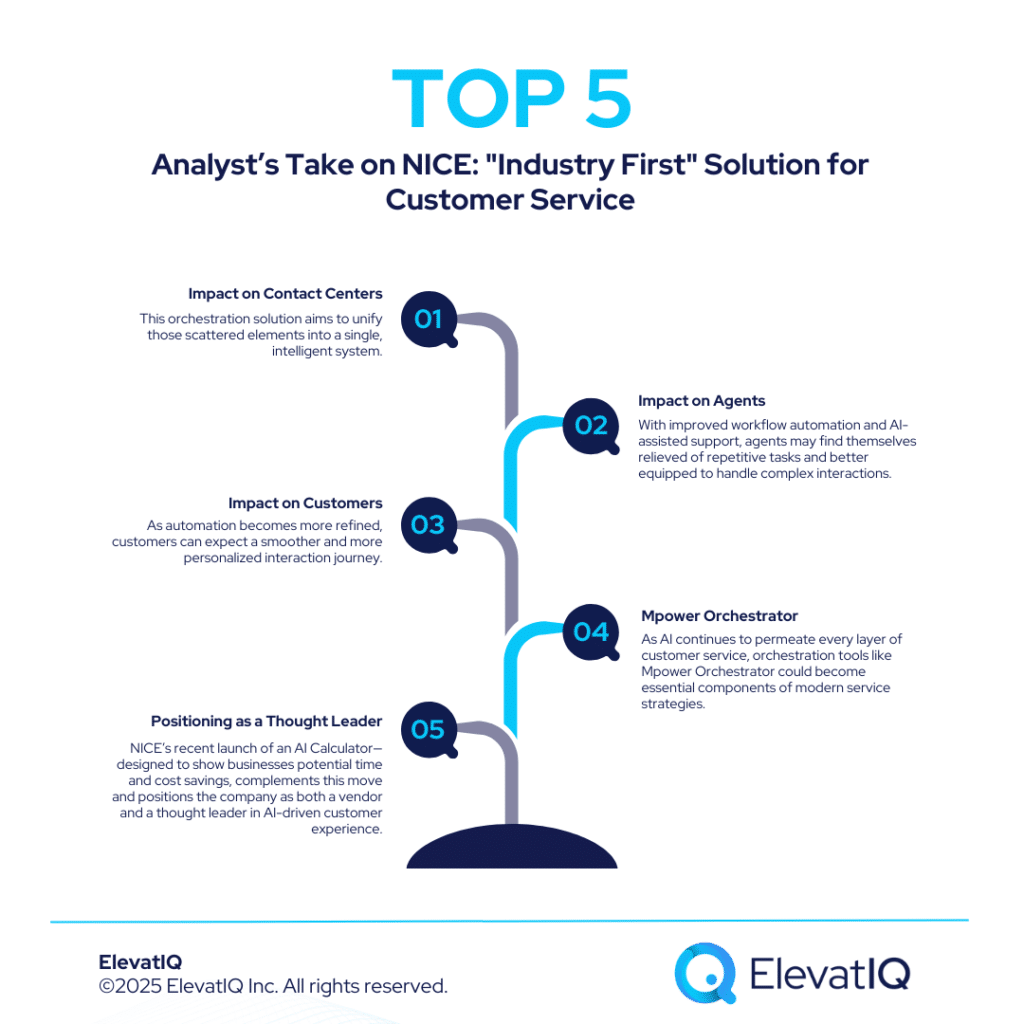
The NICE Industry First Solution could be a game-changer. For years, service leaders have been overwhelmed by a clutter of disconnected AI tools that add complexity rather than reducing it. This orchestration solution aims to unify those scattered elements into a single, intelligent system—making it easier to manage, monitor, and optimize customer service workflows.

For Agents

With improved workflow automation and AI-assisted support, agents may find themselves relieved of repetitive tasks and better equipped to handle complex interactions. Feedback mechanisms also allow agents to directly shape how AI supports them.

For Customers

Faster issue resolution, more consistent experiences, and fewer disjointed handoffs are likely outcomes. As automation becomes more refined, customers can expect a smoother and more personalized interaction journey.

Market Outlook and Future Predictions

The launch of the NICE Industry First Solution marks a significant step forward for both NICE and the broader CCaaS industry. As AI continues to permeate every layer of customer service, orchestration tools like Mpower Orchestrator could become essential components of modern service strategies.

NICE’s recent introduction of an AI Calculator—meant to show businesses how much time and money they can save using AI—complements this move. It suggests that the company is positioning itself as not just a vendor but also a thought leader in AI-powered customer experience.

Going forward, it’s likely that other vendors will respond with their own orchestration platforms, potentially leading to a wave of innovation across the industry. However, NICE’s head start and focus on usability may give it a lasting competitive edge.

Top 15 Digital Transformation Trends - Download

FAQs

NICE: “Industry First” Solution for Customer Service Read More »

SAP: Joule Introduced for Developers

SAP: Joule Introduced for Developers

SAP has expanded its AI assistant, SAP Joule, making it available for developers within its ecosystem. Previously introduced for business users in core SAP cloud products, SAP Joule now supports a wider range of users across SAP Build Process Automation, SAP Build Apps, SAP Build Code, and ABAP Cloud. The goal is to improve developer productivity by providing AI-driven assistance specifically tuned for SAP environments. Here’s a detailed breakdown of the announcement, its potential impact, and key industry insights.

SAP Joule’s Expansion for Developers

SAP initially launched Joule to help business users interact with SAP applications through natural language prompts. The company has now extended this capability to technical users, specifically developers, aiming to streamline the software development process across its platforms. Joule assists developers with several tasks, including:

  • Writing code in Java, JavaScript, and ABAP
  • Creating user interfaces for applications
  • Building data models and generating sample data
  • Refactoring and improving existing code
  • Writing unit tests for newly developed features

It also helps automate workflows by generating business rules from simple instructions. By analyzing input prompts, Joule suggests relevant templates and patterns from a library of over 400 prebuilt SAP applications. According to SAP, Joule is not designed to replace developers but to serve as an intelligent assistant that enhances developer productivity without removing the need for human expertise.

Specialization Within SAP Environments

Unlike general-purpose AI tools, SAP Joule is specifically trained to understand SAP’s platforms, standards, and programming practices. This specialization enables it to provide more accurate and relevant support compared to broader AI assistants that may lack enterprise-specific context.
In SAP Build Code, for example, Joule assists with coding best practices and security considerations unique to SAP’s environment. For ABAP Cloud, it offers suggestions aligned with SAP’s clean core principles, ensuring that generated code maintains compatibility and upgradability.

Salesforce vs SAP C/4 HANA CRM

SAP has introduced internal validation and guardrails within Joule to minimize AI hallucinations and enhance output quality. This is critical because enterprise development requires a higher level of trust, precision, and compliance compared to consumer applications.


The 2026 Digital Transformation Report

Thinking of embarking on a ERP journey and looking for a digital transformation report? Want to learn the best practices of digital transformation? Then, you have come to the right place.

Analyst’s Take on SAP Joule

Industry analysts have responded positively to SAP’s extension of Joule into developer tools. Arnal Dayaratna, Research Vice President of Software Development at IDC, commented, “What SAP is doing is providing an AI-based developer productivity assistant that’s specialized for their development environments.”

Jason Andersen, Principal Analyst at GigaOm, noted, “The expansion of Joule into SAP Build Process Automation and SAP Build Apps is a smart move that will help developers across the skill spectrum.

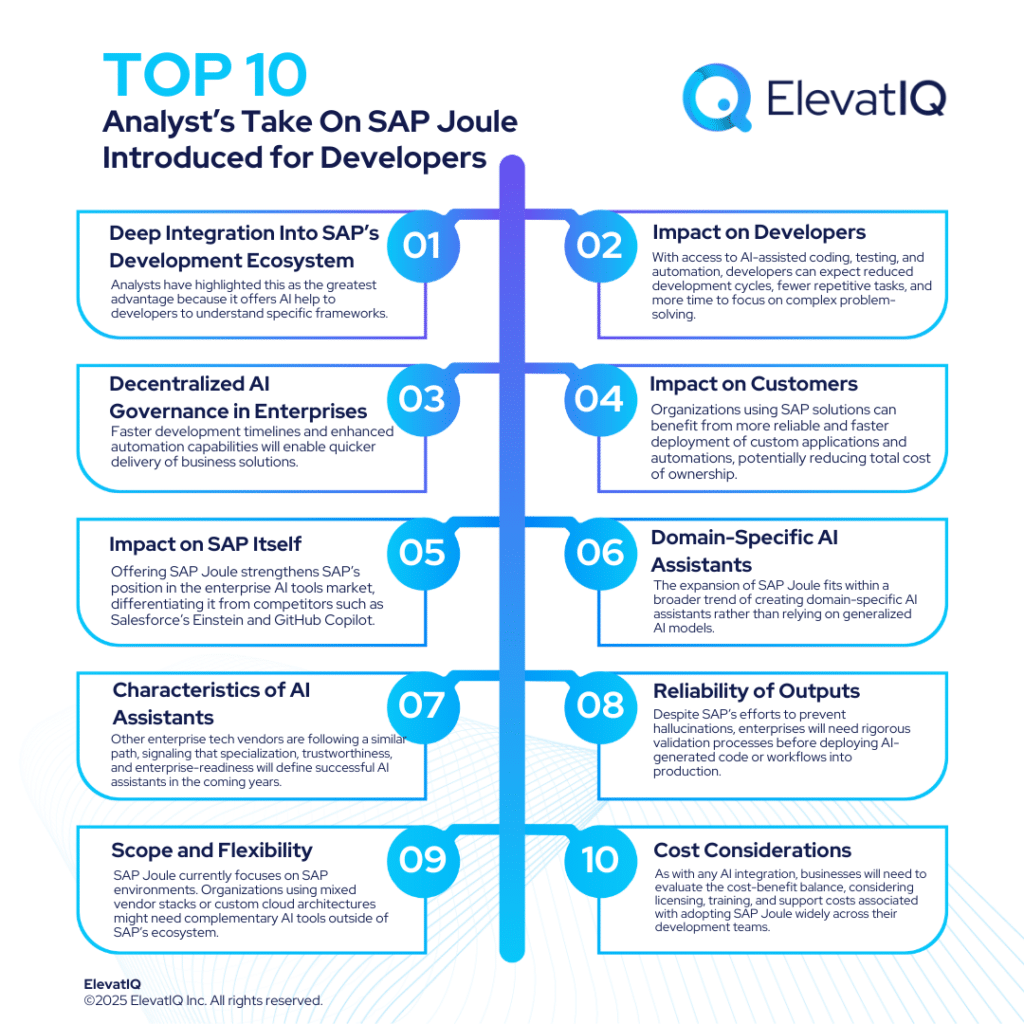
Analysts have highlighted that the biggest advantage of Joule is its deep integration into SAP’s development ecosystem, offering developers AI help that understands the specific frameworks, business processes, and governance models used by SAP customers.

Impact on Stakeholders

The rollout of SAP Joule for developers impacts multiple groups within the SAP ecosystem:

  • Developers: With access to AI-assisted coding, testing, and automation, developers can expect reduced development cycles, fewer repetitive tasks, and more time to focus on complex problem-solving.
  • Business Users and Project Managers: Faster development timelines and enhanced automation capabilities will enable quicker delivery of business solutions.
  • SAP Customers: Organizations using SAP solutions can benefit from more reliable and faster deployment of custom applications and automations, potentially reducing total cost of ownership.
  • SAP Itself: Offering Joule strengthens SAP’s position in the enterprise AI tools market, differentiating it from competitors such as Salesforce’s Einstein and GitHub Copilot.

Future Predictions and Industry Trends

The expansion of SAP Joule fits within a broader trend of creating domain-specific AI assistants rather than relying on generalized AI models. Enterprises increasingly demand AI tools that understand industry-specific language, workflows, and compliance requirements. Looking ahead, SAP is likely to enhance Joule further, deepening its integration with ABAP Cloud and SAP Build solutions. Future updates may introduce new support for cross-application workflows, deeper analytics integration, and multi-language support for global developer teams.

There is also potential for SAP to expand Joule into areas like predictive business process management, AI-driven security auditing, and intelligent debugging. These expansions would align with broader enterprise priorities around AI governance, observability, and resilience. Other vendors in the enterprise technology space are moving in a similar direction, indicating that specialization, trustworthiness, and enterprise readiness will become the defining characteristics of successful AI assistants over the next several years.

Key Considerations and Challenges

While SAP Joule offers clear benefits, certain challenges must be addressed:

  • Reliability of Outputs: Despite SAP’s efforts to prevent hallucinations, enterprises will need rigorous validation processes before deploying AI-generated code or workflows into production.
  • Security and Data Privacy: As SAP Joule operates within sensitive development environments, ensuring full compliance with GDPR, HIPAA, and other regulatory standards remains critical.
  • Developer Training and Change Management: To leverage SAP Joule effectively, developers must be trained not just on usage but also on understanding when to trust, edit, or override AI-generated suggestions.
  • Scope and Flexibility: SAP Joule currently focuses on SAP environments. Organizations using mixed vendor stacks or custom cloud architectures might need complementary AI tools outside of SAP’s ecosystem.
  • Cost Considerations: As with any AI integration, businesses will need to evaluate the cost-benefit balance, considering licensing, training, and support costs associated with adopting SAP Joule widely across their development teams.
Top 15 Digital Transformation Trends - Download

FAQs

SAP: Joule Introduced for Developers Read More »

Zendesk: Acquisition Of Local Measure To Strengthen AI-Powered Voice Solutions

Zendesk: Acquisition Of Local Measure To Strengthen AI-Powered Voice Solutions

Zendesk, a leader in AI-driven customer service solutions, recently announced its agreement to acquire Local Measure, an Australian-based Contact Center as a Service (CCaaS) provider. This Zendesk acquisition is aimed at expanding its AI-powered voice capabilities and deepening its integration with Amazon Connect, AWS’s cloud-based contact center solution. The move signifies Zendesk’s commitment to enhancing its position in the enterprise customer service market, especially in high-volume, complex service environments.

The Zendesk acquisition of Local Measure aligns with the broader industry trend of consolidating AI-driven customer experience platforms. As businesses increasingly shift towards cloud-based and AI-enhanced customer service operations, this deal could mark a significant milestone in redefining how companies approach customer interactions through voice technology. This article provides a detailed breakdown of the Zendesk Acquisition and an analysis of its potential impact on businesses, stakeholders, and the broader industry.

Breakdown of the Zendesk Acquisition

The Zendesk acquisition of Local Measure strengthens its AI-powered voice automation and deepens integration with Amazon Connect. This breakdown will explore the strategic intent behind the acquisition, its financial and legal aspects, and leadership perspectives.

Strategic Intent and Expansion into AI-Powered Voice Solutions

The Zendesk acquisition of Local Measure is a strategic move to strengthen its offerings in AI-powered voice automation. Local Measure specializes in enhancing customer interactions using AI-driven automation, intelligent call routing, and real-time insights. By acquiring this technology, Zendesk aims to provide a seamless, scalable, and intelligent voice solution for enterprises handling high customer volumes.

This acquisition will allow Zendesk to:

  • Provide businesses with enhanced customer service analytics and real-time decision-making tools.
  • Improve AI-driven automation and call routing.
  • Offer a fully integrated voice solution with Amazon Connect.

Strengthening AWS Integration with Amazon Connect

A key highlight of the Zendesk acquisition is the deeper integration with Amazon Web Services (AWS). Local Measure has been known for its seamless compatibility with Amazon Connect, a cloud-based contact center platform. The acquisition will likely boost Zendesk’s ability to offer cloud-native AI-powered voice solutions by leveraging AWS’s security, scalability, and automation features.

For Zendesk, this means:

  • A more robust partnership with AWS.
  • Better cloud-native capabilities for large enterprises.
  • Faster deployment of AI-driven customer support tools.

With AWS becoming a dominant player in the cloud contact center space, this Zendesk acquisition could position the company as a formidable alternative to traditional CCaaS providers.

Salesforce vs Zendesk, Comparison Report

The Zendesk acquisition of Local Measure is being executed under Australian corporate law through a scheme of arrangement. The deal, which is expected to close by May 2025, is subject to shareholder, regulatory, and court approvals. While exact financial details have not been disclosed, industry estimates suggest the deal values Local Measure at around $100 million.

The financial structure of the acquisition reflects Zendesk’s strategic investment in long-term growth rather than a short-term revenue boost. With AI-powered voice services gaining traction, this Zendesk acquisition could provide long-term competitive advantages, particularly in enterprise-level customer service markets.

Leadership Perspectives and Market Positioning

Zendesk’s leadership has emphasized that this Zendesk acquisition is a step toward providing a fully integrated AI-powered voice solution. CEO Tom Eggemeier stated, “With the acquisition of Local Measure, Zendesk is accelerating its ability to provide a fully integrated, AI-powered voice solution that combines the best of our platform with the flexibility, security, and scalability of Amazon Connect.”

From Local Measure’s perspective, CEO Jonathan Barouch remarked, “This acquisition means faster deployment, reduced complexity, and cloud-native innovation. Together with Zendesk, we are bringing a fresh alternative to legacy contact center providers.”


The 2026 Digital Transformation Report

Thinking of embarking on a ERP journey and looking for a digital transformation report? Want to learn the best practices of digital transformation? Then, you have come to the right place.

Analyst’s Take on the Zendesk Acquisition

The Zendesk acquisition of Local Measure reflects key industry trends, including the shift toward AI-powered customer service, cloud-based platforms, and market consolidation. This section will analyze how the acquisition aligns with these trends, its impact on various stakeholders, and potential challenges Zendesk may face in execution and adoption.

The Zendesk acquisition of Local Measure aligns with several key industry trends:

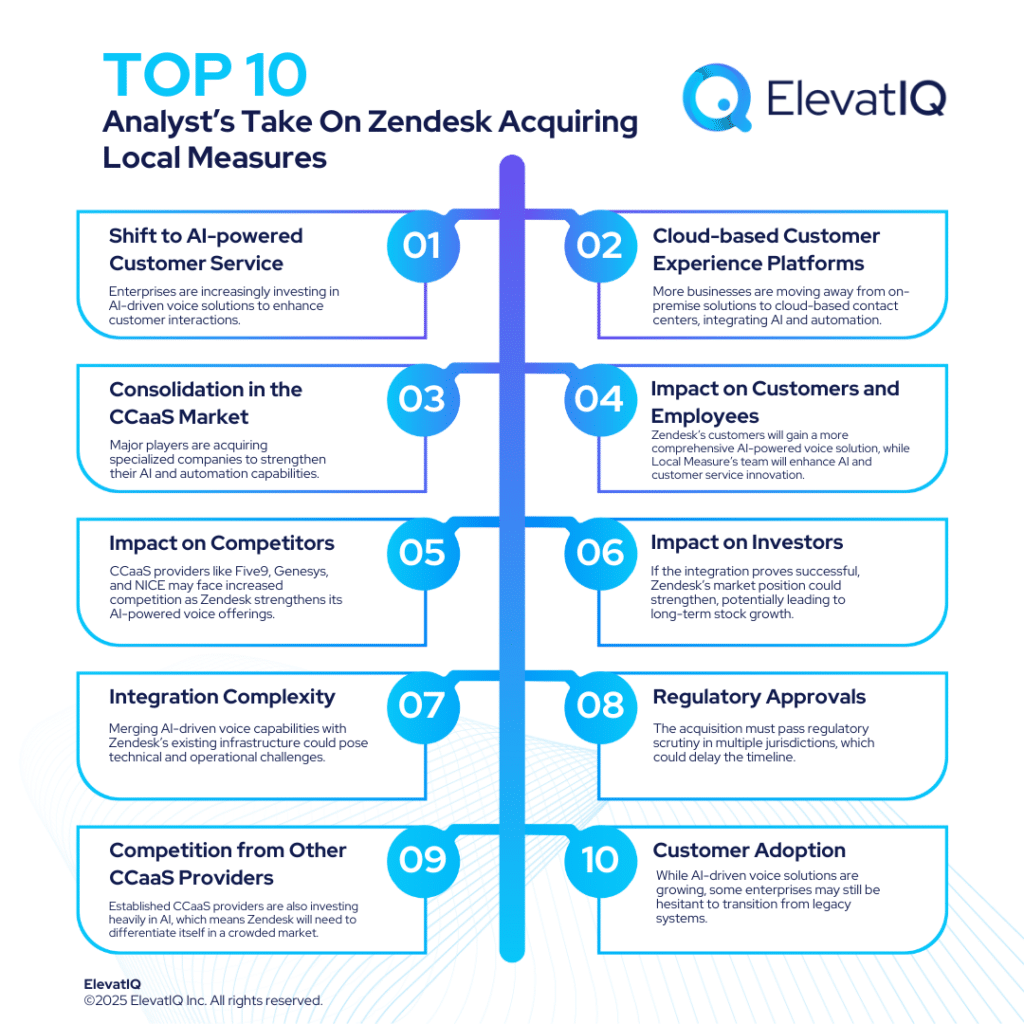
  • Shift to AI-powered Customer Service: Enterprises are increasingly investing in AI-driven voice solutions to enhance customer interactions.
  • Cloud-based Customer Experience Platforms: More businesses are moving away from on-premise solutions to cloud-based contact centers, integrating AI and automation.
  • Consolidation in the CCaaS Market: Major players are acquiring specialized companies to strengthen their AI and automation capabilities.

Impact on Stakeholders

The Zendesk acquisition is expected to affect various stakeholders in different ways:

  • Customers: Zendesk’s existing customers will likely benefit from a more comprehensive AI-powered voice solution. The integration with AWS could lead to improved scalability and security.
  • Competitors: CCaaS providers like Five9, Genesys, and NICE may face increased competition as Zendesk strengthens its AI-powered voice offerings.
  • Investors: If the integration succeeds Zendesk’s market position could strengthen, potentially leading to long-term stock growth.
  • Employees: Local Measure’s team will likely integrate with Zendesk’s AI and customer service divisions, contributing to product innovation.

Challenges and Potential Risks

While the Zendesk acquisition presents significant opportunities, there are potential challenges:

  • Integration Complexity: Merging AI-driven voice capabilities with Zendesk’s existing infrastructure could pose technical and operational challenges.
  • Regulatory Approvals: The acquisition must pass regulatory scrutiny in multiple jurisdictions, which could delay the timeline.
  • Competition from Other CCaaS Providers: Established CCaaS providers are also investing heavily in AI, which means Zendesk will need to differentiate itself in a crowded market.
  • Customer Adoption: While AI-driven voice solutions are growing, some enterprises may still be hesitant to transition from legacy systems.
Top 15 Digital Transformation Trends - Download

FAQs

Zendesk: Acquisition Of Local Measure To Strengthen AI-Powered Voice Solutions Read More »

SAP: Joule AI Agents Redefining Business Process Automation

SAP: Joule AI Agents Redefining Business Process Automation

 SAP has unveiled Joule AI Agents, an expansion of its generative AI copilot, Joule, aimed at transforming enterprise collaboration and automation. By integrating AI-driven agents across business functions like finance, sales, and customer service, SAP seeks to streamline processes, reduce inefficiencies, and enable faster decision-making. These AI agents leverage SAP Business Data Cloud and SAP Knowledge Graph to ensure accurate, context-driven actions. This article provides a detailed breakdown of SAP’s announcement, the key components of Joule AI Agents, and an analysis of its potential impact on businesses, stakeholders, and the broader industry.

Breakdown of SAP’s Joule AI Agents

Joule AI Agents are designed to streamline business operations by improving cross-functional collaboration and leveraging enterprise data effectively. With features like automated classification, knowledge management, and dispute resolution, Joule AI Agents enhance workflow efficiency across various departments.

Addressing Cross-Functional Collaboration Challenges

One of the primary objectives of Joule AI Agents is to resolve inefficiencies in business workflows, where different departments operate in silos. Many organizations struggle with aligning data, decisions, and actions, leading to delays and miscommunications. Joule AI Agents aim to bridge these gaps, ensuring seamless coordination across business functions.

Foundation: SAP Business Data Cloud & SAP Knowledge Graph

SAP highlights that AI effectiveness depends on access to high-quality, unified data. The SAP Business Data Cloud serves as a centralized data layer, combining SAP and non-SAP sources to provide AI agents with relevant business context. Additionally, the SAP Knowledge Graph acts as a semantic bridge, helping Joule AI Agents understand relationships between data and processes. This allows the agents to make informed, context-aware decisions rather than relying solely on generic AI models.

Salesforce vs SAP C/4 HANA CRM

Key AI Agents Introduced by SAP

SAP has launched ready-to-use Joule agents across multiple business functions, with further expansions planned in 2025. Some of the notable agents include:

  • Cash Collection Agent: Analyzes and resolves disputes in seconds by working across finance, customer service, and operations.
  • Q&A Agent: Proactively identifies customer questions and provides accurate answers based on internal knowledge bases.
  • Knowledge Creation Agent: Converts new case resolutions into structured knowledge articles, improving knowledge management.
  • Case Classification Agent: Intelligently classifies and routes customer inquiries, even when specific keywords are missing.

These AI agents work collaboratively, enabling end-to-end process automation. For example, the Case Classification Agent can detect a billing dispute and immediately assign it to the Cash Collection Agent, reducing resolution time.

Customization with Joule Studio

SAP plans to launch a custom agent builder within Joule Studio, allowing businesses to create AI agents tailored to their specific processes. This no-code/low-code tool will empower companies to design AI-driven workflows using SAP Build, ensuring adaptability to unique business needs.

AI Orchestration: Beyond a Copilot

SAP positions Joule not just as an AI assistant but as an AI orchestrator capable of managing multiple AI agents across different business areas. By coordinating out-of-the-box and custom AI agents, SAP aims to create a fully automated, adaptive AI ecosystem within enterprises.


The 2026 Digital Transformation Report

Thinking of embarking on a ERP journey and looking for a digital transformation report? Want to learn the best practices of digital transformation? Then, you have come to the right place.

Analyst’s Take: Observations & Implications

The introduction of Joule AI Agents aligns with the growing trend of AI-driven enterprise automation, positioning SAP alongside key industry players. As businesses integrate Joule AI Agents, factors like data security, AI adoption challenges, and evolving workforce roles will shape the long-term impact of this technology.

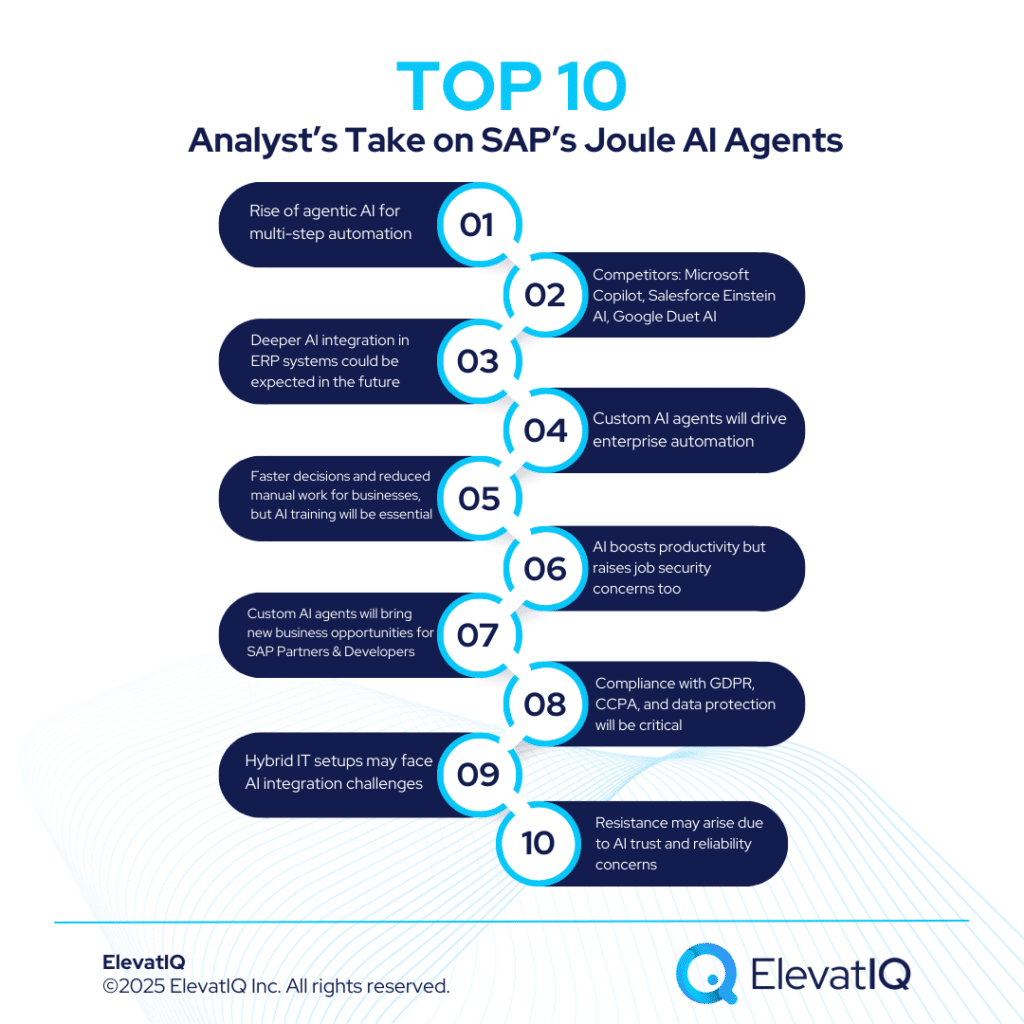
  • The rise of agentic AI, where AI systems autonomously complete complex, multi-step processes, is a growing trend. Competitors like Microsoft Copilot, Salesforce Einstein AI, and Google Duet AI are also moving towards AI-powered workflow automation.
  • SAP’s focus on trusted business data differentiates Joule from general-purpose AI assistants, as data governance and reliability are major concerns in enterprise AI adoption.

Future Predictions

  • SAP’s planned expansion of Joule AI Agents across its Business Suite suggests a long-term vision where AI becomes deeply embedded in ERP systems, potentially reducing human intervention in routine processes.
  • The introduction of a custom AI agent builder signals an upcoming trend where businesses will increasingly develop tailored AI solutions rather than relying on pre-built AI models.

Impact on Stakeholders

  • Enterprises: Organizations using SAP’s ERP solutions can expect faster decision-making, reduced manual effort, and enhanced process efficiency. However, they may need to invest in AI training and integration to maximize benefits.
  • Employees: While AI-driven automation can increase productivity, concerns over job displacement in areas like customer support and finance may arise. Instead of replacing roles, AI is likely to augment human workers by handling repetitive tasks.
  • SAP Partners & Developers: The Joule Studio AI agent builder presents opportunities for developers and SAP partners to create and monetize custom AI solutions.

Challenges & Considerations

  • Data Privacy & Security: As AI agents access sensitive business data, ensuring compliance with GDPR, CCPA, and enterprise security policies will be critical.
  • Integration Complexity: Businesses operating on hybrid IT infrastructures (SAP + non-SAP applications) may face challenges in achieving seamless AI integration.
  • User Adoption: Despite automation benefits, enterprise AI adoption often faces resistance due to concerns over AI reliability and trust. SAP may need to focus on AI explainability and user training.
Top 15 Digital Transformation Trends - Download

FAQs

SAP: Joule AI Agents Redefining Business Process Automation Read More »

ThoughtSpot: Analyst Studio Unveiled to Support AI-Driven Data Analysis

ThoughtSpot: Analyst Studio Unveiled to Support AI-Driven Data Analysis

ThoughtSpot Analyst Studio, a new data preparation and analytics platform, has been launched to enhance efficiency for data teams. Designed to streamline workflows, it aims to address challenges such as slow time-to-value, data silos, high costs, and limited technical capabilities. By incorporating AI-assisted tools, the platform empowers analysts to optimize data readiness for AI and business intelligence.

As organizations increasingly depend on AI-driven insights, the demand for seamless, cost-effective data preparation has grown. ThoughtSpot Analyst Studio bridges the gap between raw data and actionable intelligence, offering tools to prepare AI-ready datasets, reduce costs, and improve accessibility. Below is a detailed breakdown of its features, target audience, technical aspects, and strategic implications.

Purpose and Benefits

Solving Key Challenges in Data Preparation

ThoughtSpot Analyst Studio is built to address several pain points for data teams and organizations:

  • Eliminating Data Silos: It integrates various sources into a unified workspace, ensuring seamless data access.
  • Reducing Analytics Costs: Features like Datasets allow users to choose between real-time or periodic data snapshots, optimizing cloud expenditure.
  • Enhancing AI Readiness: The AI-assisted SQL editor and real-time collaboration tools help analysts prepare structured datasets for AI applications.
Business Benefits of ThoughtSpot Analyst Studio
  • Faster Decision-Making: Businesses can reduce the time spent on data preparation, enabling quicker insights.
  • Improved Collaboration: The platform fosters cross-functional teamwork between analysts, engineers, and business teams.
  • Optimized Cloud Resource Utilization: With configurable data extraction and live querying, organizations can balance performance and cost efficiency.

Key Features and Functionality

AI-Ready Data Preparation
  • ThoughtSpot Analyst Studio enables direct connectivity to multiple data sources, including cloud data warehouses, databases, and applications like Google Sheets.
  • The AI-assisted SQL editor includes autocomplete, query history tracking, and NLP-based query generation, making it faster and more accessible for users of all skill levels.
End-to-End Analytics Workflow
  • ThoughtSpot Analyst Studio combines ad-hoc analysis and advanced data science, eliminating the need for multiple tools.
  • Users can choose between live data connections and extracted datasets, helping them optimize cloud performance and costs.
Unique Features Compared to Other Data Preparation Tools
  • Seamless Multi-Language Support: The platform supports SQL, Python, and R within a single interface, eliminating the need for separate tools.
  • Datasets for Performance Optimization: The “Datasets” feature allows users to work with either static snapshots or real-time data feeds, ensuring efficient resource usage and cost control.


The 2026 Digital Transformation Report

Thinking of embarking on a ERP journey and looking for a digital transformation report? Want to learn the best practices of digital transformation? Then, you have come to the right place.

Target Audience and Usability

Who Can Benefit from ThoughtSpot Analyst Studio?
  • Data Analysts: Gain access to AI-assisted SQL querying and seamless integration with major cloud platforms.
  • Business Teams: The platform enables real-time collaboration, reducing reliance on technical teams.
  • Enterprises and SMBs: While large enterprises may see the most impact, smaller businesses can also leverage its advanced tools for cost and performance optimization.
Compatibility with Cloud Platforms
  • The tool is designed to be user-friendly, with AI assistance making it accessible to both technical and non-technical users.
  • ThoughtSpot Analyst Studio integrates with leading data platforms like Snowflake, Databricks, and Google BigQuery.

Strategic Value and Industry Relevance

Industry Trends Driving the Launch
  • Self-service analytics is growing, increasing demand for user-friendly data tools.
  • AI-powered query generation and automated data preparation are becoming key differentiators in the analytics market.
  • Businesses are seeking cost-optimized cloud solutions as cloud computing expenses continue to rise.
Enhancing Collaboration Between Data and Business Teams
  • ThoughtSpot Analyst Studio supports multi-language data manipulation and real-time collaboration, thus ensuring smoother workflows.
  • The ability to perform ad-hoc analysis without needing additional tools particularly reduces dependency on IT and data engineers.
Future Developments and AI Expansion
  • Potential expansions could include automated data cleansing, predictive analytics, and also customizable AI models.
  • While no specific enhancements have been announced, ThoughtSpot’s investment in AI suggests further AI-driven features may be introduced.

Practical Details and Access

Availability and Pricing
  • For Existing ThoughtSpot Customers: ThoughtSpot Analyst Studio is available as an add-on for ThoughtSpot Cloud users.
  • Pricing: While exact pricing is not disclosed, interested users can contact ThoughtSpot for customized pricing based on their requirements.
Adoption Considerations
  • Learning Curve: While AI-assisted tools simplify workflows, organizations may require training to maximize usage.
  • Vendor Lock-in Risks: Businesses using Tableau or Power BI may face integration challenges when transitioning.
  • Cost-Benefit Analysis: Organizations should assess whether live vs. extracted datasets align with their budget and data usage needs.

Analyst’s Take: Key Considerations and Market Impact

Impact on Different Stakeholders
  • Data Analysts: Gain greater control over data preparation, thus reducing IT dependency.
  • Business Leaders: Improved data accessibility accelerates AI-driven decision-making.
  • Data Engineers: Workloads may shift as analysts take on more data transformation tasks.
Competitive Landscape
  • ThoughtSpot Analyst Studio vs. Tableau, Looker, and Power BI: The platform is positioned as a self-service, AI-powered alternative but will compete with established BI tools.
  • AI in Analytics: AI-assisted query generation and automation are likely to become industry standards, particularly making ThoughtSpot Analyst Studio increasingly relevant.
Challenges and Considerations for Buyers
  • Integration Complexity: Businesses must ensure ThoughtSpot Analyst Studio integrates smoothly with their existing stack.
  • Long-Term Viability: Buyers should assess whether ThoughtSpot’s AI-driven approach aligns with their long-term analytics strategy.
Top 15 Digital Transformation Trends - Download

FAQs

ThoughtSpot: Analyst Studio Unveiled to Support AI-Driven Data Analysis Read More »

smartsheet acquisition

Smartsheet: Blackstone & Vista Equity Partners Finalize $8.4B Acquisition

Blackstone and Vista Equity Partners have completed their Smartsheet acquisition, a work management and collaboration platform, in an $8.4 billion all-cash transaction. Smartsheet shareholders received $56.50 per share, a price reflecting an 8.5% premium over the company’s last closing price before the announcement and a 41% premium over its 90-day volume-weighted average stock price as of July 17, 2024. Following the completion of the deal, Smartsheet has officially transitioned into private ownership and has been delisted from the New York Stock Exchange.

The Smartsheet acquisition is part of a broader trend of private equity firms investing in high-growth SaaS companies, particularly those that integrate AI and automation into enterprise workflows. With Blackstone and Vista Equity Partners taking control, the focus will likely shift toward enhancing Smartsheet’s AI capabilities, expanding its market reach, and improving operational efficiency. This transition raises key questions about its impact on customers, employees, and the competitive landscape of the work management software industry.

Breakdown of the Smartsheet Acquisition

The Smartsheet acquisition agreement includes several key elements:

  • Transaction Value and Premium: The deal was completed at $56.50 per share, representing an 8.5% increase from Smartsheet’s last closing price before the announcement and a 41% premium over its 90-day volume-weighted average stock price as of July 17, 2024.
  • Go-Shop Period: The agreement allowed Smartsheet a 45-day “go-shop” period to explore alternative acquisition offers. However, no competing proposals emerged.
  • Delisting from NYSE: With the Smartsheet acquisition finalized, the company’s shares have been removed from public trading, making it a privately held firm.

This deal highlights the growing interest of private equity firms in the SaaS market, where recurring revenue models and AI-driven automation make companies like Smartsheet attractive investment opportunities.

Strategic Rationale for the Smartsheet Acquisition

Blackstone and Vista Equity Partners have been actively investing in enterprise SaaS platforms. Their investment in Smartsheet signals confidence in its potential for long-term growth and scalability. The Smartsheet acquisition is expected to enable the company to:

  • Enhance AI and Automation Capabilities: AI-driven automation is a key focus area in work management software. With additional investment, Smartsheet is likely to integrate more AI-powered features, such as predictive analytics and workflow automation.
  • Improve Operational Efficiencies: Private equity firms often streamline operations in acquired companies, which could lead to restructuring efforts aimed at enhancing profitability and cost management.
  • Expand Market Reach: Smartsheet may prioritize global expansion and deeper penetration into the enterprise sector.

These strategic priorities align with broader trends in SaaS, where automation and AI-driven solutions are becoming critical competitive differentiators.


The 2026 Digital Transformation Report

Thinking of embarking on a ERP journey and looking for a digital transformation report? Want to learn the best practices of digital transformation? Then, you have come to the right place.

Impact of the Smartsheet Acquisition on Stakeholders

The acquisition of Smartsheet by Blackstone and Vista Equity Partners is expected to bring changes across multiple stakeholder groups, including customers, employees, and competitors. Here’s how each group may be impacted by this acquisition.

For Smartsheet Customers

Existing users of Smartsheet may see continued investment in AI-driven features, though potential adjustments to service structures could occur.

  • AI and Automation Advancements: Smartsheet is expected to introduce new AI-powered tools to enhance workflow efficiency.
  • Potential Pricing Adjustments: Private equity ownership often leads to reevaluated pricing models. While no immediate changes have been announced, customers may see modifications in subscription tiers.
  • Long-Term Product Development: The Smartsheet acquisition provides the company with financial backing to innovate further, but its long-term direction will depend on the priorities set by Blackstone and Vista.


ERP Selection: The Ultimate Guide

This is an in-depth guide with over 80 pages and covers every topic as it pertains to ERP selection in sufficient detail to help you make an informed decision.

For Smartsheet Employees

Employees at Smartsheet may experience changes as the company transitions to private ownership.

  • Expanded AI and Product Development: With increased investment, teams focused on AI and automation could see greater opportunities.
  • Potential Organizational Adjustments: Private equity acquisitions sometimes lead to restructuring efforts aimed at streamlining operations.

While private equity ownership brings financial discipline, it may also introduce shifts in corporate culture and management strategies.

For Competitors in the Work Management Market

The Smartsheet acquisition could have implications for competitors such as Asana, Monday.com, and Atlassian.

  • Increased Market Competition: Backed by Blackstone and Vista, Smartsheet may enhance its enterprise positioning, prompting rivals to strengthen their offerings.
  • Potential Industry Consolidation: The deal signals a trend of private equity investments in SaaS, which could lead to more mergers and acquisitions.
  • Shifts in Market Strategy: Competing vendors may need to refine pricing models, introduce new integrations, or differentiate their AI capabilities.

With AI and automation becoming key drivers of innovation, competitors will likely accelerate their technological advancements to remain competitive.

Analyst’s Take on the Smartsheet Acquisition

The Smartsheet acquisition by Blackstone and Vista Equity Partners presents both opportunities and challenges as the company transitions to private ownership. While increased financial flexibility could support long-term innovation, a shift in strategic priorities—such as profitability and operational efficiency, may influence its future direction.

Smartsheet’s Future Under Private Ownership

The Smartsheet acquisition presents both opportunities and challenges. While private ownership offers financial flexibility to pursue long-term innovation, new priorities, such as profitability and operational efficiency could shape Smartsheet’s future direction.

Key factors influencing its trajectory include:

  • Operational Adjustments: Changes in pricing, service structures, or internal processes could affect users and employees.
  • AI and Automation Integration: Continued advancements in AI-driven tools could reinforce Smartsheet’s market position.
  • Expansion Strategy: The company may focus on international markets and enterprise growth.


ERP Selection Requirements Template

This resource provides the template that you need to capture the requirements of different functional areas, processes, and teams.

The Smartsheet acquisition reflects a larger movement in which private equity firms are actively investing in SaaS.

  • Potential for Market Consolidation: More acquisitions in the SaaS industry could reshape competitive dynamics.
  • Recurring Revenue Models: SaaS companies offer predictable revenue, making them attractive investment opportunities.
  • AI and Automation Focus: Increasing AI adoption in enterprise software is shaping investment strategies.

Challenges and Risks of the Smartsheet Acquisition

While the acquisition presents several growth opportunities, potential risks include:

  • Operational Execution Risks: Ensuring a smooth transition while maintaining innovation will be critical for Smartsheet’s success.
  • Regulatory Scrutiny: Large technology deals sometimes face regulatory reviews, particularly regarding competition.
  • Customer Adaptation: If service models change significantly, user retention could be impacted.
+

ERP Implementation Failure Recovery

Learn how Frederick Wildman struggled with Microsoft Dynamics 365 ERP implementation failure even after spending over $5M and what options they had for recovery.

FAQs

Smartsheet: Blackstone & Vista Equity Partners Finalize $8.4B Acquisition Read More »

Zoho Analyst Day 2025: What It Means for Enterprises

Zoho Analyst Day 2025: What It Means for Enterprises

At its Analyst Day 2025, Zoho Corporation outlined its vision for enterprise automation, emphasizing Agentic AI and IoT-driven business solutions. The company’s latest advancements indicate a shift toward task-specific AI agents and an expanded IoT ecosystem. This positions the company as a key player in AI-powered enterprise software. While many technology companies focus on large, generalized AI models, Zoho has adopted an industry-specific approach. It is developing lightweight AI agents tailored for automation, security, and real-time decision-making. According to the company, these Agentic AI systems offer greater adaptability and explainability compared to traditional AI models.

Alongside AI developments, Zoho introduced new IoT solutions for manufacturing, smart buildings, energy management, and connected OEMs. It has fully integrated these solutions with its software suite and enabled support for third-party applications. This expands their use cases across various enterprise environments. The event also brought leadership changes, with co-founder Sridhar Vembu transitioning to Chief Scientist. He will focus on AI research and innovation. Meanwhile, Shailesh Kumar Davey, another co-founder, was appointed CEO, ensuring continuity in Zoho’s long-term strategic direction.

This article provides a detailed breakdown of Zoho’s key announcements and their implications for enterprises. It also includes an analyst’s perspective on opportunities, challenges, and future predictions for Zoho and its customers.

Breakdown of Key Announcements

Zoho Analyst Day 2025 brought several strategic updates, highlighting the company’s focus on AI, IoT, and enterprise automation. From leadership transitions to the introduction of Agentic AI and expanded IoT capabilities, Zoho’s latest developments signal a strong commitment to innovation. The following sections provide a detailed look at Zoho’s key announcements and their potential impact on businesses.

Leadership Transition and Strategic Vision

Zoho has undergone a major leadership transition, with former CEO Sridhar Vembu becoming Chief Scientist. He will focus on AI research and deep-tech innovation. Meanwhile, Shailesh Kumar Davey, a co-founder of Zoho, has been promoted to CEO. This is ensuring continuity in leadership as the company accelerates its AI and IoT expansion. This shift reflects Zoho’s long-term commitment to AI development, reinforcing its strategy to stand out through practical, industry-driven AI solutions. Unlike competitors investing in large-scale generative AI models, Zoho is prioritizing Agentic AI. It is smaller, task-specific AI agents designed for real-world business applications.


The 2026 Digital Transformation Report

Thinking of embarking on a ERP journey and looking for a digital transformation report? Want to learn the best practices of digital transformation? Then, you have come to the right place.

Introduction of Agentic AI

Zoho has introduced its next-generation Agentic AI framework, marking a significant step forward in its artificial intelligence capabilities. The company’s AI evolution has progressed through several stages, beginning with Proactive AI, which focused on basic automation. It was followed by Prescriptive AI, designed for recommendation-based intelligence. This was later expanded with Generative AI, enabling content creation and workflow automation. The latest development, Agentic AI, brings AI-driven decision-making and autonomous agents capable of operating independently in business environments. Unlike large, compute-intensive AI models, Zoho’s approach prioritizes specialized, task-specific AI agents designed for practical, real-world applications.

Core advantages of Zoho’s Agentic AI approach:

  • Task-Specific AI Agents: These agents handle specific tasks like decision-making, automation, and workflow optimization.
  • Explainability & Testability: AI decisions are not just automated but also verifiable through machine-checkable logic, making them more reliable for enterprises.
  • No-Code AI Customization: Businesses can train AI agents without needing extensive technical expertise, accelerating adoption.


ERP Selection: The Ultimate Guide

This is an in-depth guide with over 80 pages and covers every topic as it pertains to ERP selection in sufficient detail to help you make an informed decision.

Expansion of the Zia AI Platform

Zoho’s Zia AI platform was upgraded with several new tools to help businesses implement AI-powered automation:

  • Zia Agents: AI-powered assistants designed to handle industry-specific business tasks.
  • Zia Agent Studio: A no-code AI builder that allows businesses to create and customize AI agents without programming knowledge.
  • Zia Agent Marketplace: A repository of over 1,500 prebuilt AI models, making it easy for companies to deploy AI agents with minimal setup.
  • Zoho’s Retrieval-Augmented Generation (RAG) AI architecture allows AI to learn from real-time data instead of relying on large, pre-trained datasets, reducing bias and improving accuracy.
Zoho CRM vs Microsoft Dynamics

IoT Expansion: Industry-Specific Solutions

Zoho has announced a significant expansion of its IoT capabilities, introducing solutions tailored for industries such as manufacturing, smart buildings, energy management, and connected OEMs. In manufacturing, the company is focusing on industrial IoT solutions that enable predictive maintenance, smart factory operations, and real-time monitoring. For smart buildings, Zoho is offering energy-efficient automation, security management, and remote monitoring solutions designed for commercial infrastructure. In the energy sector, its AI-driven tools aim to enhance grid monitoring and power optimization for providers.

Additionally, for connected OEMs, Zoho is introducing automated quality control, smart supply chain monitoring, and equipment analytics to improve operational efficiency. To ensure seamless integration, Zoho’s IoT ecosystem now supports over 40 communication protocols, including MQTT, BACnet, Modbus, Zigbee, and CoAP, enabling compatibility with a broad range of enterprise systems.

Integration with Zoho and Third-Party Applications

Zoho’s AI and IoT solutions integrate seamlessly with its applications, including Zoho CRM, Zoho Analytics, Zoho Creator, and Zoho Desk. Businesses can also connect Zoho’s AI agents to SAP, Oracle, and Salesforce through API integrations for broader interoperability..The platform is built for scalability, allowing enterprises to deploy AI-driven automation across multiple departments and workflows, enhancing efficiency and operational flexibility.


ERP Selection Requirements Template

This resource provides the template that you need to capture the requirements of different functional areas, processes, and teams.

Security and Compliance in AI & IoT

Zoho has implemented end-to-end encryption across its AI and IoT-driven automation to enhance data privacy and security. In addition, device authentication mechanisms have been introduced to prevent unauthorized access and ensure system integrity. The company is also working toward compliance with major global security frameworks, making its solutions suitable for highly regulated industries such as finance, healthcare, and government.

Future Roadmap: AI-First Vertical Strategy

Zoho is refining its vertical sales strategy by focusing on industry-specific AI solutions to drive enterprise adoption. As part of this effort, the company is developing AI-powered GenAI chatbots that will enable businesses to simplify AI and IoT deployment through natural language interfaces. Looking ahead, Zoho aims to enhance its AI-first approach across all enterprise applications, making automation more intuitive, efficient, and secure.

Analyst’s Take

Zoho’s approach to Agentic AI and IoT integration reflects a strategic focus on enterprise-centric automation, distinguishing itself from competitors that emphasize generalized AI models. By developing task-specific AI agents and expanding secure, scalable IoT solutions, the company is positioning itself within the enterprise software market with a more targeted and adaptable approach.

Strengths & Market Opportunities

  • Structured & Explainable AI
    Zoho’s Agentic AI framework follows a structured, testable model that prioritizes transparency and verifiability in AI-driven decision-making. This approach addresses concerns related to unpredictable AI outputs, which remain a key challenge for enterprises adopting AI technologies.
  • Enhanced Enterprise IoT Integration
    The company’s IoT expansion strengthens its position in industries such as manufacturing, smart infrastructure, and energy management, where real-time monitoring and automation are critical.
  • IT & Security Expansion
    Zoho’s ManageEngine portfolio continues to grow, enhancing its credibility in enterprise IT automation and making it a viable competitor in compliance-heavy industries.
  • Seamless AI Deployment
    Tools like Zia Agent Studio and Agent Marketplace provide businesses with the flexibility to customize AI models without requiring deep technical expertise, simplifying AI adoption across multiple industries.

Considerations & Challenges for Enterprises

  • Adoption & AI Maturity
    Before full-scale deployment, enterprises may benefit from conducting pilot implementations to evaluate the real-world effectiveness of Zoho’s AI agents in specific use cases.
  • Enterprise System Compatibility
    Organizations that rely on SAP, Oracle, or Salesforce should assess potential integration complexities when incorporating Zoho’s AI solutions into their existing workflows.
  • Regulatory & Security Considerations
    Businesses operating in regulated sectors such as healthcare and finance must carefully examine Zoho’s compliance with industry-specific security standards to ensure data privacy and regulatory adherence.

What the Future Looks Like for Zoho and Its Customers?

  1. Deeper AI Integration Across Zoho’s Software Suite – Zoho is likely to expand its AI-driven automation across core applications, including CRM, analytics, customer support, and finance. The introduction of AI-powered workflows may improve operational efficiency and enhance decision-making for businesses.
  2. AI-First Vertical Strategies for Industry-Specific Adoption – Zoho’s emphasis on industry-focused AI suggests the development of sector-specific AI solutions tailored for industries such as retail, healthcare, manufacturing, and logistics. This aligns with increasing enterprise demand for AI tools designed to address specialized business challenges.
  3. Growth in AI-Powered IoT for Industrial Applications – As part of its IoT expansion, Zoho is expected to focus on applications like predictive maintenance, smart infrastructure, and energy management. AI integration within IoT could enable more efficient, real-time decision-making for industrial operations.
  4. Increased Focus on AI Security and Compliance – With growing enterprise reliance on AI, Zoho is likely to strengthen its security and compliance framework, ensuring data privacy and AI transparency. This could include advanced governance tools that allow businesses to monitor and audit AI-driven decisions.
  5. Evolution of Leadership and Research-Driven AI Development – With Sridhar Vembu shifting to the role of Chief Scientist, Zoho may prioritize AI research and innovation, focusing on secure, explainable AI models rather than black-box automation. This approach could help enterprises build trustworthy AI systems with improved testability.
  6. Expansion into Enterprise IT Management & Security – Through ManageEngine, Zoho is expected to enhance its role in enterprise IT automation and security. This makes it a stronger contender in the IT management space. This move could attract large-scale enterprises looking for integrated AI-powered IT solutions.
+

ERP Implementation Failure Recovery

Learn how Frederick Wildman struggled with Microsoft Dynamics 365 ERP implementation failure even after spending over $5M and what options they had for recovery.

FAQs

Zoho Analyst Day 2025: What It Means for Enterprises Read More »

FREE RESOURCE

2026 Digital Transformation Report

This digital transformation report summarizes our annual research on ERP and digital transformation trends and forecasts for the year 2026. 

Send this to a friend