ERP

This category allows you to find ERP-related content on ElevatIQ.com

Infor CloudSuite LN ERP Independent Review 2024

What is Infor? Infor has a complete product suite to meet the needs of an enterprise similar to particularly Epicor, SAP, Oracle, or Microsoft. Infor is also perhaps the only vendor after the larger ones that has the capabilities to build best-of-breed architecture akin to SAP, Oracle, and Microsoft. In fact, Infor might have deeper capabilities than Microsoft in some areas with pre-integrated best-of-breed solutions such as Infor WFM and Nexus. Infor is also the only vendor that can provide depth in several industries while not struggling with the transactional processing requirements of large accounts.

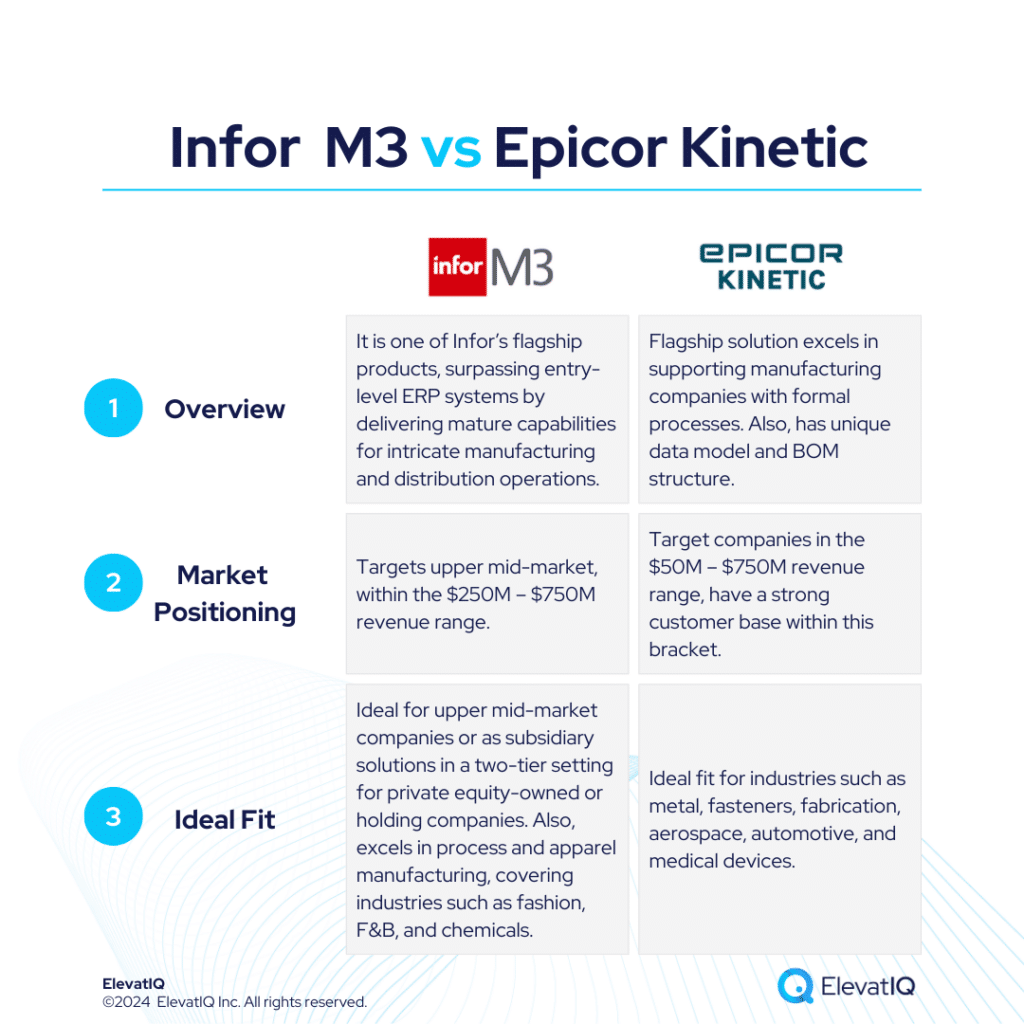
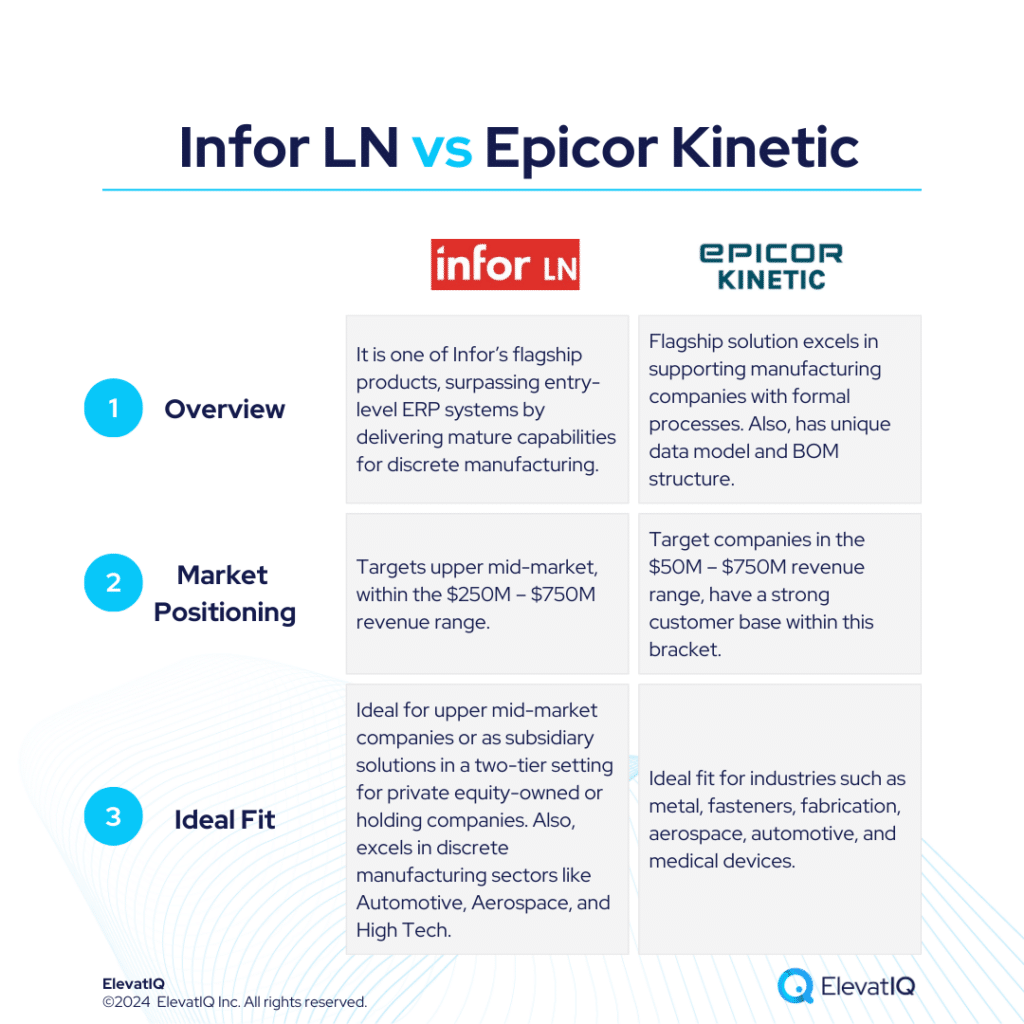
Infor LN is ideal for discrete manufacturing companies. It is successful in the upper mid-market, particularly targeting the $250M – $750M revenue range. Positioned for companies surpassing entry-level ERP systems like Acumatica, Infor CSI, or NetSuite, this solution also delivers mature capabilities for intricate manufacturing intertwined with distribution operations. Infor LN also provides a superior suite experience akin to SAP and Oracle, featuring enterprise-grade best-of-breed functionalities, including PLM, WMS, WFM, BI, and a supply chain collaboration platform.

Limitations with process-centric operations. While Infor LN excels in discrete manufacturing and offers a robust suite experience, it faces certain challenges in specific scenarios, such as process-centric operations for companies. They might also include business operations such as plastic or chemicals as part of their automotive operations. Despite limitations in broader capabilities compared to other vanilla solutions, it’s a great fit in verticals such as Automotive, Aerospace, and industrial manufacturing, seeking operational and supply chain synergies among their global entities and looking for the entire suite purpose-built for these micro-verticals.

Infor CloudSuite LN ERP Independent Review 2024


The 2025 Digital Transformation Report

Thinking of embarking on a ERP journey and looking for a digital transformation report? Want to learn the best practices of digital transformation? Then, you have come to the right place.

Key Review Insights of Infor CloudSuite LN

1. Global Operations

Among the solutions available in the market, Infor LN is one of the few solutions with robust financial hierarchies and also comprehensive global trade compliance functionalities embedded within its product. This can adequately support manufacturers particularly seeking to enhance their global financial and operational synergies. It is specifically designed to address the complexities of international trade and finance, providing the necessary tools to navigate diverse regulatory environments, streamline cross-border operations, and optimize global supply chain management.

2. Last-mile Capabilities for Diversified Manufacturing Business Models

Verticals such as apparel manufacturing demand deeper integration of PLM, vendor portals, and merchandising solutions to effectively manage their unique processes. These industries benefit from a seamless connection between design, production, and distribution stages, ensuring efficiency and also compliance across the entire lifecycle. Such complex manufacturing sectors require sophisticated handling of units, multiple layers of allocation management, and also stringent international trade compliance. Thus, the capabilities in Infor LN help manage the intricate logistics, inventory control, and regulatory adherence inherent in complex manufacturing environments.

3. Legacy UI and Experience

Infor LN is considered a legacy solution primarily due to its outdated user interface and overall user experience. Unlike modern ERP systems, it lacks several key cloud-native capabilities. For instance, it does not offer a comprehensive universal search function, which limits users’ ability to find information across the system quickly. Additionally, its support for mobile experiences is limited, meaning that users may find it challenging to access and interact with the ERP system effectively on mobile devices. These shortcomings can hinder the efficiency and flexibility expected from contemporary ERP solutions.

4. Not the Best Fit as a Corporate Ledger

Infor LN might not be the ERP system for private equity firms and holding companies that need robust global solutions particularly paired with tier-2 solutions at the subsidiary level. Also, its strengths do not align well with the requirements of these entities, which often need highly integrated and scalable systems to manage complex financial structures and global operations. As a result, Infor LN may fall short in meeting the comprehensive needs of these organizations, making it less suitable as a corporate ledger in such contexts.

5. Integration with Other Infor Products

Infor Cloud Suite comprises various products, including Infor SCM, WFM, PLM, and also Burst. These offerings cater to larger multinational companies with complex supply chain networks, providing more robust capabilities than those found in smaller mid-market solutions. For example, Infor WFM excels in managing unionized labor and handling specific reporting and payment requirements. The PLM and SCM systems, as add-ons to the LN product, deliver deep industry-specific capabilities, particularly suited for the automotive and aerospace sectors. Additionally, Infor’s acquisition of Nexus has significantly enhanced the capabilities of its SCM product in global supply chain planning. Previously, Infor’s major gap was in the MES solution, which they have successfully addressed through the acquisition of Lighthouse, resulting in a much stronger MES offering overall.

6. Provides a SAP-like Feel

The integration of Infor LN with MES enhances its capabilities, particularly in complex manufacturing processes. The Gantt view from the project perspective, similar to SAP’s Gantt chart, highlights Infor LN’s robust SAP-like feel, with features such as code configuration, costing, and production management. Infor LN is particularly designed for intricate manufacturing processes that can take months or even years to complete, necessitating meticulous tracking of changes and payments.

7. Beneficial for Project-centric Manufacturing Companies

Infor LN offers significant benefits for project-centric manufacturing companies. The system provides integrated project management, covering everything from engineering to production, estimation and bidding, accounting, procurement, and service. Its robust project scheduling feature encompasses every aspect of a project and is particularly advantageous for industries like aerospace and automotive. Infor LN distinguishes itself from other ERPs with its resource management capabilities, enabling skill-based scheduling for production or services. Additionally, the system helps eliminate silos by providing a common platform for different teams to collaborate and identify bottlenecks.

8. Not Fit for Construction Companies

Infor LN may not be the ideal choice for construction businesses because it has limitations in managing operational aspects like the relationships between general contractors and subcontractors, RFP collaboration, the submittal process, and compliance procedures.

Key Features of Infor CloudSuite LN

Financial Management

In this section, we explore and analyze the financial management module of Infor CloudSuite LN, shedding light particularly on their features and capabilities.

Financial ManagementFeatures
General LedgerThe core component of Infor LN Financials, recording all transactions within the application that affect accounting.
Accounts PayableManages and tracks sales invoices, credit notes, credit checking, credit management, customer balances, and generates interest invoices.
Accounts ReceivableHandles purchase invoices and credit notes, encompassing registration, invoice matching, and supplier balance management.
Cash ManagementOversees cash transactions, including payments and receipts with business partners, and supports manual postings and electronic banking for automatic payments, direct debits, and electronic bank statements.
Financial Budget SystemTracks and manages budget amounts and quantities for planning, enabling overhead cost planning for cost centers and other dimensions.
Cost AccountingDelivers detailed and summarized cost analysis and allocation, tracking actual amounts and performance quantities to control costs by dimension, and calculating actual rates and surcharges.
Budget ControlTracks and manages budget-related transactions, monitoring financial health in real-time to prevent deficits, and integrates accounting and budgeting functions into business processes.
Manufacturing Management

In this section, we explore and analyze the manufacturing management module of Infor CloudSuite LN, shedding light particularly on their features and capabilities.

Manufacturing ManagementFeatures
BOMLists component items of a manufactured product, detailing each item’s position, required quantity, and expiry date.
RoutingOrganizes manufacturing operations by linking them to work centers or machines, offering flexibility with standard, item-specific, network, and order quantity-dependent options.
Assembly PlanningFacilitates planning and generating assembly orders for product variants in high-volume, complex, mixed-model flow production environments.
Assembly ControlSupports companies producing complex product variants in flow assembly lines, adaptable for low-volume environments with order-specific transaction handling.
Repetitive ManufacturingManages production in repetitive manufacturing environments with high-volume production across multiple models.
Job Shop ControlOversees production order creation, planning, and execution procedures.
Project ControlHandles customer-order-driven production, supporting various project and item types with capabilities for estimating, planning, and manufacturing customized and make-to-order items.
Product ConfiguratorDefines product models and generates BOMs/routings based on selected features and options, ensuring buildable products through constraint enforcement at sales time.
Product ClassificationEstablishes a coding system for item data and facilitates efficient data retrieval and classification of new and existing items based on defined criteria.
Manufacturing ControlIncludes dashboards and stores as-built structures of production and assembly orders for monitoring and analysis.
Sales Management

In this section, we explore and analyze the sales management module of Infor CloudSuite LN, shedding light particularly on their features and capabilities.

Sales ManagementFeatures
Sales OrdersFacilitates the sale and delivery of items or services to a sold-to business partner under specified terms. Orders originate from various sources such as contracts, quotations, EDI, and planning, allowing for creation and modification within the Sales module.
Sales QuotationsProvides detailed information to help a business partner make purchasing decisions. They can be created in response to RFQs or used as sales tools to initiate engagements with potential partners.
Sales ContractsFormalizes agreements for delivering specific goods to a business partner. These agreements include detailed terms and conditions, delivery schedules, pricing, and discounts, and can be categorized into normal and special contracts.
Sales SchedulesSupports long-term sales projects with frequent deliveries, offering detailed specifications for delivery dates and times.
Margin ControlManages margins for standard item sales orders and quotations. It ensures that if the net price exceeds defined margins, appropriate actions are taken to maintain profitability.
Consumption HandlingInvolves the issue of consigned items from the warehouse to customers for their use in sales and production activities.
RetrobillingAllows for the re-invoicing of previously shipped items when price changes occur after the renegotiation date.
Commissions and RebatesIncentivize sales performance by rewarding sales-related achievements.
Procurement Management

In this section, we explore and analyze the procurement management module of Infor CloudSuite LN, shedding light particularly on their features and capabilities.

Procurement ManagementFeatures
Purchase RequisitionsAllows non-purchasing users to request materials or services without needing full knowledge of purchasing processes, even for new items or suppliers.
Requests for QuotationsSends RFQs to bidders for goods procurement, specifying items, quantities, and receipt dates, with responses compared, negotiated, and also converted to purchase orders or contracts.
Purchase OrdersCreates and modifies orders for goods and services, forming a legal obligation upon confirmation, and also distributing order information across various company departments.
Purchase ContractsRegisters agreements with suppliers particularly for the delivery of specific goods.
Purchase SchedulesProvides a detailed timetable for material supply, supporting long-term purchasing with frequent deliveries, and also offering full visibility and time-phased material requirements.
Purchase Vendor RatingMeasures vendor performance using objective and subjective criteria to particularly determine the best supplier for raw materials and supplies.
Warehouse Management

In this section, we explore and analyze the warehouse management module of Infor CloudSuite LN, shedding light particularly on their features and capabilities.

Warehouse ManagementFeatures
Inventory Planning and AnalysisReviews planned inventory transactions and also manages inventory commitments efficiently.
Warehouse OrdersManages item receipt, issuance, transfers, inspections, inventory adjustments, cycle counts, and also kit assembly.
Inventory Change OrdersFacilitates item ownership changes, inventory allocation, and also cost peg transfers.
Cross-dockingStreamlines goods flow from receiving to shipping docks directly particularly for efficient logistics management.
Direct Material SupplyGoods move from suppliers or manufacturing directly to consumption points via automatic, interactive, or manual processes.
Handling UnitsHelps utilize handling units linked particularly to warehouse movements such as orders, receipts, inspections, and shipments.
Receipts and InspectionsWarehouse receipts record physical goods acceptance, detailing quantities, dates, packing slips, and also inspection results.
ShipmentsDocuments goods transport specifics particularly including items, destinations, dates, times, and routes.
Quarantine InventoryManages rejected goods in quarantine to decide particularly on disposition options like scrap, rework, or return.
Cycle Counting and Adjustment OrdersConducts manual inventory counts and adjusts LN records at specific stockpoints.
Inventory ReportingGenerates comprehensive reports and inquiries on inventory, transactions, as well as item issues by period and warehouse.
Inventory CostingAnalyzes inventory with methods like ABC analysis, slow-moving item assessments, as well as valuation techniques.
Freight Management

In this section, we explore and analyze the freight management module of Infor CloudSuite LN, shedding light particularly on their features and capabilities.

Freight ManagementFeatures
Freight Order ControlManages and tracks freight orders throughout their lifecycle, particularly from planning to execution and subcontracting.
Freight PlanningPlans inbound and outbound transportation to ensure cost-effective and timely goods movement, also with overviews of transport capacity.
Project Management

In this section, we explore and analyze the project management module of Infor CloudSuite LN, shedding light particularly on their features and capabilities.

Project ManagementFeatures
Contract ManagementManages and retrieves contract-related tasks and data, particularly including contract type, invoice type, amount, and budgeting method.
EstimateCreates and simulates project estimates to secure contracts, also with the option to generate bids from accepted estimates.
Project BudgetManages and retrieves budget-related tasks and data, particularly including various budget types and cost analysis.
Requirements PlanningGenerates planned orders for materials, equipment, and also subcontracting based on data from Budgeting and Planning modules.
Project ProgressMeasures, records, and also monitors project progress.
Project AccountingCreates and maintains transactions particularly for costs, commitments, revenues, and financial results.
Service Management

In this section, we explore and analyze the service management module of Infor CloudSuite LN, shedding light particularly on their features and capabilities.

Service ManagementFeatures
Configuration ManagementManages multi-level asset configurations, defining warranties, and also generating service configurations from various sources, with a graphical overview.
Contract ManagementManages service contracts, creating quotes, defining terms, and also invoicing by installments for steady revenue streams.
Service QuotationsCreates and manages service order quotations, planning, monitoring, processing, and also invoicing, including on-site repairs and upgrades.
Preventive MaintenanceUses preventive maintenance for particularly customer or internal assets, with activities covered by service contracts and controlled automatically.
Territory PlanningOptimizes travel by simulating and assigning engineers to territories, balancing required and also available capacities.
Group PlanningAssigns service engineers or departments to work orders or planned activities, preparing groups for resource assignment.
Field ServiceManages service orders for on-site repairs, replacements, or upgrades, particularly including various order types and work scheduling.
Depot RepairHandles depot-related logistics and financial transactions, particularly including Return Material Authorization (RMA).
Service InspectionRegisters inspections, creates maintenance notifications, and also transfers them for follow-up actions.
Subcontract ManagementDefines and manages subcontract agreements, aligning them with main service contracts, particularly including call dispatching and reminders.
Activity ManagementDefines and maintains predefined maintenance activities based on documents and reports to also support planning and execution.

Pros and Cons of Infor CloudSuite LN

ProsCons
Ideal for upper mid-market companies or as subsidiary solutions in a two-tier setting for private equity-owned or holding companies.The limited focus on certain business models poses the risk of requiring other ERP systems to support complex and diverse business operations such as process manufacturing or metal-centric A&D companies.
It can support the most complex manufacturing business models, WBS-centric manufacturing, or support for attributes with MRP planning.Private equity and holding companies requiring global solutions particularly with a tier-2 solution at the subsidiary level might not be the best use of Infor LN’s strengths.
Most tools that make-to manufacturer would require, such as HCM, PLM, data lake, ERP, WMS, TMS, and advanced supply chain planning, are all pre-integrated with LN.Infor LN is a legacy solution with limited cloud-native capabilities such as universal search, mobile experience, etc
While most smaller solutions might require ad-hoc arrangements for global financial operations, both have them natively built.The consulting base and marketplaces are virtually non-existent for Infor LN.

Conclusion

In conclusion, Infor LN stands out as a robust solution for discrete manufacturing companies, particularly those in the upper mid-market. Its comprehensive suite of functionalities, including advanced PLM, WMS, WFM, and also BI, offers a SAP-like experience tailored to the needs of complex manufacturing and distribution operations. With strong global trade compliance and financial management capabilities, Infor LN is well-suited to support manufacturers particularly seeking to optimize their international operations and navigate diverse regulatory environments. The system’s project-centric features are particularly beneficial for industries like aerospace and automotive, providing integrated project management and resource scheduling that enhance efficiency and collaboration.

However, Infor LN does face certain limitations, especially in areas requiring process-centric operations or modern ERP functionalities. Its legacy user interface and limited cloud-native capabilities, such as universal search and mobile access, can hinder the overall user experience. Additionally, Infor LN may not be the best fit for private equity firms or holding companies needing highly integrated and scalable systems for managing complex financial structures and global operations. Despite these drawbacks, Infor LN’s depth in manufacturing and industry-specific functionalities makes it a valuable asset for companies with intricate and project-based business models, providing a solid foundation for efficient and streamlined operations. Also, companies may benefit from consulting an independent ERP consultant who can provide valuable insights and assessments to determine if Infor CloudSuite LN aligns seamlessly with their organizational requirements.

+

ERP Implementation Failure Recovery

Learn how Frederick Wildman struggled with Microsoft Dynamics 365 ERP implementation failure even after spending over $5M and what options they had for recovery.

FAQs

Infor CloudSuite LN ERP Independent Review 2024 Read More »

NetSuite vs Infor CloudSuite M3 ERP Independent Review 2024

NetSuite caters to globally dispersed small to mid-market firms, offering robust financial capabilities and localization across many countries. On the other hand, Infor CloudSuite M3 targets companies surpassing entry-level ERP systems like Acumatica, Infor CSI, or NetSuite. It also delivers mature capabilities for intricate manufacturing and distribution operations. NetSuite suits diverse businesses, including service-centric, distribution-centric, and B2C organizations. Whereas, Infor CloudSuite M3 is successful in the upper mid-market, targeting the $250M – $750M revenue range.

Infor CloudSuite M3 provides a superior suite experience akin to SAP and Oracle, featuring enterprise-grade best-of-breed functionalities, including PLM, WMS, WFM, BI, and a Supply Chain collaboration platform. On the other hand, NetSuite supports lighter manufacturing and consumer products, particularly in health, beauty, fashion, and CPG. It also targets firms with revenues between $10M and $1B, emphasizing stronger financial capabilities. 

Infor CloudSuite M3 boasts extensive features tailored for process and apparel manufacturing, covering industries such as fashion, F&B, and chemicals. It is also adept at facilitating advanced global operations, particularly for companies spanning multiple countries seeking to optimize cost synergies globally. Choosing between NetSuite vs Infor CloudSuite M3 requires a detailed examination, and thus, this comparison offers valuable insights for ERP selection projects. Therefore, let’s explore further.

NetSuite vs Infor CloudSuite M3 ERP Independent Review 2024


The 2025 Digital Transformation Report

Thinking of embarking on a ERP journey and looking for a digital transformation report? Want to learn the best practices of digital transformation? Then, you have come to the right place.

NetSuiteInfor CloudSuite M3
Started in19982006 (Acquired by Infor)
Ownership byOracle in 2016Koch Industries
No. of customers 37,000+1000+

What is NetSuite?

NetSuite stands out as the leading ERP solution, driven by its success for diverse industries particularly seeking stronger financial capabilities over the operational, robust ecosystem, credible marketplace add-ons, and comprehensive functionality. Although not as complex as some competitors like SAP S/4 HANA and Microsoft F&O, NetSuite excels in supporting diverse business models, including omnichannel architecture, matrix/dimensional inventory, and subscription-based models.

While NetSuite excels across industries, it may not be the ideal choice for industrial distributors and manufacturers due to limitations in pricing and item master capabilities. Its strength lies in supporting lighter manufacturing and consumerized products particularly health and beauty, fashion, apparel, and CPG. With robust financial capabilities and an integrated HCM solution, NetSuite is well-suited for service-centric industries, including smaller banks, credit unions, financial services, non-profit organizations, as well as the technology and media sectors. While NetSuite remains the top-ranked solution due to its product quality, there might be challenges with over-customization and integration issues, leading to implementation failures. Thus, working with NetSuite demands thorough vetting of their solution and architecture.

What Is Infor CloudSuite M3?

Infor CloudSuite M3, is one of Infor’s flagship solutions, catering to particularly distinct micro-verticals across various industries. Sharing similar suites with Infor LN and built on the Infor OS platform, it is successful in the upper mid-market, targeting the $250M – $750M revenue range. Positioned for companies surpassing entry-level ERP systems like Acumatica, Infor CSI, or NetSuite, this solution delivers mature capabilities for intricate manufacturing and distribution operations. Infor CloudSuite M3 provides a superior suite experience akin to SAP and Oracle, featuring enterprise-grade best-of-breed functionalities, including PLM, WMS, WFM, BI, and a Supply Chain collaboration platform.

Infor CloudSuite M3 boasts extensive features tailored for process manufacturing and apparel manufacturing, covering industries such as fashion, F&B, and chemicals. It is also adept at facilitating advanced global operations, particularly for companies spanning multiple countries seeking to optimize cost synergies globally. The native capabilities of Infor M3 address global trade and compliance concerns, which are crucial for international business operations.

While Infor CloudSuite M3 serves as an excellent operational solution for a 2-tier architecture for enterprise companies, its limited focus on certain industries might not be the best fit for enterprise companies diversifying their operations or aggressive with their M&A strategy. The intricate data model and Bill of Materials (BOM) demand significant internal expertise and external advisory assistance to extract operational efficiencies. Notably, the technology landscape for Infor CloudSuite M3 remains somewhat patchy and less modern compared to its competitors. Furthermore, the ecosystem and consulting support for this solution is relatively limited. Despite these challenges, Infor CloudSuite M3 stands out as a robust manufacturing solution for upper mid-market companies with budget constraints.

NetSuite vs Infor CloudSuite M3 Comparison

Navigating the choice between NetSuite vs Infor CloudSuite M3 is a significant decision for businesses particularly looking for operational efficiency and strategic alignment. Thus, this section delves into the comprehensive comparison of NetSuite vs Infor CloudSuite M3 across various critical dimensions.

NetSuiteInfor CloudSuite M3
Global Operational CapabilitiesHandles global multi-entity operations but not suitable for enterprise workloads.Robust financial hierarchies and global trade compliance functionality integrated.
Diverse CapabilitiesFavors B2C, hospitality, and service-centric industries.Supports diversified manufacturing business models.
Best-of-breed CapabilitiesContains pre-integrated HCM and FP&A components with varying maturity.Best-of-breed integrations provided out-of-the-box.
Last-mile Capabilities Limited last-mile capabilities, especially for manufacturing.Last-mile capabilities along with breadth of capabilities for diversified manufacturing business models.
Operational FunctionalitiesRicher financial capabilities over operational features.Infor CloudSuite M3 is a legacy solution with limited cloud-natve capabilities such as universal search, mobile experience, etc.
Integration CapabilitiesOffers several pre-integrated solutions with more options from Celigo.Tools such as HCM, PLM, data lake, ERP, WMS, TMS, and advanced supply chain planning, are all pre-integrated.
Manufacturing Capabilities Limited BOM layers for assembly-centric operations, requiring additional add-ons.Delivers mature capabilities for apparel, F&B, and chemical manufacturing.
Pricing ModelNamed-user based with inflexible long-term contracts.Subscription-based
Key Modules1. Financial Management
2. Accounting
3. Global Business Management
4. Inventory Management
5. Order Management
6. Supply Chain Management
7. Warehouse Management
8. Procurement
9. Customer Relationship Management
1. Financial Management
2. Manufacturing Operations
3. Enterprise Asset Management
4. Supply Chain Management
5. Customer Sales and Service
6. Application Foundation

NetSuite vs Infor CloudSuite M3 Feature Comparison

Both platforms offer a plethora of features and functionalities designed to streamline business operations and enhance efficiency. In this feature comparison, we delve into particularly the distinct capabilities of NetSuite vs Infor CloudSuite M3 across various critical dimensions, providing insights to aid businesses in making informed decisions regarding their ERP selection. Thus, this section discusses features under each of the following modules, particularly financial management and supply chain management.

Financial Management Comparison

In this section, we are discussing a detailed comparison of the financial management capabilities particularly offered by NetSuite vs Infor CloudSuite M3. By examining their respective strengths and functionalities, particularly in managing financial processes. Businesses can therefore gain valuable insights to determine the best-suited ERP solution for their financial management needs.

NetSuite Infor CloudSuite M3
Financial ManagementGeneral LedgerSupports complex general ledgers including public reporting requirements of several countriesEnables organizations to manage financial transactions, maintain accurate balances, and generate complete financial statements.
Accounts Receivable and Accounts PayableAutomates and streamlines invoice delivery, payment processing, and collections management as well as accounts payable processes.Supports analysis across all accounting dimensions, including non-reconciled data for the AP model.
Cash Flow ManagementProvides visibility to optimize cash flows, monitor bank accounts, and manage liquidity.Provides complete control over accounts receivable and cash flow processes, unifying all AR information to monitor cash collection and enhance productivity and efficiency.
Tax ManagementManages domestic and global tax, generates detailed reports, and analyzes transactions real-time.Ensures accurate VAT calculation and recording for each country, automating tax calculations based on recipient location and country-specific rules, and maintaining financial compliance.

Supply Chain Management Comparison

In this comparison, we explore and analyze the supply chain management capabilities of NetSuite vs Infor CloudSuite M3, shedding light particularly on their respective strengths and weaknesses.

NetSuiteInfor CloudSuite M3
Supply Chain ManagementWarehouse ManagementProvides the ability to optimize day-to-day warehouse operations, eliminate manual processes and minimize handling costs.Optimizes operations with inventory management, labor management, 3PL billing, and 3D visualization, enhancing efficiency and interactivity.
Inventory Management Automates inventory management processes with multi-location fulfilment, cycle counting, replenishment, traceability and item visibility.Provides advanced statistical forecasting and stock recommendations for efficient inventory management, as well as supplier and customer rebate management to maintain high margins.
Procurement Streamlines procurement processes with source management, purchase management, vendor management and invoice processing.Manages purchase activities and maintains the resulting data.
Supply Chain Planning Provides the ability to analyze demand, determine replenishment requirements, add stock and create orders according to an up-to-date supply plan.Supplies planning capabilities are one of the robust for global manufacturing operations including most of the Supply Chain suite components pre-integrated as part of the suite.
Supply Chain ExecutionOptimizes all supply chain assets, controls costs at each step.Supplies execution capabilities are one of the robust for global manufacturing operations including most of the Supply Chain execution components pre-integrated as part of the suite.

Pros of NetSuite vs Infor CloudSuite M3

When evaluating ERP solutions, understanding the distinct advantages of NetSuite vs Infor CloudSuite M3 is crucial. In this section, we are particularly exploring the strengths of NetSuite vs Infor CloudSuite M3 across various dimensions. Thus, shedding light on their respective capabilities and functionalities.

NetSuiteInfor CloudSuite M3
Provides richer financial capabilities over operational, with leaner operational layers built with the product.Ideal for upper mid-market companies or as subsidiary solutions in a two-tier setting for private equity-owned or holding companies.
Ideal for SMBs operating in different countries, but operational and supply chain planning might be limited for companies seeking global operational synergy.It can support the most complex manufacturing business models, WBS-centric manufacturing, or support for attributes with MRP planning.
The data model is B2C friendly, supporting integration with B2C channels.Most tools that make-to manufacturer would require, such as HCM, PLM, data lake, ERP, WMS, TMS, and advanced supply chain planning, are all pre-integrated with Infor CloudSuite M3.
Ideal for eCommerce-centric SMBs because of the ecosystem and the integration operations available for eCommerce-centric companies.While most smaller solutions might require ad-hoc arrangements for global financial operations, Infor CloudSuite M3 has them natively built.

Cons of NetSuite vs Infor CloudSuite M3

Just like recognizing strengths is important, it’s also crucial to weigh the specific drawbacks of NetSuite vs. Infor CloudSuite M3. Therefore, in this section, we will delve into the limitations and challenges associated with NetSuite vs. Infor CloudSuite M3 across various operational and financial dimensions.

NetSuiteInfor CloudSuite M3
Not a great value for companies operating only in a few countries.The limited focus on certain business models poses the risk of requiring other ERP systems to support complex and diverse business operations.
May struggle with transactional workload requirements of companies over $1B and the ones that might be acquiring 10-20 entities every year.Private equity and holding companies requiring global solutions with a tier-2 solution at the subsidiary level might not be the best use of Infor CloudSuite M3’s strengths.
Not ideal for startups with simpler operating models.Infor CloudSuite M3 is a legacy solution with limited cloud-native capabilities such as universal search, mobile experience, etc
Named-user-based pricing requires allocating fixed costs, even for seasonal workers or external users accessing the subset of data such as customer or vendor portals.The consulting base and marketplaces are virtually non-existent for Infor CloudSuite M3.
Not fit for companies seeking OEM-owned integration with core operational systems such as CAD or PLM.Verticals such as apparel manufacturing demand deeper integration of PLM, vendor portals, and merchandising solutions to effectively manage their unique processes.

Conclusion

In conclusion, choosing between NetSuite vs Infor CloudSuite M3 largely depends on a company’s specific needs and market positioning. NetSuite, owned by Oracle, offers a cloud-native ERP solution particularly designed for globally dispersed small to mid-market firms with revenues ranging from $10M to $1B. Its strength lies in its robust financial capabilities, making it ideal for B2C, service-centric industries, and companies particularly requiring strong financial management and localization. However, its limitations in supporting intricate manufacturing operations and its challenges with over-customization must be carefully considered. NetSuite’s ecosystem, integrated HCM, and focus on lighter manufacturing and consumer products make it a strong contender for diverse business models but might not suit enterprises with complex manufacturing needs.

On the other hand, Infor CloudSuite M3 caters to upper mid-market companies with revenues between $250M and $750M, surpassing entry-level ERP systems with mature capabilities tailored for intricate manufacturing and distribution operations. Positioned as a robust solution for industries such as fashion, F&B, and chemicals, Infor CloudSuite M3 excels in process and apparel manufacturing and supports advanced global operations with extensive last-mile and best-of-breed capabilities. Despite its strengths, the limited consulting base, patchy technology landscape, and focus on certain industries may pose challenges for companies with diverse or aggressive M&A strategies.

To get a 360-degree view of feature comparisons, it’s essential to explore not only NetSuite vs. Infor CloudSuite M3 but also insights from other analyses such as NetSuite vs. Acumatica, SAP S/4 HANA, Oracle Cloud ERP, MS Dynamics 365 F&O, and MS Dynamics 365 BC. Also, seeking assistance from an independent ERP consultant can significantly aid the decision-making process, offering specialized advice and direction tailored to the specific needs of the business.

+

ERP Implementation Failure Recovery

Learn how Frederick Wildman struggled with Microsoft Dynamics 365 ERP implementation failure even after spending over $5M and what options they had for recovery.

FAQs

NetSuite vs Infor CloudSuite M3 ERP Independent Review 2024 Read More »

Top 10 ERP Systems for Mid-sized Businesses in 2024 w/ Sam Gupta

WBSP583 – Top 10 ERP Systems for Mid-Sized Businesses in 2024

Choosing the right ERP system is crucial for mid-sized businesses aiming to simplify operations and scale efficiently. In this episode, we explored the top 10 ERP systems for mid-sized companies, discussing their strengths, weaknesses, and ideal use cases.

Understanding Market Segments

The market is segmented into four categories: startup, small, mid-sized, and enterprise. Each category has unique needs. Startups and small businesses primarily focus on basic transactional features. In contrast, mid-sized businesses, typically ranging from $100 million to $1 billion in revenue, require more advanced features. This segment is further divided into lower mid-market and upper mid-market. The lower mid-market shares similarities with small businesses in their requirements, whereas the upper mid-market aligns more closely with the needs of large businesses.

Criteria for Evaluation

Our evaluation considers various factors such as:

  • Market Fit: How well the ERP system serves the mid-sized companies or industries.
  • Industry Focus: The specific industry does the ERP system target?
  • Technology Integration: Capability to integrate with other business systems.
  • User Reviews: Feedback from mid-sized companies using the product, regarding its functionality and reliability.
  • Scalability: Ability to grow with the business without major overhaul.

10. Plex

Plex caters specifically to lower mid-sized companies in automotive and Manufacturing Execution System-centric industries. With its robust operational capabilities, Plex effectively addresses the unique needs of these sectors. Consequently, due to its specialized focus and strong performance in its target markets, Plex has secured the 10th position in our comprehensive list of top 10 ERP systems for mid-sized companies.

Pros

  • First and foremost, it demonstrates strong manufacturing execution system -centric capabilities.
  • Additionally, it is specifically designed for the automotive and life sciences sectors.
  • Furthermore, it uses cloud-native technology, enhancing its flexibility and scalability.

Cons

  • Limited focus and ecosystem
  • Not suitable for diverse business models

9. Unit4

Unit4 targets service-oriented businesses, particularly public sector and non-profit organizations. It features strong HCM integration and scheduling capabilities. As a result of its specialized focus and functionality, Unit4 has earned the 9th position in our list of top 10 ERP systems for mid-sized companies, reflecting its ability to meet unique service industry needs.

Pros

  • It has deep capabilities for service-centric industries, making it highly effective in these areas.
  • Additionally, it offers strong HCM integration, enhancing its overall functionality.
  • Moreover, it is suitable for the public sector and non-profits, meeting their specific needs.

Cons

  • Limited focus and ecosystem
  • Not ideal for diverse business models

8. Deltek ERP

Building on its specialized focus, Deltek offers tailored solutions specifically for construction and government contracting sectors. By providing unique capabilities in these niche areas, Deltek sets itself apart from more generalized ERP systems. As a result of its targeted approach and industry-specific features, Deltek has consequently earned the 8th position in our comprehensive list of top 10 ERP systems for mid-sized companies.

Pros

  • It has strong capabilities in construction and government contracting, making it effective in these areas.
  • Additionally, it uses its own databases and integrations, improving its functionality.
  • Moreover, it provides strong support for managing multiple entities, ensuring smooth operations.

Cons

  • While it caters to a specific niche, its core functionalities lack robustness.

7. SAGE X3

Sage X3 particularly excels in industries such as pharmaceuticals and agriculture, offering robust accounting and finance capabilities. As a result, it is well-suited for publicly traded companies. Given these strengths, combined with its versatility, Sage X3 has consequently secured the 7th position on our list.

Pros:

  • It offers comprehensive accounting and finance features, ensuring thorough financial management.
  • Additionally, it has a well-developed ecosystem tailored to specific industries, enhancing its versatility.
  • Moreover, it provides comprehensive inventory management and costing functionalities, improving operational efficiency.

Cons

  • It has a limited focus outside its target industries, making it less useful for other areas.
  • Additionally, it can be too complicated for smaller budgets, posing challenges for cost-conscious businesses.

6. QAD ERP

QAD specializes in the car and medical industries, providing pre-built, high-quality software tools.

Pros

  • It specializes in the car and life sciences sectors, particularly, the medical industries and offers comprehensive supply chain capabilities.
  • It also supports multiple entities seamlessly.

Cons

  • It also has limited ecosystem.
  • Ongoing stabilization of technology re-architecture.

5. IFS

IFS is widely recognized for its strong field service and asset management capabilities, thus making it a top choice for industries like construction, utilities, and telecommunications.

Pros

  • It boast of strong capabilities in field service and asset management.
  • Although built on cloud-native technology, it is not ideal for managing large, complex programs.

Cons

  • It has limited focus and ecosystem, and it is not suitable as a corporate financial ledger.

4. Epicor Kinetic

Thanks to its unique data and inventory models, Epicor Kinetic provides comprehensive ERP solution for industries within the formal manufacturing processes, particularly the automotive and metals industry.

Pros

  • It has strong capabilities in structured manufacturing.
  • It also has mature cloud capabilities.
  • It has unique inventory models tailored for industries such as metals.

Cons

  • It has limited support for complex financial hierarchies and it is less suitable for larger mid-sized companies with complex operations.

3. Infor CloudSuite LN and M3

LN and M3 target different areas: LN focuses on separate products, while M3 focuses on ongoing processes and sales, making It ideal for businesses with global operations and complex manufacturing needs. When it comes to finances, businesses may benefit from consulting assistance.

Pros

  • It offers mature solutions specifically designed for manufacturing industries.
  • It boasts of robust industry-specific capabilities.
  • It also provides strong features for optimizing operations and global effectiveness.

Cons

  • It has limited consulting capabilities.
  • It is also not suitable as a corporate ledger for diverse business models.

2. NetSuite

NetSuite is tailored for global, lower-mid-sized businesses, making it suitable for service and product-centric industries. Additionally, it stands out as a strong financial tool for upper-mid-sized companies. Although additional components might be necessary for last-mile delivery capabilities, NetSuite’s flexibility remains its key strength, offsetting this potential drawback.

Pros

  • It shows strong global capabilities with a robust ecosystem.
  • It performs well in both service-focused and product-focused industries.
  • It offers flexibility and can be customized to meet various business needs.

Cons

  • It requires additional add-ons to achieve specific features.
  • It is not ideally suited for highly complex manufacturing or distribution verticals.

1. Microsoft Dynamics 365 Finance and Operations (F&O)

Boasting powerful enterprise features, Microsoft Dynamics 365 F&O shines in global operations. Furthermore, it offers a comprehensive toolkit for mixed-mode manufacturing and finance. Given its complete capabilities, many organizations opt to collaborate with independent ERP consultants . This collaboration ensures easy setup and enhances continuous improvement.

Pros

  • It has wide global capabilities, making it ideal for businesses with international operations.
  • Integration with other Microsoft products increases efficiency and leads to a more structured workflow.
  • It works well for big and varied business models, meeting many different operational needs.

Cons

Conclusion

Selecting the best ERP system for your mid-sized company involves considering industry-specific needs, the complex nature of your operations, and future growth strategies. Therefore, the top 10 ERP systems highlighted in this article offer a range of features tailored to mid-sized businesses or companies. Consequently, by choosing from these options, companies can ensure they have the essential tools for smooth operations and scalable growth in 2024 and beyond.

WBSP583 – Top 10 ERP Systems for Mid-Sized Businesses in 2024 Read More »

Acumatica vs Infor CloudSuite M3 ERP Independent Review 2024

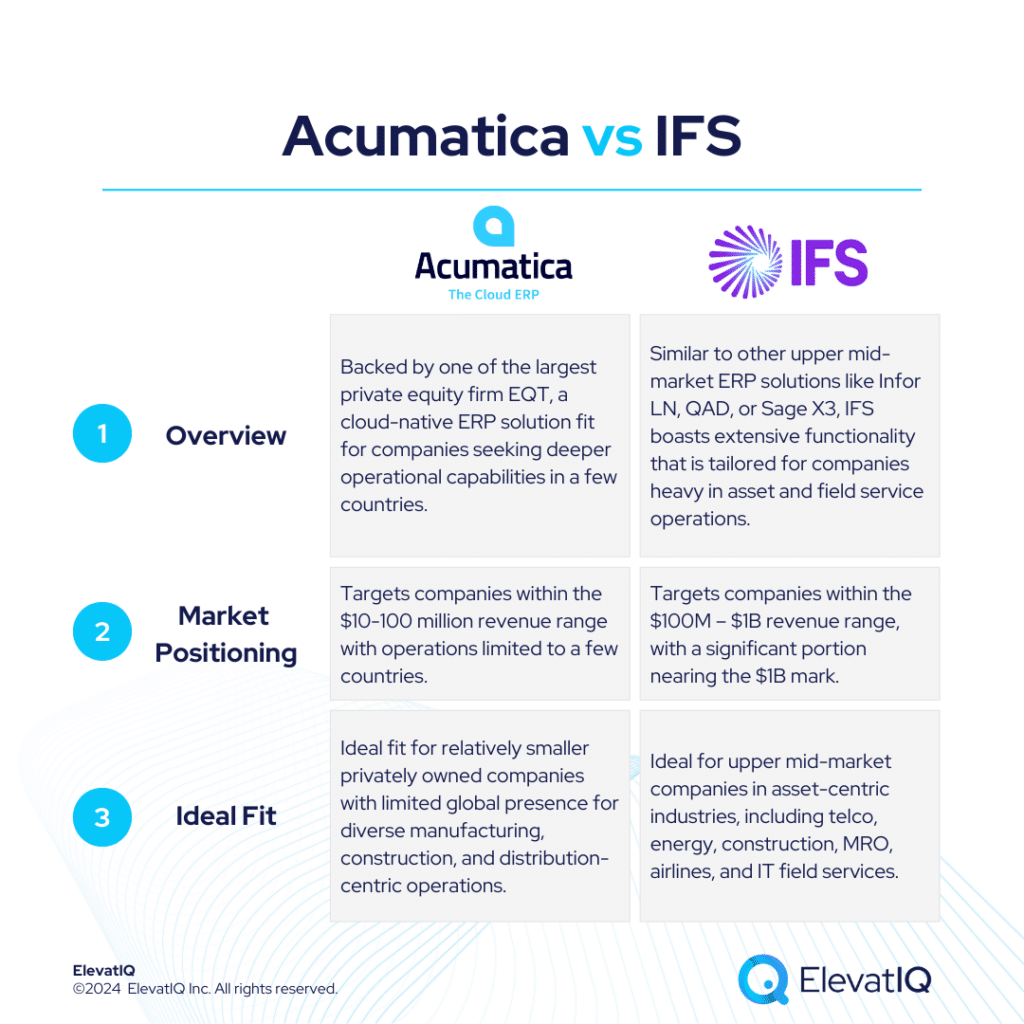
Acumatica stands out among three cloud-native ERP vendors particularly focusing on small and medium-sized businesses (SMBs), alongside NetSuite and Sage Intacct. On the other hand, Infor CloudSuite M3 targets companies surpassing entry-level ERP systems like Acumatica, Infor CSI, or NetSuite. It also delivers mature capabilities for intricate manufacturing and distribution operations. Acumatica, however, caters well to companies with revenues ranging from $10-100 million, offering limited native localization features yet suitable synergies for global operations. Whereas, Infor CloudSuite M3 is successful in the upper mid-market, targeting the $250M – $750M revenue range.

Infor CloudSuite M3 provides a superior suite experience akin to SAP and Oracle, featuring enterprise-grade best-of-breed functionalities, including PLM, WMS, WFM, BI, and a Supply Chain collaboration platform. Whereas, Acumatica’s strength lies in its multi-branch capabilities and tailored support for various business models such as manufacturing, distribution, construction, and field service.

Infor CloudSuite M3 boasts extensive features tailored for process and apparel manufacturing, covering industries such as fashion, F&B, and chemicals. It is also adept at facilitating advanced global operations, particularly for companies spanning multiple countries seeking to optimize cost synergies globally. On the other hand, Acumatica serves as an excellent entry-level system for companies transitioning from QuickBooks or smaller point systems seeking seamless cross-functional integration. Choosing between Acumatica vs Infor CloudSuite M3 requires a detailed examination, and thus, this comparison offers valuable insights for ERP selection projects. Therefore, let’s explore further.

Acumatica vs Infor CloudSuite M3 ERP Independent Review 2024


The 2025 Digital Transformation Report

Thinking of embarking on a ERP journey and looking for a digital transformation report? Want to learn the best practices of digital transformation? Then, you have come to the right place.

AcumaticaInfor CloudSuite M3
Started in20082006 (Acquired by Infor)
Ownership byEQT Partners in 2019Koch Industries
No. of customers 10,000+1000+

What is Acumatica?

Acumatica is one of three cloud-native ERP solutions particularly similar to NetSuite and Sage Intacct. It has extensive multi-branch capabilities, particularly making it friendlier for retail-centric operations. It can also host multiple business models as part of the same database spanning manufacturing, distribution, construction, and field service. Thus, making it friendlier for diverse manufacturing or distribution-centric operations. Because of its limited global operational capabilities, it primarily targets US and UK-based companies. Thus, positioned as an ideal choice for companies within the $10-100 million revenue range, the majority of Acumatica’s customer base falls under this category.

Desiring a user experience akin to Odoo or Quickbooks, Acumatica ERP also offers versatility to accommodate various business models: distribution, manufacturing, or construction-focused. Although Acumatica has limitations in mature features like dimensional inventory or allocation, it is an excellent initial system for companies looking to streamline inventory or costs. With transactional processing and some mature capabilities, such as batch transactional processing, Acumatica is positioned as a valuable choice for businesses venturing into their first or second ERP solution.

Acumatica ERP is a fit for companies seeking cloud-native experience, particularly emphasizing features like enterprise search and mobility over deeper operational capabilities. Despite its focus on small businesses, Acumatica lacks robust globalization and localization features, catering to a limited number of countries by default. This simplicity, however, benefits smaller companies by avoiding unnecessary layers of multi-entity operations. Although targeting small businesses, Acumatica ERP surpasses Odoo or Zoho with the flexibility of its data layers, necessitating consulting help for implementation. The perceived benefit of Acumatica’s pricing is also a challenge, as it’s notoriously difficult to understand and predict.

What Is Infor CloudSuite M3?

Infor CloudSuite M3, is one of Infor’s flagship solutions, catering to distinct micro-verticals across various industries. Sharing similar suites with Infor LN and built on the Infor OS platform, it is successful in the upper mid-market, targeting the $250M – $750M revenue range. Positioned for companies surpassing entry-level ERP systems like Acumatica, Infor CSI, or NetSuite, this solution delivers mature capabilities for intricate manufacturing and distribution operations. Infor CloudSuite M3 provides a superior suite experience akin to SAP and Oracle, featuring enterprise-grade best-of-breed functionalities, including PLM, WMS, WFM, BI, and a Supply Chain collaboration platform.

Infor CloudSuite M3 boasts extensive features tailored for process manufacturing and apparel manufacturing, covering industries such as fashion, F&B, and chemicals. It is also adept at facilitating advanced global operations, particularly for companies spanning multiple countries seeking to optimize cost synergies globally. The native capabilities of Infor M3 address global trade and compliance concerns, which are crucial for international business operations.

While Infor CloudSuite M3 serves as an excellent operational solution for a 2-tier architecture for enterprise companies, its limited focus on certain industries might not be the best fit for enterprise companies diversifying their operations or aggressive with their M&A strategy. The intricate data model and Bill of Materials (BOM) demand significant internal expertise and external advisory assistance to extract operational efficiencies. Notably, the technology landscape for Infor CloudSuite M3 remains somewhat patchy and less modern compared to its competitors. Furthermore, the ecosystem and consulting support for this solution is relatively limited. Despite these challenges, Infor CloudSuite M3 stands out as a robust manufacturing solution for upper mid-market companies with budget constraints.

Acumatica vs Infor CloudSuite M3 Comparison

Navigating the choice between Acumatica vs Infor CloudSuite M3 is a significant decision for businesses particularly looking for operational efficiency and strategic alignment. Thus, this section delves into the comprehensive comparison of Acumatica vs Infor CloudSuite M3 across various critical dimensions.

AcumaticaInfor CloudSuite M3
Global Operational CapabilitiesLimited multi-entity capabilities.Robust financial hierarchies and global trade compliance functionality integrated.
Diverse CapabilitiesOperationally rich for smaller companies.Supports diversified manufacturing business models.
Best-of-breed CapabilitiesLimited, relying on third-party add-ons.Best-of-breed integrations provided out-of-the-box.
Last-mile Capabilities May require add-ons for specific micro-verticals.Last-mile capabilities along with breadth of capabilities for diversified manufacturing business models.
Operational FunctionalitiesEmphasizes cloud-native experience but offers deeper operational capabilities and integration for smaller operations in fewer countries.Infor CloudSuite M3 is a legacy solution with limited cloud-natve capabilities such as universal search, mobile experience, etc.
Integration CapabilitiesNatively-integrated WMS functionality, lacks pre-integrated best-of-breed CRM, supports only embedded CRM.Tools such as HCM, PLM, data lake, ERP, WMS, TMS, and advanced supply chain planning, are all pre-integrated.
Manufacturing Capabilities Suitable for light manufacturing, limited mature capabilities such as allocation and Kanban.Delivers mature capabilities for apparel, F&B, and chemical manufacturing.
Pricing ModelConsumption-based, named, and concurrent but requires long-term contracts.Subscription-based
Key Modules1. Financial Management
2. Construction Management
3. CRM
4. Distribution Management
5. Service Management
6. Manufacturing Management 
7. Project Accounting Management
8. Payroll
9. Retail e-Commerce Management
10. Reporting, Dashboard and BI
1. Financial Management
2. Manufacturing Operations
3. Enterprise Asset Management
4. Supply Chain Management
5. Customer Sales and Service
6. Application Foundation

Acumatica vs Infor CloudSuite M3 Feature Comparison

Both platforms offer a plethora of features and functionalities designed to streamline business operations and enhance efficiency. In this feature comparison, we delve into particularly the distinct capabilities of Acumatica vs Infor CloudSuite M3 across various critical dimensions, providing insights to aid businesses in making informed decisions regarding their ERP selection. Thus, this section discusses features under each of the following modules, particularly financial management, supply chain management, and manufacturing management.

Financial Management Comparison

In this section, we are discussing a detailed comparison of the financial management capabilities particularly offered by Acumatica vs Infor CloudSuite M3.

AcumaticaInfor CloudSuite M3
Financial ManagementGeneral LedgerDesigned to support ledgers limited to support one country. Limited multi-ledger capabilities.Enables organizations to manage financial transactions, maintain accurate balances, and generate complete financial statements.
Accounts Receivable and Accounts PayableThe AR and AP might be limited to just one country with limited synergies among vendors from different countries.Supports analysis across all accounting dimensions, including non-reconciled data for the AP model.
Cash Flow ManagementManages day-to-day transactions, cash balances, funds transfers, and bank account reconciliations for smaller operations.Provides complete control over accounts receivable and cash flow processes, unifying all AR information to monitor cash collection and enhance productivity and efficiency.
Currency ManagementCreates estimates for new or existing items, convert to bills of material, production orders.Enables currency conversion for better monetary analysis, allowing amounts to be expressed in transaction, division, and company currencies, with a default exchange rate type for conversions.
Tax ManagementProvides centralized tax configuration, management, and reporting.Ensures accurate VAT calculation and recording for each country, automating tax calculations based on recipient location and country-specific rules, and maintaining financial compliance.

Supply Chain Management Comparison

In this comparison, we explore and analyze the supply chain management capabilities of Acumatica vs Infor CloudSuite M3, shedding light particularly on their respective strengths and weaknesses.

AcumaticaInfor CloudSuite M3
Supply Chain ManagementWarehouse ManagementProvides real-time inventory visibility and streamlines warehouse operations.Optimizes operations with inventory management, labor management, 3PL billing, and 3D visualization, enhancing efficiency and interactivity.
Service ManagementEnables quick service needs capture, assignment, and real-time tracking, with features like contract management and appointment schedules.Offers work order processing, maintenance, material management, and operation reporting, aiding global manufacturers, distributors, and after-sales service providers in managing complex value chains efficiently.
Inventory Management Simplifies inventory processes with flexible item management and quality traceability.Provides advanced statistical forecasting and stock recommendations for efficient inventory management, as well as supplier and customer rebate management to maintain high margins.
Purchase Order ManagementStreamlines procurement processes with policy enforcement and process controls.Includes automation, vendor payment tracking, payment scheduling, check printing, open purchase order alerts, document management, direct ACH bill payment, and vendor records
Requisition ManagementOrganizes complex distribution processes involving multiple products and suppliers.Automates procurement processes from requisition to payment, including supplier selection, purchase order management, and invoice matching.

Manufacturing Management Comparison

In this comparison, we explore and analyze the manufacturing management capabilities of Acumatica vs Infor CloudSuite M3, shedding light, particularly on their respective strengths and weaknesses.

AcumaticaInfor CloudSuite M3
Manufacturing ManagementProduction Planning Assists manufacturers in addressing production demand with the agility to adjust to fluctuating schedules, unforeseen equipment malfunctions, delayed deliveries from suppliers, and other unexpected occurrences affecting operations on the factory floor.Supports planning in both multi-facility and single-facility production environments, managing critical materials at the facility level.
BOM and RoutingLets you efficiently plan and manage inventories, costs and manufacturing processes.Defines the product structure and assembly sequence, listing components and specifying the operations, work centers, and machines required for manufacturing.
Advanced Planning and SchedulingLets you create a more streamlined and accurate production scheduled, better enforce delivery dates and optimize for capacity.Generates real-time projections by comparing demands against a long-term plan, optimizing production resources, reducing costs, improving performance, and synchronizing supply chain operations.

Pros of Acumatica vs Infor CloudSuite M3

When evaluating ERP solutions, understanding the distinct advantages of Acumatica vs Infor CloudSuite M3 is crucial. In this section, we are particularly exploring the strengths of Acumatica vs Infor CloudSuite M3 across various dimensions. Thus, shedding light on their respective capabilities and functionalities.

Acumatica Infor CloudSuite M3
Great 1st or 2nd ERP choice particularly due to limited layers and mature capabilities for larger companies.Ideal for upper mid-market companies or as subsidiary solutions in a two-tier setting for private equity-owned or holding companies.
Accommodates different business models spread in fewer countries under one database.It can support the most complex manufacturing business models, WBS-centric manufacturing, or support for attributes with MRP planning.
Great fit for SMB B2B businesses with complex product mixes.Most tools that make-to manufacturer would require, such as HCM, PLM, data lake, ERP, WMS, TMS, and advanced supply chain planning, are all pre-integrated with Infor CloudSuite M3.
Born in the cloud with consistent design principles across the application.While most smaller solutions might require ad-hoc arrangements for global financial operations, Infor CloudSuite M3 has them natively built.

Cons of Acumatica vs Infor CloudSuite M3

Just like recognizing strengths is important, it’s also crucial to weigh the specific drawbacks of Acumatica vs Infor CloudSuite M3. Therefore, in this section, we will delve into the limitations and challenges associated with Acumatica vs Infor CloudSuite M3 across various operational and financial dimensions.

Acumatica Infor CloudSuite M3
Limited capabilities when multiple countries with different currencies and sub-ledgers need to be hosted as part of the same solution.The limited focus on certain business models poses the risk of requiring other ERP systems to support complex and diverse business operations.
Not fit for companies with over $100 million in revenue.Private equity and holding companies requiring global solutions with a tier-2 solution at the subsidiary level might not be the best use of Infor CloudSuite M3’s strengths.
The mobile capabilities are leaner for complex reporting scenarios such as parallel processing or reporting labor.Infor CloudSuite M3 is a legacy solution with limited cloud-native capabilities such as universal search, mobile experience, etc
Consumption-based pricing requires consulting expertise to estimate transactions as the pricing is not as predictable.The consulting base and marketplaces are virtually non-existent for Infor CloudSuite M3.
The last-mile capabilities required for manufacturing or industrial distribution may not as strong as purpose-built solutions such as Infor or Epicor but comparable to vanilla solutions such as SAP S/4 HANA.Verticals such as apparel manufacturing demand deeper integration of PLM, vendor portals, and merchandising solutions to effectively manage their unique processes.

Conclusion

In conclusion, selecting the right ERP system is pivotal for businesses aiming to optimize their operational efficiency and strategic alignment. Acumatica vs Infor CloudSuite M3 both offer unique strengths tailored to different market segments and business needs. Acumatica shines as an excellent choice for small to medium-sized businesses, particularly those transitioning from simpler systems like QuickBooks. Its cloud-native design and multi-branch capabilities cater well to manufacturing, distribution, construction, and also field service operations within the $10-100 million revenue range. However, its limited global capabilities and complex pricing model may present challenges for larger enterprises or those with extensive international operations.

On the other hand, Infor CloudSuite M3 targets upper mid-market companies, excelling in process and apparel manufacturing industries. Its robust suite of best-of-breed functionalities, including PLM, WMS, and supply chain collaboration, particularly makes it a strong contender for companies within the $250-750 million revenue range. Despite its comprehensive capabilities, Infor CloudSuite M3’s legacy architecture and limited cloud-native features might not appeal to companies seeking modern, scalable ERP solutions.

To get a 360-degree view of feature comparisons, it’s essential to explore not only Acumatica vs. Infor CloudSuite M3 but also insights from other analyses such as Acumatica vs. NetSuite, SAP S/4 HANA, Oracle Cloud ERP, MS Dynamics 365 F&O, and MS Dynamics 365 BC. Also, seeking assistance from an independent ERP consultant can significantly aid the decision-making process, offering specialized advice and direction tailored to the specific needs of the business.

+

ERP Implementation Failure Recovery

Learn how Frederick Wildman struggled with Microsoft Dynamics 365 ERP implementation failure even after spending over $5M and what options they had for recovery.

FAQs

Acumatica vs Infor CloudSuite M3 ERP Independent Review 2024 Read More »

Top 10 Process Manufacturing ERP Systems In 2024

Process manufacturing companies. Varying substantially with their ERP needs, process manufacturing companies produce goods using a formula or recipe. Such manufacturing typically involves continuous or batch production processes and is common in industries such as food and beverage, pharmaceuticals, chemicals, and petrochemicals. Unlike discrete manufacturing, which assembles products from distinct parts, process manufacturing produces items that cannot be disassembled into their original components. These companies often deal with complex inventory and require sophisticated supply chain planning.

Process manufacturing processes. The fundamental difference between process manufacturing companies and other companies would be the complexity of formulas and recipes that drive their processes. The processes might also vary with their supply chain planning as the large majority of process manufacturers are likely to be make-to-stock, with heavy inventory and supply chain operations. The commoditized industries such as food, pharma, and chemicals are likely to have substantial Direct Store Delivery (DSD) operations with a heavy focus on eCommerce. Depending upon the product mix, new product development (NPD) would be critical with the flavors of discrete manufacturing in the form of managing their own packaging lines.

Top 10 Process Manufacturing ERP Systems In 2024

Process manufacturing ERP needs. Process manufacturing companies require ERP systems that can handle formulation and recipe throughout the R&D and production phases. Depending upon the business model whether the process manufacturer is more contract-based or an OEM, the need for quality could vary per customer or customer group. These systems must also support integration with ancillary systems such as process-specific PLMs, MES and WFM, and value chain planning and forecasting. Finally, some industries such as pharma and chemicals might require a unique data structure to accommodate distinct requirements such as capturing multiple serial and lot numbers together, making the generalized ERP systems irrelevant for this industry vertical.


The 2025 Digital Transformation Report

Thinking of embarking on a ERP journey and looking for a digital transformation report? Want to learn the best practices of digital transformation? Then, you have come to the right place.

Criteria

  • Definition of a process manufacturing company. These companies in the process manufacturing ecosystem include manufacturers formulating recipe processes to produce products in industries such as pharma, nutraceuticals, cannabis, food and beverage, etc. The list considers companies of all sizes in this ecosystem.
  • Overall market share/# of customers. The higher market share among process manufacturing companies drives higher rankings on this list.
  • Ownership/funding. The superior financial position of the ERP vendor leads to higher rankings on this list. 
  • Quality of development. How modern is the tech stack? How aggressively is the ERP vendor pushing cloud-native functionality for this product? Is the roadmap officially announced? Or uncertain?
  • Community/Ecosystem. How vibrant is the community? Social media groups? In-person user groups? Forums?
  • Depth of native functionality. Last-mile functionality for specific industries natively built into the product?
  • Quality of publicly available product documentation. How well-documented is the product? Is the documentation available publicly? How updated is the demo content available on YouTube?
  • Product share and documented commitment. Is the product share reported separately in financial statements if the ERP vendor is public?
  • Ability to natively support diversified business models. How diverse is the product in supporting multiple business models in the same product?
  • Acquisition strategy aligned with the product: Any recent acquisitions to fill a specific hole for process manufacturing industries? Any official announcements to integrate recently acquired capabilities?
  • User Reviews: How specific are the reviews about this product’s capabilities? How recent and frequent are the reviews?
  • Must be an ERP product: Edge products such as HCM, CRM, eCommerce, MES, or accounting solutions that are not fully integrated to support enterprise-wide capabilities are not qualified for this list.

10. Acumatica

Acumatica is primarily a discrete product and does not have native process manufacturing capabilities. However, the add-ons available in their ecosystem are very strong, and they have robust alliances with these companies. This makes Acumatica a potential threat in the process manufacturing sector over time. It is ideal for smaller process manufacturing companies operating US, Canada, UK, and Australia​.

Acumatica could be a significant contender for industries that require both process manufacturing and discrete manufacturing. The process manufacturing capabilities, combined with field service, construction, distribution, and e-commerce, will all be part of the same database, providing end-to-end traceability across these functions. If these capabilities are important to you, then Acumatica could be an excellent choice. Therefore, Acumatica secures the #10 spot on our list of top process manufacturing ERP systems.

Strengths 
  • Technology. Acumatica is very cloud-native, and its process manufacturing add-ons are designed with similar development standards and documentation guidelines.
  • Core ERP layers. The core ERP layers are very strong, especially for smaller companies outgrowing QuickBooks or the smaller ERP systems.
  • Ideal for seasonal businesses​. It’s also a better fit for seasonal businesses, especially in process manufacturing industries. Seasonal businesses, such as those in the food industry, often benefit from this model. Pricing and licensing may be slightly more favorable for these businesses.
Weaknesses
  • Quality and process manufacturing module through third parties. You should be aware of the risks, including integration risks. Implementation might also be more expensive due to the various moving parts involved.
  • Not suitable for companies requiring global financial consolidation. Acumatica has limited global capabilities for process companies seeking synergies among global entities.
  • Not suitable for large companies​. It is not designed for large process manufacturing companies.

9. ECI Deacom

ECI Deacom is a smaller product than Acumatica but offers slightly superior capabilities as part of its suite. It integrates all the components required for process manufacturing. It is ideal for smaller process manufacturing companies seeking suite capabilities​. With Acumatica, reliance on third-party add-ons and dealing with more vendors is necessary, whereas, with ECI Deacom, everything is provided by ECI itself as part of the suite. So, if you are a small company and are limited in your implementation needs, ECI Deacom could be a great fit.

It targets small process manufacturing companies, particularly those heavily involved in eCommerce and DTC. Its processes are tailored to industries like food and beverage or chemical-centric industries. Despite its strengths, the core ERP layers and data model are not scalable for companies seeking mature ERP capabilities. So, it suits smaller companies transitioning from QuickBooks with constrained implementation budgets. Therefore, with this ECI Deacom secures the #9 spot on our list of top process manufacturing ERP systems.

Strengths
  • Specialized process manufacturing capabilities such as catchweight, and potency. Advanced process manufacturing features critical for process manufacturers are provided out of the box.
  • Friendlier for commerce-centric companies. Features such as route accounting and other capabilities are included in the suite, especially useful in process manufacturing spaces maintaining their own fleets and assets like PODs.
  • Easier implementation​. The core ERP layers are not as detailed, making the implementation easier for smaller companies.
Weaknesses
  • Limited ERP layers. The ERP layers are going to be limited. So it’s not as moldable as some of the other ERP products.
  • Not as diverse. It may not support many different business models and transactions, leading to quick outgrowth. For complex business models with diverse processes and transactions, ECI Deacom might not be the best fit.
  • Ecosystem​. The ecosystem is limited, as compared to any similar product on this list. You primarily rely on ECI Deacom’s professional services for consulting and knowledge.

8. SYSPRO

SYSPRO excels in some process manufacturing spaces, such as chemical, food and beverage, and medical devices. It is ideal for smaller process manufacturing companies requiring distribution and discrete manufacturing capabilities. SYSPRO also includes process manufacturing capabilities like formulation and recipe support. It has a very strong alignment with eCommerce players prevalent in the process manufacturing space, increasing the available integration options. Designed for smaller companies, SYSPRO is not suited for global consolidation or complex operations. However, if operating in a few countries with installations in the US or UK, SYSPRO might be a great fit. Thus, considering all these factors SYSPRO secures the #8 spot on our list of top process manufacturing ERP systems.

Strengths 
  • Complex inventory layers. The inventory layers are far more complex. So these are going to be different attributes. And those attributes are going to be part of the process. 
  • Formulation and recipe support. With SYSPRO, the formulation and recipe support is going to be part of the product.
  • Discrete and process manufacturing in one solution​. The product natively supports both manufacturing modes, making it friendlier for process manufacturing companies managing their own packaging lines.
Weaknesses 
  • Complex process manufacturing capabilities such as catch weight, potency, and reverse BOMs. All of these capabilities might not be supported as part of SYSPRO.
  • Limited suite capabilities. While great for smaller companies, large process manufacturing companies would require specialized tools such as PLM, WMS, and TMS from third parties.
  • Limited global consolidation capabilities​. SYSPRO has limited global capabilities for process companies seeking synergies among global entities.

7. SAP S/4 HANA

SAP S/4HANA is designed for larger companies aiming to consolidate global business models across various entities, especially those with a significant global footprint or publicly traded status. It excels in complex organizational structures and is ideal for companies actively engaged in mergers and acquisitions due to their ever-changing business models. SAP S/4HANA offers flexibility in processes and transactions, catering to diverse business needs. Thus, positioning itself at the #7 spot on our list of top process manufacturing ERP systems.

Strengths 
  • ERP layers for complex organizations. It is designed for very complex organizations, essentially those companies that will be very active with their M&A cycles.
  • Diversity of the solution supporting discrete and process manufacturing. The solution is very large supporting many different business models with equal depth for process and discrete manufacturing.
  • Global compliance and localization​. Regions like South America and Europe are complex due to their small countries with unique processes. Mainstream ERP systems often lack support in such regions, leaving solutions like SAP S/4HANA, Microsoft, or Oracle as the only viable options. Alternatively, there may be niche solutions specifically designed for these geographies.
Weaknesses 
  • Last mile capabilities through third-party vendors. The last-mile capabilities will likely involve third-party vendors. Therefore the integration of suite capabilities as well as core capabilities will be highly dependent on vendors, increasing vendor integration risks.
  • Expensive implementation. The implementation costs are going to be expensive because of dealing with different vendors.
  • Requires mature internal IT team. In tailoring, customizing, and configuring these capabilities, the same capabilities that are already included as part of the suite, SAP S/4 HANA also requires a very mature internal IT team.

6. QAD

QAD is the right fit for supply chain-centric companies, particularly in industries like life sciences and food and beverage. This is where rigorous supply chain planning processes are common, despite these product types being generally less expensive. But it’s not a fit for companies with diverse business models or very small companies. QAD has seen substantial advancements in its portfolio, especially with its technology, which was a massive barrier for QAD in the past. Thus, contributing to the placement of this product at #6 spot on our list of top process manufacturing ERP systems.

Strengths 
  • Supply chain suite + ERP as part of the suite. The entire suite from QAD is included in the product itself, reducing reliance on third-party vendors. This results in cheaper implementation costs due to pre-baked, pre-configured, and pre-integrated components.
  • Process companies with discrete manufacturing lines or components. It is primarily a discrete product, although it also includes some process capabilities. However, complex process manufacturing capabilities may not be fully supported.
  • Global capabilities. From a global consolidation perspective, it is generally a larger product compared to others like Acumatica or ECI Deacom. It is designed for global supply chain collaboration across 5-20 countries.
Weaknesses
  • New technology might not be stable or rolled out to all modules. Although they have announced an upgrade to cloud-native technology, it has not yet been fully rolled out and may not be stable for the next few years.
  • Ecosystem. Having QAD alone for the ecosystem might be challenging due to its limited nature.
  • Not as diverse​. This is not a good fit for companies with hybrid business models as the data and process model is highly tailored for specific process manufacturing verticals.

5. Microsoft Dynamics 365 F&O

It is a product similar to SAP S/4 HANA, designed for more generalized cases requiring diversity and industry-specific capabilities through third-party vendor add-ons. In these scenarios, MS Dynamics 365 F&O is a better overall choice compared to SAP S/4HANA or Oracle, which have proven themselves in Fortune 500 workloads. They offer extensive capabilities relevant to mid-market companies, along with advanced cloud operational capabilities, where Microsoft is currently ahead. It has an ecosystem that makes it suitable for private equity and holding companies aiming to streamline their portfolio companies on one solution. SMBs, however, might find its complex data model overwhelming. Thus, acquiring its placement for the #5 spot on our list of top process manufacturing ERP systems.

Strengths
  • Comprehensive localization across the globe. This would be beneficial for global process manufacturing companies seeking synergies among their entities.
  • Ecosystem. One of the most active ecosystems, offering numerous solutions to support various industries, even if those capabilities aren’t part of the core ERP layers or products.
  • Recipe and formulation supported natively.​ The product data model has native support for both process and discrete manufacturing modes.
Weaknesses 
  • Last mile capabilities through third-party vendors. The last mile or industry-specific capabilities you acquire will be through third-party vendors. This approach increases vendor risk when utilizing these capabilities.
  • Expensive implementation. The implementation may be slightly more expensive because you’re dealing with many different vendors and many different add-ons.
  • Requires mature internal IT team. In tailoring, customizing, and configuring these capabilities, the same capabilities that are already included as part of the suite, MS Dynamics 365 F&O also requires a very mature internal IT team.

4. Oracle Cloud ERP

Oracle Cloud ERP is a product similar to SAP S/4HANA and MS Dynamics 365 F&O. It is designed for large global publicly traded companies, offering extensive financial capabilities for consolidation across entities and business models. However, its industry-specific capabilities are not as preconfigured or tailored as those found in other products on the list. It also excels with high transaction volumes. It is not the optimal choice for SMB process manufacturers lacking internal IT capabilities seeking full-suite capabilities. Thus, contributing to the placement of this product at #4 spot in our list of top process manufacturing ERP systems.

Strengths
  • ERP layers for complex organizations. This ERP system is designed for large global publicly traded companies. These companies typically require international financial consolidation and aim to integrate various business models and geographies into one solution. This is necessary to ensure end-to-end traceability.
  • Diversity of the solution supporting most discreet industries. The ERP layers are highly adaptable and designed to support various business models, resulting in a very diverse product. In contrast, other products may not offer the same level of diversity.
  • Well adopted among process manufacturing companies through JDE install base with pharma and F&B companies. They also have a larger presence in process manufacturing, particularly in pharma and food and beverage, due to the widespread adoption of the legacy JD Edwards product in these sectors. They are converting these customers and offer extensive capabilities tailored to these industries.
Weaknesses 
  • Last mile capabilities through third-party vendors. The last mile or industry-specific capabilities you acquire will be through third-party vendors. This approach increases vendor risk when utilizing these capabilities.
  • Expensive implementation. The implementation may be slightly more expensive because you’re dealing with many different vendors and many different add-ons.
  • Requires mature internal IT team. In tailoring, customizing, and configuring these capabilities, the same capabilities that are already included as part of the suite, Oracle Cloud ERP also requires a very mature internal IT team.

3. Aptean Process Manufacturing ERP

This solution falls under the prescriptive category, where you receive a complete suite tailored to specific industries. Aptean process manufacturing ERP’s approach is similar to Infor’s, with specific ERP products bundled into the suite. Although marketed broadly as having 15 process manufacturing solutions, these are segmented into editions like Ross or ProcessPro, each designed for highly specific micro-verticals needing tailored innovation capabilities. Unlike Acumatica, where all business models reside in one database for easier upgrades and better traceability across transactions, Aptean’s products operate on separate databases. This distinction presents risks but offers deep functionality and capabilities for specific micro-verticals. Thus, positioning itself at #3 spot on our list of top process manufacturing ERP systems.

Strengths 
  • Full suite pre-integrated. Because of full pre-integrated suite being present, the implementation costs are going to be cheaper. 
  • Complex process manufacturing capabilities. Aptean provides complex capabilities like reverse BOMs and potency ingredients tailored to each process manufacturing micro-vertical, along with unique PMS functionalities.
  • Several versions tailored for specific micro-verticals such as Ross and ProcessPro​. It is designed for highly specific micro-verticals needing tailored innovation capabilities.
Weaknesses
  • Expensive with partial implementation. Buying the complete suite from Aptean may be cheaper. However, if you opt for a rip-and-replace approach or wish to use your favorite tools with Aptean’s architecture, costs could increase. You may encounter fewer pre-baked integrations and fewer consultants knowledgeable about these integrations. Aptean may not prioritize supporting external products or suites, which could pose challenges during partial implementations. Thus, choosing between Aptean’s complete architecture or similar products may depend on your specific needs and desired diversity.
  • Not as diverse. This is not a good fit for companies with hybrid business models as the data and process model is highly tailored for specific process manufacturing verticals.
  • Limited ecosystem and consulting base​. It has a weaker ecosystem and consulting base compared to other ERP solutions.

2. Sage X3

Sage X3 is positioned as a mid-to-large product in the process manufacturing sector. It excels particularly when robust accounting processes are needed, suitable for auditor requirements in publicly traded companies. In the pharmaceutical industry, which is highly regulated, Sage X3 shines due to its comprehensive process capabilities. The ecosystem is well-developed with ample consultants, making it widely adopted in process manufacturing compared to other products on this list. Thus, considering all these factors Sage X3 has acquired the #2 spot on our list of top process manufacturing ERP systems.

Strengths 
  • Depth in accounting. It excels particularly when robust accounting processes are needed, suitable for auditor requirements in publicly traded companies.
  • Specialized process manufacturing capabilities such as catchweight. Complex process manufacturing capabilities such as catchweight, UoMs, and BOMs are all included in the product.
  • Well adopted among process manufacturing companies​. The ecosystem is well-developed with ample ERP consultants, making it widely adopted among process manufacturing companies.
Weaknesses 
  • Suite capabilities through third-parties. For suite capabilities such as PLM and configurator, you may need third-party add-ons.
  • Not the core focus for Sage. Overall, Sage X3 is not the core focus in their portfolio; Sage Intacct is their primary focus. Their target market primarily consists of SMBs rather than larger companies, which are more penetrated by other ERP providers. Their primary distribution channel is accounting firms, making them more established in the small to mid-sized market.
  • Accounting boilerplate​. The advanced accounting capabilities might not be as relevant for smaller companies primarily caring for operational capabilities.

1. Infor CloudSuite M3

Infor CloudSuite M3 is adopted among process manufacturing companies, especially those with very complex inventory and deep involvement in supply chain planning. Its key strength is that it is a complete pre-integrated suite containing several components, including specialized PLM and a tailored supply chain suite. Infor M3 is a great fit for focused process manufacturing companies with limited IT budgets but might not be the best fit for companies growing through M&A or with diverse business models. Thus, Infor CloudSuite M3 secures the #1 spot on our list of top process manufacturing ERP systems.

Strengths 
  • Comprehensive process manufacturing capabilities. Process manufacturing capabilities are one of the most robust to support the operations of global process manufacturers with many different business models including retail and rental operations.
  • Supports complex inventory and products. The attribute inventory is supported throughout processes starting from NPD to dispatch and value chain management.
  • Pre-integrated supply chain suite​. The pre-integrated supply chain suite makes the implementation cheaper and vendor risk lower.
Weaknesses 
  • Expensive. Compared to smaller suites such as ECI Deacom and SYSPRO, Infor M3 would be more expensive because of the advanced capabilities for larger and global companies.
  • Not suitable for SMBs below $250M in revenue. The advanced layers provided as part of the product might be too detailed for smaller companies, posing adoption challenges.
  • Ecosystem​. The consulting base and marketplaces are virtually non-existent for both Infor M3.
+

ERP Implementation Failure Recovery

Learn how Frederick Wildman struggled with Microsoft Dynamics 365 ERP implementation failure even after spending over $5M and what options they had for recovery.

Conclusion

In conclusion, selecting the right ERP system is crucial for process manufacturing companies due to the complexity and specificity of their operations. The top 10 ERP systems identified in this blog each offer unique strengths and capabilities that cater to various needs within the process manufacturing industry. From robust accounting processes in Sage X3 to the comprehensive pre-integrated suite of Infor CloudSuite M3, each system provides distinct advantages for managing intricate manufacturing processes, ensuring regulatory compliance, and optimizing supply chain planning. Companies must carefully evaluate their specific requirements, including the need for specialized functionalities, global capabilities, and integration ease, to make an informed decision.

The diversity in ERP systems also reflects the varying priorities and operational scales of process manufacturing companies. Smaller companies might benefit from systems like ECI Deacom or Acumatica, which offer tailored solutions for niche markets and simpler implementations. In contrast, larger companies with extensive global operations may find Oracle Cloud ERP or SAP S/4HANA more suitable due to their advanced capabilities and scalability. Ultimately, the right ERP system, chosen with the guidance of an independent ERP consultant, will not only streamline operations and enhance efficiency but also support the company’s growth.

FAQs

Top 10 Process Manufacturing ERP Systems In 2024 Read More »

Top 10 Discrete Manufacturing ERP Systems In 2024

Discrete Manufacturing Companies. Producing distinct items manufactured through a series of assembly processes, where individual components are combined to create the final product, discrete manufacturing typically involves BOMs, assembly lines, and detailed production schedules. The process results in tangible, countable products that can be individually tracked and managed through the supply chain. This type of manufacturing contrasts with process manufacturing, which produces goods in bulk, like chemicals or beverages, where the end products are not discrete items but rather homogeneous outputs.

Discrete Manufacturing Processes. It involves the production of distinct, countable items through a series of assembly and fabrication steps. These processes include assembling components, machining, welding, and quality testing, often organized along assembly lines. Each step in the process is distinct and can be tracked individually, with a focus on precision and customization. This approach is commonly used in industries like automotive, aerospace, electronics, and machinery.

Top 10 Discrete Manufacturing ERP Systems In 2024

Discrete Manufacturing ERP Needs. Modules for managing production planning, inventory control, and supply chain coordination are of utmost importance in this case. These systems must support detailed tracking of parts and components, facilitate efficient scheduling and resource allocation, and provide real-time visibility into production processes. Additionally, they require strong capabilities in quality management, engineering change control, and compliance tracking to handle the complexities of producing distinct items. Integration with CAD systems, advanced analytics for performance monitoring, and flexible reporting tools are also essential to address the unique demands of discrete manufacturing. So, which are the leading discrete manufacturing ERP systems for 2024?


The 2025 Digital Transformation Report

Thinking of embarking on a ERP journey and looking for a digital transformation report? Want to learn the best practices of digital transformation? Then, you have come to the right place.

Criteria

  • Definition of a discrete manufacturing company. These companies in the discrete manufacturing ecosystem include manufacturers that follow discrete manufacturing processes producing products in industries such as Automotive, Aerospace, Industrial, and Machinery. From the manufacturing mode types, they could belong to any of the categories such as make-to-order, make-to-stock, engineer-to-order, or project manufacturing. The list considers companies of all sizes in this ecosystem.
  • Overall market share/# of customers. The higher marketshare among discrete manufacturing companies drives higher rankings on this list.
  • Ownership/funding. The superior financial position of the ERP vendor leads to higher rankings on this list.
  • Quality of development. How modern is the tech stack? How aggressively is the ERP vendor pushing cloud-native functionality for this product? Is the roadmap officially announced? Or uncertain?
  • Community/Ecosystem. How vibrant is the community? Social media groups? In-person user groups? Forums?
  • Depth of native functionality. Last-mile functionality for specific industries natively built into the product?
  • Quality of publicly available product documentation. How well-documented is the product? Is the documentation available publicly? How updated is the demo content available on YouTube?
  • Product share and documented commitment. Is the product share reported separately in financial statements if the ERP vendor is public?
  • Ability to natively support diversified business models. How diverse is the product in supporting multiple business models in the same product?
  • Acquisition strategy aligned with the product: Any recent acquisitions to fill a specific hole for discrete manufacturing industries? Any official announcements to integrate recently acquired capabilities?
  • User Reviews: How specific are the reviews about this product’s capabilities? How recent and frequent are the reviews?
  • Must be an ERP product: Edge products such as HCM, CRM, eCommerce, MES, or accounting solutions that are not fully integrated to support enterprise-wide capabilities are not qualified for this list.

10. Plex

Adopting an MES-first strategy, Plex targets companies in the Toyota and Ford automotive ecosystems. Despite superior technology compared to other solutions on this list, Plex has fewer installs, primarily focusing on the automotive industry. Uniquely, Plex integrates some of the HCM processes tightly with MES and ERP, which is beneficial for automotive companies if skillsets and certifications are key inputs for production scheduling. However, its relevance may vary for other industries. Given its pros and cons, it maintains the #10 spot among the top 10 discrete manufacturing ERP systems.

Strengths
  1. MES-first approach. Plex excels with its MES-first architecture, which is particularly strong for shop-floor heavy industries.
  2. Stronger automotive last-mile compliance capabilities. Plex offers deep last-mile and compliance capabilities for automotive companies and other MES-intensive industries.
  3. Cloud-native​. Plex’s technology is superior due to its cloud-native origins, setting it apart from other systems.
Weaknesses
  1. Weaker ERP layers. Plex’s ERP capabilities and integration layers are not as robust, leading to potential challenges in adapting to various business transactions and models.
  2. Not as scalable for diverse business models. The ERP may face difficulties scaling to accommodate different business models, affecting its flexibility.
  3. Limited ecosystem and consulting base​. Being more prescriptive, Plex has a weaker ecosystem and consulting base compared to other ERP solutions.

9. DELMIAWorks

DELMIAWorks has performed really well from an industry perspective, particularly in more process-centric sectors such as plastics. Industries related to plastics, especially from a discrete perspective, will benefit significantly from DELMIAWorks. Additionally, it has a tighter alignment with the CAD system SolidWorks. Industries using SolidWorks will experience richer capabilities and superior alignment from a product capabilities perspective. Therefore, the industries to consider for DELMIAWorks include automotive and aerospace, especially if they are slightly more plastic-centric within those verticals. This contributes to the placement of this product at #9 spot in our list of top discrete manufacturing ERP systems.

Strengths 
  1. Seamless integration with other tools in SolidWorks portfolio. Their alignment with the CAD system SolidWorks is particularly noteworthy. Industries utilizing SolidWorks can expect seamless integration and superior alignment.
  2. Discrete and process manufacturing capabilities. Ideal for industries, that primarily focus on discrete manufacturing, but may also incorporate process manufacturing lines. This scenario is common in packaging-centric or medical device-centric industries.
  3. Supply chain best-of-breed solutions as part of the suite​. The suite comes fully equipped, pre-baked, pre-configured, and pre-integrated, saving you the hassle of investing heavily in these aspects as required by other solutions. These capabilities are typically sourced from third-party providers.
Weaknesses
  1. Legacy technology. The technology is not as cutting-edge. They haven’t invested as heavily as some of their competitors in modernizing their systems. Even vendors who entered the field later have announced plans to upgrade to cloud-native technology stacks, a move that DELMIAWorks has not yet made. As a result, their technology remains somewhat outdated and legacy-like.
  2. Not as scalable for all discrete industries. The scalability of DELMIAWorks may not be suitable for all discrete industries, particularly if your business model is complex. In such cases, where there are multiple layers across various industries, you might encounter challenges.
  3. Limited ecosystem and consulting base​. The consulting base and ecosystem for DELMIAWorks are comparable to Plex, with limitations due to the nature of the prescriptive category they belong to.

8. QAD

QAD targets mid-to-large discrete manufacturing companies such as automotive, electronics, and life sciences companies with a depth in the supply chain. It’s especially suitable for discrete companies that require deep layers of collaboration with their vendors for forecasting and planning. It excels in commoditized, consumer-centric products. These industries are strong from a supply chain planning perspective, and QAD offers superior capabilities as part of its suite. This is because, for these industries, supply chain capabilities are highly intertwined. But it’s not a fit for companies with diverse business models or very small companies. QAD has seen substantial advancements in its portfolio, especially with its technology, which was a massive barrier for QAD in the past. Thus, contributing to the placement of this product at #8 spot in our list of top discrete manufacturing ERP systems.

Strengths 
  1. Supply chain suite + ERP as part of the suite. QAD excels in offering superior capabilities within its suite, especially in terms of supply chain and ERP functionalities. This is particularly advantageous for discrete industries like automotive, where these capabilities are deeply interconnected and essential components of the suite. 
  2. Discrete companies with process manufacturing lines or components. Quite similar to those of DELMIAWorks. Both solutions offer integrated discrete and process manufacturing capabilities within their suites. However, the specific focus and target industries of QAD differ from those of DELMIAWorks. Also, the manufacturing processes they cater to and the industries they serve have distinct differences. 
  3. Global capabilities​. QAD also has strong global capabilities. If your company requires processes such as in-depth collaboration, which is very common in supply chain companies, then QAD is a great fit.
Weaknesses 
  1. New technology might not be stable or rolled out to all modules. Even though they have announced that they are upgrading their technology, it might take a few years before this version becomes stable. Initially, there will be some modules that may not be fully developed. These incomplete modules could pose challenges during ERP implementation.
  2. Ecosystem. The ecosystem or consulting support will not be as strong because this is a slightly more prescriptive category.
  3. Not as diverse​. This is not a good fit for companies with hybrid business models as the data and process model is highly tailored for specific discrete verticals.

7. Oracle Cloud ERP

Geared toward large discrete manufacturing firms with 10+ global locations (over $1B in revenue), Oracle Cloud ERP excels with high transaction volumes. Ideal for companies prioritizing financial functionality over plant-level needs or preferring plant-level integration with best-of-breed solutions. It is not the optimal choice for SMB discrete manufacturers lacking internal IT capabilities seeking full-suite capabilities. Oracle Cloud ERP is also ideal for global companies with diverse business model that plan to use multiple ERP systems at the plant level and use Oracle Cloud ERP as their corporate ERP system. Thus, contributing to the placement of this product at #7 spot in our list of top discrete manufacturing ERP systems.

Strengths
  1. ERP layers for complex organizations. This ERP system is designed for large global publicly traded companies. These companies typically require international financial consolidation and aim to integrate various business models and geographies into one solution. This is necessary to ensure end-to-end traceability.
  2. Diversity of the solution supports most discrete industries. The ERP layers are highly adaptable and designed to support various business models, resulting in a very diverse product. In contrast, other products may not offer the same level of diversity.
  3. Global compliance and localization​. They will be supported in many different countries, whereas prescriptive solutions may not have such extensive support.
Weaknesses 
  1. Last mile capabilities through third-party vendors. The last mile capabilities, especially the suite integration will often come through third-party vendors. This introduces vendor risk, as these third parties may not always be as well-audited or documented.
  2. Expensive implementation. In general, the implementation tends to be more expensive due to the involvement of multiple vendors. You also have to manage several different integrations, which might be pre-baked in other systems. Since this is a larger product, it will require significantly more time to implement.
  3. Requires a mature internal IT team. In tailoring, customizing, and configuring these capabilities, the same capabilities that are already included as part of the suite, Oracle Cloud ERP also requires a very mature internal IT team.

6. Acumatica

Acumatica is a better fit for smaller discrete manufacturing companies, primarily located in countries such as the US, Canada, the UK, and Australia. These companies often require deeper operational capabilities and may not prioritize financial consolidation. It is acceptable to keep different countries in separate instances, as there may not be significant operational or financial synergies between these companies. With limited global operational capabilities, it may not be ideal for those seeking shared services or global synergies. Nevertheless, smaller discrete manufacturing startups valuing a superior user experience would find Acumatica appealing. Thus, contributing to the placement of this product at #6 spot in our list of top discrete manufacturing ERP systems.

Strengths
  1. Discrete companies requiring CPQ and field services capabilities. It can accommodate several different business models—field service, distribution, manufacturing, and construction—all within the same product and database. This allows for far greater traceability among these business processes, eliminating the need for them to be siloed from an overall capabilities perspective.
  2. Technology. The technology is superior to some of the legacy products especially when discrete companies might care for capabilities such as enterprise search or mobility. 
  3. Ideal for seasonal discrete companies. It would also be a great fit for seasonal companies because of consumption-based pricing. For example, school supply manufacturing business, or construction, manufacturing businesses, etc.
Weaknesses
  1. Not native process manufacturing. The solution lacks native support for process manufacturing capabilities for discrete companies with hybrid business models. Although third-party add-ons are available, it can introduce the challenge of dealing with different vendors and their associated legal and technical risks.
  2. Not a native quality module. They lack a quality module owned by Acumatica, meaning you’ll need to rely on another add-on vendor to address this gap.
  3. Limited global consolidation capabilities​. Acumatica has limited global capabilities for discrete companies seeking synergies among global entities.

5. SAP S/4 HANA

SAP S/4 HANA has a positioning very similar to Oracle Cloud ERP. It is a slightly larger product designed for global financial consolidation, accommodating many different business models and processes within the same solution. When end-to-end traceability is required, but industry-specific capabilities are not a priority, SAP S/4 HANA is a better fit. It may not suitable SMB manufacturing companies without internal IT maturity. Thus, positioning itself at #5 spot in our list of top discrete manufacturing ERP systems.

Strengths 
  1. ERP layers for complex organizations. The ERP layers are ideal for complex organizations, along with best-of-breed products like SuccessFactors or EWM. However, these solutions may not offer a tailored experience for specific industries. To achieve this, you will either need to customize the system or integrate additional add-ons.
  2. Diversity of the solution supports most discrete industries. The diversity of the solution allows you to support many different business models, although tailored capabilities for specific discrete verticals might not be as detailed.
  3. Global compliance and localization​. The global compliance and localization capabilities of SAP S/4HANA are very similar to Oracle Cloud ERP.
Weaknesses
  1. Last mile capabilities through third-party vendors. The last mile or discrete-specific capabilities you acquire will be through third-party vendors. This approach increases vendor risk when utilizing these capabilities.
  2. Expensive implementations. The implementation is going to be slightly more expensive with SAP S/4 HANA just because the solution is large and designed to be highly scalable, requiring increased implementation efforts.
  3. Requires a mature internal IT team. SAP S/4 HANA also requires a very mature internal IT team to tailor, customize, and configure these capabilities.

4. Microsoft Dynamics 365 F&O

With a very similar positioning to Oracle Cloud ERP or SAP HANA, Microsoft Dynamics 365 F&O is slightly more generalized and comparatively smaller in size. It may not be as proven with Fortune 500 workloads, as well as its extensive approval layers and organizational structures might not be as relevant for mid-market companies. With slightly superior cloud capabilities, it has an ecosystem that makes it suitable for private equity and holding companies aiming to streamline their portfolio companies on one solution. SMBs, however, might find its complex data model overwhelming. Thus, resulting in the placement of the product at the #4 spot in our list of top discrete manufacturing ERP systems.

Strengths 
  1. Comprehensive localization across the globe. This would be beneficial for global discrete companies seeking synergies among their entities.
  2. Ecosystem. One of the most active ecosystems, offering numerous solutions to support various industries, even if those capabilities aren’t part of the core ERP layers or products.
  3. Development platform and Azure​. It is also slightly more customizable just because of the development platform and the layers you have exposed for the customization.
Weaknesses
  1. Last mile capabilities through third-party vendors. The last mile or industry-specific capabilities you acquire will be through third-party vendors. This approach increases vendor risk when utilizing these capabilities.
  2. Expensive implementation. The implementation may be slightly more expensive because you’re dealing with many different vendors and many different add-ons.
  3. Requires mature internal IT teams. Microsoft Dynamics 365 F&O also requires a mature internal IT team to tailor, customize, and configure these capabilities.

3. Infor CloudSuite Industrial (Syteline)

Infor CloudSuite Industrial (Syteline) is the SMB product from Infor. It’s designed for companies with engineer-heavy discrete manufacturing without mandating formal engineering processes, such as requiring revision numbers or strict change control. If your organization has more flexible engineering processes, you will find Infor CloudSuite Industrial much more enjoyable. While possessing hybrid manufacturing features, it falls short in global trade compliance and lacks support for manufacturers heavily involved in distribution-centric processes. Thus, grabbing its #3 spot in our list of top discrete manufacturing ERP systems. 

Strengths 
  1. Engineering-friendly for BOMs and costing. It’s designed for engineering-driven companies that have fluid engineering processes instead of formal processes. From the CSI perspective, the BOMs are complex manufacturing friendly, as the layers are far deeper and scalable compared to the other products.
  2. Embedded field services process. This would be helpful for discrete companies with field service-centric business models where field service processes need to overlap with production processes such as scheduling.
  3. Embedded quality processes​. This would be beneficial for companies aiming to centralize their quality processes across all touch points including inbound, outbound, and in-process.
Weaknesses 
  1. WBS-centric discrete processes. Not a better fit for discrete companies with project-centric operations, even though CSI has some project manufacturing capabilities. 
  2. Not friendly for industries with complex inventories such as metal or medical devices. The core model includes attributes only for reporting and doesn’t account for them as part of core transactions such as planning, and scheduling.
  3. Legacy technology​. The interface of Infor CloudSuite Industrial (Syteline) is still very legacy and generally, users report a steep learning curve with CSI.

2. Epicor Kinetic

Epicor Kinetic targets small-to-mid-size discrete manufacturers specializing in industries with formal engineering processes and complex inventory needs, such as automotive, aerospace, metal fabrication, and medical devices. It is equally adept at handling project-centric operations and distribution processes for discrete manufacturers with hybrid business models. However, despite recent developments, Epicor Kinetic might not be the best fit for companies with global financial operations and extensive field service operations. Thus, acquiring #2 spot on our list of top discrete manufacturing ERP systems.

Strengths
  1. Complex inventory. For example, medical devices and automotive, all of these industries require attributes as part of the product model, which are not only used for reporting but also mission-critical capabilities such as scheduling.
  2. Friendly for discrete companies heavy on distribution. Distribution-centric planning is included as part of the product. Ideal for companies with a business model that includes manufacturing plus distribution processes.
  3. Formal engineering governance​. Industries such as aerospace that are very rigid about change control and revision numbers can benefit from these capabilities.
Weaknesses 
  1. Not friendly for companies without revision numbers. The companies with ad-hoc BOMs and informal processes might struggle with mandated revision number of this product.
  2. Field service and quality processes not as embedded. Field service processes as well as quality processes are not embedded as part of the product, posing challenges in centralizing processes for all quality touch points.
  3. Weaker core accounting and finance layers​. Finance and accounting layers are not going to be as strong as some of the other products that are on this list.

1. Infor CloudSuite LN

Infor CloudSuite LN is designed for discrete manufacturing companies that require diversified support for different discrete business models globally. It is one of the most comprehensive suites among the solutions on this list. While other solutions may claim mixed-mode manufacturing capabilities or extensive suite components, they are often limited in specific manufacturing types or product types. In contrast, CloudSuite LN can cover a wide range of options, including discrete manufacturing and distribution. Thus, acquiring #1 spot on our list of top discrete manufacturing ERP systems.

Strengths
  1. Comprehensive discrete capabilities. It is designed for discrete manufacturing companies with diverse business business models containing different mode types.
  2. Pre-integrated suite. The suite is tailored and flavored with industry-specific best-of-breed tools such as CAD and PLM, maintained and supported by Infor.
  3. Global capabilities. Compared to other smaller products such as Epicor Kinetic or Infor CSI, Infor CloudSuite LN can natively support more than 30 countries for companies seeking global operational synergies among entities.
Weaknesses 
  1. Expensive. The license is likely to be perceived as expensive by smaller companies as the enterprise layers included might not be as relevant for them.
  2. Not suitable for SMBs below $250M in revenue. Not sold to smaller companies. Infor might push companies to smaller products such as CSI. Going outside of Infor might be a better choice in such scenarios as they might be able to match some layers of LN for smaller companies.
  3. Ecosystem​. The ecosystem and consulting base is fairly limited as with most prescriptive products.
+

ERP Implementation Failure Recovery

Learn how Frederick Wildman struggled with Microsoft Dynamics 365 ERP implementation failure even after spending over $5M and what options they had for recovery.

Conclusion

In conclusion, the landscape of discrete manufacturing ERP systems is vast and varied, catering to the unique needs of companies involved in producing distinct items through assembly processes. From robust supply chain management to intricate inventory control, these systems play a critical role in optimizing production efficiency and ensuring compliance. Each ERP solution offers its strengths and weaknesses, with considerations ranging from technological sophistication to industry-specific functionality.

As we’ve explored the top 10 discrete manufacturing ERP systems for 2024, it’s evident that the ideal choice depends on factors such as company size, industry focus, and operational complexity. By aligning ERP selection with specific business requirements, organizations can harness the power of these systems to drive growth and streamline operations. While this list offers valuable insights, seeking advice from an independent ERP consultant can greatly enhance your implementation success.

FAQs

Top 10 Discrete Manufacturing ERP Systems In 2024 Read More »

MS BC vs Infor LN ERP Independent Review 2024

Microsoft Dynamics 365 Business Central serves as a logical choice for companies outgrowing smaller ERP, MRP, and accounting systems like QuickBooks, Microsoft GP, Odoo, Katana, or Fulcrum. On the other hand, Infor CloudSuite LN surpasses entry-level ERP systems like Acumatica, Infor CSI, or NetSuite, by delivering mature capabilities for intricate manufacturing intertwined with distribution operations. The sweet spot for MS BC would be $30M-$250 in revenue and a higher revenue band for companies that might use MS BC just for accounting and financial reporting while using mature operational systems at the subsidiary level. Whereas, Infor LN is successful in the upper mid-market, targeting the $250M – $750M revenue range.

The biggest advantage of MS BC is its consulting ecosystem and community support, which is much bigger than most ERP ecosystems. Contrastingly, Infor LN also provides a superior suite experience akin to SAP and Oracle, featuring enterprise-grade best-of-breed functionalities, including PLM, WMS, WFM, BI, and a supply chain collaboration platform.

MS BC is also ideal for companies with diversified, global operations aspiring to keep all of their entities in one database for easier reconciliation and tracking. While Infor LN excels in discrete manufacturing and offers a robust suite experience, it does face certain challenges in specific scenarios such as with process-centric operations for companies. Choosing between MS BC vs Infor LN requires a detailed examination, and thus, this comparison offers valuable insights for ERP selection projects. Therefore, let’s explore further.

MS BC vs Infor LN ERP Independent Review 2024


The 2025 Digital Transformation Report

Thinking of embarking on a ERP journey and looking for a digital transformation report? Want to learn the best practices of digital transformation? Then, you have come to the right place.

MS Dynamics 365 BCInfor CloudSuite LN
Started in2018 (Previously NAV)2006 (when Infor acquired BaaN)
Ownership byMicrosoftKoch Industries
No. of customers 60000+1000+

What is MS Dynamics 365 Business Central?

Rearchitected with cloud-native technologies, Microsoft Dynamics 365 Business Central is the SMB solution from Microsoft, globalized and localized in most countries with a consulting base available virtually in any country or language. Microsoft Dynamics 365 Business Central serves as a logical choice for companies outgrowing smaller ERP, MRP, and accounting systems like QuickBooks, Microsoft GP, Odoo, Katana, or Fulcrum. It is positioned against competitors such as Netsuite, Sage Intacct, and Acumatica. It also offers a vibrant ecosystem with numerous add-ons catering to industry-specific needs.

The sweet spot for MS BC would be $30M-$250 in revenue and a higher revenue band for companies that might use MS BC just for accounting and financial reporting while using mature operational systems at the subsidiary level. The biggest advantage of MS Dynamics 365 BC is its consulting ecosystem and community support, which is much bigger than most ERP ecosystems, and that’s why it’s probably one of the most popular solutions across geographies.

Microsoft Dynamics 365 Business Central is also ideal for companies with diversified, global operations aspiring to keep all of their entities in one database for easier reconciliation and tracking. While the add-ons might allow companies to use Microsoft Dynamics Business Central for complex industrial operations, the natural design and core would be compatible with companies in industries such as non-profit, public sector, FMCG, F&B distribution, very light assembly manufacturing, telco, media, tech, energy, and utilities.

What Is Infor CloudSuite LN?

Infor CloudSuite LN is a complete product suite to meet the needs of an enterprise particularly similar to Epicor, SAP, Oracle, or Microsoft. Infor is also perhaps the only vendor after the larger ones that has the capabilities to build best-of-breed architecture akin to SAP, Oracle, and Microsoft. In fact, Infor might have deeper capabilities than Microsoft in some areas with pre-integrated best-of-breed solutions such as Infor WFM and Nexus. Infor is also the only vendor that can provide depth in several industries while not struggling with the transactional processing requirements of large accounts.

Infor LN is particularly ideal for discrete manufacturing companies. It is successful in the upper mid-market, targeting the $250M – $750M revenue range. Positioned for companies surpassing entry-level ERP systems like Acumatica, Infor CSI, or NetSuite, this solution delivers mature capabilities particularly for intricate manufacturing intertwined with distribution operations. Infor LN also provides a superior suite experience akin to SAP and Oracle, featuring enterprise-grade best-of-breed functionalities, including PLM, WMS, WFM, BI, and a supply chain collaboration platform.

While Infor LN excels in discrete manufacturing and offers a robust suite experience, it does face certain challenges in specific scenarios such as with process-centric operations for companies. They might also include business operations such as plastic or chemicals as part of their automotive operations. Despite limitations in broader capabilities compared to other vanilla solutions, recent upgrades acknowledge its broader application in various automotive business models.

MS BC vs Infor LN Comparison

Navigating the choice between MS BC vs Infor LN is a significant decision for businesses particularly looking for operational efficiency and strategic alignment. Thus, this section delves into the comprehensive comparison of MS BC vs Infor LN across various critical dimensions.

MS Dynamics 365 BCInfor CloudSuite LN
Global Operational CapabilitiesSupported and actively installed in most countries globally.Has sufficient layers of financial hierarchies and global trade compliance functionality pre-baked with products.
Diverse CapabilitiesSupports multiple industries and business models.Limited focus on certain business models.
Best-of-breed CapabilitiesPre-integrated with Microsoft CRM and field service but relies on third-party add-ons for additional capabilities.HCM, PLM, data lake, ERP, WMS, TMS, and advanced supply chain planning, are all pre-integrated with LN.
Last-mile Capabilities May require add-ons for specific micro-verticals.Last-mile capabilities along with breadth of capabilities for diversified manufacturing business models.
Operational FunctionalitiesEmphasizes core ERP capabilities, relying on partner add-ons for industry-specific capabilities.Infor LN is a legacy solution with limited cloud-native capabilities such as universal search, mobile experience, etc.
Integration CapabilitiesCommon data model, power platform and automate along with MS Azure platform for additional development and integration.Most tools that a manufacturer would require, such as HCM, PLM, data lake, ERP, WMS, TMS, and advanced supply chain planning, are all pre-integrated with LN.
Manufacturing Capabilities Lighter manufacturing capabilities.This solution delivers mature capabilities for intricate manufacturing and distribution operations.
Pricing ModelPer named user, per month. True consumption-based licenses can be adjusted without long-term contractsSubscription-based
Key Modules1. Financial Management
2. CRM
3. Distribution Management
4. Supply Chain Management
5. Project Accounting Management
6. Inventory Management
7. Reporting, Dashboard and BI
1. Financials
2. Human Resources
3. Manufacturing Management
4. Inventory Management
5. Purchasing Management
6. Quality Management
7. Sales Management
8. Product Technology

MS BC vs Infor LN Feature Comparison

Both platforms offer a plethora of features and functionalities designed to streamline business operations and enhance efficiency. In this feature comparison, we delve into particularly the distinct capabilities of MS BC vs Infor LN across various critical dimensions, providing insights to aid businesses in making informed decisions regarding their ERP selection. Thus, this section discusses features under each of the following modules, particularly financial management, supply chain management, and manufacturing management.

Financial Management Comparison

In this section, we are discussing a detailed comparison of the financial management capabilities particularly offered by MS BC vs Infor LN. By examining their respective strengths and functionalities, particularly in managing financial processes. Businesses can therefore gain valuable insights to determine the best-suited ERP solution for their financial management needs.

MS Dynamics 365 BCInfor CloudSuite LN
Financial ManagementGeneral LedgerInitiates general ledger postings, chart of accounts, general journals, VAT facilities, recurring journals, and source codes.The General Ledger is the core component of Infor LN Financials, recording all transactions within the application that affect accounting.
Accounts Receivable and Accounts PayableAutomates accounts receivables and payables and facilitates seamless reconciliation of accounts for swift and precise financial reporting.AR manages customer invoices and credit, while AP handles supplier invoices and balance management.
Cash Flow ManagementProvides comprehensive forecasting, analysis, and Azure ML-based prediction of cash inflows and outflows.Provides comprehensive forecasting, analysis, and Azure ML-based prediction of cash inflows and outflows.
Currency Management Manages multiple currencies across the system, including payables and receivables, general ledger reports, resource and inventory items, and bank accounts.The LN multicurrency systems allow a company to conduct accounting in multiple currencies, calculating and registering amounts in up to three currencies.
Tax Management Offers automated, configurable, and scalable tax determination, calculation, and settlement capabilities, accommodating complex tax scenarios across various business requirementsTax reporting is part of financial accounting and is limited to one country, so LN’s tax handling in a multicompany structure is similar to that in a single company environment.

Supply Chain Management Comparison

In this comparison, we explore and analyze the supply chain management capabilities of MS BC vs Infor LN, shedding light particularly on their respective strengths and weaknesses.

MS Dynamics 365 BCInfor CloudSuite LN
Supply Chain ManagementWarehouse ManagementCan be implemented in different complexity levels, depending on a company’s processes and order volume. The main difference is that activities are performed order-by-order in basic warehousing when they are consolidated for multiple orders in advanced warehousing.Warehousing focuses on managing and replenishing goods within a warehouse, including tasks to report and analyze inventory movements.
Service ManagementService management is not built as part of the core platform but a pre-integrated specialized app is available for field service operationsManages the maintenance, repair, and overhaul of field-based and plant-based products, equipment, and systems.
Inventory Management Ensures inventory availability by automatically computing stock levels, lead times, and reorder thresholds. Also, maintains optimal inventory levels by adjusting orders dynamically based on real-time inventory updates.Can support complex inventory types including dedicated inventory masters for MRO or quality components for added granularity and control
Purchase Order Management Manages purchase orders, including blanket orders and related processes.Can create and modify purchase orders for purchasing goods.
Sales Order ManagementManages sales orders, including blanket sales orders and associated processes.They are utilized to sell and deliver items or services to a sold-to business partner under specific terms and conditions, originating from various sources like Contracts, Quotations, EDI, and Planning.
Requisition Management Organizes complex distribution processes involving multiple products and suppliers. Specifies nonsystem planned requirements for different types of items, including inventory items, cost items, and service items.

Manufacturing Management Comparison

In this comparison, we explore and analyze the manufacturing management capabilities of MS BC vs Infor LN, shedding light, particularly on their respective strengths and weaknesses.

MS Dynamics 365 BCInfor CloudSuite LN
Manufacturing ManagementProduction Planning Enables the creation of production orders, definition of routings, allocation of resources, and optimization of production sequences, ensuring seamless operations.One of the most robust production planning capabilities including advanced planning and scheduling capabilities for diverse manufacturing operations
BOM and Routing Allows for the detailed mapping of production processes, including the components, subassemblies, and resources used, as well as the sequence of operations. It is stored as general item data for LN in Item Production Data (IPD).
Advanced Planning and Scheduling Takes into account all demand and supply data, nets the results, and creates suggestions for balancing the supply to meet the demand, ensuring optimized resource utilization and efficient production control.Stores scheduling information for projects, allowing you to define project plans along with associated activities and milestones.

Pros of MS BC vs Infor LN

When evaluating ERP solutions, understanding the distinct advantages of MS BC vs Infor LN is crucial. In this section, we are particularly exploring the strengths of MS BC vs Infor LN across various dimensions. Thus, shedding light on their respective ERP capabilities and functionalities.

MS Dynamics 365 BCInfor CloudSuite LN
Natively supports global regions and localizations where Acumatica, Epicor, or Infor might have limited support.Ideal for upper mid-market companies or as subsidiary solutions in a two-tier setting for private equity-owned or holding companies.
Unlike several products, it has support for several European, Asian, and African countries where most products might struggle.It can support the most complex manufacturing business models, WBS-centric manufacturing, or support for attributes with MRP planning.
The data model is friendlier for FMCG and distribution companies requiring native support for complex features such as bin tracking or license plate support.Most tools that make-to manufacturer would require, such as HCM, PLM, data lake, ERP, WMS, TMS, and advanced supply chain planning, are all pre-integrated with LN.
The product has been completely rearchitected using the cloud-native architecture. Cloud ERP capabilities are stronger than those of competing products.While most smaller solutions might require ad-hoc arrangements for global financial operations, Infor CloudSuite LN has them natively built.

Cons of MS BC vs Infor LN

Just like recognizing strengths is important, it’s also crucial to weigh the specific drawbacks of MS BC vs Infor LN. Therefore, in this section, we will delve into the limitations and challenges associated with MS BC vs Infor LN across various operational and financial dimensions.

MS Dynamics 365 BCInfor CloudSuite LN
Only fit for FMCG-centric distributors. The industrial distribution would require add-ons to support capabilities.The limited focus on certain business models poses the risk of requiring other ERP systems to support complex and diverse business operations such as process manufacturing or metal-centric A&D companies.
While the ecosystem may have options for distribution industries, it might not have integrations with the best-of-breed eCommerce systems in the industrial distribution space.Private equity and holding companies requiring global solutions with a tier-2 solution at the subsidiary level might not be the best use of Infor LN’s strengths.
The financial traceability may not be as intuitive for global, publicly traded non-profit companies.Infor LN is a legacy solution with limited cloud-native capabilities such as universal search, mobile experience, etc
The data layers are highly detailed, requiring substantial consulting help to be successful.The consulting base and marketplaces are virtually non-existent for Infor LN.
Microsoft doesn’t offer any support or control to its smaller products, leading to ERP implementation issues.The integration of Infor LN with MES enhances its capabilities, particularly in complex manufacturing processes.
While Microsoft Dynamics 365 BC has a vibrant marketplace to augment its core capabilities, the last-mile capabilities required for manufacturing or industrial distribution might be limited.Verticals such as automotive manufacturing demand deeper integration of PLM, CAD, and vendor portals to effectively manage their unique processes.

Conclusion

In conclusion, both MS BC and Infor LN present compelling ERP solutions tailored to distinct market segments and operational needs. MS BC stands out with its extensive global support and cloud-native architecture, making it an excellent fit for SMBs in various industries such as non-profits, public sector, FMCG, and light manufacturing. Its strength lies in its vast consulting ecosystem and community support, which facilitate seamless implementation and customization. However, MS BC may require additional third-party add-ons to meet the complex requirements of industrial distribution and more intricate manufacturing operations.

On the other hand, Infor LN excels in serving upper mid-market companies, particularly in discrete manufacturing sectors like automotive, aerospace, and high-tech industries. Its comprehensive suite of pre-integrated best-of-breed functionalities, including PLM, WMS, and advanced supply chain planning, ensures robust operational capabilities. Despite its strength in handling complex manufacturing processes, Infor LN faces challenges such as limited cloud-native features and a smaller consulting base compared to MS BC. Ultimately, the choice between MS BC vs Infor LN depends on a company’s specific needs, operational complexity, and strategic goals, making it crucial particularly for businesses to conduct a thorough evaluation to determine the most suitable ERP solution. Also, seeking assistance from an independent ERP consultant can significantly aid the decision-making process.

+

ERP Implementation Failure Recovery

Learn how Frederick Wildman struggled with Microsoft Dynamics 365 ERP implementation failure even after spending over $5M and what options they had for recovery.

FAQs

MS BC vs Infor LN ERP Independent Review 2024 Read More »

Oracle Cloud ERP vs Infor LN ERP Independent Review 2024

Oracle Cloud ERP vs Infor LN ERP Independent Review 2024

Oracle ERP Cloud remains a top choice for large companies across diverse industries, particularly media, telecommunications, construction, energy, oil and gas, and healthcare. Despite the need for internal IT expertise, it is also suitable for companies with a need to integrate various third-party software systems. On the other hand, Infor CloudSuite LN surpasses entry-level ERP systems like Acumatica, Infor CSI, or NetSuite, by delivering mature capabilities for intricate manufacturing intertwined with distribution operations.

It is also successful in the upper mid-market, targeting the $250M – $750M revenue range. On the other hand, Oracle Cloud ERP particularly caters to companies needing ledger-level security and hierarchical financial reporting. Infor LN also provides a superior suite experience akin to SAP and Oracle, featuring enterprise-grade best-of-breed functionalities, including PLM, WMS, WFM, BI, and a supply chain collaboration platform. While Infor LN excels in discrete manufacturing and offers a robust suite experience, it does face certain challenges in specific scenarios such as with process-centric operations for companies.

Choosing between Oracle Cloud ERP vs Infor LN requires a detailed examination, and thus, this comparison offers valuable insights for ERP selection projects. Therefore, let’s explore further.

Oracle Cloud ERP vs Infor LN ERP Independent Review 2024


The 2025 Digital Transformation Report

Thinking of embarking on a ERP journey and looking for a digital transformation report? Want to learn the best practices of digital transformation? Then, you have come to the right place.

Oracle Cloud ERPInfor CloudSuite LN
Started in20122006 (when Infor acquired BaaN)
Ownership byOracleKoch Industries
No. of customers 10000+1000+

What is Oracle Cloud ERP?

Oracle ERP Cloud remains a top choice for large companies across diverse industries, including media, telecommunications, construction, energy, oil and gas, and healthcare (post-acquisition of Cerner). It is particularly suitable for organizations with substantial internal IT expertise and a requirement for integrating various proprietary and third-party software systems, such as patient claims management or utility billing solutions.

Oracle ERP Cloud is well-suited for global companies using it as their corporate financial ledger while employing other systems at the subsidiary level. Its robust financial capabilities cater to companies needing ledger-level security and hierarchical financial reporting, such as LOB, functions, or funds. Additionally, it seamlessly integrates a powerful HCM solution along with a natively integrated EPM solution.

Oracle ERP Cloud excels in risk management, advertising, and Cx cloud, particularly catering to industries like financial services and insurance. While it is a superior fit for service-centric industries, its success in product-centric industries has been limited. Often used as a corporate ledger, it might deploy another operationally rich solution at the subsidiary level in certain industries. Despite its strength for large enterprises, Oracle ERP Cloud is not the ideal choice for SMB customers.

What Is Infor CloudSuite LN?

Infor CloudSuite LN is a complete product suite to meet the needs of an enterprise particularly similar to Epicor, SAP, Oracle, or Microsoft. Infor is also perhaps the only vendor after the larger ones that has the capabilities to build best-of-breed architecture akin to SAP, Oracle, and Microsoft. In fact, Infor might have deeper capabilities than Microsoft in some areas with pre-integrated best-of-breed solutions such as Infor WFM and Nexus. Infor is also the only vendor that can provide depth in several industries while not struggling with the transactional processing requirements of large accounts.

Infor LN is particularly ideal for discrete manufacturing companies. It is successful in the upper mid-market, targeting the $250M – $750M revenue range. Positioned for companies surpassing entry-level ERP systems like Acumatica, Infor CSI, or NetSuite, this solution delivers mature capabilities particularly for intricate manufacturing intertwined with distribution operations. Infor LN also provides a superior suite experience akin to SAP and Oracle, featuring enterprise-grade best-of-breed functionalities, including PLM, WMS, WFM, BI, and a supply chain collaboration platform.

While Infor LN excels in discrete manufacturing and offers a robust suite experience, it does face certain challenges in specific scenarios such as with process-centric operations for companies. They might also include business operations such as plastic or chemicals as part of their automotive operations. Despite limitations in broader capabilities compared to other vanilla solutions, recent upgrades acknowledge its broader application in various automotive business models.

Oracle Cloud ERP vs Infor LN Comparison

Navigating the choice between Oracle Cloud ERP vs Infor LN is a significant decision for businesses particularly looking for operational efficiency and strategic alignment. Thus, this section delves into the comprehensive comparison of Oracle Cloud ERP vs Infor LN across various critical dimensions.

Oracle Cloud ERPInfor CloudSuite LN
Global Operational CapabilitiesEnterprise-grade multi-entity capabilities worldwide.Has sufficient layers of financial hierarchies and global trade compliance functionality pre-baked with products.
Diverse CapabilitiesSupports varied business models, may need third-party add-ons for industry specifics.Limited focus on certain business models.
Best-of-breed CapabilitiesSuite includes HCM, CPQ, WMS, RMS, TMS.HCM, PLM, data lake, ERP, WMS, TMS, and advanced supply chain planning, are all pre-integrated with LN.
Last-mile Capabilities Requires add-ons for micro-verticals.Last-mile capabilities along with breadth of capabilities for diversified manufacturing business models.
Operational FunctionalitiesDeeper supply chain and logistics capabilities.Infor LN is a legacy solution with limited cloud-native capabilities such as universal search, mobile experience, etc.
Integration CapabilitiesEnterprise-grade integration suite with pre-integrated components.Most tools that a manufacturer would require, such as HCM, PLM, data lake, ERP, WMS, TMS, and advanced supply chain planning, are all pre-integrated with LN.
Manufacturing Capabilities Best value for focused manufacturing at subsidiary level.This solution delivers mature capabilities for intricate manufacturing and distribution operations.
Pricing ModelNamed-user basedSubscription-based
Key Modules1. Financial Management
2. Project Management
3. Procurement
4. Risk Management and Compliance
5. Enterprise Performance Management
6. Supply Chain and Manufacturing
7. ERP Analytics
1. Financials
2. Human Resources
3. Manufacturing Management
4. Inventory Management
5. Purchasing Management
6. Quality Management
7. Sales Management
8. Product Technology

Oracle Cloud ERP vs Infor LN Feature Comparison

Both platforms offer a plethora of features and functionalities designed to streamline business operations and enhance efficiency. In this feature comparison, we delve into particularly the distinct capabilities of Oracle Cloud ERP vs Infor LN across various critical dimensions, providing insights to aid businesses in making informed decisions regarding their ERP selection. Thus, this section discusses features under each of the following modules, particularly financial management, supply chain management, and manufacturing management.

Financial Management Comparison

In this section, we are discussing a detailed comparison of the financial management capabilities particularly offered by Oracle Cloud ERP vs Infor LN. By examining their respective strengths and functionalities, particularly in managing financial processes. Businesses can therefore gain valuable insights to determine the best-suited ERP solution for their financial management needs.

Oracle Cloud ERPInfor CloudSuite LN
Financial ManagementGeneral LedgerEnterprise-grade ledgers to support multi-country operations at the global level with layers of sub-ledgers and complex closing process.The General Ledger is the core component of Infor LN Financials, recording all transactions within the application that affect accounting.
Accounts Receivable and Accounts PayableSupport for complex, global AR and AP processes, including shared services.AR manages customer invoices and credit, while AP handles supplier invoices and balance management.
Cash Flow ManagementEnterprise-grade capabilities for cash and treasury management.Provides comprehensive forecasting, analysis, and Azure ML-based prediction of cash inflows and outflows.
Currency Management Enterprise-grade capabilities for currency management, including support for complex currency processes such as hedging.The LN multicurrency systems allow a company to conduct accounting in multiple currencies, calculating and registering amounts in up to three currencies.
Tax Management Global and enterprise-grade tax management capabilities, with support for most countries in the world.Tax reporting is part of financial accounting and is limited to one country, so LN’s tax handling in a multicompany structure is similar to that in a single company environment.

Supply Chain Management Comparison

In this comparison, we explore and analyze the supply chain management capabilities of Oracle Cloud ERP vs Infor LN, shedding light particularly on their respective strengths and weaknesses.

SAP S/4 HANAInfor CloudSuite LN
Supply Chain ManagementWarehouse ManagementStreamlines warehouse operations, enhances inventory management, and ensures seamless multichannel fulfillment, end-to-end inventory visibility, and integration with advanced features for efficient resource allocation and workflow optimization.Warehousing focuses on managing and replenishing goods within a warehouse, including tasks to report and analyze inventory movements.
Service ManagementEnsures efficient and effective service delivery through features like service request management, incident handling, and knowledge management.Manages the maintenance, repair, and overhaul of field-based and plant-based products, equipment, and systems.
Inventory Management Enables efficient management of goods flow, including inbound, within the warehouse, and outbound, while also supporting consigned inventory capabilities.Can support complex inventory types including dedicated inventory masters for MRO or quality components for added granularity and control
Purchase Order Management Helps organizations digitally manage and process purchase orders for supply chain and procurement activities, improving efficiency and reducing overhead costs.Can create and modify purchase orders for purchasing goods.
Requisition Management Ability to manage complex requisition management processes of globally complex enterprises. Specifies nonsystem planned requirements for different types of items, including inventory items, cost items, and service items.

Manufacturing Management Comparison

In this comparison, we explore and analyze the manufacturing management capabilities of Oracle Cloud ERP vs Infor LN, shedding light, particularly on their respective strengths and weaknesses.

Oracle Cloud ERPInfor CloudSuite LN
Manufacturing ManagementProduction Planning Offers production planning capabilities including capacity planning, MRP, shop floor control, and demand planning.One of the most robust production planning capabilities including advanced planning and scheduling capabilities for diverse manufacturing operations
BOM and Routing Allows you to define lists of components associated with a parent item and outlines step-by-step operations required for manufacturing an assembly. It is stored as general item data for LN in Item Production Data (IPD).
Advanced Planning and Scheduling Plans all supply chain facilities, supporting both short-term detailed scheduling and long-term aggregate planning within a single plan. It also considers finite capacity constraints and offers holistic optimization capabilities.Stores scheduling information for projects, allowing you to define project plans along with associated activities and milestones.

Pros of Oracle Cloud ERP vs Infor LN

When evaluating ERP solutions, understanding the distinct advantages of Oracle Cloud ERP vs Infor LN is crucial. In this section, we are particularly exploring the strengths of Oracle Cloud ERP vs Infor LN across various dimensions. Thus, shedding light on their respective capabilities and functionalities.

Oracle Cloud ERPInfor CloudSuite LN
The product architecture supports the needs of large, complex financial organizations with deep sub-ledger hierarchies.Ideal for upper mid-market companies or as subsidiary solutions in a two-tier setting for private equity-owned or holding companies.
Oracle Cloud ERP has an ecosystem of experienced consultants capable of handling the architecture of such complex enterprises.It can support the most complex manufacturing business models, WBS-centric manufacturing, or support for attributes with MRP planning.
The embedded HCM and CRM processes are suitable for large non-profit organizations. The P2P workflows are friendlier for the indirect procurement needs of non-profit organizations.Most tools that make-to manufacturer would require, such as HCM, PLM, data lake, ERP, WMS, TMS, and advanced supply chain planning, are all pre-integrated with LN.
The workload Oracle Cloud ERP is designed to process millions of GL entries per hour.While most smaller solutions might require ad-hoc arrangements for global financial operations, Infor CloudSuite LN has them natively built.

Cons of Oracle Cloud ERP vs Infor LN

Just like recognizing strengths is important, it’s also crucial to weigh the specific drawbacks of Oracle Cloud ERP vs Infor LN. Therefore, in this section, we will delve into the limitations and challenges associated with Oracle Cloud ERP vs Infor LN across various operational and financial dimensions.

Oracle Cloud ERPInfor CloudSuite LN
Transactional and financial traceability may not be intuitive for large enterprises.The limited focus on certain business models poses the risk of requiring other ERP systems to support complex and diverse business operations such as process manufacturing or metal-centric A&D companies.
Data model and translations could overwhelm companies transitioning from QuickBooks.Private equity and holding companies requiring global solutions with a tier-2 solution at the subsidiary level might not be the best use of Infor LN’s strengths.
Complex MRP runs might pose challenges for costing and scheduling.Infor LN is a legacy solution with limited cloud-native capabilities such as universal search, mobile experience, etc
Customization and configuration may take longer due to unnecessary functionality.The consulting base and marketplaces are virtually non-existent for Infor LN.
P2P processes, CPQ, and manufacturing capabilities may not suit product-centric organizations.The integration of Infor LN with MES enhances its capabilities, particularly in complex manufacturing processes.
Limited last-mile functionality for quality and compliance, requiring add-ons or custom development.Verticals such as automotive manufacturing demand deeper integration of PLM, CAD, and vendor portals to effectively manage their unique processes.

Conclusion

In conclusion, both Oracle Cloud ERP and Infor LN offer robust and comprehensive ERP solutions tailored to distinct market segments and operational needs. Oracle Cloud ERP is a premier choice for large enterprises with complex financial and operational requirements, particularly excelling in industries such as media, telecommunications, construction, energy, oil and gas, and healthcare. Its strength lies in its extensive financial management capabilities, global scalability, and integration with various third-party systems, making it ideal for organizations with substantial IT expertise and global operations. However, it may not be the best fit for small to mid-sized businesses due to its complexity and cost.

On the other hand, Infor LN targets the upper mid-market, specifically companies within the $250M – $750M revenue range, and excels in discrete manufacturing sectors like automotive, aerospace, and high-tech. It provides a mature suite experience with pre-integrated best-of-breed functionalities such as PLM, WMS, WFM, and advanced supply chain planning. While it faces challenges in process-centric operations and lacks some cloud-native capabilities, Infor LN remains a strong contender for manufacturing and distribution operations. Ultimately, the choice between Oracle Cloud ERP vs Infor LN should be guided by the specific operational needs, industry requirements, and strategic goals of the organization. Also, seeking assistance from an independent ERP consultant can significantly aid the decision-making process, offering specialized advice and direction tailored to the specific needs of the business.

+

ERP Implementation Failure Recovery

Learn how Frederick Wildman struggled with Microsoft Dynamics 365 ERP implementation failure even after spending over $5M and what options they had for recovery.

FAQs

Oracle Cloud ERP vs Infor LN ERP Independent Review 2024 Read More »

SAP S/4 HANA vs Infor LN ERP Independent Review 2024

SAP S/4 HANA vs Infor LN ERP Independent Review 2024

SAP maintains its dominance in the ERP market, largely due to its stronghold in the enterprise segment where deals are significantly larger compared to the mid-market. The architecture complementing the S/4 HANA Suite is particularly favored by enterprise-grade companies, offering leading products like SuccessFactors, Hybris, EWM, Ariba, and Concur. On the other hand, Infor CloudSuite LN surpasses entry-level ERP systems like Acumatica, Infor CSI, or NetSuite, by delivering mature capabilities for intricate manufacturing intertwined with distribution operations.

SAP S/4 HANA targets larger companies with revenues exceeding $1B and with a substantial global presence, aiming to keep all global entities in one system. Whereas, Infor LN is a successful upper mid-market player, targeting the $250M – $750M revenue range. SAP S/4 HANA often becomes a default choice for enterprise companies due to high transaction volumes, stringent governance, and traceability needs. It particularly shines in product-centric enterprises requiring robust capabilities like MRP and allocation for global workloads. On the other hand, compared to SAP, Infor LN provides a similar suite experience, featuring enterprise-grade best-of-breed functionalities, including PLM, WMS, WFM, BI, and a supply chain collaboration platform.

Choosing between SAP S/4 HANA vs Infor LN requires a detailed examination, and thus, this comparison offers valuable insights for ERP selection projects. Therefore, let’s explore further.

SAP S/4 HANA vs Infor LN ERP Independent Review 2024


The 2025 Digital Transformation Report

Thinking of embarking on a ERP journey and looking for a digital transformation report? Want to learn the best practices of digital transformation? Then, you have come to the right place.

SAP S/4 HANAInfor CloudSuite LN
Started inPioneers of ERP2006 (when Infor acquired BaaN)
Ownership bySAPKoch Industries
No. of customers 28000+1000+

What is SAP S/4 HANA?

SAP S/4 HANA remains the top choice for large enterprises with global needs and extensive localization requirements across multiple continents. In this league, its primary rival is Oracle. While alternatives like Unit4, IFS, or Deltek might handle the workload for larger enterprises, they often lack the robust global compliance and transactional capabilities that SAP S/4 HANA offers. Additionally, SAP S/4 HANA excels in providing superior transactional workflow capabilities that are purpose-built to streamline traceability for large and complex organizations.

Moreover, SAP S/4 HANA is an ideal choice for companies seeking a best-of-breed architecture tailored to the needs of specific functions. This architecture allows for operational cores on different ledgers, which is particularly crucial for larger distribution and 3PL companies managing complex WMS networks. Companies with intricate HCM operations and stringent compliance requirements may find it necessary to integrate a best-of-breed system.

Additionally, for enterprises requiring sophisticated eCommerce platforms with components like CDP or CPQ, SAP S/4 HANA provides the essential capabilities. The flexibility and enterprise-grade best-of-breed architecture make SAP S/4 HANA a standout solution for such diverse operational needs. The cloud version may require additional third-party add-ons, similar to NetSuite. Nevertheless, organizations opting for the on-prem version can access superior capabilities, potentially outperforming other ERP systems.

What Is Infor CloudSuite LN?

Infor CloudSuite LN is a complete product suite to meet the needs of an enterprise particularly similar to Epicor, SAP, Oracle, or Microsoft. Infor is also perhaps the only vendor after the larger ones that has the capabilities to build best-of-breed architecture akin to SAP, Oracle, and Microsoft. In fact, Infor might have deeper capabilities than Microsoft in some areas with pre-integrated best-of-breed solutions such as Infor WFM and Nexus. Infor is also the only vendor that can provide depth in several industries while not struggling with the transactional processing requirements of large accounts.

Infor LN is particularly ideal for discrete manufacturing companies. It is successful in the upper mid-market, targeting the $250M – $750M revenue range. Positioned for companies surpassing entry-level ERP systems like Acumatica, Infor CSI, or NetSuite, this solution delivers mature capabilities particularly for intricate manufacturing intertwined with distribution operations. Infor LN also provides a superior suite experience akin to SAP and Oracle, featuring enterprise-grade best-of-breed functionalities, including PLM, WMS, WFM, BI, and a supply chain collaboration platform.

While Infor LN excels in discrete manufacturing and offers a robust suite experience, it does face certain challenges in specific scenarios such as with process-centric operations for companies. They might also include business operations such as plastic or chemicals as part of their automotive operations. Despite limitations in broader capabilities compared to other vanilla solutions, recent upgrades acknowledge its broader application in various automotive business models.

SAP S/4 HANA vs Infor LN Comparison

Navigating the choice between SAP S/4 HANA vs Infor LN is a significant decision for businesses particularly looking for operational efficiency and strategic alignment. Thus, this section delves into the comprehensive comparison of SAP S/4 HANA vs Infor LN across various critical dimensions.

SAP S/4 HANAInfor CloudSuite LN
Global Operational CapabilitiesDeeper multi-entity capabilities; widely installed globally.Has sufficient layers of financial hierarchies and global trade compliance functionality pre-baked with products.
Diverse CapabilitiesHandles diverse business models; may require add-ons for deeper capabilities.Limited focus on certain business models.
Best-of-breed CapabilitiesPre-integrated enterprise apps; augmented by third-party add-ons.HCM, PLM, data lake, ERP, WMS, TMS, and advanced supply chain planning, are all pre-integrated with LN.
Last-mile Capabilities Limited last-mile capabilities; may also need add-ons for micro-verticals.Last-mile capabilities along with breadth of capabilities for diversified manufacturing business models.
Operational FunctionalitiesEnterprise-grade operational capabilities; industry-specific features limited.Infor LN is a legacy solution with limited cloud-native capabilities such as universal search, mobile experience, etc.
Integration CapabilitiesHas several tools pre-integrated as part of the architecture but industry-specific integrations such as CAD, PLM, etc require third-party add-ons.Most tools that a manufacturer would require, such as HCM, PLM, data lake, ERP, WMS, TMS, and advanced supply chain planning, are all pre-integrated with LN.
Manufacturing Capabilities Complex capabilities; industry-specific limitations.This solution delivers mature capabilities for intricate manufacturing and also distribution operations.
Pricing ModelFUE (Full Use Equivalent)Subscription-based
Key Modules1. Financial Management
2. Sales
3. Procurement
4. Manufacturing Management
5. Supply Chain Management
6. Professional Services Automation
7. CRM
1. Financials
2. Human Resources
3. Manufacturing Management
4. Inventory Management
5. Purchasing Management
6. Quality Management
7. Sales Management
8. Product Technology

SAP S/4 HANA vs Infor LN Feature Comparison

Both platforms offer a plethora of features and functionalities designed to streamline business operations and enhance efficiency. In this feature comparison, we delve into particularly the distinct capabilities of SAP S/4 HANA vs Infor LN across various critical dimensions, providing insights to aid businesses in making informed decisions regarding their ERP selection. Thus, this section discusses features under each of the following modules, particularly financial management, supply chain management, and manufacturing management.

Financial Management Comparison

In this section, we are discussing a detailed comparison of the financial management capabilities particularly offered by SAP S/4 HANA vs Infor LN. By examining their respective strengths and functionalities, particularly in managing financial processes. Businesses can therefore gain valuable insights to determine the best-suited ERP solution for their financial management needs.

SAP S/4 HANAInfor CloudSuite LN
Financial ManagementGeneral LedgerCan support the needs of even the most complex financial organizations with more than ten ledger rollups at the country level and conversions.The General Ledger is the core component of Infor LN Financials, recording all transactions within the application that affect accounting.
Accounts Receivable and Accounts PayableSupports global collaboration of customers and vendors, including shared service model.AR manages customer invoices and credit, while AP handles supplier invoices and also balance management.
Cash Flow ManagementComplex treasury capabilities with support for global operations, including maintaining treasury KPIs, workflows, and processes for dedicated treasury departments.Provides comprehensive forecasting, analysis, and Azure ML-based prediction of cash inflows and outflows.
Currency Management Can support complex currency workflows such as hedging and planning for current impact on different financial statements and accounts globally.The LN multicurrency systems allow a company to conduct accounting in multiple currencies, calculating and registering amounts in up to three currencies.
Tax Management Has built-in support for taxes in over 100 countries.Tax reporting is part of financial accounting and is limited to one country, so LN’s tax handling in a multicompany structure is similar to that in a single company environment.

Supply Chain Management Comparison

In this comparison, we explore and analyze the supply chain management capabilities of SAP S/4 HANA vs Infor LN, shedding light particularly on their respective strengths and weaknesses.

SAP S/4 HANAInfor CloudSuite LN
Supply Chain ManagementWarehouse ManagementCan support embedded or standalone architectural patterns along with complex business models such as 3PL or warehouse value-added services for third-party logistics.Warehousing focuses on managing and replenishing goods within a warehouse, including tasks to report and analyze inventory movements.
Service ManagementCan support complex quotes and service scheduling workflows of globally operated companies with large crews of field workers with scheduling dependencies of global operations.Manages the maintenance, repair, and overhaul of field-based and plant-based products, equipment, and systems.
Inventory Management Robust inventory management capabilities accommodating many different business models and inventory types of complex, global organizations.Can support complex inventory types including dedicated inventory masters for MRO or quality components for added granularity and control
Purchase Order Management Complex purchase order management workflows with automated approval rules, multiple layers of hierarchies of global organizations with procurement processes integrated with project management, and MRP engines.Can create and modify purchase orders for purchasing goods.
Requisition Management Ability to manage complex requisition management processes of globally complex enterprises. Specifies nonsystem planned requirements for different types of items, including inventory items, cost items, and service items.

Manufacturing Management Comparison

In this comparison, we explore and analyze the manufacturing management capabilities of SAP S/4 HANA vs Infor LN shedding light, particularly on their respective strengths and weaknesses.

SAP S/4 HANAInfor CloudSuite LN
Manufacturing ManagementProduction Planning One of the most complex planning capabilities with enterprise-grade strategies to optimize production cycles for global companies.One of the most robust production planning capabilities including advanced planning and scheduling capabilities for diverse manufacturing operations
BOM and Routing Enterprise-grade BOM scalability for a variety of business models and products. It is stored as general item data for LN in Item Production Data (IPD).
Advanced Planning and Scheduling Enterprise-grade advanced APS capabilities for complex globally distributed planning workloads that need to be collaborated across geographies.Stores scheduling information for projects, allowing you to define project plans along with associated activities and milestones.

Pros of SAP S/4 HANA vs Infor LN

When evaluating ERP solutions, understanding the distinct advantages of SAP S/4 HANA vs Infor LN is crucial. In this section, we are particularly exploring the strengths of SAP S/4 HANA vs Infor LN across various dimensions. Thus, shedding light on their respective capabilities and functionalities.

SAP S/4 HANAInfor CloudSuite LN
It is an ideal solution as the corporate financial ledger for global companies with multiple layers of financial hierarchies operating in multiple countries.Ideal for upper mid-market companies or as subsidiary solutions in a two-tier setting for private equity-owned or holding companies.
The item master, product model, and warehouse architecture can accommodate the needs of most manufacturing business models.It can support the most complex manufacturing business models, WBS-centric manufacturing, or support for attributes with MRP planning.
Because of the power of HANA, SAP S/4 HANA can process very complex MRP runs with product models containing millions of serial numbers and SKUs, making it much faster than most ERP systems.Most tools that make-to manufacturer would require, such as HCM, PLM, data lake, ERP, WMS, TMS, and advanced supply chain planning, are all pre-integrated with LN.
Ideal fit for complex operations with its transactional maps capabilities built with the products, making debugging complex financial enterprises easier.While most smaller solutions might require ad-hoc arrangements for global financial operations, Infor CloudSuite LN has them natively built.

Cons of SAP S/4 HANA vs Infor LN

Just like recognizing strengths is important, it’s also crucial to weigh the specific drawbacks of SAP S/4 HANA vs Infor LN. Therefore, in this section, we will delve into the limitations and challenges associated with SAP S/4 HANA vs Infor LN across various operational and financial dimensions.

SAP S/4 HANAInfor CloudSuite LN
The controls provided as part of the product may feel unnecessary and overwhelming for smaller companies.The limited focus on certain business models poses the risk of requiring other ERP systems to support complex and diverse business operations such as process manufacturing or metal-centric A&D companies.
Overbloated financial control processes, such as compliance, allocation, and approval flows, are only necessary for large organizations.Private equity and holding companies requiring global solutions with a tier-2 solution at the subsidiary level might not be the best use of Infor LN’s strengths.
The data model is overwhelming for smaller organizations outgrowing QuickBooks or smaller ERP systems.Infor LN is a legacy solution with limited cloud-native capabilities such as universal search, mobile experience, etc
Despite advanced financial traceability and technical capabilities, the functional capabilities are not as rich as with its on-prem version.The consulting base and marketplaces are virtually non-existent for Infor LN.
While SAP S/4 HANA has one of the best best-of-breed solutions, they might not be as pre-integrated as other solutions.The integration of Infor LN with MES enhances its capabilities, particularly in complex manufacturing processes.
In industries where it might not be the most frequently installed as an operational solution, the other solutions are likely to have deeper last-mile capabilities.Verticals such as automotive manufacturing demand deeper integration of PLM, CAD, and vendor portals to effectively manage their unique processes.

Conclusion

In conclusion, the choice between SAP S/4 HANA and Infor CloudSuite LN hinges on the specific needs and scale of an organization. SAP S/4 HANA stands out for its robust global capabilities, making it the preferred choice for large enterprises with extensive international operations and complex financial hierarchies. Its best-of-breed architecture, deep transactional workflows, and comprehensive support for diverse business models ensure that it can meet the demands of the most intricate and expansive organizations. However, these extensive features may seem overwhelming and unnecessarily complex for smaller companies.

On the other hand, Infor CloudSuite LN excels as an upper mid-market solution, providing mature capabilities for intricate manufacturing and distribution operations. It is particularly well-suited for discrete manufacturing sectors such as automotive and aerospace, offering integrated functionalities that rival those of larger ERP systems. While it may have some limitations in broader business model applications and cloud-native capabilities, Infor LN’s focused approach and pre-integrated best-of-breed solutions make it a powerful option for mid-sized companies or as a subsidiary solution in a two-tier ERP setup. Also, businesses must carefully assess their specific requirements with assistance from an independent ERP consultant. They can significantly aid the decision-making process, offering specialized advice and direction tailored to the specific needs of the business.

+

ERP Implementation Failure Recovery

Learn how Frederick Wildman struggled with Microsoft Dynamics 365 ERP implementation failure even after spending over $5M and what options they had for recovery.

FAQs

SAP S/4 HANA vs Infor LN ERP Independent Review 2024 Read More »

Understanding Unit4 ERP System Capabilities

WBSP581: Understanding Unit4 ERP System Capabilities – An Expert Review

Enterprise Resource Planning (ERP) systems , like those offered by Unit4 ERP are essential tools for businesses, offering a bundled suite of various software components. However, just combining different software offerings does not automatically make a collection an ERP. What determines this is the level of embeddedness of these components. Additionally, the components included within an ERP can vary depending on the industry.

Now while an ERP’s core requirements are finance and accounting, the approach differs across industries. For instance, some systems include Advanced Transportation Management, Financial Planning and Analysis, Product Lifecycle Management, Warehouse Management Systems, or Transportation Management Systems.

In this podcast, a panel of industry experts conducted an independent review of Unit4’s ERP System capabilities. They highlighted its unique suite approach, which includes ERP, Adaptive Case Management, Straight-Through Processing, and Financial Planning and Analysis. Let’s explore all these in detail, beginning with what the core of an ERP should be.

Core Components of an ERP

At its heart, an ERP must provide finance and accounting functionalities. However, the key difference lies in how these components are integrated. For example, some ERPs emphasize the integration of procurement and financial planning capabilities, while others might focus more on project management or human resources.

Service-Centric vs Product-Centric ERPs

ERPs can be broadly classified into two categories – service-centric and product-centric. These two types cater to very different business operations and have unique requirements:

  • Service-Centric ERPs

These ERP systems are designed specifically for service-centric industries, prioritizing service delivery rather than product distribution. Examples include professional services, the public sector, non-profit organizations, and higher education. In these industries, individual employees and their specific skills and schedules are crucial, making human capital management integration essential.

  • Product-Centric ERPs

These ERP systems cater to product-centric industries focused on manufacturing and distributing products. They require tight integration with supply chain management, warehouse management, and transportation management systems to ensure efficient production and distribution processes.

The Importance of Cross-Functional Integration

Cross-functional integration is the backbone of an effective ERP system. It ensures that different modules within the ERP can communicate and share data seamlessly. This integration is crucial for maintaining data integrity and providing a unified view of the organization’s operations. For service-centric industries, this includes tight integration of HCM (Human Capital Management) processes with financial and operational workflows.

For example, in industries like consulting, every individual’s specific expertise, certification, and availability need to be tracked carefully. This is essential for accurate project scheduling, resource allocation, and cost estimation. Unit4 ERP System capabilities excels in this aspect, making it a strong contender in the service-centric ERP market.

On the other hand, in product-centric industries, integration between ERP and supply chain processes is more critical.

Unit4 ERP Capabilities – The Unique Approach

Unit4 ERP system capabilities are comprehensive suite, particularly for service-centric industries, such as professional services, the public sector, not-for-profit, and higher education. Their approach ensures that all critical business functions are seamlessly integrated, providing a full view of the organization’s operations. Their suite are not limited to the following:

  • ERP

Core financial and accounting functionalities

  • HCM

Human Capital Management to handle your people processes, simplify and increase the accuracy of your payroll, and more.

  • FM&A

Unit4 Financials by Coda offers integrated financial management and accounting solutions for full control and visibility of the entire record-to-report cycle.

  • FP&A

Financial Planning and Analysis for detailed budgeting and agile data-driven forecasting.

  • S2C

Enhanced procurement capabilities, especially after acquiring Scanmarket, which added strategic sourcing and contract lifecycle management functionalities.

Comparing Unit4 ERP System with Other Service-Centric ERPs

  • Workday

Similar to Unit4, Workday integrates HCM with finance and procurement, making it a strong competitor in the service-centric ERP market. It started as an HCM solution and later added financial management capabilities.

  • NetSuite

Offers a broader range of functionalities, including support for product-centric processes, but is also strong in service-centric verticals.

  • FinancialForce

Another ERP focused on Professional Services Automation built on the Salesforce platform. It offers finance and PSA but lacks comprehensive HCM integration.

  • Sage Intacct

Targets service-centric verticals with a focus on finance and accounting but lacks the comprehensive suite offered by Unit4.

  • Blackbaud

Caters to the SMB segment focusing on non-profits, offering a slightly different approach than Unit4’s mid-market focus.

Features and Acquisitions of Unit4

Unit4 has expanded its capabilities through strategic acquisitions. For example, the acquisition of Scanmarket brought advanced procure-to-pay (P2P) functionalities into its suite. P2P is essential for managing procurement processes from requisition to payment, ensuring transparency and control over organizational spending.

User Experience and Flexibility Of Unit4 ERP

Unit4’s ERP system stands out for its user-centric design and flexibility. It adapts to the specific needs of its users, providing intuitive interfaces and customizable workflows. This is particularly beneficial for service-centric industries where flexibility in handling complex processes and projects is crucial. The system’s ability to adapt to changing business needs without requiring significant reconfiguration makes it a preferred choice for dynamic organizations.

Unit4 ERP Integration with Emerging Technologies

Unit4 has also integrated emerging technologies like AI and machine learning into its ERP suite. These technologies enhance decision-making by providing predictive analytics and insights, automating routine tasks, and improving overall operational efficiency. For instance, AI-driven analytics in the FP&A module can help organizations forecast financial performance more accurately, identify trends, and make informed strategic decisions.

Conclusion

Unit4 stands out as a leading ERP system for service-centric industries, offering a comprehensive suite that includes ERP, ACM, STP, and FP&A. Its ability to provide deep integration across these functions makes it a powerful tool for organizations where individual skills and detailed financial planning are crucial. By addressing the unique requirements of service-centric industries, Unit4 ensures that businesses can operate efficiently and effectively, making it a valuable asset in the ERP market.

Whether you’re a professional services firm, a non-profit, or part of the public sector, understanding the strengths and capabilities of Unit4 can help you make informed decisions about your ERP needs.

WBSP581: Understanding Unit4 ERP System Capabilities – An Expert Review Read More »

FREE RESOURCE

2025 Digital Transformation Report

This digital transformation report summarizes our annual research on ERP and digital transformation trends and forecasts for the year 2025. 

Send this to a friend