Food and Beverage

Top 13 Reasons Why Companies Switch to a New ERP

Top 13 Reasons Why Companies Switch to a New ERP

“The ability to learn faster than your competitors may be the only sustainable competitive advantage,” says Arie de Geus of Shell Oil. And the best way to assess whether you are ready for something is by reviewing your competitors, especially if you are unsure. This article outlines most scenarios when other businesses consider upgrading their ERP systems. It will help you explore your journey by learning from your competitors.


ERP Selection: The Ultimate Guide

This is an in-depth guide with over 80 pages and covers every topic as it pertains to ERP selection in sufficient detail to help you make an informed decision.

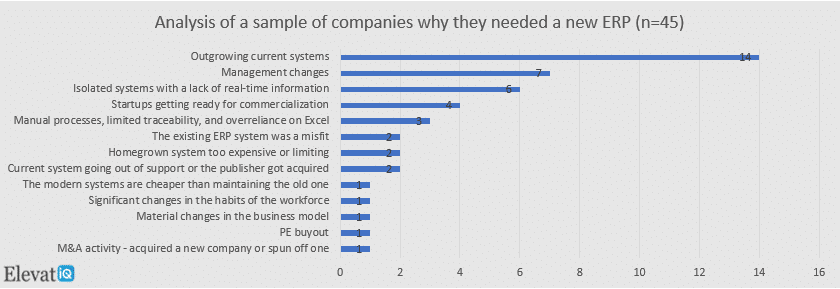
To prepare this list, we have analyzed a random sample of 45 companies from our client base. And their triggers of the need for an ERP system. This chart represents the results of that analysis. “Outgrowing current systems” seem to be the leading factor while “management changes” seems to be the second biggest factor.

Understanding these triggers and the core reasons behind them will help you identify opportunities for your company. One thing you might not want to do is to miss the opportunities just because of unawareness.

1. Outgrowing current systems

This seems to be the top reason why companies usually look for a new ERP. ERP systems are designed based on the size of a company, industry, etc. What are the major variables for selecting the right ERP system? How much planning would you need for your company, as ERP systems are primarily responsible for planning?

Installing an ERP for the first time? You may be aiming for the ERP upgrade to last the next 10-20 years. This is rarely true, though, especially if you are a growing company. Also, as you grow, the need for planning changes every couple of years. For example, a small company with a revenue of $50M? You will be overplanning if you plan like a large company with a revenue of $5B company. This planning may also be counter-productive.

Similarly, an ERP that is designed to assist with the planning of a large company may not be the best fit for a small company or vice versa. Every couple of years, your need for planning changes. And so does the need for an ERP system that is suitable for the size of your company.

Think of it this way, if you are single and the only reason why you need a car is to commute to work then Corolla may be enough. A truck may be overkill. However, if you are in a moving business where you have to carry heavy goods then Corolla may not be enough. As with vehicles, you need to choose the right ERP system depending on the stage of your company. And once you outgrow it, you need to plan the upgrade.

This is why companies outgrow their systems every couple of years and why this is a predominant reason for a switch.

2. Management changes

This is among the top two reasons for a new ERP project. Once a company hires a seasoned controller, CFO, or IT executive, they hire them as current management feels that their business has room to be organized and streamlined. These executives need to have the necessary experience to take the company to the next level.

For example, as the company grows, it might be pursuing several compliance certifications. Such as HIPAA or 21 CFR Part 11. As well as end-to-end traceability. Until now, they may have been able to manage the manual processes as they were small. Now management may feel that with growth, the manual processes could be inefficient and risky. And the executives will be responsible for automating these processes.

These executives may have worked for a larger organization and used a sophisticated ERP system firsthand. The goal is to use to get inspired by that experience and streamline the current business. This is why management change is the second most common reason for a new ERP.


The 2026 Digital Transformation Report

Thinking of embarking on a ERP journey and looking for a digital transformation report? Want to learn the best practices of digital transformation? Then, you have come to the right place.

3. Isolated systems with a lack of real-time information

While this reason could be thought of as similar to outgrowing the current system, this is listed as a separate item. These companies might not be growing as fast, but they might be operating on isolated systems. Such as QuickBooks or Sage as their accounting system. Epicor or Mysis is the manufacturing add-on, and there are a couple of Shop Floor and WMS add-ons. This architecture may be able to meet the needs of a small company with under $5M in revenue. It may be harder to grow afterward, however, as there will be significant duplication of data. And analytical work required to produce real-time data for their sales, operations, and finance teams.

The driver here is not necessarily the outpaced growth but it’s the architecture of ad-hoc systems. Real-time information across the processes is needed. An example of real-time information would be:

  • Which inventory items are in the stock that the sales team can comfortably use to commit to the customer?
  • What is the profit margin on each item that is being sold? And if there may be a product mix that might allow them to earn a higher profit margin without losing the sale?
  • Which regions sell the products with the highest profit margin and which are the highest-grossing?

This information is typically gathered in the form of delayed reports in the case of the architecture of disconnected systems. With a fully integrated system, you can get this information with a bunch of clicks. Getting this deep insight is a huge value for a company that has never had access to such information. And this is why this is the third reason for a new ERP.

4. Startups getting ready for commercialization

Some startups might spend a significant amount of time in the R&D phase. For example, a new battery manufacturing technology company, a new solar panel, or a medical device. Once they are ready for commercialization, they will be in high demand by other manufacturers or distributors who want to take advantage of the new technology and commercialize the products before the market becomes too crowded.

The startup would need to ramp up its manufacturing capacity at a very fast pace and manage its fulfillment process. Startups such as these experience a significant amount of growth in their early years, and in most cases, they will be growing faster than their peers.

To manage this growth, they like to be on an ERP system before their commercialization and this is why this is another reason why companies look for a new ERP.

5. Manual processes, limited traceability, and overreliance on Excel

There are two groups of companies that fall into this category. Some of these companies could be traditional companies that’s been running like this for decades but with changing times they feel that they could be benefited by digitizing their processes. The other category of companies could be the smaller companies under $5M that never needed a system as they could manage their business on paper or spreadsheets until now but now it’s becoming unmanageable.

Both of these groups exhibit similar behavior in terms of their processes. Their processes are overly manual or they utilize spreadsheets to manage their end-to-end processes. These companies feel that they can’t grow with these manual processes or they feel that they could be growing faster if they didn’t have as many bottlenecks in their processes. This is why is also the reason why companies look for a new ERP.

6. The existing ERP was a misfit

Companies in this group would install an ERP, but the vendor or the consultant may have failed to understand the business of the company and installed the wrong ERP. For example, most ERP systems specialize in certain industries. They typically are cheaper in those industries and have lower implementation risks, as they have been proven there. Let’s take an example of the Acumatica ERP system. It specializes in certain industries, such as manufacturing, distribution, field service, and construction.

+

ERP Optimization And Integration Architecture Development

Learn how Work Sharp fixed their broken ERP implementation that caused customer service issues and improved Supply Chain planning.

Infor CloudSuite Industrial (Syteline), however, focuses on very specific manufacturing industries such as Automotive, Electronics/Electrical Manufacturing, Aerospace and Defense, Medical devices, Windows and Door Manufacturing, and Industrial Machinery and Automation. If a consultant misunderstands the requirement of a distribution company and recommends Infor CloudSuite Industrial (Syteline) ERP for them, it would be a terrible fit as it is not designed for distribution companies. Similarly, if an ERP that has deep specialization in a specific micro-vertical will be far cheaper than a generalized ERP.

The reason why this is also a reason for a new ERP is that most ERP consulting firms specialize in only one ERP system, and sometimes it’s hard for them to know if they might be overcommitting with the only system they might be expert on. This is why it is important to work with a consulting firm such as ElevatIQ, which specializes in multiple ERP systems, so they can recommend the most appropriate option for you based on your business model and needs.

7. Homegrown systems too expensive or limiting

Since ERP engagements are one of the most intimate relationships where ERP consultants are likely to know most about their business, some companies don’t feel like working with these consultants as they feel that their business processes are unique and they don’t feel comfortable standardizing them and aligning them with industry-leading practices.

From our experience, we notice this issue only with smaller companies. Once a company grows beyond $30M in revenue, they usually focus on its core expertise and outsource other processes. For example, for a manufacturing company, volume or precision manufacturing could be their core expertise. Similarly, for a distributor, scaling their supply chain and optimizing their operations could be their expertise.

The homegrown systems are also not as agile as some of the modern cloud ERP systems such as Infor CloudSuite Industrial (Syteline) and Acumatica. They could also be very expensive. This is why these companies look for a new ERP system when their homegrown system becomes too expensive or limiting.

8. The current system going out of support or the publisher got acquired

This is also among one the chief reasons why companies look for a new ERP system. For example, Macola and Infor Point.Man are expected to go out of support very soon and most businesses that were on these systems would need to find a new home.

If publishers don’t have enough install base or not growing, they are likely to go out of business. This is why it is important to check the financial standing of the publisher. They might also get acquired by larger ERP players. For example, Point.Man was acquired by Infor. If this happens, in some cases, the companies that are acquiring may decide to kill the product and move to some of their other ERP systems, such as Infor CloudSuite Industrial (Syteline). Sticking with an outdated ERP may be riskier, and this is also the reason why companies are looking for a new ERP.

9. The modern systems are cheaper than maintaining the old one

This reason is similar to the homegrown case but the difference here is that you might be on another ERP system such as Microsoft GP or SAP Business One with significant customization by the reseller that may have become expensive to maintain over time due to hardware costs, maintenance, and upgrades required.

Cloud ERP systems such as Acumatica or Infor CloudSuite Industrial (Syteline) are far cheaper due to economies of scale and because the industry-specific functionality is built as part of the product.

The customized legacy systems may not have enough market share to provide the same economy of scale that publishers such as Infor can offer through their industry-specific editions and this is why this is also the reason why companies look for a new ERP to reduce their annual spend.

10. Significant changes in the habits of the workforce

Each demographic demonstrates specific habits. For example, older generations are not as tech-savvy and they might be fine with command-based legacy ERP systems. The newer generations, however, are used to modern technologies with intuitive interfaces on their mobile devices.

Most legacy systems such as Microsoft GP or Macola were not mobile-friendly as they were designed when mobile technologies were not as prevalent. The newer applications such as Acumatica were born in the age of cloud and mobile, and therefore, they provide a better experience to the users than legacy systems.

Companies that are going through a culture transformation such as hiring newer workers or tech-savvy workers or a pandemic such as COVID-19 might require the workforce to be enabled with mobile-friendly technologies, and this is why this is another reason why companies look for a new ERP system.

11. Material changes in the business model

Companies that are going through a business model transformation such as a manufacturing company pursuing direct-to-consumer or e-commerce capabilities, or a distribution trying to deepen in their value chain and may manufacture the goods themselves.

If this happens and if they might have an industry-specific ERP, they may need to upgrade it considering the new business model.

It may not be wise to buy a diverse ERP or an ERP considering the new business model if such a change may not be likely in the foreseeable future as it may be more expensive.

However, once these changes are in place, you may want to assess your revised processes and find an ERP that is suitable for the new business model. This is another reason why companies look for a new ERP if they have experienced a material change in their business model.

12. PE buyout

The reason why private equity may be interested in a manufacturing or a distribution company is that they feel that by optimizing the company’s process and by putting better management and control, they can improve the top or the bottom line, in the hope of increasing the value of the company in a specific period. The period for which they buy these companies could be anywhere from 5-7 years as they expect to exit after that.

To fix the process issues or to integrate or standardize with other companies in their portfolio, the companies might be interested in replacing their ERP systems and this is why this is also the reason why companies replace an ERP system.

13. M&A activity – acquired a new company or spun off one

Mergers and acquisitions are very common in the manufacturing and distribution industries. Manufacturing companies could acquire other companies to penetrate newer markets, capitalize on a technology or process, or for the economy of scale.

+

M&A ERP Integration Failure Rescue

Learn how Pride Sports struggled with Supply Chain and inventory allocation issues, as well as operational disruptions due to poorly planned M&A integration and ERP transformation project.

These M&A activities drive the need for integration and the integration might drive the need for a modern ERP that is slightly more integration-friendly. The other reasons could be similar to PE buyout where companies might standardize the ERP systems so that integration doesn’t become cost-prohibitive and it’s more seamless than a heterogeneous architecture would provide.

Conclusion

Now that you know a bit about the different triggers of why companies look for a new ERP. You might want to watch for these opportunities in your company and be faster than your competitors to gain a sustainable competitive advantage.

To the very least, review at least every year and decide if your systems might be ready for an upgrade.

Top 13 Reasons Why Companies Switch to a New ERP Read More »

What is Acumatica?

What is Acumatica? And How It Is Different From Other ERPs?

When we think of business management or ERP systems, we think of them as being hard. Hard at pretty much everything: 1) Hard to use. 2) Hard to implement. 3) Hard to maintain. 4) Hard to learn. In fact, there has been a common agreement in the ERP community. That is? ERP systems are not meant to be easy. Acumatica changes this.

It has changed the whole ERP buying and implementation experience? So much so that I have personally never heard the word “HARD” being referred to with Acumatica at all. When we ask our customers about their experience with Acumatica, this is what they say. 1) Easy to use. 2) Easy to implement. 3) Easy to maintain. 4) Easy to learn.


The 2026 Digital Transformation Report

Thinking of embarking on a ERP journey and looking for a digital transformation report? Want to learn the best practices of digital transformation? Then, you have come to the right place.

What makes Acumatica so easy to use?

While there are so many great things about Acumatica and why it is so easy at everything, we are going to cover just one feature as part of this article, which is quickly processing a sales order with one click, which is also the bulk of O2C (Order-to-cash) process.

In other similar systems, to complete an O2C transaction, you might have to remember multiple commands, memorize several screen names, and perform tons of chores before you can close your invoice or fulfill the order. The experience was closer to preparing for an exam.

In fact, in the older days, when a new employee joined an ERP project, it would take several days for them just to master this process in an ERP system. But why would Acumatica be any different?

It is the design philosophy

The reason why we wanted to cover this specific scenario is not that this is the most compelling feature of Acumatica but to demonstrate the whole design and user experience philosophy of Acumatica. In fact, this is the mindset they have used to design the whole platform.

+

Digital Transformation Change And Project Management

Learn how Big Country Raw managed the change and transformation despite their limited budget for ERP implementation and eCommerce integration.

They continue using these principles as they release industry-specific editions with last-mile functionality for several industries and build deeper capabilities. This is probably the reason why it is the fastest-growing cloud ERP system.

If you are not familiar with an O2C transaction of an ERP system, it would be your entire order fulfillment process where the sales team would kick off the process by capturing an order in the ERP system, which would be followed by releasing the order for the operations team to pick-pack-and-ship (or for the production team to manufacture and then followed by the operations team to complete their processes if you are a manufacturing company), and finally, once the shipping is complete, it would be released to the finance team to close the transaction.

This process is applicable in most order-driven industries whether we talk about simpler businesses such as retail and distribution, or complex manufacturing businesses such as industrial automation, machinery, automotive, building materials, food & beverage, or life sciences.

Now you might argue that the one-click process may not be sufficient due to process complexity for a lot of these businesses. We agree with your assessment but the goal of this article is not to show you features that might be relevant to specific industries but to demonstrate Acumatica’s design philosophy using a very simple feature or an idea.

One-click Process of Acumatica

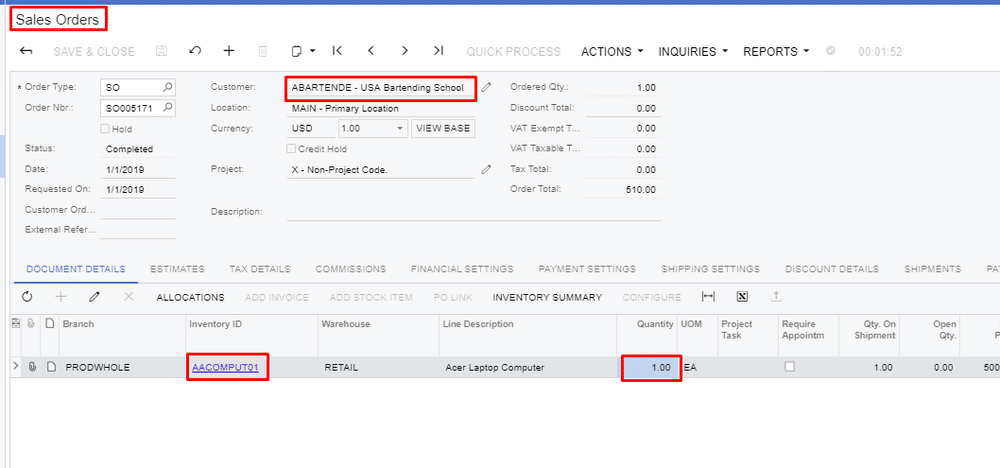
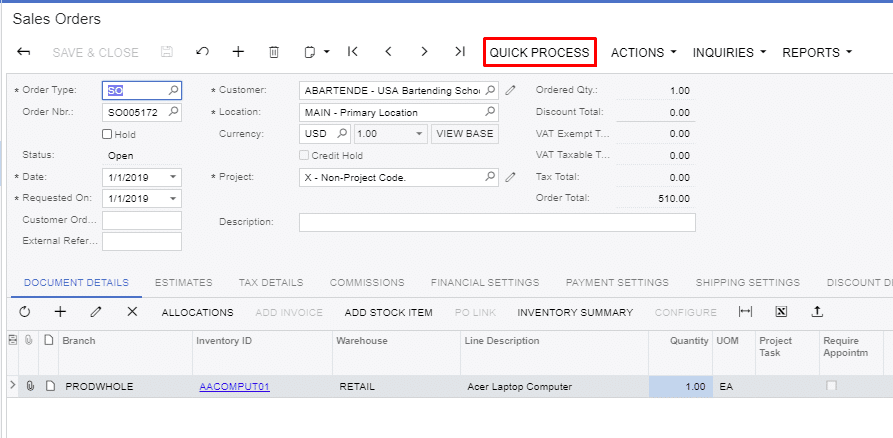
On the sales order screen, choose a customer, select an item, and quantity.

Then hit “Quick Process” This is the one-click step, which is the only click that is required to complete the entire transaction.

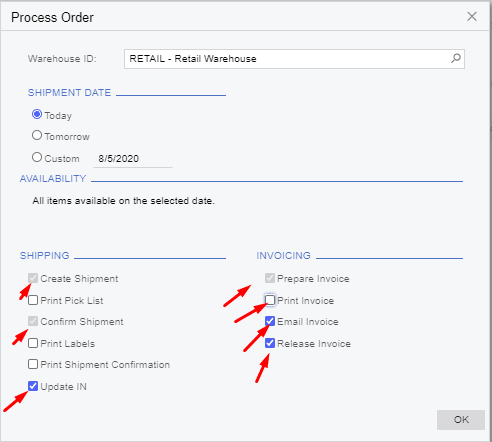
Choose all processing options such as releasing the invoice, emailing the invoice, etc you want to perform as part of this step and then hit OK.

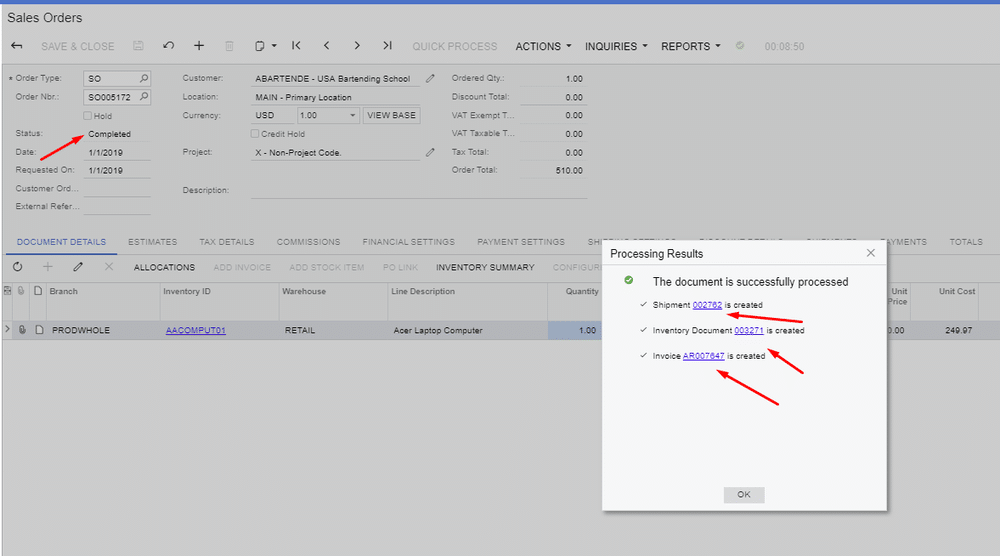
You will see the following screen once the transaction is completed. And you will note that it has finished the entire process including creating shipment documents, generating invoices, etc.

The ease of use has financial benefits too

Processes such as these are built throughout the system to reduce the number of clicks a user has to perform their job. This helps with learning the system faster, as well as making the users efficient and reducing the implementation time. This is also the reason why Acumatica provides better ROI and lower total cost of ownership (TCO) compared to other systems.


ERP Selection: The Ultimate Guide

This is an in-depth guide with over 80 pages and covers every topic as it pertains to ERP selection in sufficient detail to help you make an informed decision.

Conclusion

Unlike other ERP systems, Acumatica is easy-to-use. It’s especially helpful for businesses that may be implementing an ERP system for the first time and might be outgrowing smaller accounting systems such as Quickbooks, Xero, or Sage. With Acumatica, not only you can ramp up your teams on a new ERP system quickly, but you can also integrate your end-to-end processes. Finally, if you are a simple business with not a very complex order-to-cash cycle, the one-click feature is extremely handy to ensure that you are enabling your employees with the quickest way of completing their jobs without the system coming in their way.

Now that you know a little about Acumatica, make sure you include it as part of your next evaluation process.

What is Acumatica? And How It Is Different From Other ERPs? Read More »

Top 6 Risks of Financially Unstable ERP Publishers

Top 6 Risks of Financially Unstable ERP Publishers

Gordon B. Hinckley once said, “You can’t build a great building on a weak foundation.” Similarly, in the context of ERP systems, the “foundation” represents the financial stability of your ERP publisher, while the “building” symbolizes your company’s business continuity. This idea is straightforward, yet many businesses opt for potentially financially unstable ERP publishers without fully grasping their implications. In this article, you will learn why the financial stability of your ERP publisher is crucial and what could happen if you choose one that isn’t financially sound.

We have listed down the categories of publishers that would fall under these categories:

  • A small publisher without inadequate market share to support ongoing development and maintenance costs.
  • A well-known publisher that is operating at a loss in order to gain market share.
  • A product that is not profitable but backed by a large, financially sound corporation.

When you implement an ERP system, you are relying on an algorithm that is developed and continuously maintained by the ERP publisher, even if you own the code in the case of an on-prem installation. The costs of this ongoing maintenance are typically shared by their customers. If the publisher lacks sufficient market share and existing customers are unwilling to pay more, the publisher may face financial difficulties. This could lead to the following consequences for you.


ERP Selection: The Ultimate Guide

This is an in-depth guide with over 80 pages and covers every topic as it pertains to ERP selection in sufficient detail to help you make an informed decision.

1. ERP products no longer supported

Much like cars or heavy machinery, ERP products are complex systems that should only be fixed by their publishers to avoid unintended consequences. If you’ve chosen a publisher that can no longer provide official support due to financial difficulties, your options are limited to seeking help from unauthorized consultants, which could lead to unpredictable behavior of your ERP system, or starting the implementation process all over again. To avoid this scenario, it’s best to steer clear of the financially unstable ERP publishers mentioned earlier.

How often do ERP publishers face cash challenges? ERP development is expensive and can drain cash flow. The frequency of these challenges largely depends on their cash reserves. As a general guideline, we recommend that ERP publishers with thousands of installations in the SME market to maintain financial stability. For markets with larger customers, this number may be lower.

2. Unable to provide regulatory upgrades

ERP publishers need to develop new features or update existing functionality to ensure compliance with changing regulations. If the publisher lacks the financial resources to support this development, you may find yourself out of compliance, potentially facing monetary penalties. When the Everest ERP system experienced financial troubles, its customers had to find a new solution to maintain regulatory compliance. You can avoid this situation by choosing financially stable ERP publishers.


ERP System Scorecard Matrix

This resource provides a framework for quantifying the ERP selection process and how to make heterogeneous solutions comparable.

3. Incompatible with underlying software or hardware

ERP products rely on various software packages and hardware components. For instance, Acumatica ERP is built on the .Net platform, which is owned and maintained by Microsoft. Each version of .Net is compatible with a specific version of Windows software, and Windows software may only work with certain Intel processors. Whenever an underlying component is updated, any dependent component must also be updated to maintain compatibility.

If an ERP publisher is not financially stable enough to support ongoing compatibility fixes with hardware and software, you may have to undergo the implementation process again with a different ERP publisher. Alternatively, the software could stop working suddenly due to compatibility issues, leading to disruptions in your business operations.

4. Chances of getting acquired

If an ERP publisher faces financial difficulties, they may need to secure an investor to fund development and maintenance. This investor could be a larger ERP publisher, such as Infor or Oracle.

When larger companies acquire smaller ERP publishers, they often use various strategies: 1) raise prices to recover ongoing losses, 2) discontinue the product and push you to switch to one of their own, 3) reduce support and other benefits you previously received, or 4) impose limits on storage or bandwidth, requiring you to upgrade. In any of these scenarios, you’ll either face higher costs or undergo another ERP implementation.

5. Inability to find consultants to get support on the product

Consultants prefer working with products backed by financially stable companies, as it minimizes risks to their careers. If an ERP publisher is facing financial challenges, you may find it difficult to secure consultants who can support the product.

+

ECommerce Supply Chain Transformation

Learn how LockNLube transformed its inventory and supply chain challenges by consolidating over 20 systems.

6. Each of these risks has the following financial implications for your company.

  1. Pay more than the agreed amount originally.
  2. Lose investments on the original upgrade and might need to plan for a premature switch.
  3. Forced to switch to an unwanted and expensive product in case of an acquisition.
  4. Forced out of the platform if the product gets shut down by the acquiring company

Conclusion

ERP publishers provide the foundation for your business operations. Opting for a weak foundation, such as a financially weaker publisher, is not a wise decision. While you might save a small amount of money with these publishers, the financial risks involved could have serious consequences that aren’t worth the savings.


The 2026 Digital Transformation Report

Thinking of embarking on a ERP journey and looking for a digital transformation report? Want to learn the best practices of digital transformation? Then, you have come to the right place.

Top 6 Risks of Financially Unstable ERP Publishers Read More »

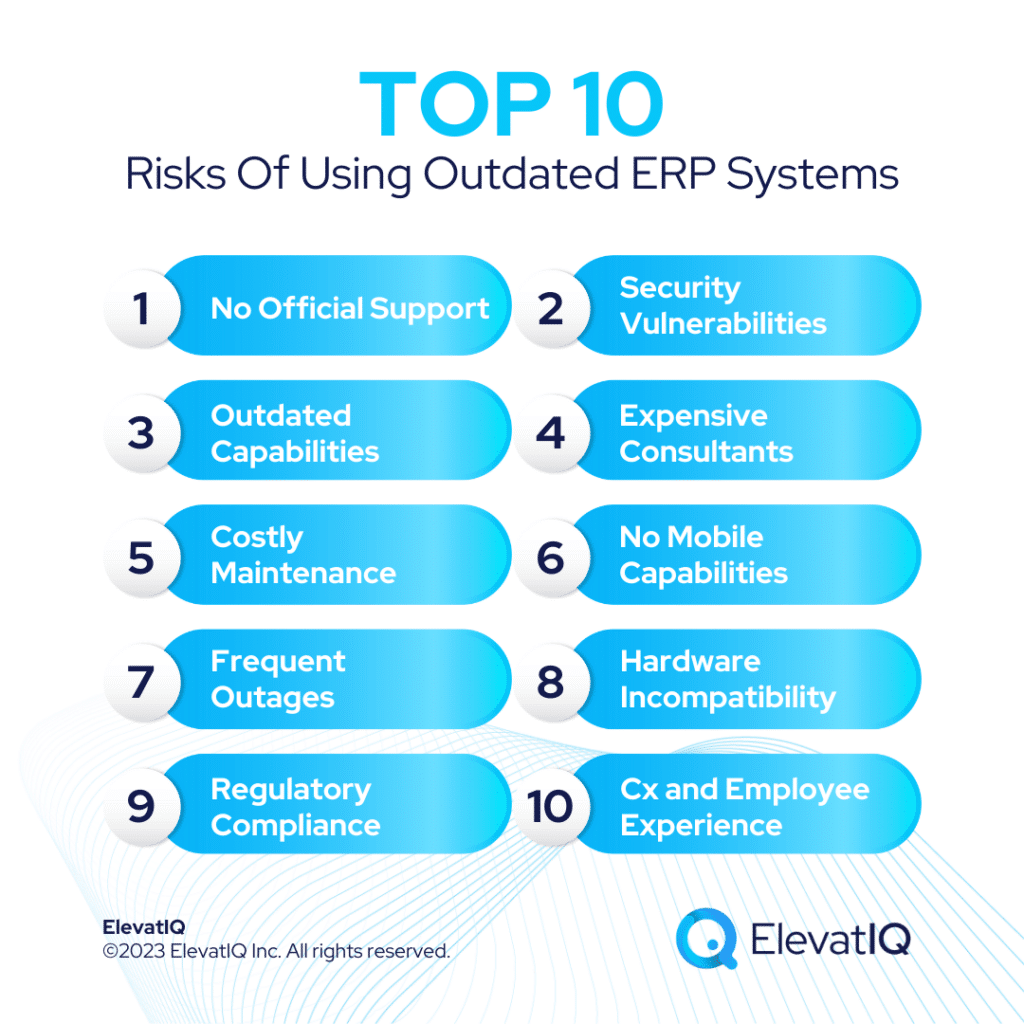
Top 10 Risks Of Using Outdated ERP Systems

Top 10 Risks Of Using Outdated ERP Systems

The market is flooded with dozens of outdated ERP systems (confusing to the extent that they use vendor names to refer to a product, as keeping up with millions of products is nearly impossible), including Macola, SAP R3/ECC, and Point.Man, as well as older versions of Syteline and Epicor. Legacy ERP products from publishers like Sage, IBM, Oracle, and Microsoft are also prevalent. These outdated systems span across various publishers and product categories. In some cases, the ERP publisher may no longer support these products or versions, or they may have even been advised to discontinue support altogether.


ERP Selection: The Ultimate Guide

This is an in-depth guide with over 80 pages and covers every topic as it pertains to ERP selection in sufficient detail to help you make an informed decision.

As the cost of supporting legacy versions rises due to a shrinking install base (having a handful of installations for a product isn’t uncommon in the ERP industry), vendors often employ various strategies to encourage customers to migrate to newer versions. In some cases, these warnings may simply be tactics to nudge you toward the version they prefer. However, not all publishers operate the same way. For some, the decision to phase out support is genuine, as maintaining these products or versions may no longer be financially viable. The install base may have dwindled to a point where the cost of upgrades and maintenance is no longer justified. Failing to understand the product life cycle can have repercussions. Consider the car market—what automotive manufacturer do you know that supports a car or model indefinitely? None, would you not agree?

Now that we agree most products have life cycles—and for good reason—it’s wise to embrace and evaluate the risks of using a product against the producer’s recommendations. Yet, that’s not always how life works, so why do businesses choose to stick with outdated software? There could be several reasons. Perhaps it’s the belief that the old software no longer incurs costs. Or maybe the memory of a difficult and disruptive ERP installation still lingers. Another factor could be the advice of a consultant who discourages upgrading. Finally, it might simply be a lack of understanding of the risks and benefits associated with upgrading.

1. No Official Support

Tip: If you are still lucky to have support from your publisher on the outdated ERP systems that you are using, you may want to skip this section and move to the next.

Some consultants may argue that lack of official support isn’t a concern, but support from the publisher remains critical. Why? An ERP system is essentially a black box, and only the OEMs truly understand its inner workings—or should be the ones addressing serious product issues. While you might find workarounds or apply temporary fixes, the long-term behavior of the system becomes unpredictable. These improvised solutions could have unintended consequences.

To put this into perspective, official support is like a manufacturer’s warranty or the support provided with a car. Sure, you might take your car to a local mechanic for minor repairs, even if they aren’t certified or endorsed by manufacturers like Honda or BMW. However, when a major issue arises—such as engine or transmission failure—the mechanic may not be equipped to handle it, leaving you without reliable support. You can’t afford to take such a gamble with financial software, which functions as the “brain” of your company. Imagine the consequences if your company’s brain were to malfunction.


The 2026 Digital Transformation Report

Thinking of embarking on a ERP journey and looking for a digital transformation report? Want to learn the best practices of digital transformation? Then, you have come to the right place.

2. Security Vulnerabilities

Outdated ERP systems leave you vulnerable to security risks because the core software is no longer being updated. Why is this a serious concern for financial software? Financial applications hold sensitive and confidential data about your company and its customers. If this data were to be compromised due to a security vulnerability, the financial and reputational consequences could be significant—risks that no business can afford to overlook.

To illustrate this, consider security updates like annual flu shots. Just as flu shots are a preventive measure to protect you from evolving flu strains, security updates protect your software from emerging threats. Each year, new strains of flu viruses are identified, requiring the vaccine to be updated—and the same principle applies to software. With official support from the OEM, they monitor new strains of computer viruses and security threats, providing regular updates to keep your system protected.

You definitely don’t want to catch the “ERP flu,” especially if you’re not accustomed to handling it. So far, your publisher has shielded you by providing preventive upgrades to keep your system protected.

3. Outdated Capabilities

Explaining or showcasing software capabilities can be challenging because, for many, software feels like a vast black box. Similarly, it’s not always easy to convey why the features you currently rely on might be outdated. A helpful analogy is to think about cars: you’d probably agree that driving a 1992 Nissan would be a vastly different experience compared to driving a 2020 model.

If we asked you to compare these two models, some casual users might point out that the design of the older model isn’t as appealing, or they might assume that the 2020 version is obviously better. On the other hand, those with a bit more technical knowledge might highlight differences in safety ratings, engine power, or transmission quality. Regardless of their level of expertise, however, both groups would likely agree that the 2020 model outperforms the 1992 version, offering enhanced capabilities due to technological advancements and improved design.


ERP System Scorecard Matrix

This resource provides a framework for quantifying the ERP selection process and how to make heterogeneous solutions comparable.

4. Expensive Consultants

In the consulting market, consultants are eager to work with the latest and most cutting-edge technologies, as it boosts their resumes. They aim to capitalize on emerging trends by becoming early adopters before the market gets saturated. The same logic applies to older products and technologies. When an OEM shifts its strategy, consultants typically move away from outdated ERP systems to avoid having their resumes become obsolete. Those who remain to support these legacy systems will likely charge significantly higher rates due to the scarcity of qualified experts.

There’s no way to avoid this; it’s simply how the talent market operates, driven by supply and demand. To avoid ending up in a tough spot, the best course of action is to upgrade your product as the market evolves. Otherwise, you could find yourself stuck with a 1992 car and a broken transmission, with only a few expensive experts able to fix it. The difference with ERP systems is that, while replacing a car carries minimal risk, the stakes are much higher with ERP systems. The risks include business disruption and potential financial loss.

5. Costly Upgrades and Maintenance

Older systems demand more time for troubleshooting and extended maintenance since they’re no longer being updated by the OEM. The reason people upgrade their cars isn’t just for prestige—it’s because maintaining an older car becomes more expensive. Maintenance costs can sometimes exceed the cost of purchasing a new one. ERPs are no different.

How many 1992 cars do you see on the road today? And if you don’t drive one yourself, why would you risk using outdated ERP systems? I’m sure you’d agree that sticking with such an old system is far from a smart decision.

6. No Mobile Capabilities

When older technologies were created, mobile devices were not as widespread, so they weren’t built to be compatible with them. In contrast, modern cloud software provides the flexibility to access your system from anywhere, on any device. This means you can have real-time insights right at your fingertips, along with the ability to manage your ERP from a mobile phone.

7. Frequent Outages

A 1992 car is less likely to be reliable and may break down frequently, and the same holds true for your ERP system. Since the software isn’t being updated, it’s prone to malfunctioning, and your consultants may take longer to fix issues because they might not be familiar with what’s causing the problems. This could disrupt your business processes, preventing you from fulfilling orders or generating invoices.


ERP Selection Requirements Template

This resource provides the template that you need to capture the requirements of different functional areas, processes, and teams.

8. Hardware or OS Incompatibility

Even if your consultants manage to find workarounds for the software, it may not be compatible with newer database versions. This could lead to issues where the software doesn’t function properly with the latest operating systems or hardware.

9. Challenges in complying with regulatory requirements

Modern software typically updates automatically to reflect changes in laws and regulations, such as updates to PCI compliance, data security, new tax laws, and accounting rules. By using outdated software, you not only miss out on these essential updates, but you also risk facing significant fines for non-compliance with these regulations.

10. Customer and Employee Experience

Regardless of whether you’re a small or large business, today’s customers have similar expectations to those of Amazon when it comes to their experience. They value reliability and traceability with their orders, and they prefer to engage with businesses that are predictable and trustworthy. Using risky software, however, introduces unpredictability, undermining your ability to deliver with credibility.

+

M&A ERP Integration Failure Rescue

Learn how Pride Sports struggled with Supply Chain and inventory allocation issues, as well as operational disruptions due to poorly planned M&A integration and ERP transformation project.

The same goes for employee experience. Millennials grew up using mobile devices and social media platforms like Facebook. They’d rather work for your competitors than struggle with outdated, clunky software. With talent already being hard to find, you don’t want your software to be the reason you lose top candidates.

Conclusion

Switching from outdated ERP systems requires extensive planning, and to avoid being caught off guard, it’s wise to align your ERP upgrade process with current market trends. Skipping a model or two isn’t the end of the world, but driving a 1992 car is far from a smart choice.

Your first step should be to check if your current software is still supported by the OEM and explore your options if support has been discontinued. Independent ERP Consulting firms like ElevatIQ can assist with data migration and transition planning, helping you avoid potential issues down the road.

Top 10 Risks Of Using Outdated ERP Systems Read More »

Top Learnings for a Manufacturing CFO

Top Learnings for a Manufacturing CFO

Are you a new CFO in a manufacturing company, and haven’t yet been exposed to manufacturing accounting or operations? It’s crucial to understand the intricacies of this industry to succeed in your role. Most manufacturing companies begin seeking a senior finance operations leader when they reach $20-50 million in revenue. Prior to that, they may outsource financial operations. They might use smaller accounting systems like QuickBooks, often with support from an external CPA firm. In these cases, the company’s owners or principals typically oversee the operations.

Once the company reaches the $20 million mark, it becomes difficult to maintain the same operational structure. At this point, they hire a financial operations leader like yourself to streamline processes and take control of the company’s financial position.


The 2026 Digital Transformation Report

Thinking of embarking on a ERP journey and looking for a digital transformation report? Want to learn the best practices of digital transformation? Then, you have come to the right place.

the difference between a controller and a manufacturing CFO role

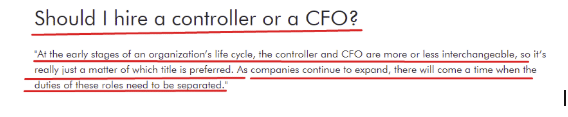
Before we start digging into the CFO role itself, it will be beneficial to understand the difference between a controller and a CFO role. How they differ, and how they both will be collaborating. Here is a snippet from the article published by one of the top recruiting agencies:

As you may have noted, the CFO and Controller roles are interchangeable in smaller companies. For simplicity, we are talking about manufacturing companies that may hire a controller or a manufacturing CFO for the first time. We will be using these terms interchangeably as well in this article.

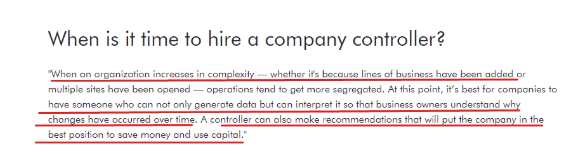
Before we start, let’s start with some triggers why companies hire a controller or manufacturing CFO. Unless they might be replacing a seasoned executive, in most cases, they hire them to streamline operations and improve financial control. Here is the same article again that talks about these events:

As the article suggests, expanding operations that could include adding additional plants is among the reasons why they might hire a controller or manufacturing CFO. The first time.

Have you been a manufacturing CFO before? If so, your job may be easier since you’re already familiar with how manufacturing companies operate and the key metrics to track for control. However, if you’re transitioning from a completely different industry, such as distribution or construction, you can expect a steep learning curve, as manufacturing financial operations are quite distinct.


ERP Selection: The Ultimate Guide

This is an in-depth guide with over 80 pages and covers every topic as it pertains to ERP selection in sufficient detail to help you make an informed decision.

Understanding the business model of a manufacturing company is critical

The first question you need to ask is whether the company operates in the process industry or discrete manufacturing. These two types of manufacturing differ significantly in terms of operations, compliance, and reporting. The best way to understand how discrete manufacturing differs from process manufacturing is to look at examples of manufacturing businesses and their products. Here are a few examples to help illustrate:

Examples of discrete manufacturers

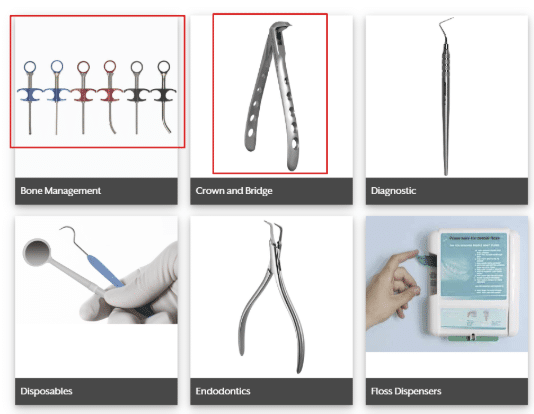
This is an example of a discrete manufacturer from the New York area that produces surgical instruments for the dental healthcare industry.

This is another example of a discrete manufacturer from the New York area. That produces fluid sealing and pipeline solutions for several industries. Including Chemical Processing, Primary Metals, Pulp and Paper, and Pharmaceutical

Examples of process manufacturers

This is an example of a process manufacturer from the New York area that is a pharmaceutical manufacturer of prescription tablets and capsule formulations.

This is another example of a process manufacturer from the New York area that manufacturers packaged food for pets.

Were you able to spot the difference between discrete and process manufacturing through these examples? The key distinction lies in their manufacturing processes and how they produce their products. Process manufacturing uses formulations to create goods, whereas discrete manufacturing relies on a Bill of Materials (BOM). Formulations might resemble a mathematical formula (e.g., M3 = 2*M2 + M1) and involve interdependencies between the quantities or proportions of materials. In contrast, discrete manufacturing’s BOMs may include multiple layers for sub-components, but typically, the quantity of one material is not dependent on another.

For simplicity, most Food and Beverage, Chemicals, and Pharmaceutical companies are categorized under the process industry. On the other hand, companies that are more hardware-centric or assembly-oriented, such as Industrial Machinery, Electrical and Electronics Manufacturing, Automotive, Windows and Doors, and Medical Devices, are examples of discrete manufacturing. If you’re still unsure, here’s what Google suggests as the first search result:

Once you understand whether your company falls into the process or discrete category, the next step is to grasp how these products are ordered, planned, and how inventory is replenished. You also need to understand the production process and the sales approach.

This will help you determine how many of your processes are make-to-order (produced after receiving an order), make-to-stock (produced in advance to meet demand and stored in inventory), engineered-to-order (involving significant engineering and typically long-term), or project-centric manufacturing (where the entire manufacturing process is treated as a project rather than a continuous process).

+

M&A ERP Integration Failure Rescue

Learn how Pride Sports struggled with Supply Chain and inventory allocation issues, as well as operational disruptions due to poorly planned M&A integration and ERP transformation project.

After manufacturing processes, next comes the inventory

Once you have thoroughly analyzed each process, the next step is to assess how organized your inventory is, and whether there are formal processes in place for managing raw materials, work in progress (WIP), and finished goods. If your company has never had a controller or CFO, there’s a strong possibility that formal processes for inventory or the Bill of Materials (BOM) may not be established.

Identifying and categorizing your inventory, along with mapping the value chain, is crucial. This will enable you to perform product costing for each manufactured item, which is essential not only for understanding production costs but also for setting prices and determining discounts.

After mapping your inventory, the next step is to identify all your resources, including machines and tools, and map them to each operation. Since manufacturing involves many moving parts and costly machines, mapping these operations will help with costing, scheduling, and forecasting labor demand, ensuring your production runs at an optimal level.

Finance and accounting are a bit different too

Assuming you have a strong background in finance and accounting, I won’t go into those topics in detail here. The main difference between accounting for manufacturing and other organizations lies in the chart of accounts. Manufacturing organizations tend to have a more detailed chart of accounts, primarily to support product costing. As each BOM progresses through the production process, it may update multiple accounts as labor and materials are reported on the production order.

Other accounting topics to consider: If payment terms, payment methods, pricing and discounting procedures, and approval processes are not documented and centralized, you’ll likely need to sift through past paper-based invoices and orders to gather and organize this information.

+

ERP Optimization And Integration Architecture Development

Learn how Work Sharp fixed their broken ERP implementation that caused customer service issues and improved Supply Chain planning.

Don’t forget customers, vendors, employees, and payroll processes

If you’ve already documented and gathered the major details of your business, the next step is to analyze your customer and vendor groups, as well as clean up any duplicate or outdated records. You may also need to map the end-to-end sales and purchasing processes. Finally, it’s important to understand how timesheets, expenses, and payroll are generated, as this will give you a comprehensive view of the organization.

This may seem overwhelming, but once you have a clear understanding of the business, that’s when your real work begins. As mentioned earlier, your role is to streamline operations and automate processes to help the company scale. The more manual and ad-hoc processes you have, the more bottlenecks and duplicated efforts you’ll encounter, making operations inefficient and costly. Your goal should be to automate and standardize as much as possible.

An integrated system could Help

Documenting these processes will help identify inefficiencies, but without a fully integrated system that connects all of your processes, implementing your recommendations and process improvements will be challenging, making it harder to streamline operations.

This is why incorporating the implementation of a fully integrated system should be a key part of your efforts. In fact, during your interview, they may ask if you have experience implementing an ERP system, or if ERP implementation could be a driving factor for the role. Typically, when a company recognizes the need to streamline its operations for the next phase of growth, it signals that they are ready for an ERP implementation. An ERP implementation involves several phases, including preparation and documentation. The steps mentioned above serve as a precursor to this process.

Top Learnings for a Manufacturing CFO Read More »

Top Tips for a Digital Transformation Champion

Top Tips for a Digital Transformation Champion

Years back, I had this big idea that I strongly believed in and felt could be a game-changer for my employer. I had everything down to be a digital transformation champion. The design. The prototype. The user experience. The hockey stick graph. The customer persona. The target market. The strategy. However, knowing my CFO from my experience, I felt nervous about pitching. I often heard “voices” in my head that CFOs don’t believe in big ideas. Their role is to shut them down.

Over the years, as I worked closely with financial executives, I’ve come to understand that pitching to them isn’t as challenging once you understand what they care for. Read on to learn how to tailor a pitch to your financial executives’ needs.


The 2026 Digital Transformation Report

Thinking of embarking on a ERP journey and looking for a digital transformation report? Want to learn the best practices of digital transformation? Then, you have come to the right place.

The Pitch

A good pitch consists of four essential components:

The purpose of the pitch.

This is perhaps the second most important component of the pitch. It must include the overarching benefit, which connects to either the bottom line or the top line. Let’s take an example of a hypothetical pitch.

“By replacing the legacy ERP, we would be able to ship your products within 24 hrs. I have analyzed competitive data. Through that, I learned that the competitors who can ship within 24 hrs have been growing their sales by 2x. Based on my market research, our customers prefer sooner delivery. Because they want the online experience to be closer to walking to a store, with near-real-time gratification of their spend, the ERP transformation project would help us increase our sales by 20%, boosting customer experience as well as employee satisfaction.”

As you can see, how this pitch tries to connect with the overarching benefits of increasing sales. As well as providing specific details on how that would be done. This is how a digital transformation champion needs to frame the pitch to get the attention of the CFOs.

What’s in it for them?

This is perhaps the most important component of any pitch. If a pitch is not aligned with the audience’s interest, it’s probably a non-starter. CFOs are responsible for managing the bottom line. That is, they are not only responsible for ensuring that the company can meet revenue objectives and collect cash but also responsible for containing costs. When sales teams fail to deliver on their commitments, they ensure that the bottom-line objectives are met. The best way to score with CFOs is to put yourself in their shoes. What would you like to hear in a pitch yourself if you were them?

What’s in it for you?

While you might feel that this part may not be as important, it is equally critical to show your commitment and credibility. If you have not outlined how this would personally impact a digital transformation champion, it’s hard to assess if you have analyzed it thoroughly, avoiding any biases with your proposal. This also helps in ascertaining the sustainability of the idea to ensure your commitment to it in the long term.

+

Omnichannel ECommerce Customer Experience Transformation

Learn how fashion retailer AKIRA built a digital roadmap and managed stakeholder expectations to transform its processes and systems.

A good call to action.

Before attending the pitch meeting, take time to anticipate potential outcomes based on how the discussion might unfold and prepare a call to action for each scenario. For instance: 1) they might fully embrace the idea before you’ve even finished pitching, 2) they could dismiss it immediately, or 3) they might remain neutral and request additional information. Remember, a deal isn’t finalized until it’s truly sealed.

This is the mindset a digital transformation champion must adopt when navigating various scenarios. For instance, if the idea is completely rejected, you could ask probing questions to uncover whether there are any aspects of the idea that might simplify their work or address their needs.

In most cases, engaging them in conversation will provide valuable insights that can help you refine and align your pitch to their interests. However, the most critical part of the meeting is determining the next step. Once you’re out of their immediate focus, they may quickly forget what was discussed, potentially requiring you to start over. Having a clear call to action and a defined next step ensures you stay connected and remain on their radar.

When pitching, keep this in mind: the best pitches are the ones where you hardly have to pitch at all—your champions will advocate for you and handle the job.

The Champions

You might be wondering how, as a digital transformation champion, you can gather market data and field insights about what customers value and how competitors are performing in comparison to you.

To gain these insights, it’s essential to build strong relationships with the sales and marketing teams. While your expertise lies in technical skills, which they may lack, you can leverage these skills to analyze customer and market data through secondary research, such as reviewing internal data sources. In exchange for their field or market knowledge, this collaboration can be mutually beneficial. If you present this data effectively, it could prove valuable to them, creating a win-win situation. Additionally, if you gain the support of your sales team, they can become powerful advocates and pitch on your behalf.

Your champions can also offer valuable insights into what your CFO is likely to prioritize, as they may have more experience interacting with other executives. They can help you tailor your pitch to better align with the CFO’s interests. When selling to champions, your goal is to make the idea feel like it’s their own. If they’re not willing to take ownership of it, chances are you won’t be able to sell it to the CFO either. This can serve as a useful test to assess whether the idea is worthy of the CFO’s time. You may only get one opportunity, so when requesting a meeting, ensure that it’s truly worth their time.

The Financials

While ideas are important, CFOs are primarily driven by numbers. If you’re not experienced in calculating ROI or TCO, consider building relationships with interns in the finance department who have formal education in NPV and future cash flow analysis. They may be eager to showcase their analytical skills to the CFO. Bring them onto your pitch team and let them present the numbers. The more team members you have supporting your pitch, the better.

Your objective during the pitch meeting is not just to grab the CFO’s attention. If you’ve thoroughly analyzed how this idea benefits you in your role, their attention will naturally follow, assuming everything goes well. At this point, your main goal should be to gather as many people as possible in the room who are ready to pitch on your behalf. During the meeting, your role is to act as a moderator, guiding the flow of the discussion, determining who speaks when, and maintaining control of the situation.

The financials are only valuable if all assumptions are thoroughly vetted. Ensure you use reliable sources and have sufficient data to support your claims, as this is crucial for impressing a CFO. Evaluate all financial risks associated with the idea and prepare a backup plan for each one. If you overlook or ignore even a single financial risk, your entire plan could be questioned.

How do you excite CFOs?


Keep in mind that it is in a CFO’s best interest to consider projects that contribute to managing the company’s bottom line. If you’ve done a thorough job analyzing the numbers and gathered credible evidence to support your claims, CFOs will pursue your idea if there’s even the slightest chance it could provide financial benefit to the company.

CFOs have a deeper understanding of financials than anyone else in the company, so they focus on the financial feasibility of your next big idea, which is honed through experience. Just because one idea didn’t succeed doesn’t mean the next one won’t. The best advice we can offer is to never stop trying!

Top Tips for a Digital Transformation Champion Read More »
Is QuickBooks an ERP System?

Is QuickBooks an ERP System?

QuickBooks is not necessarily an ERP system, although commonly referred to as one, as some people feel that ERP and accounting systems are comparable (and interchangeable). If you are in a group that does NOT regard it as an ERP, then this article may not be for you. However, if you do regard it as an ERP, then read on to learn about two camps inside the QuickBooks ERP group:

  1. The first camp considers it the most intuitive, tiny ERP system (terribly simple), perfect for companies who don’t have large budgets and overarching needs.
  2. The second camp, on the other hand, regards it as the most terrible ERP system (simply terrible), prone to errors and causing similar issues as spreadsheets, such as duplication of data across systems, lack of control, unavailability of real-time financial data, and overreliance on analysts for reporting.

In either case, read on to learn more about why these camps differ in their opinions about QuickBooks.


The 2026 Digital Transformation Report

Thinking of embarking on a ERP journey and looking for a digital transformation report? Want to learn the best practices of digital transformation? Then, you have come to the right place.

Terribly Simple ERP camp: QuickBooks is the best ERP ever

To some extent, we agree with their assessment. That QuickBooks Enterprise/Online/QBO /QBE (collectively referred to as “QuickBooks” henceforth) is most certainly one of the easiest ERPs ever built. Why? Because it is designed for users who don’t have experience with any other more sophisticated ERP systems. Moreover, its design is friendly for accountants or business users with preliminary accounting knowledge (or needs). Yet most of the complex tasks are still expected to be performed either manually or through the use of spreadsheets.

When you log in to QuickBooks, everything looks great. You can create invoices or bills without any limitations and perform journal entries as you like. Financial statements that you need for the most common usage are all pre-built. The batch process is super easy, and you just have to watch a couple of YouTube videos to master it. You can connect your bank accounts with one simple click. And all your transactions are right there for you to perform reconciliation or close books. The recurring entries and closing process is super easy as well.

The users of this camp feel that QuickBooks is the best system ever designed. And every single ERP system out there must be inspired by its business model. Now let’s hear from the second camp why they feel that it’s terrible.

Simply terrible ERP camp: QuickBooks is the most terrible ERP system ever

If everything is so easy about QuickBooks, why does the 2nd camp feel that it’s terrible? Well, to understand their perspective, let’s first analyze the demographics of these groups.

Recapping the point mentioned above for the 1st camp, the user base of that camp didn’t have experience using a “real” ERP system.

The 2nd camp, however, consists of users who have used at least one ERP system in the past or have significant experience solving complex business or accounting problems–using a system. They have seen the fully automated, end-to-end integration of the processes first-hand. And they understand that their lives weren’t as difficult when they had access to such a system. They didn’t have as much chaos and didn’t have to manage as many spreadsheets. They also didn’t have to create as many ad-hoc processes even though the other company was much larger in terms of operations.

While the 2nd camp agrees with the 1st camp about the overall ease of use of QuickBooks, they feel that QuickBooks’ design has limitations as per their experience.

An Example of a Hypothetical Business

To understand this better, let’s take an example of a hypothetical business. When a business is small, say under $5 mil, their teams are small, too. Their employee strength could be 5-6 people, with each employee independently responsible for their functions. One is for sales, the other is for purchasing, and the third is for accounting. They can manage their functions as they want without overstepping.

Continuing to the same example. Once a company grows past $5 mil, the order volume will most likely go up. More people will need to manage each function. The functions such as operations or finance would grow in proportion as well. With more people added to each group, they will bring unique perspectives to each problem, different ways of documenting processes, and different ways of performing the same tasks. With the functions being independent, they would have their budgets and freedom to buy the software/tools that make them efficient. The added growth would lead to additional processes, such as geographic or product expansion.

While QuickBooks could be great to assist with accounting for this company, the other processes would remain largely manual or disconnected if managed in different software (such as an inventory or WMS add-on for QuickBooks, or an add-on to integrate Zoho or Salesforce CRM with QuickBooks, FreshBooks, Xero, or Sage). For instance, inventory is not connected to the accounting system, or the warehouses are completely isolated or running based on an “honor system.” Or the sales system living a life of its own or running manually. Likely, there will not be end-to-end visibility or limited control over the processes.


ERP System Scorecard Matrix

This resource provides a framework for quantifying the ERP selection process and how to make heterogeneous solutions comparable.

Another Example of This Camp

Let’s take a hypothetical example of a business problem at this stage if their salespeople or customers ask them to sign a large contract where they expect them to deliver within 10 days. Without the data available for previous successes (or failures), it’s very hard to commit to the delivery date (and execute with confidence). If they need the necessary data to back up their decisions (and whether they have enough capacity to commit to such demand), their data will be duplicated across multiple systems. They might also need the help of an analyst who can quickly crunch a report.

As you can imagine, it would be a nightmare to be in this position, and this is why they feel that QuickBooks is simply a terrible ERP system, as It is not designed to be an ERP system.

Now, you must be wondering which perspective you should focus on. In other words, which camp should one join?


ERP Selection: The Ultimate Guide

This is an in-depth guide with over 80 pages and covers every topic as it pertains to ERP selection in sufficient detail to help you make an informed decision.

Here are our take and recommendation

We recommend identifying your tribe. Are you a company that is under $5 million in revenue (with limited experience implementing a real ERP)? In this case, we recommend managing with QuickBooks and with isolated systems (such as an inventory add-on for QuickBooks, a WMS add-on for QuickBooks, or an add-on to integrate Zoho CRM with QuickBooks). Or the combination of manual processes augmented with the use of spreadsheets.

On the other hand, once you grow past $5 million, then it might be time to migrate to fully integrated processes and consolidated data siloes. This new state would require embracing the new dynamic as their design removes data siloes, operating on one data model, to reduce operational reconciliation overhead. This would be a mindset shift as it might feel like increasing some work because of the boilerplate with such data and process model. But it will help with the overarching operational efficiency, allowing you to scale.

It’s just unfair to compare QuickBooks with an ERP system (or call it an ERP system).

What if I want a system that is as easy as QuickBooks but has all the bells and whistles of a sophisticated ERP system

Well, for all practical purposes, we have some bad news for you: such a system doesn’t exist. While there are systems that would be closer to providing a similar user experience, replicating the same user experience is nearly impossible.

Think of it this way: Honda Civic Coupe might smoothly swerve around turns, but replicating this experience would be nearly impossible when your family is ready for an SUV. Upgrading to an SUV (or an ERP) requires a mindset shift and getting used to the new ways of working. Comparing SUVs and Honda Civics is unfair as they are designed for different purposes, just like ERP systems and QuickBooks.

Is QuickBooks an ERP System? Read More »

Top 8 Advantages of Canadian ERP Consulting Companies

Top 8 Advantages of Canadian ERP Consulting Companies

The Canadian government has several programs each year for Canadian companies to digitally transform their businesses. These programs may be available for specific industry verticals, such as Automotive or Food and Beverage. The other programs, on the other hand, may help with specific initiatives, such as digitally transforming businesses or exploring industry4.0 opportunities. Some Canadian companies are also government-approved digital advisors through the CDAP or DMAP program. These grant opportunities might only be available if you work with Canadian ERP consulting companies.

Top 8 Advantages of Canadian ERP Consulting Companies

1. Local Expertise

Lack of in-person site visits could make or break an ERP implementation. While ERP consultants work with a variety of businesses and may have prior experience working with a similar business, each business has its own unique processes. To develop an understanding of these processes, the team must survey the site. They should also closely observe users and how they perform their daily operations, interacting with them to develop a deeper understanding of implied requirements.

The other reason why ERP projects fail is that key details are lost in translation. For example, if the entire team that is actually implementing the project is working remotely and only the sales team is available for on-site interactions, the core team will have a hard time following the requirements. They will also have a hard time implementing them in alignment with the business needs.

Lack of in-person site visits could make or break an ERP implementation.


The 2026 Digital Transformation Report

Thinking of embarking on a ERP journey and looking for a digital transformation report? Want to learn the best practices of digital transformation? Then, you have come to the right place.

2. In-person Support

If you are a business that hardly requires hardware interaction, for example, say if you are a professional services company or a consulting firm, you might not need as much in-person assistance.

However, if you are a manufacturing or distribution business and your users are not as tech-savvy, most likely, you will be automating your warehouse as well as the shop floor. If they face issues while using barcode readers or recording time on the shop-floor monitor, they would require in-person assistance. You might also require assistance with label printing, etc. This could even be a more pressing need if you don’t have an in-house IT to help with your issues. A local consultant would be handy if you are not able to ship your orders or invoice your customers due to hardware or training issues.

The other reason why ERP projects fail is that key details are lost in translation.


ERP Selection: The Ultimate Guide

This is an in-depth guide with over 80 pages and covers every topic as it pertains to ERP selection in sufficient detail to help you make an informed decision.

3. Canadian regulations

Canada has specific nuances when it comes to its tax structure, e.g., HST and GST computations and their reporting. The fixed assets laws are always evolving, requiring the consultant to be knowledgeable of local laws and regulations. Finally, there are specific provincial taxes, such as environmental taxes on shipped goods in each province.

Requirements such as these may not even be supported by the ERP product as they are highly localized. While some custom development may still be required for these requirements, you can at least save some time by hiring consultants who are already trained with the local laws and regulations.

+

Digital Transformation Change And Project Management

Learn how Big Country Raw managed the change and transformation despite their limited budget for ERP implementation and eCommerce integration.

4. Cross-border Process Expertise

Most Canadian businesses transact with US suppliers and customers. They also purchase raw materials from or ship finished goods to the US. If you have any cross-border transactions as part of your business, you might have specific documentation requirements for NAFTA, such as a certificate of origin.

Unless you are a very low-volume business and you plan to produce this documentation manually, most likely, you would require this documentation to be produced by the ERP. Canadian ERP consulting companies are knowledgeable and can help you with these needs.

5. Intercompany Expertise

If you transact with the US, most likely, you may have a US entity to do business with the US customers. If so, it’s also very likely that you will be performing some inter-company transactions. In some cases, if you also have a holding company, you may need to consolidate your financial statements to be able to report at the parent company level.

To capture inter-company transactions and their taxes appropriately, the consultant must have prior knowledge of inter-company transactions as they relate to US and Canadian regulations.

6. Bank Format Expertise

If you plan to integrate with Canadian customers or suppliers, they might have unique messaging requirements that are compliant with Canadian regulations.

Also, if you plan to integrate with banks, the EFT message files must be structured as required by Canadian banks. The consultant must be familiar with messaging formats and EFT messages, or they will require more time for their own training before they can help you.

7. Grant Application Expertise

The Canadian government offers several programs to help small to medium-sized businesses. Most of these programs have unique requirements for their eligibility. Based on our experience, a lot of applications get rejected due to a misunderstanding of program requirements. Our partners have deep expertise and are always updated with the programs that may be offered by federal, provincial, or local governments.

A local consultant would be handy if you are not able to ship your orders or invoice your customers due to hardware or training issues.

8. Requirement for Grants

If you plan to apply for government or tax benefits for your ERP implementation or training, most programs mandate working with a Canadian company as the Canadian government is trying to maximize the benefits they are offering to local small businesses.

The consultant may also have special pricing promotions for Canadian ERP consulting companies as they might be getting tax benefits from the government to work with Canadian customers. Working with a Canadian company will solidify your chances of being eligible for these benefits and promotions.


ERP Selection Requirements Template

This resource provides the template that you need to capture the requirements of different functional areas, processes, and teams.

Top 8 Advantages of Canadian ERP Consulting Companies Read More »

What is an ERP?

What is an ERP? Enterprise Resource Planning?

As with any buzzword, you might find varying opinions (and thousands of definitions) of ERP systems. Some people call it an accounting/financial system, primarily because you can’t implement an ERP without a finance module. Others refer to it as an order management system (just because product-centric industries use it primarily). Finally, if you ask an ERP vendor, they might claim that it’s the ultimate software — you will ever need to run your enterprise. But how true are these claims (or interpretations)? Is an ERP system really that capable? Are there any limitations?

While it is true that an ERP system can run the majority of business processes for several industries, ERP is not always the best choice in every scenario. Based on the experience of our management team implementing ERP software for various industries for the past 20 years, this is how we define it:


The 2026 Digital Transformation Report

Thinking of embarking on a ERP journey and looking for a digital transformation report? Want to learn the best practices of digital transformation? Then, you have come to the right place.

a Management Information System

A modern ERP enables managers (and executives) to use the appropriate real-time information (and data) needed to make key decisions on devices of their convenience. An average small business employee wears more than five hats, while founders (or owners) might shoulder the remaining responsibilities. Since owners are typically the longest-serving employees, their heads generally contain the most tribal knowledge. As they grow and hire more managers, the owners and managers will have limited information available to them. This is due to the added responsibilities and their limited bandwidth. It’s also due to the “filtering” in cascading information from middle management to executive circles (intentionally or unintentionally). Filtering might exist for several reasons, including their fear of being penalized (or tailoring the message to what they like to hear).

This generally leads to erroneous decisions because of misleading information, leading to high failure rates of their strategic initiatives. Because of this experience, owners and managers become highly risk-averse, avoiding ideas outside of their comfort zone. A modern ERP system provides an integrated view of the organization at managers’ fingertips. This view helps them tap into opportunities with confidence (without biased information).

A “Buy-vs-Build” decision

An ERP is meant to be a packaged product that you buy. So you don’t have to build it yourself. Unless you plan to run your business manually, you will require business software to host your processes, such as Finance/Accounting, Sales/Marketing, HR, and Operations. Most small businesses might start with a basic accounting system such as Quickbooks or Xero (or a small CRM such as Zoho or Hubspot). The other technical-savvy businesses may have in-house developers who might write a system on their own.

While developers may have differing opinions here, sponsors with prior experience funding a software development project would define it in three terms: Difficult, expensive, and risky. Your least risky option would be to find off-the-shelf, already-built software. That is most commonly used in your industry or micro-industry. While not always possible, as each business has some uniqueness to it, your best bet would be to evaluate the closest option. Generally, these options are tailored for your micro-industry, supporting most current and future business models and transactions (as well as geographies). Despite these options containing tailored processes for your industry, you still need to plan for some level of customization, which needs to be articulated and mapped with great detail before signing any contracts.

From the perspective of manufacturing or operations management, this is also the same-old “buy-vs-build” concept. This is a topic that management schools have been coaching for decades, and it is generally also familiar to most executives. When you buy an ERP, you make a conscious choice to buy an already-built product as opposed to building it on your own.

To illustrate it further, making a decision to implement an ERP is like buying an iPhone. You buy it because you appreciate the way the iPhone works. Customizing it to make it look like your old Nokia would not be a smart choice. In fact, it may turn out to be difficult, expensive, and risky.


ERP System Scorecard Matrix

This resource provides a framework for quantifying the ERP selection process and how to make heterogeneous solutions comparable.

single source of truth for the entire organization

An ERP eliminates departmental (and functional silos), providing unifying access to information across the enterprise without conflicts (or duplication). While the concept of a single source of truth has been prevalent in various contexts, the true essence is rarely understood, let alone implemented. If you are not familiar with this concept, the best analogy would be to compare it with our human brains. Imagine if our body parts controlled their own tiny “brains” and the problems associated with federated intelligence and control systems.

An average business uses more than ten systems (or “brains”), such as a payroll system. It could also be an accounting system or a reporting system. Ignoring all other “brains,” such as millions of spreadsheets sitting on each employee’s desktop (and don’t forget the real brains of your key employees as they contain tribal knowledge as much as other siloed systems do). This problem of multiple “brains” causes several issues: 1) duplication of efforts. 2) slowed processing. 3) inefficient onboarding of new resources. 4) added costs of maintaining each system. 5) lack of control. An ERP system provides the very same “glue” that our human brains do. It helps us organize information without a second or conflicting source of truth.

the most strategic investment without fail

An ERP always turns out to be a strategic investment for most businesses. Done right, it is a key enabler for most other forms of investments, such as human resources or IP. While successful business owners (and executives) may have differing views on strategic investments, some regard it to be their key employees. Others view the product, idea, opportunity, or brand to be their strategic assets. However, in our view, it is the culture that attracts key employees and enables long-lasting processes, which has the potential to create an assembly line for generating product ideas.

The key ingredients of culture typically consist of clearly defined roles and responsibilities. They also include fair measurement and recognition of their contributions. Access to information is key to enabling this culture. The other major factors include a career path (the traceability of how their contributions would lead to success in their careers), helping create a differentiating culture. Implemented effectively, this is exactly what an ERP does to your business, which is why it’s one of the most strategic investments ever.


ERP Selection: The Ultimate Guide

This is an in-depth guide with over 80 pages and covers every topic as it pertains to ERP selection in sufficient detail to help you make an informed decision.

a journey

While several industry-specific ERP options exist to expedite the process, an ERP journey is never finished with implementation. In fact, managers with experience implementing several ERPs suggest that the ERP journey typically starts with a successful implementation.

To understand this, think of an ERP as modular components that are available to construct different buildings for various use cases. Pre-built modular components are likely to provide an immediate ROI as you don’t have to invest your time and resources in constructing them from scratch. Once you own a house, you will have a better understanding of your needs, which are likely to grow over time. While there are several methods available for need realization, such as Phase 0 (Zero) — which will be very similar to creating a model house or a blueprint before starting construction — there will always be gaps in your expectations vs what you would get in the real world. So, living an ERP life often leads to superior processes and a better understanding of what works for your specific context, which evolves over a period of time.

With time, as with houses, ERPs advance with superior capabilities (and technologies). So, once you install an ERP, you are setting yourself up for a very exciting and rewarding journey. A journey that enriches as time passes and as your experience grows using it. Be open-minded with an ERP project — and treat it like a journey as opposed to a trip.

What is an ERP? Enterprise Resource Planning? Read More »

How do ERP systems work

How do ERP systems work?

ERP is such a broad and deep subject that understanding how ERP systems work is really challenging. ERP stands for Enterprise Resource Planning. Historically, the whole idea was to plan the resources for an enterprise (or a company). And make them available for various users and business processes in a centralized manner. But which resources?

The resources could be human resources, machines, products, or assets. While some resources are common in most industries, such as human resources and assets, some industries, such as banking or service companies, may not have products or machines. On the other hand, other industries, such as manufacturing or distribution, may not sell services.

While the ERP term captures the true essence, it misses an “F.” “F” stands for finance. If we included an “F” in the term ERP, it would become “Enterprise Resource Financial Planning.” This is great as the foundation of any ERP is the finance module. In other words, if you are trying to find software that could automate your sales process but can’t replace your current accounting software, it means that you probably don’t need an ERP. You might just need LOB software such as a CRM (read what is a CRM?).

The term ERFP does a great job of capturing the fundamental assumption of capturing the finance/accounting piece, even though it is slightly misleading. Why? Because ERPs help with several other planning activities such as operations, sales, inventory, warehouse, etc. That’s probably the reason why they called it an ERP to begin with.


The 2026 Digital Transformation Report

Thinking of embarking on a ERP journey and looking for a digital transformation report? Want to learn the best practices of digital transformation? Then, you have come to the right place.

The Importance of Finance Module with ERP Systems

But why is the finance module always required in the case of an ERP? If the finance/accounting dept was completely siloed, as it is common with businesses that use software such as QuickBooks, Sage, or Xero. They would miss important financial insights to make key decisions, or they would be required to fetch and duplicate data and reports across departments. Some of the key decisions organizations typically make with the help of an ERP are:

  • How much inventory do they need to ensure that their sales team is not missing opportunities without overstocking?
  • Which items need to be purchased or produced in order to ensure that production is never halted?
  • How much cash do they need in each month and quarter? This is to prevent cash flow shortages and ensure that the company can run its operations, even if customers don’t pay timely.

As you can imagine, these decisions can’t be made without financial data. Now that we agree that ERPs embed accounting and finance processes across the enterprise. Imagine how your salesperson would react if they needed to learn accounting as part of their job responsibilities. This is why ERPs are also very good at encapsulating accounting. This helps with connected operations with accounting performed in an automated fashion in the background. This also helps generate real-time financial statements and insights for critical transactional business decisions. While this could be a great convenience for business users, it might not be as comfortable for a finance person who relates to journal entries more than core operational transactions because of their background. This is where reality kicks in: there is always a bit of a learning curve for every user. A successful ERP implementation requires that users forget their old habits and learn new ways of doing things.


ERP Selection: The Ultimate Guide

This is an in-depth guide with over 80 pages and covers every topic as it pertains to ERP selection in sufficient detail to help you make an informed decision.

ERP Systems Automate Enterprise-wide Workflows

ERPs are also very good at automating enterprise-wide workflows, improving inter-departmental communication and collaboration, and enhancing customer experience. For example, when you get an inquiry for a quote from your customer, your sales team will look into inventory. They can check if the order can be fulfilled from a nearby warehouse. If not, they might book the order from this warehouse. Or, they might alert the other distribution center to ship the product directly from there or transfer it to this location in order to ship from here.

Your sales users–and, in some cases, customers–might be able to review inventory levels and shipping times, identifying the most cost-effective distribution center to fulfill the order. As a manufacturing business, you might want to know whether producing goods internally may be more cost-effective than sourcing from a vendor. Once goods are shipped, the finance team may be alerted to invoice the customer and ensure that the revenues are collected timely so that you don’t lose money because of delayed receivables. While these features sound promising, an ERP is far deeper with capabilities in what it can do to automate processes. And gain efficiencies.


ERP Selection Requirements Template

This resource provides the template that you need to capture the requirements of different functional areas, processes, and teams.

ERPs are so versatile and customizable that there is not a single industry that can’t benefit from an ERP. Small companies and large enterprises all take advantage of an ERP. If you are not using an ERP today for your operations, most likely, you are using siloed and disparate systems. Or you have added additional staff to perform routine and mundane tasks. That could easily be automated using an ERP.

Conclusion

ERPs have evolved so much that it’s hard to keep track of the advancements. Modern ERPs provide a consistent experience across devices, whether a user is using an ERP on their phone or on a barcode reader. On a machine prompt or on a desktop. Traditional ERPs were archaic in their look and feel due to technical limitations, but modern ERPs have modernized their platforms. Sometimes, they could be as easy as using Facebook with real-time KPI widgets on each user’s homepage as well as notifications about the tasks they are expected to perform throughout the day on their phone. Plus, intuitive workflows without remembering thousands of commands or screens.


ERP System Scorecard Matrix

This resource provides a framework for quantifying the ERP selection process and how to make heterogeneous solutions comparable.

How do ERP systems work? Read More »

FREE RESOURCE

2026 Digital Transformation Report

This digital transformation report summarizes our annual research on ERP and digital transformation trends and forecasts for the year 2026. 

Send this to a friend